Listening Between the Lines: Joint Learning of ASR Embeddings and LLM-Augmented Linguistics for Dementia Detection
Pith reviewed 2026-07-01 07:07 UTC · model grok-4.3
The pith
A multimodal framework extracts acoustic embeddings from Whisper and prompts an LLM for linguistic features to detect dementia from speech.
A machine-rendered reading of the paper's core claim, the machinery that carries it, and where it could break.
Core claim
The central claim is that dual-purpose use of Whisper for acoustic embeddings and transcripts, followed by LLM prompting for interpretable linguistic descriptors and gated fusion of the two modalities, produces a joint representation that detects dementia more effectively than single-modality baselines.
What carries the argument
The gated fusion network that merges variable-length acoustic embeddings (from temporal networks with attention pooling) with LLM-derived linguistic feature vectors.
If this is right
- Multimodal fusion improves over acoustic-only and linguistic-only pathways.
- Both acoustic and linguistic streams contribute distinct information to the classification decision.
- The framework operates end-to-end from raw audio without requiring separate feature engineering for each modality.
Where Pith is reading between the lines
- The same dual-extraction plus gated-fusion pattern could be tested on other speech-based clinical tasks such as depression or aphasia screening.
- If the LLM features prove stable across ASR error rates, the method reduces dependence on costly manual transcription for large-scale screening.
- Extending the linguistic prompting to include temporal discourse markers might further tighten the connection between acoustic timing and semantic flow.
Load-bearing premise
The LLM extracts consistent and unbiased features for lexical diversity, syntactic complexity, semantic coherence, and discourse patterns from ASR-generated transcripts.
What would settle it
Running the same pipeline on a new set of recordings where human transcripts replace the ASR output and measuring whether the performance gap between multimodal and acoustic-only models disappears.
Figures

read the original abstract
Early detection of dementia through speech analysis offers a non-invasive screening alternative, but capturing both acoustic and linguistic biomarkers remains challenging. We propose a multimodal framework leveraging Whisper for dual-purpose extraction: acoustic representations from encoder outputs and transcripts via automatic speech recognition (ASR). For the acoustic pathway, temporal networks with attention pooling aggregate variable-length sequences into fixed-dimensional embeddings. For the linguistic pathway, we prompt a large language model (LLM) to extract interpretable features spanning lexical diversity, syntactic complexity, semantic coherence, and discourse patterns. A gated fusion network integrates both modalities. On ADReSS and ADReSSo, our method achieves F1-scores of 89.47% and 90.14%, demonstrating effective integration of acoustic and LLM-augmented linguistic features. Ablation shows that multimodal fusion consistently outperforms either modality alone.
Editorial analysis
A structured set of objections, weighed in public.
Referee Report
Summary. The manuscript proposes a multimodal framework for dementia detection that extracts acoustic embeddings and ASR transcripts from Whisper, applies temporal networks with attention pooling to the acoustic pathway, prompts an LLM to derive linguistic features (lexical diversity, syntactic complexity, semantic coherence, discourse patterns) from the transcripts, and integrates the modalities via a gated fusion network. It reports F1-scores of 89.47% on ADReSS and 90.14% on ADReSSo, with an ablation indicating that multimodal fusion outperforms either modality alone.
Significance. If the reported F1 scores can be substantiated with full methods, baselines, and validation, the approach could meaningfully advance non-invasive dementia screening by combining acoustic representations with LLM-augmented linguistic biomarkers on established public benchmarks. The dual use of Whisper and the explicit multimodal fusion are potentially useful design choices, though the current lack of supporting details prevents a full assessment of novelty or robustness.
major comments (3)
- [Abstract] Abstract: The central performance claims (F1-scores of 89.47% on ADReSS and 90.14% on ADReSSo) are stated without any description of experimental setup, baseline systems, statistical significance tests, dataset splits, or error analysis, making it impossible to evaluate the soundness of the empirical results.
- [Abstract] Abstract (linguistic pathway): The assumption that the LLM produces stable, unbiased features from ASR transcripts of pathological speech is load-bearing for the multimodal claim but is unsupported by any validation (e.g., comparison of LLM features on ASR vs. manual transcripts, prompting details, or inter-run consistency metrics), leaving open the possibility that gains arise from ASR artifacts rather than genuine linguistic biomarkers.
- [Abstract] Abstract (ablation): The statement that 'multimodal fusion consistently outperforms either modality alone' provides no quantitative ablation results, no description of the single-modality configurations, and no statistical comparison, which is required to substantiate the value of the gated fusion component.
Simulated Author's Rebuttal
We thank the referee for the constructive feedback on the abstract. The full manuscript contains the requested details in the methods and experiments sections, but we agree the abstract can be strengthened for self-containment and will revise accordingly.
read point-by-point responses
-
Referee: [Abstract] Abstract: The central performance claims (F1-scores of 89.47% on ADReSS and 90.14% on ADReSSo) are stated without any description of experimental setup, baseline systems, statistical significance tests, dataset splits, or error analysis, making it impossible to evaluate the soundness of the empirical results.
Authors: The experimental setup, baselines, statistical significance tests, dataset splits, and error analysis are fully detailed in Sections 3 and 4 of the manuscript. To address the concern about the abstract, we will revise it to include a concise summary of the key experimental elements (e.g., 5-fold cross-validation on ADReSS/ADReSSo, comparison to prior baselines) while respecting length constraints. revision: yes
-
Referee: [Abstract] Abstract (linguistic pathway): The assumption that the LLM produces stable, unbiased features from ASR transcripts of pathological speech is load-bearing for the multimodal claim but is unsupported by any validation (e.g., comparison of LLM features on ASR vs. manual transcripts, prompting details, or inter-run consistency metrics), leaving open the possibility that gains arise from ASR artifacts rather than genuine linguistic biomarkers.
Authors: The manuscript describes the prompting strategy in Section 3.2. We acknowledge the need for explicit validation of LLM feature stability; we will add a new analysis subsection reporting comparisons of LLM features on ASR versus manual transcripts and inter-run consistency metrics to confirm the features reflect genuine linguistic biomarkers. revision: yes
-
Referee: [Abstract] Abstract (ablation): The statement that 'multimodal fusion consistently outperforms either modality alone' provides no quantitative ablation results, no description of the single-modality configurations, and no statistical comparison, which is required to substantiate the value of the gated fusion component.
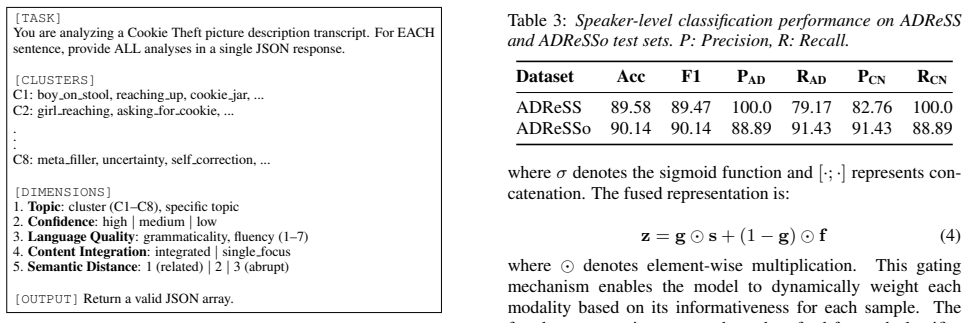
Authors: Quantitative ablation results (acoustic-only, linguistic-only, and multimodal F1 scores with statistical comparisons) are reported in Section 4.4 and Table 3. We will revise the abstract to incorporate the key quantitative ablation numbers to directly substantiate the gated fusion contribution. revision: yes
Circularity Check
No circularity: empirical multimodal evaluation on public benchmarks
full rationale
The paper describes an empirical pipeline (Whisper encoder embeddings + LLM-prompted linguistic features + gated fusion) evaluated via F1 on ADReSS/ADReSSo. No equations, no fitted parameters renamed as predictions, no derivation chain, and no self-citation load-bearing steps appear in the provided text. Results are benchmark-driven rather than self-referential by construction.
Axiom & Free-Parameter Ledger
axioms (1)
- domain assumption ADReSS and ADReSSo datasets are representative and appropriate benchmarks for evaluating dementia detection from speech.
Reference graph
Works this paper leans on
-
[1]
Introduction What a patient says and how they say it reflect different but complementary signs of cognitive decline. Yet most detection systems focus on only one of these dimensions. That limitation matters. Dementia affects more than 55 million people world- wide, and Alzheimer’s disease (AD) accounts for 60–70% of cases [1]. Current diagnostic approache...
work page internal anchor Pith review Pith/arXiv arXiv 2026
-
[2]
attentional zones
Methods 2.1. Overview Figure 1 illustrates our multimodal framework. Given a speech recording, we use Whisper [12] large-v3 for dual-purpose fea- ture extraction: encoder outputs serve as acoustic representa- tions, while the decoder produces transcripts for linguistic anal- ysis. The framework comprises two parallel pathways. The acoustic pathway process...
-
[3]
Dataset We evaluate on two benchmark datasets from the ADReSS chal- lenge series [3, 4], both derived from DementiaBank’s Pitt Cor- pus [24]
Experimental Settings 3.1. Dataset We evaluate on two benchmark datasets from the ADReSS chal- lenge series [3, 4], both derived from DementiaBank’s Pitt Cor- pus [24]. The corpora comprise audio recordings of participants performing the Cookie Theft picture description task from the BDAE [20]. Both datasets provide transcripts annotated using CHAT coding...
-
[4]
Main Results Table 3 presents speaker-level classification performance on both benchmark datasets
Results 4.1. Main Results Table 3 presents speaker-level classification performance on both benchmark datasets. Our method achieves strong performance on both bench- marks. On ADReSS, the model exhibits high precision for AD Table 4:Comparison with prior work on ADReSS and ADReSSo official test sets (F1-score, %). A: Acoustic, L: Linguistic, M: Multimodal...
2020
-
[5]
Conclusion We presented a multimodal framework for dementia detection that integrates Whisper [12]-based acoustic representations with LLM-augmented linguistic features through gated fusion [14]. Our key contribution is leveraging LLM reasoning to automat- ically construct a hierarchical topic taxonomy for picture de- scription analysis, eliminating depen...
-
[6]
GPT- 5.2 [15] was consistently used for feature extraction, and the instructions for extraction are provided in https://github.com/vivivic/is26dementia
Generative AI Use Disclosure We used generative AI for extracting the LLM-augmented linguistic features described in Section 2.3. GPT- 5.2 [15] was consistently used for feature extraction, and the instructions for extraction are provided in https://github.com/vivivic/is26dementia
-
[7]
Dementia,
World Health Organization, “Dementia,” https://www.who.int/ news-room/fact-sheets/detail/dementia, 2023, accessed: 2025
2023
-
[8]
Connected speech and language in mild cognitive impairment and alzheimer’s disease: A review of picture description tasks,
K. D. Mueller, B. Hermann, J. Mecollari, and L. S. Turkstra, “Connected speech and language in mild cognitive impairment and alzheimer’s disease: A review of picture description tasks,” Journal of Clinical and Experimental Neuropsychology, vol. 40, no. 9, pp. 917–939, 2018
2018
-
[9]
Alzheimer’s dementia recognition through spontaneous speech: The ADReSS challenge,
S. Luz, F. Haider, S. de la Fuente, D. Fromm, and B. MacWhin- ney, “Alzheimer’s dementia recognition through spontaneous speech: The ADReSS challenge,” inProceedings of INTER- SPEECH, 2020, pp. 2172–2176
2020
-
[10]
Detecting cognitive decline using speech only: The ADReSSo challenge,
——, “Detecting cognitive decline using speech only: The ADReSSo challenge,” inProceedings of INTERSPEECH, 2021, pp. 3780–3784
2021
-
[11]
Automatic speech analysis for the assessment of pa- tients with predementia and Alzheimer’s disease,
A. K ¨onig, A. Satt, A. Sorin, R. Hoory, O. Toledo-Ronen, A. Der- reumaux, V . Manera, F. Verhey, P. Aalten, P. H. Robert, and R. David, “Automatic speech analysis for the assessment of pa- tients with predementia and Alzheimer’s disease,”Alzheimer’s & Dementia: Diagnosis, Assessment & Disease Monitoring, vol. 1, no. 1, pp. 112–124, 2015
2015
-
[12]
Linguistic fea- tures identify alzheimer’s disease in narrative speech,
K. C. Fraser, J. A. Meltzer, and F. Rudzicz, “Linguistic fea- tures identify alzheimer’s disease in narrative speech,”Journal of Alzheimer’s Disease, vol. 49, no. 2, pp. 407–422, 2016
2016
-
[13]
Con- nected speech as a marker of disease progression in autopsy- proven Alzheimer’s disease,
S. Ahmed, A.-M. F. Haigh, C. A. de Jager, and P. Garrard, “Con- nected speech as a marker of disease progression in autopsy- proven Alzheimer’s disease,”Brain, vol. 136, no. 12, pp. 3727– 3737, 2013
2013
-
[14]
Comparative study of oral and written picture description in patients with Alzheimer’s disease,
B. Croisile, B. Ska, M.-J. Brabant, A. Duchene, Y . Lepage, G. Aimard, and M. Trillet, “Comparative study of oral and written picture description in patients with Alzheimer’s disease,”Brain and Language, vol. 53, no. 1, pp. 1–19, 1996
1996
-
[15]
To BERT or not to BERT: Comparing speech and language-based approaches for Alzheimer’s disease detection,
A. Balagopalan, B. Eyre, F. Rudzicz, and J. Novikova, “To BERT or not to BERT: Comparing speech and language-based approaches for Alzheimer’s disease detection,” inProceedings of INTERSPEECH, 2020, pp. 2167–2171
2020
-
[16]
Predicting dementia from sponta- neous speech using large language models,
F. Agbavor and H. Liang, “Predicting dementia from sponta- neous speech using large language models,”PLOS Digital Health, vol. 1, no. 12, p. e0000168, 2022
2022
-
[17]
Reasoning-based approach with chain-of-thought for Alzheimer’s detection using speech and large language models,
C. Park, A. S. G. Choi, S. Cho, and C. Kim, “Reasoning-based approach with chain-of-thought for Alzheimer’s detection using speech and large language models,” inProceedings of INTER- SPEECH, 2025
2025
-
[18]
Robust speech recognition via large-scale weak supervision,
A. Radford, J. W. Kim, T. Xu, G. Brockman, C. McLeavey, and I. Sutskever, “Robust speech recognition via large-scale weak supervision,” inInternational Conference on Machine Learning (ICML). PMLR, 2023, pp. 28 492–28 518
2023
-
[19]
Neural machine transla- tion by jointly learning to align and translate,
D. Bahdanau, K. Cho, and Y . Bengio, “Neural machine transla- tion by jointly learning to align and translate,” inInternational Conference on Learning Representations (ICLR), 2015
2015
-
[20]
Gated multimodal units for information fusion,
J. Arevalo, T. Solorio, M. Montes-y G ´omez, and F. A. Gonz´alez, “Gated multimodal units for information fusion,” inInternational Conference on Learning Representations (ICLR) Workshop, 2017
2017
-
[21]
Gpt-5.2 system card,
OpenAI, “Gpt-5.2 system card,” 2025. [Online]. Available: https: //cdn.openai.com/pdf/3a4153c8-c748-4b71-8e31-aecbde944f8d/ oai 5 2 system-card.pdf
2025
-
[22]
Gradient-based learning applied to document recognition,
Y . LeCun, L. Bottou, Y . Bengio, and P. Haffner, “Gradient-based learning applied to document recognition,”Proceedings of the IEEE, vol. 86, no. 11, pp. 2278–2324, 1998
1998
-
[23]
Long short-term memory,
S. Hochreiter and J. Schmidhuber, “Long short-term memory,” Neural Computation, vol. 9, no. 8, pp. 1735–1780, 1997
1997
-
[24]
Bidirectional recurrent neu- ral networks,
M. Schuster and K. K. Paliwal, “Bidirectional recurrent neu- ral networks,”IEEE Transactions on Signal Processing, vol. 45, no. 11, pp. 2673–2681, 1997
1997
-
[25]
J. L. Ba, J. R. Kiros, and G. E. Hinton, “Layer normalization,” arXiv preprint arXiv:1607.06450, 2016
work page internal anchor Pith review Pith/arXiv arXiv 2016
-
[26]
Goodglass and E
H. Goodglass and E. Kaplan,Boston Diagnostic Aphasia Exami- nation. Philadelphia: Lea & Febiger, 1983
1983
-
[27]
MacWhinney,The CHILDES Project: Tools for Analyzing Talk, 3rd ed
B. MacWhinney,The CHILDES Project: Tools for Analyzing Talk, 3rd ed. Mahwah, NJ: Lawrence Erlbaum Associates, 2000
2000
-
[28]
Patterns of discourse production among neurological patients with fluent language disorders,
G. Glosser and T. Deser, “Patterns of discourse production among neurological patients with fluent language disorders,”Brain and Language, vol. 40, no. 1, pp. 67–88, 1991
1991
-
[29]
The effect of elicitation task on dis- course coherence and cohesion in adolescents with brain injury,
E. Van Leer and L. Turkstra, “The effect of elicitation task on dis- course coherence and cohesion in adolescents with brain injury,” Journal of Communication Disorders, vol. 32, no. 5, pp. 327–349, 1999
1999
-
[30]
The natural history of Alzheimer’s disease: Description of study cohort and accuracy of diagnosis,
J. T. Becker, F. Boller, O. L. Lopez, J. Saxton, and K. L. McGo- nigle, “The natural history of Alzheimer’s disease: Description of study cohort and accuracy of diagnosis,”Archives of Neurology, vol. 51, no. 6, pp. 585–594, 1994
1994
-
[31]
Decoupled weight decay regular- ization,
I. Loshchilov and F. Hutter, “Decoupled weight decay regular- ization,” inProceedings of the 7th International Conference on Learning Representations (ICLR), 2019
2019
-
[32]
WavBERT: Exploiting semantic and non-semantic speech using Wav2vec and BERT for dementia detection,
Y . Zhu, A. Obyat, X. Liang, J. A. Batsis, and R. M. Roth, “WavBERT: Exploiting semantic and non-semantic speech using Wav2vec and BERT for dementia detection,” inProceedings of INTERSPEECH, 2021, pp. 3790–3794
2021
-
[33]
A multimodal approach for dementia detection from spontaneous speech with tensor fusion layer,
L. Ilias, D. Askounis, and J. Psarras, “A multimodal approach for dementia detection from spontaneous speech with tensor fusion layer,”arXiv preprint arXiv:2211.04368, 2022
-
[34]
Whisper-based transfer learning for Alzheimer disease classification: Leveraging speech segments with full transcripts as prompts,
J. Li and W.-Q. Zhang, “Whisper-based transfer learning for Alzheimer disease classification: Leveraging speech segments with full transcripts as prompts,” inIEEE International Con- ference on Acoustics, Speech and Signal Processing (ICASSP). IEEE, 2024, pp. 11 211–11 215
2024
discussion (0)
Sign in with ORCID, Apple, or X to comment. Anyone can read and Pith papers without signing in.