No Evidence for Superradiant Axions in LIGO-Virgo-KAGRA GWTC-5 Binary Black Hole Spins
Pith reviewed 2026-07-03 19:48 UTC · model grok-4.3
The pith
Black hole spins from 257 LIGO-Virgo-KAGRA mergers show no sign of axion-induced depletion.
A machine-rendered reading of the paper's core claim, the machinery that carries it, and where it could break.
Core claim
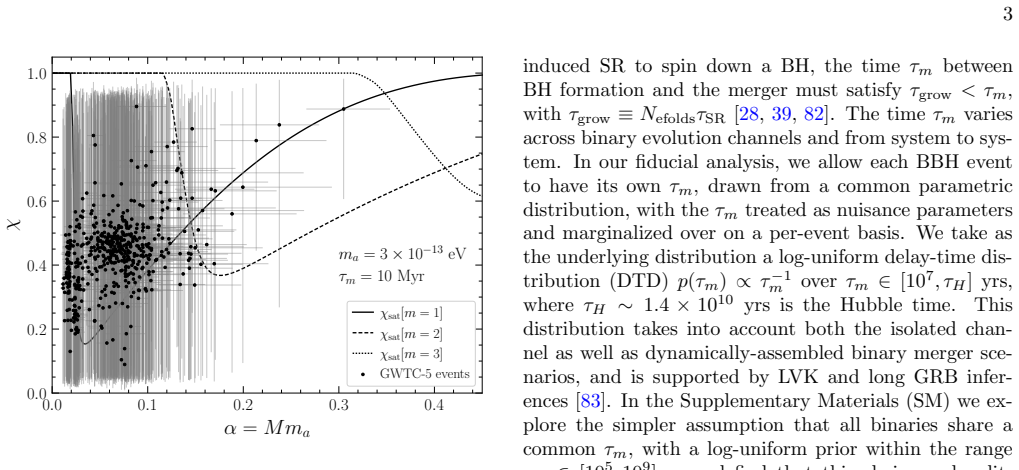
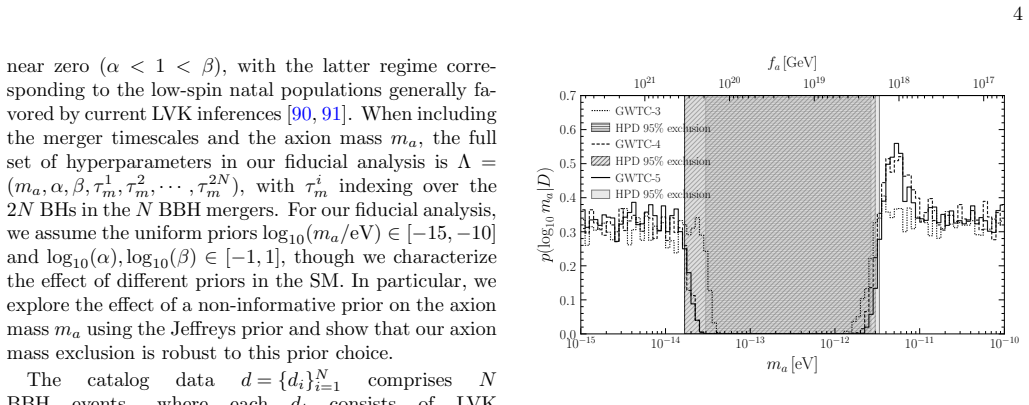
The presence of axions at a given mass would imprint a unique signature in the observed mass-spin relation relative to the formation distribution. Using the LIGO-Virgo-KAGRA GWTC-5 catalog containing N=257 mergers, no evidence for axions is found across more than two decades in mass, excluding axion masses 1.7 × 10^{-14} eV ≲ m_a ≲ 3.3 × 10^{-12} eV at 95 percent .
What carries the argument
Hierarchical Bayesian population model that compares the observed mass-spin relation against a formation-channel distribution to detect superradiance-induced spin depletion.
If this is right
- Axions in the excluded mass window would have produced an observable depletion in black hole spins that is absent in the data.
- This supplies one of the strongest robust lower bounds on the QCD axion mass because it avoids the modeling systematics of prior X-ray spin measurements.
- The constraint applies across black hole masses from 5 to 135 solar masses.
- The same analysis framework can be rerun on future catalogs with larger event counts.
Where Pith is reading between the lines
- Future gravitational-wave catalogs with improved spin precision could tighten the excluded window or reveal a signal if axions exist at the boundary masses.
- The method offers a template for constraining other ultralight bosons that induce similar spin-extraction instabilities.
- It highlights that population-level statistics from gravitational waves can serve as a cleaner probe than individual electromagnetic spin measurements for this class of particles.
Load-bearing premise
The hierarchical Bayesian population model accurately captures the intrinsic black hole spin distribution from formation channels, and any superradiance-induced spin depletion produces a detectable deviation in the observed mass-spin relation.
What would settle it
A statistically significant excess of slowly spinning black holes at masses where the superradiance instability window for axions in the 1.7 × 10^{-14} to 3.3 × 10^{-12} eV range would falsify the no-evidence result.
Figures

read the original abstract
The quantum chromodynamics (QCD) axion and axion-like particles may form bound clouds around spinning black holes (BHs) when their Compton wavelength is comparable to the BH gravitational radius, depleting the BH spin through what is known as a $\textit{superradiance}$ instability. Using binary BH (BBH) spin measurements obtained from the LIGO-Virgo-KAGRA GWTC-5 catalog, the most extensive public BBH catalog to date containing $N=257$ mergers with BH masses spanning roughly $5$-$135$ $M_\odot$, we perform a hierarchical Bayesian analysis in the context of a BH spin population model to constrain ultralight axions. The presence of axions at a given mass would imprint a unique signature in the observed mass-spin relation relative to the formation distribution. We find no evidence for axions across more than two decades in mass, excluding axion masses $1.7 \times 10^{-14} \, {\rm eV} \lesssim m_a \lesssim 3.3 \times 10^{-12} \, {\rm eV}$ at 95% confidence. Because prior superradiance bounds in this range derive from X-ray spin measurements with substantial modeling systematics, this result represents one of the strongest robust lower bounds on the QCD axion mass.
Editorial analysis
A structured set of objections, weighed in public.
Referee Report
Summary. The manuscript performs a hierarchical Bayesian analysis of black hole spin measurements from the GWTC-5 catalog of 257 binary black hole mergers (masses ~5-135 M_⊙) to search for superradiant axion effects. Axions in a specific mass range would deplete spins in a mass-dependent way, imprinting a signature distinct from formation channels. The analysis finds no evidence and excludes axion masses 1.7×10^{-14} eV ≲ m_a ≲ 3.3×10^{-12} eV at 95% CL, presenting this as a robust bound relative to X-ray spin measurements.
Significance. If the population model is rigid enough to prevent absorption of superradiance-induced depletion, the result would provide a statistically powerful constraint on ultralight axions using a large, homogeneous GW dataset with potentially lower systematics than prior X-ray bounds. The broad mass coverage and use of standard hierarchical methods on public catalog data are positive features.
major comments (2)
- [Abstract] Abstract: the claim that axion presence 'would imprint a unique signature in the observed mass-spin relation relative to the formation distribution' is load-bearing for the 95% CL exclusion, yet the abstract provides no demonstration that the hierarchical spin population model (with its free parameters for the mass-spin relation) is rigid enough to prevent a mass-dependent spin cutoff from being reabsorbed into the formation hyperparameters, particularly given large spin measurement uncertainties in GWTC-5.
- The hierarchical Bayesian analysis relies on the population model accurately capturing intrinsic spins from formation channels without degeneracy; without explicit details on the model parametrization, data selection for the 257 events, or tests for absorption of the superradiance signature, the exclusion cannot be verified as fully supported.
Simulated Author's Rebuttal
We thank the referee for their constructive comments on our manuscript. We address each major comment below, providing clarifications on the population model and analysis details while noting where revisions can strengthen the presentation.
read point-by-point responses
-
Referee: [Abstract] Abstract: the claim that axion presence 'would imprint a unique signature in the observed mass-spin relation relative to the formation distribution' is load-bearing for the 95% CL exclusion, yet the abstract provides no demonstration that the hierarchical spin population model (with its free parameters for the mass-spin relation) is rigid enough to prevent a mass-dependent spin cutoff from being reabsorbed into the formation hyperparameters, particularly given large spin measurement uncertainties in GWTC-5.
Authors: The abstract is necessarily concise. The main text specifies that the hierarchical model parametrizes the intrinsic spin distribution with flexible, mass-dependent hyperparameters drawn from standard formation-channel priors. The superradiance effect imposes a sharp, mass-thresholded spin depletion (to near-zero spin) that is functionally distinct from the smoother mass-spin trends permitted by formation hyperparameters. Posterior checks in the manuscript confirm that this feature is not fully reabsorbed, even with GWTC-5 uncertainties. We will revise the abstract to note this distinction briefly. revision: partial
-
Referee: The hierarchical Bayesian analysis relies on the population model accurately capturing intrinsic spins from formation channels without degeneracy; without explicit details on the model parametrization, data selection for the 257 events, or tests for absorption of the superradiance signature, the exclusion cannot be verified as fully supported.
Authors: Data selection uses the full public GWTC-5 catalog of 257 binary black hole events with standard quality cuts as stated in the methods. The population model follows the standard hierarchical Bayesian framework with explicit parametrization of the mass-spin hyperparameters given in the text. The analysis marginalizes over these hyperparameters and compares the evidence with and without the superradiance depletion term; the resulting exclusion arises because the formation-only model cannot accommodate the observed distribution under the axion hypothesis. We will add an explicit subsection or appendix with absorption tests in the revised manuscript. revision: yes
Circularity Check
No circularity: exclusion derived from direct comparison of data to independent population model
full rationale
The paper performs a hierarchical Bayesian fit of a spin population model to GWTC-5 data and reports an exclusion on axion masses where no deviation from the formation distribution is observed. No equations, parameters, or results are shown to reduce by construction to fitted inputs or self-citations; the central claim rests on the external catalog data and the model's ability to capture formation channels without the target signature being absorbed by definition. This is the standard non-circular structure for population inference papers.
Axiom & Free-Parameter Ledger
free parameters (1)
- parameters of the BH spin population model
axioms (1)
- domain assumption Superradiance instability depletes black hole spin when axion Compton wavelength is comparable to black hole gravitational radius
Reference graph
Works this paper leans on
-
[1]
R. D. Peccei and H. R. Quinn, CP Conservation in the Presence of Instantons, Phys. Rev. Lett.38, 1440 (1977)
1977
-
[2]
R. D. Peccei and H. R. Quinn, Constraints Imposed by CP Conservation in the Presence of Instantons, Phys. Rev.D16, 1791 (1977)
1977
-
[3]
Weinberg, A New Light Boson?, Phys
S. Weinberg, A New Light Boson?, Phys. Rev. Lett.40, 223 (1978)
1978
-
[4]
Wilczek, Problem of Strong p and t Invariance in the Presence of Instantons, Phys
F. Wilczek, Problem of Strong p and t Invariance in the Presence of Instantons, Phys. Rev. Lett.40, 279 (1978)
1978
-
[5]
Preskill, M
J. Preskill, M. B. Wise, and F. Wilczek, Cosmology of the Invisible Axion, Phys. Lett.120B, 127 (1983)
1983
-
[6]
L. F. Abbott and P. Sikivie, A Cosmological Bound on the Invisible Axion, Phys. Lett.120B, 133 (1983)
1983
-
[7]
Dine and W
M. Dine and W. Fischler, The Not So Harmless Axion, Phys. Lett.120B, 137 (1983)
1983
-
[8]
Witten, Some Properties of O(32) Superstrings, Phys
E. Witten, Some Properties of O(32) Superstrings, Phys. Lett. B149, 351 (1984)
1984
-
[9]
Choi and J
K. Choi and J. E. Kim, Harmful Axions in Super- string Models, Phys. Lett. B154, 393 (1985), [Erratum: Phys.Lett.B 156, 452 (1985)]. 6
1985
-
[10]
S. M. Barr, Harmless Axions in Superstring Theories, Phys. Lett. B158, 397 (1985)
1985
-
[11]
P. Svrcek and E. Witten, Axions In String Theory, JHEP06, 051, arXiv:hep-th/0605206 [hep-th]
work page internal anchor Pith review Pith/arXiv arXiv
-
[12]
A. Arvanitaki, S. Dimopoulos, S. Dubovsky, N. Kaloper, and J. March-Russell, String Axiverse, Phys. Rev.D81, 123530 (2010), arXiv:0905.4720 [hep-th]
work page internal anchor Pith review Pith/arXiv arXiv 2010
-
[13]
M. Demirtas, C. Long, L. McAllister, and M. Still- man, The Kreuzer-Skarke Axiverse, JHEP04, 138, arXiv:1808.01282 [hep-th]
work page internal anchor Pith review Pith/arXiv arXiv
-
[14]
J. Halverson, C. Long, B. Nelson, and G. Salinas, To- wards string theory expectations for photon couplings to axionlike particles, Phys. Rev. D100, 106010 (2019), arXiv:1909.05257 [hep-th]
- [15]
-
[16]
N. Gendler, D. J. E. Marsh, L. McAllister, and J. Moritz, Glimmers from the Axiverse, (2023), arXiv:2309.13145 [hep-th]
- [17]
- [18]
-
[19]
P. Agrawal, M. Nee, and M. Reig, Axion couplings in Orbifold GUTs, (2025), arXiv:2511.21830 [hep-ph]
-
[20]
J. N. Benabou, G. A. Dainelli, M. Reig, and B. R. Safdi, Heterotic String Theory Suggests a QCD Axion Near 0.5 neV, (2026), arXiv:2605.04142 [hep-th]
work page internal anchor Pith review Pith/arXiv arXiv 2026
- [21]
-
[22]
P. Carenza, T. Fischer, M. Giannotti, G. Guo, G. Mart´ ınez-Pinedo, and A. Mirizzi, Improved ax- ion emissivity from a supernova via nucleon-nucleon bremsstrahlung, JCAP10(10), 016, [Erratum: JCAP 05, E01 (2020)], arXiv:1906.11844 [hep-ph]
-
[23]
M. Buschmann, C. Dessert, J. W. Foster, A. J. Long, and B. R. Safdi, Upper Limit on the QCD Axion Mass from Isolated Neutron Star Cooling, Phys. Rev. Lett. 128, 091102 (2022), arXiv:2111.09892 [hep-ph]
-
[24]
A. Caputo and G. Raffelt, Astrophysical Axion Bounds: The 2024 Edition, PoSCOSMICWISPers, 041 (2024), arXiv:2401.13728 [hep-ph]
-
[25]
Cosmic Axion Spin Precession Experiment (CASPEr)
D. Budker, P. W. Graham, M. Ledbetter, S. Rajendran, and A. Sushkov, Proposal for a Cosmic Axion Spin Pre- cession Experiment (CASPEr), Phys. Rev. X4, 021030 (2014), arXiv:1306.6089 [hep-ph]
work page internal anchor Pith review Pith/arXiv arXiv 2014
-
[26]
Y. Kahn, B. R. Safdi, and J. Thaler, Broadband and Resonant Approaches to Axion Dark Matter Detection, Phys. Rev. Lett.117, 141801 (2016), arXiv:1602.01086 [hep-ph]
work page internal anchor Pith review Pith/arXiv arXiv 2016
-
[27]
Brouweret al.(DMRadio), Proposal for a definitive search for GUT-scale QCD axions, Phys
L. Brouweret al.(DMRadio), Proposal for a definitive search for GUT-scale QCD axions, Phys. Rev. D106, 112003 (2022), arXiv:2203.11246 [hep-ex]
-
[28]
Exploring the String Axiverse with Precision Black Hole Physics
A. Arvanitaki and S. Dubovsky, Exploring the String Axiverse with Precision Black Hole Physics, Phys. Rev. D83, 044026 (2011), arXiv:1004.3558 [hep-th]
work page internal anchor Pith review Pith/arXiv arXiv 2011
-
[29]
G. Grilli di Cortona, E. Hardy, J. Pardo Vega, and G. Villadoro, The QCD axion, precisely, JHEP01, 034, arXiv:1511.02867 [hep-ph]
work page internal anchor Pith review Pith/arXiv arXiv
-
[30]
Reece, Extra-dimensional axion expectations, JHEP 07, 130, arXiv:2406.08543 [hep-ph]
M. Reece, Extra-dimensional axion expectations, JHEP 07, 130, arXiv:2406.08543 [hep-ph]
-
[31]
Positivity of the gravitational path integral implies the axionic weak gravity conjecture
G. Di Ubaldo, L. V. Iliesiu, H. W. Lin, and C. Yan, Pos- itivity of the gravitational path integral implies the ax- ionic weak gravity conjecture, (2026), arXiv:2605.05305 [hep-th]
work page internal anchor Pith review Pith/arXiv arXiv 2026
-
[32]
Wormholes and the imaginary distance bound
J. Maldacena, A. Maloney, and B. McPeak, Worm- holes and the imaginary distance bound, (2026), arXiv:2605.05336 [hep-th]
work page internal anchor Pith review Pith/arXiv arXiv 2026
-
[33]
GWTC-5.0: Observations from the Second Part of the Fourth LIGO-Virgo-KAGRA Observing Run and Updates to the Gravitational-Wave Transient Catalog, (2026), arXiv:2605.27225 [gr-qc]
work page internal anchor Pith review Pith/arXiv arXiv 2026
-
[34]
Damour, N
T. Damour, N. Derulle, and B. Ruffini, On quantum res- onances in stationary geometries, Lett. Nuovo Cimento 15, 257 (1976)
1976
-
[35]
I. M. Ternov, V. R. Khalilov, G. A. Chizhov, and A. B. Gaina, Finite motion of massive particles in the Kerr and Schwarzschild fields, Sov. Phys. J.21, 1200 (1978)
1978
-
[36]
T. J. Zouros and D. M. Eardley, Instabilities of massive scalar perturbations of a rotating black hole, Ann. Phys. (N.Y.)118, 139 (1979)
1979
-
[37]
Instability of Massive Scalar Fields in Kerr-Newman Spacetime
H. Furuhashi and Y. Nambu, Instability of massive scalar fields in Kerr-Newman space-time, Prog. Theor. Phys.112, 983 (2004), arXiv:gr-qc/0402037
work page internal anchor Pith review Pith/arXiv arXiv 2004
-
[38]
S. R. Dolan, Instability of the massive Klein-Gordon field on the Kerr spacetime, Phys. Rev. D76, 084001 (2007), arXiv:0705.2880 [gr-qc]
work page internal anchor Pith review Pith/arXiv arXiv 2007
-
[39]
Discovering the QCD Axion with Black Holes and Gravitational Waves
A. Arvanitaki, M. Baryakhtar, and X. Huang, Dis- covering the QCD Axion with Black Holes and Grav- itational Waves, Phys. Rev. D91, 084011 (2015), arXiv:1411.2263 [hep-ph]
work page internal anchor Pith review Pith/arXiv arXiv 2015
-
[40]
Black Hole Mergers and the QCD Axion at Advanced LIGO
A. Arvanitaki, M. Baryakhtar, S. Dimopoulos, S. Dubovsky, and R. Lasenby, Black Hole Mergers and the QCD Axion at Advanced LIGO, Phys. Rev. D95, 043001 (2017), arXiv:1604.03958 [hep-ph]
work page internal anchor Pith review Pith/arXiv arXiv 2017
- [41]
-
[42]
M. Baryakhtar, M. Galanis, R. Lasenby, and O. Simon, Black hole superradiance of self-interacting scalar fields, Phys. Rev. D103, 095019 (2021), arXiv:2011.11646 [hep-ph]
- [43]
- [44]
-
[45]
S. Hoof, D. J. E. Marsh, J. Sisk-Reyn´ es, J. H. Matthews, and C. Reynolds, Getting more out of black hole su- perradiance: a statistically rigorous approach to ul- tralight boson constraints from black hole spin mea- surements, Mon. Not. Roy. Astron. Soc.546, staf1564 (2026), arXiv:2406.10337 [hep-ph]
- [46]
- [47]
- [48]
-
[49]
Constraining the mass of dark photons and axion-like particles through black-hole superradiance
V. Cardoso, ´O. J. C. Dias, G. S. Hartnett, M. Middle- ton, P. Pani, and J. E. Santos, Constraining the mass of dark photons and axion-like particles through black-hole superradiance, JCAP03, 043, arXiv:1801.01420 [gr-qc]
work page internal anchor Pith review Pith/arXiv arXiv
-
[50]
M. J. Stott and D. J. E. Marsh, Black hole spin constraints on the mass spectrum and number of axionlike fields, Phys. Rev. D98, 083006 (2018), arXiv:1805.02016 [hep-ph]
work page internal anchor Pith review Pith/arXiv arXiv 2018
- [51]
- [52]
- [53]
- [54]
-
[55]
Simulation-Based Prediction of Black Hole Fe K$\alpha$ Line Profiles
C. Nagele, J. H. Krolik, B. E. Kinch, and J. D. Schnittman, Simulation-Based Prediction of Black Hole Fe KαLine Profiles, (2026), arXiv:2605.20317 [astro- ph.HE]
work page internal anchor Pith review Pith/arXiv arXiv 2026
-
[56]
K. Belczynskiet al., Evolutionary roads leading to low effective spins, high black hole masses, and O1/O2 rates for LIGO/Virgo binary black holes, Astron. Astrophys. 636, A104 (2020), arXiv:1706.07053 [astro-ph.HE]
-
[57]
M. Fishbach and V. Kalogera, Apples and Or- anges: Comparing Black Holes in X-Ray Binaries and Gravitational-wave Sources, Astrophys. J. Lett.929, L26 (2022), arXiv:2111.02935 [astro-ph.HE]
- [58]
-
[59]
Stochastic and resolvable gravitational waves from ultralight bosons
R. Brito, S. Ghosh, E. Barausse, E. Berti, V. Cardoso, I. Dvorkin, A. Klein, and P. Pani, Stochastic and resolv- able gravitational waves from ultralight bosons, Phys. Rev. Lett.119, 131101 (2017), arXiv:1706.05097 [gr- qc]
work page internal anchor Pith review Pith/arXiv arXiv 2017
-
[60]
A first search for a stochastic gravitational-wave background from ultralight bosons
L. Tsukada, T. Callister, A. Matas, and P. Meyers, First search for a stochastic gravitational-wave background from ultralight bosons, Phys. Rev. D99, 103015 (2019), arXiv:1812.09622 [astro-ph.HE]
work page internal anchor Pith review Pith/arXiv arXiv 2019
-
[61]
C. Palombaet al., Direct constraints on ultra-light boson mass from searches for continuous gravita- tional waves, Phys. Rev. Lett.123, 171101 (2019), arXiv:1909.08854 [astro-ph.HE]
-
[62]
L. Tsukada, R. Brito, W. E. East, and N. Siemonsen, Modeling and searching for a stochastic gravitational- wave background from ultralight vector bosons, Phys. Rev. D103, 083005 (2021), arXiv:2011.06995 [astro- ph.HE]
- [63]
- [64]
-
[65]
R. Abbottet al.(LIGO Scientific, Virgo, KAGRA), All-sky search for gravitational wave emission from scalar boson clouds around spinning black holes in LIGO O3 data, Phys. Rev. D105, 102001 (2022), arXiv:2111.15507 [astro-ph.HE]
-
[66]
J. R. Sprague, S. L. Larson, Z. Wang, S. Klomp, A. Laeuger, G. Winstone, N. Aggarwal, A. A. Geraci, and V. Kalogera (LSD), Simulating the Galactic popu- lation of axion clouds around stellar-origin black holes: Gravitational wave signals in the 10–100 kHz band, Phys. Rev. D110, 123025 (2024), arXiv:2409.03714 [astro-ph.HE]
- [67]
-
[68]
An axion-like scalar field environment effect on binary black hole merger
Q. Yang, L.-W. Ji, B. Hu, Z.-J. Cao, and R.-G. Cai, An axion-like scalar field environment effect on binary black hole merger, Res. Astron. Astrophys.18, 065 (2018), arXiv:1706.00678 [gr-qc]
work page internal anchor Pith review Pith/arXiv arXiv 2018
-
[69]
S. Choudhary, N. Sanchis-Gual, A. Gupta, J. C. Degollado, S. Bose, and J. A. Font, Gravitational waves from binary black hole mergers surrounded by scalar field clouds: Numerical simulations and observa- tional implications, Phys. Rev. D103, 044032 (2021), arXiv:2010.00935 [gr-qc]
- [70]
- [71]
- [72]
- [73]
- [74]
-
[75]
S. Roy, R. Vicente, J. C. Aurrekoetxea, K. Clough, and P. G. Ferreira, Scalar fields around black hole binaries in LIGO-Virgo-KAGRA, (2025), arXiv:2510.17967 [gr- qc]
work page internal anchor Pith review Pith/arXiv arXiv 2025
- [76]
- [77]
-
[78]
O’Hare, cajohare/axionlimits: Axionlimits,https: //cajohare.github.io/AxionLimits/(2020)
C. O’Hare, cajohare/axionlimits: Axionlimits,https: //cajohare.github.io/AxionLimits/(2020)
2020
-
[79]
Superradiance -- the 2020 Edition
R. Brito, V. Cardoso, and P. Pani, Superradiance: New Frontiers in Black Hole Physics, Lect. Notes Phys.906, pp.1 (2015), arXiv:1501.06570 [gr-qc]
work page internal anchor Pith review Pith/arXiv arXiv 2015
-
[80]
Gravitational wave searches for ultralight bosons with LIGO and LISA
R. Brito, S. Ghosh, E. Barausse, E. Berti, V. Cardoso, I. Dvorkin, A. Klein, and P. Pani, Gravitational wave searches for ultralight bosons with LIGO and LISA, Phys. Rev. D96, 064050 (2017), arXiv:1706.06311 [gr- qc]
work page internal anchor Pith review Pith/arXiv arXiv 2017
discussion (0)
Sign in with ORCID, Apple, or X to comment. Anyone can read and Pith papers without signing in.