MolSight: A Graph-Aware Vision-Language Model for Unified Chemical Image Understanding
Pith reviewed 2026-07-03 15:38 UTC · model grok-4.3
The pith
MolSight improves vision-language models for molecular images by injecting bond adjacency and aligning visuals to chemical symbols.
A machine-rendered reading of the paper's core claim, the machinery that carries it, and where it could break.
Core claim
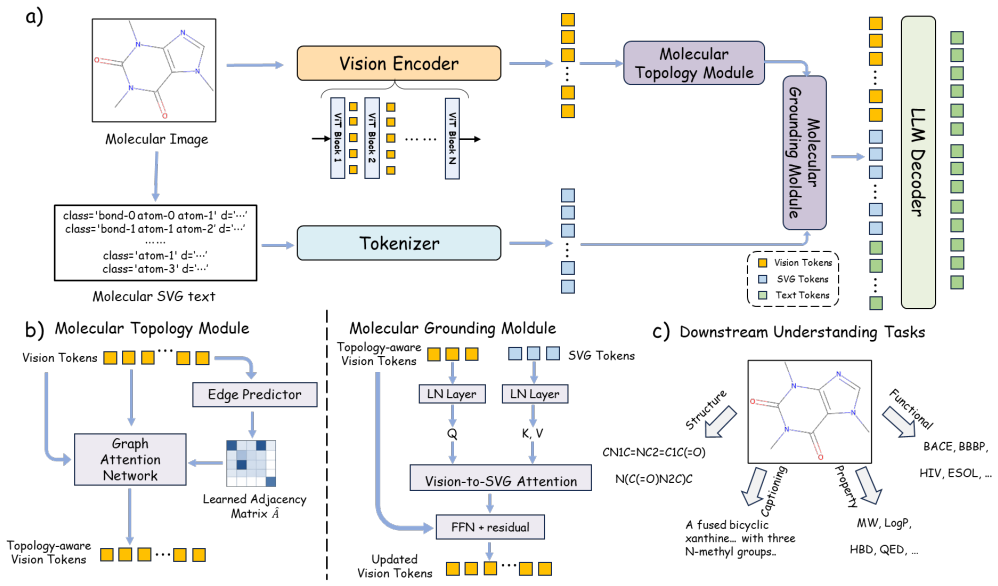
MolSight is a graph-aware vision-language model framework that integrates a Molecular Topology Module to inject chemical-bond adjacency information into vision tokens and a Molecular Grounding Module to align visual features with chemical symbolic semantics, resulting in stronger performance across molecular visual understanding tasks.
What carries the argument
Molecular Topology Module and Molecular Grounding Module, which embed bond adjacency into vision tokens and link those tokens to symbolic chemical semantics.
If this is right
- Molecular images can be processed directly for structure and function without separate graph conversion steps.
- Unified vision-language systems become viable for molecular design and drug discovery workflows.
- Performance gains appear across multiple chemical visual tasks compared with prior models and tools.
- A new baseline level of molecular image reasoning is established for subsequent work.
Where Pith is reading between the lines
- The same module pattern could be tested on other image domains that contain implicit graphs, such as circuit diagrams or protein interaction maps.
- Performance on noisy or hand-drawn molecular sketches from laboratory notebooks remains an open question for real deployment.
- Combining the model with larger language models might enable end-to-end pipelines that both interpret an image and propose synthetic routes.
Load-bearing premise
That adding bond adjacency to vision tokens and linking visuals to chemical symbols will overcome the structural alignment and topological weaknesses of existing vision-language models.
What would settle it
A controlled test in which a standard vision-language model without the two modules matches or exceeds MolSight accuracy on the same set of molecular image benchmarks.
Figures
read the original abstract
Using molecular large language models (LLMs) as a unified framework for understanding molecular structures and functions is emerging as a new trend in tasks such as molecular design and drug discovery. However, these models struggle to fully capture the visual representation of molecular structures, limiting their potential. While existing molecular vision-language models (VLMs) show promise, they still face challenges in structural alignment and lack the necessary topological modeling for accurate molecular understanding. To address this, we propose MolSight, a graph-aware vision-language model framework designed to enhance the understanding of molecular images by VLMs. MolSight integrates a Molecular Topology Module to inject chemical-bond adjacency information into vision tokens, and a Molecular Grounding Module to align visual features with chemical symbolic semantics. Our experiments demonstrate that MolSight significantly outperforms existing VLMs, molecular LLMs, and specialized tools across multiple chemical visual understanding tasks, achieving a new level of molecular image reasoning.
Editorial analysis
A structured set of objections, weighed in public.
Referee Report
Summary. The paper proposes MolSight, a graph-aware vision-language model for molecular image understanding. It integrates a Molecular Topology Module to inject chemical-bond adjacency information into vision tokens and a Molecular Grounding Module to align visual features with chemical symbolic semantics. Experiments are claimed to show that MolSight significantly outperforms existing VLMs, molecular LLMs, and specialized tools across multiple chemical visual understanding tasks.
Significance. If validated, the approach of explicitly injecting graph topology and grounding visual features to symbolic chemistry could address known limitations in VLMs for structural molecular reasoning, with potential impact on drug discovery and molecular design pipelines.
major comments (1)
- Abstract: The central claim of significant outperformance is presented without any experimental details, datasets, metrics, baselines, error bars, or result tables, making it impossible to determine whether the performance claims are supported by the paper's own data or methods.
Simulated Author's Rebuttal
We thank the referee for their feedback. The single major comment concerns the level of detail in the abstract; we address it directly below and note that the manuscript body contains the requested experimental information.
read point-by-point responses
-
Referee: Abstract: The central claim of significant outperformance is presented without any experimental details, datasets, metrics, baselines, error bars, or result tables, making it impossible to determine whether the performance claims are supported by the paper's own data or methods.
Authors: We agree that the abstract is written at a high level and omits specific experimental details. The full paper (Sections 4 and 5) specifies the datasets (e.g., PubChem, ChEMBL-derived molecular image sets), metrics (accuracy, F1, exact match on structure recognition and property prediction), baselines (standard VLMs, molecular LLMs, and specialized tools), and reports results with tables and error bars. To improve clarity we will revise the abstract to briefly name the primary evaluation tasks, key datasets, and the magnitude of gains while remaining within length limits. revision: partial
Circularity Check
No significant circularity
full rationale
The provided abstract and description introduce MolSight via two new modules (Molecular Topology Module and Molecular Grounding Module) whose purpose is stated descriptively, with performance claims resting on experiments. No equations, parameter-fitting steps, self-citations used as load-bearing uniqueness theorems, or renamings of prior results appear in the text. The derivation chain therefore contains no self-definitional reductions, fitted-input predictions, or imported ansatzes that collapse to the inputs by construction. The central claim remains an empirical assertion about outperformance rather than a closed logical loop.
Axiom & Free-Parameter Ledger
Reference graph
Works this paper leans on
-
[1]
Cell , volume=
A deep learning approach to antibiotic discovery , author=. Cell , volume=. 2020 , publisher=
2020
-
[2]
Nature , volume=
Scaling deep learning for materials discovery , author=. Nature , volume=. 2023 , publisher=
2023
-
[3]
SMILES, a chemical language and information system. 1. Introduction to methodology and encoding rules , author=. Journal of chemical information and computer sciences , volume=. 1988 , publisher=
1988
-
[5]
Nature , volume=
Autonomous chemical research with large language models , author=. Nature , volume=. 2023 , publisher=
2023
-
[6]
Digital Discovery , volume=
Comparing software tools for optical chemical structure recognition , author=. Digital Discovery , volume=. 2024 , publisher=
2024
-
[7]
Nature Communications , volume=
PatCID: an open-access dataset of chemical structures in patent documents , author=. Nature Communications , volume=. 2024 , publisher=
2024
-
[9]
International conference on machine learning , pages=
Learning transferable visual models from natural language supervision , author=. International conference on machine learning , pages=. 2021 , organization=
2021
-
[11]
Proceedings of the IEEE/CVF international conference on computer vision , pages=
Emerging properties in self-supervised vision transformers , author=. Proceedings of the IEEE/CVF international conference on computer vision , pages=
-
[12]
International conference on machine learning , pages=
Blip-2: Bootstrapping language-image pre-training with frozen image encoders and large language models , author=. International conference on machine learning , pages=. 2023 , organization=
2023
-
[13]
Advances in neural information processing systems , volume=
Visual instruction tuning , author=. Advances in neural information processing systems , volume=
-
[15]
International conference on machine learning , pages=
Neural message passing for quantum chemistry , author=. International conference on machine learning , pages=. 2017 , organization=
2017
-
[17]
Proceedings of the 2022 Conference on Empirical Methods in Natural Language Processing , pages=
Translation between molecules and natural language , author=. Proceedings of the 2022 Conference on Empirical Methods in Natural Language Processing , pages=
2022
-
[18]
Proceedings of the 2023 Conference on Empirical Methods in Natural Language Processing , pages=
Biot5: Enriching cross-modal integration in biology with chemical knowledge and natural language associations , author=. Proceedings of the 2023 Conference on Empirical Methods in Natural Language Processing , pages=
2023
-
[20]
Proceedings of the 2023 Conference on Empirical Methods in Natural Language Processing , pages=
Molca: Molecular graph-language modeling with cross-modal projector and uni-modal adapter , author=. Proceedings of the 2023 Conference on Empirical Methods in Natural Language Processing , pages=
2023
-
[22]
The Thirteenth International Conference on Learning Representations , year=
Atomas: Hierarchical adaptive alignment on molecule-text for unified molecule understanding and generation , author=. The Thirteenth International Conference on Learning Representations , year=
-
[23]
Computers in biology and medicine , volume=
Git-mol: A multi-modal large language model for molecular science with graph, image, and text , author=. Computers in biology and medicine , volume=. 2024 , publisher=
2024
-
[24]
Proceedings of the AAAI Conference on Artificial Intelligence , volume=
Chemvlm: Exploring the power of multimodal large language models in chemistry area , author=. Proceedings of the AAAI Conference on Artificial Intelligence , volume=
-
[27]
Advances in neural information processing systems , volume=
Flamingo: a visual language model for few-shot learning , author=. Advances in neural information processing systems , volume=
-
[29]
Proceedings of the IEEE conference on computer vision and pattern recognition , pages=
Making the v in vqa matter: Elevating the role of image understanding in visual question answering , author=. Proceedings of the IEEE conference on computer vision and pattern recognition , pages=
-
[30]
European conference on computer vision , pages=
Microsoft coco: Common objects in context , author=. European conference on computer vision , pages=. 2014 , organization=
2014
-
[32]
2024 International Joint Conference on Neural Networks (IJCNN) , pages=
Zero-shot visual reasoning by vision-language models: Benchmarking and analysis , author=. 2024 International Joint Conference on Neural Networks (IJCNN) , pages=. 2024 , organization=
2024
-
[34]
InternVL3.5: Advancing Open-Source Multimodal Models in Versatility, Reasoning, and Efficiency
Internvl3. 5: Advancing open-source multimodal models in versatility, reasoning, and efficiency , author=. arXiv preprint arXiv:2508.18265 , year=
work page internal anchor Pith review Pith/arXiv arXiv
-
[35]
Nucleic acids research , volume=
PubChem 2023 update , author=. Nucleic acids research , volume=. 2023 , publisher=
2023
-
[36]
Nature Machine Intelligence , volume=
Multi-modal molecule structure--text model for text-based retrieval and editing , author=. Nature Machine Intelligence , volume=. 2023 , publisher=
2023
-
[37]
Journal of chemical information and modeling , volume=
MolScribe: robust molecular structure recognition with image-to-graph generation , author=. Journal of chemical information and modeling , volume=. 2023 , publisher=
2023
-
[38]
Journal of Cheminformatics , volume=
DECIMER: towards deep learning for chemical image recognition , author=. Journal of Cheminformatics , volume=. 2020 , publisher=
2020
-
[39]
Findings of the Association for Computational Linguistics: EMNLP 2024 , pages=
Moleculeqa: A dataset to evaluate factual accuracy in molecular comprehension , author=. Findings of the Association for Computational Linguistics: EMNLP 2024 , pages=
2024
-
[40]
Proceedings of the AAAI Conference on Artificial Intelligence , volume=
RTMol: Rethinking Molecule-text Alignment in a Round-trip View , author=. Proceedings of the AAAI Conference on Artificial Intelligence , volume=
-
[41]
Chemical science , volume=
MoleculeNet: a benchmark for molecular machine learning , author=. Chemical science , volume=. 2018 , publisher=
2018
-
[42]
Advances in Neural Information Processing Systems , volume=
Molvision: Molecular property prediction with vision language models , author=. Advances in Neural Information Processing Systems , volume=
-
[43]
Nature Machine Intelligence , volume=
A quantitative analysis of knowledge-learning preferences in large language models in molecular science , author=. Nature Machine Intelligence , volume=. 2025 , publisher=
2025
-
[44]
International Conference on Learning Representations , volume=
Mol-instructions: A large-scale biomolecular instruction dataset for large language models , author=. International Conference on Learning Representations , volume=
-
[45]
Achiam, J.; Adler, S.; Agarwal, S.; Ahmad, L.; Akkaya, I.; Aleman, F. L.; Almeida, D.; Altenschmidt, J.; Altman, S.; Anadkat, S.; et al. 2023. Gpt-4 technical report. arXiv preprint arXiv:2303.08774
work page internal anchor Pith review Pith/arXiv arXiv 2023
-
[46]
Adak, D.; Rawat, Y.; and Vyas, S. 2026. Molvision: Molecular property prediction with vision language models. Advances in Neural Information Processing Systems 38
2026
-
[47]
Alayrac, J.-B.; Donahue, J.; Luc, P.; Miech, A.; Barr, I.; Hasson, Y.; Lenc, K.; Mensch, A.; Millican, K.; Reynolds, M.; et al. 2022. Flamingo: a visual language model for few-shot learning. Advances in neural information processing systems 35:23716--23736
2022
-
[48]
Bai, J.; Bai, S.; Chu, Y.; Cui, Z.; Dang, K.; Deng, X.; Fan, Y.; Ge, W.; Han, Y.; Huang, F.; et al. 2023. Qwen technical report. arXiv preprint arXiv:2309.16609
work page internal anchor Pith review Pith/arXiv arXiv 2023
-
[49]
Relational inductive biases, deep learning, and graph networks
Battaglia, P. W.; Hamrick, J. B.; Bapst, V.; Sanchez-Gonzalez, A.; Zambaldi, V.; Malinowski, M.; Tacchetti, A.; Raposo, D.; Santoro, A.; Faulkner, R.; et al. 2018. Relational inductive biases, deep learning, and graph networks. arXiv preprint arXiv:1806.01261
work page internal anchor Pith review Pith/arXiv arXiv 2018
-
[50]
A.; MacKnight, R.; Kline, B.; and Gomes, G
Boiko, D. A.; MacKnight, R.; Kline, B.; and Gomes, G. 2023. Autonomous chemical research with large language models. Nature 624(7992):570--578
2023
-
[51]
ChemCrow: Augmenting large-language models with chemistry tools
Bran, A. M.; Cox, S.; Schilter, O.; Baldassari, C.; White, A. D.; and Schwaller, P. 2023. Chemcrow: Augmenting large-language models with chemistry tools. arXiv preprint arXiv:2304.05376
work page internal anchor Pith review Pith/arXiv arXiv 2023
-
[52]
Caron, M.; Touvron, H.; Misra, I.; J \'e gou, H.; Mairal, J.; Bojanowski, P.; and Joulin, A. 2021. Emerging properties in self-supervised vision transformers. In Proceedings of the IEEE/CVF international conference on computer vision , 9650--9660
2021
- [53]
-
[54]
Chen, L.; Shi, R.; Yu, G.; and Yang, Y. 2026. Rtmol: Rethinking molecule-text alignment in a round-trip view. In Proceedings of the AAAI Conference on Artificial Intelligence , volume 40, 75--82
2026
- [55]
-
[56]
Dosovitskiy, A.; Beyer, L.; Kolesnikov, A.; Weissenborn, D.; Zhai, X.; Unterthiner, T.; Dehghani, M.; Minderer, M.; Heigold, G.; Gelly, S.; et al. 2020. An image is worth 16x16 words: Transformers for image recognition at scale. arXiv preprint arXiv:2010.11929
work page internal anchor Pith review Pith/arXiv arXiv 2020
-
[57]
Edwards, C.; Lai, T.; Ros, K.; Honke, G.; Cho, K.; and Ji, H. 2022. Translation between molecules and natural language. In Proceedings of the 2022 Conference on Empirical Methods in Natural Language Processing , 375--413
2022
-
[58]
Fang, Y.; Liang, X.; Zhang, N.; Liu, K.; Huang, R.; Chen, Z.; Fan, X.; and Chen, H. 2024. Mol-instructions: A large-scale biomolecular instruction dataset for large language models. In International Conference on Learning Representations , volume 2024, 48221--48251
2024
-
[59]
S.; Riley, P
Gilmer, J.; Schoenholz, S. S.; Riley, P. F.; Vinyals, O.; and Dahl, G. E. 2017. Neural message passing for quantum chemistry. In International conference on machine learning , 1263--1272. Pmlr
2017
-
[60]
Goyal, Y.; Khot, T.; Summers-Stay, D.; Batra, D.; and Parikh, D. 2017. Making the v in vqa matter: Elevating the role of image understanding in visual question answering. In Proceedings of the IEEE conference on computer vision and pattern recognition , 6904--6913
2017
-
[61]
A.; Thiessen, P
Kim, S.; Chen, J.; Cheng, T.; Gindulyte, A.; He, J.; He, S.; Li, Q.; Shoemaker, B. A.; Thiessen, P. A.; Yu, B.; et al. 2023. Pubchem 2023 update. Nucleic acids research 51(D1):D1373--D1380
2023
-
[62]
Semi-Supervised Classification with Graph Convolutional Networks
Kipf, T. N., and Welling, M. 2016. Semi-supervised classification with graph convolutional networks. arXiv preprint arXiv:1609.02907
work page internal anchor Pith review Pith/arXiv arXiv 2016
-
[63]
J.; Boehme, T.; Boyer, S
Krasnov, A.; Barnabas, S. J.; Boehme, T.; Boyer, S. K.; and Weber, L. 2024. Comparing software tools for optical chemical structure recognition. Digital Discovery 3(4):681--693
2024
-
[64]
Li, J.; Li, D.; Savarese, S.; and Hoi, S. 2023. Blip-2: Bootstrapping language-image pre-training with frozen image encoders and large language models. In International conference on machine learning , 19730--19742. PMLR
2023
-
[65]
Li, J.; Zhang, D.; Wang, X.; Hao, Z.; Lei, J.; Tan, Q.; Zhou, C.; Liu, W.; Yang, Y.; Xiong, X.; et al. 2025. Chemvlm: Exploring the power of multimodal large language models in chemistry area. In Proceedings of the AAAI Conference on Artificial Intelligence , volume 39, 415--423
2025
-
[66]
Lin, T.-Y.; Maire, M.; Belongie, S.; Hays, J.; Perona, P.; Ramanan, D.; Doll \'a r, P.; and Zitnick, C. L. 2014. Microsoft coco: Common objects in context. In European conference on computer vision , 740--755. Springer
2014
-
[67]
Liu, H.; Li, C.; Wu, Q.; and Lee, Y. J. 2023a. Visual instruction tuning. Advances in neural information processing systems 36:34892--34916
-
[68]
Liu, S.; Nie, W.; Wang, C.; Lu, J.; Qiao, Z.; Liu, L.; Tang, J.; Xiao, C.; and Anandkumar, A. 2023b. Multi-modal molecule structure--text model for text-based retrieval and editing. Nature Machine Intelligence 5(12):1447--1457
-
[69]
Liu, Z.; Li, S.; Luo, Y.; Fei, H.; Cao, Y.; Kawaguchi, K.; Wang, X.; and Chua, T.-S. 2023c. Molca: Molecular graph-language modeling with cross-modal projector and uni-modal adapter. In Proceedings of the 2023 Conference on Empirical Methods in Natural Language Processing , 15623--15638
2023
-
[70]
Liu, P.; Ren, Y.; Tao, J.; and Ren, Z. 2024. Git-mol: A multi-modal large language model for molecular science with graph, image, and text. Computers in biology and medicine 171:108073
2024
-
[71]
Liu, P.; Tao, J.; and Ren, Z. 2025. A quantitative analysis of knowledge-learning preferences in large language models in molecular science. Nature Machine Intelligence 7(2):315--327
2025
-
[72]
Lu, X.; Cao, H.; Liu, Z.; Bai, S.; Chen, L.; Yao, Y.; Zheng, H.-T.; and Li, Y. 2024. Moleculeqa: A dataset to evaluate factual accuracy in molecular comprehension. In Findings of the Association for Computational Linguistics: EMNLP 2024 , 3769--3789
2024
-
[73]
S.; Aykol, M.; Cheon, G.; and Cubuk, E
Merchant, A.; Batzner, S.; Schoenholz, S. S.; Aykol, M.; Cheon, G.; and Cubuk, E. D. 2023. Scaling deep learning for materials discovery. Nature 624(7990):80--85
2023
-
[74]
I.; Yu, F.; and Staar, P
Morin, L.; Weber, V.; Meijer, G. I.; Yu, F.; and Staar, P. W. 2024. Patcid: an open-access dataset of chemical structures in patent documents. Nature Communications 15(1):6532
2024
-
[75]
Nagar, A.; Jaiswal, S.; and Tan, C. 2024. Zero-shot visual reasoning by vision-language models: Benchmarking and analysis. In 2024 International Joint Conference on Neural Networks (IJCNN) , 1--8. IEEE
2024
-
[76]
Pei, Q.; Zhang, W.; Zhu, J.; Wu, K.; Gao, K.; Wu, L.; Xia, Y.; and Yan, R. 2023. Biot5: Enriching cross-modal integration in biology with chemical knowledge and natural language associations. In Proceedings of the 2023 Conference on Empirical Methods in Natural Language Processing , 1102--1123
2023
-
[77]
W.; and Barzilay, R
Qian, Y.; Guo, J.; Tu, Z.; Li, Z.; Coley, C. W.; and Barzilay, R. 2023. Molscribe: robust molecular structure recognition with image-to-graph generation. Journal of chemical information and modeling 63(7):1925--1934
2023
-
[78]
W.; Hallacy, C.; Ramesh, A.; Goh, G.; Agarwal, S.; Sastry, G.; Askell, A.; Mishkin, P.; Clark, J.; et al
Radford, A.; Kim, J. W.; Hallacy, C.; Ramesh, A.; Goh, G.; Agarwal, S.; Sastry, G.; Askell, A.; Mishkin, P.; Clark, J.; et al. 2021. Learning transferable visual models from natural language supervision. In International conference on machine learning , 8748--8763. PmLR
2021
-
[79]
Rajan, K.; Zielesny, A.; and Steinbeck, C. 2020. Decimer: towards deep learning for chemical image recognition. Journal of Cheminformatics 12(1):65
2020
-
[80]
M.; Yang, K.; Swanson, K.; Jin, W.; Cubillos-Ruiz, A.; Donghia, N
Stokes, J. M.; Yang, K.; Swanson, K.; Jin, W.; Cubillos-Ruiz, A.; Donghia, N. M.; MacNair, C. R.; French, S.; Carfrae, L. A.; Bloom-Ackermann, Z.; et al. 2020. A deep learning approach to antibiotic discovery. Cell 180(4):688--702
2020
- [81]
-
[82]
Veli c kovi \'c , P.; Cucurull, G.; Casanova, A.; Romero, A.; Lio, P.; and Bengio, Y. 2017. Graph attention networks. arXiv preprint arXiv:1710.10903
work page internal anchor Pith review Pith/arXiv arXiv 2017
-
[83]
Weininger, D. 1988. Smiles, a chemical language and information system. 1. introduction to methodology and encoding rules. Journal of chemical information and computer sciences 28(1):31--36
1988
-
[84]
N.; Gomes, J.; Geniesse, C.; Pappu, A
Wu, Z.; Ramsundar, B.; Feinberg, E. N.; Gomes, J.; Geniesse, C.; Pappu, A. S.; Leswing, K.; and Pande, V. 2018. Moleculenet: a benchmark for molecular machine learning. Chemical science 9(2):513--530
2018
- [85]
- [86]
-
[87]
Zhang, Y.; Ye, G.; Yuan, C.; Han, B.; Huang, L.-K.; Yao, J.; Liu, W.; and Rong, Y. 2025. Atomas: Hierarchical adaptive alignment on molecule-text for unified molecule understanding and generation. In The Thirteenth International Conference on Learning Representations
2025
discussion (0)
Sign in with ORCID, Apple, or X to comment. Anyone can read and Pith papers without signing in.