REVIEW 3 major objections 6 minor 48 references
A robot policy’s attention to imagined future video frames predicts—and can be steered to improve—its ability to recombine familiar skills into new tasks.
Reviewed by Pith at T0; open to challenge. T0 means a machine referee read the full paper against a public rubric. the ladder, T0–T4 →
T0 review · grok-4.5
2026-07-10 12:37 UTC pith:GU2KKJLZ
load-bearing objection Solid systems paper: TR is a useful attention diagnostic for when VAMs actually use video futures, and TR-gated guidance helps OOD without wrecking ID; the causal story is a bit oversold relative to the design-grid evidence. the 3 major comments →
Understanding and Mitigating the Video-Action Generalization Gap via Temporal Ratio
The pith
A machine-rendered reading of the paper's core claim, the machinery that carries it, and where it could break.
Core claim
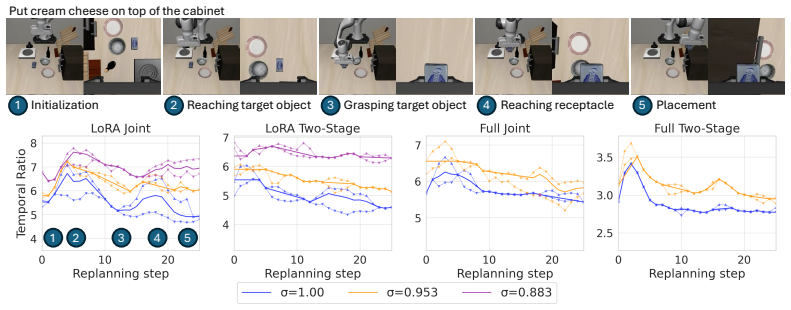
The video-action generalization gap is driven by under-use of useful future rollouts: compositional success requires both a useful video future and action-head reliance on that future during planning. Temporal Ratio—the attention mass on future latent frames relative to the anchored current frame—predicts a model’s compositional capacity across design choices, tracks planning versus manipulation phases within an episode, and supplies a runtime signal for TR-Adaptive Guidance that scales language and plan velocity guidance with TR, mitigating the OOD–ID gap without retraining.
What carries the argument
Temporal Ratio (TR): head-averaged action-token attention over future video latent tokens divided by attention over the clean current-frame tokens. It diagnoses plan-following versus present anchoring, predicts OOD capacity, and sets the adaptive scale that concentrates language and plan guidance in high-TR planning phases and relaxes it for precise local control.
Load-bearing premise
When the action head attends strongly to future frames, those partially denoised video futures are compositionally correct enough that amplifying them helps rather than locking in a wrong plan.
What would settle it
Find or train a high-TR configuration whose video rollouts are systematically wrong on compositional OOD tasks; if TR-Adaptive Guidance then lowers OOD success relative to the unguided policy (while TR remains high), the claim that amplifying futures during high-TR phases improves composition is falsified.
If this is right
- Latent VAM design should target intermediate video noise and adaptation methods that raise TR, not only ID success or raw video quality.
- Inference-time methods can close compositional gaps without retraining by reading attention and amplifying video conditioning only in high-TR phases.
- Low TR during grasping is appropriate; forcing future attention there can hurt precision, so phase-aware guidance is necessary.
- Correct video-level composition is insufficient if the action head ignores the future; TR is required to diagnose utilization.
- The same partially denoised latents and TR-adaptive schedule transfer from LIBERO to multi-task real bimanual control.
Where Pith is reading between the lines
- Attention-ratio probes of planning versus reacting may transfer cheaply to other conditioning modalities (for example language versus vision tokens) without new architectures.
- Training losses that explicitly encourage high TR in planning phases could reduce dependence on inference-time guidance.
- As video backbones improve physical plausibility under shift, the bottleneck moves from utilization (TR) to generation quality; adaptive guidance then becomes more reliable rather than riskier.
- Phase-dependent routing may explain why inverse-dynamics from fully denoised or fully noisy futures often fails on novel recombinations even when the video looks plausible.
Editorial analysis
A structured set of objections, weighed in public.
Referee Report
Summary. The paper studies the video-action generalization (VAG) gap: latent video-action models (VAMs) built on generative video backbones often lose compositional priors after action finetuning. Through a design-space sweep over backbone adaptation (LoRA vs full), joint vs two-stage training, video feature noise level σ_v, and prediction horizon T, the authors show that ID/OOD success is fragmented and not explained by standard design heuristics. They introduce Temporal Ratio (TR; Eq. 3), the action-head attention mass on future latent frames relative to the clean current-frame anchor, and report that TR correlates with compositional OOD capacity, rises during planning phases, and falls during precise manipulation. Building on this, they propose TR-Adaptive Guidance (Alg. 3), which scales language and plan velocity-space guidance with online TR. On LIBERO compositional OOD suites, their best unguided VAM reaches 55.7% avg OOD (vs ~6–27% for prior WAM/VAM/VLA baselines) and adaptive guidance raises this to 59.4% while largely preserving ID; on real bimanual YAM compositional scenes, guidance improves avg success from 71.7% to 83.3%.
Significance. If the diagnosis holds, the paper contributes a useful mechanistic interface between video generative priors and action heads: an attention-based runtime signal that both explains when compositional video conditioning is used and enables a simple inference-time intervention. Strengths include a systematic design-space study (Fig. 3; App. C Table 4), an interpretable metric grounded in the first-frame anchor mechanism of the video denoiser, phase-resolved TR analysis (Fig. 5), flat vs TR-adaptive ablations (App. C.2 Tables 5–6), multi-seed LIBERO evaluation, and real multi-task bimanual transfer. The work is of clear interest to robot learning and video-conditioned policy communities, and the limitations section honestly flags the failure mode when futures are wrong. The contribution is more diagnostic-and-mitigation than a new architecture, but that is appropriate given the stated research question.
major comments (3)
- §4.1 and Fig. 1 (bottom) / Fig. 5: The claim that TR is a structural predictor of compositional capacity is supported mainly by design-grid correlation (higher TR with intermediate σ_v and with successful episodes) rather than an intervention that varies TR while holding video-feature quality fixed. Because σ_v jointly changes future SNR and TR, the predictor claim risks confounding reliance with feature quality. Please either (i) report a controlled analysis that partials out σ_v/T (e.g., residual correlation of TR with OOD within fixed σ_v cells, or forced attention reweighting), or (ii) explicitly reframe TR as a useful correlational/runtime diagnostic rather than a causal structural predictor, and adjust abstract/intro wording accordingly.
- §4.2, Alg. 3, and App. C.2 Tables 5–6: The headline mitigation (LIBERO OOD 55.7%→59.4%; real 71.7%→83.3%) compares unguided vs TR-adaptive at the selected best cell (σ_v=0.883, T=5, Joint+LoRA). Flat guidance already reaches 57.3% OOD but collapses ID (94.3%→84.3%); adaptive recovers ID and adds ~2 pp OOD. This supports phase-selective scheduling for ID preservation, but does not isolate TR as the causal schedule signal versus any schedule that reduces guidance during low-TR/manipulation phases. A load-bearing control is a fixed or non-TR schedule matched on average guidance weight (or a phase oracle / random schedule with the same mean dose). Without it, the “via Temporal Ratio” framing of the mitigation over-attributes gains to TR relative to guidance dose and partially denoised video quality.
- §5.2 Table 1 and App. C Table 4: “Ours (best unguided/guided)” are selected from a large multi-axis grid (paradigm × σ_v × T, plus guidance weights). Reporting only the peak cell inflates the apparent VAG-gap closure relative to baselines that are not similarly re-tuned on the OOD suites. Please report mean/median OOD over the design grid (or a pre-specified selection rule using only ID validation), and state whether guidance hyperparameters were chosen on OOD or held out. This is necessary for the comparative claim that the approach “mitigates the OOD–ID compositional generalization gap” beyond prior VAMs.
minor comments (6)
- Table 1: Mimic-Video OOD is omitted as “unfair” (footnote 1). Briefly quantify or cite the released checkpoint structure so readers can judge the omission; otherwise the WAM/VAM baseline block looks incomplete.
- Fig. 3 and Fig. 1 (top): The fragmented ID–OOD manifold is central to motivating TR, but axis labels and which cells are Joint+LoRA vs Two-Stage are hard to parse in the text rendering; ensure the camera-ready figure has a clear legend and consistent color mapping.
- Eq. (3): Specify whether TR is averaged over action tokens, layers, and heads before use in Alg. 3, and confirm that ℓ*=15 (App. C.4) was fixed before OOD evaluation rather than chosen post hoc for best adaptive gains.
- §5.2 / Limitations: The paper correctly notes that guidance amplifies wrong futures. A short quantitative failure case (high TR + incorrect video plan → lower success under guidance) would make this caveat concrete rather than only qualitative.
- App. E.6: Inference cost (1 vs 2–3 video passes) is acknowledged; a wall-clock Hz comparison on the real platform would help readers assess deployability of combined guidance.
- Typos/notation: “W AMs” / “V AMs” spacing artifacts appear throughout; “Cosmos-2.5” vs “Cosmos-Predict 2.5” should be consistent; arXiv ID in the review context is 2607.08127—verify final citation metadata.
Circularity Check
No derivation circularity: TR is an attention diagnostic; OOD/ID success is external task completion; guidance gains are empirical, not forced by definition.
full rationale
The paper’s load-bearing chain is empirical, not algebraic. Temporal Ratio (Eq. 3) is defined as the ratio of action-head attention mass on future latent tokens V+ to attention on the clean current-frame tokens V0. Compositional capacity is measured by external task success on LIBERO OOD suites and real-world bimanual trials—not by TR itself. Correlation of TR with OOD success across the design grid (Fig. 1 bottom, Fig. 5) and phase-dependent TR fluctuation are observational findings; they do not make success equal TR by construction. TR-Adaptive Guidance (Alg. 3) rescales language/plan velocity guidance with a clipped TR ratio relative to an episode baseline; reported gains (LIBERO avg OOD 55.7%→59.4%; real-world 71.7%→83.3%) are measured by the same external success metric against unguided and flat-guidance ablations (App. C.2). Choosing the best design cell (σv=0.883, T=5, Joint+LoRA) and base guidance weights is ordinary hyperparameter selection, not a fitted parameter renamed as a prediction of a forced quantity. Architecture follows prior VAMs [12,13] without a self-authored uniqueness theorem or ansatz that forbids alternatives. Limitations explicitly note that wrong video futures make guidance harmful—consistent with an independent empirical claim, not a closed definitional loop. No self-definitional identity, no fitted-input-as-prediction, and no load-bearing self-citation chain.
Axiom & Free-Parameter Ledger
free parameters (5)
- video feature noise level σ_v
- latent horizon T and plan horizon T′
- guidance base weights w_lang, w_plan and s_max
- DiT extraction layer k and Gemma TR layer ℓ*
- LoRA rank, learning rates, λ, training steps
axioms (4)
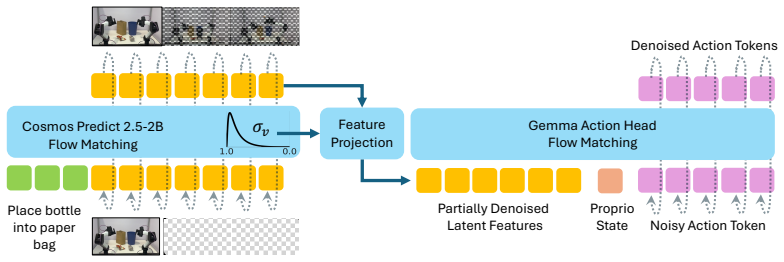
- domain assumption Flow-matching video and action denoising with a clean t=0 observation anchor at every video step is a valid interface for transferring video priors to control.
- ad hoc to paper Head-averaged softmax attention mass on future vs current video tokens is a valid proxy for the action head’s reliance on imagined futures.
- domain assumption LIBERO compositional OOD suites (Li) and the constructed multi-receptacle YAM scenes measure compositional generalization rather than unrelated distribution shift.
- domain assumption Partially denoised intermediate DiT features (not full pixel video) carry the compositional plan the action head should follow.
invented entities (2)
-
Temporal Ratio (TR)
no independent evidence
-
TR-Adaptive Guidance
no independent evidence
read the original abstract
Generative video foundation models exhibit strong compositional priors, yet world-action models (WAMs) and video-action models (VAMs) often lose these priors after finetuning on robotic action data. We refer to this discrepancy as the video-action generalization gap. In this paper, we systematically investigate this gap by evaluating a comprehensive design space of VAMs, demonstrating that standard design choices yield no emergent explanation pattern. To explain this behavior, we introduce the Temporal Ratio (TR), an attention-based measure of how strongly the action head relies on future latent rollouts relative to the anchored current frame. TR has two key properties: first, a model's structural reliance on future-predictive latents, measured via TR, acts as a predictor of its compositional generalization capacity; second, it natively fluctuates based on task phase, shifting attention to future frames during planning and reverting to the present frame for precise manipulation. Finally, based on these findings, we propose an inference-time adaptive guidance method, which exploits this intrinsic feature attention pattern to dynamically amplify compositional video conditioning signals precisely when the policy relies on future rollouts. Evaluated on the LIBERO benchmark and real-world tasks, our approach mitigates the OOD-ID compositional generalization gap. More details: https://umishra.me/temporal-ratio/
Figures





Reference graph
Works this paper leans on
-
[1]
K. Farid, R. Sahay, Y . A. Alnaggar, S. Schrodi, V . Fischer, C. Schmid, and T. Brox. What drives compositional generalization in visual generative models?arXiv preprint arXiv:2510.03075, 2025
work page internal anchor Pith review Pith/arXiv arXiv 2025
- [2]
-
[3]
X. Zhou, Y . Xu, G. Tie, Y . Chen, G. Zhang, D. Chu, P. Zhou, and L. Sun. Libero-pro: To- wards robust and fair evaluation of vision-language-action models beyond memorization.arXiv preprint arXiv:2510.03827, 2025
work page internal anchor Pith review Pith/arXiv arXiv 2025
-
[4]
Q. Li. Task reconstruction and extrapolation forπ 0 using text latent.arXiv preprint arXiv:2505.03500, 2025
work page internal anchor Pith review Pith/arXiv arXiv 2025
-
[5]
Y . Fang, Y . Feng, D. Jing, J. Liu, Y . Yang, Z. Wei, D. Szafir, and M. Ding. When vision overrides language: Evaluating and mitigating counterfactual failures in vlas.arXiv preprint arXiv:2602.17659, 2026
work page internal anchor Pith review arXiv 2026
-
[6]
S. Fei, S. Wang, J. Shi, Z. Dai, J. Cai, P. Qian, L. Ji, X. He, S. Zhang, Z. Fei, et al. Libero-plus: In-depth robustness analysis of vision-language-action models.arXiv preprint arXiv:2510.13626, 2025
work page internal anchor Pith review Pith/arXiv arXiv 2025
-
[7]
A. Ali, J. Bai, M. Bala, Y . Balaji, A. Blakeman, T. Cai, J. Cao, T. Cao, E. Cha, Y .-W. Chao, et al. World simulation with video foundation models for physical ai.arXiv preprint arXiv:2511.00062, 2025
work page internal anchor Pith review Pith/arXiv arXiv 2025
-
[8]
T. Wan, A. Wang, B. Ai, B. Wen, C. Mao, C.-W. Xie, D. Chen, F. Yu, H. Zhao, J. Yang, et al. Wan: Open and advanced large-scale video generative models.arXiv preprint arXiv:2503.20314, 2025
work page internal anchor Pith review Pith/arXiv arXiv 2025
-
[9]
Veo: a text-to-video generation system
Google DeepMind Veo Team. Veo: a text-to-video generation system. Technical report, Google DeepMind, 2025. URLhttps://storage.googleapis.com/deepmind-media/ veo/Veo-3-Tech-Report.pdf
work page 2025
-
[10]
M. J. Kim, Y . Gao, T.-Y . Lin, Y .-C. Lin, Y . Ge, G. Lam, P. Liang, S. Song, M.-Y . Liu, C. Finn, et al. Cosmos policy: Fine-tuning video models for visuomotor control and planning.arXiv preprint arXiv:2601.16163, 2026
work page internal anchor Pith review Pith/arXiv arXiv 2026
-
[11]
S. Ye, Y . Ge, K. Zheng, S. Gao, S. Yu, G. Kurian, S. Indupuru, Y . L. Tan, C. Zhu, J. Xiang, et al. World action models are zero-shot policies.arXiv preprint arXiv:2602.15922, 2026
work page internal anchor Pith review Pith/arXiv arXiv 2026
-
[12]
J. Pai, L. Achenbach, V . Montesinos, B. Forrai, O. Mees, and E. Nava. mimic-video: Video- action models for generalizable robot control beyond vlas.arXiv preprint arXiv:2512.15692, 2025
work page internal anchor Pith review Pith/arXiv arXiv 2025
- [13]
-
[14]
T. Yuan, Z. Dong, Y . Liu, and H. Zhao. Fast-wam: Do world action models need test-time future imagination?arXiv preprint arXiv:2603.16666, 2026
work page internal anchor Pith review Pith/arXiv arXiv 2026
- [15]
-
[16]
Y . Du, S. Yang, P. Florence, F. Xia, A. Wahid, P. Sermanet, T. Yu, P. Abbeel, J. B. Tenen- baum, L. Kaelbling, et al. Video language planning. InInternational Conference on Learning Representations, volume 2024, pages 31138–31155, 2024. 9
work page 2024
-
[17]
L. Li, Q. Zhang, Y . Luo, S. Yang, R. Wang, F. Han, M. Yu, Z. Gao, N. Xue, X. Zhu, et al. Causal world modeling for robot control.arXiv preprint arXiv:2601.21998, 2026
work page internal anchor Pith review Pith/arXiv arXiv 2026
-
[18]
Video Generators are Robot Policies
J. Liang, P. Tokmakov, R. Liu, S. Sudhakar, P. Shah, R. Ambrus, and C. V ondrick. Video generators are robot policies.arXiv preprint arXiv:2508.00795, 2025
work page internal anchor Pith review Pith/arXiv arXiv 2025
-
[19]
S. Li, Y . Gao, D. Sadigh, and S. Song. Unified video action model.arXiv preprint arXiv:2503.00200, 2025
work page internal anchor Pith review Pith/arXiv arXiv 2025
-
[20]
C. Zhu, R. Yu, S. Feng, B. Burchfiel, P. Shah, and A. Gupta. Unified world models: Cou- pling video and action diffusion for pretraining on large robotic datasets.arXiv preprint arXiv:2504.02792, 2025
work page internal anchor Pith review Pith/arXiv arXiv 2025
-
[21]
Q. Feng, J. Yu, J. Liu, Y . Jia, Z. Wu, H. Chen, Z. Qian, S. Gu, P. Jia, S. Ma, et al. Harmowam: Harmonizing generalizable and precise manipulation via adaptive world action models.arXiv preprint arXiv:2605.10942, 2026
work page internal anchor Pith review Pith/arXiv arXiv 2026
-
[22]
Flow Matching for Generative Modeling
Y . Lipman, R. T. Chen, H. Ben-Hamu, M. Nickel, and M. Le. Flow matching for generative modeling.arXiv preprint arXiv:2210.02747, 2022
work page internal anchor Pith review Pith/arXiv arXiv 2022
-
[23]
B. Liu, Y . Zhu, C. Gao, Y . Feng, Q. Liu, Y . Zhu, and P. Stone. Libero: Benchmark- ing knowledge transfer for lifelong robot learning.ArXiv, abs/2306.03310, 2023. URL https://api.semanticscholar.org/CorpusID:259089508
work page internal anchor Pith review Pith/arXiv arXiv 2023
-
[24]
$\pi_0$: A Vision-Language-Action Flow Model for General Robot Control
K. Black, N. Brown, D. Driess, A. Esmail, M. Equi, C. Finn, N. Fusai, L. Groom, K. Hausman, B. Ichter, et al.π 0: A vision-language-action flow model for general robot control.arXiv preprint arXiv:2410.24164, 2024
work page internal anchor Pith review Pith/arXiv arXiv 2024
-
[25]
G. Team. Gemma 3 technical report.ArXiv, abs/2503.19786, 2025. URLhttps://api. semanticscholar.org/CorpusID:277313563
work page internal anchor Pith review Pith/arXiv arXiv 2025
-
[26]
$\pi_{0.5}$: a Vision-Language-Action Model with Open-World Generalization
P. Intelligence, K. Black, N. Brown, J. Darpinian, K. Dhabalia, D. Driess, A. Esmail, M. Equi, C. Finn, N. Fusai, et al.π 0.5: a vision-language-action model with open-world generalization. arXiv preprint arXiv:2504.16054, 2025
work page internal anchor Pith review Pith/arXiv arXiv 2025
-
[27]
E. J. Hu, Y . Shen, P. Wallis, Z. Allen-Zhu, Y . Li, S. Wang, L. Wang, W. Chen, et al. Lora: Low-rank adaptation of large language models.Iclr, 1(2):3, 2022
work page 2022
-
[28]
A. Allshire, H. G. Singh, R. Singh, A. Rashid, H. Choi, D. McAllister, J. Yu, Y . Chen, H. Huang, P. Abbeel, X. Chen, R. Duan, P. Isola, J. Malik, F. Shentu, G. Shi, P. Wu, and A. Kanazawa. Scalable behavior cloning with open data, training, and evaluation.arXiv preprint, 2026. URLhttps://abc.bot/
work page 2026
-
[29]
M. J. Kim, K. Pertsch, S. Karamcheti, T. Xiao, A. Balakrishna, S. Nair, R. Rafailov, E. Foster, G. Lam, P. Sanketi, et al. Openvla: An open-source vision-language-action model.arXiv preprint arXiv:2406.09246, 2024
work page internal anchor Pith review Pith/arXiv arXiv 2024
-
[30]
${\pi}_{0.7}$: a Steerable Generalist Robotic Foundation Model with Emergent Capabilities
P. Intelligence, B. Ai, A. Amin, R. Aniceto, A. Balakrishna, G. Balke, K. Black, G. Bokin- sky, S. Cao, T. Charbonnier, et al.π 0.7: a steerable generalist robotic foundation model with emergent capabilities.arXiv preprint arXiv:2604.15483, 2026
work page internal anchor Pith review Pith/arXiv arXiv 2026
-
[31]
GR00T N1: An Open Foundation Model for Generalist Humanoid Robots
J. Bjorck, F. Casta ˜neda, N. Cherniadev, X. Da, R. Ding, L. Fan, Y . Fang, D. Fox, F. Hu, S. Huang, et al. Gr00t n1: An open foundation model for generalist humanoid robots.arXiv preprint arXiv:2503.14734, 2025
work page internal anchor Pith review Pith/arXiv arXiv 2025
-
[32]
G. R. Team, S. Abeyruwan, J. Ainslie, J.-B. Alayrac, M. G. Arenas, T. Armstrong, A. Balakr- ishna, R. Baruch, M. Bauza, M. Blokzijl, et al. Gemini robotics: Bringing ai into the physical world.arXiv preprint arXiv:2503.20020, 2025. 10
work page internal anchor Pith review Pith/arXiv arXiv 2025
-
[33]
H. Fang, J. Duan, D. Clay, S. Wang, S. Liu, W. Huang, X. Fan, W.-C. Tsai, S. Chen, Y . R. Wang, et al. Molmoact2: Action reasoning models for real-world deployment.arXiv preprint arXiv:2605.02881, 2026
work page internal anchor Pith review Pith/arXiv arXiv 2026
-
[34]
J. Jang, S. Ye, Z. Lin, J. Xiang, J. Bjorck, Y . Fang, F. Hu, S. Huang, K. Kundalia, Y .-C. Lin, et al. Dreamgen: Unlocking generalization in robot learning through video world models. arXiv preprint arXiv:2505.12705, 2025
work page internal anchor Pith review Pith/arXiv arXiv 2025
-
[35]
Y . Du, S. Yang, B. Dai, H. Dai, O. Nachum, J. Tenenbaum, D. Schuurmans, and P. Abbeel. Learning universal policies via text-guided video generation.Advances in neural information processing systems, 36:9156–9172, 2023
work page 2023
-
[36]
P.-C. Ko, J. Mao, Y . Du, S.-H. Sun, and J. B. Tenenbaum. Learning to act from actionless videos through dense correspondences. InInternational Conference on Learning Representa- tions, volume 2024, pages 40938–40958, 2024
work page 2024
-
[37]
B. Chen, T. Zhang, H. Geng, C. Zhang, P. Li, K. Song, W. T. Freeman, J. Malik, P. Abbeel, R. Tedrake, et al. Large video planner enables generalizable robot control.arXiv preprint arXiv:2512.15840, 2025
work page internal anchor Pith review Pith/arXiv arXiv 2025
-
[38]
C. Deng, D. Zhu, K. Li, C. Gou, F. Li, Z. Wang, S. Zhong, W. Yu, X. Nie, Z. Song, et al. Emerg- ing properties in unified multimodal pretraining.arXiv preprint arXiv:2505.14683, 2025
work page internal anchor Pith review Pith/arXiv arXiv 2025
-
[39]
H. Wu, Y . Jing, C. Cheang, G. Chen, J. Xu, X. Li, M. Liu, H. Li, and T. Kong. Unleashing large- scale video generative pre-training for visual robot manipulation. InInternational Conference on Learning Representations, volume 2024, pages 10641–10662, 2024
work page 2024
-
[40]
FLARE: Robot Learning with Implicit World Modeling
R. Zheng, J. Wang, S. Reed, J. Bjorck, Y . Fang, F. Hu, J. Jang, K. Kundalia, Z. Lin, L. Magne, et al. Flare: Robot learning with implicit world modeling.arXiv preprint arXiv:2505.15659, 2025
work page internal anchor Pith review Pith/arXiv arXiv 2025
-
[41]
Q. Zhao, Y . Lu, M. J. Kim, Z. Fu, Z. Zhang, Y . Wu, Z. Li, Q. Ma, S. Han, C. Finn, et al. Cot- vla: Visual chain-of-thought reasoning for vision-language-action models. InProceedings of the Computer Vision and Pattern Recognition Conference, pages 1702–1713, 2025
work page 2025
-
[42]
B. Tharwat, Y . Nasser, A. Abouzeid, and I. Reid. Latent action pretraining through world modeling.arXiv preprint arXiv:2509.18428, 2025
-
[43]
Y . Hu, Y . Guo, P. Wang, X. Chen, Y .-J. Wang, J. Zhang, K. Sreenath, C. Lu, and J. Chen. Video prediction policy: A generalist robot policy with predictive visual representations.arXiv preprint arXiv:2412.14803, 2024
work page internal anchor Pith review Pith/arXiv arXiv 2024
-
[44]
H. Qi, H. Yin, A. Zhu, Y . Du, and H. Yang. Inference-time enhancement of generative robot policies via predictive world modeling.IEEE Robotics and Automation Letters, 11(5):5534– 5541, 2026. doi:10.1109/LRA.2026.3673995
- [45]
-
[46]
Compositional Abilities Emerge Multiplicatively: Exploring Diffusion Models on a Synthetic Task
M. Okawa, E. S. Lubana, R. P. Dick, and H. Tanaka. Compositional abilities emerge mul- tiplicatively: Exploring diffusion models on a synthetic task.ArXiv, abs/2310.09336, 2023. URLhttps://api.semanticscholar.org/CorpusID:264146105
work page internal anchor Pith review Pith/arXiv arXiv 2023
-
[47]
T. Wiedemer, P. Mayilvahanan, M. Bethge, and W. Brendel. Compositional generalization from first principles.Advances in Neural Information Processing Systems, 36:6941–6960, 2023
work page 2023
-
[48]
I2RT. Y AM 6-DOF arm.https://i2rt.com/products/yam-6-dof-arm, 2025. Accessed 2026-06-03. 11 Contents 1 Introduction 1 2 Design Space of Video-Action Models 2 2.1 Background . . . . . . . . . . . . . . . . . . . . . . . . . . . . . . . . . . . . . . 2 2.2 Design Axes . . . . . . . . . . . . . . . . . . . . . . . . . . . . . . . . . . . . . . 3 3 Systematic...
work page 2025
discussion (0)
Sign in with ORCID, Apple, or X to comment. Anyone can read and Pith papers without signing in.