CAPE: Control Algorithm Performance Evaluation under Learned Vehicle Dynamics Models
Reviewed by Pith T0 review T1 audit T2 compute T3 formal T4 kernel 2026-06-28 04:40 UTCgrok-4.3pith:2JBA3QY3record.jsonopen to challenge →

The pith
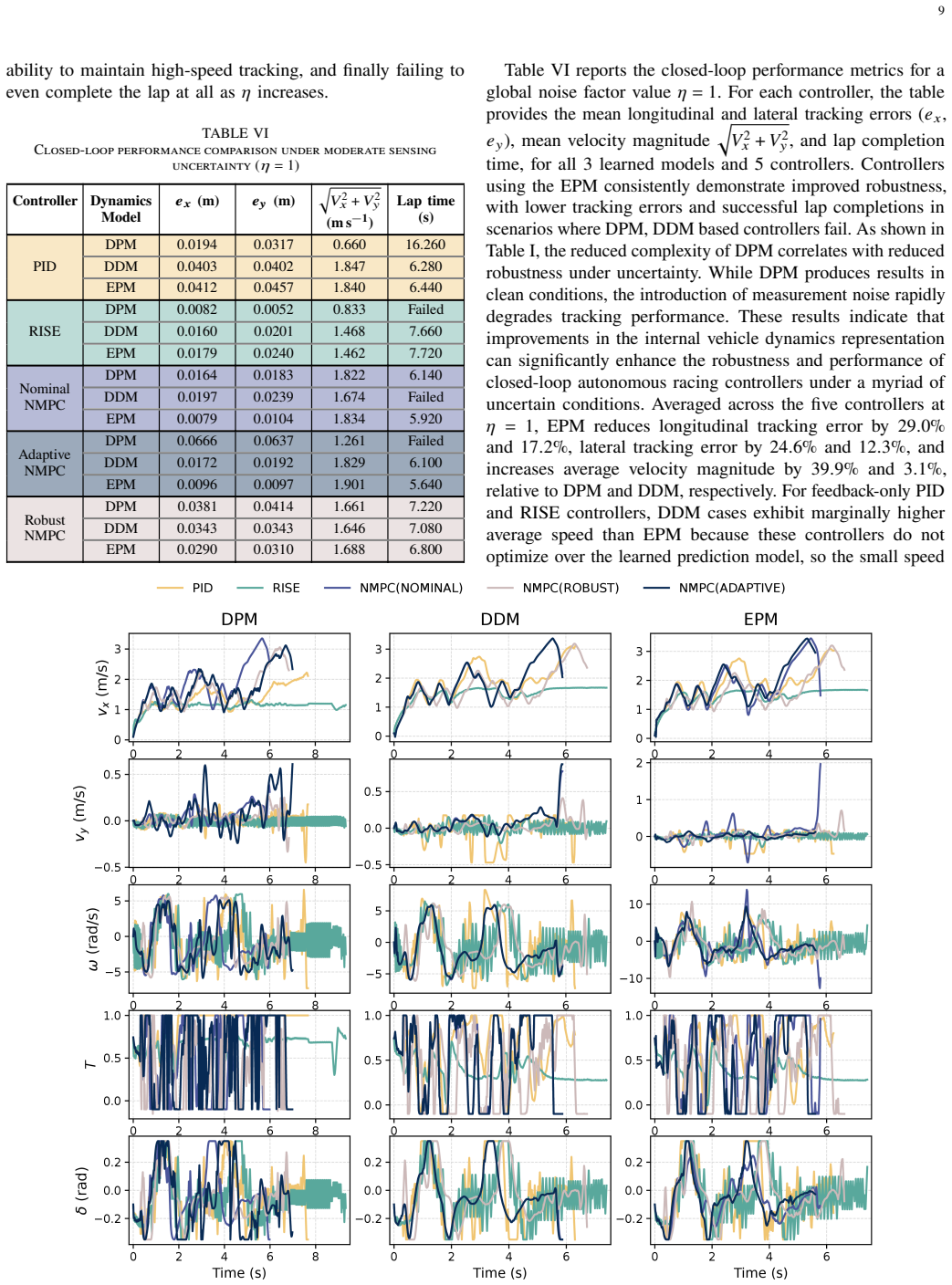
The CAPE framework shows that an enhanced physics model yields faster lap times and lower tracking errors than two other learned vehicle dynamics models when tested in closed-loop racing controllers under disturbances.
A machine-rendered reading of the paper's core claim, the machinery that carries it, and where it could break.
Core claim
The CAPE framework evaluates five closed-loop control architectures under three learned vehicle dynamics models and finds that the proposed enhanced physics model (EPM) achieves the best average lap times and lowest longitudinal and lateral tracking errors across all tested controllers. Specifically, Adaptive NMPC with EPM records 5.82 s lap times versus 12.99 s for DPM and 8.80 s for DDM. When evaluated in a disturbance-aware simulator that includes measurement noise, process disturbances, actuator delay, and parametric uncertainty at moderate scaling, EPM reduces longitudinal tracking error by 29.0% and 17.2%, lateral tracking error by 24.6% and 12.3%, and increases average velocity by 39.
What carries the argument
The enhanced physics model (EPM), a learned vehicle dynamics representation that combines physics structure with data-driven terms to improve closed-loop prediction accuracy.
If this is right
- Controllers using EPM maintain higher average velocities while reducing both longitudinal and lateral errors under identical configurations.
- The CAPE benchmark allows direct comparison of model quality through closed-loop metrics rather than open-loop prediction error alone.
- EPM improves robustness when measurement noise, process disturbances, actuator delay, and parametric uncertainty are present at moderate levels.
- Average results across controllers show consistent gains in velocity magnitude and error reduction relative to the two comparison models.
Where Pith is reading between the lines
- If EPM generalizes beyond the tested track and vehicle, the same benchmarking approach could rank dynamics models for other autonomous tasks such as highway driving or aerial navigation.
- The framework could be extended by replacing the simulator with logged real-vehicle data to test how well each model predicts actual closed-loop behavior.
- Designers of racing controllers might prioritize EPM-style models when simulation-to-reality transfer is the main performance bottleneck.
Load-bearing premise
The learned EPM and the disturbance-aware simulation framework accurately represent the vehicle dynamics and uncertainties that matter for closed-loop controller performance.
What would settle it
Running the same five controllers on a physical vehicle and measuring whether EPM still produces lower lap times and tracking errors than DPM and DDM would confirm or refute the performance advantage.
Figures




read the original abstract
We propose the Control Algorithm Performance Evaluation (CAPE) framework, a systematic methodology for benchmarking racing controllers under our proposed learned enhanced physics model (EPM). The proposed framework enables cross-controller comparison by evaluating five closed-loop control architectures. We further compare our proposed EPM with two state-of-the-art learned vehicle dynamics models: Deep Pacejka Model (DPM) and Deep-learning Dynamics Model (DDM). Closed-loop experiments show that across all models and controllers, the proposed EPM achieves best average lap times. Specifically, the Adaptive NMPC with EPM achieves a time of 5.82 s, compared with 12.99 s for DPM and 8.80 s for DDM, while simultaneously producing substantially lower longitudinal and lateral tracking errors under identical controller configurations. We further evaluate all three models and five controllers using a disturbance-aware simulation framework incorporating measurement noise, process disturbances, actuator delay, and parametric uncertainty. Under moderate global disturbance scaling factor ({\eta} = 1), results averaged across the five controllers show that EPM reduces a) longitudinal tracking error by 29.0% and 17.2%; b) lateral tracking error by 24.6% and 12.3%; c) while increasing average velocity magnitude by 39.9% and 3.1% relative to DPM and DDM, respectively. Overall, CAPE establishes a systematic benchmark for evaluating the performance of learned vehicle dynamics models in a closed-loop control framework and demonstrates that our proposed EPM significantly improves controller robustness and performance under realistic uncertainties.
Editorial analysis
A structured set of objections, weighed in public.
Referee Report
Summary. The manuscript proposes the CAPE framework for systematic benchmarking of racing controllers using learned vehicle dynamics models. It introduces an Enhanced Physics Model (EPM) and compares it to the Deep Pacejka Model (DPM) and Deep-learning Dynamics Model (DDM) in closed-loop simulations involving five control architectures. The key results indicate that EPM achieves the best average lap times across models and controllers, with Adaptive NMPC + EPM at 5.82 s versus 12.99 s for DPM and 8.80 s for DDM, and lower tracking errors. Under disturbance-aware simulations with η = 1, EPM shows reductions in longitudinal and lateral errors and increased velocity compared to the baselines.
Significance. If the learned EPM and the disturbance model faithfully represent the vehicle dynamics and uncertainties, this work offers a valuable methodology for evaluating learned dynamics in closed-loop control settings and demonstrates potential advantages of physics-enhanced models for improving robustness in autonomous racing applications. The use of multiple controllers and disturbance scaling provides a more comprehensive evaluation than open-loop model comparisons alone.
major comments (2)
- [Abstract and §4] Abstract and §4 (Experiments): The reported numerical results (e.g., lap times of 5.82 s, 12.99 s, 8.80 s and percentage error reductions of 29.0%, 17.2%, etc.) are presented without accompanying details on the training dataset size and source, the neural network architectures for DPM, DDM, and EPM, the validation split or cross-validation procedure, or any statistical tests for significance of the differences. This information is necessary to evaluate whether the performance gains are robust or could be due to overfitting or specific hyperparameter choices.
- [Disturbance-aware simulation framework (likely §3 or §5)] Disturbance-aware simulation framework (likely §3 or §5): The parameters for measurement noise, process disturbances, actuator delay, and parametric uncertainty are not specified with reference to physical measurements or literature on real vehicle sensor/actuator characteristics. Without this grounding, the claim that the framework incorporates 'realistic uncertainties' and that EPM improves performance under them rests on unverified modeling choices that could bias the comparison.
minor comments (1)
- [Notation] The definition of the global disturbance scaling factor η should be clarified with an equation or explicit formula in the methods section.
Simulated Author's Rebuttal
We thank the referee for the constructive feedback on our manuscript. The comments highlight important aspects of experimental rigor and grounding that will strengthen the presentation. We address each major comment below and will revise the manuscript accordingly.
read point-by-point responses
-
Referee: [Abstract and §4] Abstract and §4 (Experiments): The reported numerical results (e.g., lap times of 5.82 s, 12.99 s, 8.80 s and percentage error reductions of 29.0%, 17.2%, etc.) are presented without accompanying details on the training dataset size and source, the neural network architectures for DPM, DDM, and EPM, the validation split or cross-validation procedure, or any statistical tests for significance of the differences. This information is necessary to evaluate whether the performance gains are robust or could be due to overfitting or specific hyperparameter choices.
Authors: We agree that these details are essential for assessing reproducibility and robustness. The full manuscript contains some of this information in §4, but we acknowledge it is not presented with sufficient clarity or completeness. In the revised version we will expand §4 to explicitly report: (i) the training dataset size and source (number of trajectories collected from the simulator and any real-vehicle data if used), (ii) the precise neural-network architectures (layer counts, neuron sizes, activation functions) for DPM, DDM and EPM, (iii) the validation split and any cross-validation procedure employed, and (iv) statistical tests (e.g., paired t-tests or Wilcoxon tests) on the lap-time and error differences across the five controllers, including p-values and confidence intervals. These additions will directly address concerns about overfitting or hyperparameter sensitivity. revision: yes
-
Referee: [Disturbance-aware simulation framework (likely §3 or §5)] Disturbance-aware simulation framework (likely §3 or §5): The parameters for measurement noise, process disturbances, actuator delay, and parametric uncertainty are not specified with reference to physical measurements or literature on real vehicle sensor/actuator characteristics. Without this grounding, the claim that the framework incorporates 'realistic uncertainties' and that EPM improves performance under them rests on unverified modeling choices that could bias the comparison.
Authors: We accept that the disturbance parameters require explicit grounding. The current manuscript states the functional forms but does not cite supporting literature or measurements. In the revision we will add, in the disturbance-aware simulation section, specific numerical values together with references to established sources (e.g., sensor noise characteristics from automotive IMU datasheets, actuator delay measurements reported in autonomous racing literature, and tire-parameter uncertainty ranges from Pacejka-model identification studies). We will also clarify how the global scaling factor η is applied and why the chosen magnitudes are representative of real-world conditions. This will substantiate the claim of realistic uncertainties and allow readers to judge potential bias. revision: yes
Circularity Check
No circularity: empirical simulation benchmarks with independent model comparisons
full rationale
The paper reports direct empirical results from closed-loop simulations comparing EPM, DPM, and DDM under identical controllers and a disturbance-aware framework. Lap times, tracking errors, and velocity metrics are generated outputs of the simulation environment rather than quantities that reduce by construction to fitted inputs or self-citations. No derivation chain, uniqueness theorem, or ansatz is invoked that loops back to the paper's own definitions or prior self-citations. The central claims rest on simulation fidelity assumptions, which is a validity concern but not a circularity reduction per the enumerated patterns.
Axiom & Free-Parameter Ledger
invented entities (1)
-
Enhanced Physics Model (EPM)
no independent evidence
Reference graph
Works this paper leans on
-
[1]
Autonomous robot racing competitions: Truly multivehicle autonomous racing competitions,
H. Moon, S. H. Kang, J. Eom, et al., “Autonomous robot racing competitions: Truly multivehicle autonomous racing competitions,” IEEE Robotics & Automation Magazine, vol. 31, no. 1, pp. 123–132, 2024
2024
-
[2]
Hierarchical control for head-to-head autonomous racing,
R. S. Thakkar, A. S. Samyal, D. Fridovich-Keil, Z. Xu, and U. Topcu, “Hierarchical control for head-to-head autonomous racing,”Field Robotics, vol. 4, pp. 46–69, 2024
2024
-
[3]
Trajectory tracking control for autonomous vehicles: A systematic prisma review of models and strategies,
M. S. Albhaisi, M. Prauzek, T. T. H. Minh, S. Ozana, and J. Konecny, “Trajectory tracking control for autonomous vehicles: A systematic prisma review of models and strategies,”Annual Reviews in Control, vol. 61, p. 101047, 2026
2026
-
[4]
Autonomous vehicles on the edge: A survey on autonomous vehicle racing,
J. Betz, H. Zheng, A. Liniger,et al., “Autonomous vehicles on the edge: A survey on autonomous vehicle racing,”IEEE Open Journal of Intelligent Transportation Systems, vol. 3, pp. 458–488, 2022
2022
-
[5]
A survey of vehicle dynamics modeling methods for autonomous racing: Theoretical models, physical/virtual platforms, and perspectives,
T. Zhang, Y. Sun, Y. Wang, B. Li, Y. Tian, and F.-Y. Wang, “A survey of vehicle dynamics modeling methods for autonomous racing: Theoretical models, physical/virtual platforms, and perspectives,”IEEE Transactions on Intelligent Vehicles, vol. 9, no. 3, pp. 4312–4334, 2024
2024
-
[6]
A comprehensive benchmark of vehicle dynamics models for autonomous racing: A deep dive into mpc,
N. Musiu, E. Mascaro, A. Raji, A. De Felice, S. Sorrentino, and M. Bertogna, “A comprehensive benchmark of vehicle dynamics models for autonomous racing: A deep dive into mpc,”Vehicle System Dynamics, pp. 1–33, 2026
2026
-
[7]
Physics embedded neural network vehicle model and applications in risk-aware autonomous driving using latent features,
T. Kim, H. Lee, and W. Lee, “Physics embedded neural network vehicle model and applications in risk-aware autonomous driving using latent features,” in2022 IEEE/RSJ International Conference on Intelligent Robots and Systems (IROS), 2022, pp. 4182–4189
2022
-
[8]
Deep dynamics: Vehicle dynamics modeling with a physics-constrained neural network for autonomous racing,
J. Chrosniak, J. Ning, and M. Behl, “Deep dynamics: Vehicle dynamics modeling with a physics-constrained neural network for autonomous racing,”IEEE Robotics and Automation Letters, vol. 9, no. 6, pp. 5292– 5297, 2024
2024
-
[9]
Model parameter identification via a hyperparameter optimization scheme for autonomous racing systems,
H. Seong, C. Chung, and D. H. Shim, “Model parameter identification via a hyperparameter optimization scheme for autonomous racing systems,”IEEE Control Systems Letters, vol. 7, pp. 1652–1657, 2023
2023
-
[10]
Exploiting symmetry in dynamics for model-based reinforcement learning with asymmetric rewards,
Y. Sonmez, N. Junnarkar, and M. Arcak, “Exploiting symmetry in dynamics for model-based reinforcement learning with asymmetric rewards,”IEEE Control Systems Letters, vol. 8, pp. 1180–1185, 2024
2024
-
[11]
Lateral control for autonomous vehicles: A robust bounded back-stepping technique,
A. Selman, “Lateral control for autonomous vehicles: A robust bounded back-stepping technique,”IEEE Transactions on Intelligent Vehicles, vol. 11, no. 1, pp. 52–62, 2026
2026
-
[12]
Control strategies for autonomous vehicle path tracking: A comparative study of pid, pure-pursuit, and stanley methods,
M. Bousskoulet al., “Control strategies for autonomous vehicle path tracking: A comparative study of pid, pure-pursuit, and stanley methods,” in EPJ Web of Conferences, vol. 312, 2025, p. 06001
2025
-
[13]
Learning-based model predictive control for autonomous racing,
J. Kabzan, L. Hewing, A. Liniger, and M. N. Zeilinger, “Learning-based model predictive control for autonomous racing,”IEEE Robotics and Automation Letters, vol. 4, no. 4, pp. 3363–3370, 2019
2019
-
[14]
Piecewise affine relaxation of discrete value functions in learning model predictive control with application to autonomous racing,
E. Joa, C. Kim, D. Shin, and S. Woo, “Piecewise affine relaxation of discrete value functions in learning model predictive control with application to autonomous racing,”IEEE Control Systems Letters, vol. 8, pp. 2187–2192, 2024
2024
-
[15]
Model predictive control for systems with partially unknown dynamics under signal temporal logic specifications,
Z. F. Dai, Y. V. Pant, and S. L. Smith, “Model predictive control for systems with partially unknown dynamics under signal temporal logic specifications,”IEEE Control Systems Letters, vol. 8, pp. 2931–2936, 2024
2024
-
[16]
Uncertainty- aware safe trajectory planner based on model predictive control for autonomous driving,
Z. Guo, H. Chen, F. Xu, Y. Hu, J. Lin, and L. Guo, “Uncertainty- aware safe trajectory planner based on model predictive control for autonomous driving,”IEEE Transactions on Intelligent Transportation Systems, vol. 26, no. 8, pp. 12068–12079, 2025
2025
-
[17]
On the regret of model predictive control with imperfect inputs,
C. Liu, S. Shi, and B. De Schutter, “On the regret of model predictive control with imperfect inputs,”IEEE Control Systems Letters, vol. 9, pp. 601–606, 2025
2025
-
[18]
Safe control with learned certificates: A survey of neural lyapunov, barrier, and contraction methods for robotics and control,
C. Dawson, S. Gao, and C. Fan, “Safe control with learned certificates: A survey of neural lyapunov, barrier, and contraction methods for robotics and control,”IEEE Transactions on Robotics, vol. 39, no. 3, pp. 1749–1767, 2023
2023
-
[19]
Actor–critic physics-informed neural lyapunov control,
J. Wang and M. Fazlyab, “Actor–critic physics-informed neural lyapunov control,”IEEE Control Systems Letters, vol. 8, pp. 1751–1756, 2024
2024
-
[20]
Stability margins of neural network controllers,
N. Junnarkar, M. Arcak, and P. Seiler, “Stability margins of neural network controllers,” in2025 American Control Conference (ACC), 2025, pp. 1355–1360
2025
-
[21]
Fine-tuning hybrid physics-informed neural networks for vehicle dynamics model estimation,
S. Fang and K. Yu, “Fine-tuning hybrid physics-informed neural networks for vehicle dynamics model estimation,”IFAC-PapersOnLine, vol. 58, no. 28, pp. 810–815, 2024, The 4th Modeling, Estimation, and Control Conference – 2024
2024
-
[22]
Advancing autonomous racing: A comprehensive survey of the roboracer (f1tenth) platform,
I. Charles, H. Maghsoumi, and Y. Fallah, “Advancing autonomous racing: A comprehensive survey of the roboracer (f1tenth) platform,” in 2025 6th International Conference on Artificial Intelligence, Robotics and Control (AIRC), IEEE, 2025, pp. 207–213
2025
-
[23]
Optimization-based autonomous racing of 1:43 scale rc cars,
A. Liniger, A. Domahidi, and M. Morari, “Optimization-based autonomous racing of 1:43 scale rc cars,”Optimal Control Applications and Methods, vol. 36, no. 5, pp. 628–647, 2015
2015
-
[24]
R. N. Jazar,Vehicle dynamics: theory and application. Springer Nature, 2025
2025
-
[25]
LE-PAVD: Learning-Enhanced Physics-Aware Vehicle Dynamics for High-Speed Autonomous Navigation
M. A. Arrafi, M. Ali, N. M. Stiffler, and K. B. Kidambi, “Le-pavd: Learning-enhanced physics-aware vehicle dynamics for high-speed autonomous navigation,”arXiv preprint arXiv:2605.08489, 2026
work page internal anchor Pith review Pith/arXiv arXiv 2026
-
[26]
Bayesrace: Learning to race autonomously using prior experience,
A. Jain, M. O’Kelly, P. Chaudhari, and M. Morari, “Bayesrace: Learning to race autonomously using prior experience,” inConference on Robot Learning, PMLR, 2021, pp. 1918–1929
2021
-
[27]
Development and control of an autonomous rc racing car,
A. Mekky, R. Jain, S. Bandreddi, and D. L. Peters, “Development and control of an autonomous rc racing car,”IFAC-PapersOnLine, vol. 58, no. 28, pp. 678–683, 2024
2024
-
[28]
Comparison of path tracking and torque-vectoring controllers for autonomous electric vehicles,
C. Chatzikomis, A. Sorniotti, P. Gruber, M. Zanchetta, D. Willans, and B. Balcombe, “Comparison of path tracking and torque-vectoring controllers for autonomous electric vehicles,”IEEE Transactions on Intelligent Vehicles, vol. 3, no. 4, pp. 559–570, 2018
2018
-
[29]
Adaptive modified rise control for quadrotors: Enhancing trajectory tracking through uncertainty compensation,
K. Johnston, M. A. Arrafi, K. B. Kidambi, and M. Tiwari, “Adaptive modified rise control for quadrotors: Enhancing trajectory tracking through uncertainty compensation,”IEEE Access, vol. 13, pp. 169166– 169177, 2025
2025
-
[30]
A continuous asymptotic tracking control strategy for uncertain nonlinear systems,
B. Xian, D. M. Dawson, M. S. de Queiroz, and J. Chen, “A continuous asymptotic tracking control strategy for uncertain nonlinear systems,” IEEE Transactions on Automatic Control, vol. 49, no. 7, pp. 1206–1211, 2004
2004
-
[31]
Learning- based model predictive control: Toward safe learning in control,
L. Hewing, K. P. Wabersich, M. Menner, and M. N. Zeilinger, “Learning- based model predictive control: Toward safe learning in control,”Annual Review of Control, Robotics, and Autonomous Systems, vol. 3, no. 1, pp. 269–296, 2020
2020
-
[32]
Robust tube- based mpc for tracking of constrained linear systems with additive disturbances,
D. Limón, I. Alvarado, T. Alamo, and E. F. Camacho, “Robust tube- based mpc for tracking of constrained linear systems with additive disturbances,”Journal of Process Control, vol. 20, no. 3, pp. 248–260, 2010
2010
discussion (0)
Sign in with ORCID, Apple, or X to comment. Anyone can read and Pith papers without signing in.