Cyclically ordered quivers
Pith reviewed 2026-05-24 00:21 UTC · model grok-4.3
The pith
A cyclic ordering on the vertices of a quiver produces new powerful mutation invariants.
A machine-rendered reading of the paper's core claim, the machinery that carries it, and where it could break.
Core claim
A cyclically ordered quiver is a quiver together with a cyclic ordering of its vertices; this structure gives rise to new powerful mutation invariants that are preserved under the natural extension of quiver mutation to the ordered setting.
What carries the argument
The cyclic ordering of vertices, which augments the quiver to define additional invariants preserved by mutation.
Load-bearing premise
The cyclic ordering of vertices is a structure that naturally arises in many important applications.
What would settle it
An explicit pair of cyclically ordered quivers related by a sequence of mutations whose associated invariants differ.
Figures





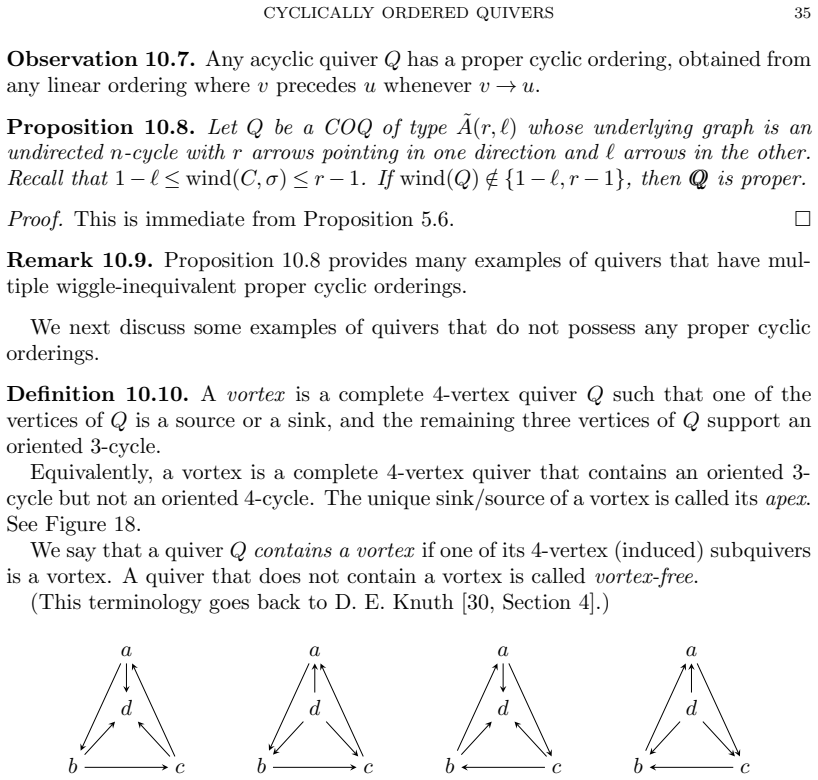
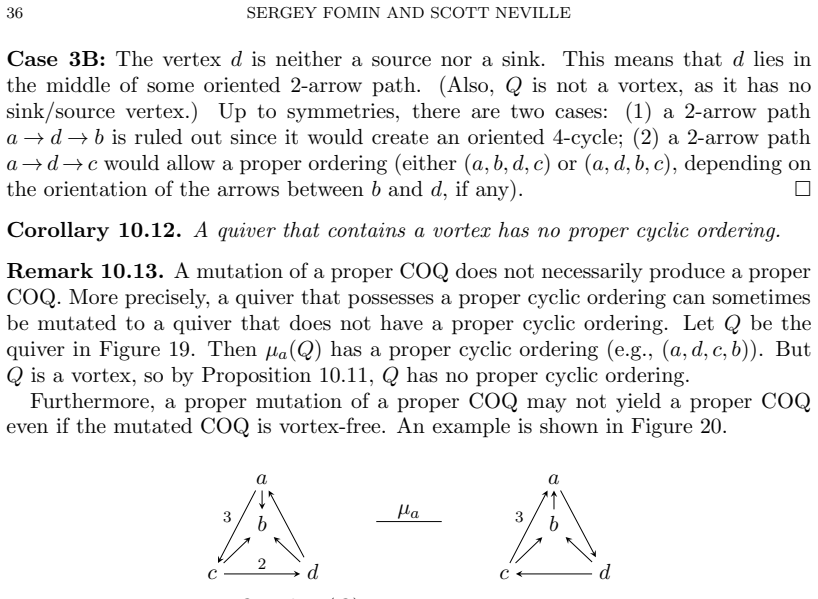
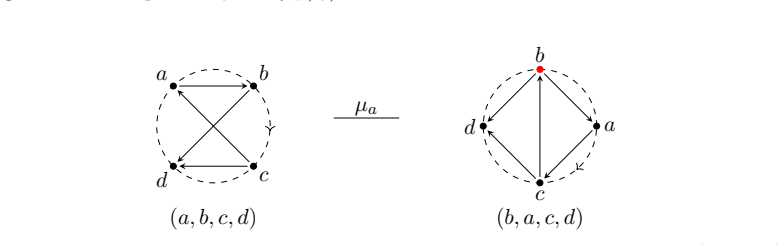


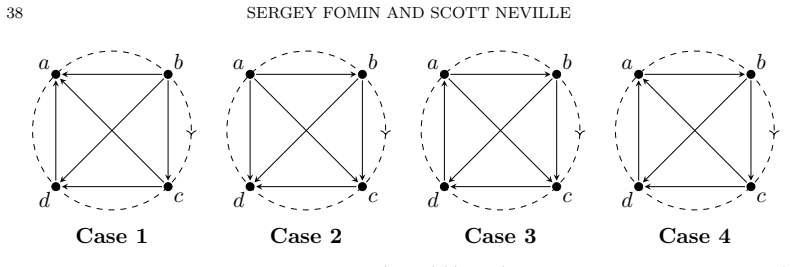
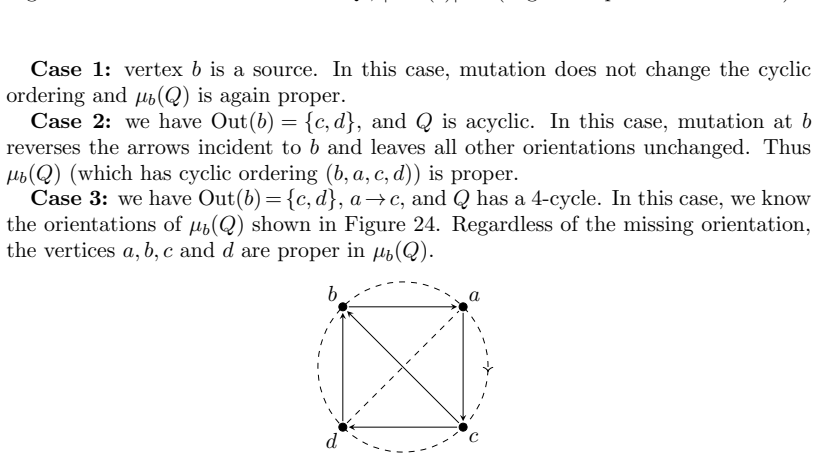
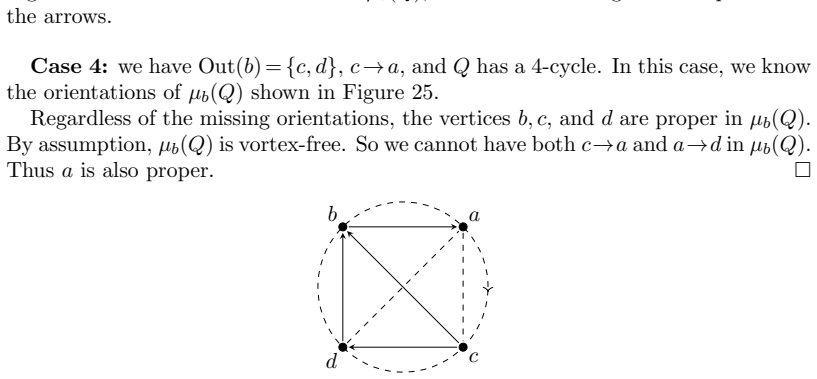


read the original abstract
A cyclically ordered quiver is a quiver endowed with an additional structure of a cyclic ordering of its vertices. This structure, which naturally arises in many important applications, gives rise to new powerful mutation invariants.
Editorial analysis
A structured set of objections, weighed in public.
Referee Report
Summary. The paper defines a cyclically ordered quiver as a standard quiver equipped with an additional cyclic ordering on its vertices. It asserts that this structure arises naturally in applications and produces new powerful mutation invariants.
Significance. New mutation invariants for quivers would be of interest in representation theory and cluster algebras if they are shown to be distinct from existing ones and to have concrete applications. The manuscript provides no explicit construction of any invariant, no proof of invariance under mutation, and no comparison to known invariants, so the potential significance cannot be assessed from the given text.
major comments (1)
- [Abstract] Abstract: the central claim that the cyclic ordering 'gives rise to new powerful mutation invariants' is stated with no derivation, no explicit formula for any invariant, no example quiver, and no verification that the claimed invariants are preserved under mutation or are independent of existing ones.
Simulated Author's Rebuttal
We thank the referee for their report. The primary concern is that the abstract's claim regarding new mutation invariants lacks supporting details in the manuscript. We address this point directly below.
read point-by-point responses
-
Referee: [Abstract] Abstract: the central claim that the cyclic ordering 'gives rise to new powerful mutation invariants' is stated with no derivation, no explicit formula for any invariant, no example quiver, and no verification that the claimed invariants are preserved under mutation or are independent of existing ones.
Authors: The referee correctly observes that the provided manuscript text consists only of the definition and the unsubstantiated claim, with no explicit construction of an invariant, no formula, no example, no proof of mutation invariance, and no comparison to known invariants. This renders the significance of the claimed invariants impossible to assess from the text. We agree that these elements are required and will revise the manuscript to supply them. revision: yes
Circularity Check
No significant circularity
full rationale
The abstract defines cyclically ordered quivers by adding a cyclic ordering to standard quivers and states that this produces new mutation invariants. No equations, derivations, predictions, or self-citations appear in the given text. No load-bearing step reduces to an input by construction, fitted parameter, or self-citation chain. The manuscript is therefore self-contained at the definitional level with no circularity to flag.
Axiom & Free-Parameter Ledger
Forward citations
Cited by 3 Pith papers
-
Eventual sign coherence
Random mutations on skew-symmetric quivers yield sign-coherent c-vectors almost surely, proving the asymptotic sign coherence conjecture for arbitrary rank.
-
Geometric helices on del Pezzo surfaces from tilting
All geometric helices on del Pezzo surfaces are related by elementary operations including tilting, implying that non-commutative crepant resolutions of their affine cones are related by mutations.
-
The HOMFLY Polynomial of a Forest Quiver
Defines HOMFLY polynomial of forest quivers recursively, equates it to plabic link HOMFLY, and gives closed form via independent sets.
Reference graph
Works this paper leans on
- [1]
-
[2]
A. Beineke, T. Br¨ ustle, and L. Hille, Cluster-cyclic quivers with three vertices and the Markov equation. With an appendix by O. Kerner, Algebr. Represent. Theory 14 (2011), 97–112
work page 2011
-
[3]
A. Berenstein, S. Fomin, and A. Zelevinsky, Cluster algebras III: Upper bounds and double Bruhat cells, Duke Math. J. 126 (2005), 1–52
work page 2005
-
[4]
W. Bley, T. Hofmann, and H. Johnston, Computation of lattice isomorphisms and the integral matrix similarity problem, Forum Math. Sigma 10 (2022), Paper No. e87, 36 pp
work page 2022
-
[5]
A. I. Bondal, A symplectic groupoid of triangular bilinear forms and the braid group, Izv. Math. 68 (2004), no. 4, 659–708
work page 2004
-
[6]
A. I. Bondal and A. E. Polishchuk, Homological properties of associative algebras: the method of helices, Russian Acad. Sci. Izv. Math. 42 (1994), no. 2, 219–260
work page 1994
-
[7]
A. E. Brouwer, The enumeration of locally transitive tournaments, Afdeling Zuivere Wiskunde [Department of Pure Mathematics], Report 138/80, Mathematisch Centrum, Amsterdam, 1980
work page 1980
-
[8]
P. Caldero and B. Keller, From triangulated categories to cluster algebras. II, Ann. Sci. Ecole Norm. Sup. 39 (2006), 983–1009
work page 2006
-
[9]
P. J. Cameron, Orbits of permutation groups on unordered sets. II, J. London Math. Soc. (2) 23 (1981), 249–264
work page 1981
-
[10]
Casals, A binary invariant of matrix mutation, arXiv:2311.03601, to appear in J
R. Casals, A binary invariant of matrix mutation, arXiv:2311.03601, to appear in J. Comb. Algebra
-
[11]
S. Cecotti and C. Vafa, On classification of N = 2 supersymmetric theories, Comm. Math. Phys. 158 (1993), 569–644
work page 1993
-
[12]
H. Derksen and T. Owen, New graphs of finite mutation type, Electron. J. Combin. 15 (2008), no. 1, Research Paper 139, 15 pp
work page 2008
-
[13]
Dubrovin, Geometry of 2D topological field theories, Lecture Notes in Math
B. Dubrovin, Geometry of 2D topological field theories, Lecture Notes in Math. 1620 (1996), Springer-Verlag, 120–348
work page 1996
-
[14]
B. Eick, T. Hofmann, and E. A. O’Brien, The conjugacy problem in GL( n, Z), J. Lond. Math. Soc. 100 (2019), 731–756
work page 2019
-
[15]
Ervin, New hereditary and mutation-invariant properties arising from forks, Electron
T. Ervin, New hereditary and mutation-invariant properties arising from forks, Electron. J. Combin. 31, Paper No. 1.16, 30 (2024)
work page 2024
-
[16]
Y.-W. Fan and J. P. Whang, Stokes matrices and exceptional isomorphisms, Math. Ann. , to appear, https://doi.org/10.1007/s00208-024-02850-8
-
[17]
A. Felikson, M. Shapiro, and P. Tumarkin, Skew-symmetric cluster algebras of finite mutation type, J. Eur. Math. Soc. 14 (2012), 1135–1180
work page 2012
- [18]
- [19]
- [20]
-
[21]
Introduction to cluster algebras
S. Fomin, L. Williams, and A. Zelevinsky, Introduction to cluster algebras. Chapters 1–3, arXiv:1608.05735
-
[22]
S. Fomin and A. Zelevinsky, Cluster algebras I: Foundations, J. Amer. Math. Soc. 15 (2002), 497–529
work page 2002
-
[23]
S. Fomin and A. Zelevinsky, Cluster algebras II: Finite type classification, Invent. Math. 154 (2003), 63–121
work page 2003
-
[24]
S. Fomin and A. Zelevinsky, Cluster algebras IV: Coefficients, Compos. Math. 143 (2007), 112–164
work page 2007
-
[25]
A. P. Fordy and R. J. Marsh, Cluster mutation-periodic quivers and associated Laurent se- quences, J. Algebraic Combin. 34 (2011), no.1, 19–66
work page 2011
-
[26]
F. J. Grunewald, Solution of the conjugacy problem in certain arithmetic groups, Word prob- lems II, pp. 101–139 Stud. Logic Found. Math. 95, North-Holland, 1980. CYCLICALLY ORDERED QUIVERS 49
work page 1980
-
[27]
F. Grunewald and D. Segal, Some general algorithms. I. Arithmetic groups. Ann. of Math. 112 (1980), 531–583
work page 1980
-
[28]
W. Gu, A decomposition algorithm for the oriented adjacency graph of the triangulations of a bordered surface with marked points, Electron. J. Combin. 18 (2011), no.1, Paper 91, 45 pp
work page 2011
-
[29]
R. A. Horn and V. V. Sergeichuk, Canonical forms for complex matrix congruence and *congru- ence, Linear Algebra Appl. 416 (2006), 1010–1032
work page 2006
-
[30]
D. E. Knuth, Axioms and hulls , Lecture Notes in Computer Science 606, Springer-Verlag, 1992
work page 1992
-
[31]
J. W. Moon, Tournaments whose subtournaments are irreducible or transitive, Canad. Math. Bull. 22 (1979), 75–79
work page 1979
-
[32]
Muller, Locally acyclic cluster algebras, Adv
G. Muller, Locally acyclic cluster algebras, Adv. Math. 233 (2013), 207–247
work page 2013
-
[33]
Neville, Totally proper orderings of acyclic quivers, 2024, in preparation
S. Neville, Totally proper orderings of acyclic quivers, 2024, in preparation
work page 2024
-
[34]
A. N. Rudakov, Integer-valued bilinear forms and vector bundles, Math. USSR-Sb. 66 (1990), no. 1, 189–197
work page 1990
-
[35]
R. A. Sarkisjan, The conjugacy problem for collections of integral matrices, Mat. Zametki 25 (1979), 811–824, 956
work page 1979
-
[36]
A. I. Seven, Mutation classes of skew-symmetrizable 3 ×3 matrices, Proc. Amer. Math. Soc. 141 (2013), 1493–1504
work page 2013
-
[37]
Seven, Cluster algebras and symmetric matrices, Proc
A. Seven, Cluster algebras and symmetric matrices, Proc. Amer. Math. Soc. . 143, 469-478 (2015)
work page 2015
-
[38]
A. Seven and ˙I. ¨Unal, Congruence invariants of matrix mutation, arXiv:2403.10626
-
[39]
P. F. Stebe, Conjugacy separability of groups of integer matrices, Proc. Amer. Math. Soc. 32 (1972), 1–7
work page 1972
-
[40]
Warkentin, Exchange graphs via quiver mutation, Ph.D
M. Warkentin, Exchange graphs via quiver mutation, Ph.D. thesis, Technische Universit¨ at Chem- nitz, 2014, https://nbn-resolving.org/urn:nbn:de:bsz:ch1-qucosa-153172 . Department of Mathematics, University of Michigan, Ann Arbor, MI 48109, USA Email address: fomin@umich.edu Email address: nevilles@umich.edu
work page 2014
discussion (0)
Sign in with ORCID, Apple, or X to comment. Anyone can read and Pith papers without signing in.