REVIEW 3 major objections 4 minor 69 references
A scoping review of 1,465 papers finds a structural hole between chip-process AI and sustainability governance, and proposes a six-layer architecture to close it.
Reviewed by Pith at T0; open to challenge. T0 means a machine referee read the full paper against a public rubric. the ladder, T0–T4 →
T0 review · deepseek-v4-flash
2026-08-01 03:38 UTC pith:4NK3BG2H
load-bearing objection Useful SSbD-semiconductor synthesis with reproducible data, but the claimed structural hole is partly a query-design artifact — worth serious review. the 3 major comments →
Scoping Review of AI, Metrology, and ESG in the Semiconductor Sector: Implications for Safe and Sustainable by Design (SSbD)
The pith
A machine-rendered reading of the paper's core claim, the machinery that carries it, and where it could break.
Core claim
The central claim is that the field's core-periphery structure is not just a bibliometric curiosity but a system-level gap: the cluster anchored by virtual metrology, deep learning, and fabrication is only weakly linked to the clusters for supply-chain resilience and sustainability, and the weakest link is between sustainability/device-performance and the AI core. The paper claims that closing this gap requires treating the semiconductor value chain as a System of Systems, and it offers a six-layer SSbD architecture—chemical substitution, RegTech/CBAM compliance, federated industrial data spaces, metrology-based optimization, Industry 4.0 digital twins, and socio-technical transitions—to do
What carries the argument
The key machinery is two-fold. First, a bibliometric network analysis that maps keyword co-occurrence and conceptual structure, which is used to identify structural holes between clusters—especially the missing bridge between AI-driven process control and sustainability governance. In network terms, a structural hole is an absence of connections between two otherwise well-connected groups. Second, the proposed six-layer SSbD architecture, whose load-bearing components are virtual metrology (predicting wafer or process quality from sensor data instead of measuring every unit), localized federated learning, and defensive RegTech mechanisms that trace data provenance. The architecture is design
Load-bearing premise
The observed gap between AI-driven process optimization and sustainability governance is treated as an emergent property of the literature, but the search strategy partitioned the corpus into six pre-defined domains, so the 'structural hole' may partly be a result of that partition rather than a fact about the field; the paper provides no baseline or robustness check to rule this out.
What would settle it
Re-run the same network analysis with a single joint query that combines process-optimization terms (virtual metrology, AI, yield) with sustainability terms (Scope 3, CBAM, lifecycle) and with a random null model; if the AI-core cluster and sustainability cluster merge, the structural hole is an artifact of query design. Alternatively, survey semiconductor fabs that use virtual metrology to see whether any of them emit process-level carbon or emissions data into their compliance reporting; if none do, the gap is real at the operational level.
If this is right
- If the structural hole is real, then sustainability metrics can and should be treated as control variables alongside yield and throughput in semiconductor fabrication.
- The grid-to-core pathway implies that energy and emissions data from power electronics can be integrated into virtual metrology feedback loops, giving CBAM reporting a real-time process-data foundation.
- The standards-through-supply-chain pathway implies that SSbD and emissions requirements can be embedded in procurement and design governance, making compliance a design constraint rather than a downstream audit.
- The architecture implies that federated data spaces can carry CBAM and ESG data across regions while preserving data sovereignty, which is necessary for global supply chains.
- If provenance-aware data fabrics are built, digital product passports for chips become a realistic mechanism for 'chemical-to-chip' traceability and circularity.
Where Pith is reading between the lines
- A direct test of the central claim would be to see whether real fabrication lines that use virtual metrology actually output emissions or lifecycle data; if none do, the structural hole is operational, not just bibliographic.
- The paper's six-domain query design may pre-separate the literature into the same clusters that later appear disconnected; a single joint query or a null-model baseline could either shrink or confirm the structural hole.
- The defensive RegTech idea—guarding against vendors using AI to game sustainability reports—generalizes naturally to any industry with ESG ratings, not just semiconductors.
- The architecture is a scaffold, not a working system; the next concrete step would be to pilot it against an existing fab's data infrastructure to identify which integration points are hardest.
Editorial analysis
A structured set of objections, weighed in public.
Referee Report
Summary. The paper reports a scoping review of 1,465 Web of Science and Scopus documents spanning AI-integrated metrology, supply-chain ESG, and federated industrial data spaces. It applies bibliometric methods—multiple correspondence analysis, keyword co-occurrence, and co-authorship mapping—and claims that the literature exhibits a fragmented core-periphery structure with a critical structural hole between AI-driven process optimization and downstream sustainability governance. To close these gaps, the paper proposes a six-layer Safe and Sustainable by Design (SSbD) architecture built on virtual metrology, federated data spaces, and RegTech mechanisms. The architecture is explicitly described as an early-stage conceptual scaffold rather than a validated operational model.
Significance. If the central empirical claim were robust, the paper would make a useful integrative contribution by mapping an interdisciplinary landscape and proposing a concrete systems architecture linking process-level metrology to CBAM/SSbD compliance. The manuscript has notable strengths: the search strategy is reported in detail (Table II), the processed data are deposited with a DOI, dataset characteristics are transparently tabulated (Table III), and the authors clearly flag the architecture as a first-iteration hypothesis. However, the core claim of a structural hole currently rests on a pre-structured query design and visual inspection of cluster maps, with no quantitative gap metric, null-model baseline, or sensitivity analysis. The proposed architecture is motivated by that finding, so the empirical weakness is load-bearing.
major comments (3)
- [Section III-B, Table II] The central structural-hole finding is not robust because the six domain queries predefine the conceptual categories that later appear as disconnected clusters. For example, Domain 1 forces 'supply chain' with 'Scope 3/carbon emissions', Domain 4 forces 'metrology' with 'AI', and Domain 6 forces 'circular economy/LCA' with 'AI'. Since the corpus is the union of these six queries, documents retrieved by different domains will exhibit systematically disjoint keyword sets regardless of the intellectual structure of the field. The manuscript itself states in III-B that the queries 'roughly follow the six areas covered in Section II', which confirms this risk. No null model, permutation baseline, or sensitivity analysis is provided to show that the observed separation exceeds what the query design alone would produce. This is load-bearing because the six-layer architecture in Section V-B is j
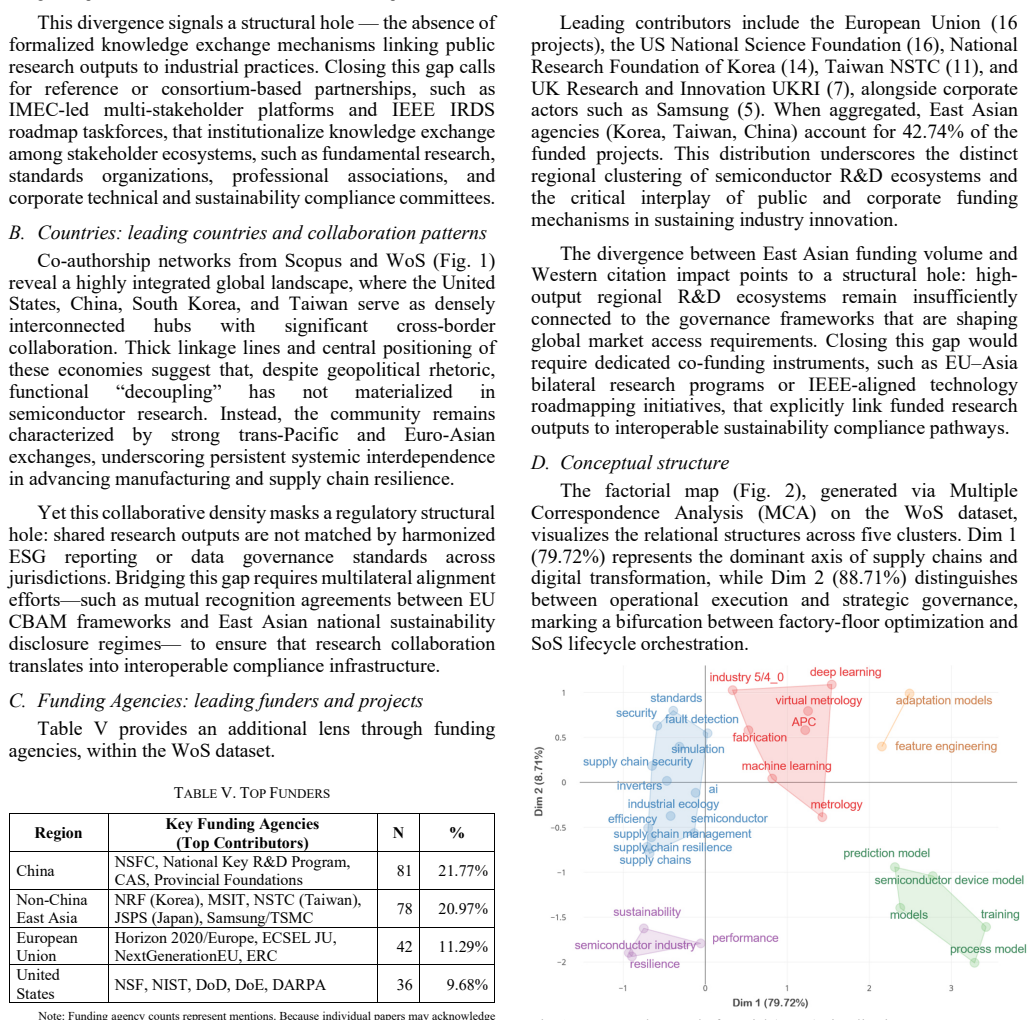
- [Section IV-D, Figs. 2 and 3] Structural holes are asserted from visual interpretation of the MCA factorial map and keyword co-occurrence network, but no quantitative network metric is reported. The text states that 'the most critical structural hole lies between Cluster 4 and Cluster 1' and later that 'the network reveals two primary structural holes', yet it gives no Burt constraint values, inter-cluster edge densities, modularity scores, or statistical comparison against a random graph. Consequently, the existence of a 'hole' is not operationalized. Please report quantitative inter-cluster connectivity measures and, ideally, a baseline comparison. Without these, the claim cannot be evaluated beyond visual impression.
- [Section VI / Section V-B] The manuscript oscillates between claiming that the architecture 'demonstrates' how the components build a provenance-aware data fabric and stating that it is a 'structured conceptual scaffold' awaiting validation. The abstract and Section V-B use strong language, while Section VI correctly limits the contribution as an early-stage synthesis. Given that the architecture is the main proposed deliverable, the claims should be uniformly framed as a design hypothesis. This does not require new experiments, but it affects how readers weigh the contribution.
minor comments (4)
- [Table II vs. Table III] The row sums in Table II (WoS: 121+52+45+99+35+17=369; Scopus: 237+260+285+265+14+47=1108) do not match the totals in Table III (WoS 363, Scopus 1102). Please clarify how duplicates across domains and the final deduplicated 1,465-document corpus are derived, or state that the totals are the union after removing cross-domain overlap.
- [Figures 2 and 3] In the version under review, Figures 2 and 3 are referenced with captions but the actual graphics are not present. The cluster labels and visual structural-hole claims cannot be verified without the images. Please ensure the final files include fully legible figures with legends and color labels.
- [Table IV] The affiliation 'Centre National De La Recherche Scientifique' is abbreviated as CNRC; the standard abbreviation is CNRS. Please correct.
- [Section V-B] The statement that 'defensive prompt structures' prevent 'compliance gaming' is speculative and is supported only by a general reference on research-quality evaluation by AI [59]. Please either provide evidence specific to ESG/sustainability reporting or explicitly mark this as a design assumption.
Circularity Check
Structural hole finding is substantially an artifact of the six-domain query partition; no null model rules out query-imposed fragmentation.
specific steps
-
self definitional
[Section III-B / Table II; Section IV-D]
"selected six thematic domains (see Table II), which roughly follows the six areas covered in Section II. ... The most critical structural hole lies between Cluster 4 (sustainability and performance) and Cluster 1 (AI and virtual metrology): environmental impact metrics are not yet co-evolving with AI-driven process optimization."
Table II's queries pre-partition the corpus: q4=(semiconductor/Wafer Fab) AND (metrology/in-situ sensor) AND (AI/ML/analytics); q6=(semiconductor/Wafer Fab) AND (circular/LCA) AND (AI/ML/analytics); q1=(semiconductor) AND (supply chain) AND (Scope 3/carbon/resilience/safety). The MCA and keyword co-occurrence maps in Section IV-D are computed on the union of these disjoint query outputs, so a document in the AI/metrology cluster is required to carry q4 terms and a document in the sustainability cluster is required to carry q6 or q1 terms. A bridge between the two clusters can appear only if a single paper independently satisfies two different query families; the search strategy never jointly requires metrology plus lifecycle/sustainability terms. The reported 'critical structural hole' is
full rationale
The central derivation chain is: Table II defines six domain-specific Boolean queries; the union of their hits becomes the 1,465-document corpus; MCA and keyword co-occurrence maps are computed from that corpus; and the maps are interpreted as revealing a 'critical structural hole' between AI/metrology and sustainability. This is partially circular because the query design already separates the keyword families that are later reported as disconnected. A bridge between the AI-core cluster and the sustainability cluster can only be observed if individual papers independently happen to satisfy two disjoint query families, and the paper provides no baseline showing that the observed separation exceeds what the query construction alone would produce. The circularity is partial rather than total: the maps could in principle have shown cross-cluster links for papers retrieved by multiple queries, and some cluster labels (Power Electronics, Predictive Modelling) are not direct copies of the query domains. However, the central claimed structural hole is substantially an input of the search strategy. I found no load-bearing self-citation circularity: the self-citations support context and data availability, but they do not carry the empirical claim.
Axiom & Free-Parameter Ledger
free parameters (3)
- Six-domain query partition
- Keyword thesaurus/merging choices
- Six-layer architecture design
axioms (5)
- domain assumption WoS and Scopus indexing sufficiently represents the semiconductor field's knowledge structure.
- domain assumption Keyword co-occurrence absence validly measures knowledge integration gaps.
- domain assumption The SSbD framework, developed for chemicals, transfers to semiconductor manufacturing.
- domain assumption System of Systems is the correct paradigm for integrating metrology, AI, and ESG.
- domain assumption RegTech platforms and federated data spaces can be made interoperable at scale.
invented entities (3)
-
Six-layer SSbD architecture
no independent evidence
-
Provenance-aware data fabric
no independent evidence
-
Defensive RegTech mechanisms / defensive prompt structures
no independent evidence
read the original abstract
The semiconductor sector faces a dual transition: scaling manufacturing execution through Artificial Intelligence (AI) while satisfying stringent sustainability mandates, such as the EU Carbon Border Adjustment Mechanism (CBAM). This paper presents a scoping review of 1,465 documents indexed in Web of Science and Scopus, spanning AI-integrated metrology, supply chain ESG, and federated industrial data spaces. Network analysis reveals a highly fragmented "core-periphery" knowledge structure, emphasizing a critical structural hole between AI-driven process optimization and downstream sustainability governance. To close these gaps, this study proposes a 6-layer Safe and Sustainable by Design (SSbD) architecture grounded in a System of Systems (SoS) paradigm. By establishing distinct "grid-to-core" and "standards-through-supply-chain" integration pathways, the proposed framework demonstrates how virtual metrology (VM), localized federated learning, and defensive RegTech mechanisms can build provenance-aware data fabrics. Ultimately, this architecture positions regulatory compliance as a driver for innovation, enabling secure, climate-neutral, and circular value chains in semiconductor manufacturing.
Figures



Reference graph
Works this paper leans on
-
[1]
Semico nductor supply chain resilience and disruption: insights, mitigation, an d future directions,
W. Xiong, D. D. Wu, and J. H. Y. Yeung, “Semico nductor supply chain resilience and disruption: insights, mitigation, an d future directions,” International Journal of Production Research , vol. 63, no. 9, pp. 3442– 3465, May 2025, doi: 10.1080/00207543.2024.2387074
arXiv 2025
-
[2]
V. Ramani, D. Ghosh, and M. S. Sodhi, “Understa nding systemic disruption from the Covid-19-induced semiconductor shortage for the auto industry,” Omega , vol. 113, p. 102720, Dec. 2022, doi: 10.1016/j.omega.2022.102720
arXiv 2022
-
[3]
H. Matsuo, “Implications of the Tohoku earthqua ke for Toyota’s coordination mechanism: Supply chain disruption of automotive semiconductors,” International Journal of Production Economics , pp. 217–227, Mar. 2015. doi: 10.1016/j.ijpe.2014.07.010
-
[4]
With new export controls on critical mine rals, supply concentration risks become reality,
IEA, “With new export controls on critical mine rals, supply concentration risks become reality,” IEA , Oct. 23, 2025. Accessed: Mar. 17, 2026. [Online]. Available: https://www.iea.org/commentaries/with-new-export-controls-on- critical-minerals-supply-concentration-risks-become-reality
2025
-
[5]
IRDS 2024 chapter-- Environment, safety, health & sustainability (ESHS): environmental sustainability of the semiconductor facilities (ESSF),
IEEE, “IRDS 2024 chapter-- Environment, safety, health & sustainability (ESHS): environmental sustainability of the semiconductor facilities (ESSF),” International Roa dmap for Devices and Systems (IRDS), 2024. Available: https://irds. ieee.org/images/files/pdf/2024/2024IRDS_ESHS-ESSF.pdf
2024
-
[6]
Virtual metrolog y in semiconductor manufacturing: Current status and future prospects,
V. Maitra, Y. Su, and J. Shi, “Virtual metrolog y in semiconductor manufacturing: Current status and future prospects, ” Expert Systems with Applications , Sep. 01, 2024. doi: 10.1016/j.eswa.2024.123559
arXiv 2024
-
[7]
Virtual Metrology Model Robustness Against Chamber Condition Variation Using Deep Lear ning,
T. Tsutsui and T. Matsuzawa, “Virtual Metrology Model Robustness Against Chamber Condition Variation Using Deep Lear ning,” IEEE Transactions on Semiconductor Manufacturing , vol. 32, no. 4, pp. 428– 433, Nov. 2019, doi: 10.1109/TSM.2019.2931328
arXiv 2019
-
[8]
V irtual Metrology for Etch Profile in Silicon Trench Etching With SF₆/O₂/Ar Pl asma,
J. E. Choi, H. Park, Y. Lee, and S. J. Hong, “V irtual Metrology for Etch Profile in Silicon Trench Etching With SF₆/O₂/Ar Pl asma,” IEEE Transactions on Semiconductor Manufacturing , vol. 35, no. 1, pp. 128– 136, Feb. 2022, doi: 10.1109/TSM.2021.3138918
arXiv 2022
-
[9]
D. Kim, P. Kang, S. Cho, H. Lee, and S. Doh, “M achine learning-based novelty detection for faulty wafer detection in sem iconductor manufacturing,” Expert Systems with Applications , pp. 4075–4083, Mar. 2012. doi: 10.1016/j.eswa.2011.09.088
-
[10]
Safe and sustainable by design - Research and innovation,
European Commission, “Safe and sustainable by design - Research and innovation,” Mar. 06, 2026. Accessed: Mar. 13, 2026 . [Online]. Available: https://research-and-innovation.ec.europ a.eu/research- area/industrial-research-and-innovation/chemicals-and-advanced- materials/safe-and-sustainable-design_en
2026
-
[11]
M. Tunali, D. Voelker, C. Burkart, K. Schwirn, and B. Nowack, “Recommendations for making the European Commission ’s Safe and Sustainable by Design framework practicable for bio cides,” Sustainable Chemistry and Pharmacy , vol. 48, p. 102221, Dec. 2025, doi: 10.1016/j.scp.2025.102221
arXiv 2025
-
[12]
A. Schmitz and M. A. Wimmer, “Enhancing public procurement through GRC management: navigating the evolving EU regulatory landscape,” Conference on Digital Government Research , vol. 26, May 2025, doi: 10.59490/dgo.2025.978
-
[13]
Virtual metrology as an approach for product quality estima tion in Industry 4.0: a systematic review and integrative conceptual framework,
P.-A. Dreyfus, F. Psarommatis, G. May, and D. Kiritsis, “Virtual metrology as an approach for product quality estima tion in Industry 4.0: a systematic review and integrative conceptual framework,” International Journal of Production Research , pp. 742–765, Jan. 17,
-
[14]
System of Systems - the meaning of of,
J. Boardman and B. Sauser, “System of Systems - the meaning of of,” in 2006 IEEE/SMC International Conference on System of Systems Engineering , Apr. 2006, p. 6 pp.-. doi: 10.1109/SYSOSE.2006.1652284
Pith/arXiv arXiv 2006
-
[15]
An integrated framework of Industry 3.5 and an empirical study of simulation-based automate d material handling system for semiconductor manufacturing,
C.-F. Chien and T.-Y. Hong, “An integrated framework of Industry 3.5 and an empirical study of simulation-based automate d material handling system for semiconductor manufacturing,” International Journal of Logistics-Research and Applications , pp. 309–325, Feb. 01,
-
[16]
Integrated Semico nductor Supply Chain Production Planning,
J. J. Lowe and S. J. Mason, “Integrated Semico nductor Supply Chain Production Planning,” IEEE Transactions on Semiconductor Manufacturing , pp. 116–126, May 2016. doi: 10.1109/TSM.2016.2544202
arXiv 2016
-
[17]
Integrating resilience and reliability in semiconductor supply chains during disruptions,
D. Kumar, G. Soni, S. K. Mangla, J. Liao, A. P . S. Rathore, and Y. Kazancoglu, “Integrating resilience and reliability in semiconductor supply chains during disruptions,” International Journal of Production Economics , Oct. 2024. doi: 10.1016/j.ijpe.2024.109376
arXiv 2024
-
[18]
Y. Yu, D. Ma, and Y. Wang, “Structural resilie nce evolution and vulnerability assessment of semiconductor materials supply network in the global semiconductor industry,” International Journal of Production Economics , Apr. 2024. doi: 10.1016/j.ijpe.2024.109172
arXiv 2024
-
[19]
Y.-C. Tsao, H. T. Balo, and C. K. H. Lee, “Res ilient and sustainable semiconductor supply chain network design under tra de credit and uncertainty of supply and demand,” International Journal of Production Economics , Aug. 2024. doi: 10.1016/j.ijpe.2024.109318
arXiv 2024
-
[20]
H.-T. Liao, C.-L. Pan, and Z. Wu, “Digital tra nsformation and innovation and business ecosystems: A bibliometric analysis for conceptual insights and collaborative practices for ecosystem innovation,” International Journal of Innovation Studies , vol. 8, no. 4, pp. 406–431, Dec. 2024, doi: 10.1016/j.ijis.2024.04.003
-
[21]
S. Rolf, J. Baines, J. Germann, and S. Starrs, “The geographies and geopolitics of industrial policy: Designing a data- driven UK semiconductor strategy,” European Urban and Regional Studies , pp. 115–123, Apr. 2025. doi: 10.1177/09697764241303838
-
[22]
The European Chips Act: Europe’s Quest for Semiconductor Autonomy,
J. V. Camps and A. Saz-Carranza, “The European Chips Act: Europe’s Quest for Semiconductor Autonomy,” Center for Global Economy and Geopolitics , pp. 10–17, 2023
2023
-
[23]
The paradox of semiconductors—EU governance between sovereignty and interdependence,
L. Monsees, “The paradox of semiconductors—EU governance between sovereignty and interdependence,” Cambridge Review of International Affairs , vol. 38, no. 1, pp. 3–21, Jan. 2025, doi: 10.1080/09557571.2024.2405915
arXiv 2025
-
[24]
From Overdependence to Independen ce: European Policy Frameworks for Semiconductor Supply Chain Resilienc e,
R. Glatter, “From Overdependence to Independen ce: European Policy Frameworks for Semiconductor Supply Chain Resilienc e,” IE Economics Review , vol. 6, no. 1, p., Jan. 2025
2025
-
[25]
Navigating the pat h to sustainability: case study insights from Taiwan’s semiconductor sector,
H. Hu, B. Lin, and S. Sun, “Navigating the pat h to sustainability: case study insights from Taiwan’s semiconductor sector,” presented at the EGU General Assembly Conference, Apr. 2025, pp. EGU 25-18950. doi: 10.5194/egusphere-egu25-18950
-
[26]
Sustainable global semiconductor supply chain network design considering ESG,
M.-C. Chen, S. Pang, and S.-Y. Su, “Sustainable global semiconductor supply chain network design considering ESG,” Technology in Society , Jun. 2025. doi: 10.1016/j.techsoc.2025.102829
arXiv 2025
-
[27]
On the Need of International Cross-Data Space Interworking: An EU–Japan Case Study,
J. R. Santana et al. , “On the Need of International Cross-Data Space Interworking: An EU–Japan Case Study,” IT Professional , vol. 27, no. 5, pp. 59–65, Sep. 2025, doi: 10.1109/MITP.2025.3545214
arXiv 2025
-
[28]
Evolution and future of manufacturing systems,
H. ElMaraghy, L. Monostori, G. Schuh, and W. ElMaraghy, “Evolution and future of manufacturing systems,” CIRP Annals , vol. 70, no. 2, pp. 635–658, Jan. 2021, doi: 10.1016/j.cirp.2021.05.008
-
[29]
D. Ivanov, “The Industry 5.0 framework: viability-based integration of the resilience, sustainability, and human-centricit y perspectives,” International Journal of Production Research , vol. 61, no. 5, pp. 1683– 1695, Mar. 2023, doi: 10.1080/00207543.2022.2118892
arXiv 2023
-
[30]
A multimodal hier archical learning approach for virtual metrology in semiconductor man ufacturing,
Q. Chen, W. Qin, and H. Xu, “A multimodal hier archical learning approach for virtual metrology in semiconductor man ufacturing,” Journal of Manufacturing Systems , vol. 80, pp. 194–205, Jun. 2025, doi: 10.1016/j.jmsy.2025.02.010
-
[31]
GenAI applications of vision-language models for semiconductor defect classification,
T.-H. Lin et al. , “GenAI applications of vision-language models for semiconductor defect classification,” in Metrology, Inspection, and Process Control XXXIX , SPIE, Apr. 2025, pp. 88–102. doi: 10.1117/12.3064772
-
[32]
F rom Industry 4.0 to Industry 5.0: The Triple Transition Digital, Green and Social
A. J. Schröder, M. Cuypers, and A. Götting, “F rom Industry 4.0 to Industry 5.0: The Triple Transition Digital, Green and Social.” Cham: Springer, 2024, pp. 35–51. doi: 10.1007/978-3-031-35479-3_3
-
[33]
I. M. De La Vega Hernández, G. M. Sekli, and K . Santander, “Scientific mapping and systematic literature review on sociotechnical change and transition to Industry 5.0 or Society 5. 0,” IEEE Eng. Manag. Rev. , vol. 54, no. 2, pp. 79–104, Apr. 2026, doi: 10.1109/EMR.2025.3618554
arXiv 2026
-
[34]
K. Voulgaridis, T. Lagkas, C. M. Angelopoulos, A.-A. A. Boulogeorgos, V. Argyriou, and P. Sarigiannidis, “D igital product passports as enablers of digital circular economy: a framework based on technological perspective,” Telecommun Syst , vol. 85, no. 4, pp. 699–715, Apr. 2024, doi: 10.1007/s11235-024-01104-x
-
[35]
H.-T. Liao, C.-L. Pan, and Y. Zhang, “Smart di gital platforms for carbon neutral management and services: business mo dels based on ITU standards for green digital transformation,” Front. Ecol. Evol. , vol. 11, Mar. 2023, doi: 10.3389/fevo.2023.1134381
arXiv 2023
-
[36]
Roadmap ping for strategy and innovation,
R. Phaal, C. Farrukh, and D. Probert, “Roadmap ping for strategy and innovation,” Aligning technology and markets in a dynamic world. University of Cambridge , 2010
2010
-
[37]
Emerging trends in roadmapping research: A bibliom etric literature review,
S. Vinayavekhin, R. Phaal, T. Thanamaitreejit, and K. Asatani, “Emerging trends in roadmapping research: A bibliom etric literature review,” Technology Analysis & Strategic Management , vol. 35, no. 5, pp. 558–572, May 2023, doi: 10.1080/09537325.2021.1979210
arXiv 2023
-
[38]
Geneva, Switzerland: International Telecommunication Union (ITU), 2020
ITU-D, Bridging the digital innovation divide: a toolkit for developing sustainable ict-centric ecosystem projects . Geneva, Switzerland: International Telecommunication Union (ITU), 2020. Available: http://handle.itu.int/11.1002/pub/816bc8cc-en
2020
-
[39]
H.-T. Liao, “Orchestrating the twin transition : sustainable AI and semiconductor ecosystems (RegTech & FinTech framewo rks),” May 09, 2026. doi: 10.17605/OSF.IO/DPJYN
-
[40]
bibliometrix: an R-tool for comprehensive science mapping analysis,
M. Aria and C. Cuccurullo, “bibliometrix: an R-tool for comprehensive science mapping analysis,” Journal of Informetrics , 2017, doi: 10.1016/j.joi.2017.08.007
-
[41]
J. W. Schneider and P. Borlund, “Introduction to bibliometrics for construction and maintenance of thesauri: Methodical considerations,” Journal of Documentation , vol. 60, no. 5, pp. 524–549, Jan. 2004, doi: 10.1108/00220410410560609
-
[42]
Y. Zhang, X. Zhou, A. L. Porter, and J. M. V. Gomila, “How to combine term clumping and technology roadmapping fo r newly emerging science & technology competitive intellige nce: "problem & solution” pattern based semantic TRIZ tool and case study,” Scientometrics , vol. 101, no. 2, pp. 1375–1389, Nov. 2014, doi: 10.1007/s11192-014-1262-2
-
[43]
H.-A. Kuo, C.-F. Chien, H. Ehm, and T. Ponsign on, “A semantic web- based risk assessment framework for collaborative planning to enhance overall supply chain effectiveness for semiconducto r industry,” Applied Soft Computing , Dec. 2023. doi: 10.1016/j.asoc.2023.110976
arXiv 2023
-
[44]
I. Mishra, S. Amarasuriya, and M. N. Samani, “ Chips and challenges: an integrative review on sustainability and risk ma nagement in semiconductor supply chains,” Corporate Social Responsibility and Environmental Management , Jan. 26, 2026. doi: 10.1002/csr.70435
-
[45]
H. Guo, Z. Shen, H. Chen, M. Dong, and K. Y. D ong, “The impact of supply chain risk complexity and concentration on f inancial and ESG performance in chinas semiconductor industry,” IEEE Transactions on Engineering Management , pp. 390–401, 2026. doi: 10.1109/TEM.2025.3639355
arXiv 2026
-
[46]
S. U. A. Laghari, S. Manickam, A. K. Al-Ani, S . Ul Rehman, and S. Karuppayah, “SECS/GEMsec: a mechanism for detection and prevention of cyber-attacks on SECS/GEM communicati ons in industry 4.0 landscape,” IEEE Access , pp. 154380–154394, 2021. doi: 10.1109/ACCESS.2021.3127515
arXiv 2021
-
[47]
Contact-less integrity verification of microelectronics using ne ar-field EM analysis,
J. Huan, P. Dehghanzadeh, S. Mandal, and S. Bh unia, “Contact-less integrity verification of microelectronics using ne ar-field EM analysis,” IEEE Access , pp. 80588–80599, 2023. doi: 10.1109/ACCESS.2023.3300222
arXiv 2023
-
[48]
S.-K. S. Fan and A.-T. Zheng, “A novel rolling -window and production-maintenance-based machine learning appro ach to virtual metrology in semiconductor manufacturing,” IEEE Transactions on Automation Science and Engineering , pp. 15713–15727, 2025. doi: 10.1109/TASE.2025.3570863
arXiv 2025
-
[49]
Review of Application s of Experimental Designs in Wafer Manufacturing,
H.-Y. Chen and C. Chen, “Review of Application s of Experimental Designs in Wafer Manufacturing,” Applied System Innovation , Nov. 28, 2025. doi: 10.3390/asi8060183
-
[50]
Nanoelectronics-enabled reservoir computing hardware for real-time robotic controls,
M. Chen et al. , “Nanoelectronics-enabled reservoir computing hardware for real-time robotic controls,” Science Advances , Mar. 26,
-
[51]
J. Maldonado-Romo and M. Aldape-Perez, “Sustainable circular micro index for evaluating virtual substitution using mac hine learning with the path planning problem as a case study,” Sustainability , Dec. 2021. doi: 10.3390/su132313436
-
[52]
Standards: road mapping computer technology trends enlightens industry,
F. D. Wright and T. M. Conte, “Standards: road mapping computer technology trends enlightens industry,” Computer , pp. 100–103, Jun
-
[53]
Analysis of the structure and robustness of the global semiconductor trade networ k,
L. Li, H. Wang, Z. Li, and S. Hu, “Analysis of the structure and robustness of the global semiconductor trade networ k,” PLOS One , Jan. 09, 2025. doi: 10.1371/journal.pone.0313162
-
[54]
Z. Luo, M. Gu, Q. Quan, Z. Jiang, and C. Wang, “Strategies for managing perfluorinated compounds (PFCs) in semicon ductor manufacturing: a supply chain and public management approach,” TETR , vol. 2, pp. 76–85, Aug. 2024, doi: 10.62051/25t71d58
-
[55]
An overview of semicon ductor industry efforts to reduce PFAS use and emissions in plasma processes,
L. Beu and M. Gresham, “An overview of semicon ductor industry efforts to reduce PFAS use and emissions in plasma processes,” vol. 12958, pp. 129580–129580, Apr. 2024, doi: 10.1117/12.3013226
-
[56]
Y. Yin and Y. Yang, “Sustainable transition of the global semiconductor industry: challenges, strategies, and future directions,” Sustainability , vol. 17, no. 7, p. 3160, Apr. 2025, doi: 10.3390/su17073160
-
[57]
V. E. Valderama, F. C. Ballesteros, S. Garcia- Segura, and M.-C. Lu, “Transforming wastewater into resources: a review o f fluidized-bed homogeneous crystallization for sustainable treatme nt and recovery,” Journal of Environmental Chemical Engineering , Oct. 2025. doi: 10.1016/j.jece.2025.118702
arXiv 2025
-
[58]
2024 IRDS edition: outside system connectivity,
IEEE, “2024 IRDS edition: outside system connectivity,” International Roadmap for Devices and Systems (IRDS), 2024. Avail able: https://irds.ieee.org/images/files/pdf/2024/2024IRDS_OSC.pdf
2024
-
[59]
M. Thelwall, “Research quality evaluation by A I in the era of large language models: advantages, disadvantages, and systemic effects – an opinion paper,” Scientometrics , vol. 130, no. 10, pp. 5309–5321, Oct. 2025, doi: 10.1007/s11192-025-05361-8
-
[60]
H. Abu-Rasheed, C. Weber, J. Zenkert, M. Dornh ofer, and M. Fathi, “Transferrable framework based on knowledge graphs for generating explainable results in domain-specific, intelligent information retrieval,” Informatics-Basel , Mar. 2022. doi: 10.3390/informatics9010006
-
[61]
A global south str ategy for evaluating research value with ChatGPT,
R. Nunkoo and M. Thelwall, “A global south str ategy for evaluating research value with ChatGPT,” Quantitative Science Studies , vol. 7, pp. 419–438, May 2026, doi: 10.1162/QSS.a.460
-
[62]
F. Ou et al. , “Industrial multi-machine data aggregation, AI-ready data preparation, and machine learning for virtual metro logy in semiconductor wafer and slider production,” Digital Chemical Engineering , Jun. 2025. doi: 10.1016/j.dche.2025.100242
arXiv 2025
-
[63]
K.-C. Lin, S.-C. Chang, Y.-C. Liao, and C.-W. Wu, “A proactive approach of optimizing real-time equipment monitori ng settings for enhancing end-of-line yield,” IEEE Transactions on Semiconductor Manufacturing , pp. 469–477, Aug. 2025. doi: 10.1109/TSM.2025.3574015
arXiv 2025
-
[64]
Virtual metrology in semiconductor fabrication foundry using deep learni ng neural networks,
T. C. Tin, S. C. Tan, and C. K. Lee, “Virtual metrology in semiconductor fabrication foundry using deep learni ng neural networks,” IEEE Access , pp. 81960–81973, 2022. doi: 10.1109/ACCESS.2022.3193783
arXiv 2022
-
[65]
S. K. Jagatheesaperumal, M. Rahouti, K. Ahmad, A. Al-Fuqaha, and M. Guizani, “The duo of artificial intelligence and big data for Industry 4.0: applications, techniques, challenges, and futu re research directions,” IEEE Internet Things J. , vol. 9, no. 15, pp. 12861–12885, Aug. 2022, doi: 10.1109/JIOT.2021.3139827
arXiv 2022
-
[2018]
doi: 10.1109/MC.2018.2701628
arXiv 2018
-
[2022]
doi: 10.1080/00207543.2021.1976433
arXiv 2021
-
[2024]
doi: 10.1080/13675567.2022.2090528
arXiv 2022
-
[2025]
doi: 10.1126/sciadv.adu2663
discussion (0)
Sign in with ORCID, Apple, or X to comment. Anyone can read and Pith papers without signing in.