Electromagnetic Signatures From Primordial Black Holes in the Solar System
Pith reviewed 2026-06-30 11:38 UTC · model grok-4.3
The pith
Asteroid-mass primordial black holes could produce detectable Hawking-radiated photons for instruments like AMEGO-X during close transits.
A machine-rendered reading of the paper's core claim, the machinery that carries it, and where it could break.
Core claim
We calculate expected local transit rates for extended PBH mass distributions which could comprise all the dark matter. We find that proposed instruments such as the AMEGO-X satellite could reliably detect PBH transits within O(0.1 AU) of the Earth, while the HAWC and LHAASO observatories are both sensitive to PBH explosions out to O(0.1 pc) and O(0.5 pc) respectively. We also show that a PBH explosion at about 10^3 AU could yield measurable electromagnetic signals depending on alignment with detector fields of view.
What carries the argument
Hawking radiation spectra from asteroid-mass PBHs (10^17 g to 10^23 g) under extended mass distributions, used to predict photon fluxes from transits and explosions.
If this is right
- AMEGO-X could reliably detect PBH transits within O(0.1 AU) of Earth.
- HAWC is sensitive to PBH explosions out to O(0.1 pc).
- LHAASO is sensitive to PBH explosions out to O(0.5 pc).
- Future PBH explosions at distances around 1000 AU could produce measurable electromagnetic signals if aligned with detector fields of view.
- The 2023 KM3NeT neutrino event at suggested distance would not have produced detectable electromagnetic signals due to sky location and HAWC status.
Where Pith is reading between the lines
- Multi-messenger follow-up of high-energy neutrino events could incorporate electromagnetic searches for PBH explosions as a standard protocol.
- Non-detections over time with these instruments would tighten bounds on the dark matter fraction in this mass range beyond current gravitational constraints.
- The distance-dependent sensitivity windows could be combined with other PBH search methods to map allowed regions of parameter space more precisely.
Load-bearing premise
The PBHs follow the specific extended mass distributions that make up all dark matter and emit standard Hawking radiation without additional suppression or environmental effects.
What would settle it
A null result from long-term monitoring by AMEGO-X showing no transits at the calculated rate, or a non-detection of an explosion signal by HAWC at the expected distance and energy for a candidate event.
Figures





read the original abstract
Primordial black holes (PBHs) in the asteroid-mass range, with typical masses $10^{17}\,{\rm g}\lesssim M \lesssim 10^{23}\,{\rm g}$, have drawn significant recent attention as a viable dark matter candidate. The peak frequencies of photons emitted via Hawking radiation from asteroid-mass PBHs range from infrared to $\gamma$-ray bands. We calculate expected local transit rates for extended PBH mass distributions which could comprise all the dark matter. We evaluate prospects for detecting Hawking-radiated photons from local PBH transits through the inner Solar System and from PBH explosions in the far outer edges of the Solar System. We consider several existing and proposed ground-based and space-based instruments sensitive to photons from the radio band to ultrahigh energy $\gamma$-rays. We find that proposed instruments, such as the AMEGO-X satellite, could reliably detect PBH transits within ${\cal O} (0.1 \, {\rm AU})$ of the Earth, while the HAWC and LHAASO observatories are both sensitive to PBH explosions out to ${\cal O}(0.1 \, {\rm pc})$ and ${\cal O}(0.5 \, {\rm pc})$ respectively. We conclude by specifically considering potential companion electromagnetic signatures in the case of a PBH explosion about $10^3\,{\rm AU}$ from Earth, which has been suggested as a potential source for the $\sim 220 \, {\rm PeV}$ ultrahigh-energy KM3-230213A neutrino event observed by the KM3NeT collaboration in 2023. Whereas we find that the recent KM3NeT event would not have yielded detectable electromagnetic signals -- due to its location on the sky, proposed distance from Earth, and the offline status of the HAWC observatory at that time -- we demonstrate that future PBH explosions at comparable distances could yield measurable electromagnetic signals at Earth, depending on alignment of the PBH burst with detector fields of view.
Editorial analysis
A structured set of objections, weighed in public.
Referee Report
Summary. The paper calculates expected local transit rates for asteroid-mass PBHs (10^17 g ≲ M ≲ 10^23 g) under extended mass distributions that could comprise all dark matter. It evaluates detection prospects for Hawking-radiated photons from PBH transits in the inner Solar System and explosions at the outer edges, considering instruments from radio to UHE gamma rays. Key claims are that AMEGO-X could detect transits within O(0.1 AU) of Earth, while HAWC and LHAASO are sensitive to explosions out to O(0.1 pc) and O(0.5 pc); it also assesses electromagnetic counterparts to a possible PBH explosion at ~10^3 AU linked to the KM3-230213A neutrino event.
Significance. If the central results hold, the work supplies concrete, instrument-specific forecasts for electromagnetic detection of PBH dark matter candidates, including multi-messenger implications for events like the recent KM3NeT neutrino. This could enable direct tests of PBH abundance and mass functions via existing and proposed observatories.
major comments (1)
- [Abstract and §3] Abstract and §3: the quoted detection distances (AMEGO-X to O(0.1 AU); HAWC/LHAASO to O(0.1–0.5 pc) for explosions) are derived from transit rates and photon fluxes that assume particular extended PBH mass distributions normalized to all DM together with unmodified Hawking spectra. No robustness scan is shown against variations in mass-function width, cutoffs, or modest efficiency reductions, so the numerical reaches are conditional on these inputs.
minor comments (1)
- [final section] The discussion of the specific KM3NeT event (offline status of HAWC, sky location, distance) is useful but would benefit from a brief quantitative estimate of the expected photon fluence at Earth for the assumed 10^3 AU distance.
Simulated Author's Rebuttal
We thank the referee for their detailed and constructive report. We address the single major comment below, agreeing where appropriate and outlining planned revisions.
read point-by-point responses
-
Referee: [Abstract and §3] Abstract and §3: the quoted detection distances (AMEGO-X to O(0.1 AU); HAWC/LHAASO to O(0.1–0.5 pc) for explosions) are derived from transit rates and photon fluxes that assume particular extended PBH mass distributions normalized to all DM together with unmodified Hawking spectra. No robustness scan is shown against variations in mass-function width, cutoffs, or modest efficiency reductions, so the numerical reaches are conditional on these inputs.
Authors: We agree that the quoted O(0.1 AU) and O(0.1–0.5 pc) reaches are derived for the specific extended mass distributions (normalized to all DM) and standard Hawking spectra adopted in the paper. These distributions were selected as representative cases capable of comprising the full dark-matter density, consistent with the recent literature on asteroid-mass PBHs. The order-of-magnitude notation is intended to convey indicative scales rather than precise limits. No explicit robustness scan over mass-function width, cutoffs, or efficiency reductions was performed, as the focus was on benchmark scenarios. We will revise the abstract and §3 to state explicitly that the quoted distances are conditional on these assumptions and add a short paragraph discussing the qualitative impact of modest variations in the mass-function parameters. revision: yes
Circularity Check
No significant circularity; results derived from external standard inputs
full rationale
The paper computes transit rates and detection distances using standard Hawking radiation spectra and assumed extended PBH mass distributions normalized to all dark matter as external inputs. No equations reduce the output quantities (e.g., O(0.1 AU) or O(0.1-0.5 pc) reaches) to quantities defined by the paper's own fits or self-citations. The central claims follow directly from these inputs without self-definitional loops, fitted-input predictions, or load-bearing self-citations that would force the result by construction. This is the expected non-circular outcome for a calculation paper.
Axiom & Free-Parameter Ledger
free parameters (1)
- parameters of the extended PBH mass distribution
axioms (2)
- standard math Hawking radiation spectrum for Schwarzschild black holes in flat spacetime
- domain assumption PBHs can comprise all dark matter with asteroid-mass distributions
Reference graph
Works this paper leans on
-
[1]
The FUV detector malfunctioned in 2009 and the mission continued observing in the NUV until
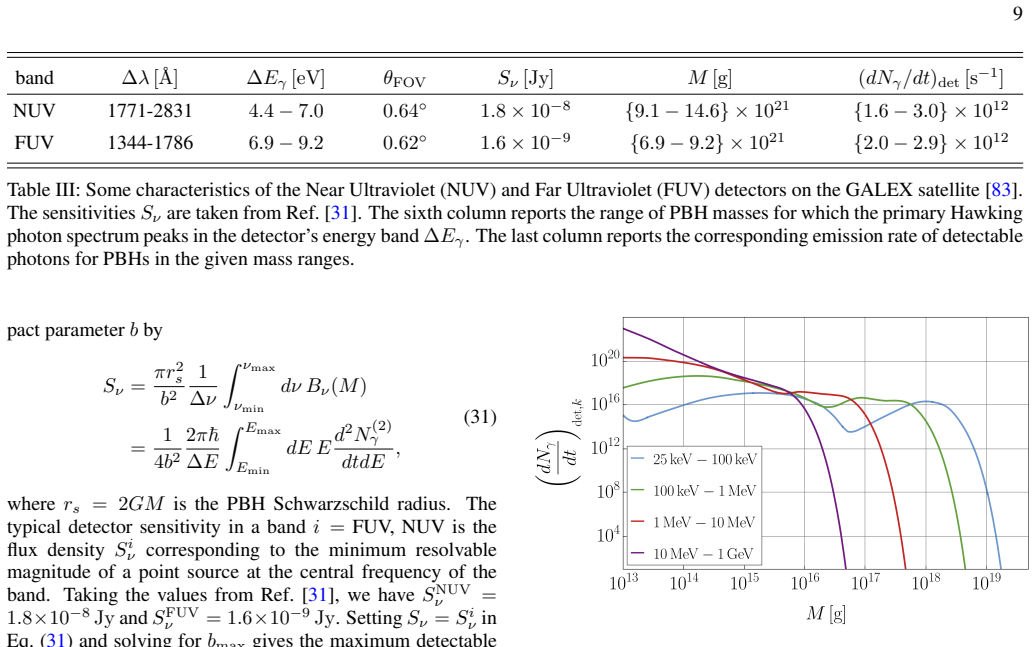
GALEX TheGalaxy Evolution Explorer(GALEX) satellite mis- sion was launched in April 2003, with instruments to observe in the near-UV (NUV ,1771−2831 ˚A ) and far-UV (FUV , 1344−1786 ˚A ) [83]. The FUV detector malfunctioned in 2009 and the mission continued observing in the NUV until
2003
-
[2]
[83] for a summary of All-sky and Medium- depth Imaging Surveys, Ref
See Ref. [83] for a summary of All-sky and Medium- depth Imaging Surveys, Ref. [84] for a detailed discussion of the GALEX Time Domain Survey, and Ref. [85] for a discus- sion of GALEX calibration and detector parameters. Table III includes GALEX parameters referenced in this section for the NUV and FUV instruments. A first estimate of the prospects for d...
-
[3]
According to Ref
AMEGO-X An instrument of interest to detect higher-energy pho- tons from PBH transits is the proposedAll-sky Medium En- ergy Gamma-ray Observatory eXplorer(AMEGO-X) satel- lite. According to Ref. [86], the satellite’s instruments should be able to track photons from transient phenomena within the range10 keV≤E γ ≤1 GeVwith typical sensitivities of∼0.5−11 ...
-
[5]
Using the reported effective areaA eff(E)from Ref
HAWC We repeat the above analysis for the High Altitude Water Cherenkov (HAWC) Observatory, with sensitivity to photons in the range300 GeV≲E γ ≲10 TeV. Using the reported effective areaA eff(E)from Ref. [104], we first compute the weighted emission rate of detectable photons(dN/dt) det via Eq. (49). See Fig. 12 for a plot of(dN/dt) det as a func- tion of...
-
[6]
Fermi-LAT We have shown that LHAASO-WCDA and HAWC are vi- able candidate experiments to detect a rare PBH explosion within the Kuiper Belt or Oort Cloud, if such an explosion oc- curs within their respective fields of view. However, as noted by Refs. [24, 25], the HAWC and LHAASO fields of view do not overlap with each other. We briefly comment on the pos...
-
[7]
Black hole explosions,
S. W. Hawking, “Black hole explosions,” Nature248, 30–31 (1974)
1974
-
[8]
Particle Creation by Black Holes,
S. W. Hawking, “Particle Creation by Black Holes,” Com- mun. Math. Phys.43, 199–220 (1975), [Erratum: Com- mun.Math.Phys. 46, 206 (1976)]
1975
-
[9]
Particle Emission Rates from a Black Hole: Massless Particles from an Uncharged, Nonrotating Hole,
Don N. Page, “Particle Emission Rates from a Black Hole: Massless Particles from an Uncharged, Nonrotating Hole,” Phys. Rev. D13, 198–206 (1976)
1976
-
[10]
Particle Emission Rates from a Black Hole. 2. Massless Particles from a Rotating Hole,
Don N. Page, “Particle Emission Rates from a Black Hole. 2. Massless Particles from a Rotating Hole,” Phys. Rev. D14, 3260–3273 (1976)
1976
-
[11]
Particle Emission Rates from a Black Hole. 3. Charged Leptons from a Nonrotating Hole,
Don N. Page, “Particle Emission Rates from a Black Hole. 3. Charged Leptons from a Nonrotating Hole,” Phys. Rev. D16, 2402–2411 (1977)
1977
-
[12]
Quark- and gluon- jet emission from primordial black holes: The instantaneous spectra,
Jane H. MacGibbon and B. R. Webber, “Quark- and gluon- jet emission from primordial black holes: The instantaneous spectra,” Phys. Rev. D41, 3052–3079 (1990)
1990
-
[13]
Quark- and gluon-jet emission from pri- mordial black holes. II. The emission over the black-hole life- time,
Jane H. MacGibbon, “Quark- and gluon-jet emission from pri- mordial black holes. II. The emission over the black-hole life- time,” Phys. Rev. D44, 376–392 (1991)
1991
-
[14]
Constraints on Primordial Black Holes
Bernard Carr, Kazunori Kohri, Yuuiti Sendouda, and Jun’ichi Yokoyama, “Constraints on primordial black holes,” Rept. Prog. Phys.84, 116902 (2021), arXiv:2002.12778 [astro- ph.CO]
work page internal anchor Pith review Pith/arXiv arXiv 2021
-
[15]
Primordial Black Holes as Dark Matter: Recent Developments
Bernard Carr and Florian Kuhnel, “Primordial Black Holes as Dark Matter: Recent Developments,” Ann. Rev. Nucl. Part. Sci.70, 355–394 (2020), arXiv:2006.02838 [astro-ph.CO]
work page internal anchor Pith review Pith/arXiv arXiv 2020
-
[16]
Primordial Black Holes as a dark matter candidate
Anne M. Green and Bradley J. Kavanagh, “Primordial Black Holes as a dark matter candidate,” J. Phys. G48, 043001 (2021), arXiv:2007.10722 [astro-ph.CO]
work page internal anchor Pith review Pith/arXiv arXiv 2021
-
[17]
Albert Escriv `a, Florian K ¨uhnel, and Yuichiro Tada, “Primor- dial black holes,” inBlack Holes in the Era of Gravitational- Wave Astronomy, edited by Manuel Arca Sedda, Elisa Borto- las, and Mario Spera (2024) pp. 261–377, arXiv:2211.05767 [astro-ph.CO]
-
[19]
Observational evidence for primordial black holes: A positivist perspective,
Bernard Carr, Sebastien Clesse, Juan Garcia-Bellido, Michael Hawkins, and Florian Kuhnel, “Observational evidence for primordial black holes: A positivist perspective,” Phys. Rept. 1054, 1–68 (2024), arXiv:2306.03903 [astro-ph.CO]
-
[20]
Close encounters of the primordial kind: A new observable for primordial black holes as dark matter,
Tung X. Tran, Sarah R. Geller, Benjamin V . Lehmann, and David I. Kaiser, “Close encounters of the primordial kind: A new observable for primordial black holes as dark matter,” Phys. Rev. D110, 063533 (2024), arXiv:2312.17217 [astro- ph]
-
[21]
Michal Cuadrat-Grzybowski, S ´ebastien Clesse, Pascale De- fraigne, Michel Van Camp, and Bruno Bertrand, “Prob- ing primordial black holes and dark matter clumps in the Solar System with gravimeter and Global Navigation Satel- lite Systems networks,” Phys. Rev. D110, 063029 (2024), arXiv:2403.14397 [astro-ph.CO]
-
[22]
Primordial Black Holes in the Solar System,
Valentin Thoss and Andreas Burkert, “Primordial Black Holes in the Solar System,” Astrophys. J.980, 238 (2025), arXiv:2409.04518 [astro-ph.EP]
-
[23]
Gravitational wave signals from primordial black holes orbiting solar-type stars,
Vitorio A. De Lorenci, David I. Kaiser, Patrick Peter, Lucas S. Ruiz, and Noah E. Wolfe, “Gravitational wave signals from primordial black holes orbiting solar-type stars,” Phys. Rev. D 112, 063063 (2025), arXiv:2504.07517 [gr-qc]
-
[24]
Detecting dark objects in the Solar System with gravitational wave observatories,
Valentin Thoss and Abraham Loeb, “Detecting dark objects in the Solar System with gravitational wave observatories,” Phys. Rev. D112, 083050 (2025), arXiv:2507.19577 [gr-qc]
-
[25]
Alexandra P. Klipfel, Peter Fisher, and David I. Kaiser, “Hawking radiation signatures from primordial black holes transiting the inner Solar System: Prospects for detection,” Phys. Rev. D112, 103007 (2025), arXiv:2506.14041 [astro- ph.CO]
-
[26]
Ultrahigh-Energy Neutrinos from Primordial Black Holes,
Alexandra P. Klipfel and David I. Kaiser, “Ultrahigh-Energy Neutrinos from Primordial Black Holes,” Phys. Rev. Lett.135, 121003 (2025), arXiv:2503.19227 [hep-ph]
-
[27]
Could We Observe an Exploding Black Hole in the Near Future?
Michael J. Baker, Joaquim Iguaz Juan, Aidan Symons, and Andrea Thamm, “Could We Observe an Exploding Black Hole in the Near Future?” Phys. Rev. Lett.135, 111002 (2025), arXiv:2503.10755 [hep-ph]
-
[28]
Could the KM3–230213A event be caused by an evaporating primordial black hole?
Andrea Boccia and Fabio Iocco, “Could the KM3–230213A event be caused by an evaporating primordial black hole?” Phys. Rev. D112, 063045 (2025), arXiv:2502.19245 [astro- ph.HE]
-
[29]
Michael J. Baker, Joaquim Iguaz Juan, Aidan Symons, and Andrea Thamm, “Explaining the PeV Neutrino Fluxes at KM3NeT and IceCube with Quasiextremal Primor- dial Black Holes,” Phys. Rev. Lett.136, 061002 (2026), arXiv:2505.22722 [hep-ph]
-
[30]
Could a Primordial Black Hole Explosion Explain the Ex- tremely High-Energy KM3NeT Neutrino Event?
Lua F. T. Airoldi, Gustavo F. S. Alves, Yuber F. Perez- Gonzalez, Gabriel M. Salla, and Renata Zukanovich Funchal, “Could a Primordial Black Hole Explosion Explain the Ex- tremely High-Energy KM3NeT Neutrino Event?” Phys. Rev. Lett.136, 041002 (2026), arXiv:2505.24666 [hep-ph]
-
[31]
Tackling transient sources with neutrino telescopes,
Lua F. T. Airoldi, Gustavo F. S. Alves, Yuber F. Perez- Gonzalez, Gabriel M. Salla, and Renata Zukanovich Funchal, “Tackling transient sources with neutrino telescopes,” Phys. Rev. D113, 023052 (2026), arXiv:2505.24652 [astro-ph.HE]
-
[32]
Exploring memory-burdened primordial black holes with ultra-high-energy cosmic-rays,
Antonio Ambrosone, Marco Chianese, and Carmelo Evoli, “Exploring memory-burdened primordial black holes with ultra-high-energy cosmic-rays,” (2026), arXiv:2603.15827 [astro-ph.HE]
-
[33]
High-energy neutrino constraints on primordial black holes as dark matter
Mainak Mukhopadhyay and Joaquim Iguaz Juan, “High- energy neutrino constraints on primordial black holes as dark matter,” (2026), arXiv:2604.09762 [astro-ph.HE]
work page internal anchor Pith review Pith/arXiv arXiv 2026
-
[34]
Probing the parti- cle spectrum of nature with evaporating black holes,
Michael J. Baker and Andrea Thamm, “Probing the parti- cle spectrum of nature with evaporating black holes,” SciPost Phys.12, 150 (2022), arXiv:2105.10506 [hep-ph]
-
[35]
Black hole evapora- tion beyond the Standard Model of particle physics,
Michael J. Baker and Andrea Thamm, “Black hole evapora- tion beyond the Standard Model of particle physics,” JHEP 01, 063 (2023), arXiv:2210.02805 [hep-ph]
-
[36]
Observation of an ultra-high- energy cosmic neutrino with KM3NeT,
S. Aielloet al.(KM3NeT), “Observation of an ultra-high- energy cosmic neutrino with KM3NeT,” Nature638, 376–382 (2025), [Erratum: Nature 640, E3 (2025)]. 21
2025
-
[37]
Direct detection of Black Holes via electromagnetic radiation
J. L. G. Sobrinho and P. Augusto, “Direct detection of Black Holes via electromagnetic radiation,” Mon. Not. Roy. Astron. Soc.441, 2878–2884 (2014), arXiv:1406.1785 [astro-ph.CO]
work page internal anchor Pith review Pith/arXiv arXiv 2014
-
[38]
Detecting Planet 9 via Hawking radiation,
Alexandre Arbey and J ´er´emy Auffinger, “Detecting Planet 9 via Hawking radiation,” (2020), arXiv:2006.02944 [gr-qc]
-
[39]
Limits on primordial black holes de- tectability with Isatis: a BlackHawk tool,
J ´er´emy Auffinger, “Limits on primordial black holes de- tectability with Isatis: a BlackHawk tool,” Eur. Phys. J. C82, 384 (2022), arXiv:2201.01265 [astro-ph.HE]
-
[40]
Primordial black hole constraints with Hawking radiation—A review,
J ´er´emy Auffinger, “Primordial black hole constraints with Hawking radiation—A review,” Prog. Part. Nucl. Phys.131, 104040 (2023), arXiv:2206.02672 [astro-ph.CO]
-
[41]
Probing Dark Sectors with Exploding Black Holes: Gamma Rays,
Michael J. Baker, Joaquim Iguaz Juan, Aidan Symons, and Andrea Thamm, “Probing Dark Sectors with Exploding Black Holes: Gamma Rays,” (2025), arXiv:2512.19603 [hep-ph]
-
[42]
Refining Galactic primordial black hole evaporation constraints,
Pedro De la Torre Luque, Jordan Koechler, and Shyam Balaji, “Refining Galactic primordial black hole evaporation constraints,” Phys. Rev. D110, 123022 (2024), [Erratum: Phys.Rev.D 112, 109904 (2025)], arXiv:2406.11949 [astro- ph.HE]
-
[43]
Dark matter in X-rays: revised XMM- Newton limits and new constraints from eROSITA,
Shyam Balaji, Damon Cleaver, Pedro De la Torre Luque, and Miltiadis Michailidis, “Dark matter in X-rays: revised XMM- Newton limits and new constraints from eROSITA,” JCAP11, 053 (2025), arXiv:2506.02310 [hep-ph]
-
[44]
Alexandre Arbey and J ´er´emy Auffinger, “BlackHawk: A pub- lic code for calculating the Hawking evaporation spectra of any black hole distribution,” Eur. Phys. J. C79, 693 (2019), arXiv:1905.04268 [gr-qc]
-
[45]
Physics Beyond the Standard Model with BlackHawk v2.0,
Alexandre Arbey and J ´er´emy Auffinger, “Physics Beyond the Standard Model with BlackHawk v2.0,” Eur. Phys. J. C81, 910 (2021), arXiv:2108.02737 [gr-qc]
-
[46]
Gravitational ion- ization by Schwarzschild primordial black holes,
Alexandra P. Klipfel and David I. Kaiser, “Gravitational ion- ization by Schwarzschild primordial black holes,” Phys. Rev. D113, 063031 (2026), arXiv:2601.05935 [hep-ph]
-
[47]
A new search for primordial black hole evaporations using the Whipple gamma-ray telescope,
E. T. Lintonet al., “A new search for primordial black hole evaporations using the Whipple gamma-ray telescope,” JCAP 01, 013 (2006)
2006
-
[48]
New limit on the rate density of evaporating black holes,
D. E. Alexandreaset al., “New limit on the rate density of evaporating black holes,” Phys. Rev. Lett.71, 2524–2527 (1993)
1993
-
[49]
Limits on Primordial Black Hole evapora- tion with the H.E.S.S. array of Cherenkov telescopes,
J-F. Glicenstein, A. Barnacka, M. Vivier, and T. Herr (H.E.S.S.), “Limits on Primordial Black Hole evapora- tion with the H.E.S.S. array of Cherenkov telescopes,” in 33rd International Cosmic Ray Conference(2013) p. 0930, arXiv:1307.4898 [astro-ph.HE]
-
[50]
Search for Primordial Black Hole Evaporation with VERITAS,
Simon Archambault (VERITAS), “Search for Primordial Black Hole Evaporation with VERITAS,” PoSICRC2017, 691 (2018), arXiv:1709.00307 [astro-ph.HE]
-
[52]
Milagro Limits and HAWC Sensitivity for the Rate-Density of Evaporating Primordial Black Holes
A. A. Abdoet al., “Milagro Limits and HAWC Sensitivity for the Rate-Density of Evaporating Primordial Black Holes,” Astropart. Phys.64, 4–12 (2015), arXiv:1407.1686 [astro- ph.HE]
work page internal anchor Pith review Pith/arXiv arXiv 2015
-
[53]
A. Albertet al.(HAWC), “Constraining the Local Burst Rate Density of Primordial Black Holes with HAWC,” JCAP04, 026 (2020), arXiv:1911.04356 [astro-ph.HE]
-
[54]
Search for the evaporation of primordial black holes with H.E.S.S
F. Aharonianet al.(H.E.S.S.), “Search for the evaporation of primordial black holes with H.E.S.S.” JCAP04, 040 (2023), arXiv:2303.12855 [astro-ph.HE]
-
[55]
All-Sky Search for Individual Primordial Black Hole Bursts with LHAASO,
Zhen Caoet al.(LHAASO), “All-Sky Search for Individual Primordial Black Hole Bursts with LHAASO,” Phys. Rev. Lett.135, 181005 (2025), arXiv:2505.24586 [astro-ph.HE]
-
[56]
A Microscopic Model of Holography: Survival by the Burden of Memory
Gia Dvali, “A Microscopic Model of Holography: Survival by the Burden of Memory,” (2018), arXiv:1810.02336 [hep-th]
work page internal anchor Pith review Pith/arXiv arXiv 2018
-
[57]
Black hole metamorphosis and stabilization by memory burden,
Gia Dvali, Lukas Eisemann, Marco Michel, and Sebastian Zell, “Black hole metamorphosis and stabilization by memory burden,” Phys. Rev. D102, 103523 (2020), arXiv:2006.00011 [hep-th]
-
[58]
Ultralight black holes as sources of high-energy particles,
Michael Zantedeschi and Luca Visinelli, “Ultralight black holes as sources of high-energy particles,” Phys. Dark Univ. 49, 102034 (2025), arXiv:2410.07037 [astro-ph.HE]
-
[59]
Tran- sitioning to Memory Burden: Detectable Small Primordial Black Holes as Dark Matter,
Gia Dvali, Michael Zantedeschi, and Sebastian Zell, “Tran- sitioning to Memory Burden: Detectable Small Primordial Black Holes as Dark Matter,” (2025), arXiv:2503.21740 [hep- ph]
-
[60]
Gabriele Montefalcone, Dan Hooper, Katherine Freese, Chris Kelso, Florian Kuhnel, and Pearl Sandick, “Can a breakdown of Hawking evaporation open a new mass window for primor- dial black holes as dark matter?” Phys. Rev. D113, 023524 (2026), arXiv:2503.21005 [astro-ph.CO]
-
[61]
Massive Primordial Black Holes as Dark Matter and their detection with Gravitational Waves
Juan Garc ´ıa-Bellido, “Massive Primordial Black Holes as Dark Matter and their detection with Gravitational Waves,” J. Phys. Conf. Ser.840, 012032 (2017), arXiv:1702.08275 [astro-ph.CO]
work page internal anchor Pith review Pith/arXiv arXiv 2017
-
[62]
Primordial Black Holes with QCD Color Charge,
Elba Alonso-Monsalve and David I. Kaiser, “Primordial Black Holes with QCD Color Charge,” Phys. Rev. Lett.132, 231402 (2024), arXiv:2310.16877 [hep-ph]
-
[63]
Immortality through the dark forces: Dark-charge pri- mordial black holes as dark matter candidates,
Jessica Santiago, Justin Feng, Sebastian Schuster, and Matt Visser, “Immortality through the dark forces: Dark-charge pri- mordial black holes as dark matter candidates,” Phys. Rev. D 112, 123529 (2025), arXiv:2503.20696 [gr-qc]
-
[64]
Charge and Particle Conservation in Black-Hole Decay,
B. Carter, “Charge and Particle Conservation in Black-Hole Decay,” Phys. Rev. Lett.33, 558–561 (1974)
1974
-
[65]
Vacuum polarization and the spontaneous loss of charge by black holes,
G. W. Gibbons, “Vacuum polarization and the spontaneous loss of charge by black holes,” Commun.Math. Phys.44, 245– 264 (1975)
1975
-
[66]
Spin Distribution of Primordial Black Holes
Takeshi Chiba and Shuichiro Yokoyama, “Spin Distribution of Primordial Black Holes,” PTEP2017, 083E01 (2017), arXiv:1704.06573 [gr-qc]
work page internal anchor Pith review Pith/arXiv arXiv 2017
-
[67]
The evolu- tion of primordial black holes and their final observable spins,
V . De Luca, G. Franciolini, P. Pani, and A. Riotto, “The evolu- tion of primordial black holes and their final observable spins,” JCAP04, 052 (2020), arXiv:2003.02778 [astro-ph.CO]
-
[68]
Black hole induced spins from hyperbolic encounters in dense clusters,
Santiago Jaraba and Juan Garcia-Bellido, “Black hole induced spins from hyperbolic encounters in dense clusters,” Phys. Dark Univ.34, 100882 (2021), arXiv:2106.01436 [gr-qc]
-
[69]
Extreme-Value Statistics of the Spin of Primordial Black Holes,
Siri Chongchitnan and Joseph Silk, “Extreme-Value Statistics of the Spin of Primordial Black Holes,” Phys. Rev. D104, 083018 (2021), arXiv:2109.12268 [astro-ph]
-
[70]
Particle emission rates from a black hole: Massless particles from an uncharged, nonrotating hole,
Don N. Page, “Particle emission rates from a black hole: Massless particles from an uncharged, nonrotating hole,” Phys. Rev. D13, 198–206 (1976)
1976
-
[71]
Greybody factors for Schwarzschild black holes: Path-ordered exponentials and product integrals
Finnian Gray and Matt Visser, “Greybody Factors for Schwarzschild Black Holes: Path-Ordered Exponentials and Product Integrals,” Universe4, 93 (2018), arXiv:1512.05018 [gr-qc]
work page internal anchor Pith review Pith/arXiv arXiv 2018
-
[72]
Torbj ¨orn Sj ¨ostrand, Stefan Ask, Jesper R. Christiansen, Richard Corke, Nishita Desai, Philip Ilten, Stephen Mrenna, Stefan Prestel, Christine O. Rasmussen, and Peter Z. Skands, “An Introduction to PYTHIA 8.2,” Comput. Phys. Commun. 191, 159–177 (2015), arXiv:1410.3012 [hep-ph]
work page internal anchor Pith review Pith/arXiv arXiv 2015
-
[73]
Dark Matter Spectra from the Electroweak to the Planck Scale,
Christian W. Bauer, Nicholas L. Rodd, and Bryan R. Webber, “Dark Matter Spectra from the Electroweak to the Planck Scale,” J. High Energ. Phys.2021, 121 (2021), arXiv:2007.15001 [hep-ph]
-
[74]
New cosmological constraints on primordial black holes
B. J. Carr, Kazunori Kohri, Yuuiti Sendouda, and Jun’ichi Yokoyama, “New cosmological constraints on pri- 22 mordial black holes,” Phys. Rev. D81, 104019 (2010), arXiv:0912.5297 [astro-ph]
work page internal anchor Pith review Pith/arXiv arXiv 2010
-
[75]
Constraints on primordial black holes from Galactic gamma-ray background
B. J. Carr, Kazunori Kohri, Yuuiti Sendouda, and Jun’ichi Yokoyama, “Constraints on primordial black holes from Galactic gamma-ray background,” Phys. Rev. D94, 044029 (2016), arXiv:1604.05349 [astro-ph]
work page internal anchor Pith review Pith/arXiv arXiv 2016
-
[76]
INTE- GRAL constraints on primordial black holes and particle dark matter,
Ranjan Laha, Julian B. Mu ˜noz, and Tracy R. Slatyer, “INTE- GRAL constraints on primordial black holes and particle dark matter,” Phys. Rev. D101, 123514 (2020), arXiv:2004.00627 [astro-ph]
- [77]
-
[78]
Constraining Pri- mordial Black Hole Abundance with the Galactic 511 keV Line,
William DeRocco and Peter W. Graham, “Constraining Pri- mordial Black Hole Abundance with the Galactic 511 keV Line,” Phys. Rev. Lett.123, 251102 (2019), arXiv:1906.07740 [astro-ph.CO]
-
[79]
Ranjan Laha, “Primordial black holes as a dark matter can- didate are severely constrained by the Galactic Center 511 keV gamma-ray line,” Phys. Rev. Lett.123, 251101 (2019), arXiv:1906.09994 [astro-ph]
-
[80]
Search for Gamma-Ray Emission from Local Primordial Black Holes with the Fermi Large Area Telescope
M. Ackermannet al.(Fermi-LAT), “Search for Gamma- Ray Emission from Local Primordial Black Holes with the Fermi Large Area Telescope,” Astrophys. J.857, 49 (2018), arXiv:1802.00100 [astro-ph.HE]
work page internal anchor Pith review Pith/arXiv arXiv 2018
-
[81]
How open is the asteroid-mass primordial black hole window?
Matthew Gorton and Anne M. Green, “How open is the asteroid-mass primordial black hole window?” SciPost Phys. 17, 032 (2024), arXiv:2403.03839 [astro-ph.CO]
-
[82]
Effects of Hawking evaporation on PBH distributions,
Markus R. Mosbech and Zachary S. C. Picker, “Effects of Hawking evaporation on PBH distributions,” SciPost Phys.13, 100 (2022), arXiv:2203.05743 [astro-ph.HE]
-
[83]
Cosmological evolution of primordial black holes,
Jared R. Rice and Bing Zhang, “Cosmological evolution of primordial black holes,” JHEAp13-14, 22–31 (2017), arXiv:1702.08069 [astro-ph.HE]
discussion (0)
Sign in with ORCID, Apple, or X to comment. Anyone can read and Pith papers without signing in.