REVIEW 5 major objections 6 minor 1 cited by
Distributed AI Agents for Cognitive Underwater Robot Autonomy
T0 review · 5 major / 6 minor · reviewed 2026-08-06 · deepseek-v4-flash
Pith's one-line read UROSA claims that a distributed crew of LLM agents can replace an underwater robot's hand-coded control program, letting it plan, learn, and write its own fixes mid-mission.
desk verdict A genuinely new distributed-LLM architecture for underwater robots, but the central empirical claims are contradicted by the paper's own tables and the evaluation is largely self-referential. read the letter →
The pith
A machine-rendered reading of the paper's core claim, the machinery that carries it, and where it could break.
The reading
What carries the argument
The load-bearing object is the Agentic ROS 2 Node, a composite that fuses an LLM reasoner with a Safety Parser and standard ROS 2 publishers and subscribers. Around it sits the distributed cognitive core: a Commander agent that decomposes missions with chain-of-thought reasoning and self-refinement, specialist agents for perception, planning, code synthesis, and diagnostics, and a shared vector database used as long-term memory. The Teacher-Student instructional loop is a second mechanism: a Teacher agent rewrites the Student's SYSTEM prompt each episode, turning the prompt itself into the policy being optimised. The third mechanism is the Autonomous Code Synthesis agent, which writes a ROS 2 node and its unit tests from a natural-language request and deploys the node into the live graph if the tests pass.
What would settle it
Run the on-the-fly node-generation workflow with a requirement crafted so that the generated code passes its self-written unit tests but violates a physical safety invariant not covered by those tests, such as ignoring a maximum-thruster limit during a specific sensor dropout; observing the node deployed and executed in the live system would directly count against the runtime-safety claim.
Extended reading notes
Core claim
UROSA's central claim is that cognitive autonomy emerges from a team of agentic nodes: each Agentic ROS 2 Node combines an LLM-based reasoner, a safety parser, and standard ROS 2 communication. The Commander agent decomposes high-level goals into sub-tasks and directs specialist agents (perception, motion planning, code synthesis, diagnostics, digital twin curation), while all agents share a vector database that grounds decisions in past experience via retrieval-augmented generation. Behaviour is shaped not by retraining but by rewriting the SYSTEM prompt, which acts as a 'behavioural constitution' carrying the vehicle's physical models and reasoning rules. The paper further claims that on-the-fly code generation with self-written unit tests lets the system extend itself at runtime, and that a three-layer safety stack (prompt scaffolding, RAG grounding, output validation) can keep these capabilities aligned with operator intent.
Load-bearing premise
The entire runtime self-extension and safety story depends on the assumption that code generated by an LLM is safe to run on the live robot once the same LLM's own unit tests pass, so the code and its check share the same blind spots.
Editorial extensions
If this is right
- Operators would specify missions in natural language instead of writing or recompiling code, shifting robot development from imperative programming to declarative goal setting.
- A vehicle equipped with UROSA could self-repair a failed navigation sensor by generating and deploying a compensating filter at runtime, as demonstrated with the compass/DVL Kalman filter that reduced drift by an estimated 70%.
- Fault diagnosis would no longer require a pre-enumerated failure catalogue; the diagnostic agent infers failures by comparing live telemetry with an expected physical model.
- Multi-robot coordination could be settled by emergent agent-to-agent negotiation rather than pre-planned deconfliction, with all 40 tested conflict runs keeping positive separation.
- The same architecture is designed to be model-agnostic, so advances in LLM and VLM capabilities can be dropped into the framework without redesigning the cognitive layer.
Reading between the lines
- If the approach transfers beyond marine robots, the circularity of LLM-generated code validated by LLM-written tests becomes the main obstacle: a second, independent check (a verifier, a simulation with injected faults, or a human reviewer) would likely be required before such systems act in safety-critical settings.
- The paper's design implies a future in which the diagnostics agent does not just report failures but closes the loop by rewriting the control allocation matrix; the authors name this self-reconfiguration as future work, and it would be the natural stress test of the architecture's runtime-adaptation claim.
- The safety parser as described checks syntax and predefined operational limits, so it would not catch a semantically plausible command that is dangerous outside the enumerated rules; testing the layered stack against adversarial language inputs would show how much of the safety claim is architectural versus prompt-based.
- Because the experimentally demonstrated planning success depends on LLM vision and language interpretation, with success rates of 40–80% on perception-in-the-loop tasks, scaling UROSA to cluttered open-water operations would likely require fallback behaviour or confidence thresholds.
Editorial analysis
A structured set of objections, weighed in public.
Referee Report
Summary. The manuscript proposes UROSA, an architecture in which distributed LLM/VLM agents replace the monolithic control program of an underwater robot. The core components are a Commander agent, specialist agents for perception, planning, code synthesis, and diagnostics, a shared vector database for retrieval-augmented generation, a Teacher-Student prompt-tuning loop, and runtime ROS 2 node generation. Validation consists of simulations and tank experiments covering obstacle avoidance, map-based planning, UVMS command interpretation, visual disturbance recovery, online behavioral tuning, autonomous code generation, diagnostic fault detection, and multi-agent negotiation. The paper's stated central claim is that UROSA provides significant advantages over traditional rule-based architectures in handling unforeseen scenarios, uncertainty, and novel missions.
Significance. The paper addresses an important and timely problem, moving beyond pre-programmed autonomy toward LLM-based cognitive control in safety-critical marine robotics, and the architecture is broad in scope. If the claimed capabilities were established with rigorous evidence, the work would be of interest to the robotics and AI-agent communities. However, the empirical validation as reported does not establish the central claim: the only head-to-head comparisons show UROSA underperforming the baseline on all quantitative axes, and several headline results are either prompt-encoded procedures or evaluated by the same agent that produces the output. The paper does not release code, exact SYSTEM prompts, or the test harness, which limits reproducibility. Its strength is a well-motivated integration blueprint; its weakness is the gap between the claims and the reported evidence.
major comments (5)
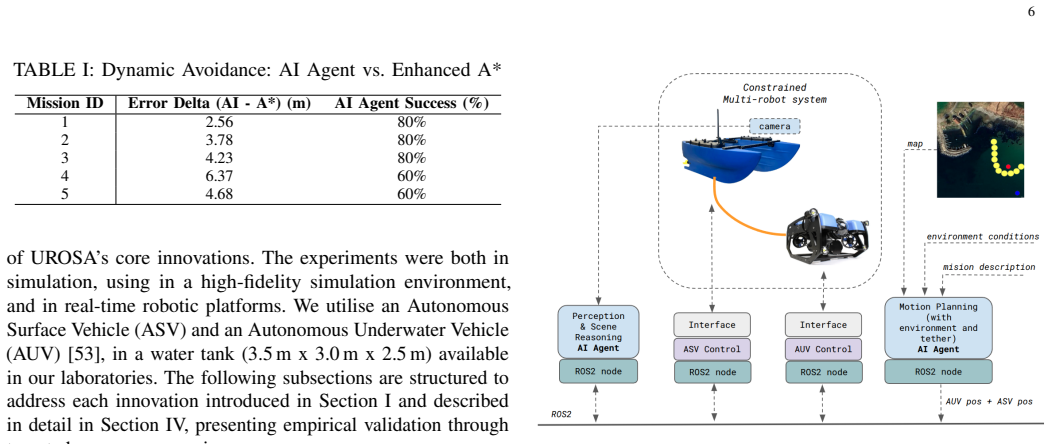
- [Section V-A, Tables I and II] In every mission and map configuration, the AI agent's positioning error exceeds the A* baseline (error deltas of 2.56-6.37 m and 2.98-8.13 m) and its success rate is at most 80%, with many values at 40-60%; no baseline success rate is reported. The text's explanation that the AI uses a live perception feed while A* receives ground truth is a confound, not an advantage. To support the abstract claim of significant advantages in unforeseen scenarios and environmental uncertainty, the comparison needs a condition in which the rule-based planner degrades or fails, e.g., missing ground truth, a moved obstacle, or a change after mission start. No such condition appears. In addition, success is not explicitly defined, and no error bars or trial-level statistics are given, so the comparison cannot be interpreted as evidence of superior adaptability.
- [Section V-A.3, Table III] The manipulator experiment compares a 1.3 s AI planning time with a 0.05 s A*+PRM time and reports Interpretation Success of 90% for the AI only; Planning Success is 100% for both. This does not demonstrate an advantage over the traditional planner on planning; it demonstrates that the AI can interpret varied natural-language wording, a capability that the baseline is not designed to provide and is marked N/A. The claim of superiority in novel mission objectives would require, for example, measuring whether the traditional planner can be re-targeted without reprogramming, or comparing task-level completion under out-of-distribution instructions. As reported, the evidence shows a slower planner with a separate, unbenchmarked interpretation capability.
- [Section IV-D, V-C, Table VII] The diagnostic agent's 100% accuracy is expected from the prompt: the SYSTEM prompt specifies a 10-message sliding window, the thruster allocation matrix, expected-PWM comparison, and a fixed fault taxonomy (dead/out-of-range, drift, asymmetry). This is effectively a static decision tree expressed in natural language, not a demonstration of dynamic, predictive diagnostics without a predefined fault list. To support the claim, the authors need to run the agent on fault modes not enumerated in the prompt, on corrupted or partially missing data, and compare against a standard threshold-based diagnostic baseline. Without this, the result is circular with respect to the 'no static fault tree' claim.
- [Section V-B.2, Table V] The relevance metric behind Table V is not defined. If 'Avg. Info. Relevance' is scored by the same Teacher agent that writes the corrective SYSTEM prompts, the improvement is circular and does not establish that the Student's behavior is actually more useful to a human operator. The paper should define the metric, specify who or what assigns it, and report the judgments of an independent annotator or a task-level measure such as detection accuracy of the target objects. Without this, the claim of rapid convergence on desired behavior is not independently verified.
- [Section IV-C, V-B.3, Table VI] The runtime code-generation workflow gates deployment on unit tests written by the same model that generated the code. Because the code and tests share the same failure modes, passing those tests does not provide sufficient evidence of correctness or safety for a live ROS 2 graph. The 70% drift reduction for the emergency Kalman node is stated as an estimate, with no comparison to a baseline or error analysis, and the success rates in Table VI (70-80%) mean that one to three of every ten trials fail. For a safety-critical claim about runtime self-repair, the paper needs an independent verification step, a clear definition of functionally incorrect, an analysis of failure consequences, and a quantitative test of the Safety Parser described in Section IV-E. As written, the experiment does not support the claim that the framework is safe to deploy in this mode.
minor comments (6)
- [Section V-B.3] The sentence 'Most significantly, in the navigation failure scenario...' is duplicated verbatim; delete one copy.
- [References] Several references are malformed, e.g., [5] 'B. e. a. Brown, T.' and [10] contains an acronym in the author position; the reference list needs a full editorial pass.
- [Section V-A.2] The sentence ending 'reaching success rates of up to 80% on.' has a trailing 'on'; complete or remove it.
- [Section V-D, Fig. 9] The figure caption contains the typo 'Iustration'; also, the collision avoidance behavior is implemented by explicitly embedding a negotiation protocol and vehicle dimensions in the SYSTEM prompt, so calling the resulting deconfliction 'emergent' overstates the result.
- [Tables I, II, IV, V, VIII] Averages are reported without standard deviations or per-cell trial counts, and some trial counts are only given in the surrounding text; adding error bars or confidence intervals would materially improve interpretability.
- [Reproducibility] The paper would be more reproducible if the exact SYSTEM prompts, Modelfiles, and examples of generated unit tests were included or released; the website and video are useful but are not a substitute for a code artifact.
Circularity Check
Diagnostic and Teacher-Student validations reduce to prompt-embedded procedures; headline advantage claim is contradicted by the paper's own tables.
-
self definitional
[Section IV-D and V-C, Table VII]
"The prompt instructs the agent to: ... (2) Utilise an embedded domain-specific physical model—the vehicle’s thruster allocation matrix—to determine the expected thruster behaviour for any commanded movement. (3) Compare the expected PWM values against the observed data for each thruster in the time window, using defined logic to classify distinct fault types (e.g., dead or out-of-range). ... This entire diagnostic procedure, governed by the initial prompt, allows the agent ... to diagnose issues without relying on a predefined list of faults."
The claimed capability is defined as a prompt-embedded decision procedure that already names the fault classes and specifies the comparison logic. The test disables thrusters, ArduPilot reflects the lack of response in the JSON status, and the agent executes exactly the instructed commanded-vs-observed PWM comparison. The 100% accuracy in Table VII is therefore the rule set running as written, not evidence of detecting 'complex, emergent failures' beyond a static fault tree. The 'without a predefined list of faults' claim is circular: the static tree has been moved verbatim into the SYSTEM prompt.
-
self definitional
[Section IV-B and V-B.2, Table V]
"The Teacher’s objective was to guide the Student’s policy from providing verbose descriptions of the whole scene to reporting only the presence and location of a specific target. ... At each episode in a trial, the Student generated a description, and the Teacher provided corrective feedback by generating a new SYSTEM prompt to re-tune the Student’s behaviour for the next episode. ... Table V shows the averaged performance across all 20 trials."
The reported convergence metric, Avg. Info. Relevance (%), is not anchored to any external ground-truth label. The Teacher both decides what information is relevant and writes the new SYSTEM prompt that reshapes the Student's output. Reaching 100% relevance after episode 6 therefore measures the Student's compliance with the Teacher's own instruction loop; the target and the metric are generated by the same agent that performs the optimization. The result is forced by construction and provides no independent evidence of improved information quality.
full rationale
Two of the four headline innovations are validated by metrics defined by the same prompt machinery under test. The Predictive Diagnostics result (Table VII) is the execution of a decision procedure embedded in the SYSTEM prompt that already enumerates fault types and directs commanded-vs-observed PWM comparison, so the 'no static fault tree' claim is a relocation, not a removal, of the rules. The Teacher-Student experiment (Table V) reports convergence to 100% relevance as judged by the Teacher that generates each new prompt, making the improvement self-referential. The on-the-fly code-generation flow additionally gates success on unit tests written by the same LLM that writes the code, though the single external 70% drift-reduction measurement gives that mechanism some independent content. The broad claim of 'significant advantages over traditional rule-based architectures' is not itself circular, but the paper's Tables I-III show the AI agent never beats the A* baseline on any reported quantitative head-to-head metric; that is a correctness/evidence problem, not a circularity one. No load-bearing self-citation chain or imported uniqueness theorem appears; the authors' own A* references [54,55] serve only as baseline implementations. Score 6 reflects that central empirical validations for two key mechanisms reduce by construction, while the architecture itself has substantial independent content.
Assumptions & free parameters
free parameters (2)
- Collision safety distance threshold =
not reported
- Diagnostic sliding window length =
10 status messages
assumptions (5)
- domain assumption LLM and VLM outputs can be constrained to be safe and correct by SYSTEM prompt scaffolding and a syntactic Safety Parser.
- ad hoc to paper Unit tests written by the same LLM that generated the code are a sufficient correctness and safety gate for runtime deployment.
- domain assumption Retrieval-augmented generation from the vector database prevents hallucination and grounds decisions in verified knowledge.
- ad hoc to paper Modifying the Student agent's SYSTEM prompt reliably re-tunes its policy in the desired direction across episodes.
- domain assumption The digital twin has sufficient fidelity for predictive planning and for validating newly generated code.
Cite this review
Pith. "Pith review of Distributed AI Agents for Cognitive Underwater Robot Autonomy." pith.science (2026). https://pith.science/paper/BBKEFAYC
@misc{pith2026250723735,
  author       = {Pith},
  title        = {Pith review of: Distributed AI Agents for Cognitive Underwater Robot Autonomy},
  year         = {2026},
  howpublished = {\url{https://pith.science/paper/BBKEFAYC}},
  note         = {Machine review of arXiv:2507.23735}
}
read the original abstract
Achieving robust cognitive autonomy in robots navigating complex, unpredictable environments remains a fundamental challenge in robotics. This paper presents Underwater Robot Self-Organizing Autonomy (UROSA), a groundbreaking architecture leveraging distributed Large Language Model AI agents integrated within the Robot Operating System 2 (ROS 2) framework to enable advanced cognitive capabilities in Autonomous Underwater Vehicles. UROSA decentralises cognition into specialised AI agents responsible for multimodal perception, adaptive reasoning, dynamic mission planning, and real-time decision-making. Central innovations include flexible agents dynamically adapting their roles, retrieval-augmented generation utilising vector databases for efficient knowledge management, reinforcement learning-driven behavioural optimisation, and autonomous on-the-fly ROS 2 node generation for runtime functional extensibility. Extensive empirical validation demonstrates UROSA's promising adaptability and reliability through realistic underwater missions in simulation and real-world deployments, showing significant advantages over traditional rule-based architectures in handling unforeseen scenarios, environmental uncertainties, and novel mission objectives. This work not only advances underwater autonomy but also establishes a scalable, safe, and versatile cognitive robotics framework capable of generalising to a diverse array of real-world applications.
Figures


Figures from the paper (5 more)


Forward citations
Cited by 1 Pith paper
-
USIM and U0: A Vision-Language-Action Dataset and Model for General Underwater Robots
Introduces USIM simulation dataset and U0 VLA model with CAP module for general underwater robot tasks, reporting 0.0359 offline error and 43.1% online success rate.
Reference graph
Works this paper leans on
-
[1]
S. J. Russell and P. Norvig, Artificial intelligence: A modern approach . Pearson Education, 2020
work page 2020
-
[2]
N. J. Nilsson, “Shakey the robot,” SRI International Menlo Park CA Artificial Intelligence Center, Tech. Rep., 1984
work page 1984
-
[3]
Intelligence without representation,
R. A. Brooks, “Intelligence without representation,” Artificial Intelligence, vol. 47, no. 1-3, pp. 139–159, 1991
1991
-
[4]
R. C. Arkin, Behavior-based robotics. MIT Press, 1998
work page 1998
-
[5]
Language models are few-shot learners,
B. e. a. Brown, T. “Language models are few-shot learners,” in Advances in Neural Information Processing Systems , vol. 33, 2020, pp. 1877–1901
work page 2020
-
[6]
A. Vaswani, N. Shazeer, N. Parmar, J. Uszkoreit, L. Jones, N. Gomez, A. L. Kaiser, and I. Polosukhin, “Attention is all you need,” in Advances in Neural Information Processing Systems , 2017, pp. 5998–6008
work page 2017
-
[7]
J. E. Laird, The Soar cognitive architecture . MIT Press, 2012
work page 2012
-
[8]
An integrated theory of the mind,
J. R. Anderson, E. H. Bothell, M. D. Byrne, S. Douglass, C. Lebiere, and Y . Qin, “An integrated theory of the mind,” Psychological Review, vol. 111, no. 4, p. 1036, 2004
work page 2004
Show all 60 references
-
[9]
Survey of hallucination in natural language generation,
Z. Ji, N. Lee, R. Frieske, T. Yu, D. Su, Y . Xu, E. Ishii, Y . J. Bang, A. Madotto, and P. Fung, “Survey of hallucination in natural language generation,” ACM Comput. Surv., vol. 55, no. 12, Mar. 2023. [Online]. Available: https://doi.org/10.1145/3571730
2023 doi
-
[10]
A survey on hallucination in large language models: Principles, taxonomy, challenges, and open questions,
L. Huang, W. Yu, W. Ma, W. Zhong, Z. Feng, H. Wang, Q. Chen, W. Peng, X. Feng, B. Qin, and T. Liu, “A survey on hallucination in large language models: Principles, taxonomy, challenges, and open questions,” ACM Trans. Inf. Syst. , vol. 43, no. 2, Jan. 2025. [Online]. Available...
2025 doi
-
[11]
Large language model alignment: A survey,
T. Shen, R. Jin, Y . Huang, C. Liu, W. Dong, Z. Guo, X. Wu, Y . Liu, and D. Xiong, “Large language model alignment: A survey,” arXiv preprint arXiv:2309.15025, 2023
2023 arXiv
-
[12]
Enabling novel mission operations and interactions with rosa: The robot operating system agent,
R. Royce, M. Kaufmann, J. Becktor, S. Moon, K. Carpenter, K. Pak, A. Towler, R. Thakker, and S. Khattak, “Enabling novel mission operations and interactions with rosa: The robot operating system agent,” NASA/JPL-Caltech Technical Report, 2025
2025
-
[13]
Agent ai: Surveying the horizons of multimodal interaction,
Z. e. a. Durante, “Agent ai: Surveying the horizons of multimodal interaction,” arXiv preprint arXiv:2401.03568 , 2024
2024 arXiv
-
[14]
Programs with common sense,
J. McCarthy, “Programs with common sense,” in Mechanisation of Thought Processes, vol. 1, 1959, pp. 77–84
1959
-
[15]
Strips: A new approach to theorem proving applied to problem solving,
R. E. Fikes and N. J. Nilsson, “Strips: A new approach to theorem proving applied to problem solving,” Artificial Intelligence, vol. 2, no. 3-4, pp. 189–208, 1971
1971
-
[16]
Some philosophical problems from the standpoint of artificial intelligence,
J. McCarthy and P. J. Hayes, “Some philosophical problems from the standpoint of artificial intelligence,” Machine Intelligence , vol. 4, pp. 463–502, 1969
1969
-
[17]
Pengi: An implementation of a theory of activity,
P. E. Agre and D. Chapman, “Pengi: An implementation of a theory of activity,” in AAAI, 1987, pp. 268–272
1987
-
[18]
A robust layered control system for a mobile robot,
R. A. Brooks, “A robust layered control system for a mobile robot,” IEEE Journal of Robotics and Automation , vol. 2, no. 1, pp. 14–23, 1986
1986
-
[19]
Pfeifer and C
R. Pfeifer and C. Scheier, Understanding intelligence. MIT Press, 1999
1999
-
[20]
Clark, Being there: Putting brain, body, and world together again
A. Clark, Being there: Putting brain, body, and world together again . MIT Press, 1997
1997
-
[21]
Six views of embodied cognition,
M. Wilson, “Six views of embodied cognition,” Psychonomic Bulletin & Review, vol. 9, no. 4, pp. 625–636, 2002
2002
-
[22]
J. R. Anderson, How can the mind occur in the body? Oxford University Press, 2007
2007
-
[23]
The tractability of subsumption in frame-based description languages,
R. J. Brachman and H. J. Levesque, “The tractability of subsumption in frame-based description languages,” in AAAI, 1984, pp. 34–37
1984
-
[24]
Large language models (LLMs): survey, technical frameworks, and future challenges,
P. Kumar, “Large language models (LLMs): survey, technical frameworks, and future challenges,” Artif. Intell. Rev., vol. 57, no. 10, pp. 1–51, Aug. 2024
2024
-
[25]
Gpt-4 technical report,
OpenAI, “Gpt-4 technical report,” arXiv preprint arXiv:2303.08774, 2023
2023 arXiv
-
[26]
Sparks of artificial general intelligence: Early experi- ments with gpt-4,
S. e. a. Bubeck, “Sparks of artificial general intelligence: Early experi- ments with gpt-4,” arXiv preprint arXiv:2303.12712, 2023
2023 arXiv
-
[27]
Large language models as general-purpose policies for robots,
N. Mirchev, S. Jiang, S. Shah, and A. Garg, “Large language models as general-purpose policies for robots,” arXiv preprint arXiv:2305.05042, 2023
2023 arXiv
-
[28]
Do as i can, not as i say: Grounding language in robotic affordances,
M. e. a. Ahn, “Do as i can, not as i say: Grounding language in robotic affordances,” arXiv preprint arXiv:2204.01691, 2022
2022 arXiv
-
[29]
Rt-2: Vision-language-action models transfer web knowledge to robotic control,
A. e. a. Brohan, “Rt-2: Vision-language-action models transfer web knowledge to robotic control,” arXiv preprint arXiv:2207.05736, 2023
2023 arXiv
-
[30]
Learning transferable visual models from natural language supervision,
A. e. a. Radford, “Learning transferable visual models from natural language supervision,” in International Conference on Machine Learning . PMLR, 2021, pp. 8748–8763
2021
-
[31]
Visual grounding for language-guided navigation,
K. Gupta, A. A. Yan, J. Guo, Y . Cheng, L. Yang, H. Chen, L. and K. Keutzer, “Visual grounding for language-guided navigation,” in Proceedings of the IEEE/CVF Winter Conference on Applications of Computer Vision, 2023, pp. 3562–3572
2023
-
[32]
Palm-e: An embodiment-aware language model for instruction following with visual and tactile feedback,
D. e. a. Driess, “Palm-e: An embodiment-aware language model for instruction following with visual and tactile feedback,” arXiv preprint arXiv:2203.16939, 2023
2023 arXiv
-
[33]
Scaling up visual and vision-language representation learning with noisy text supervision,
C. Jia, Y . T. Chen, Z. Lu, S. Tunyasuvunakool, N. De Freitas, and D. Tarlow, “Scaling up visual and vision-language representation learning with noisy text supervision,” in International Conference on Machine Learning. PMLR, 2021, pp. 4615–4625
2021
-
[34]
Vision-language models are zero-shot reward function approximators,
K. Zhu, C. Gan, L. Wang, Y . Fang, X. Dai, and S. Han, “Vision-language models are zero-shot reward function approximators,” arXiv preprint arXiv:2303.02896, 2023
2023 arXiv
-
[35]
Code as policies: Language model-based discrete action policies for embodied ai,
J. Liang, W. Huang, F. Xia, P. Xu, K. Hausman, B. Ichter, P. Florence, and A. Zeng, “Code as policies: Language model-based discrete action policies for embodied ai,” arXiv preprint arXiv:2209.07753, 2023
2023 arXiv
-
[36]
Socratic models: Composing zero-shot multimodality with language,
A. e. a. Zeng, “Socratic models: Composing zero-shot multimodality with language,” in International Conference on Machine Learning . PMLR, 2023, pp. 26 944–26 967
2023
-
[37]
React: Synergizing reasoning and acting in language models for task solving,
S. Yao, W. Zhao, J. Wang, Y . Cao, S. Narasimhan, and D. Zhao, “React: Synergizing reasoning and acting in language models for task solving,” arXiv preprint arXiv:2210.03629, 2023
2023 arXiv
-
[38]
Cooperative mobile robotics: Antecedents and directions,
Y . U. Cao, A. S. Fukunaga, and A. B. Kahng, “Cooperative mobile robotics: Antecedents and directions,” Autonomous Robots, vol. 4, no. 1, pp. 7–27, 1997
1997
-
[39]
Stone, Ed., Multiagent systems: A modern approach to distributed artificial intelligence
P. Stone, Ed., Multiagent systems: A modern approach to distributed artificial intelligence. MIT Press, 2000
2000
-
[40]
Wooldridge, An introduction to multiagent systems
M. Wooldridge, An introduction to multiagent systems . John Wiley & Sons, 2009
2009
-
[41]
Consensus and cooperation in networked multi-agent systems,
R. Olfati-Saber, J. A. Fax, and R. M. Murray, “Consensus and cooperation in networked multi-agent systems,” Proceedings of the IEEE , vol. 95, no. 1, pp. 215–233, 2007
2007
-
[42]
Beyond human-centered autonomy: Collaboration and reciprocal adaptation in human-agent teams,
J. M. Bradshaw, R. R. Hoffman, M. Johnson, and P. J. Feltovich, “Beyond human-centered autonomy: Collaboration and reciprocal adaptation in human-agent teams,” IEEE Intelligent Systems , vol. 32, no. 3, pp. 70–78, 2017
2017
-
[43]
Longo, L
M. Longo, L. Rathenau, and J. Weber, Ethical autonomy in intelligent agents: Embedding ethics into artificial intelligence . Springer Nature, 2023
2023
-
[44]
Evolving dynamical neural networks for adaptive behavior,
R. D. Beer, M. Randall, and P. Fitch, “Evolving dynamical neural networks for adaptive behavior,” Adaptive Behavior , vol. 22, no. 1, pp. 3–27, 2014
2014
-
[45]
On faithfulness and hallucination in abstractive summarization,
J. Maynez, S. Narayan, L. Lokhande, and R. Reddy, “On faithfulness and hallucination in abstractive summarization,” in Proceedings of the 58th Annual Meeting of the Association for Computational Linguistics , 2020, pp. 1883–1896
2020
-
[46]
What edge computing can do for deep learning,
M. Verhelst and E. Moons, “What edge computing can do for deep learning,” in 2017 IEEE International Conference on Computer Commu- nications Workshops (INFOCOM WKSHPS) . IEEE, 2017, pp. 1–6
2017
-
[47]
Concrete ai safety problems,
D. Amodei, C. Olah, J. Steinhardt, P. Christiano, J. Schulman, and I. Sutskever, “Concrete ai safety problems,” arXiv preprint arXiv:1606.06565, 2016
2016 arXiv
-
[48]
Challenges in autonomous vehicle verification and validation,
P. Koopman and M. Wagner, “Challenges in autonomous vehicle verification and validation,” SAE International Journal of Transportation Safety, vol. 5, no. 1, pp. 19–27, 2017
2017
-
[49]
Robot ethics: Mapping the issues for computer scientists,
P. Lin, K. Abney, and R. Jenkins, “Robot ethics: Mapping the issues for computer scientists,” AI Magazine, vol. 32, no. 1, p. 15, 2011
2011
-
[50]
Wallach and C
W. Wallach and C. Allen, Moral machines: Teaching robots right from wrong. Oxford University Press, 2008
2008
-
[51]
Chain-of-thought prompting elicits reasoning in large language models,
J. Wei, X. Wang, D. Schuurmans, M. Bosma, B. Ichter, F. Xia, E. Chi, Q. Le, and D. Zhou, “Chain-of-thought prompting elicits reasoning in large language models,” arXiv preprint arXiv:2201.11903, 2022
2022 arXiv
-
[52]
Self-refine: Iterative refinement with self-feedback,
A. e. a. Madaan, “Self-refine: Iterative refinement with self-feedback,” arXiv preprint arXiv:2303.17651, 2023
2023 arXiv
-
[53]
From market-ready rovs to low-cost auvs,
J. S. Willners, I. Carlucho, T. Łuczy´nski, S. Katagiri, C. Lemoine, J. Roe, D. Stephens, S. Xu, Y . Carreno, `Eric Pairet, C. Barbalata, Y . Petillot, and S. Wang, “From market-ready rovs to low-cost auvs,” in OCEANS 2021: San Diego–Porto. IEEE, 2021, pp. 1–7
2021
-
[54]
Framework for robust motion planning of tethered multi-robot systems in marine environments,
M. Buchholz, I. Carlucho, Z. Huang, M. Grimaldi, P. Nicolay, S. Tun c ¸ay, and Y . R. Petillot, “Framework for robust motion planning of tethered multi-robot systems in marine environments,” in Proceedings of the IEEE/MTS OCEANS Conference . Brest, France: IEEE, May 2025
2025
-
[55]
Tethered multi-robot systems in marine environments,
M. Buchholz, I. Carlucho, M. Grimaldi, and Y . R. Petillot, “Tethered multi-robot systems in marine environments,” in Proceedings of the ICRA 2025 AQU2ASIM Workshop on Marine Robotics , Atlanta, USA, 2025
2025
-
[56]
Context-aware behavior learning with heuristic motion memory for underwater manipulation,
M. Buchholz, I. Carlucho, M. Grimaldi, M. Koskinopoulou, and Y . R. Petillot, “Context-aware behavior learning with heuristic motion memory for underwater manipulation,” 2025. [Online]. Available: https://arxiv.org/abs/2507.14099
2025 arXiv
-
[57]
Autonomous underwater manipulation: Current trends in dynamics, control, planning, perception, and future directions,
E. Morgan, I. Carlucho, W. Ard, and C. Barbalata, “Autonomous underwater manipulation: Current trends in dynamics, control, planning, perception, and future directions,” Current Robotics Reports, vol. 3, no. 4, pp. 187–198, 2022
2022
-
[58]
ArduPilot: Open source autopilot software suite,
The ArduPilot Development Team, “ArduPilot: Open source autopilot software suite,” https://ardupilot.org, 2025, accessed: 5-July-2025
2025
-
[59]
Stonefish: An advanced open-source simulation tool designed for marine robotics, with a ros interface,
P. Cie´slak, “Stonefish: An advanced open-source simulation tool designed for marine robotics, with a ros interface,” in OCEANS 2019 - Marseille , 2019, pp. 1–6
2019
-
[60]
Stonefish: Supporting machine learning research in marine robotics,
M. Grimaldi, P. Cieslak, E. Ochoa, V . Bharti, H. Rajani, I. Carlucho, M. Koskinopoulou, Y . R. Petillot, and N. Gracias, “Stonefish: Supporting machine learning research in marine robotics,” 2025. [Online]. Available: https://arxiv.org/abs/2502.11887
2025 arXiv
Reviewed August 6, 2026 · model on record in the stance chip above.
Discussion (0). Sign in to comment.