No evolution in the number density of little red dots from cosmic dawn to cosmic noon
Pith reviewed 2026-06-30 04:50 UTC · model grok-4.3
The pith
Little red dots maintain constant number density above a luminosity threshold from redshift 2 onward.
A machine-rendered reading of the paper's core claim, the machinery that carries it, and where it could break.
Core claim
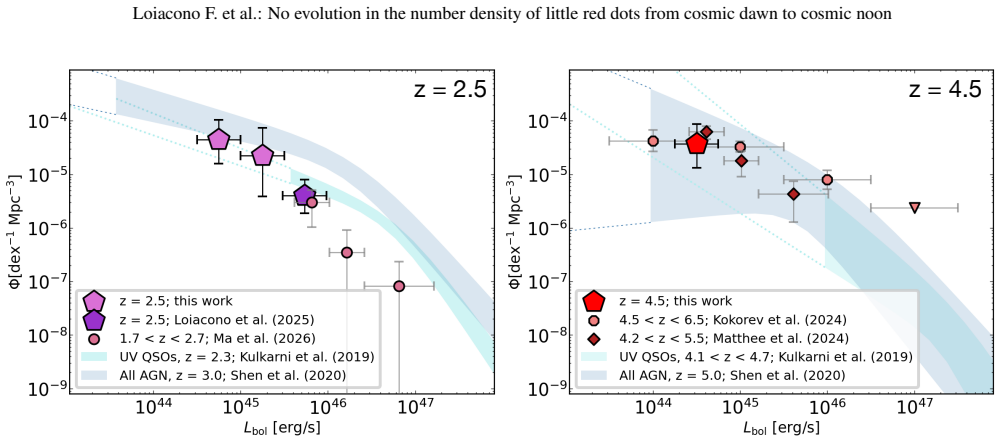
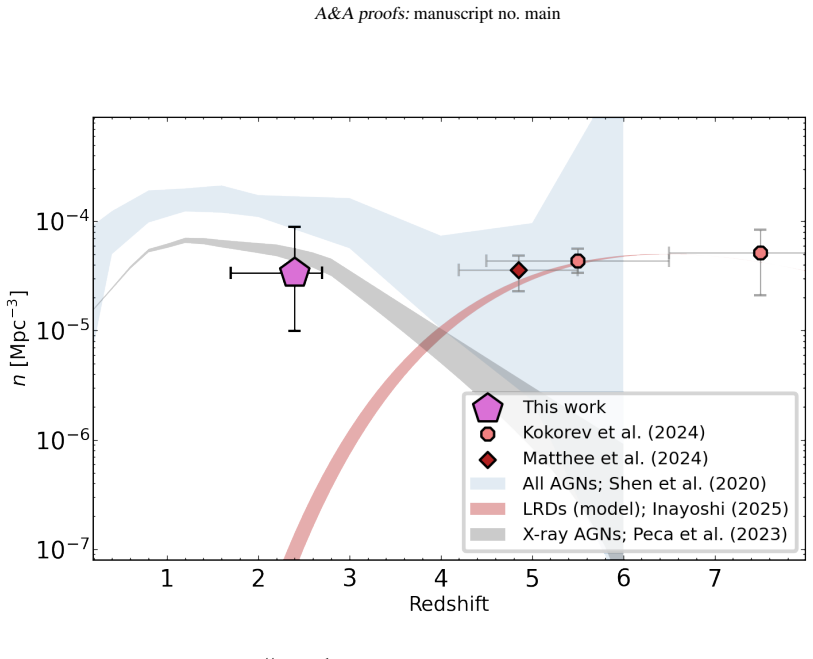
Five sources selected by line width above 1000 km/s, red color, and X-ray non-detection yield a space density for little red dots with L_bol greater than or equal to 3 times 10^44 erg s^{-1} that shows no significant evolution at z greater than 2. At z=2.4 the density is only a factor of about two below that of all pre-JWST AGNs above the same luminosity, while at z=4.5 it matches estimates from wider fields. The abundance at cosmic noon reaches 3.4 plus 5.6 minus 2.4 times 10^{-5} per cubic megaparsec, roughly 350 times above recent model predictions.
What carries the argument
The sample of five broad-line emitters selected via FWHM greater than or equal to 1000 km s^{-1}, F200W minus F356W greater than 0, and X-ray non-detection, from which the bolometric luminosity function of little red dots is derived.
If this is right
- At z=2.4 the space density of LRDs is only a factor of two below that of all pre-JWST AGNs above the luminosity threshold.
- At z=4.5 the derived density matches independent estimates from larger sky areas.
- The measured abundance at cosmic noon exceeds model predictions by a factor of about 350.
- If LRDs mark the rapid early growth phase of supermassive black holes, seed formation remains efficient down to z approximately 2.
- Alternatively the objects may represent a high-accretion episode in already mature black holes.
Where Pith is reading between the lines
- Models that underpredict LRD densities at z less than 4 may require adjustments to their black-hole seeding or accretion prescriptions.
- The constant density suggests LRDs could account for a larger fraction of the overall AGN population at cosmic noon than previously modeled.
- Repeating the selection in independent JWST fields would test whether the small sample size in this single field biases the density estimate.
Load-bearing premise
The five selected broad-line emitters form a complete and uncontaminated sample that represents the full little red dot population for luminosity function calculations.
What would settle it
A wider-area survey applying identical selection criteria at z between 2 and 5 that measures a number density differing by more than the reported uncertainties would falsify the no-evolution result.
Figures


read the original abstract
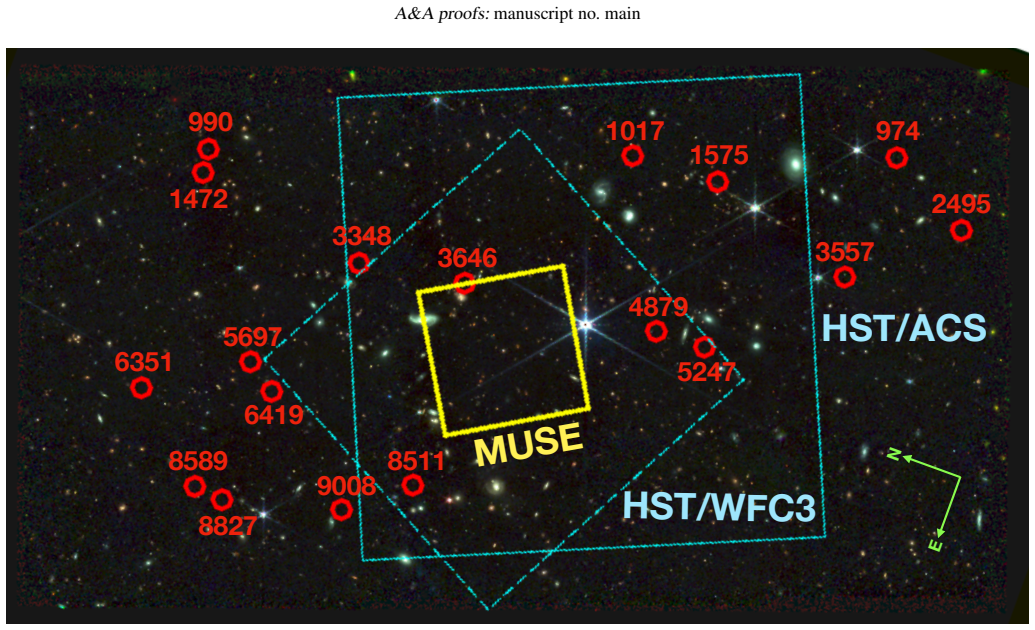
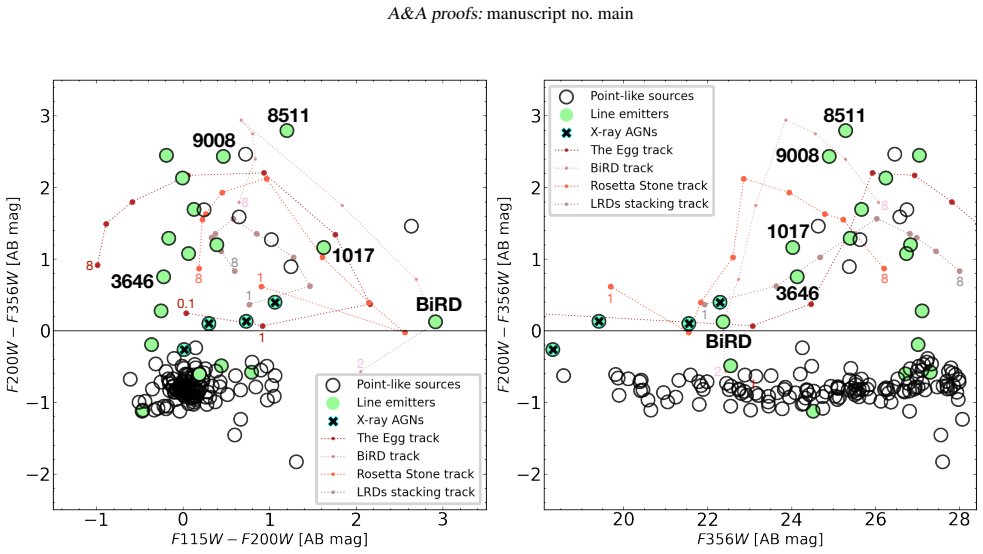
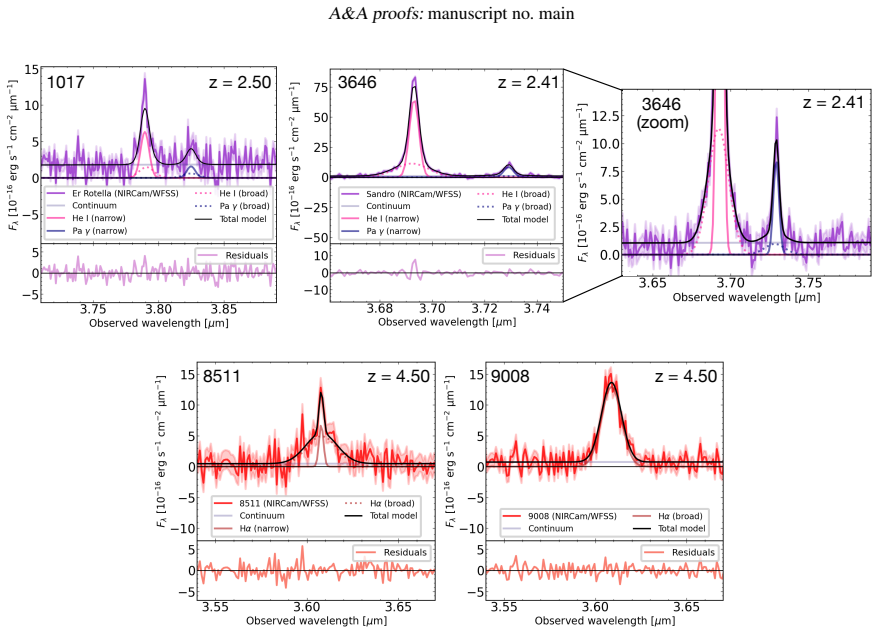
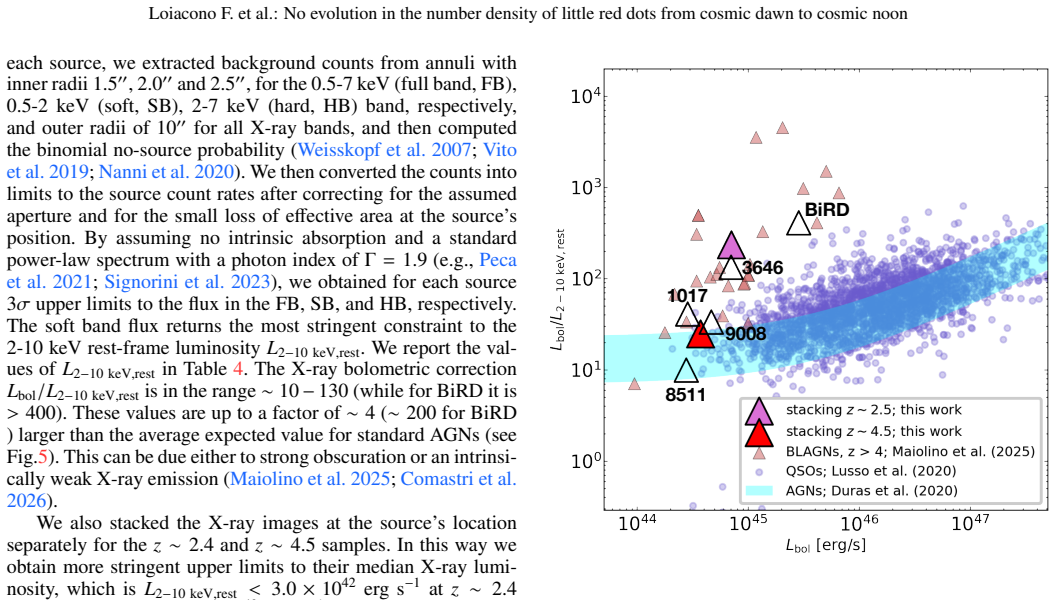
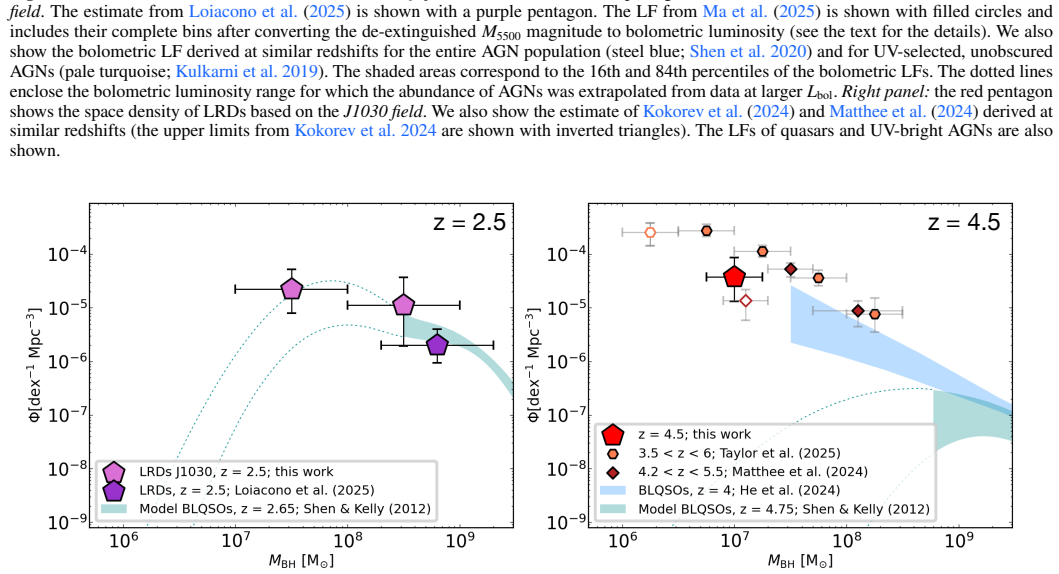
We present our search for little red dots (LRDs) in the "J1030 field", a region of the sky around the $z\sim 6.3$ quasar SDSS J1030+0524, observed by the JWST EIGER program. Over 154 point-like sources selected in a JWST-based photometric catalog, we find five broad line emitters (with $FWHM \gtrsim 1000\ \rm km s^{-1}$) that are red ($F200W - F356W > 0$) and are undetected in the X-rays. We use these sources to derive the bolometric luminosity function (LF) of LRDs at $z = 2.4$ and $z = 4.5$. At $z = 2.4$, the space density of LRDs is only a factor of $\sim 2$ lower than that of all pre-JWST active galactic nuclei (AGNs) with bolometric luminosity $L_{\rm bol} \gtrsim 3 \times 10^{44}\ \rm erg\ s^{-1}$. At $z = 4.5$, our estimate is consistent with those derived for LRDs based on larger areas of the sky. A similar behaviour is observed in the black hole mass function. More importantly, we study the number density of LRDs from cosmic dawn to cosmic noon. We find that there is no significant evolution in the abundance of LRDs with $L_{\rm bol} \gtrsim 3 \times 10^{44}\ \rm erg\ s^{-1}$ at $z > 2$. We speculate that the drop at $z < 4$ seen by other studies is due to their sampling of only the bright-end of the LRDs LF. At cosmic noon, the abundance of LRDs is $n = 3.4^{+5.6}_{-2.4} \times 10^{-5}\ \rm Mpc^{-3}$, which is a factor of $\sim 350$ larger than recent model predictions and is comparable with that of X-ray selected AGNs with similar bolometric luminosity. Our result may imply that, if LRDs are the early, rapid stages of supermassive black hole growth, as suggested by some models, then the formation of black hole seeds can be efficient down to epochs as recent as cosmic noon. Alternatively, LRDs may simply be a high-accretion phase in already mature black holes.
Editorial analysis
A structured set of objections, weighed in public.
Referee Report
Summary. The paper reports a search for little red dots (LRDs) in the J1030 field using JWST EIGER data, identifying five broad-line emitters (FWHM ≳1000 km s^{-1}) that are red (F200W-F356W>0) and X-ray undetected among 154 point-like sources. These are used to derive the bolometric luminosity function at z=2.4 and z=4.5, yielding a space density of n=3.4^{+5.6}_{-2.4}×10^{-5} Mpc^{-3} at z=2.4 for L_bol≳3×10^{44} erg s^{-1}. The central claim is that there is no significant evolution in LRD abundance with this luminosity threshold from z>2 to cosmic noon, with the z=2.4 density comparable to X-ray AGNs but ~350× higher than model predictions; implications for black hole seed formation or accretion phases are discussed.
Significance. If the no-evolution result holds after addressing sample limitations, it would indicate that LRDs remain abundant at z~2.4, challenging models and suggesting either efficient black hole seed formation persisting to cosmic noon or a common high-accretion phase in mature systems. The direct comparison to pre-JWST AGN densities and higher-z LRD estimates from wider fields provides useful context, and the JWST-based identification of broad-line LRDs at lower redshift is a concrete observational contribution.
major comments (3)
- [Abstract and LF section] Abstract and luminosity function derivation: The no-evolution conclusion at z>2 rests on the z=2.4 density from only five sources (n=3.4^{+5.6}_{-2.4}×10^{-5} Mpc^{-3}); the large Poisson uncertainties mean the claimed statistical consistency with z=4.5 and other works may reflect low statistical power rather than true constancy. The manuscript must detail the exact LF computation, volume corrections, and any completeness factors applied to this small sample.
- [Sample selection] Sample selection criteria: The five sources are defined by FWHM≳1000 km s^{-1}, red color, and X-ray non-detection; this selection risks incompleteness if LRDs lacking broad lines or with alternate X-ray properties exist, directly affecting whether the derived density represents the full population for the no-evolution claim.
- [Observational setup and results] Field and variance: All five sources come from the single J1030 field (centered on a z~6.3 quasar); cosmic variance is not quantified, which is load-bearing for the z=2.4 density and the cross-redshift comparison.
minor comments (2)
- [Abstract] The abstract states 'a similar behaviour is observed in the black hole mass function' without numbers or a figure reference; add a brief quantitative statement or pointer to the relevant panel.
- [Throughout] Notation for bolometric luminosity (L_bol) and redshift bins should be checked for consistency between text, tables, and any equations.
Simulated Author's Rebuttal
We thank the referee for their careful reading and constructive comments, which have helped clarify several aspects of the analysis. We address each major comment below and have revised the manuscript accordingly to improve clarity on the luminosity function derivation and limitations.
read point-by-point responses
-
Referee: [Abstract and LF section] Abstract and luminosity function derivation: The no-evolution conclusion at z>2 rests on the z=2.4 density from only five sources (n=3.4^{+5.6}_{-2.4}×10^{-5} Mpc^{-3}); the large Poisson uncertainties mean the claimed statistical consistency with z=4.5 and other works may reflect low statistical power rather than true constancy. The manuscript must detail the exact LF computation, volume corrections, and any completeness factors applied to this small sample.
Authors: We agree that the small sample yields large Poisson uncertainties and that the no-evolution statement is formally consistent within errors rather than a high-significance detection of constancy. In the revised manuscript we have expanded Section 3 to provide the explicit LF formula, the comoving volume calculation for the J1030 field at each redshift slice, the 1/V_max weighting applied to each source, and the photometric completeness correction derived from the point-source selection efficiency. We also added a sentence noting that the result is limited by small-number statistics. revision: yes
-
Referee: [Sample selection] Sample selection criteria: The five sources are defined by FWHM≳1000 km s^{-1}, red color, and X-ray non-detection; this selection risks incompleteness if LRDs lacking broad lines or with alternate X-ray properties exist, directly affecting whether the derived density represents the full population for the no-evolution claim.
Authors: We acknowledge that the broad-line plus red-color plus X-ray-undetected criteria may miss LRDs without detectable broad lines or with different X-ray properties. The revised text now includes an explicit limitations paragraph stating that the reported density applies specifically to this spectroscopically confirmed broad-line subset and may therefore be a lower limit to the total LRD population. This selection was chosen to enable direct comparison with higher-redshift LRD samples that use the same criteria. revision: partial
-
Referee: [Observational setup and results] Field and variance: All five sources come from the single J1030 field (centered on a z~6.3 quasar); cosmic variance is not quantified, which is load-bearing for the z=2.4 density and the cross-redshift comparison.
Authors: We agree that cosmic variance is not quantified in the original submission. In the revision we have added a paragraph estimating the field-to-field variance using the analytic prescription of Somerville et al. (2004) for the probed volume and number density; the estimated fractional variance is ~30%, which remains smaller than the Poisson uncertainty. We also note the consistency of our z=4.5 point with wider-area measurements as supporting evidence that the single-field result is not strongly biased. revision: yes
Circularity Check
No circularity: direct observational count of LRDs yields number densities without reduction to fitted inputs or self-citations
full rationale
The paper's central result is an empirical space density n = 3.4^{+5.6}_{-2.4} × 10^{-5} Mpc^{-3} at z=2.4 derived from counting five qualifying sources among 154 point-like objects in a single JWST field, then comparing this count-based value to independent literature estimates at z>4.5. No equations define a quantity in terms of itself, no fitted parameters are relabeled as predictions, and no uniqueness theorems or ansatzes are imported via self-citation; the 'no significant evolution' statement follows from direct comparison of these independent measurements with stated Poisson uncertainties. The derivation chain is therefore self-contained as a standard observational luminosity-function estimate.
Axiom & Free-Parameter Ledger
axioms (1)
- domain assumption The five sources with broad lines, red colors, and no X-ray detection are LRDs suitable for deriving the bolometric luminosity function.
Reference graph
Works this paper leans on
-
[1]
T., Bogdán, Á., Kovács, O
Ananna, T. T., Bogdán, Á., Kovács, O. E., Natarajan, P., & Hickox, R. C. 2024, ApJ, 969, L18
2024
-
[2]
T., Treister, E., Urry, C
Ananna, T. T., Treister, E., Urry, C. M., et al. 2019, ApJ, 871, 240
2019
-
[3]
2018, PASP, 130, 124501
Annunziatella, M., Marchesini, D., Stefanon, M., et al. 2018, PASP, 130, 124501
2018
-
[4]
C., Rossi, E
Begelman, M. C., Rossi, E. M., & Armitage, P. J. 2008, MNRAS, 387, 1649
2008
-
[5]
2011, ApJ, 742, 13
Bellovary, J., V olonteri, M., Governato, F., et al. 2011, ApJ, 742, 13
2011
-
[6]
& Arnouts, S
Bertin, E. & Arnouts, S. 1996, A&AS, 117, 393
1996
-
[7]
2002, in Astronomical Society of the Pacific Conference Series, V ol
Bertin, E., Mellier, Y ., Radovich, M., et al. 2002, in Astronomical Society of the Pacific Conference Series, V ol. 281, Astronomical Data Analysis Software and Systems XI, ed. D. A. Bohlender, D. Durand, & T. H. Handley, 228
2002
-
[8]
Brazzini, M., D’Eugenio, F., Maiolino, R., et al. 2026, arXiv e-prints, arXiv:2601.22214
-
[9]
2025, JWST Calibration Pipeline
Bushouse, H., Eisenhamer, J., Dencheva, N., et al. 2025, JWST Calibration Pipeline
2025
-
[10]
Chisholm, J., Berg, D. A., Boylan-Kolchin, M., et al. 2026, arXiv e-prints, arXiv:2602.15935
-
[11]
2026, A&A, 706, A302 D’Amato, Q., Gilli, R., Vignali, C., et al
Comastri, A., Lanzuisi, G., Vito, F., et al. 2026, A&A, 706, A302 D’Amato, Q., Gilli, R., Vignali, C., et al. 2020, A&A, 636, A37 D’Amato, Q., Prandoni, I., Gilli, R., et al. 2022, A&A, 668, A133 de Graaff, A., Rix, H.-W., Naidu, R. P., et al. 2025, arXiv e-prints, arXiv:2503.16600
-
[12]
2025, A&A, 704, A313
Delvecchio, I., Daddi, E., Magnelli, B., et al. 2025, A&A, 704, A313
2025
-
[13]
2020, A&A, 636, A73
Duras, F., Bongiorno, A., Ricci, F., et al. 2020, A&A, 636, A73
2020
-
[14]
2024, ApJ, 974, 275 Euclid Collaboration: Bisigello, L., Rodighiero, G., Fotopoulou, S., et al
Eilers, A.-C., Mackenzie, R., Pizzati, E., et al. 2024, ApJ, 974, 275 Euclid Collaboration: Bisigello, L., Rodighiero, G., Fotopoulou, S., et al. 2025, arXiv e-prints, arXiv:2503.15323
-
[15]
W., Lang, D., & Goodman, J
Foreman-Mackey, D., Hogg, D. W., Lang, D., & Goodman, J. 2013, PASP, 125, 306
2013
-
[16]
G., Herrera, D., et al
Gawiser, E., van Dokkum, P. G., Herrera, D., et al. 2006, ApJS, 162, 1
2006
-
[17]
1986, ApJ, 303, 336
Gehrels, N. 1986, ApJ, 303, 336
1986
-
[18]
Geris, S., Maiolino, R., Ji, X., et al. 2026, arXiv e-prints, arXiv:2606.21614 Article number, page 16 of 19 Loiacono F. et al.: No evolution in the number density of little red dots from cosmic dawn to cosmic noon
work page internal anchor Pith review Pith/arXiv arXiv 2026
-
[19]
2007, A&A, 463, 79
Gilli, R., Comastri, A., & Hasinger, G. 2007, A&A, 463, 79
2007
-
[20]
Greene, J. E. & Ho, L. C. 2005, ApJ, 630, 122
2005
-
[21]
E., Labbe, I., Goulding, A
Greene, J. E., Labbe, I., Goulding, A. D., et al. 2024, ApJ, 964, 39
2024
-
[22]
N., Maiolino, R., Juodžbalis, I., et al
Hainline, K. N., Maiolino, R., Juodžbalis, I., et al. 2025, ApJ, 979, 138
2025
-
[23]
2023, ApJ, 959, 39
Harikane, Y ., Zhang, Y ., Nakajima, K., et al. 2023, ApJ, 959, 39
2023
-
[24]
2024, ApJ, 962, 152
He, W., Akiyama, M., Enoki, M., et al. 2024, ApJ, 962, 152
2024
-
[25]
Hviding, R. E., de Graaff, A., Miller, T. B., et al. 2025, arXiv e-prints, arXiv:2506.05459 Ili´c, D., Popovi´c, L. ˇC., La Mura, G., Ciroi, S., & Rafanelli, P. 2012, A&A, 543, A142
-
[26]
2025, ApJ, 988, L22
Inayoshi, K. 2025, ApJ, 988, L22
2025
-
[27]
& Maiolino, R
Inayoshi, K. & Maiolino, R. 2025, ApJ, 980, L27
2025
-
[28]
2024, A&A, 684, A153
Iwasawa, K., Liu, T., Boller, T., et al. 2024, A&A, 684, A153
2024
-
[29]
2026, MNRAS, 545, staf2235
Ji, X., D’Eugenio, F., Juodžbalis, I., et al. 2026, MNRAS, 545, staf2235
2026
-
[30]
2025, arXiv e-prints, arXiv:2501.13082
Ji, X., Maiolino, R., Übler, H., et al. 2025, arXiv e-prints, arXiv:2501.13082
-
[31]
Jones, B. L., Kocevski, D. D., Pacucci, F., et al. 2025, arXiv e-prints, arXiv:2510.07376 Juodžbalis, I., Ji, X., Maiolino, R., et al. 2024a, MNRAS, 535, 853 Juodžbalis, I., Maiolino, R., Baker, W. M., et al. 2025, arXiv e-prints, arXiv:2504.03551 Juodžbalis, I., Maiolino, R., Baker, W. M., et al. 2024b, Nature, 636, 594 Juodžbalis, I., Marconcini, C., D’...
-
[32]
J., Matthee, J., et al
Kashino, D., Lilly, S. J., Matthee, J., et al. 2023, ApJ, 950, 66
2023
-
[33]
2009, ApJ, 695, 809
Kim, S., Stiavelli, M., Trenti, M., et al. 2009, ApJ, 695, 809
2009
-
[34]
D., Finkelstein, S
Kocevski, D. D., Finkelstein, S. L., Barro, G., et al. 2025, ApJ, 986, 126
2025
-
[35]
I., Greene, J
Kokorev, V ., Caputi, K. I., Greene, J. E., et al. 2024, ApJ, 968, 38
2024
-
[36]
Kulkarni, G., Worseck, G., & Hennawi, J. F. 2019, MNRAS, 488, 1035
2019
-
[37]
Labbe, I., Greene, J. E., Matthee, J., et al. 2024, arXiv e-prints, arXiv:2412.04557
-
[38]
J., Peterson, B
Landt, H., Ward, M. J., Peterson, B. M., et al. 2013, MNRAS, 432, 113
2013
-
[39]
Liddle, A. R. 2007, MNRAS, 377, L74
2007
-
[40]
2026, ApJ, 997, 364
Lin, X., Fan, X., Cai, Z., et al. 2026, ApJ, 997, 364
2026
-
[41]
2024, ApJ, 974, 147
Lin, X., Wang, F., Fan, X., et al. 2024, ApJ, 974, 147
2024
-
[42]
2025, A&A, 703, A36
Loiacono, F., Gilli, R., Mignoli, M., et al. 2025, A&A, 703, A36
2025
-
[43]
2020, A&A, 642, A150
Lusso, E., Risaliti, G., Nardini, E., et al. 2020, A&A, 642, A150
2020
-
[44]
Ma, Y ., Greene, J. E., Setton, D. J., et al. 2025, arXiv e-prints, arXiv:2504.08032
-
[45]
2025, arXiv e-prints, arXiv:2501.09854
Madau, P. 2025, arXiv e-prints, arXiv:2501.09854
-
[46]
& Dickinson, M
Madau, P. & Dickinson, M. 2014, ARA&A, 52, 415
2014
-
[47]
& Haardt, F
Madau, P. & Haardt, F. 2024, ApJ, 976, L24
2024
-
[48]
Madau, P. & Maiolino, R. 2026, arXiv e-prints, arXiv:2605.05074
work page internal anchor Pith review Pith/arXiv arXiv 2026
-
[49]
Wings of little dots: Exponential broad lines from a stratified BLR
Madau, P., Maiolino, R., Scholtz, J., & D’Eugenio, F. 2026, arXiv e-prints, arXiv:2604.04216
work page internal anchor Pith review Pith/arXiv arXiv 2026
-
[50]
2025, MNRAS, 538, 1921
Maiolino, R., Risaliti, G., Signorini, M., et al. 2025, MNRAS, 538, 1921
2025
-
[51]
2024, A&A, 691, A145
Maiolino, R., Scholtz, J., Curtis-Lake, E., et al. 2024, A&A, 691, A145
2024
-
[52]
2021, A&A, 656, A117
Marchesi, S., Mignoli, M., Gilli, R., et al. 2021, A&A, 656, A117
2021
-
[53]
P., Brammer, G., et al
Matthee, J., Naidu, R. P., Brammer, G., et al. 2024, ApJ, 963, 129
2024
-
[54]
2024, arXiv e-prints, arXiv:2412.04224
Mazzolari, G., Gilli, R., Maiolino, R., et al. 2024, arXiv e-prints, arXiv:2412.04224
-
[55]
Mazzolari, G., Gilli, R., Mignoli, M., et al. 2026, arXiv e-prints, arXiv:2603.10176
-
[56]
2025, A&A, 700, A12
Mazzolari, G., Scholtz, J., Maiolino, R., et al. 2025, A&A, 700, A12
2025
-
[57]
2020, A&A, 642, L1
Mignoli, M., Gilli, R., Decarli, R., et al. 2020, A&A, 642, L1
2020
-
[58]
A "Black Hole Star" Reveals the Remarkable Gas-Enshrouded Hearts of the Little Red Dots
Naidu, R. P., Matthee, J., Katz, H., et al. 2025, arXiv e-prints, arXiv:2503.16596
work page internal anchor Pith review Pith/arXiv arXiv 2025
-
[59]
2020, A&A, 637, A52
Nanni, R., Gilli, R., Vignali, C., et al. 2020, A&A, 637, A52
2020
-
[60]
2020, ApJ, 904, 89
Niida, M., Nagao, T., Ikeda, H., et al. 2020, ApJ, 904, 89
2020
-
[61]
A., Brammer, G., Naidu, R
Oesch, P. A., Brammer, G., Naidu, R. P., et al. 2023, MNRAS, 525, 2864
2023
-
[62]
Osterbrock, D. E. 1989, Astrophysics of gaseous nebulae and active galactic nu- clei
1989
-
[63]
& Narayan, R
Pacucci, F. & Narayan, R. 2024, ApJ, 976, 96
2024
-
[64]
Park, K., Torralba, A., Matthee, J., et al. 2026, arXiv e-prints, arXiv:2605.14233
work page internal anchor Pith review Pith/arXiv arXiv 2026
-
[65]
M., et al
Peca, A., Cappelluti, N., Urry, C. M., et al. 2023, ApJ, 943, 162
2023
-
[66]
2002, A&A, 390, 1089 Pérez-González, P
Peca, A., Vignali, C., Gilli, R., et al. 2021, ApJ, 906, 90 Pérez-González, P. G., Barro, G., Carniani, S., et al. 2026, arXiv e-prints, arXiv:2602.20247
-
[67]
L., Lequeux, J., Maurice, E., Prevot, L., & Rocca-V olmerange, B
Prevot, M. L., Lequeux, J., Maurice, E., Prevot, L., & Rocca-V olmerange, B. 1984, A&A, 132, 389
1984
-
[68]
Reines, A. E. & V olonteri, M. 2015, ApJ, 813, 82
2015
-
[69]
T., Strauss, M
Richards, G. T., Strauss, M. A., Fan, X., et al. 2006, AJ, 131, 2766
2006
-
[70]
H., et al
Rinaldi, P., Bonaventura, N., Rieke, G. H., et al. 2025, ApJ, 992, 71
2025
-
[71]
Rinaldi, P., Hainline, K., D’Eugenio, F., et al. 2026, arXiv e-prints, arXiv:2604.07138
work page internal anchor Pith review Pith/arXiv arXiv 2026
-
[72]
C., Brotherton, M
Runnoe, J. C., Brotherton, M. S., & Shang, Z. 2012, MNRAS, 422, 478
2012
-
[73]
2025, arXiv preprint arXiv:2503.16595 —
Rusakov, V ., Watson, D., Nikopoulos, G. P., et al. 2025, arXiv e-prints, arXiv:2503.16595
-
[74]
1968, ApJ, 151, 393
Schmidt, M. 1968, ApJ, 151, 393
1968
-
[75]
2026b, arXiv e-prints, arXiv:2603.22277
Scholtz, J., D’Eugenio, F., Maiolino, R., et al. 2026, arXiv e-prints, arXiv:2603.22277
-
[76]
F., Faucher-Giguère, C.-A., et al
Shen, X., Hopkins, P. F., Faucher-Giguère, C.-A., et al. 2020, MNRAS, 495, 3252
2020
-
[77]
& Kelly, B
Shen, Y . & Kelly, B. C. 2012, ApJ, 746, 169
2012
-
[78]
2023, A&A, 676, A49
Signorini, M., Marchesi, S., Gilli, R., et al. 2023, A&A, 676, A49
2023
-
[79]
On the quenching of LRD X-ray emission by both Compton-thick gas and high accretion rates
Sneppen, A., Watson, D., Matthews, J. H., & Sim, S. A. 2026, arXiv e-prints, arXiv:2605.15263
work page internal anchor Pith review Pith/arXiv arXiv 2026
-
[80]
& Laor, A
Stern, J. & Laor, A. 2012, MNRAS, 423, 600
2012
discussion (0)
Sign in with ORCID, Apple, or X to comment. Anyone can read and Pith papers without signing in.