An aperiodic set of Wang tiles for every quadratic irrational
Pith reviewed 2026-06-25 22:50 UTC · model grok-4.3
The pith
For any irrationals α and β from the same quadratic field, a finite set of striped Wang tiles exists that forces aperiodic tilings with exactly those densities.
A machine-rendered reading of the paper's core claim, the machinery that carries it, and where it could break.
Core claim
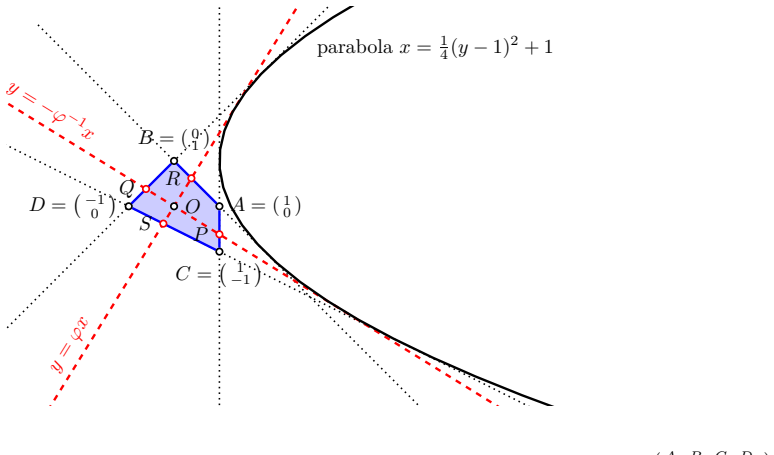
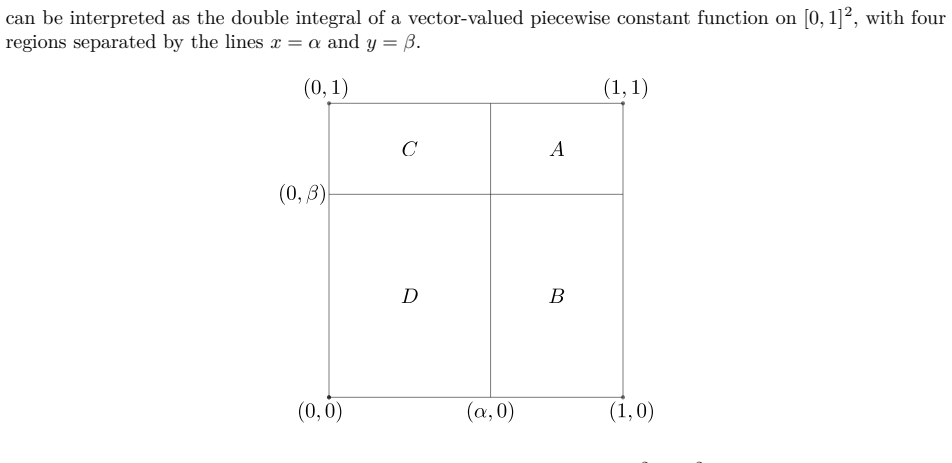
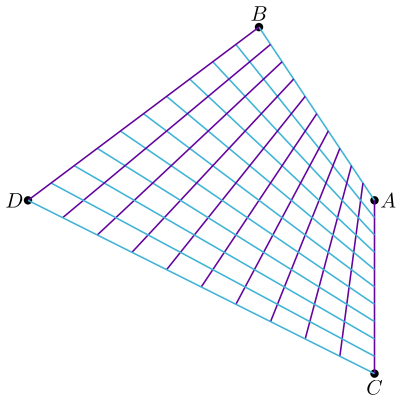
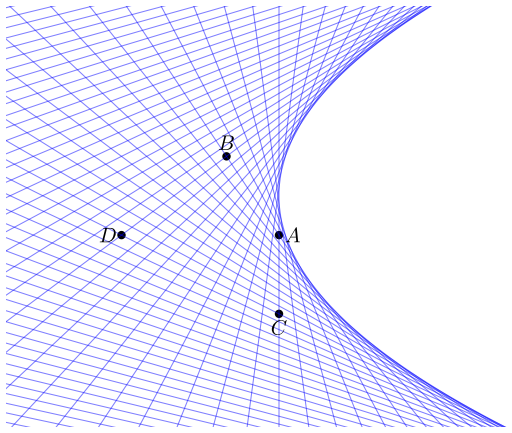
For every pair (α,β)∈[0,1]² of irrational numbers in the same quadratic number field, we construct a finite aperiodic set of Wang tiles with stripes that admits a valid tiling whose density of vertical stripes is α and density of horizontal stripes is β. Non-periodicity is established by a sufficient condition that uses the geometric property of a quadrilateral circumscribed to a parabola to conclude that the stripe densities must be irrational.
What carries the argument
Sufficient condition for non-periodicity of striped Wang tiles that derives aperiodicity from irrational stripe densities via the geometric property of a quadrilateral circumscribed to a parabola.
If this is right
- The 24-tile Penrose encoding and the family of metallic-mean Wang tiles are aperiodic by the new geometric criterion.
- Every pair of irrationals in the same quadratic field can be realized exactly as the stripe densities of some aperiodic striped tiling.
- Periodic tilings of striped Wang tiles are constrained to have rational densities under the circumscribed-quadrilateral condition.
- Explicit finite tile sets can be generated for each desired quadratic-irrational density pair.
Where Pith is reading between the lines
- The method could be tested on irrationals of higher degree by replacing the parabola with a suitable higher-degree curve.
- The number of tiles required may grow with the degree of the number field containing the densities.
- Density-control via stripes may combine with substitution or cut-and-project constructions to produce new aperiodic systems.
- Smallest tile sets realizing specific densities such as the golden ratio could be found by optimizing the construction.
Load-bearing premise
The geometric property of a quadrilateral circumscribed to a parabola correctly forces any periodic striped tiling to have rational densities.
What would settle it
Produce a periodic valid tiling of one of the constructed tile sets and measure stripe densities that turn out to be irrational.
Figures


read the original abstract
We propose a sufficient condition for the non-periodicity of a set of Wang tiles. It applies to sets of Wang tiles whose tiles have vertical or horizontal stripes. The proof is based on a geometric argument involving a quadrilateral circumscribed to a parabola from which we conclude the irrationality of the densities of the vertical and horizontal stripes. We apply the sufficient condition to propose new proofs of non-periodicity of known sets of Wang tiles, including an encoding of Penrose tilings into 24 Wang tiles and the family of metallic mean Wang tiles. Conversely, for every pair $(\alpha,\beta)\in[0,1]^2$ of irrational numbers in the same quadratic number field, we construct a finite aperiodic set of Wang tiles with stripes that admits a valid tiling whose density of vertical stripes is $\alpha$ and density of horizontal stripes is $\beta$.
Editorial analysis
A structured set of objections, weighed in public.
Referee Report
Summary. The manuscript proposes a sufficient condition for non-periodicity of Wang tiles featuring vertical or horizontal stripes. The condition relies on a geometric argument involving a quadrilateral circumscribed about a parabola, from which the irrationality of the densities of vertical and horizontal stripes is deduced to imply non-periodicity. The condition is used to provide new proofs of non-periodicity for known tile sets, such as a 24-tile encoding of Penrose tilings and metallic mean Wang tiles. In the converse direction, for any pair of irrationals α, β in the same quadratic number field, the authors construct a finite set of striped Wang tiles that admits a valid tiling with vertical stripe density α and horizontal stripe density β.
Significance. If the sufficient condition is rigorously established without hidden assumptions on tiling configurations, the result would be significant for the theory of aperiodic tilings. It provides a general method to construct aperiodic Wang tiles with prescribed irrational densities from quadratic fields, extending specific known examples to a broad class. The explicit constructions for the converse direction strengthen the contribution by making the result constructive.
major comments (3)
- [sufficient condition] The sufficient condition (as stated in the abstract and developed in the main argument): the geometric property of a quadrilateral circumscribed to a parabola is used to conclude that irrational stripe densities force non-periodicity. It must be shown explicitly that this rules out periodic realizations for arbitrary valid tilings (without additional unstated constraints on stripe alignment or adjacency), as this implication is load-bearing for both the reproofs of known examples and the new constructions.
- [converse constructions] The converse constructions (for arbitrary (α,β) in the same quadratic field): the manuscript must detail how the finite tile sets are assembled to simultaneously achieve the exact densities α, β while satisfying the sufficient condition for aperiodicity; any dependence on field-specific properties should be isolated to confirm generality within quadratic irrationals.
- [applications to known sets] Application to the 24-tile Penrose encoding and metallic mean tiles: the new proofs via the sufficient condition should be compared directly to prior arguments to verify that the parabola-based step adds a genuinely independent verification of non-periodicity rather than assuming the known aperiodicity.
minor comments (1)
- [abstract and introduction] Notation for stripe densities α and β should be introduced with explicit definitions early in the text to avoid ambiguity when discussing the [0,1]² interval.
Simulated Author's Rebuttal
We thank the referee for their careful reading and constructive comments. We address each major comment point by point below.
read point-by-point responses
-
Referee: [sufficient condition] The sufficient condition (as stated in the abstract and developed in the main argument): the geometric property of a quadrilateral circumscribed to a parabola is used to conclude that irrational stripe densities force non-periodicity. It must be shown explicitly that this rules out periodic realizations for arbitrary valid tilings (without additional unstated constraints on stripe alignment or adjacency), as this implication is load-bearing for both the reproofs of known examples and the new constructions.
Authors: The proof assumes an arbitrary valid periodic tiling and forms the circumscribed quadrilateral from the average stripe positions determined by the densities; the geometric property then forces a contradiction with irrationality. No unstated constraints on alignment are used beyond the periodicity and validity enforced by the Wang rules. To address the request for explicitness, we will add a clarifying sentence in the theorem statement and proof. revision: yes
-
Referee: [converse constructions] The converse constructions (for arbitrary (α,β) in the same quadratic field): the manuscript must detail how the finite tile sets are assembled to simultaneously achieve the exact densities α, β while satisfying the sufficient condition for aperiodicity; any dependence on field-specific properties should be isolated to confirm generality within quadratic irrationals.
Authors: Section 4 assembles the sets by selecting a finite collection of stripe patterns whose proportions are governed by the minimal polynomial of the quadratic field, ensuring the vertical and horizontal densities equal α and β exactly while the irrationality guarantees the sufficient condition holds. Field-specific aspects are isolated to the initial choice of base proportions derived from the ring of integers; the remainder of the construction is uniform. We will expand the exposition with an explicit assembly algorithm. revision: yes
-
Referee: [applications to known sets] Application to the 24-tile Penrose encoding and metallic mean tiles: the new proofs via the sufficient condition should be compared directly to prior arguments to verify that the parabola-based step adds a genuinely independent verification of non-periodicity rather than assuming the known aperiodicity.
Authors: The new proofs compute the densities directly from the tile sets and invoke the sufficient condition; they do not presuppose aperiodicity from earlier arguments but derive non-periodicity from density irrationality via the parabola geometry. This is independent of substitution or inflation techniques used previously. We will add a short comparative paragraph in the applications section. revision: partial
Circularity Check
No significant circularity; derivation is self-contained
full rationale
The paper introduces a new sufficient condition for non-periodicity of striped Wang tiles, proved via an independent geometric argument (quadrilateral circumscribed to a parabola) that directly links irrational densities to aperiodicity. This condition is then applied to reprove known examples and to certify explicit new constructions for pairs (α,β) in the same quadratic field. No load-bearing step reduces by definition, by fitted-parameter renaming, or by self-citation chain to the target result; the geometric proof and tile constructions stand as external content relative to the claimed densities and aperiodicity.
Axiom & Free-Parameter Ledger
axioms (1)
- domain assumption A set of striped Wang tiles is non-periodic whenever the densities of vertical and horizontal stripes are irrational numbers lying in the same quadratic field, as shown by the quadrilateral-parabola argument.
Reference graph
Works this paper leans on
-
[1]
[Aki12] S. Akiyama. A Note on Aperiodic Ammann Tiles.Discrete Comput. Geom., 48(3):702–710, October 2012.doi:10.1007/s00454-012-9418-4. [Ber66] R. Berger. The undecidability of the domino problem.Mem. Amer. Math. Soc. No., 66:72,
-
[2]
doi:10.1017/CBO9781139025256. [BKOR87] H. J. M. Bos, C. Kers, F. Oort, and D. W. Raven. Poncelet’s closure theorem.Expo. Math., 5:289–364,
-
[3]
[BR10] V. Berthé and M. Rigo, editors.Combinatorics, automata and number theory, volume 135 of Encyclopedia of Mathematics and its Applications. Cambridge University Press, Cambridge, 2010.doi:10.1017/CBO9780511777653. [Cul96] K. Culik, II. An aperiodic set of13Wang tiles.Discrete Math., 160(1-3):245–251,
-
[4]
doi:10.1016/S0012-365X(96)00118-5. [DM25] V. Dragović and M. H. Murad. Parable of the parabola.Expo. Math., 43(6):36,
-
[5]
doi:10.1016/j.exmath.2025.125717. Id/No 125717. [ENP07] S. Eigen, J. Navarro, and V. S. Prasad. An aperiodic tiling using a dynamical sys- tem and Beatty sequences. InDynamics, ergodic theory, and geometry, volume 54 of Math. Sci. Res. Inst. Publ., pages 223–241. Cambridge Univ. Press, Cambridge,
-
[6]
doi:10.1017/CBO9780511755187.009. [FGMn24] D. Frettlöh, A. Garber, and N. Mañibo. Substitution tilings with transcendental inflation factor. Discrete Anal., pages Paper No. 11, 24, 2024.doi:10.19086/da.1254. [Fog02] N. P. Fogg.Substitutions in Dynamics, Arithmetics and Combinatorics, volume 1794 ofLecture Notes in Mathematics. Springer-Verlag, Berlin,
-
[7]
Edited by V. Berthé, S. Ferenczi, C. Mauduit and A. Siegel.doi:10.1007/b13861. [Fre17] D. Frettlöh. More inflation tilings. InAperiodic order. Vol. 2, volume 166 ofEncyclopedia Math. Appl., pages 1–37. Cambridge Univ. Press, Cambridge,
-
[8]
[Hoc16] M. Hochman. Multidimensional shifts of finite type and sofic shifts. InCombinatorics, words and symbolic dynamics, volume 159 ofEncyclopedia Math. Appl., pages 296–358. Cambridge Univ. Press, Cambridge, 2016.doi:10.1017/CBO9781139924733.010. [HP94] W. V. D. Hodge and D. Pedoe.Methods of algebraic geometry. Volume I. Book I: Algebraic preliminaries...
-
[9]
Jeandel and M
[JR21] E. Jeandel and M. Rao. An aperiodic set of 11 Wang tiles.Adv. Comb., 2021:37,
2021
-
[10]
doi:10.19086/aic.18614. Id/No
-
[11]
[JR25] H. Jang and E. A. Robinson, Jr. Directional expansiveness for Rd-actions and for Penrose tilings, April 2025.arxiv:2504.10838. [Kar96] J. Kari. A small aperiodic set of Wang tiles.Discrete Math., 160(1-3):259–264,
arXiv 2025
-
[12]
doi:10.1016/0012-365X(95)00120-L. [Lab19] S. Labbé. A self-similar aperiodic set of 19 Wang tiles.Geom. Dedicata, 201:81–109,
-
[13]
doi:10.1007/s10711-018-0384-8. [Lab20] S. Labbé. Three characterizations of a self-similar aperiodic 2-dimensional subshift. December 2020.arxiv:2012.03892, 46 p., book chapter in preparation. 40 [Lab21] S. Labbé. Substitutive structure of Jeandel-Rao aperiodic tilings.Discrete Comput. Geom., 65(3):800–855, 2021.doi:10.1007/s00454-019-00153-3. [Lab25a] S....
-
[14]
doi:10.1090/psapm/060/2078846. [LM95] D. Lind and B. Marcus.An Introduction to Symbolic Dynamics and Coding. Cambridge Uni- versity Press, Cambridge, 1995.doi:10.1017/CBO9780511626302. [ML71] S.MacLane.Categories for the working mathematician, volume5ofGrad. Texts Math.Springer, Cham, 1971.doi:book/10.1007/978-1-4757-4721-8. [Moz89] S. Mozes. Tilings, sub...
-
[15]
[Rob71] R. M. Robinson. Undecidability and nonperiodicity for tilings of the plane.Invent. Math., 12:177–209, 1971.doi:10.1007/BF01418780. [Sch01] K. Schmidt. Multi–dimensional symbolic dynamical systems. InCodes, Systems, and Graphical Models (Minneapolis, MN, 1999), volume 123 ofIMA Vol. Math. Appl., pages 67–82. Springer, New York, 2001.doi:10.1007/978...
-
[16]
[SMKGS24] D. Smith, J. S. Myers, C. S. Kaplan, and C. Goodman-Strauss. An aperiodic monotile.Comb. Theory, 4(1):Paper No. 6, 91, 2024.doi:10.5070/C64163843. [Wal82] P. Walters.An Introduction to Ergodic Theory, volume 79 ofGTM. Springer-Verlag, New York-Berlin,
-
[17]
[Wan61] H. Wang. Proving theorems by pattern recognition – II.Bell System Technical Journal, 40(1):1– 41, January 1961.doi:10.1002/j.1538-7305.1961.tb03975.x. 41
discussion (0)
Sign in with ORCID, Apple, or X to comment. Anyone can read and Pith papers without signing in.