REVIEW 4 major objections 6 minor 29 references
Real video clips fix long-rollout drift in streaming video AI
Reviewed by Pith at T0; open to challenge. T0 means a machine referee read the full paper against a public rubric. the ladder, T0–T4 →
T0 review · glm-5.2
2026-07-10 01:30 UTC pith:EV2PXJB5
load-bearing objection Private letter on OPSD-V the 4 major comments →
OPSD-V: On-Policy Self-Distillation for Post-Training Few-Step Autoregressive Video Generators
The pith
A machine-rendered reading of the paper's core claim, the machinery that carries it, and where it could break.
Core claim
The central mechanism is the asymmetric cache construction between student and teacher. The student conditions on its own self-generated KV cache (replicating inference), while the teacher conditions on a hybrid cache where older generated history is replaced by real-video chunks but the most recent chunk remains student-generated. This creates a teacher target that is cleaner than what the student sees (because older errors are washed out by real data) yet still autoregressively anchored to the student's current state (because the latest chunk is shared). Supervising the student to match the teacher's velocity at the student's own visited noisy latents then corrects the model on the states它
What carries the argument
The teacher cache (Eq. 12): a hybrid KV cache where all but the most recent chunk come from real video rather than student generation. This is the object that makes the supervision both cleaner than the student's own state and semantically compatible with the student's current rollout position.
Load-bearing premise
The teacher's velocity prediction, computed with a hybrid real-video-plus-student cache, is assumed to be a useful correction for the student's current state. If the student's generated trajectory has diverged too far from the real video's semantic content—different objects, different motion—the teacher's correction direction may not align with what the student actually needs, and the paper does not quantify how much divergence is tolerable before the supervision signal degr
What would settle it
Apply OPSD-V post-training to a model whose initial rollout diverges sharply from the real training video's semantic content (e.g., different subject identity or contradictory motion). If the teacher's velocity at the student's noisy latent points in a direction that increases rather than decreases the student's error on subsequent chunks, the method's core assumption—that real-video context produces cleaner targets regardless of trajectory divergence—would be falsified.
If this is right
- Post-training with real long-video context could become a standard refinement step for any few-step AR video model, analogous to how RLHF post-training refines language models without changing their inference path.
- The asymmetric-cache self-distillation principle may transfer to other autoregressive modalities with evolving context (e.g., long-form audio or text generation) where error accumulation in cached context is a bottleneck.
- If the method scales with more training data and longer videos as the authors suggest, it could narrow the quality gap between streaming AR video generators and offline bidirectional video models for long-horizon generation.
- The finding that test-time cache quality alone affects long-rollout stability (Fig. 2, lower) implies that inference-time cache-replacement or cache-cleaning heuristics might yield immediate gains without any training.
Editorial analysis
A structured set of objections, weighed in public.
Referee Report
Summary. The paper proposes OPSD-V, a post-training method for few-step autoregressive (AR) video diffusion models. The core idea is on-policy self-distillation: the student model follows its exact inference-time rollout (generating chunks from its own KV cache), while a teacher—parameterized as an EMA copy of the student—is evaluated at the same student-visited noisy latents and timesteps but conditioned on a 'cleaner' cache where older generated history is replaced by real-video chunks (Eq. 12). A velocity-matching loss (Eq. 14) provides dense supervision along the denoising trajectory. The method is applied to two base models (Self-Forcing and LongLive) and evaluated on one-minute video generation using VBenchLong and a user study. Results show improvements in Quality Score and Dynamic Degree with no added inference cost.
Significance. The paper addresses a genuine and timely problem: long-horizon degradation in few-step AR video generators whose training supervision is limited by short-clip teachers. The proposed framework is clearly specified, with exact cache construction rules (Eq. 12–13), a well-defined loss (Eq. 14), and a memory-efficient training algorithm (Algorithm 1) that makes long-rollout post-training tractable. The diagnostic in Fig. 2 (test-time cache intervention on the base model) is a clean motivating experiment that isolates cache quality as a bottleneck. The method preserves the original few-step inference path with zero added inference cost, which is a practical strength. Code and project page are promised. The idea of using real long-video data as privileged temporal context rather than direct reconstruction targets is a reasonable and novel instantiation of on-policy self-distillation for the AR video setting.
major comments (4)
- §4.3, Eq. (12)–(14): The central supervision signal assumes the teacher velocity v̂^t_{i,k} = f_θ̄(z^s_{i,k}, t_k, c, h^t_i) is a corrective target for the student. However, z^s_{i,k} is produced by the student's trajectory (conditioned on its own generated chunks), while h^t_i replaces older history with real-video chunks that may depict different content, objects, or motion. The paper acknowledges this risk (§4 intro: 'semantic and temporal mismatch') but never measures the divergence between student rollout and real video, nor establishes whether there is a threshold beyond which the teacher target becomes misleading. The consistent Semantic Score decrease on both models (Table 1: LongLive 0.4911→0.4904, Self-Forcing 0.4897→0.4864) could be a symptom of this mismatch. The authors should either (a) measure student-vs-real-video divergence (e.g., feature distance) across the rollout and
- §5.1, Table 1: The quantitative evaluation uses only 240 prompts total (120 MovieGenBench + 120 internal 'MeiBench'). For a method claiming improvements in long-horizon generation, this is a relatively small evaluation set, and no confidence intervals or significance tests are reported. The Quality Score improvements (0.8138→0.8242 for LongLive, 0.8259→0.8389 for Self-Forcing) are modest in absolute terms. Without variance estimates, it is difficult to assess whether these gains are statistically meaningful or within noise. The authors should report standard deviations or confidence intervals, or at minimum discuss the statistical reliability of the reported improvements.
- §5.4, Fig. 7: The ablation comparing student-trajectory vs. teacher-trajectory supervision is qualitative only (visual comparison of blur). This is a load-bearing design choice—the entire method hinges on evaluating the teacher at student-visited states. A quantitative ablation (VBenchLong scores for both variants) would substantially strengthen the claim that on-policy states are necessary. The current presentation does not allow the reader to verify the magnitude of the effect.
- §5.1: The training dataset is small (3,800 videos, ~1 minute each) and the training is only 200 iterations on 24 H800 GPUs. The paper does not discuss whether the method has converged or whether further training would yield additional gains. Given that the improvements are attributed to the supervision signal rather than the data or compute, some analysis of training dynamics (loss curves, quality vs. iterations) would help establish that the gains come from the method rather than from additional exposure to long-video data. A comparison against a simpler baseline—e.g., continued LoRA training on the same long-video data with a standard reconstruction or DMD loss—would isolate the contribution of the on-policy self-distillation mechanism.
minor comments (6)
- §4.4, Eq. (15): The warm-up M=7 is justified by the Wan-based AR models' local training window of 7 chunks (21 latent frames). It would help to state the sensitivity of results to this choice, even briefly.
- Table 1: The 'Semantic Score' decreases for both models after OPSD-V. The paper notes a 'mild trade-off' (§5.3) but does not discuss whether this is acceptable or whether it indicates the teacher is pulling toward real-video content at the expense of prompt alignment. A brief discussion of this trade-off would be informative.
- Fig. 2 (bottom): The diagnostic experiment is described in text but the figure itself is not referenced with specific frame numbers or quantitative metrics. Stating how many frames/chunks were compared and whether the improvement was measured objectively would strengthen the motivation.
- §5.3, Fig. 5: The user study has 10 participants and 20 video pairs (10 per backbone). This is a small sample. The paper should acknowledge this limitation more explicitly, and ideally report inter-rater agreement.
- References: Several citations use future-dated arXiv IDs (e.g., 2601.xxxxx, 2602.xxxxx, 2603.xxxxx, 2605.xxxxx). These appear to be placeholder or incorrect dates and should be verified.
- §3.1: The notation h_i for cache state is introduced but the distinction between h^s_i (student) and h^t_i (teacher) is only made explicit in §4. A forward reference or earlier introduction of the superscript convention would improve readability.
Circularity Check
No significant circularity: the teacher's corrective signal derives from external real-video data, not from the student's own outputs or fitted parameters.
full rationale
The central derivation chain of OPSD-V is not circular. The student rollout (Eq. 5-9) produces on-policy states (z^s_{i,k}, h^s_i) using the model's own generated chunks. The teacher target (Eq. 10, 12) is evaluated at the same student-visited noisy latents z^s_{i,k} but conditioned on a cache h^t_i where older history is replaced by real-video chunks x^data. The velocity matching loss (Eq. 14) then minimizes the distance between the student prediction and this teacher target. The teacher's corrective signal originates from external ground-truth data (real long videos), not from the student's own predictions or a parameter fitted to the target variable. The EMA teacher (bar_theta) is a copy of the student, but its predictions are conditioned on privileged real-video context, providing an independent supervision source rather than a self-referential definition. The ablation in Fig. 7 (teacher-trajectory supervision fails) further confirms that the result is not trivially forced by construction: if the method were circular, switching to teacher-trajectory states would not produce the observed catastrophic failure. The only minor self-referential element is that the teacher parameters bar_theta are an EMA copy of the student theta, but this is a standard self-distillation technique and does not make the target equivalent to the input by definition, since the conditioning context differs. The Semantic Score degradation noted in Table 1 is a correctness concern (potential semantic mismatch between student trajectory and real-video context), not a circularity issue. The derivation is self-contained against external benchmarks (VBenchLong, user study) and the central claim has independent empirical content. Score: 2 (one minor self-referential element via EMA teacher that is not load-bearing for the logical validity of the supervision signal).
Axiom & Free-Parameter Ledger
free parameters (5)
- M (warm-up chunks) =
7
- EMA decay rate =
0.9999
- Training iterations =
200
- LoRA rank =
not specified
- Learning rate =
not specified
axioms (4)
- domain assumption Real long videos provide a cleaner target distribution for supervising long AR rollouts than short-clip teacher distributions.
- domain assumption Replacing older generated KV-cache history with real-video chunks yields a teacher velocity prediction that is a useful correction for the student's current state.
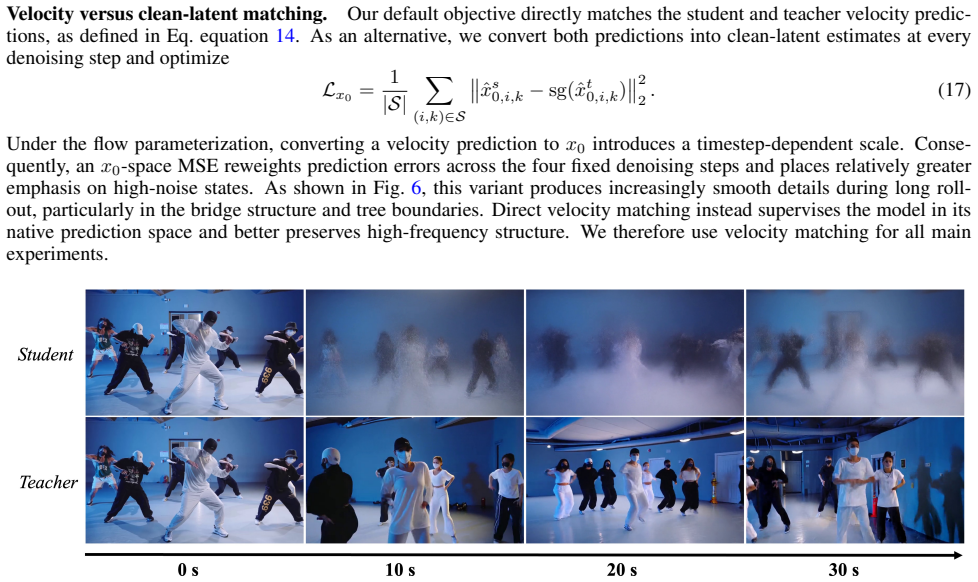
- domain assumption Velocity matching in the native prediction space is superior to clean-latent (x0) matching for long-rollout supervision.
- domain assumption Stop-gradient through the solver transition (Eq. 6) does not materially harm the training signal.
invented entities (1)
-
AR-consistent real-video teacher cache
independent evidence
read the original abstract
We propose OPSD-V, an on-policy self-distillation paradigm for post-training few-step autoregressive (AR) video diffusion models. Existing few-step AR video generators can produce long videos with low latency, but still suffer from error accumulation and weakened motion dynamics during long autoregressive rollout. OPSD-V reduces long-horizon degradation while preserving the original few-step inference path. The key idea is to introduce real long-video data as temporal context during training and use it to provide dense trajectory-level supervision. Specifically, the student follows the exact inference-time rollout, generating each chunk conditioned on its own previously generated KV cache. In parallel, the teacher is evaluated at the same student-visited denoising states, but uses a cleaner AR-consistent temporal cache in which older history can be replaced by real-video context. This provides dense denoising-level corrective targets under on-policy AR cache dynamics, without changing the sampler, number of denoising steps, or inference-time cache mechanism. We apply OPSD-V to representative few-step AR video models, including Self-Forcing and LongLive. Experiments show consistent improvements in visual quality, motion dynamics, and VBenchLong scores. A user study with 10 participants comparing 20 video pairs shows that OPSD-V is preferred over the base models in 66.0% of overall-preference judgments (82.5% excluding ties).
Figures


Reference graph
Works this paper leans on
-
[1]
MAGI-1: Autoregressive Video Generation at Scale
URLhttps: //arxiv.org/abs/2505.13211. Philip J. Ball, Jakob Bauer, Frank Belletti, Bethanie Brownfield, Ariel Ephrat, Shlomi Fruchter, Agrim Gupta, Kristian Holsheimer, Aleksander Holynski, Jiri Hron, Christos Kaplanis, Marjorie Limont, Matt McGill, Yanko Oliveira, Jack Parker-Holder, Frank Perbet, Guy Scully, Jeremy Shar, Stephen Spencer, Omer Tov, Ruben...
work page internal anchor Pith review Pith/arXiv arXiv
-
[2]
Diffusion Forcing: Next-token Prediction Meets Full-Sequence Diffusion
Boyuan Chen, Diego Monso, Yilun Du, Max Simchowitz, Russ Tedrake, and Vincent Sitzmann. Diffusion forcing: Next- token prediction meets full-sequence diffusion.arXiv preprint arXiv:2407.01392,
work page internal anchor Pith review Pith/arXiv arXiv
-
[3]
SkyReels-V2: Infinite-length Film Generative Model
URLhttps://arxiv.org/abs/2504.13074. Justin Cui, Jie Wu, Ming Li, Tao Yang, Xiaojie Li, Rui Wang, Andrew Bai, Yuanhao Ban, and Cho-Jui Hsieh. Self- forcing++: Towards minute-scale high-quality video generation.arXiv preprint arXiv:2510.02283,
work page internal anchor Pith review Pith/arXiv arXiv
-
[4]
Flow-OPD: On-Policy Distillation for Flow Matching Models
Zhen Fang, Wenxuan Huang, Yu Zeng, Yiming Zhao, Shuang Chen, Kaituo Feng, Yunlong Lin, Lin Chen, Zehui Chen, Shaosheng Cao, and Feng Zhao. Flow-opd: On-policy distillation for flow matching models.arXiv preprint arXiv:2605.08063,
work page internal anchor Pith review Pith/arXiv arXiv
-
[5]
AnyFlow: Any-Step Video Diffusion Model with On-Policy Flow Map Distillation
Yuchao Gu, Guian Fang, Yuxin Jiang, Weijia Mao, Song Han, Han Cai, and Mike Zheng Shou. Anyflow: Any-step video diffusion model with on-policy flow map distillation.arXiv preprint arXiv:2605.13724,
work page internal anchor Pith review Pith/arXiv arXiv
-
[6]
LTX-2: Efficient Joint Audio-Visual Foundation Model
Yoav HaCohen, Benny Brazowski, Nisan Chiprut, Yaki Bitterman, Andrew Kvochko, Avishai Berkowitz, Daniel Shalem, Daphna Lifschitz, Dudu Moshe, Eitan Porat, et al. Ltx-2: Efficient joint audio-visual foundation model.arXiv preprint arXiv:2601.03233,
work page internal anchor Pith review Pith/arXiv arXiv
-
[7]
Self-Distillation Zero: Self-Revision Turns Binary Rewards into Dense Supervision
15 Yinghui He, Simran Kaur, Adithya Bhaskar, Yongjin Yang, Jiarui Liu, Narutatsu Ri, Liam Fowl, Abhishek Panigrahi, Danqi Chen, and Sanjeev Arora. Self-distillation zero: Self-revision turns binary rewards into dense supervision.arXiv preprint arXiv:2604.12002,
work page internal anchor Pith review Pith/arXiv arXiv
-
[8]
Self Forcing: Bridging the Train-Test Gap in Autoregressive Video Diffusion
Xun Huang, Zhengqi Li, Guande He, Mingyuan Zhou, and Eli Shechtman. Self forcing: Bridging the train-test gap in autoregressive video diffusion.arXiv preprint arXiv:2506.08009, 2025a. Ziqi Huang, Fan Zhang, Xiaojie Xu, Yinan He, Jiashuo Yu, Ziyue Dong, Qianli Ma, Nattapol Chanpaisit, Chenyang Si, Yuming Jiang, et al. Vbench++: Comprehensive and versatile ...
work page internal anchor Pith review Pith/arXiv arXiv
-
[9]
D-OPSD: On-Policy Self-Distillation for Continuously Tuning Step-Distilled Diffusion Models
Dengyang Jiang, Xin Jin, Dongyang Liu, Zanyi Wang, Mingzhe Zheng, Ruoyi Du, Xiangpeng Yang, Qilong Wu, Zhen Li, Peng Gao, Harry Yang, and Steven Hoi. D-opsd: On-policy self-distillation for continuously tuning step-distilled diffusion models.arXiv preprint arXiv:2605.05204,
work page internal anchor Pith review Pith/arXiv arXiv
-
[10]
Pyramidal flow matching for efficient video generative modeling
Yang Jin, Zhicheng Sun, Ningyuan Li, Kun Xu, Hao Jiang, Nan Zhuang, Quzhe Huang, Yang Song, Yadong Mu, and Zhouchen Lin. Pyramidal flow matching for efficient video generative modeling. InInternational Conference on Learning Representations, volume 2025, pp. 23378–23402,
work page 2025
-
[11]
HunyuanVideo: A Systematic Framework For Large Video Generative Models
Weijie Kong, Qi Tian, Zijian Zhang, et al. Hunyuanvideo: A systematic framework for large video generative models. arXiv preprint arXiv:2412.03603,
work page internal anchor Pith review Pith/arXiv arXiv
-
[12]
Haodong Li, Shaoteng Liu, Zhe Lin, and Manmohan Chandraker. Rolling sink: Bridging limited-horizon training and open-ended testing in autoregressive video diffusion.arXiv preprint arXiv:2602.07775, 2026a. Lin Li, Qihang Zhang, Yiming Luo, Shuai Yang, Ruilin Wang, Fei Han, Mingrui Yu, Zelin Gao, Nan Xue, Xing Zhu, Yujun Shen, and Yinghao Xu. Causal world m...
work page internal anchor Pith review Pith/arXiv arXiv
-
[13]
Dongyang Liu, Peng Gao, David Liu, Ruoyi Du, Zhen Li, Qilong Wu, Xin Jin, Sihan Cao, Shifeng Zhang, Hongsheng Li, and Steven Hoi. Decoupled dmd: Cfg augmentation as the spear, distribution matching as the shield.arXiv preprint arXiv:2511.22677, 2025a. Kunhao Liu, Wenbo Hu, Jiale Xu, Ying Shan, and Shijian Lu. Rolling forcing: Autoregressive long video dif...
-
[14]
Longcat-video technical report.arXiv preprint arXiv:2510.22200,
Meituan LongCat Team, Xunliang Cai, Qilong Huang, Zhuoliang Kang, Hongyu Li, Shijun Liang, Liya Ma, Siyu Ren, Xiaoming Wei, Rixu Xie, and Tong Zhang. Longcat-video technical report.arXiv preprint arXiv:2510.22200,
-
[15]
Scalable Diffusion Models with Transformers
William Peebles and Saining Xie. Scalable diffusion models with transformers.arXiv preprint arXiv:2212.09748,
work page internal anchor Pith review Pith/arXiv arXiv
-
[16]
Movie Gen: A Cast of Media Foundation Models
Adam Polyak, Amit Zohar, Andrew Brown, Andros Tjandra, Animesh Sinha, Ann Lee, Apoorv Vyas, Bowen Shi, Chih- Yao Ma, Ching-Yao Chuang, et al. Movie gen: A cast of media foundation models.arXiv preprint arXiv:2410.13720,
work page internal anchor Pith review Pith/arXiv arXiv
-
[17]
Self-Distillation Enables Continual Learning
Idan Shenfeld, Mehul Damani, Jonas Hübotter, and Pulkit Agrawal. Self-distillation enables continual learning.arXiv preprint arXiv:2601.19897,
work page internal anchor Pith review Pith/arXiv arXiv
-
[18]
Joonghyuk Shin, Zhengqi Li, Richard Zhang, Jun-Yan Zhu, Jaesik Park, Eli Shechtman, and Xun Huang. Motionstream: Real-time video generation with interactive motion controls.arXiv preprint arXiv:2511.01266,
-
[19]
Denoising Diffusion Implicit Models
16 Jiaming Song, Chenlin Meng, and Stefano Ermon. Denoising diffusion implicit models.arXiv preprint arXiv:2010.02502,
work page internal anchor Pith review Pith/arXiv arXiv 2010
-
[20]
LongCat-Video-Avatar 1.5 Technical Report
Meituan LongCat Team, Xunliang Cai, Meng Cheng, Feng Gao, Zhe Kong, Jiamu Li, Le Li, Weiheng Li, Hongyu Liu, Shuai Tan, et al. Longcat-video-avatar 1.5 technical report.arXiv preprint arXiv:2605.26486, 2026a. Robbyant Team, Zelin Gao, Qiuyu Wang, Yanhong Zeng, Jiapeng Zhu, Ka Leong Cheng, Yixuan Li, Hanlin Wang, Yinghao Xu, Shuailei Ma, Yihang Chen, Jie L...
work page internal anchor Pith review Pith/arXiv arXiv
-
[21]
Flowact-r1: Towards interactive humanoid video generation.arXiv preprint arXiv:2601.10103,
Lizhen Wang, Yongming Zhu, Zhipeng Ge, Youwei Zheng, Longhao Zhang, Tianshu Hu, Shiyang Qin, Mingshuang Luo, Jiaxu Zhang, Xin Chen, et al. Flowact-r1: Towards interactive humanoid video generation.arXiv preprint arXiv:2601.10103,
-
[22]
InfiniteTalk: Audio-driven Video Generation for Sparse-Frame Video Dubbing
Shaoshu Yang, Zhe Kong, Feng Gao, Meng Cheng, Xiangyu Liu, Yong Zhang, Zhuoliang Kang, Wenhan Luo, Xunliang Cai, Ran He, and Xiaoming Wei. Infinitetalk: Audio-driven video generation for sparse-frame video dubbing, 2025a. URLhttps://arxiv.org/abs/2508.14033. Shuai Yang, Wei Huang, Ruihang Chu, Yicheng Xiao, Yuyang Zhao, Xianbang Wang, Muyang Li, Enze Xie,...
work page internal anchor Pith review Pith/arXiv arXiv
-
[23]
World Action Models are Zero-shot Policies
URLhttps: //arxiv.org/abs/2602.15922. Hidir Yesiltepe, Tuna Meral, Adil Kaan Akan, Kaan Oktay, and Pinar Yanardag. Infinity-rope: Action-controllable infinite video generation emerges from autoregressive self-rollout. InProceedings of the IEEE/CVF Conference on Computer Vision and Pattern Recognition, pp. 40256–40265,
work page internal anchor Pith review Pith/arXiv arXiv
-
[24]
Jung Yi, Wooseok Jang, Paul Hyunbin Cho, Jisu Nam, Heeji Yoon, and Seungryong Kim. Deep forcing: Training-free long video generation with deep sink and participative compression.arXiv preprint arXiv:2512.05081,
-
[25]
One-step Diffusion with Distribution Matching Distillation
Tianwei Yin, Michaël Gharbi, Richard Zhang, Eli Shechtman, Fredo Durand, William T. Freeman, and Taesung Park. One-step diffusion with distribution matching distillation.arXiv preprint arXiv:2311.18828,
work page internal anchor Pith review Pith/arXiv arXiv
-
[26]
Reward-Forcing: Autoregressive Video Generation with Reward Feedback
Jingran Zhang, Ning Li, Yuanhao Ban, Andrew Bai, and Justin Cui. Reward-forcing: Autoregressive video generation with reward feedback.arXiv preprint arXiv:2601.16933,
work page internal anchor Pith review Pith/arXiv arXiv
-
[27]
Self-Distilled Reasoner: On-Policy Self-Distillation for Large Language Models
17 Siyan Zhao, Zhihui Xie, Mengchen Liu, Jing Huang, Guan Pang, Feiyu Chen, and Aditya Grover. Self-distilled reasoner: On-policy self-distillation for large language models.arXiv preprint arXiv:2601.18734,
work page internal anchor Pith review Pith/arXiv arXiv
-
[28]
Open-Sora: Democratizing Efficient Video Production for All
Zangwei Zheng, Xiangyu Peng, Tianji Yang, Chenhui Shen, Shenggui Li, Hongxin Liu, Yukun Zhou, Tianyi Li, and Yang You. Open-sora: Democratizing efficient video production for all.arXiv preprint arXiv:2412.20404,
work page internal anchor Pith review Pith/arXiv arXiv
-
[29]
Hongzhou Zhu, Min Zhao, Guande He, Hang Su, Chongxuan Li, and Jun Zhu. Causal forcing: Autoregressive diffusion distillation done right for high-quality real-time interactive video generation.arXiv preprint arXiv:2602.02214, 2026
work page internal anchor Pith review Pith/arXiv arXiv 2026
discussion (0)
Sign in with ORCID, Apple, or X to comment. Anyone can read and Pith papers without signing in.