Interpreting "Interpretability" and Explaining "Explainability" in Machine Learning in Physics
Pith reviewed 2026-06-26 00:51 UTC · model grok-4.3
The pith
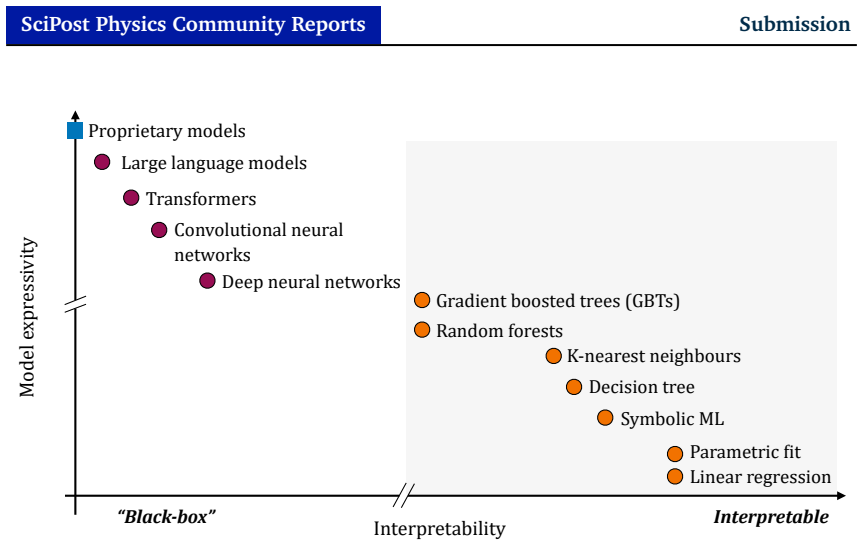
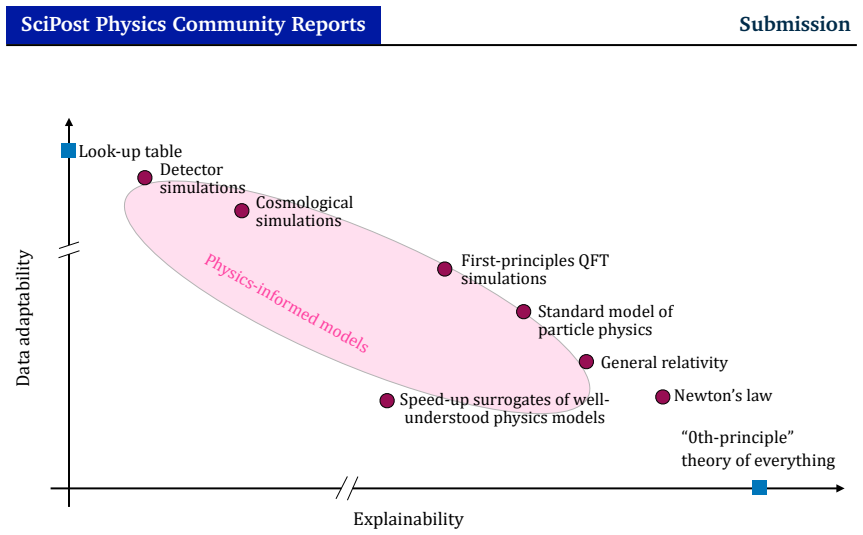
Machine-learned models in physics face the same scientific questions as classical models, with interpretability and explainability treated as deliberate design choices.
A machine-rendered reading of the paper's core claim, the machinery that carries it, and where it could break.
Core claim
Interpretability concerns the structural transparency of a model while explainability concerns its scientific content through mapping onto domain knowledge; both are deliberate modeling choices rather than inherent properties, and machine-learned models remain subject to the same scientific questions as classical models, differing only in scale.
What carries the argument
The distinction between structural transparency (interpretability) and domain-knowledge mapping (explainability), together with their respective trade-offs against expressivity and adaptability.
If this is right
- Model design must include explicit choices about the level of structural transparency required for a given task.
- Post-hoc tools become necessary when intrinsic structure alone cannot deliver the needed domain mapping.
- Task specification determines whether interpretability, explainability, or neither is prioritized.
- Intervention plans must be part of the initial model architecture rather than added afterward.
Where Pith is reading between the lines
- The same distinction could guide model choices in other data-intensive sciences where domain mapping is central.
- Reframing the properties as choices suggests new architectures that optimize one dimension while accepting limits on the other.
- It implies that discussions of black-box models can shift from prohibition to calibrated trade-off decisions based on the physics task.
Load-bearing premise
The proposed distinction between structural transparency and domain-knowledge mapping captures the primary practical and conceptual needs when applying machine learning to physics problems.
What would settle it
An example of a machine-learned physics model that cannot be made scientifically usable without simultaneously achieving both high structural transparency and high domain-knowledge mapping, or a case in which a machine-learned model evades the standard scientific questions applied to classical models.
Figures

read the original abstract
We review the concepts of interpretability and explainability as they apply to machine learning in physics. We define interpretability as concerning the structural transparency of a model (the ability to understand or approximate its inner workings) and explainability as concerning the scientific content of a model (the ability to map it onto domain knowledge). We discuss the trade-offs each entails (interpretability vs. expressivity; explainability vs. adaptability), the contexts in which each is needed, and the intrinsic and post-hoc tools available for achieving them. Throughout, we emphasize that machine-learned models are subject to the same scientific questions as classical models, differing only in scale, and that interpretability and explainability are best understood as deliberate modeling choices rather than inherent properties. We also emphasize the importance of task specification and intervention plans as a core aspect of model design.
Editorial analysis
A structured set of objections, weighed in public.
Referee Report
Summary. The manuscript reviews interpretability and explainability in machine learning applied to physics. It defines interpretability as structural transparency (understanding or approximating inner workings) and explainability as the ability to map the model onto domain knowledge. The paper discusses associated trade-offs (interpretability vs. expressivity; explainability vs. adaptability), the contexts in which each is relevant, and available tools. It argues that machine-learned models face the same scientific questions as classical models (differing only in scale), positions interpretability and explainability as deliberate modeling choices rather than inherent properties, and stresses the importance of task specification and intervention plans as core aspects of model design.
Significance. If the proposed distinction and framing hold, the paper offers a clear conceptual scaffold that could help physicists treat ML models with the same scrutiny applied to traditional models. Framing these properties as choices rather than fixed attributes encourages explicit design decisions around transparency and scientific utility. The emphasis on task specification aligns with standard scientific practice and may reduce misuse of black-box models in physics applications.
minor comments (2)
- [Abstract] Abstract: the trade-off discussion is stated at a high level; adding one or two brief physics-specific examples (e.g., in a regression or classification task) would make the distinction between structural transparency and domain mapping more concrete without altering the central argument.
- The manuscript would benefit from explicit cross-references to key prior reviews on interpretability in the physical sciences to situate the proposed definitions relative to existing usage in the literature.
Simulated Author's Rebuttal
We thank the referee for the positive and accurate summary of the manuscript, as well as the recommendation for minor revision. The assessment that the proposed distinction offers a useful conceptual scaffold and that framing these properties as deliberate choices aligns with scientific practice is encouraging. No major comments were provided in the report.
Circularity Check
No significant circularity
full rationale
The manuscript is a conceptual review paper that defines interpretability (structural transparency) and explainability (domain-knowledge mapping) as deliberate modeling choices. It contains no equations, no fitted parameters, no derivations, and no predictions that could reduce to inputs by construction. All claims are discursive and definitional; the central reframing (ML models face the same scientific questions as classical models, differing only in scale) is presented as a modeling perspective rather than a derived result. No self-citation load-bearing steps, uniqueness theorems, or ansatzes appear. The derivation chain is empty by design.
Axiom & Free-Parameter Ledger
axioms (1)
- domain assumption Interpretability and explainability are best treated as deliberate modeling choices rather than fixed properties of any given algorithm.
Reference graph
Works this paper leans on
-
[1]
2019 , eprint=
Challenging Common Assumptions in the Unsupervised Learning of Disentangled Representations , author=. 2019 , eprint=
2019
-
[2]
E(2) Equivariant Neural Networks for Robust Galaxy Morphology Classification. arXiv e-prints , keywords =. doi:10.48550/arXiv.2311.01500 , archivePrefix =. 2311.01500 , primaryClass =
-
[3]
Rotation-invariant convolutional neural networks for galaxy morphology prediction
Rotation-invariant convolutional neural networks for galaxy morphology prediction. , keywords =. doi:10.1093/mnras/stv632 , archivePrefix =. 1503.07077 , primaryClass =
work page internal anchor Pith review Pith/arXiv arXiv doi:10.1093/mnras/stv632
-
[4]
KiDS-SBI: Simulation-based inference analysis of KiDS-1000 cosmic shear
von Wietersheim-Kramsta, Maximilian and Lin, Kiyam and Tessore, Nicolas and Joachimi, Benjamin and Loureiro, Arthur and Reischke, Robert and Wright, Angus H. KiDS-SBI: Simulation-based inference analysis of KiDS-1000 cosmic shear. Astron. Astrophys. 2025. doi:10.1051/0004-6361/202450487. arXiv:2404.15402
-
[5]
Deep learning insights into cosmological structure formation , author =. Phys. Rev. D , volume =. 2024 , month =. doi:10.1103/PhysRevD.109.063524 , url =
-
[6]
DeepLSS: Breaking Parameter Degeneracies in Large-Scale Structure with Deep-Learning Analysis of Combined Probes , author =. Phys. Rev. X , volume =. 2022 , month =. doi:10.1103/PhysRevX.12.031029 , url =
-
[7]
Ntampaka, Michelle and Vikhlinin, Alexey , year=. The Importance of Being Interpretable: Toward an Understandable Machine Learning Encoder for Galaxy Cluster Cosmology , volume=. The Astrophysical Journal , publisher=. doi:10.3847/1538-4357/ac423e , number=
-
[8]
Interpreting deep learning models for weak lensing , author =. Phys. Rev. D , volume =. 2020 , month =. doi:10.1103/PhysRevD.102.123506 , url =
-
[9]
Real-Time Gravitational Wave Science with Neural Posterior Estimation , author =. Phys. Rev. Lett. , volume =. 2021 , month =. doi:10.1103/PhysRevLett.127.241103 , url =
-
[10]
Z. Dark energy survey year 3 results: Cosmology with peaks using an emulator approach. Mon. Not. Roy. Astron. Soc. 2022. doi:10.1093/mnras/stac078. arXiv:2110.10135
-
[11]
Jeffrey, N. and others. Dark energy survey year 3 results: likelihood-free, simulation-based wCDM inference with neural compression of weak-lensing map statistics. Mon. Not. Roy. Astron. Soc. 2024. doi:10.1093/mnras/stae2629. arXiv:2403.02314
-
[12]
Nature Reviews Physics , keywords =
Cosmological simulations of galaxy formation. Nature Reviews Physics , keywords =. doi:10.1038/s42254-019-0127-2 , archivePrefix =. 1909.07976 , primaryClass =
-
[13]
Discovering Physical Concepts with Neural Networks
Iten, Raban and Metger, Tony and Wilming, Henrik and del Rio, L \' dia and Renner, Renato. Discovering Physical Concepts with Neural Networks. Phys. Rev. Lett. 2020. doi:10.1103/PhysRevLett.124.010508. arXiv:1807.10300
-
[14]
International Conference on Learning Representations , year =
Higgins, Irina and Matthey, Loic and Pal, Arka and Burgess, Christopher and Glorot, Xavier and Botvinick, Matthew and Mohamed, Shakir and Lerchner, Alexander , title =. International Conference on Learning Representations , year =. 1804.03599 , archivePrefix =
-
[15]
Advances in Neural Information Processing Systems , volume =
Chen, Xi and Duan, Yan and Houthooft, Rein and Schulman, John and Sutskever, Ilya and Abbeel, Pieter , title =. Advances in Neural Information Processing Systems , volume =. 2016 , eprint =
2016
-
[16]
Machine Learning: Science and Technology , keywords =
Predicting the thermal Sunyaev-Zel'dovich field using modular and equivariant set-based neural networks. Machine Learning: Science and Technology , keywords =. doi:10.1088/2632-2153/ac78c2 , archivePrefix =. 2203.00026 , primaryClass =
-
[17]
Fanaroff-Riley classification of radio galaxies using group-equivariant convolutional neural networks. , keywords =. doi:10.1093/mnras/stab530 , archivePrefix =. 2102.08252 , primaryClass =
-
[18]
Physics-informed neural networks in the recreation of hydrodynamic simulations from dark matter.Mon
Physics-informed neural networks in the recreation of hydrodynamic simulations from dark matter. , keywords =. doi:10.1093/mnras/stad3394 , archivePrefix =. 2303.14090 , primaryClass =
-
[19]
2025 , eprint=
SPINN: Advancing Cosmological Simulations of Fuzzy Dark Matter with Physics Informed Neural Networks , author=. 2025 , eprint=
2025
-
[20]
The Mira-Titan Universe. III. Emulation of the Halo Mass Function. , keywords =. doi:10.3847/1538-4357/abac5c , archivePrefix =. 2003.12116 , primaryClass =
-
[21]
Aricò, Giovanni and Angulo, Raul E and Contreras, Sergio and Ondaro-Mallea, Lurdes and Pellejero-Ibañez, Marcos and Zennaro, Matteo , year=. The BACCO simulation project: a baryonification emulator with neural networks , volume=. Monthly Notices of the Royal Astronomical Society , publisher=. doi:10.1093/mnras/stab1911 , number=
-
[22]
Toward a halo mass function for precision cosmology: the limits of universality
Tinker, Jeremy L. and Kravtsov, Andrey V. and Klypin, Anatoly and Abazajian, Kevork and Warren, Michael S. and Yepes, Gustavo and Gottlober, Stefan and Holz, Daniel E. Toward a halo mass function for precision cosmology: The Limits of universality. Astrophys. J. 2008. doi:10.1086/591439. arXiv:0803.2706
work page internal anchor Pith review Pith/arXiv arXiv doi:10.1086/591439 2008
-
[23]
The Structure of Cold Dark Matter Halos. , keywords =. doi:10.1086/177173 , archivePrefix =
-
[24]
Trudy Astrofizicheskogo Instituta Alma-Ata , year = 1965, month = jan, volume =
On the Construction of a Composite Model for the Galaxy and on the Determination of the System of Galactic Parameters. Trudy Astrofizicheskogo Instituta Alma-Ata , year = 1965, month = jan, volume =
1965
-
[25]
Springel, Volker. The Cosmological simulation code GADGET-2. Mon. Not. Roy. Astron. Soc. 2005. doi:10.1111/j.1365-2966.2005.09655.x. arXiv:astro-ph/0505010
-
[26]
Efficient Computation of CMB anisotropies in closed FRW models
Lewis, Antony and Challinor, Anthony and Lasenby, Anthony. Efficient computation of CMB anisotropies in closed FRW models. 2000. doi:10.1086/309179. arXiv:astro-ph/9911177
work page internal anchor Pith review Pith/arXiv arXiv doi:10.1086/309179 2000
-
[27]
The EAGLE project: Simulating the evolution and assembly of galaxies and their environments
The EAGLE project: simulating the evolution and assembly of galaxies and their environments. , keywords =. doi:10.1093/mnras/stu2058 , archivePrefix =. 1407.7040 , primaryClass =
work page internal anchor Pith review Pith/arXiv arXiv doi:10.1093/mnras/stu2058
-
[28]
2019, MNRAS, 490, 3196, doi: 10.1093/mnras/stz2338
First results from the TNG50 simulation: the evolution of stellar and gaseous discs across cosmic time. , keywords =. doi:10.1093/mnras/stz2338 , archivePrefix =. 1902.05553 , primaryClass =
-
[29]
Introducing the Illustris Project: simulating the coevolution of dark and visible matter in the Universe. , keywords =. doi:10.1093/mnras/stu1536 , archivePrefix =. 1405.2921 , primaryClass =
work page internal anchor Pith review Pith/arXiv arXiv doi:10.1093/mnras/stu1536
-
[30]
The Cosmic Linear Anisotropy Solving System (CLASS) II: Approximation schemes
The Cosmic Linear Anisotropy Solving System (CLASS). Part II: Approximation schemes. , keywords =. doi:10.1088/1475-7516/2011/07/034 , archivePrefix =. 1104.2933 , primaryClass =
work page internal anchor Pith review Pith/arXiv arXiv doi:10.1088/1475-7516/2011/07/034 2011
-
[31]
TPZ: photometric redshift PDFs and ancillary information by using prediction trees and random forests. , keywords =. doi:10.1093/mnras/stt574 , archivePrefix =. 1303.7269 , primaryClass =
work page internal anchor Pith review Pith/arXiv arXiv doi:10.1093/mnras/stt574
-
[32]
ANNz: estimating photometric redshifts using artificial neural networks
ANNz: Estimating Photometric Redshifts Using Artificial Neural Networks. , keywords =. doi:10.1086/383254 , archivePrefix =. astro-ph/0311058 , primaryClass =
work page internal anchor Pith review Pith/arXiv arXiv doi:10.1086/383254
-
[33]
Spurio Mancini, Alessio and Piras, Davide and Alsing, Justin and Joachimi, Benjamin and Hobson, Michael P , year=. CosmoPower: emulating cosmological power spectra for accelerated Bayesian inference from next-generation surveys , volume=. Monthly Notices of the Royal Astronomical Society , publisher=. doi:10.1093/mnras/stac064 , number=
-
[34]
Advances in Neural Information Processing Systems 30 , editor =
A Unified Approach to Interpreting Model Predictions , author =. Advances in Neural Information Processing Systems 30 , editor =. 2017 , publisher =
2017
-
[35]
2017 , eprint=
SmoothGrad: removing noise by adding noise , author=. 2017 , eprint=
2017
-
[36]
International Journal of Computer Vision , author =
Selvaraju, Ramprasaath R. and Cogswell, Michael and Das, Abhishek and Vedantam, Ramakrishna and Parikh, Devi and Batra, Dhruv , year=. Grad-CAM: Visual Explanations from Deep Networks via Gradient-Based Localization , volume=. International Journal of Computer Vision , publisher=. doi:10.1007/s11263-019-01228-7 , number=
-
[37]
2015 , eprint=
Learning Deep Features for Discriminative Localization , author=. 2015 , eprint=
2015
-
[38]
2014 , eprint=
Deep Inside Convolutional Networks: Visualising Image Classification Models and Saliency Maps , author=. 2014 , eprint=
2014
-
[39]
Why should i trust you?
" Why should i trust you?" Explaining the predictions of any classifier , author=. Proceedings of the 22nd ACM SIGKDD international conference on knowledge discovery and data mining , pages=
-
[40]
Piras, Davide and Herold, Laura and Lucie-Smith, Luisa and Komatsu, Eiichiro. CDM and early dark energy in latent space: A data-driven parametrization of the CMB temperature power spectrum. Phys. Rev. D. 2025. doi:10.1103/PhysRevD.111.083537. arXiv:2502.09810
-
[41]
Lucie-Smith, Luisa and Peiris, Hiranya V. and Pontzen, Andrew. Explaining Dark Matter Halo Density Profiles with Neural Networks. Phys. Rev. Lett. 2024. doi:10.1103/PhysRevLett.132.031001. arXiv:2305.03077
-
[42]
A deep-learning model for the density profiles of subhaloes in IllustrisTNG
Lucie-Smith, Luisa and Despali, Giulia and Springel, Volker. A deep-learning model for the density profiles of subhaloes in IllustrisTNG. Mon. Not. Roy. Astron. Soc. 2024. doi:10.1093/mnras/stae1487. arXiv:2403.12125
-
[43]
and Pontzen, Andrew and Piras, Davide
Guo, Ningyuan and Lucie-Smith, Luisa and Peiris, Hiranya V. and Pontzen, Andrew and Piras, Davide. Deep learning insights into non-universality in the halo mass function. Mon. Not. Roy. Astron. Soc. 2024. doi:10.1093/mnras/stae1696. arXiv:2405.15850
-
[44]
Lucie-Smith, Luisa and Peiris, Hiranya V. and Pontzen, Andrew. An interpretable machine learning framework for dark matter halo formation. Mon. Not. Roy. Astron. Soc. 2019. doi:10.1093/mnras/stz2599. arXiv:1906.06339
-
[45]
Insights into the origin of halo mass profiles from machine learning
Lucie-Smith, Luisa and Adhikari, Susmita and Wechsler, Risa H. Insights into the origin of halo mass profiles from machine learning. Mon. Not. Roy. Astron. Soc. 2022. doi:10.1093/mnras/stac1833. arXiv:2205.04474
-
[46]
and Pontzen, Andrew and Nord, Brian and Thiyagalingam, Jeyan and Piras, Davide
Lucie-Smith, Luisa and Peiris, Hiranya V. and Pontzen, Andrew and Nord, Brian and Thiyagalingam, Jeyan and Piras, Davide. Discovering the building blocks of dark matter halo density profiles with neural networks. Phys. Rev. D. 2022. doi:10.1103/PhysRevD.105.103533. arXiv:2203.08827
-
[47]
Interpretable Machine Learning for Science with PySR and SymbolicRegression.jl
Interpretable Machine Learning for Science with PySR and SymbolicRegression.jl. arXiv e-prints , keywords =. doi:10.48550/arXiv.2305.01582 , archivePrefix =. 2305.01582 , primaryClass =
work page internal anchor Pith review Pith/arXiv arXiv doi:10.48550/arxiv.2305.01582
-
[48]
2026 , eprint=
Why do we do astrophysics? , author=. 2026 , eprint=
2026
-
[49]
Arico’, Giovanni and Angulo, Raul and Zennaro, Matteo , year=. Accelerating Large-Scale-Structure data analyses by emulating Boltzmann solvers and Lagrangian Perturbation Theory , volume=. doi:10.12688/openreseurope.14310.2 , journal=
-
[50]
Lehman, Kai and Schuster, Nico and Lucie-Smith, Luisa and Hamaus, Nico and Davies, Christopher T. and Dolag, Klaus , year=. Cosmological inference with cosmic voids and neural network emulators , volume=. doi:10.1051/0004-6361/202554592 , journal=
-
[51]
SPECULATOR: Emulating Stellar Population Synthesis for Fast and Accurate Galaxy Spectra and Photometry. , keywords =. doi:10.3847/1538-4365/ab917f , archivePrefix =. 1911.11778 , primaryClass =
-
[52]
Despali, Giulia and Giocoli, Carlo and Angulo, Raul E. and Tormen, Giuseppe and Sheth, Ravi K. and Baso, Giacomo and Moscardini, Lauro. The universality of the virial halo mass function and models for non-universality of other halo definitions. Mon. Not. Roy. Astron. Soc. 2016. doi:10.1093/mnras/stv2842. arXiv:1507.05627
work page internal anchor Pith review Pith/arXiv arXiv doi:10.1093/mnras/stv2842 2016
-
[53]
Marcinkevičs, Ričards and Vogt, Julia E. , title =. WIREs Data Mining and Knowledge Discovery , volume =. doi:https://doi.org/10.1002/widm.1493 , url =. https://wires.onlinelibrary.wiley.com/doi/pdf/10.1002/widm.1493 , abstract =
-
[54]
A comprehensive guide to the physics and usage of PYTHIA 8.3
Bierlich, Christian and others. A comprehensive guide to the physics and usage of PYTHIA 8.3. SciPost Phys. Codeb. 2022. doi:10.21468/SciPostPhysCodeb.8. arXiv:2203.11601
work page internal anchor Pith review Pith/arXiv arXiv doi:10.21468/scipostphyscodeb.8 2022
-
[55]
Alwall, Johan and Herquet, Michel and Maltoni, Fabio and Mattelaer, Olivier and Stelzer, Tim. MadGraph 5 : Going Beyond. JHEP. 2011. doi:10.1007/JHEP06(2011)128. arXiv:1106.0522
work page internal anchor Pith review Pith/arXiv arXiv doi:10.1007/jhep06(2011)128 2011
-
[56]
Agostinelli, S. and others. GEANT4 - A Simulation Toolkit. Nucl. Instrum. Meth. A. 2003. doi:10.1016/S0168-9002(03)01368-8
-
[57]
Menzo, Tony and Roman, Alexander and Gleyzer, Sergei and Matchev, Konstantin and Fleming, George T. and H. HEPTAPOD: Orchestrating High Energy Physics Workflows Towards Autonomous Agency. 2025. arXiv:2512.15867
arXiv 2025
-
[58]
Bakshi, S. D. and others. ArgoLOOM: agentic AI for fundamental physics from quarks to cosmos. 2025. arXiv:2510.02426
arXiv 2025
-
[59]
Plehn, Tilman and Schiller, Daniel and Schmal, Nikita. MadAgents. 2026. arXiv:2601.21015
Pith/arXiv arXiv 2026
-
[60]
2015 , eprint=
Distilling the Knowledge in a Neural Network , author=. 2015 , eprint=
2015
-
[61]
2019 , eprint=
On the Spectral Bias of Neural Networks , author=. 2019 , eprint=
2019
-
[62]
The Pareto Frontier of Resilient Jet Tagging
Gambhir, Rikab and LeBlanc, Matt and Zhou, Yuanchen. The Pareto Frontier of Resilient Jet Tagging. 39th Annual Conference on Neural Information Processing Systems : Includes Machine Learning and the Physical Sciences (ML4PS). 2025. arXiv:2509.19431
arXiv 2025
-
[63]
Streamlining latent spaces in machine learning using moment pooling
Gambhir, Rikab and Osathapan, Athis and Thaler, Jesse. Streamlining latent spaces in machine learning using moment pooling. Phys. Rev. D. 2024. doi:10.1103/PhysRevD.110.074020. arXiv:2403.08854
-
[64]
2023 , eprint=
STL: Surprisingly Tricky Logic (for System Validation) , author=. 2023 , eprint=
2023
-
[65]
2019 , eprint=
Attention is not Explanation , author=. 2019 , eprint=
2019
-
[66]
Proceedings of the National Academy of Science , keywords =
Cranmer, Kyle and Brehmer, Johann and Louppe, Gilles , year=. The frontier of simulation-based inference , volume=. Proceedings of the National Academy of Sciences , publisher=. doi:10.1073/pnas.1912789117 , number=
-
[67]
CaloChallenge 2022: a community challenge for fast calorimeter simulation
Amram, Oz and others. CaloChallenge 2022: a community challenge for fast calorimeter simulation. Rept. Prog. Phys. 2025. doi:10.1088/1361-6633/ae1304. arXiv:2410.21611
-
[68]
and Kanwar, Gurtej and Romero-L \'o pez, Fernando and Shanahan, Phiala E
Abbott, Ryan and Boyda, Denis and Fu, Yang and Hackett, Daniel C. and Kanwar, Gurtej and Romero-L \'o pez, Fernando and Shanahan, Phiala E. and Urban, Julian M. Variance reduction in lattice QCD observables via normalizing flows. 2026. arXiv:2603.02984
arXiv 2026
-
[69]
Abbott, Ryan and Boyda, Denis and Kanwar, Gurtej and Romero-L \'o pez, Fernando and Hackett, Daniel C. and Shanahan, Phiala E. and Urban, Julian M. Progress in Normalizing Flows for 4d Gauge Theories. PoS. 2025. doi:10.22323/1.466.0066. arXiv:2502.00263
-
[70]
Machine-learning approaches to accelerating lattice simulations
Lawrence, Scott. Machine-learning approaches to accelerating lattice simulations. PoS. 2025. doi:10.22323/1.466.0010. arXiv:2502.02670
-
[71]
Fast inference of deep neural networks in FPGAs for particle physics
Duarte, Javier and others. Fast inference of deep neural networks in FPGAs for particle physics. JINST. 2018. doi:10.1088/1748-0221/13/07/P07027. arXiv:1804.06913
-
[72]
Bal, A. and Brandes, T. and Iemmi, F. and Klute, M. and Maier, B. and Mikuni, V. and Arrestad, T. K. Distilling particle knowledge for fast reconstruction at high-energy physics experiments. Mach. Learn. Sci. Tech. 2024. doi:10.1088/2632-2153/ad43b1. arXiv:2311.12551
-
[73]
hls4ml: A Flexible, Open-Source Platform for Deep Learning Acceleration on Reconfigurable Hardware
Schulte, Jan-Frederik and others. hls4ml: A Flexible, Open-Source Platform for Deep Learning Acceleration on Reconfigurable Hardware. 2025. arXiv:2512.01463
arXiv 2025
-
[74]
(Eds.), Contributions to the Theory of Games, Volume II
Shapley, Lloyd S. A Value for n -Person Games. Contributions to the Theory of Games. 1953. doi:10.1515/9781400881970-018
-
[75]
An operational definition of quark and gluon jets
Komiske, Patrick T. and Metodiev, Eric M. and Thaler, Jesse. An operational definition of quark and gluon jets. JHEP. 2018. doi:10.1007/JHEP11(2018)059. arXiv:1809.01140
work page internal anchor Pith review Pith/arXiv arXiv doi:10.1007/jhep11(2018)059 2018
-
[76]
Journal of High Energy Physics , year =
Komiske, Patrick T. and Metodiev, Eric M. and Thaler, Jesse. Energy Flow Networks: Deep Sets for Particle Jets. JHEP. 2019. doi:10.1007/JHEP01(2019)121. arXiv:1810.05165
-
[77]
and Gambhir, Rikab and Tasissa, Abiy and Thaler, Jesse
Ba, Demba and Dogra, Akshunna S. and Gambhir, Rikab and Tasissa, Abiy and Thaler, Jesse. SHAPER: can you hear the shape of a jet?. JHEP. 2023. doi:10.1007/JHEP06(2023)195. arXiv:2302.12266
-
[78]
and Youssef, Ahmed and Zupan, Jure
Bierlich, Christian and Ilten, Phil and Menzo, Tony and Mrenna, Stephen and Szewc, Manuel and Wilkinson, Michael K. and Youssef, Ahmed and Zupan, Jure. Describing hadronization via histories and observables for Monte-Carlo event reweighting. SciPost Phys. 2025. doi:10.21468/SciPostPhys.18.2.054. arXiv:2410.06342
-
[79]
Lorentz-Equivariant Geometric Algebra Transformers for High-Energy Physics
Spinner, Jonas and Bres \'o , Victor and de Haan, Pim and Plehn, Tilman and Thaler, Jesse and Brehmer, Johann. Lorentz-Equivariant Geometric Algebra Transformers for High-Energy Physics. 38th conference on Neural Information Processing Systems. 2024. arXiv:2405.14806
arXiv 2024
-
[80]
SEAL - A Symmetry EncourAging Loss for High Energy Physics
Hebbar, Pradyun and Madula, Thandikire and Mikuni, Vinicius and Nachman, Benjamin and Outmezguine, Nadav and Savoray, Inbar. SEAL - A Symmetry EncourAging Loss for High Energy Physics. 2025. arXiv:2511.01982
arXiv 2025
discussion (0)
Sign in with ORCID, Apple, or X to comment. Anyone can read and Pith papers without signing in.