REVIEW 3 major objections 5 minor 2 cited by
Automated Vehicles Should be Connected with Natural Language
T0 review · 3 major / 5 minor · reviewed 2026-08-06 · deepseek-v4-flash
Pith's one-line read This paper argues that natural language should become the foundational communication protocol for multi-agent collaborative driving, replacing raw sensor data, neural network features, and perception results as the primary exchange medium.
desk verdict A clear, honest position paper arguing for natural language as the V2X layer; the case holds as a research agenda, but the interoperability claim rests on an unproven shared-semantics assumption. read the letter →
The pith
A machine-rendered reading of the paper's core claim, the machinery that carries it, and where it could break.
The reading
What carries the argument
The load-bearing object is the natural-language V2X message as a universal exchange unit, for example: "I am slowing down because there is a cyclist on the right shoulder who appears unsteady." One short sentence simultaneously carries perception, assessment, intent, and rationale. The argument rests on the claim that this message type outperforms raw sensor data, neural features, and bounding-box or occupancy outputs on bandwidth, interoperability, adaptability, human compatibility, and decision-level coordination, and that large vision-language models make generation and interpretation feasible.
What would settle it
Measure the end-to-end latency and misinterpretation rate of a language-based V2X alert in a time-critical scenario, such as a pedestrian dart-out at an unsignalized intersection, using representative vision-language models on automotive-grade hardware. If message round-trip consistently exceeds the emergency-response budget on the order of 100 milliseconds, or produces a material fraction of wrong or ambiguous intents, the universal-language protocol fails at its core.
Extended reading notes
Core claim
The central claim is a design thesis: multi-agent collaborative driving has hit limits set by its communication media, and the medium that removes those limits is human natural language, generated and interpreted by large vision-language models. Existing media trade off bandwidth, completeness, and interoperability: raw sensor data exceeds available budgets, learned features break across heterogeneous agents, and perception results lose context and skip decision-level coordination. Natural language carries perception, state assessment, intended action, and causal reasoning in a single short message, scales its detail to channel conditions without protocol renegotiation, and provides a common channel for vehicles, roadside units, drones, pedestrians, and humans. The authors explicitly position language as the primary, universal protocol with structured numeric data as a complement, not as the exclusive medium.
Load-bearing premise
The whole argument depends on large vision-language models being able to generate and interpret safety-critical driving messages quickly and reliably enough for real-time use; the paper concedes the latency issue and only says specialized driving models are promising.
Editorial extensions
If this is right
- V2X systems should be redesigned around intent and reasoning messages, with structured numeric data used only where precision is genuinely required.
- Heterogeneous agents with different sensor suites, models, and manufacturers could interoperate without feature alignment or shared neural architectures.
- Decision-level collaboration, such as negotiation at intersections, merging, and emergency yielding, becomes direct and explicit rather than inferred from perception data.
- Human drivers and pedestrians can participate in the same communication channel, improving mixed-traffic safety and transparency.
- Messages can compress to short high-priority alerts during bandwidth limits or emergencies without protocol renegotiation.
Reading between the lines
- Beyond roads, the same logic likely extends to any setting where heterogeneous machines and people share space, such as warehouse robots, delivery drones, and pedestrian devices.
- The paper leaves implicit that language could serve as the semantic layer that labels and explains structured data, so hybrid protocols may converge on language-plus-numbers even if pure language falls short.
- A fair test of the latency premise would be whether distilled driving-specialized vision-language models can sustain a 10 Hz message exchange on automotive-grade hardware, since the paper concedes this is not yet demonstrated.
- The paper's hybrid caveat implies an open design problem: specifying a shared driving vocabulary and fallback rules for when language messages are ambiguous or missing.
Editorial analysis
A structured set of objections, weighed in public.
Referee Report
Summary. This position paper argues that natural language, processed by large vision-language models (LVLMs), should become the foundational communication protocol for multi-agent collaborative driving. It reviews existing communication media (raw sensor data, neural-network features, perception results), identifies challenges (bandwidth, heterogeneity, decision-level fusion, scenario variability, transparency), and then makes a case for natural language based on semantic richness, bandwidth efficiency, adaptability, interoperability, human compatibility, and support for intent communication. The paper acknowledges and responds to several counterarguments, including precision, latency, security, and hybrid approaches, and concludes with a call to prioritize research on natural-language V2X frameworks.
Significance. If the central thesis is correct, it would motivate a significant redesign of V2X architectures and a new research agenda for protocol-level natural-language semantics. The paper is clearly written and does a service by articulating a coherent alternative to data-oriented collaboration, gathering relevant recent literature, and explicitly engaging with counterarguments. It also makes honest concessions: Section 5.2 admits that LVLM latency is currently unproven, and Section 5.4 concedes that precise numeric data remains useful. However, the paper is argumentative rather than empirical, and its key load-bearing claim of universal interoperability rests on an unexamined assumption about shared semantics across independently trained LVLMs. The absence of quantitative support for the bandwidth comparisons and the lack of a concrete semantic-interoperability mechanism are the main weaknesses.
major comments (3)
- [§4.3, §5.1] The claim of model-agnostic interoperability is load-bearing but not established. Section 4.3 asserts that 'natural language carries semantics in the words themselves' and that any agent with a shared ontology can interpret it, yet no shared ontology, message grammar, or grounding mechanism is defined anywhere in the paper. The paper's own Section 3.2 warns that models with identical architectures trained on slightly different datasets exhibit 'silent divergences'; this applies directly to LVLMs trained on different driving corpora, which could ground phrases such as 'Entering now; intersection clear in three seconds' differently. Section 5.1's response appeals to 'consistent terminology and contextual grounding' and cites works on single models, but does not demonstrate cross-model agreement or propose a protocol-level specification of the encoding/decoding relation. Without this, natural language is a proposal for a protocol rather than the universal protocol the conclusions claim.
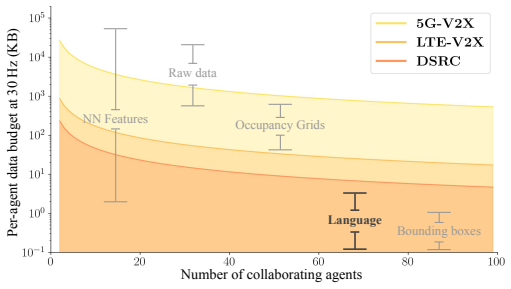
- [Figure 2, Table 1] The quantitative evidence for the bandwidth argument is unsubstantiated. Figure 2 presents a per-agent data budget comparison across communication protocols and data modalities, but the manuscript provides no data source, no calculation methodology, and no assumptions about message sizes or protocol overhead; the caption even says 'Language and bounding box messages remain efficient' without definition. Table 1 lists bandwidths and latencies for DSRC, LTE-V2X, and 5G-V2X, but only DSRC and 5G-V2X rows are backed by the cited references [56,57] in the text; the LTE-V2X figures lack a source. These figures are central to the paper's 'bandwidth efficiency' advantage, so they should either be properly sourced and computed or explicitly labeled as illustrative.
- [§5.2] The feasibility of real-time LVLM-based communication is acknowledged as an open problem but then effectively assumed away. Section 5.2 states that 'specialized models optimized for driving can run with less resource requirements' and that 'it is promising' that LVLMs will become efficient enough, citing [103], but provides no measured latency or throughput figures. The final sentence of the section says the use of natural language 'should be encouraged' rather than showing that it can meet the real-time constraints of safety-critical maneuvers. As a position paper, an explicit research agenda is acceptable, but the strength of the Conclusions—which describe natural language as 'the foundational communication protocol'—should be tempered to match the level of evidence, or the paper should include concrete numbers from compressed models.
minor comments (5)
- [§5.2] There are multiple typos: 'their is a tendency' should be 'there is a tendency', 'communincation' should be 'communication', 'drive-specicalized' should be 'driving-specialized', and 'A Vs' should be 'AVs'.
- [§5.1] The sentence 'An natural language text like' should be 'A natural language text like', and 'converting such accidental alert into structural numerical data is either trivial nor necessary' should be 'is neither trivial nor necessary'.
- [Figure 2] The figure axis label reads 'Per-agent data budget at 30 Hz (KB)', but the caption says 'Data budgets are shown in kilobytes'; clarify what message size is assumed for a 'language' message and how the curves are computed.
- [General] The boxed 'Heterogeneity Metaphor' and 'Perception is a Tool, Driving is the Goal' passages are stylistic and interrupt the technical narrative; consider moving them to a footnote or removing them.
- [References] Several references are unpublished arXiv preprints, including several by the authors themselves; while this is common in fast-moving areas, the paper would benefit from a note that key claims rely on these preprints.
Circularity Check
No significant circularity: the paper is a position/argument with no fitted parameters, equations, or derived predictions; self-citations are supporting evidence, not load-bearing reductions.
full rationale
The paper is a position/opinion argument, not a derivation. It contains no equations, no fitted parameters, no quantitative predictions, and no uniqueness theorem. The central claim—that natural language should be the foundational V2X communication protocol—is justified by normative premises ("Transportation systems exist ultimately to serve people"), qualitative comparisons of existing communication media, and illustrative examples of language messages. None of these steps reduces by construction to its own inputs. The paper's feasibility assertions about LVLMs are supported by a mix of self-citations (LangCoop [26], STAMP [51], DRAMA-X [11], V2X-LLM [62], V2X-UniPool [102]) and external works (DriveLM [28], DriveGPT4 [101], Talking Vehicles [25], V2V-LLM [73]). Even in Section 5.1, where the authors rebut precision/ambiguity concerns, they cite both their own and independent sources, and the claim is empirical rather than a derived result. The acknowledged limitations (latency in Section 5.2, security in Section 5.3) are honest caveats, not circular moves. The skeptic's concern that 'shared semantics' is undefined is a substantive correctness/feasibility gap in the proposal, but it is not a case of the paper's conclusion being equivalent, by definition or by fit, to its premises. Therefore no circular step is exhibited, and the appropriate score is 0.
Assumptions & free parameters
assumptions (3)
- domain assumption Transportation systems serve people, therefore human language is the natural medium for V2X communication.
- domain assumption Any vehicle equipped with an LVLM can generate and interpret language-based messages regardless of its sensor suite or planning algorithm.
- domain assumption Natural language messages are lightweight (a few bytes to kilobytes) and convey sufficient semantic detail for cooperative driving.
Cite this review
Pith. "Pith review of Automated Vehicles Should be Connected with Natural Language." pith.science (2026). https://pith.science/paper/JF737A5T
@misc{pith2026250701059,
  author       = {Pith},
  title        = {Pith review of: Automated Vehicles Should be Connected with Natural Language},
  year         = {2026},
  howpublished = {\url{https://pith.science/paper/JF737A5T}},
  note         = {Machine review of arXiv:2507.01059}
}
read the original abstract
Multi-agent collaborative driving promises improvements in traffic safety and efficiency through collective perception and decision making. However, existing communication media -- including raw sensor data, neural network features, and perception results -- suffer limitations in bandwidth efficiency, information completeness, and agent interoperability. Moreover, traditional approaches have largely ignored decision-level fusion, neglecting critical dimensions of collaborative driving. In this paper we argue that addressing these challenges requires a transition from purely perception-oriented data exchanges to explicit intent and reasoning communication using natural language. Natural language balances semantic density and communication bandwidth, adapts flexibly to real-time conditions, and bridges heterogeneous agent platforms. By enabling the direct communication of intentions, rationales, and decisions, it transforms collaborative driving from reactive perception-data sharing into proactive coordination, advancing safety, efficiency, and transparency in intelligent transportation systems.
Figures


Forward citations
Cited by 2 Pith papers
-
Unleashing Hierarchical Reasoning: An LLM-Driven Framework for Training-Free Referring Video Object Segmentation
A training-free pipeline parses a video query with an LLM, tracks candidates with SAM2, then uses coarse motion plus conditional pose reasoning to segment the referred object.
-
Research Challenges and Progress in the End-to-End V2X Cooperative Autonomous Driving Competition
This paper summarizes the CVPR 2025 V2X cooperative driving challenge, its winning solutions, and the open research problems it reveals.
Reference graph
Works this paper leans on
-
[103]
Generalizing End-To-End Autonomous Driving In Real-World Environments Using Zero-Shot LLMs
Zeyu Dong, Yimin Zhu, Yansong Li, Kevin Mahon, and Yu Sun. Generalizing end-to- end autonomous driving in real-world environments using zero-shot llms. arXiv preprint arXiv:2411.14256, 2024. 9 16
work page Pith review arXiv 2024
-
[1]
Towards vehicle-to-everything autonomous driving: A survey on collaborative perception
Si Liu, Chen Gao, Yuan Chen, Xingyu Peng, Xianghao Kong, Kun Wang, Runsheng Xu, Wentao Jiang, Hao Xiang, Jiaqi Ma, et al. Towards vehicle-to-everything autonomous driving: A survey on collaborative perception. arXiv preprint arXiv:2308.16714, 2023. 1, 5
arXiv 2023
-
[2]
An efficient and provably secure ecc-based conditional privacy-preserving authentication for vehicle-to-vehicle com- munication in vanets
Ikram Ali, Yong Chen, Niamat Ullah, Rajesh Kumar, and Wen He. An efficient and provably secure ecc-based conditional privacy-preserving authentication for vehicle-to-vehicle com- munication in vanets. IEEE Transactions on V ehicular Technology, 70(2):1278–1291, 2021. 1
2021
-
[3]
Multi-agent reinforcement learning for autonomous driving: A survey
Ruiqi Zhang, Jing Hou, Florian Walter, Shangding Gu, Jiayi Guan, Florian Röhrbein, Yali Du, Panpan Cai, Guang Chen, and Alois Knoll. Multi-agent reinforcement learning for autonomous driving: A survey. arXiv preprint arXiv:2408.09675, 2024. 1
arXiv 2024
-
[4]
Airv2x: Unified air-ground vehicle-to-everything collaboration
Xiangbo Gao, Yuheng Wu, Xuewen Luo, Keshu Wu, Xinghao Chen, Yuping Wang, Chenxi Liu, Yang Zhou, and Zhengzhong Tu. Airv2x: Unified air-ground vehicle-to-everything collaboration. arXiv preprint arXiv:2506.19283, 2025. 1
arXiv 2025
-
[5]
Generative ai for autonomous driving: Frontiers and opportunities
Yuping Wang, Shuo Xing, Cui Can, Renjie Li, Hongyuan Hua, Kexin Tian, Zhaobin Mo, Xiangbo Gao, Keshu Wu, Sulong Zhou, et al. Generative ai for autonomous driving: Frontiers and opportunities. arXiv preprint arXiv:2505.08854, 2025. 1, 4
arXiv 2025
-
[6]
Ai2-active safety: Ai-enabled interaction-aware active safety analysis with vehicle dynamics
Keshu Wu, Zihao Li, Sixu Li, Xinyue Ye, Dominique Lord, and Yang Zhou. Ai2-active safety: Ai-enabled interaction-aware active safety analysis with vehicle dynamics. arXiv preprint arXiv:2505.00322, 2025. 1
arXiv 2025
-
[7]
Hypergraph- based motion generation with multi-modal interaction relational reasoning
Keshu Wu, Yang Zhou, Haotian Shi, Dominique Lord, Bin Ran, and Xinyue Ye. Hypergraph- based motion generation with multi-modal interaction relational reasoning. arXiv preprint arXiv:2409.11676, 2024. 1
arXiv 2024
Show all 103 references
-
[8]
Physically analyzable ai-based nonlinear platoon dynamics modeling during traffic oscillation: A koopman approach.IEEE Transactions on Intelligent Transportation Systems, 2025
Kexin Tian, Haotian Shi, Yang Zhou, and Sixu Li. Physically analyzable ai-based nonlinear platoon dynamics modeling during traffic oscillation: A koopman approach.IEEE Transactions on Intelligent Transportation Systems, 2025. 1
2025
-
[9]
Optimal measurement of traffic hysteresis under traffic oscillations: A binary integer programming approach
Fan Pu, Yang Zhou, Soyoung Ahn, Sixu Li, Wissam Kontar, and Xiubin Wang. Optimal measurement of traffic hysteresis under traffic oscillations: A binary integer programming approach. Available at SSRN 5019798. 1
-
[10]
Nonlinear oscillatory response of automated vehicle car-following: Theoretical analysis with traffic state and control input limits
Sixu Li and Yang Zhou. Nonlinear oscillatory response of automated vehicle car-following: Theoretical analysis with traffic state and control input limits. Available at SSRN 4940014. 1
-
[11]
Drama-x: A fine-grained intent prediction and risk reasoning benchmark for driving
Mihir Godbole, Xiangbo Gao, and Zhengzhong Tu. Drama-x: A fine-grained intent prediction and risk reasoning benchmark for driving. arXiv preprint arXiv:2506.17590, 2025. 1
2025 arXiv
-
[12]
Cooper: Cooperative perception for connected autonomous vehicles based on 3d point clouds
Qi Chen, Sihai Tang, Qing Yang, and Song Fu. Cooper: Cooperative perception for connected autonomous vehicles based on 3d point clouds. In 2019 IEEE 39th International Conference on Distributed Computing Systems (ICDCS) , pages 514–524. IEEE, 2019. 1, 2
2019
-
[13]
Cooperative lidar object detection via feature sharing in deep networks
Ehsan Emad Marvasti, Arash Raftari, Amir Emad Marvasti, Yaser P Fallah, Rui Guo, and Hongsheng Lu. Cooperative lidar object detection via feature sharing in deep networks. In 2020 IEEE 92nd V ehicular Technology Conference (VTC2020-Fall), pages 1–7. IEEE, 2020. 1
2020
-
[14]
When2com: Multi-agent perception via communication graph grouping
Yen-Cheng Liu, Junjiao Tian, Nathaniel Glaser, and Zsolt Kira. When2com: Multi-agent perception via communication graph grouping. In Proceedings of the IEEE/CVF Conference on computer vision and pattern recognition , pages 4106–4115, 2020. 1
2020
-
[15]
V2vnet: Vehicle-to-vehicle communication for joint perception and prediction
Tsun-Hsuan Wang, Sivabalan Manivasagam, Ming Liang, Bin Yang, Wenyuan Zeng, and Raquel Urtasun. V2vnet: Vehicle-to-vehicle communication for joint perception and prediction. In Computer Vision–ECCV 2020: 16th European Conference, Glasgow, UK, August 23–28, 2020, Proceedings, P...
2020
-
[16]
Multimodal deep-learning for object recognition combining camera and lidar data
Gledson Melotti, Cristiano Premebida, and Nuno Gonçalves. Multimodal deep-learning for object recognition combining camera and lidar data. In 2020 IEEE International Conference on Autonomous Robot Systems and Competitions (ICARSC) , pages 177–182. IEEE, 2020. 1, 2 10
2020
-
[17]
Depth completion via inductive fusion of planar lidar and monocular camera
Chen Fu, Chiyu Dong, Christoph Mertz, and John M Dolan. Depth completion via inductive fusion of planar lidar and monocular camera. In 2020 IEEE/RSJ International Conference on Intelligent Robots and Systems (IROS) , pages 10843–10848. IEEE, 2020. 1, 2
2020
-
[18]
Dsd- net: Deep structured self-driving network
Wenyuan Zeng, Shenlong Wang, Renjie Liao, Yun Chen, Bin Yang, and Raquel Urtasun. Dsd- net: Deep structured self-driving network. In Computer Vision–ECCV 2020: 16th European Conference, Glasgow, UK, August 23–28, 2020, Proceedings, Part XXI 16 , pages 156–172. Springer, 2020. 1, 2
2020
-
[19]
Vips: Real-time perception fusion for infrastructure-assisted autonomous driving
Shuyao Shi, Jiahe Cui, Zhehao Jiang, Zhenyu Yan, Guoliang Xing, Jianwei Niu, and Zhenchao Ouyang. Vips: Real-time perception fusion for infrastructure-assisted autonomous driving. In Proceedings of the 28th annual international conference on mobile computing and networking , p...
2022
-
[20]
We need to talk: Identifying and overcoming communication-critical scenarios for self-driving
Nathaniel Moore Glaser and Zsolt Kira. We need to talk: Identifying and overcoming communication-critical scenarios for self-driving. arXiv preprint arXiv:2305.04352, 2023. 1, 2
2023 arXiv
-
[21]
Advancements and chal- lenges in achieving fully autonomous self-driving vehicles
Venkata Satya Rahul Kosuru and Ashwin Kavasseri Venkitaraman. Advancements and chal- lenges in achieving fully autonomous self-driving vehicles. World J. Adv. Res. Rev, 18(1):161– 167, 2023. 1
2023
-
[22]
Sequencing-enabled hierarchi- cal cooperative cav on-ramp merging control with enhanced stability and feasibility
Sixu Li, Yang Zhou, Xinyue Ye, Jiwan Jiang, and Meng Wang. Sequencing-enabled hierarchi- cal cooperative cav on-ramp merging control with enhanced stability and feasibility. IEEE Transactions on Intelligent V ehicles, 2024. 1
2024
-
[23]
Simulating the unseen: Crash prediction must learn from what did not happen
Zihao Li, Xinyuan Cao, Xiangbo Gao, Kexin Tian, Keshu Wu, Mohammad Anis, Hao Zhang, Keke Long, Jiwan Jiang, Xiaopeng Li, et al. Simulating the unseen: Crash prediction must learn from what did not happen. arXiv preprint arXiv:2505.21743, 2025. 1
2025 arXiv
-
[24]
Colmdriver: Llm- based negotiation benefits cooperative autonomous driving
Changxing Liu, Genjia Liu, Zijun Wang, Jinchang Yang, and Siheng Chen. Colmdriver: Llm- based negotiation benefits cooperative autonomous driving. arXiv preprint arXiv:2503.08683,
-
[25]
Talking vehicles: Cooperative driving via natural language, 2025
Jiaxun Cui, Chen Tang, Jarrett Holtz, Janice Nguyen, Alessandro G Allievi, Hang Qiu, and Peter Stone. Talking vehicles: Cooperative driving via natural language, 2025. 2, 7
2025
-
[26]
Lang- coop: Collaborative driving with language
Xiangbo Gao, Yuheng Wu, Rujia Wang, Chenxi Liu, Yang Zhou, and Zhengzhong Tu. Lang- coop: Collaborative driving with language. arXiv preprint arXiv:2504.13406, 2025. 2, 5, 6, 7, 8
2025 arXiv
-
[27]
Openemma: Open-source multimodal model for end-to-end autonomous driving
Shuo Xing, Chengyuan Qian, Yuping Wang, Hongyuan Hua, Kexin Tian, Yang Zhou, and Zhengzhong Tu. Openemma: Open-source multimodal model for end-to-end autonomous driving. In Proceedings of the Winter Conference on Applications of Computer Vision , pages 1001–1009, 2025. 2, 8
2025
-
[28]
Drivelm: Driving with graph visual question answering
Chonghao Sima, Katrin Renz, Kashyap Chitta, Li Chen, Hanxue Zhang, Chengen Xie, Jens Beißwenger, Ping Luo, Andreas Geiger, and Hongyang Li. Drivelm: Driving with graph visual question answering. In European Conference on Computer Vision, pages 256–274. Springer,
-
[29]
Multi-frame, lightweight & effi- cient vision-language models for question answering in autonomous driving
Akshay Gopalkrishnan, Ross Greer, and Mohan Trivedi. Multi-frame, lightweight & effi- cient vision-language models for question answering in autonomous driving. arXiv preprint arXiv:2403.19838, 2024. 2
2024 arXiv
-
[30]
Reason2drive: Towards interpretable and chain-based reasoning for autonomous driving
Ming Nie, Renyuan Peng, Chunwei Wang, Xinyue Cai, Jianhua Han, Hang Xu, and Li Zhang. Reason2drive: Towards interpretable and chain-based reasoning for autonomous driving. In European Conference on Computer Vision, pages 292–308. Springer, 2024. 2
2024
-
[31]
Nuscenes-spatialqa: A spatial understanding and reasoning benchmark for vision-language models in autonomous driving
Kexin Tian, Jingrui Mao, Yunlong Zhang, Jiwan Jiang, Yang Zhou, and Zhengzhong Tu. Nuscenes-spatialqa: A spatial understanding and reasoning benchmark for vision-language models in autonomous driving. arXiv preprint arXiv:2504.03164, 2025. 2 11
2025 arXiv
-
[32]
Vision language models in autonomous driving: A survey and outlook
Xingcheng Zhou, Mingyu Liu, Ekim Yurtsever, Bare Luka Zagar, Walter Zimmer, Hu Cao, and Alois C Knoll. Vision language models in autonomous driving: A survey and outlook. IEEE Transactions on Intelligent V ehicles, 2024. 2
2024
-
[33]
Object classification using cnn-based fusion of vision and lidar in autonomous vehicle environment
Hongbo Gao, Bo Cheng, Jianqiang Wang, Keqiang Li, Jianhui Zhao, and Deyi Li. Object classification using cnn-based fusion of vision and lidar in autonomous vehicle environment. IEEE Transactions on Industrial Informatics , 14(9):4224–4231, 2018. 2
2018
-
[34]
Cooperative percep- tion for 3d object detection in driving scenarios using infrastructure sensors.IEEE Transactions on Intelligent Transportation Systems, 23(3):1852–1864, 2020
Eduardo Arnold, Mehrdad Dianati, Robert de Temple, and Saber Fallah. Cooperative percep- tion for 3d object detection in driving scenarios using infrastructure sensors.IEEE Transactions on Intelligent Transportation Systems, 23(3):1852–1864, 2020. 2
2020
-
[35]
Why anticipatory sensing matters in commercial acc systems under cut-in scenarios: A perspective from stochastic safety analysis
Hao Zhang, Sixu Li, Zihao Li, Mohammad Anis, Dominique Lord, and Yang Zhou. Why anticipatory sensing matters in commercial acc systems under cut-in scenarios: A perspective from stochastic safety analysis. Accident Analysis & Prevention, 218:108064, 2025. 2
2025
-
[36]
A temporal fusion transformer for short-term freeway traffic speed multistep prediction
Hao Zhang, Yajie Zou, Xiaoxue Yang, and Hang Yang. A temporal fusion transformer for short-term freeway traffic speed multistep prediction. Neurocomputing, 500:329–340, 2022. 2
2022
-
[37]
Collabora- tive perception for connected and autonomous driving: Challenges, possible solutions and opportunities
Senkang Hu, Zhengru Fang, Yiqin Deng, Xianhao Chen, and Yuguang Fang. Collabora- tive perception for connected and autonomous driving: Challenges, possible solutions and opportunities. arXiv preprint arXiv:2401.01544, 2024. 2
2024 arXiv
-
[38]
Model-agnostic multi-agent perception framework
Runsheng Xu, Weizhe Chen, Hao Xiang, Xin Xia, Lantao Liu, and Jiaqi Ma. Model-agnostic multi-agent perception framework. In 2023 IEEE International Conference on Robotics and Automation (ICRA), pages 1471–1478. IEEE, 2023. 2
2023
-
[39]
Uncertainty quantification of collaborative detection for self-driving
Sanbao Su, Yiming Li, Sihong He, Songyang Han, Chen Feng, Caiwen Ding, and Fei Miao. Uncertainty quantification of collaborative detection for self-driving. In 2023 IEEE Inter- national Conference on Robotics and Automation (ICRA) , pages 5588–5594. IEEE, 2023. 2
2023
-
[40]
Collaborative multi-object tracking with conformal uncertainty propagation
Sanbao Su, Songyang Han, Yiming Li, Zhili Zhang, Chen Feng, Caiwen Ding, and Fei Miao. Collaborative multi-object tracking with conformal uncertainty propagation. IEEE Robotics and Automation Letters, 2024. 2
2024
-
[41]
Occ3d: A large-scale 3d occupancy prediction benchmark for autonomous driving
Xiaoyu Tian, Tao Jiang, Longfei Yun, Yucheng Mao, Huitong Yang, Yue Wang, Yilun Wang, and Hang Zhao. Occ3d: A large-scale 3d occupancy prediction benchmark for autonomous driving. Advances in Neural Information Processing Systems , 36:64318–64330, 2023. 2
2023
-
[42]
Accurate training data for occupancy map prediction in automated driving using evidence theory
Jonas Kälble, Sascha Wirges, Maxim Tatarchenko, and Eddy Ilg. Accurate training data for occupancy map prediction in automated driving using evidence theory. In Proceedings of the IEEE/CVF Conference on Computer Vision and Pattern Recognition , pages 5281–5290, 2024. 2
2024
-
[43]
Bevsegformer: Bird’s eye view semantic segmentation from arbitrary camera rigs
Lang Peng, Zhirong Chen, Zhangjie Fu, Pengpeng Liang, and Erkang Cheng. Bevsegformer: Bird’s eye view semantic segmentation from arbitrary camera rigs. In Proceedings of the IEEE/CVF Winter Conference on Applications of Computer Vision , pages 5935–5943, 2023. 2
2023
-
[44]
Clft: Camera-lidar fusion trans- former for semantic segmentation in autonomous driving
Junyi Gu, Mauro Bellone, Tomáš Pivoˇnka, and Raivo Sell. Clft: Camera-lidar fusion trans- former for semantic segmentation in autonomous driving. IEEE Transactions on Intelligent V ehicles, 2024. 2
2024
-
[45]
Sscbench: A large-scale 3d semantic scene completion benchmark for autonomous driving
Yiming Li, Sihang Li, Xinhao Liu, Moonjun Gong, Kenan Li, Nuo Chen, Zijun Wang, Zhiheng Li, Tao Jiang, Fisher Yu, et al. Sscbench: A large-scale 3d semantic scene completion benchmark for autonomous driving. In 2024 IEEE/RSJ International Conference on Intelligent Robots and S...
2024
-
[46]
Where2comm: Communication-efficient collaborative perception via spatial confidence maps
Yue Hu, Shaoheng Fang, Zixing Lei, Yiqi Zhong, and Siheng Chen. Where2comm: Communication-efficient collaborative perception via spatial confidence maps. Advances in neural information processing systems , 35:4874–4886, 2022. 2 12
2022
-
[47]
V2x-vit: Vehicle-to-everything cooperative perception with vision transformer
Runsheng Xu, Hao Xiang, Zhengzhong Tu, Xin Xia, Ming-Hsuan Yang, and Jiaqi Ma. V2x-vit: Vehicle-to-everything cooperative perception with vision transformer. In European conference on computer vision, pages 107–124. Springer, 2022. 2
2022
-
[48]
Cocmt: Communication-efficient cross-modal transformer for collaborative perception
Rujia Wang, Xiangbo Gao, Hao Xiang, Runsheng Xu, and Zhengzhong Tu. Cocmt: Communication-efficient cross-modal transformer for collaborative perception. arXiv preprint arXiv:2503.13504, 2025. 2
2025 arXiv
-
[49]
Cobevt: Cooperative bird’s eye view semantic segmentation with sparse transformers
Runsheng Xu, Zhengzhong Tu, Hao Xiang, Wei Shao, Bolei Zhou, and Jiaqi Ma. Cobevt: Cooperative bird’s eye view semantic segmentation with sparse transformers. In Conference on Robot Learning, pages 989–1000. PMLR, 2023. 2
2023
-
[50]
An extensible framework for open heterogeneous collaborative perception
Yifan Lu, Yue Hu, Yiqi Zhong, Dequan Wang, Siheng Chen, and Yanfeng Wang. An extensible framework for open heterogeneous collaborative perception. arXiv preprint arXiv:2401.13964,
-
[51]
Stamp: Scalable task and model-agnostic collaborative perception
Xiangbo Gao, Runsheng Xu, Jiachen Li, Ziran Wang, Zhiwen Fan, and Zhengzhong Tu. Stamp: Scalable task and model-agnostic collaborative perception. arXiv preprint arXiv:2501.18616,
-
[52]
Opv2v: An open benchmark dataset and fusion pipeline for perception with vehicle-to-vehicle communication
Runsheng Xu, Hao Xiang, Xin Xia, Xu Han, Jinlong Li, and Jiaqi Ma. Opv2v: An open benchmark dataset and fusion pipeline for perception with vehicle-to-vehicle communication. In 2022 International Conference on Robotics and Automation (ICRA) , pages 2583–2589. IEEE, 2022. 2
2022
-
[53]
V2v4real: A real-world large-scale dataset for vehicle-to-vehicle cooperative perception
Runsheng Xu, Xin Xia, Jinlong Li, Hanzhao Li, Shuo Zhang, Zhengzhong Tu, Zonglin Meng, Hao Xiang, Xiaoyu Dong, Rui Song, et al. V2v4real: A real-world large-scale dataset for vehicle-to-vehicle cooperative perception. In Proceedings of the IEEE/CVF Conference on Computer Visio...
2023
-
[54]
V2x-real: a largs-scale dataset for vehicle-to- everything cooperative perception
Hao Xiang, Zhaoliang Zheng, Xin Xia, Runsheng Xu, Letian Gao, Zewei Zhou, Xu Han, Xinkai Ji, Mingxi Li, Zonglin Meng, et al. V2x-real: a largs-scale dataset for vehicle-to- everything cooperative perception. In European Conference on Computer Vision , pages 455–470. Springer, 2024. 2
2024
-
[55]
Uvcpnet: A uav-vehicle collaborative perception network for 3d object detection
Yuchao Wang, Peirui Cheng, Pengju Tian, Xiangru Li, Xiaoyu Zhang, and Licheng Jiao. Uvcpnet: A uav-vehicle collaborative perception network for 3d object detection. arXiv preprint arXiv:2406.04647, 2024. 3
2024 arXiv
-
[56]
John B. Kenney. Dedicated short-range communications (dsrc) standards in the united states. Proceedings of the IEEE, 99(7):1162–1182, 2011. 3
2011
-
[57]
C-v2x use cases, methodology, and service level requirements, 2020
5GAA. C-v2x use cases, methodology, and service level requirements, 2020. 3
2020
-
[58]
Bridging the domain gap for multi-agent perception
Runsheng Xu, Jinlong Li, Xiaoyu Dong, Hongkai Yu, and Jiaqi Ma. Bridging the domain gap for multi-agent perception. In 2023 IEEE International Conference on Robotics and Automation (ICRA), pages 6035–6042. IEEE, 2023. 4
2023
-
[59]
V2X Communications Message Set Dictionary
SAE International. V2X Communications Message Set Dictionary. Technical Report SAE J2735_202409, SAE International, September 2024. Revised September 2024. 4, 5
2024
-
[60]
Parker, Bin Ran, David A
Keshu Wu, Pei Li, Yang Cheng, Steven T. Parker, Bin Ran, David A. Noyce, and Xinyue Ye. A digital twin framework for physical-virtual integration in v2x-enabled connected vehicle corridors. IEEE Transactions on Intelligent Transportation Systems, pages 1–14, 2025. 4
2025
-
[61]
Parker, and David A
Pei Li, Keshu Wu, Yang Cheng, Steven T. Parker, and David A. Noyce. How does c-v2x perform in urban environments? results from real-world experiments on urban arterials. IEEE Transactions on Intelligent V ehicles, 9(1):2520–2530, 2024. 4
2024
-
[62]
V2x-llm: Enhancing v2x integration and understanding in connected vehicle corridors
Keshu Wu, Pei Li, Yang Zhou, Rui Gan, Junwei You, Yang Cheng, Jingwen Zhu, Steven T Parker, Bin Ran, David A Noyce, et al. V2x-llm: Enhancing v2x integration and understanding in connected vehicle corridors. arXiv preprint arXiv:2503.02239, 2025. 5 13
2025 arXiv
-
[63]
Negotiation of drivable areas of cooperative ve- hicles for conflict resolution
Stefanie Manzinger and Matthias Althoff. Negotiation of drivable areas of cooperative ve- hicles for conflict resolution. In 2017 IEEE 20th International Conference on Intelligent Transportation Systems (ITSC), pages 1–8. IEEE, 2017. 5
2017
-
[64]
V2x cooperative perception for autonomous driving: Recent advances and challenges
Tao Huang, Jianan Liu, Xi Zhou, Dinh C Nguyen, Mostafa Rahimi Azghadi, Yuxuan Xia, Qing-Long Han, and Sumei Sun. V2x cooperative perception for autonomous driving: Recent advances and challenges. arXiv preprint arXiv:2310.03525, 2023. 5
-
[65]
Virtual roads, smarter safety: A digital twin framework for mixed autonomous traffic safety analysis
Hao Zhang, Ximin Yue, Kexin Tian, Sixu Li, Keshu Wu, Zihao Li, Dominique Lord, and Yang Zhou. Virtual roads, smarter safety: A digital twin framework for mixed autonomous traffic safety analysis. arXiv preprint arXiv:2504.17968, 2025. 5
2025 arXiv
-
[66]
Rochim, and Charisma T
Rinta Kridalukmana, Dania Eridani, Risma Septiana, Adian F. Rochim, and Charisma T. Setyobudhi. Developing autopilot agent transparency for collaborative driving. In 2022 19th International Joint Conference on Computer Science and Software Engineering (JCSSE) , pages 1–6, 2022. 6
2022
-
[67]
Collaborative autonomous driving—a survey of solution approaches and future challenges
Sumbal Malik, Manzoor Ahmed Khan, and Hesham El-Sayed. Collaborative autonomous driving—a survey of solution approaches and future challenges. Sensors, 21(11):3783, 2021. 6
2021
-
[68]
Autotrust: Benchmarking trustworthiness in large vision language models for autonomous driving
Shuo Xing, Hongyuan Hua, Xiangbo Gao, Shenzhe Zhu, Renjie Li, Kexin Tian, Xiaopeng Li, Heng Huang, Tianbao Yang, Zhangyang Wang, et al. Autotrust: Benchmarking trustworthiness in large vision language models for autonomous driving. arXiv preprint arXiv:2412.15206,
-
[69]
Stalled waymo creates traffic chaos in the mission
The San Francisco Standard. Stalled waymo creates traffic chaos in the mission. https://sfstandard.com/2023/03/03/ stalled-waymo-creates-traffic-chaos-in-mission/ , 2023. [Accessed 13-03- 2025]. 6
2023
-
[70]
Toward human-vehicle collaboration: Review and perspectives on human-centered collaborative automated driving
Yang Xing, Chen Lv, Dongpu Cao, and Peng Hang. Toward human-vehicle collaboration: Review and perspectives on human-centered collaborative automated driving. Transportation research part C: emerging technologies, 128:103199, 2021. 6
2021
-
[71]
Senserag: Constructing environmental knowledge bases with proactive querying for llm-based autonomous driving
Xuewen Luo, Chenxi Liu, Fan Ding, Fengze Yang, Yang Zhou, Junnyong Loo, and Hwa Hui Tew. Senserag: Constructing environmental knowledge bases with proactive querying for llm-based autonomous driving. In Proceedings of the Winter Conference on Applications of Computer Vision, p...
2025
-
[72]
V2x-vlm: End-to-end v2x cooperative autonomous driving through large vision-language models
Junwei You, Haotian Shi, Zhuoyu Jiang, Zilin Huang, Rui Gan, Keshu Wu, Xi Cheng, Xiaopeng Li, and Bin Ran. V2x-vlm: End-to-end v2x cooperative autonomous driving through large vision-language models. arXiv preprint arXiv:2408.09251, 2024. 6
2024 arXiv
-
[73]
V2v-llm: Vehicle-to-vehicle cooperative autonomous driving with multi-modal large language models
Hsu-kuang Chiu, Ryo Hachiuma, Chien-Yi Wang, Stephen F Smith, Yu-Chiang Frank Wang, and Min-Hung Chen. V2v-llm: Vehicle-to-vehicle cooperative autonomous driving with multi-modal large language models. arXiv preprint arXiv:2502.09980, 2025. 6, 9
2025
-
[74]
Feder- ated multi-agent deep reinforcement learning for resource allocation of vehicle-to-vehicle communications
Xiang Li, Lingyun Lu, Wei Ni, Abbas Jamalipour, Dalin Zhang, and Haifeng Du. Feder- ated multi-agent deep reinforcement learning for resource allocation of vehicle-to-vehicle communications. IEEE Transactions on V ehicular Technology, 71(8):8810–8824, 2022. 7
2022
-
[75]
A comprehensive survey on vehicular networking: Communications, applications, challenges, and upcoming research directions
Nehad Hameed Hussein, Chong Tak Yaw, Siaw Paw Koh, Sieh Kiong Tiong, and Kok Hen Chong. A comprehensive survey on vehicular networking: Communications, applications, challenges, and upcoming research directions. IEEE Access, 10:86127–86180, 2022. 7
2022
-
[76]
Context-aware resource allocation for vehicle-to-vehicle communications in cellular-v2x networks
Fuxin Zhang and Guangping Wang. Context-aware resource allocation for vehicle-to-vehicle communications in cellular-v2x networks. Ad Hoc Networks, 163:103582, 2024. 7
2024
-
[77]
Palm-e: An embodied multimodal language model
Danny Driess, Fei Xia, Mehdi SM Sajjadi, Corey Lynch, Aakanksha Chowdhery, Ayzaan Wahid, Jonathan Tompson, Quan Vuong, Tianhe Yu, Wenlong Huang, et al. Palm-e: An embodied multimodal language model. 2023. 7 14
2023
-
[78]
Do as i can, not as i say: Grounding language in robotic affordances
Michael Ahn, Anthony Brohan, Noah Brown, Yevgen Chebotar, Omar Cortes, Byron David, Chelsea Finn, Chuyuan Fu, Keerthana Gopalakrishnan, Karol Hausman, et al. Do as i can, not as i say: Grounding language in robotic affordances. arXiv preprint arXiv:2204.01691, 2022. 7
2022 arXiv
-
[79]
On 5g-v2x use cases and enabling technologies: A comprehensive survey
Ahmad Alalewi, Iyad Dayoub, and Soumaya Cherkaoui. On 5g-v2x use cases and enabling technologies: A comprehensive survey. Ieee Access, 9:107710–107737, 2021. 7
2021
-
[80]
Queue length estimation for signalized intersections under partially connected vehicle environment
Lu Wei, Jin-hong Li, Li-wen Xu, Lei Gao, and Jian Yang. Queue length estimation for signalized intersections under partially connected vehicle environment. Journal of Advanced Transportation, 2022(1):9568723, 2022. 7
2022
-
[81]
Advancing vulnerable road users safety: Interdisciplinary review on v2x communication and trajectory prediction
Behzad Abdi, Sara Mirzaei, Morteza Adl, Severin Hidajat, and Ali Emadi. Advancing vulnerable road users safety: Interdisciplinary review on v2x communication and trajectory prediction. IEEE Transactions on Intelligent Transportation Systems, 2024. 7
2024
-
[82]
Deep learning enabled semantic communication systems
Huiqiang Xie, Zhijin Qin, Geoffrey Ye Li, and Biing-Hwang Juang. Deep learning enabled semantic communication systems. IEEE transactions on signal processing , 69:2663–2675,
-
[83]
Manual on uniform traffic control devices
C Traffic. Manual on uniform traffic control devices. US Department of Transportation, Federal Highway Administation, 2009. 7
2009
-
[84]
Cognitive design features on traffic signs
Annie WY Ng and Alan HS Chan. Cognitive design features on traffic signs. Engineering letters, 14(1), 2007. 7
2007
-
[85]
Impacts of automated vehicles on highway infrastructure
Deepak Gopalakrishna, Paul J Carlson, Peter Sweatman, Deepak Raghunathan, Les Brown, Nayel Urena Serulle, et al. Impacts of automated vehicles on highway infrastructure. 2021. 7
2021
-
[86]
Assessing the barriers and implications of autonomous vehicles: Implementation in sustainable cities
Irfan Ullah, Jianfeng Zheng, Alessandro Severino, and Arshad Jamal. Assessing the barriers and implications of autonomous vehicles: Implementation in sustainable cities. Sustainable Futures, 9:100564, 2025. 7
2025
-
[87]
A vision–language model-based traffic sign detection method for high-resolution drone images: A case study in guyuan, china
Jianqun Yao, Jinming Li, Yuxuan Li, Mingzhu Zhang, Chen Zuo, Shi Dong, and Zhe Dai. A vision–language model-based traffic sign detection method for high-resolution drone images: A case study in guyuan, china. Sensors, 24(17):5800, 2024. 7
2024
-
[88]
Planning safety trajectories with dual-phase, physics-informed, and transportation knowledge-driven large language models
Rui Gan, Pei Li, Keke Long, Bocheng An, Junwei You, Keshu Wu, and Bin Ran. Planning safety trajectories with dual-phase, physics-informed, and transportation knowledge-driven large language models. arXiv preprint arXiv:2504.04562, 2025. 7
2025 arXiv
-
[89]
Pragmatic communication in multi-agent collaborative perception
Yue Hu, Xianghe Pang, Xiaoqi Qin, Yonina C Eldar, Siheng Chen, Ping Zhang, and Wenjun Zhang. Pragmatic communication in multi-agent collaborative perception. arXiv preprint arXiv:2401.12694, 2024. 7
2024 arXiv
-
[90]
Game-theoretic llm: Agent workflow for negotiation games
Wenyue Hua, Ollie Liu, Lingyao Li, Alfonso Amayuelas, Julie Chen, Lucas Jiang, Mingyu Jin, Lizhou Fan, Fei Sun, William Wang, et al. Game-theoretic llm: Agent workflow for negotiation games. arXiv preprint arXiv:2411.05990, 2024. 7
2024 arXiv
-
[91]
Modeling lane-changing behavior in a connected environment: A game theory approach
Alireza Talebpour, Hani S Mahmassani, and Samer H Hamdar. Modeling lane-changing behavior in a connected environment: A game theory approach. Transportation Research Procedia, 7:420–440, 2015. 7
2015
-
[92]
Cooperative driving of connected autonomous vehicles in heterogeneous mixed traffic: A game theoretic approach
Shiyu Fang, Peng Hang, Chongfeng Wei, Yang Xing, and Jian Sun. Cooperative driving of connected autonomous vehicles in heterogeneous mixed traffic: A game theoretic approach. IEEE Transactions on Intelligent V ehicles, 2024. 7
2024
-
[93]
Game theoretic application to intersection management: A literature review
Ziye Qin, Ang Ji, Zhanbo Sun, Guoyuan Wu, Peng Hao, and Xishun Liao. Game theoretic application to intersection management: A literature review. IEEE Transactions on Intelligent V ehicles, 2024. 7
2024
-
[94]
Emergency vehicle lane pre- clearing: From microscopic cooperation to routing decision making
Jiaming Wu, Balázs Kulcsár, Soyoung Ahn, and Xiaobo Qu. Emergency vehicle lane pre- clearing: From microscopic cooperation to routing decision making. Transportation research part B: methodological, 141:223–239, 2020. 8 15
2020
-
[95]
The cooperative sorting strategy for connected and automated vehicle platoons
Jiaming Wu, Soyoung Ahn, Yang Zhou, Pan Liu, and Xiaobo Qu. The cooperative sorting strategy for connected and automated vehicle platoons. Transportation Research Part C: Emerging Technologies, 123:102986, 2021. 8
2021
-
[96]
Large language models powered context-aware motion prediction in autonomous driving
Xiaoji Zheng, Lixiu Wu, Zhijie Yan, Yuanrong Tang, Hao Zhao, Chen Zhong, Bokui Chen, and Jiangtao Gong. Large language models powered context-aware motion prediction in autonomous driving. In 2024 IEEE/RSJ International Conference on Intelligent Robots and Systems (IROS), page...
2024
-
[97]
Cross-and context-aware attention based spatial- temporal graph convolutional networks for human mobility prediction
Zhaobin Mo, Haotian Xiang, and Xuan Di. Cross-and context-aware attention based spatial- temporal graph convolutional networks for human mobility prediction. ACM Transactions on Spatial Algorithms and Systems , 10(4):1–25, 2024. 8
2024
-
[98]
Stackelberg game-theoretic trajectory guidance for multi-robot systems with koopman operator
Yuhan Zhao and Quanyan Zhu. Stackelberg game-theoretic trajectory guidance for multi-robot systems with koopman operator. In 2024 IEEE International Conference on Robotics and Automation (ICRA), pages 12326–12332. IEEE, 2024. 8
2024
-
[99]
Gtp-udrive: Unified game-theoretic trajectory planner and decision-maker for autonomous driving in mixed traffic environments
Nouhed Naidja, Marc Revilloud, Stéphane Font, and Guillaume Sandou. Gtp-udrive: Unified game-theoretic trajectory planner and decision-maker for autonomous driving in mixed traffic environments. In 2024 IEEE Intelligent V ehicles Symposium (IV), pages 3262–3268. IEEE,
2024
-
[100]
On-board vision-language models for personalized autonomous vehicle motion control: System design and real-world validation
Can Cui, Zichong Yang, Yupeng Zhou, Juntong Peng, Sung-Yeon Park, Cong Zhang, Yun- sheng Ma, Xu Cao, Wenqian Ye, Yiheng Feng, et al. On-board vision-language models for personalized autonomous vehicle motion control: System design and real-world validation. arXiv preprint arXi...
2024 arXiv
-
[101]
Drivegpt4: Interpretable end-to-end autonomous driving via large language model
Zhenhua Xu, Yujia Zhang, Enze Xie, Zhen Zhao, Yong Guo, Kwan-Yee K Wong, Zhenguo Li, and Hengshuang Zhao. Drivegpt4: Interpretable end-to-end autonomous driving via large language model. IEEE Robotics and Automation Letters , 2024. 8
2024
-
[102]
V2x-unipool: Unifying multimodal perception and knowledge reasoning for autonomous driving
Xuewen Luo, Fengze Yang, Fan Ding, Xiangbo Gao, Shuo Xing, Yang Zhou, Zhengzhong Tu, and Chenxi Liu. V2x-unipool: Unifying multimodal perception and knowledge reasoning for autonomous driving. arXiv preprint arXiv:2506.02580, 2025. 8
2025
Reviewed August 6, 2026 · model on record in the stance chip above.
Discussion (0). Sign in to comment.