Unveiling the properties of galaxy cores excavated by supermassive black hole binaries with SHARP
Pith reviewed 2026-07-01 04:42 UTC · model grok-4.3
The pith
SHARP-VESPER IFU and MICADO+MORFEO instruments can detect cores scoured by black hole binaries up to reionization and in over 40 times more volume.
A machine-rendered reading of the paper's core claim, the machinery that carries it, and where it could break.
Core claim
The SHARP-VESPER IFU and MICADO+MORFEO instruments can detect central scourings with sizes above ~500 pc in principle up to reionization; smaller cores of ~150 pc can be detected up to z~0.14, encompassing a volume that is more than 40 times the one available at present. In addition, they can enable the search for these features in smaller galaxies, enhancing by a factor 30 the volume over which we can search for pc-size cores around 1-10 million solar mass MBHs.
What carries the argument
Core scouring by supermassive black hole binaries, which ejects stars on radial orbits to produce flat stellar density cores and central tangential anisotropy detectable with integral field unit observations.
If this is right
- The fraction of scoured galaxies and their properties will constrain the rate of galaxy mergers and the masses and environments of black hole binaries.
- Kinematic and morphological data from these detections will provide electromagnetic context for gravitational wave signals expected from LISA and pulsar timing arrays.
- Observations can reach galaxies near reionization, revealing early merger activity in the universe.
- Smaller galaxies become accessible, allowing study of black hole binary effects in systems with lower-mass black holes.
Where Pith is reading between the lines
- Detection of scoured cores at high redshift would imply that black hole binary hardening and star ejection occurred in the early universe.
- The expanded sample could be cross-checked against merger simulations to test how binary evolution depends on galactic environment.
- Absence of expected scoured cores might indicate that other processes like gas accretion or later mergers erase the signatures.
Load-bearing premise
The flat density cores and central tangential anisotropy produced by binary scouring remain identifiable and distinguishable from other dynamical processes at high redshift and in lower-mass galaxies.
What would settle it
A survey using these instruments that detects no flat cores or tangential anisotropy in the predicted high-redshift or low-mass galaxy samples would falsify the detectability claim.
Figures

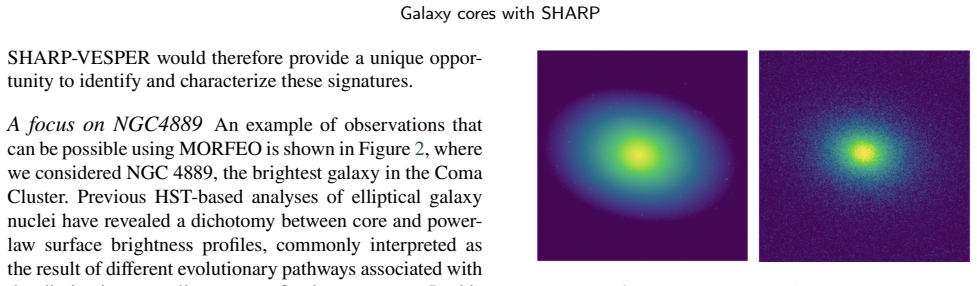
read the original abstract
Massive black hole (MBH) binaries form as a result of galaxy mergers and can coalesce into a single MBH by emitting gravitational waves detectable by LISA and pulsar timing array campaigns. Although electromagnetic observations of bound MBH binaries are extremely challenging, an indirect signature of their passage is the core scouring: a bound binary shrinks by ejecting nearby stars, creating a flat stellar density core of the size of the binary influence radius. Through this mechanism, stars on radial orbits are preferentially ejected, resulting in a central tangential anisotropy in the velocity field of stars that can be identified via IFU observations. At present, the sample of galaxies with such properties is limited by instrument resolution to the closest giant ellipticals within the nearest ~100 Mpc. The SHARP-VESPER IFU and MICADO+MORFEO instruments can work in concert to detect both these features: their unprecedented spatial resolution can allow us to detect central scourings with sizes above ~500 pc in principle up to reionization; smaller cores of ~150 pc can be detected up to z~0.14, encompassing a volume that is more than 40 times the one available at present. In addition, they can enable the search for these features in smaller galaxies, enhancing by a factor 30 the volume over which we can search for pc-size cores around 1-10 million solar mass MBHs. The fraction of scoured galaxies, combined with their kinematic and morphological properties, carry information on the amount of merging binaries, their masses and typical environment, thus knowing this will be fundamental to complement the forthcoming gravitational wave data.
Editorial analysis
A structured set of objections, weighed in public.
Referee Report
Summary. The manuscript proposes that the SHARP-VESPER IFU and MICADO+MORFEO instruments can detect flat stellar density cores and central tangential anisotropy produced by supermassive black hole binary scouring. It claims that cores above ~500 pc are detectable in principle up to reionization, ~150 pc cores up to z~0.14 (volume increase >40x), and that the instruments enable searches for pc-scale cores in lower-mass galaxies (volume increase ~30x), thereby expanding the sample beyond the current limit of ~100 Mpc and providing complementary constraints on merger rates for upcoming gravitational-wave observations.
Significance. If the projected instrument resolutions are realized and the scouring signatures remain observationally distinguishable, the work identifies a concrete path to enlarge the sample of scoured galaxies by more than an order of magnitude and to extend studies to lower-mass systems. This would supply empirical priors on binary merger fractions, masses, and environments that are directly relevant to LISA and pulsar-timing-array science.
major comments (2)
- [Abstract] Abstract: the stated detection thresholds (~500 pc to reionization; ~150 pc to z~0.14) and volume multipliers (40x and 30x) are presented as direct consequences of angular resolution, yet no explicit calculation, assumed cosmology, surface-brightness limit, or simulation of kinematic recovery is referenced. Because these numbers are load-bearing for the central claim of a 40-fold volume increase, the supporting derivation must be supplied.
- [Abstract] The manuscript assumes that flat cores and tangential anisotropy produced by binary scouring remain identifiable and separable from other dynamical processes (e.g., AGN feedback, minor mergers, or projection effects) at z>1 and in galaxies with MBH masses 1–10×10^6 M_⊙. No quantitative test or reference to high-redshift simulations is provided to support this assumption, which directly affects the claimed reach to reionization.
minor comments (2)
- [Abstract] The abstract refers to “the fraction of scoured galaxies” carrying information on merging binaries, but does not define how this fraction would be measured or what selection biases would affect it.
- [Abstract] Notation for instrument names (SHARP-VESPER, MICADO+MORFEO) is introduced without a brief parenthetical description of their wavelength coverage or expected Strehl ratio, which would aid readers unfamiliar with the specific facilities.
Simulated Author's Rebuttal
We thank the referee for their constructive comments on our manuscript. We address each major comment below and have revised the manuscript to incorporate additional details and clarifications where appropriate.
read point-by-point responses
-
Referee: [Abstract] Abstract: the stated detection thresholds (~500 pc to reionization; ~150 pc to z~0.14) and volume multipliers (40x and 30x) are presented as direct consequences of angular resolution, yet no explicit calculation, assumed cosmology, surface-brightness limit, or simulation of kinematic recovery is referenced. Because these numbers are load-bearing for the central claim of a 40-fold volume increase, the supporting derivation must be supplied.
Authors: We agree that the abstract would benefit from explicit references to the supporting calculations. In the revised manuscript, we will add a sentence in the abstract cross-referencing Section 3, where the detection thresholds are derived from the instruments' angular resolutions (e.g., 0.01 arcsec for MICADO+MORFEO), using a flat ΛCDM cosmology (H_0=70 km s^{-1} Mpc^{-1}, Ω_m=0.3) and typical IFU surface-brightness limits. The volume multipliers are computed from the ratio of comoving volumes out to the respective redshifts versus the current ~100 Mpc limit. Kinematic recovery considerations are discussed via mock observations in the same section. revision: yes
-
Referee: [Abstract] The manuscript assumes that flat cores and tangential anisotropy produced by binary scouring remain identifiable and separable from other dynamical processes (e.g., AGN feedback, minor mergers, or projection effects) at z>1 and in galaxies with MBH masses 1–10×10^6 M_⊙. No quantitative test or reference to high-redshift simulations is provided to support this assumption, which directly affects the claimed reach to reionization.
Authors: We acknowledge the lack of dedicated high-redshift simulations in the current work. The assumption is based on the expectation that the characteristic scales and kinematic signatures of scouring (core size ~ binary influence radius, tangential anisotropy) remain distinguishable, as shown in local samples and N-body simulations. We will add a paragraph in the discussion section noting potential overlaps with AGN feedback or mergers at high z, citing available merger simulations (e.g., those addressing dynamical friction and stellar ejection), and explicitly stating that full quantitative separability tests at z>1 are beyond the present scope but represent an important avenue for future study. revision: partial
Circularity Check
No significant circularity; proposal is self-contained
full rationale
The manuscript is a forward-looking observational proposal on instrument capabilities for detecting MBH binary scouring signatures. No derivations, parameter fits, or predictions are presented that reduce to the paper's own inputs. Detection thresholds (~500 pc to reionization, ~150 pc to z~0.14) and volume multipliers (40x, 30x) are stated as direct consequences of quoted angular resolutions, without equations, self-citations, or fitted inputs. The central claims rest on external instrument projections and prior literature on scouring, with no load-bearing self-referential steps. This is the expected outcome for a non-derivational proposal paper.
Axiom & Free-Parameter Ledger
axioms (2)
- domain assumption Core scouring by MBH binaries produces flat stellar density cores of size comparable to the binary influence radius and central tangential anisotropy.
- domain assumption These morphological and kinematic features can be detected and distinguished from other processes using IFU observations at the stated resolutions.
Reference graph
Works this paper leans on
-
[1]
The Near-Infrared Spectrograph (NIRSpec) on the James Webb Space Telescope. I. Overview of the instrument and its capabilities. , keywords =. doi:10.1051/0004-6361/202142663 , archivePrefix =. 2202.03305 , primaryClass =
work page internal anchor Pith review Pith/arXiv arXiv doi:10.1051/0004-6361/202142663
-
[2]
First light for the GRAVITY+ Adaptive Optics: Extreme adaptive optics for the Very Large Telescope Interferometer. , keywords =. doi:10.1051/0004-6361/202555666 , archivePrefix =. 2509.21431 , primaryClass =
-
[3]
The Enhanced Resolution Imager and Spectrograph for the VLT. , keywords =. doi:10.1051/0004-6361/202346559 , archivePrefix =. 2304.02343 , primaryClass =
-
[4]
The data processing pipeline for the MUSE instrument. , keywords =. doi:10.1051/0004-6361/202037855 , archivePrefix =. 2006.08638 , primaryClass =
-
[5]
BlackTHUNDER: Evidence of three massive black holes in a z~5 galaxy
BlackTHUNDER: evidence for three massive black holes in a z -0.5ex 5 galaxy. arXiv e-prints , keywords =. doi:10.48550/arXiv.2509.21575 , archivePrefix =. 2509.21575 , primaryClass =
work page internal anchor Pith review Pith/arXiv arXiv doi:10.48550/arxiv.2509.21575
-
[6]
A black hole in a near-pristine galaxy 700 million years after the Big Bang
A black hole in a near-pristine galaxy 700 million years after the Big Bang. arXiv e-prints , keywords =. doi:10.48550/arXiv.2505.22567 , archivePrefix =. 2505.22567 , primaryClass =
work page internal anchor Pith review Pith/arXiv arXiv doi:10.48550/arxiv.2505.22567
-
[7]
A dormant overmassive black hole in the early Universe. , keywords =. doi:10.1038/s41586-024-08210-5 , archivePrefix =. 2403.03872 , primaryClass =
-
[8]
A preliminary design review study of the scientific performance of MAORY (MORFEO) , volume=
Arcidiacono, Carmelo and Portaluri, Elisa and Gullieuszik, Marco and Cantiello, Michele and Annibali, Francesca and Ciliegi, Paolo and Agapito, Guido and Plantet, Cedric and Busoni, Lorenzo , year=. A preliminary design review study of the scientific performance of MAORY (MORFEO) , volume=. Adaptive Optics Systems VIII , publisher=. doi:10.1117/12.2629068...
-
[9]
MAORY AO performances , volume=
Agapito, Guido and Plantet, Cedric and Busoni, Lorenzo and Arcidiacono, Carmelo and Oberti, Sylvain and Verinaud, Chirstophe and Louarn, Miska Le and Puglisi, Alfio and Esposito, Simone and Ciliegi, Paolo , year=. MAORY AO performances , volume=. Adaptive Optics Systems VII , publisher=. doi:10.1117/12.2561338 , abstractNote=
-
[10]
and Fusco, Thierry and Bonaglia, Marco and Esposito, Simone , year=
Plantet, Cédric and Neichel, Benoît and Agapito, Guido and Busoni, Lorenzo and Correia, Carlos M. and Fusco, Thierry and Bonaglia, Marco and Esposito, Simone , year=. Sky coverage assessment for the European ELT: a joint evaluation for MAORY/MICADO and HARMONI , volume=. Journal of Astronomical Telescopes, Instruments, and Systems , publisher=. doi:10.111...
-
[11]
Planck 2013 results. XVI. Cosmological parameters. , keywords =. doi:10.1051/0004-6361/201321591 , archivePrefix =. 1303.5076 , primaryClass =
work page internal anchor Pith review Pith/arXiv arXiv doi:10.1051/0004-6361/201321591 2013
-
[12]
Ground-based and Airborne Instrumentation for Astronomy X , year = 2024, editor =
SHARP: a near-IR multi-mode spectrograph conceived for MORFEO@ELT. Ground-based and Airborne Instrumentation for Astronomy X , year = 2024, editor =
2024
-
[13]
MORFEO at ELT: the adaptive optics module for ELT , volume=
Ciliegi, Paolo and Agapito, Guido and Aliverti, Matteo and Annibali, Francesca and Aridiacono, Carmelo and Azzaroli, Nicolò and Balestra, Andrea and Baronchelli, Ivano and Ballone, Alessandro and Baruffolo, Andrea and Battaini, Federico and Benedetti, Simone and Bergomi, Maria and Bianco, Andrea and Bonaglia, Marco and Briguglio, Runa and Busoni, Lorenzo ...
-
[14]
Supermassive Black Holes and Their Host Spheroids. I. Disassembling Galaxies. , keywords =. doi:10.3847/0067-0049/222/1/10 , archivePrefix =. 1511.07446 , primaryClass =
work page internal anchor Pith review Pith/arXiv arXiv doi:10.3847/0067-0049/222/1/10
-
[15]
The Dynamical Fingerprint of Core Scouring in Massive Elliptical Galaxies
The Dynamical Fingerprint of Core Scouring in Massive Elliptical Galaxies. , keywords =. doi:10.1088/0004-637X/782/1/39 , archivePrefix =. 1311.3783 , primaryClass =
work page internal anchor Pith review Pith/arXiv arXiv doi:10.1088/0004-637x/782/1/39
-
[16]
Depleted Galaxy Cores and Dynamical Black Hole Masses
Depleted Galaxy Cores and Dynamical Black Hole Masses. , keywords =. doi:10.1088/0004-6256/146/6/160 , archivePrefix =. 1310.5310 , primaryClass =
work page internal anchor Pith review Pith/arXiv arXiv doi:10.1088/0004-6256/146/6/160
-
[17]
Galaxy Core Formation by Supermassive Black Hole Binaries: The Importance of Realistic Initial Conditions and Galaxy Morphology. , keywords =. doi:10.3847/1538-4357/ac1fe4 , archivePrefix =. 2108.08317 , primaryClass =
-
[18]
The Simultaneous Formation of Cored, Tangentially Biased, and Kinematically Decoupled Centers in Massive Early-type Galaxies. , keywords =. doi:10.3847/2041-8213/ab04b1 , archivePrefix =. 1812.02732 , primaryClass =
work page internal anchor Pith review Pith/arXiv arXiv doi:10.3847/2041-8213/ab04b1 2041
-
[19]
Spectral Properties of Quasars from Sloan Digital Sky Survey Data Release 14: The Catalog. , keywords =. doi:10.3847/1538-4365/ab99c5 , archivePrefix =. 1910.10395 , primaryClass =
-
[20]
The second data release from the European Pulsar Timing Array. IV. Implications for massive black holes, dark matter, and the early Universe. , keywords =. doi:10.1051/0004-6361/202347433 , archivePrefix =. 2306.16227 , primaryClass =
-
[21]
The Science of the Einstein Telescope
The Science of the Einstein Telescope. arXiv e-prints , keywords =. doi:10.48550/arXiv.2503.12263 , archivePrefix =. 2503.12263 , primaryClass =
work page internal anchor Pith review Pith/arXiv arXiv doi:10.48550/arxiv.2503.12263
-
[22]
Astrophysics with the Laser Interferometer Space Antenna
Astrophysics with the Laser Interferometer Space Antenna. Living Reviews in Relativity , keywords =. doi:10.1007/s41114-022-00041-y , archivePrefix =. 2203.06016 , primaryClass =
work page internal anchor Pith review Pith/arXiv arXiv doi:10.1007/s41114-022-00041-y
-
[23]
Eight New Ultramassive Black Hole Masses confirm Best Correlation with Galaxy Core Sizes. arXiv e-prints , keywords =. doi:10.48550/arXiv.2512.04178 , archivePrefix =. 2512.04178 , primaryClass =
-
[24]
LISA Definition Study Report. arXiv e-prints , keywords =. doi:10.48550/arXiv.2402.07571 , archivePrefix =. 2402.07571 , primaryClass =
work page internal anchor Pith review Pith/arXiv arXiv doi:10.48550/arxiv.2402.07571
-
[25]
A CEERS Discovery of an Accreting Supermassive Black Hole 570 Myr after the Big Bang: Identifying a Progenitor of Massive z > 6 Quasars. , keywords =. doi:10.3847/2041-8213/ace619 , archivePrefix =. 2303.08918 , primaryClass =
-
[26]
Applications of Digital Image Processing XXXIV , year = 2011, editor =
AETC: Advanced Exposure Time Calculator. Applications of Digital Image Processing XXXIV , year = 2011, editor =. doi:10.1117/12.913304 , adsurl =
-
[27]
Core Formation by Binary Scouring and Gravitational Wave Recoil in Massive Elliptical Galaxies. , keywords =. doi:10.3847/1538-4357/ad7390 , archivePrefix =. 2408.12537 , primaryClass =
-
[28]
The kinematics of -drop bulges from spectral synthesis modelling of a hydrodynamical simulation. , keywords =. doi:10.1093/mnras/stx172 , archivePrefix =. 1702.02162 , primaryClass =
work page internal anchor Pith review Pith/arXiv arXiv doi:10.1093/mnras/stx172
-
[29]
Automated bar detection in local disc galaxies from the SDSS - The colors of bars
Automated bar detection in local disk galaxies from the SDSS. The colors of bars. , keywords =. doi:10.1051/0004-6361/201629115 , archivePrefix =. 1607.05563 , primaryClass =
work page internal anchor Pith review Pith/arXiv arXiv doi:10.1051/0004-6361/201629115
-
[30]
Extreme mass ratio inspirals and tidal disruption events in nuclear clusters - I. Time-dependent rates. , keywords =. doi:10.1093/mnras/stac1453 , archivePrefix =. 2205.06277 , primaryClass =
-
[31]
The Tidal Disruption of Sun-like Stars by Massive Black Holes. , keywords =. doi:10.3847/2041-8213/ab379a , archivePrefix =. 1907.04859 , primaryClass =
-
[32]
Tidal Disruption Events from Eccentric Orbits and Lessons Learned from the Noteworthy ASASSN-14ko. , keywords =. doi:10.3847/1538-4357/acafe1 , archivePrefix =. 2206.13494 , primaryClass =
-
[33]
A likely repeating partial tidal disruption event
Deciphering the extreme X-ray variability of the nuclear transient eRASSt J045650.3 - 203750. A likely repeating partial tidal disruption event. , keywords =. doi:10.1051/0004-6361/202244805 , archivePrefix =. 2208.12452 , primaryClass =
-
[34]
The Tidal Disruption of Giant Stars and their Contribution to the Flaring Supermassive Black Hole Population. , keywords =. doi:10.1088/0004-637X/757/2/134 , archivePrefix =. 1206.2922 , primaryClass =
work page internal anchor Pith review Pith/arXiv arXiv doi:10.1088/0004-637x/757/2/134
-
[35]
Weighing Black Holes using Tidal Disruption Events
Weighing Black Holes Using Tidal Disruption Events. , keywords =. doi:10.3847/1538-4357/ab010f , archivePrefix =. 1801.08221 , primaryClass =
work page internal anchor Pith review Pith/arXiv arXiv doi:10.3847/1538-4357/ab010f
-
[36]
Stellar Tidal Disruption Events with Abundances and Realistic Structures (STARS): Library of Fallback Rates. , keywords =. doi:10.3847/1538-4357/abc489 , archivePrefix =. 2007.10996 , primaryClass =
-
[37]
QPEs from impacts between the secondary and a rigidly precessing accretion disc in an EMRI system. arXiv e-prints , keywords =. doi:10.48550/arXiv.2304.00775 , archivePrefix =. 2304.00775 , primaryClass =
-
[38]
External versus internal triggers of bar formation in cosmological zoom-in simulations
External versus internal triggers of bar formation in cosmological zoom-in simulations. , keywords =. doi:10.1093/mnras/stx2503 , archivePrefix =. 1705.02348 , primaryClass =
work page internal anchor Pith review Pith/arXiv arXiv doi:10.1093/mnras/stx2503
-
[39]
Pulications de L'Observatoire Astronomique de l'Universit\'e de Tartu , Year =
-
[40]
arXiv , Doi =:1404.0380 , Keywords =
, Year =. arXiv , Doi =:1404.0380 , Keywords =
-
[41]
doi:10.1088/1742-6596/372/1/012018 , Eid =
Journal of Physics Conference Series , Year =. doi:10.1088/1742-6596/372/1/012018 , Eid =
-
[42]
2003 , Series =
Gravitational N-Body Simulations: Tools and Algorithms , Author =. 2003 , Series =
2003
- [44]
-
[45]
arXiv , Doi =:0908.1100 , Keywords =
, Year =. arXiv , Doi =:0908.1100 , Keywords =
-
[46]
arXiv , Doi =:1305.2953 , Keywords =
, Year =. arXiv , Doi =:1305.2953 , Keywords =
-
[47]
arXiv , Doi =:1202.0839 , Owner =
Classical and Quantum Gravity , Year =. arXiv , Doi =:1202.0839 , Owner =
-
[48]
ArXiv e-prints , Year =
-
[49]
arXiv , Doi =:0910.1587 , Keywords =
, Year =. arXiv , Doi =:0910.1587 , Keywords =
-
[50]
arXiv , Doi =:1110.5937 , Keywords =
, Year =. arXiv , Doi =:1110.5937 , Keywords =
-
[51]
arXiv , Doi =:0901.4485 , Keywords =
, Year =. arXiv , Doi =:0901.4485 , Keywords =
-
[52]
Structure and Dynamics of Elliptical Galaxies , Year =
-
[53]
arXiv , Doi =:1501.04567 , Keywords =
, Year =. arXiv , Doi =:1501.04567 , Keywords =
-
[54]
arXiv , Doi =:1510.01137 , Keywords =
, Year =. arXiv , Doi =:1510.01137 , Keywords =
-
[55]
arXiv , Doi =:1204.3106 , Primaryclass =
European Physical Journal Special Topics , Year =. arXiv , Doi =:1204.3106 , Primaryclass =
-
[56]
arXiv , Doi =:1405.3986 , Keywords =
, Year =. arXiv , Doi =:1405.3986 , Keywords =
-
[57]
arXiv , Doi =:1509.02165 , Keywords =
, Year =. arXiv , Doi =:1509.02165 , Keywords =
-
[58]
doi:10.1086/154711 , Keywords =
, Year =. doi:10.1086/154711 , Keywords =
-
[59]
, year = 1999, month = oct, volume =
, Year =. doi:10.1046/j.1365-8711.1999.02740.x , Eprint =
- [60]
-
[61]
arXiv , Doi =:1305.7238 , Keywords =
, Year =. arXiv , Doi =:1305.7238 , Keywords =
-
[62]
arXiv , Doi =:0908.3873 , Keywords =
, Year =. arXiv , Doi =:0908.3873 , Keywords =
-
[63]
doi:10.1038/324446a0 , Keywords =
, Year =. doi:10.1038/324446a0 , Keywords =
-
[64]
Astrophysical Ages and Times Scales , Year =
- [65]
-
[66]
arXiv , Doi =:1510.03111 , Keywords =
, Year =. arXiv , Doi =:1510.03111 , Keywords =
- [67]
- [68]
-
[69]
ISBN 978-0-691-13026-2 (HB)
Galactic Dynamics: Second Edition, by James Binney and Scott Tremaine. ISBN 978-0-691-13026-2 (HB). Published by Princeton University Press, Princeton, NJ USA, 2008. , Owner =. 2008 , Adsnote =
2008
-
[70]
, Keywords =
Princeton, NJ, Princeton University Press, 1987, 747 p. , Keywords =. 1987 , Adsnote =
1987
-
[71]
arXiv , Doi =:1710.05025 , Keywords =
, Year =. arXiv , Doi =:1710.05025 , Keywords =
-
[72]
arXiv , Doi =:0810.2723 , Owner =
Science , Year =. arXiv , Doi =:0810.2723 , Owner =
-
[73]
Can supernova kicks trigger EMRIs in the Galactic Centre?
Can supernova kicks trigger EMRIs in the Galactic Centre?. , keywords =. doi:10.1093/mnras/stz440 , archivePrefix =. 1902.04581 , primaryClass =
work page internal anchor Pith review Pith/arXiv arXiv doi:10.1093/mnras/stz440 1902
- [74]
-
[75]
arXiv , Doi =:1710.09418 , Keywords =
, Year =. arXiv , Doi =:1710.09418 , Keywords =
-
[76]
arXiv , Doi =:1208.4498 , Keywords =
, Year =. arXiv , Doi =:1208.4498 , Keywords =
- [77]
- [78]
-
[79]
arXiv , Doi =:0903.2135 , Keywords =
, Year =. arXiv , Doi =:0903.2135 , Keywords =
-
[80]
arXiv , Doi =:1201.1414 , Keywords =
, Year =. arXiv , Doi =:1201.1414 , Keywords =
- [81]
discussion (0)
Sign in with ORCID, Apple, or X to comment. Anyone can read and Pith papers without signing in.