EasyScan_HEP 2: Agent-Ready Parameter Scans for High-Energy Physics
Pith reviewed 2026-07-01 05:11 UTC · model grok-4.3
The pith
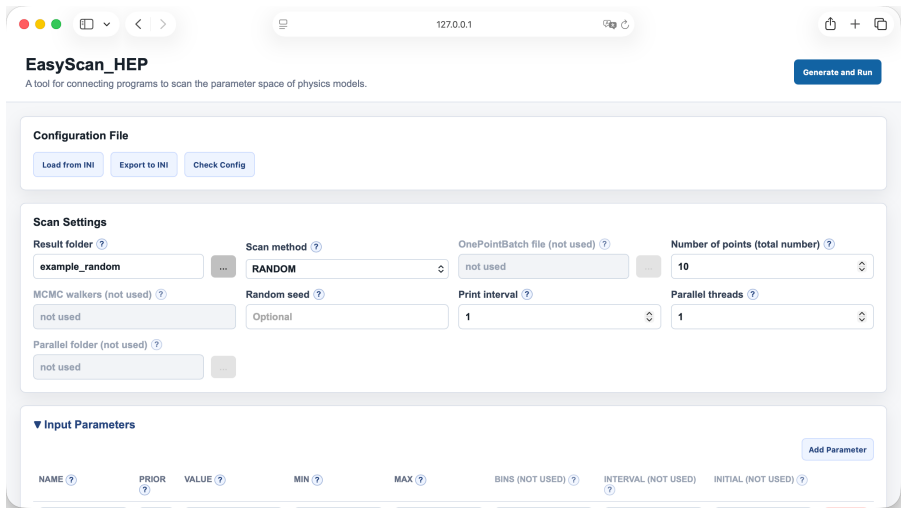
EasyScan_HEP 2 adds command-line and machine-readable interfaces so AI assistants can turn natural language requests into complete parameter scan .ini files.
A machine-rendered reading of the paper's core claim, the machinery that carries it, and where it could break.
Core claim
EasyScan_HEP 2 exposes agent-facing command-line and machine-readable interfaces, allowing an assistant to translate natural language requests into an explicit .ini configuration that defines the scan method, external-program workflow, constraints, and outputs. The framework also supports AI-assisted extension to new scan methods, as illustrated by the integration of BESTFIT, EMCEE, and DYNESTY, while preserving reproducibility, transparency, and user control.
What carries the argument
Agent-facing command-line and machine-readable interfaces that convert natural language into explicit .ini scan configuration files.
If this is right
- AI assistants can define scan methods, external-program workflows, constraints, and outputs in a single .ini file.
- New scan methods such as BESTFIT, EMCEE, and DYNESTY can be added through AI-assisted extension.
- Generated configurations remain inspectable by users via a local Web UI.
- Parameter scans become compatible with AI-assisted workflows while keeping reproducibility and user control intact.
Where Pith is reading between the lines
- Physicists could delegate routine scan setup to agents and focus only on reviewing the final .ini file.
- The same interface pattern could be applied to other HEP tools that currently require manual configuration files.
- Iterative refinement becomes possible if an agent can read the output of one scan and propose an updated .ini for the next run.
Load-bearing premise
AI assistants can produce correct, usable .ini configuration files from natural language descriptions without requiring extensive human debugging or post-processing.
What would settle it
Give an AI assistant a specific natural language request for a parameter scan with defined constraints and outputs, then check whether the generated .ini file runs the intended workflow without any manual edits.
Figures


read the original abstract
AI agents are beginning to reshape the preparation and steering of computational workflows in high-energy physics phenomenology. To accommodate this change, we upgrade EasyScan_HEP to make the construction of parameter-scan configuration files more accessible to AI assistance. EasyScan_HEP 2 exposes agent-facing command-line and machine-readable interfaces, allowing an assistant to translate natural language requests into an explicit .ini configuration that defines the scan method, external-program workflow, constraints, and outputs. The resulting configuration can be inspected through a local Web UI. The framework also supports AI-assisted extension to new scan methods, as illustrated by the integration of BESTFIT, EMCEE, and DYNESTY. In this way, EasyScan_HEP 2 adapts parameter scans to AI-assisted workflows while preserving reproducibility, transparency, and user control.
Editorial analysis
A structured set of objections, weighed in public.
Referee Report
Summary. The manuscript describes EasyScan_HEP 2, an upgrade to EasyScan_HEP that introduces agent-facing command-line and machine-readable interfaces. These interfaces are intended to allow AI assistants to translate natural language requests into explicit .ini configuration files that define the scan method, external-program workflow, constraints, and outputs. The framework also supports AI-assisted extension to new scan methods (BESTFIT, EMCEE, DYNESTY) and provides a local Web UI for inspection, while preserving reproducibility, transparency, and user control.
Significance. If the claimed interfaces function as described, the work could meaningfully adapt parameter-scan tools to AI-assisted workflows in HEP phenomenology. The emphasis on reproducibility and user control is a constructive feature. However, the absence of any validation for the core AI-translation capability limits the assessed significance of the contribution.
major comments (1)
- [Abstract] Abstract: The assertion that the new interfaces 'allow an assistant to translate natural language requests into an explicit .ini configuration' is presented without examples of NL-to-.ini translations, success/failure metrics, integration tests with agents, or usage demonstrations. This claim is load-bearing for the paper's stated purpose yet remains unsubstantiated.
minor comments (1)
- The manuscript would benefit from an explicit comparison table or section detailing which features are new in version 2 versus the original EasyScan_HEP.
Simulated Author's Rebuttal
We thank the referee for their thoughtful review and constructive feedback on our manuscript. We address the single major comment below and outline the revisions we will make.
read point-by-point responses
-
Referee: [Abstract] Abstract: The assertion that the new interfaces 'allow an assistant to translate natural language requests into an explicit .ini configuration' is presented without examples of NL-to-.ini translations, success/failure metrics, integration tests with agents, or usage demonstrations. This claim is load-bearing for the paper's stated purpose yet remains unsubstantiated.
Authors: We agree that the manuscript would be strengthened by concrete illustrations of the claimed capability. The paper's contribution centers on the design and exposure of agent-facing command-line and machine-readable interfaces that enable an external assistant to produce valid .ini files defining scan methods, workflows, constraints, and outputs. The integration of BESTFIT, EMCEE, and DYNESTY is presented as an example of AI-assisted extension. However, the text does not include explicit NL-to-.ini examples, success metrics, or agent integration tests. In the revised version we will add a short subsection (or appendix) containing (i) representative natural-language prompts, (ii) the corresponding .ini files produced via the new interfaces, and (iii) a brief description of the interaction workflow. This addition will substantiate the abstract claim while preserving the manuscript's focus on framework architecture and reproducibility. We view this as a targeted, low-scope revision that directly responds to the referee's concern. revision: yes
Circularity Check
No circularity in software description paper
full rationale
The paper is a software description of EasyScan_HEP 2 upgrades for AI-agent interfaces. It contains no mathematical derivations, equations, fitted quantities, predictions, or self-referential claims. The central assertion is an architectural statement about exposed command-line and machine-readable interfaces; no load-bearing step reduces by construction to its own inputs. No self-citations, uniqueness theorems, or ansatzes are invoked in any derivation chain. This is a normal self-contained software paper with score 0.
Axiom & Free-Parameter Ledger
Reference graph
Works this paper leans on
-
[1]
Machine Learning in High Energy Physics Community White Paper
K. Albertsson, et al., Machine Learning in High Energy Physics Community White Paper, J. Phys. Conf. Ser. 1085 (2) (2018) 022008.arXiv:1807.02876,doi:10.1088/ 1742-6596/1085/2/022008
work page internal anchor Pith review Pith/arXiv arXiv 2018
-
[2]
Deep Learning and its Application to LHC Physics
D. Guest, K. Cranmer, D. Whiteson, Deep Learning and its Application to LHC Physics, Ann. Rev. Nucl. Part. Sci. 68 (2018) 161–181.arXiv:1806.11484,doi: 10.1146/annurev-nucl-101917-021019
work page internal anchor Pith review Pith/arXiv arXiv doi:10.1146/annurev-nucl-101917-021019 2018
-
[3]
M. Feickert, B. Nachman, A Living Review of Machine Learning for Particle Physics (2 2021).arXiv:2102.02770
-
[4]
G. Karagiorgi, G. Kasieczka, S. Kravitz, B. Nachman, D. Shih, Machine Learning in the Search for New Fundamental Physics (12 2021).arXiv:2112.03769
- [5]
-
[6]
P. Richmond, C. Papageorgakis, V. Niarchos, B. Chowdhury, P. Agarwal, FeynTune: large language models for high-energy theory, Mach. Learn. Sci. Tech. 7 (2) (2026) 025012.arXiv:2508.03716,doi:10.1088/2632-2153/ae47bb
-
[7]
H. Qu, L. Gouskos, ParticleNet: Jet Tagging via Particle Clouds, Phys. Rev. D 101 (5) (2020) 056019.arXiv:1902.08570,doi:10.1103/PhysRevD.101.056019
-
[8]
M. Paganini, L. de Oliveira, B. Nachman, CaloGAN : Simulating 3D high energy particle showers in multilayer electromagnetic calorimeters with generative adversarial networks, Phys. Rev. D 97 (1) (2018) 014021.arXiv:1712.10321,doi:10.1103/PhysRevD.97. 014021
work page internal anchor Pith review Pith/arXiv arXiv doi:10.1103/physrevd.97 2018
-
[9]
J. Brehmer, F. Kling, I. Espejo, K. Cranmer, MadMiner: Machine learning-based infer- ence for particle physics, Comput. Softw. Big Sci. 4 (1) (2020) 3.arXiv:1907.10621, doi:10.1007/s41781-020-0035-2
-
[10]
Constraining Effective Field Theories with Machine Learning
J. Brehmer, K. Cranmer, G. Louppe, J. Pavez, Constraining Effective Field Theories with Machine Learning, Phys. Rev. Lett. 121 (11) (2018) 111801.arXiv:1805.00013, doi:10.1103/PhysRevLett.121.111801. 12
work page internal anchor Pith review Pith/arXiv arXiv doi:10.1103/physrevlett.121.111801 2018
-
[11]
W. Searle, C. Balázs, Y. Xiao, Y. Zhang, Machine learning left-right breaking from grav- itational waves, JCAP 11 (2025) 034.arXiv:2506.09319,doi:10.1088/1475-7516/ 2025/11/034
- [12]
-
[13]
arXiv:2512.15867 [hep-ph] https://arxiv.org/ abs/2512.15867
T. Menzo, A. Roman, S. Gleyzer, K. Matchev, G. T. Fleming, S. Höche, S. Mrenna, P. Shyamsundar, HEPTAPOD: Orchestrating High Energy Physics Workflows Towards Autonomous Agency (12 2025).arXiv:2512.15867
-
[14]
E. Gendreau-Distler, J. Ho, D. Kim, L. T. Le Pottier, H. Wang, C. Yang, Automating High Energy Physics Data Analysis with LLM-Powered Agents, in: 39th Annual Con- ference on Neural Information Processing Systems: Includes Machine Learning and the Physical Sciences (ML4PS), 2025.arXiv:2512.07785
-
[15]
E. A. Moreno, S. Bright-Thonney, A. Novak, D. Garcia, P. Harris, AI Agents Can Already Autonomously Perform Experimental High Energy Physics (3 2026).arXiv: 2603.20179
work page internal anchor Pith review Pith/arXiv arXiv 2026
-
[16]
D. A. Faroughy, S. Palacios Schweitzer, I. Pang, S. Mishra-Sharma, D. Shih, Collider- Bench: Benchmarking AI Agents with Particle Physics Analysis Reproduction (5 2026). arXiv:2605.13950
work page internal anchor Pith review Pith/arXiv arXiv 2026
- [17]
-
[18]
P. Agrawal, N. Craig, A. Madden, I. V. Lombera, The FERMIACC: Agents for Particle Theory (3 2026).arXiv:2603.22538
-
[19]
M. Lucente, S. Pascoli, F. Sala, M. Zandi, DarkAgents (6 2026).arXiv:2606.11157
work page internal anchor Pith review Pith/arXiv arXiv 2026
-
[20]
I. R. Wang, LeWRON: Agentic Analysis of Electroweak Phase Transitions (6 2026). arXiv:2606.19425
work page internal anchor Pith review Pith/arXiv arXiv 2026
-
[21]
A. J. Costa, C. Doglioni, C. Gütschow, A. D. Pilkington, S. Sinha, AgentRivet: an automated system for producing Rivet routines from journal publications (6 2026). arXiv:2606.13535
work page internal anchor Pith review Pith/arXiv arXiv 2026
-
[22]
P. Bechtle, K. Desch, P. Wienemann, Fittino, a program for determining MSSM param- eters from collider observables using an iterative method, Comput. Phys. Commun. 174 (2006) 47–70.arXiv:hep-ph/0412012,doi:10.1016/j.cpc.2005.09.002
work page internal anchor Pith review Pith/arXiv arXiv doi:10.1016/j.cpc.2005.09.002 2006
-
[23]
SFITTER: SUSY Parameter Analysis at LHC and LC
R. Lafaye, T. Plehn, D. Zerwas, SFITTER: SUSY parameter analysis at LHC and LC (4 2004).arXiv:hep-ph/0404282
work page internal anchor Pith review Pith/arXiv arXiv 2004
-
[24]
Athron, et al., GAMBIT: The Global and Modular Beyond-the-Standard-Model In- ference Tool, Eur
P. Athron, et al., GAMBIT: The Global and Modular Beyond-the-Standard-Model In- ference Tool, Eur. Phys. J. C 77 (11) (2017) 784, [Addendum: Eur.Phys.J.C 78, 98 (2018)].arXiv:1705.07908,doi:10.1140/epjc/s10052-017-5321-8
-
[25]
G. D. Martinez, J. McKay, B. Farmer, P. Scott, E. Roebber, A. Putze, J. Conrad, Comparison of statistical sampling methods with ScannerBit, the GAMBIT scanning module, Eur. Phys. J. C 77 (11) (2017) 761.arXiv:1705.07959,doi:10.1140/epjc/ s10052-017-5274-y. 13
-
[26]
J. De Blas, et al.,HEPfit: a code for the combination of indirect and direct constraints on high energy physics models, Eur. Phys. J. C 80 (5) (2020) 456.arXiv:1910.14012, doi:10.1140/epjc/s10052-020-7904-z
-
[27]
M. Mühlleitner, M. O. P. Sampaio, R. Santos, J. Wittbrodt, ScannerS: parameter scans in extended scalar sectors, Eur. Phys. J. C 82 (3) (2022) 198.arXiv:2007.02985, doi:10.1140/epjc/s10052-022-10139-w
-
[28]
xBIT: an easy to use scanning tool with machine learning abilities
F. Staub, xBIT: an easy to use scanning tool with machine learning abilities (6 2019). arXiv:1906.03277
work page internal anchor Pith review Pith/arXiv arXiv 2019
-
[29]
M. D. Goodsell, A. Joury, BSMArt: Simple and fast parameter space scans, Comput. Phys. Commun. 297 (2024) 109057.arXiv:2301.01154,doi:10.1016/j.cpc.2023. 109057
- [30]
-
[31]
L. Shang, Y. Zhang, EasyScan_HEP: A tool for connecting programs to scan the parameter space of physics models, Comput. Phys. Commun. 296 (2024) 109027. arXiv:2304.03636,doi:10.1016/j.cpc.2023.109027
-
[32]
E. Guo, P. Jackson, J. M. Yang, P. Zhu, Jarvis-HEP: A lightweight Python framework for workflow composition and parameter scans in high-energy physics (4 2026).arXiv: 2604.25557
work page internal anchor Pith review Pith/arXiv arXiv 2026
-
[33]
J. Ren, L. Wu, J. M. Yang, J. Zhao, Exploring supersymmetry with machine learning, Nucl. Phys. B 943 (2019) 114613.arXiv:1708.06615,doi:10.1016/j.nuclphysb. 2019.114613
work page internal anchor Pith review Pith/arXiv arXiv doi:10.1016/j.nuclphysb 2019
-
[34]
S. Caron, T. Heskes, S. Otten, B. Stienen, Constraining the Parameters of High- Dimensional Models with Active Learning, Eur. Phys. J. C 79 (11) (2019) 944.arXiv: 1905.08628,doi:10.1140/epjc/s10052-019-7437-5
- [35]
-
[36]
A. Hammad, M. Park, R. Ramos, P. Saha, Exploration of parameter spaces assisted by machine learning, Comput. Phys. Commun. 293 (2023) 108902.arXiv:2207.09959, doi:10.1016/j.cpc.2023.108902
- [37]
-
[38]
S. S. AbdusSalam, et al., Simple and statistically sound recommendations for analysing physical theories, Rept. Prog. Phys. 85 (5) (2022) 052201.arXiv:2012.09874,doi: 10.1088/1361-6633/ac60ac. 14
-
[39]
A.Hammad, R.Ramos, DLScanner: Aparameterspacescannerpackageassistedbydeep learning methods, Comput. Phys. Commun. 314 (2025) 109659.arXiv:2412.19675, doi:10.1016/j.cpc.2025.109659
-
[40]
X. Zeng, Y. Zhang, Numerical Tools for Electroweak Phase Transition, Universe 12 (3) (2026) 73.doi:10.3390/universe12030073
-
[41]
DifferentialEvolution-aSimpleandEfficientHeuristicforGlobalOptimizationoverContinuous Spaces
R. Storn, K. Price, Differential Evolution – A Simple and Efficient Heuristic for global Optimization over Continuous Spaces, J. Global Optim. 11 (4) (1997) 341–359.doi: 10.1023/A:1008202821328
-
[42]
SciPy 1.0--Fundamental Algorithms for Scientific Computing in Python
P. Virtanen, et al., SciPy 1.0–Fundamental Algorithms for Scientific Comput- ing in Python, Nature Meth. 17 (2020) 261.arXiv:1907.10121,doi:10.1038/ s41592-019-0686-2
work page internal anchor Pith review Pith/arXiv arXiv 2020
-
[43]
D. Foreman-Mackey, D. W. Hogg, D. Lang, J. Goodman, emcee: The MCMC Hammer, Publ. Astron. Soc. Pac. 125 (925) (2013) 306–312.arXiv:1202.3665,doi:10.1086/ 670067
work page internal anchor Pith review Pith/arXiv arXiv 2013
-
[44]
J. S. Speagle, dynesty: a dynamic nested sampling package for estimating Bayesian posteriors and evidences, Mon. Not. Roy. Astron. Soc. 493 (3) (2020) 3132–3158.arXiv: 1904.02180,doi:10.1093/mnras/staa278
work page internal anchor Pith review Pith/arXiv arXiv doi:10.1093/mnras/staa278 2020
-
[45]
MultiNest: an efficient and robust Bayesian inference tool for cosmology and particle physics
F. Feroz, M. P. Hobson, M. Bridges, MultiNest: an efficient and robust Bayesian infer- ence tool for cosmology and particle physics, Mon. Not. Roy. Astron. Soc. 398 (2009) 1601–1614.arXiv:0809.3437,doi:10.1111/j.1365-2966.2009.14548.x
work page internal anchor Pith review Pith/arXiv arXiv doi:10.1111/j.1365-2966.2009.14548.x 2009
-
[46]
V. Silveira, A. Zee, SCALAR PHANTOMS, Phys. Lett. B 161 (1985) 136–140.doi: 10.1016/0370-2693(85)90624-0
-
[47]
Gauge Singlet Scalars as Cold Dark Matter
J. McDonald, Gauge singlet scalars as cold dark matter, Phys. Rev. D 50 (1994) 3637– 3649.arXiv:hep-ph/0702143,doi:10.1103/PhysRevD.50.3637
work page internal anchor Pith review Pith/arXiv arXiv doi:10.1103/physrevd.50.3637 1994
-
[48]
C. P. Burgess, M. Pospelov, T. ter Veldhuis, The Minimal model of nonbaryonic dark matter: A Singlet scalar, Nucl. Phys. B 619 (2001) 709–728.arXiv:hep-ph/0011335, doi:10.1016/S0550-3213(01)00513-2
work page internal anchor Pith review Pith/arXiv arXiv doi:10.1016/s0550-3213(01)00513-2 2001
-
[49]
G. Alguero, G. Belanger, F. Boudjema, S. Chakraborti, A. Goudelis, S. Kraml, A. Mjal- lal, A. Pukhov, micrOMEGAs 6.0: N-component dark matter, Comput. Phys. Commun. 299 (2024) 109133.arXiv:2312.14894,doi:10.1016/j.cpc.2024.109133
-
[50]
micrOMEGAs 7: Beyond standard cosmology
G. Belanger, A. Belyaev, N. Bernal, F. Boudjema, S. Chakraborti, A. Goudelis, A. Pukhov, micrOMEGAs 7: Beyond standard cosmology (6 2026).arXiv:2606.06645
work page internal anchor Pith review Pith/arXiv arXiv 2026
-
[51]
A. Beniwal, M. Lewicki, M. White, A. G. Williams, Gravitational waves and electroweak baryogenesis in a global study of the extended scalar singlet model, JHEP 02 (2019) 183. arXiv:1810.02380,doi:10.1007/JHEP02(2019)183
work page internal anchor Pith review Pith/arXiv arXiv doi:10.1007/jhep02(2019)183 2019
-
[52]
Y. Xiao, J. M. Yang, Y. Zhang, Dilution of dark matter relic density in singlet extension models, JHEP 02 (2023) 008.arXiv:2207.14519,doi:10.1007/JHEP02(2023)008
-
[53]
C. Balázs, Y. Xiao, J. M. Yang, Y. Zhang, New vacuum stability limit from cosmolog- ical history, Nucl. Phys. B 1002 (2024) 116533.arXiv:2301.09283,doi:10.1016/j. nuclphysb.2024.116533. 15
work page doi:10.1016/j 2024
-
[54]
Y. Xiao, J. M. Yang, Y. Zhang, Implications of nano-Hertz gravitational waves on elec- troweakphasetransitioninthesingletdarkmattermodel, Sci.Bull.68(2023)3158–3164. arXiv:2307.01072,doi:10.1016/j.scib.2023.11.025
-
[55]
P.Athron, C.Balázs, A.Fowlie, Y.Zhang, PhaseTracer: tracingcosmologicalphasesand calculating transition properties, Eur. Phys. J. C 80 (6) (2020) 567.arXiv:2003.02859, doi:10.1140/epjc/s10052-020-8035-2
-
[56]
P. Athron, C. Balazs, A. Fowlie, L. Morris, W. Searle, Y. Xiao, Y. Zhang, PhaseTracer2: from the effective potential to gravitational waves, Eur. Phys. J. C 85 (5) (2025) 559. arXiv:2412.04881,doi:10.1140/epjc/s10052-025-14258-y. 16
discussion (0)
Sign in with ORCID, Apple, or X to comment. Anyone can read and Pith papers without signing in.