Unveiling the nature of barium stars. I. Asteroseismic masses and the evolutionary link between Ba dwarfs and giants
Pith reviewed 2026-06-25 19:42 UTC · model grok-4.3
The pith
Asteroseismic masses indicate barium giants evolve from barium dwarfs through main-sequence accretion.
A machine-rendered reading of the paper's core claim, the machinery that carries it, and where it could break.
Core claim
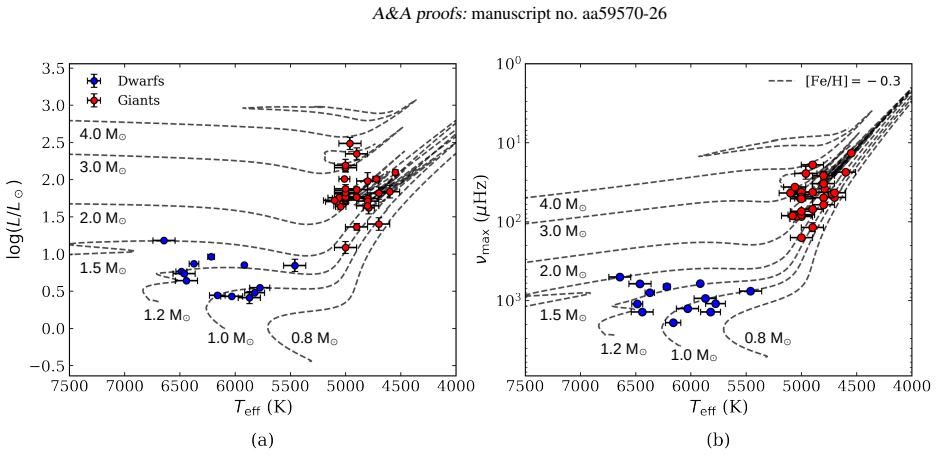
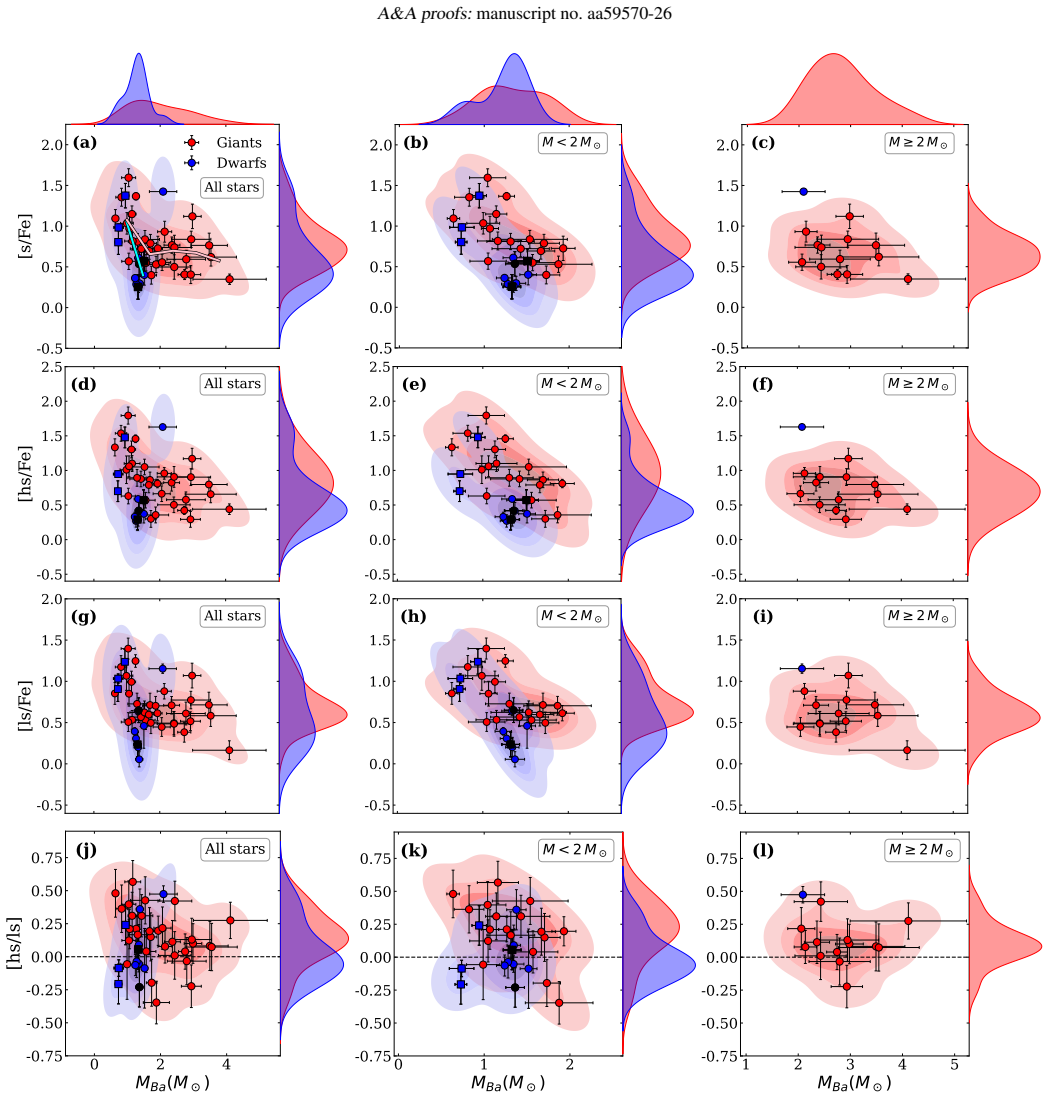
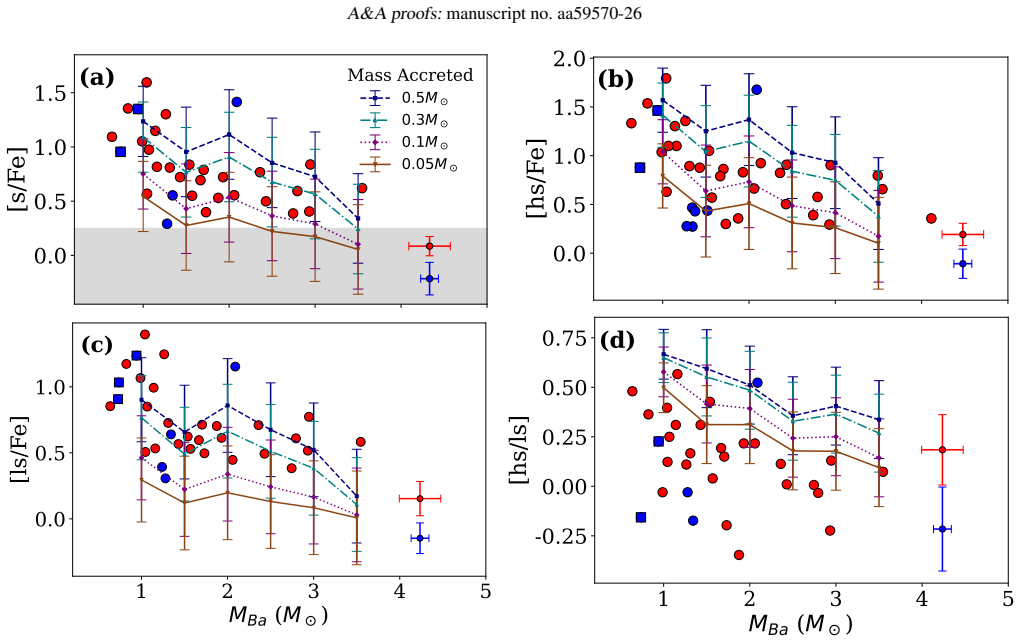
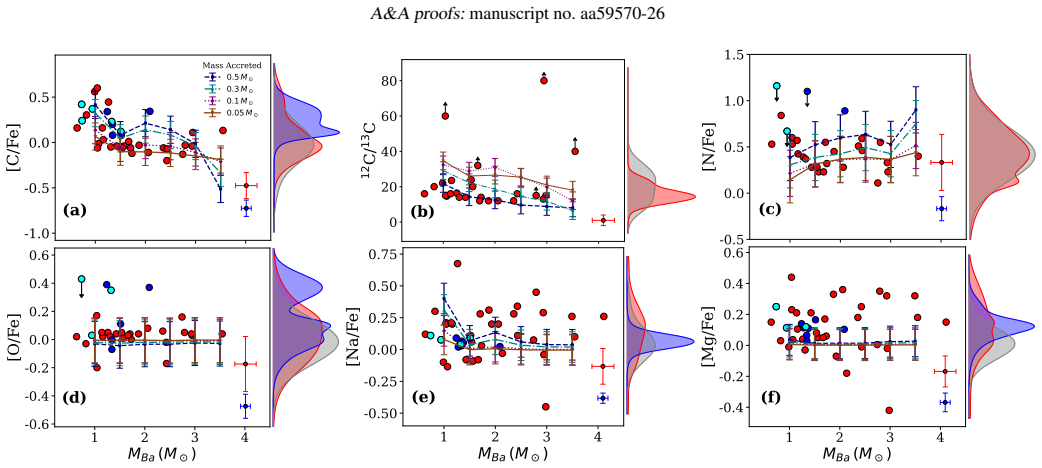
The average masses of Ba dwarfs and Ba giants are significantly different at 1.29±0.09 M⊙ versus 1.96±0.16 M⊙. Their mass distributions peak around 1.3 M⊙. No intermediate-mass Ba dwarfs are found. The results support Ba giants evolving from Ba dwarfs with mass accretion on the main sequence, requiring 0.1-0.5 M⊙ accreted mass and post-accretion mixing to explain abundances, though standard AGB yields do not fully account for the [hs/ls] ratio.
What carries the argument
Asteroseismic mass determinations from TESS photometry combined with stellar evolution models that include accretion of AGB nucleosynthesis yields.
If this is right
- The mass difference between Ba dwarfs and Ba giants indicates that accretion occurs before the dwarf leaves the main sequence.
- A substantial population of intermediate-mass Ba dwarfs should exist but is not observed in the current sample.
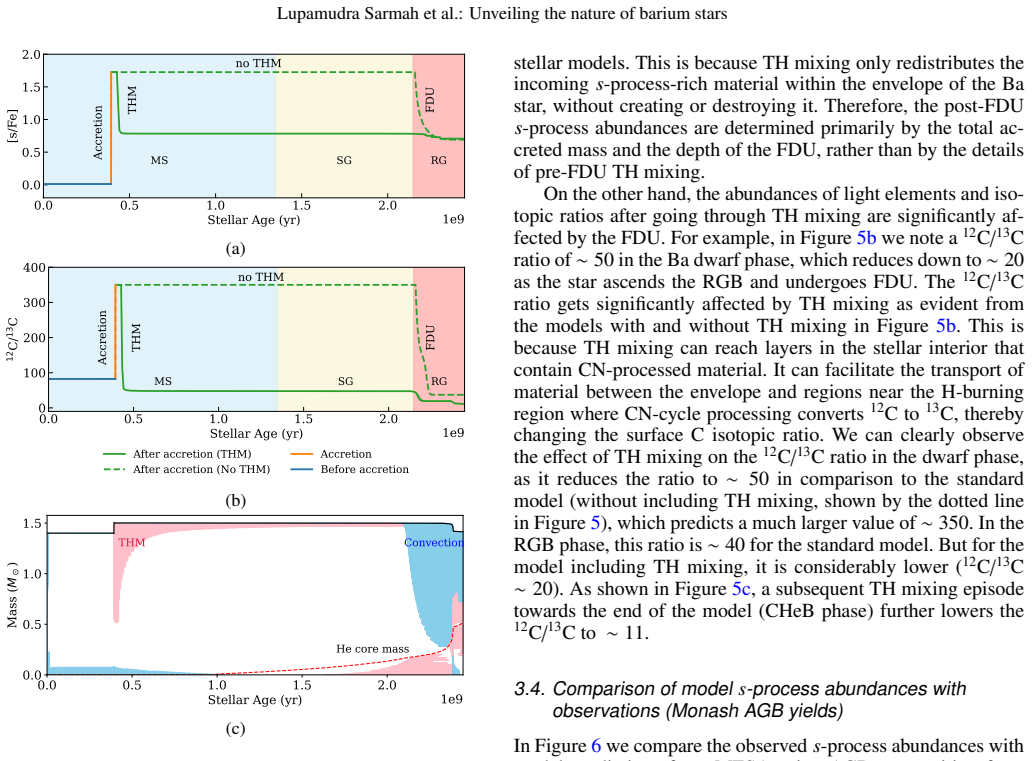
- Post-accretion mixing is necessary to reproduce the s-process abundances and low carbon isotope ratios.
- The mismatch in [hs/ls] ratio implies that single-star AGB yields alone cannot explain the chemical enrichment.
- Abundance trends show anti-correlation with stellar mass, especially in the low-mass regime.
Where Pith is reading between the lines
- If the sample is representative, binary evolution models may need to adjust the timing or efficiency of mass transfer to avoid producing intermediate-mass Ba dwarfs.
- The requirement for additional mixing suggests that internal processes in the accretor star play a key role in distributing the transferred material.
- Extending this to larger samples could test whether the mass peak at 1.3 solar masses reflects a preferred binary separation or companion mass.
- The failure of Monash AGB yields for the [hs/ls] ratio points to the need for revised nucleosynthesis calculations in AGB stars.
Load-bearing premise
The Ba dwarf sample must be unbiased and complete, with asteroseismic masses free of large systematic offsets that would change the reported mass difference.
What would settle it
Detection of a significant number of intermediate-mass barium dwarfs or revision of asteroseismic mass scales showing no average mass difference between the two groups.
Figures


read the original abstract
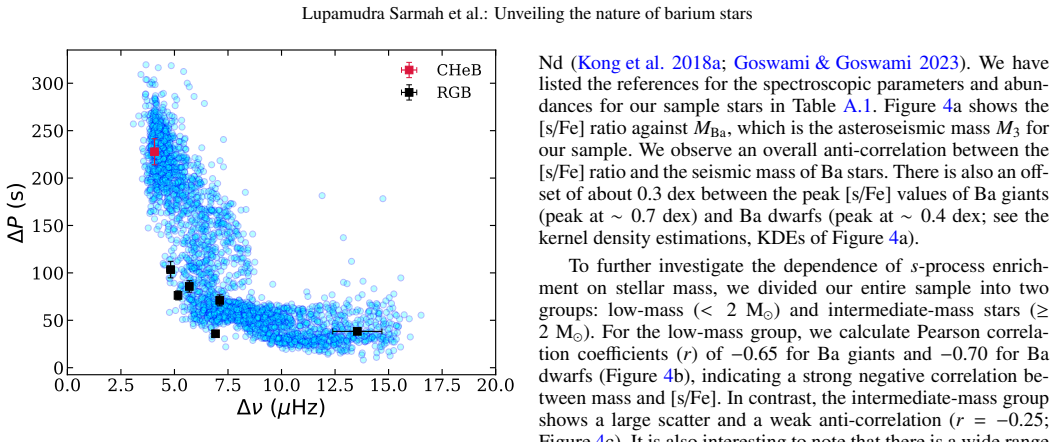
Barium star systems are excellent sites for studying AGB nucleosynthesis, binary evolution, and mass transfer processes. However, an accurate estimation of their fundamental stellar parameters is still lacking. Using TESS data, we made the first extensive asteroseismic mass measurements of 31 Ba giants and 13 Ba dwarfs. For some, we were able to measure $\Delta P$, ascertaining their evolutionary phase. We then constructed a grid of stellar models across the relevant mass range, where we accreted AGB material using composition from existing yields. We found that the average masses of the Ba dwarfs and Ba giants are significantly different ($1.29\pm0.09~\rm{M}_\odot$ versus $1.96\pm0.16~\rm{M}_\odot$, respectively). However, their mass distributions peak around $1.3~\rm{M}_\odot$. While our sample of Ba giants spans the low- and intermediate-mass regime, we found no intermediate-mass Ba dwarfs. The abundance trends of $s$-process elements show an overall anti-correlation with stellar mass, particularly in the low-mass regime. The stellar models adopting Monash AGB yields can satisfactorily reproduce the observed light elements, $s$, and heavy-$s$ abundance trends, with an accreted mass of $0.1-0.5~\rm{M}_\odot$, but fail to explain the [hs/ls] ratio. Our results support an evolutionary scenario in which Ba giants evolve from Ba dwarfs, with mass accretion occurring while the progenitor Ba star is still on the main sequence. In this scenario, a substantial number of intermediate-mass Ba dwarfs are expected. We found that post-accretion additional mixing in our models is critical to explain the observed $s$-process abundances in Ba dwarfs and the low C isotopic ratio ($<30$) in Ba giants. The mismatch between the model and the observed [hs/ls] ratio suggests that the chemical enrichment of Ba stars cannot be explained by standard single-star AGB yields alone (abridged for arXiv).
Editorial analysis
A structured set of objections, weighed in public.
Referee Report
Summary. The manuscript reports the first extensive asteroseismic mass measurements from TESS data for 31 Ba giants and 13 Ba dwarfs. Average masses are 1.29±0.09 M⊙ (dwarfs) versus 1.96±0.16 M⊙ (giants), with both distributions peaking near 1.3 M⊙; no intermediate-mass Ba dwarfs are found. Models using Monash AGB yields with 0.1-0.5 M⊙ accreted material reproduce light-element, s-process, and heavy-s trends but fail on the [hs/ls] ratio. Post-accretion mixing is invoked to match C isotopic ratios. The results are interpreted as supporting an evolutionary scenario in which Ba giants descend from Ba dwarfs via main-sequence mass accretion.
Significance. If the mass measurements prove robust and the dwarf sample representative, the work would strengthen the case for main-sequence accretion as the dominant channel for barium-star formation and expose limitations of standard single-star AGB yields. The independent TESS oscillation data for masses and the use of pre-existing Monash yields (rather than new parameter fitting) are clear strengths that reduce circularity.
major comments (3)
- [Abstract] Abstract (mass-distribution and evolutionary-scenario paragraphs): the central claim that the absence of intermediate-mass Ba dwarfs supports main-sequence accretion rests on a sample of only 13 objects; no selection criteria, completeness assessment, or discussion of possible TESS detection biases (e.g., amplitude or classification efficiency varying with mass) are supplied, leaving the physical interpretation of the absence unsecured.
- [Abstract] Abstract: no error budgets, data-selection criteria, or fitting details are given for the asteroseismic masses; because the reported 0.67 M⊙ average offset and the dwarf-giant comparison are load-bearing for the evolutionary scenario, the absence of these diagnostics prevents assessment of possible systematics (surface effects, mode identification, grid choices) that could differ between evolutionary phases.
- [Abstract] Abstract: the statement that models “satisfactorily reproduce” the observed trends with an accreted mass of 0.1-0.5 M⊙ is presented without describing how the accreted-mass range was determined from the grid or which abundance diagnostics were used for the fit; this detail is required to evaluate whether the models genuinely support the proposed scenario or merely illustrate a plausible parameter window.
minor comments (1)
- The abstract is noted as abridged; the full text should expand the methods section to include the precise asteroseismic pipeline and model-grid specifications so that the mass and abundance results can be reproduced.
Simulated Author's Rebuttal
We thank the referee for the constructive and detailed comments. We address each major comment below, clarifying what is already in the manuscript body while agreeing to strengthen the abstract where the concerns are valid. Revisions will focus on adding concise context to the abstract without altering the core results.
read point-by-point responses
-
Referee: [Abstract] Abstract (mass-distribution and evolutionary-scenario paragraphs): the central claim that the absence of intermediate-mass Ba dwarfs supports main-sequence accretion rests on a sample of only 13 objects; no selection criteria, completeness assessment, or discussion of possible TESS detection biases (e.g., amplitude or classification efficiency varying with mass) are supplied, leaving the physical interpretation of the absence unsecured.
Authors: The abstract summarizes the result; full sample construction, TESS data requirements, and Ba-star classification criteria appear in Section 2. The 13 Ba dwarfs represent the largest asteroseismic sample currently available. We acknowledge that a dedicated completeness assessment and explicit bias discussion are not present and will add a short paragraph in the discussion section (and a qualifying clause in the abstract) noting the sample limitations, possible TESS amplitude/classification biases, and the fact that the absence of intermediate-mass dwarfs is reported as an observational finding rather than a statistically complete statement. The evolutionary interpretation is presented as supported by the existing data but remains subject to future larger samples. revision: partial
-
Referee: [Abstract] Abstract: no error budgets, data-selection criteria, or fitting details are given for the asteroseismic masses; because the reported 0.67 M⊙ average offset and the dwarf-giant comparison are load-bearing for the evolutionary scenario, the absence of these diagnostics prevents assessment of possible systematics (surface effects, mode identification, grid choices) that could differ between evolutionary phases.
Authors: The abstract reports the mean masses and their formal uncertainties; the underlying TESS light-curve selection, frequency extraction, mode identification, and grid-based modeling (including surface-effect corrections) are described in Sections 3 and 4, with explicit tests for phase-dependent systematics. To address the referee’s point, we will insert one additional sentence in the abstract summarizing the asteroseismic pipeline and noting that full error budgets and robustness checks appear in the main text. revision: yes
-
Referee: [Abstract] Abstract: the statement that models “satisfactorily reproduce” the observed trends with an accreted mass of 0.1-0.5 M⊙ is presented without describing how the accreted-mass range was determined from the grid or which abundance diagnostics were used for the fit; this detail is required to evaluate whether the models genuinely support the proposed scenario or merely illustrate a plausible parameter window.
Authors: The 0.1–0.5 M⊙ range was obtained by running the Monash yield grid and identifying the accreted masses that simultaneously reproduce the observed trends in light elements, [s/Fe], and [hs/Fe] (see Section 5 and associated figures). We will revise the abstract to state explicitly that the range is the interval over which the models match those specific abundance diagnostics, thereby clarifying the fitting procedure. revision: yes
Circularity Check
No significant circularity; derivation is self-contained
full rationale
Asteroseismic masses are obtained directly from independent TESS oscillation frequencies and mode analysis, with no dependence on the evolutionary scenario or abundance fits. Stellar models adopt pre-existing Monash AGB yields as fixed inputs rather than deriving or fitting new yields to the Ba-star data; the accreted-mass range 0.1-0.5 M⊙ is an output of matching observed trends, not a redefinition of the input. The evolutionary link is inferred from the observed mass distributions (dwarfs vs. giants) and the reported absence of intermediate-mass dwarfs, none of which are defined in terms of the conclusion itself. No self-citation chains, uniqueness theorems, or ansatzes from prior author work are invoked as load-bearing steps. The derivation therefore rests on external data and external yield tables.
Axiom & Free-Parameter Ledger
free parameters (1)
- accreted mass =
0.1-0.5 Msun
axioms (2)
- domain assumption Monash AGB yields represent the composition transferred from the donor star
- domain assumption Standard asteroseismic scaling relations hold for barium stars
Reference graph
Works this paper leans on
-
[1]
s-process enriched post-AGB star J003643.94─723722.1 in the SMC with an extreme C/O ratio and the first precise detection of lead. , keywords =. doi:10.1017/pasa.2025.10085 , archivePrefix =. 2509.05015 , primaryClass =
-
[2]
Is Extra Mixing Really Needed in Asymptotic Giant Branch Stars?
Is Extra Mixing Really Needed in Asymptotic Giant Branch Stars?. , keywords =. doi:10.1088/0004-637X/713/1/374 , archivePrefix =. 1002.4904 , primaryClass =
work page internal anchor Pith review Pith/arXiv arXiv doi:10.1088/0004-637x/713/1/374
-
[3]
Transiting Exoplanet Survey Satellite (TESS). Journal of Astronomical Telescopes, Instruments, and Systems , year = 2015, month = jan, volume =. doi:10.1117/1.JATIS.1.1.014003 , adsurl =
work page internal anchor Pith review doi:10.1117/1.jatis.1.1.014003 2015
-
[4]
Transiting Exoplanet Survey Satellite (TESS). Space Telescopes and Instrumentation 2014: Optical, Infrared, and Millimeter Wave , year = 2014, editor =. doi:10.1117/12.2063489 , archivePrefix =. 1406.0151 , primaryClass =
work page internal anchor Pith review Pith/arXiv arXiv doi:10.1117/12.2063489 2014
-
[5]
and Doty, J
Vanderspek, R. and Doty, J. and Fausnaugh, M. and others , title =. 2018 , note =
2018
-
[6]
European Physical Journal Web of Conferences , year = 2017, series =
Data preparation for asteroseismology with TESS. European Physical Journal Web of Conferences , year = 2017, series =. doi:10.1051/epjconf/201716001005 , archivePrefix =. 1610.02702 , primaryClass =
-
[7]
Software and Cyberinfrastructure for Astronomy IV , year = 2016, series =
The TESS science processing operations center. Software and Cyberinfrastructure for Astronomy IV , year = 2016, editor =. doi:10.1117/12.2233418 , adsurl =
-
[8]
Lightkurve: Kepler and TESS time series analysis in Python
-
[9]
Caldwell, Douglas A. and Jenkins, Jon M. and Ting, Eric B. , title =. 2020 , publisher =. doi:10.17909/T9-WPZ1-8S54 , url =
-
[10]
Caldwell, D. A. and Jenkins, J. M. and Ting, E. B. , year =. TESS light curves from full frame images (tess-spoc) , howpublished =
-
[11]
, archivePrefix = "arXiv", eprint =
Preparation of Kepler light curves for asteroseismic analyses. , keywords =. doi:10.1111/j.1745-3933.2011.01042.x , archivePrefix =. 1103.0382 , primaryClass =
-
[12]
Detection of Solar-like Oscillations in Subgiant and Red Giant Stars Using 2 minute Cadence TESS Data. , keywords =. doi:10.3847/1538-4365/ad18db , archivePrefix =. 2401.11134 , primaryClass =
-
[13]
The connection between stellar granulation and oscillation as seen by the Kepler mission
The connection between stellar granulation and oscillation as seen by the Kepler mission. , keywords =. doi:10.1051/0004-6361/201424313 , archivePrefix =. 1408.0817 , primaryClass =
work page internal anchor Pith review Pith/arXiv arXiv doi:10.1051/0004-6361/201424313
-
[14]
Granulation in Red Giants: observations by the Kepler mission and 3D convection simulations
Granulation in Red Giants: Observations by the Kepler Mission and Three-dimensional Convection Simulations. , keywords =. doi:10.1088/0004-637X/741/2/119 , archivePrefix =. 1109.1194 , primaryClass =
work page internal anchor Pith review Pith/arXiv arXiv doi:10.1088/0004-637x/741/2/119
-
[15]
Metallicity effect on stellar granulation detected from oscillating red giants in open clusters
Metallicity effect on stellar granulation detected from oscillating red giants in open clusters. , keywords =. doi:10.1051/0004-6361/201731094 , archivePrefix =. 1707.07474 , primaryClass =
work page internal anchor Pith review Pith/arXiv arXiv doi:10.1051/0004-6361/201731094
-
[16]
Understanding the Lomb-Scargle Periodogram
Understanding the Lomb-Scargle Periodogram. , keywords =. doi:10.3847/1538-4365/aab766 , archivePrefix =. 1703.09824 , primaryClass =
work page internal anchor Pith review Pith/arXiv arXiv doi:10.3847/1538-4365/aab766
-
[17]
Detection of Possible p-Mode Oscillations on Procyon. , keywords =. doi:10.1086/169725 , adsurl =
-
[18]
Observations of Intensity Fluctuations Attributed to Granulation and Faculae on Sun-like Stars from the Kepler Mission. , keywords =. doi:10.1088/0004-637X/767/1/34 , archivePrefix =. 1302.5563 , primaryClass =
work page internal anchor Pith review Pith/arXiv arXiv doi:10.1088/0004-637x/767/1/34
-
[19]
emcee: The MCMC Hammer. , keywords =. doi:10.1086/670067 , archivePrefix =. 1202.3665 , primaryClass =
work page internal anchor Pith review Pith/arXiv arXiv doi:10.1086/670067
-
[20]
A Conceptual Introduction to Markov Chain Monte Carlo Methods. arXiv e-prints , keywords =. doi:10.48550/arXiv.1909.12313 , archivePrefix =. 1909.12313 , primaryClass =
-
[21]
The Journal of Open Source Software , keywords =
pySYD: Automated measurements of global asteroseismic parameters. The Journal of Open Source Software , keywords =. doi:10.21105/joss.03331 , archivePrefix =. 2108.00582 , primaryClass =
-
[22]
Automated extraction of oscillation parameters for Kepler observations of solar-type stars
Automated extraction of oscillation parameters for Kepler observations of solar-type stars. Communications in Asteroseismology , keywords =. doi:10.48550/arXiv.0910.2764 , archivePrefix =. 0910.2764 , primaryClass =
work page internal anchor Pith review Pith/arXiv arXiv doi:10.48550/arxiv.0910.2764
-
[23]
1980, title Asymptotic approximations for stellar nonradial pulsations
Asymptotic approximations for stellar nonradial pulsations. , keywords =. doi:10.1086/190678 , adsurl =
-
[24]
Gravity modes as a way to distinguish between hydrogen- and helium-burning red giant stars
Gravity modes as a way to distinguish between hydrogen- and helium-burning red giant stars. , keywords =. doi:10.1038/nature09935 , archivePrefix =. 1103.5805 , primaryClass =
work page internal anchor Pith review Pith/arXiv arXiv doi:10.1038/nature09935
-
[25]
Period spacings in red giants. II. Automated measurement. , keywords =. doi:10.1051/0004-6361/201527259 , archivePrefix =. 1602.04940 , primaryClass =
work page internal anchor Pith review Pith/arXiv arXiv doi:10.1051/0004-6361/201527259
-
[26]
, keywords =
Nonradial pulsation of the delta Scuti star BU CANCRI in the Praesepe cluster. , keywords =
-
[27]
Period spacings of Doradus pulsators in the Kepler field: Rossby and gravity modes in 82 stars. , keywords =. doi:10.1093/mnras/stz1171 , archivePrefix =. 1904.12291 , primaryClass =
work page internal anchor Pith review Pith/arXiv arXiv doi:10.1093/mnras/stz1171 1904
-
[28]
Mining the GALAH Data. I. Study of Five Super Lithium-rich Metal-poor Giants. , keywords =. doi:10.3847/1538-4357/ad35b9 , archivePrefix =. 2403.15542 , primaryClass =
-
[29]
A Large and Pristine Sample of Standard Candles across the Milky Way: 100,000 Red Clump Stars with 3\. , keywords =. doi:10.3847/2041-8213/aabf8e , archivePrefix =. 1803.06650 , primaryClass =
work page internal anchor Pith review Pith/arXiv arXiv doi:10.3847/2041-8213/aabf8e 2041
-
[30]
Estimating Distances from Parallaxes. V. Geometric and Photogeometric Distances to 1.47 Billion Stars in Gaia Early Data Release 3. , keywords =. doi:10.3847/1538-3881/abd806 , archivePrefix =. 2012.05220 , primaryClass =
work page internal anchor Pith review Pith/arXiv arXiv doi:10.3847/1538-3881/abd806 2012
-
[31]
Photometric content and validation
Gaia Early Data Release 3. Photometric content and validation. , keywords =. doi:10.1051/0004-6361/202039587 , archivePrefix =. 2012.01916 , primaryClass =
-
[32]
A 3D Dust Map Based on Gaia, Pan-STARRS 1 and 2MASS
A 3D Dust Map Based on Gaia, Pan-STARRS 1, and 2MASS. , keywords =. doi:10.3847/1538-4357/ab5362 , archivePrefix =. 1905.02734 , primaryClass =
work page internal anchor Pith review Pith/arXiv arXiv doi:10.3847/1538-4357/ab5362 1905
-
[33]
The Astronomical Journal , author =
The Two Micron All Sky Survey (2MASS). , keywords =. doi:10.1086/498708 , adsurl =
-
[34]
The Pan-STARRS1 Surveys. arXiv e-prints , keywords =. doi:10.48550/arXiv.1612.05560 , archivePrefix =. 1612.05560 , primaryClass =
work page internal anchor Pith review Pith/arXiv arXiv doi:10.48550/arxiv.1612.05560
-
[35]
Comparison of two different extinction laws with Hipparcos observations
Comparison of two different extinction laws with HIPPARCOS observations. , keywords =. doi:10.48550/arXiv.astro-ph/9805018 , archivePrefix =. astro-ph/9805018 , primaryClass =
work page internal anchor Pith review Pith/arXiv arXiv doi:10.48550/arxiv.astro-ph/9805018
-
[36]
The effective temperature scale of giant stars (F0-K5). II. Empirical calibration of T _ eff versus colours and [Fe/H]. , keywords =. doi:10.1051/aas:1999521 , adsurl =
-
[37]
On the use of empirical bolometric corrections for stars
On the Use of Empirical Bolometric Corrections for Stars. , keywords =. doi:10.1088/0004-6256/140/5/1158 , archivePrefix =. 1008.3913 , primaryClass =
work page internal anchor Pith review Pith/arXiv arXiv doi:10.1088/0004-6256/140/5/1158
-
[38]
Determination of Stellar Ages from Asteroseismology. , keywords =. doi:10.1086/184700 , adsurl =
-
[39]
Radius Determination of Solar-type Stars Using Asteroseismology: What to Expect from the Kepler Mission. , keywords =. doi:10.1088/0004-637X/700/2/1589 , archivePrefix =. 0906.0766 , primaryClass =
work page internal anchor Pith review Pith/arXiv arXiv doi:10.1088/0004-637x/700/2/1589
-
[40]
Asteroseismology of red giants from the first four months of Kepler data: Fundamental parameters
Asteroseismology of red giants from the first four months of Kepler data: Fundamental stellar parameters. , keywords =. doi:10.1051/0004-6361/201015263 , archivePrefix =. 1010.4589 , primaryClass =
work page internal anchor Pith review Pith/arXiv arXiv doi:10.1051/0004-6361/201015263
-
[41]
Detection of solar-like oscillations in relics of the Milky Way: asteroseismology of K giants in M4 using data from the NASA K2 mission. , keywords =. doi:10.1093/mnras/stw1555 , archivePrefix =. 1606.02115 , primaryClass =
work page internal anchor Pith review Pith/arXiv arXiv doi:10.1093/mnras/stw1555
-
[42]
Integrated mass-loss of evolved stars in M4 using asteroseismology. , keywords =. doi:10.1093/mnras/stac1918 , archivePrefix =. 2207.02406 , primaryClass =
-
[43]
Testing Scaling Relations for Solar-like Oscillations from the Main Sequence to Red Giants Using Kepler Data. , keywords =. doi:10.1088/0004-637X/743/2/143 , archivePrefix =. 1109.3460 , primaryClass =
work page internal anchor Pith review Pith/arXiv arXiv doi:10.1088/0004-637x/743/2/143
-
[44]
Nominal values for selected solar and planetary quantities: IAU 2015 Resolution B3
Nominal Values for Selected Solar and Planetary Quantities: IAU 2015 Resolution B3. , keywords =. doi:10.3847/0004-6256/152/2/41 , archivePrefix =. 1605.09788 , primaryClass =
work page internal anchor Pith review Pith/arXiv arXiv doi:10.3847/0004-6256/152/2/41 2015
-
[45]
Calculating asteroseismic diagrams for solar-like oscillations
Calculating Asteroseismic Diagrams for Solar-like Oscillations. , keywords =. doi:10.1088/0004-637X/743/2/161 , archivePrefix =. 1109.3455 , primaryClass =
work page internal anchor Pith review Pith/arXiv arXiv doi:10.1088/0004-637x/743/2/161
-
[46]
Table of Contents of: "Red Giants as Probes of the Structure and Evolution of the Milky Way"
Red Giants as Probes of the Structure and Evolution of the Milky Way. Red Giants as Probes of the Structure and Evolution of the Milky Way , year = 2012, editor =. doi:10.1007/978-3-642-18418-5 , archivePrefix =. 1108.4406 , primaryClass =
work page internal anchor Pith review Pith/arXiv arXiv doi:10.1007/978-3-642-18418-5 2012
-
[47]
Asteroseismology of 16000 Kepler Red Giants: Global Oscillation Parameters, Masses, and Radii
Asteroseismology of 16,000 Kepler Red Giants: Global Oscillation Parameters, Masses, and Radii. , keywords =. doi:10.3847/1538-4365/aaaf74 , archivePrefix =. 1802.04455 , primaryClass =
work page internal anchor Pith review Pith/arXiv arXiv doi:10.3847/1538-4365/aaaf74
-
[48]
Asfgrid: Asteroseismic parameters for a star
-
[49]
Stellar Population Synthesis Based Modeling of the Milky Way Using Asteroseismology of 13,000 Kepler Red Giants. , keywords =. doi:10.3847/0004-637X/822/1/15 , archivePrefix =. 1603.05661 , primaryClass =
work page internal anchor Pith review Pith/arXiv arXiv doi:10.3847/0004-637x/822/1/15
-
[50]
Three new barium dwarfs with WD companions: BD+68 1027, RE J0702+129 and BD+80 670
Three new barium dwarfs with white dwarf companions: BD+68 1027, RE J0702+129 and BD+80 670. , keywords =. doi:10.1093/mnras/stx2809 , archivePrefix =. 1710.10750 , primaryClass =
work page internal anchor Pith review Pith/arXiv arXiv doi:10.1093/mnras/stx2809
-
[51]
Spectroscopic Study of Ba and CEMP-s Stars: Mass Distribution of AGB Progenitors. , keywords =. doi:10.3847/1538-3881/aca971 , archivePrefix =. 2212.00834 , primaryClass =
-
[52]
Modelling Kepler red giants in eclipsing binaries: calibrating the mixing-length parameter with asteroseismology. , keywords =. doi:10.1093/mnras/stx3079 , archivePrefix =. 1712.01424 , primaryClass =
work page internal anchor Pith review Pith/arXiv arXiv doi:10.1093/mnras/stx3079
-
[53]
Impact of the convective mixing-length parameter on stellar metallicity. , keywords =. doi:10.1051/0004-6361/201937110 , adsurl =
-
[54]
The formation of barium giants via mass accretion in binary systems. , keywords =. doi:10.1093/mnras/stab1734 , archivePrefix =. 2106.08225 , primaryClass =
-
[55]
The Carbon Star Phenomenon , year = 2000, editor =
Binarity among Barium Dwarfs and CH Subgiants: Will They Become Barium Giants?. The Carbon Star Phenomenon , year = 2000, editor =
2000
-
[56]
Nucleosynthesis and Mixing on the Asymptotic Giant Branch. III. Predicted and Observed s-Process Abundances. , keywords =. doi:10.1086/322258 , archivePrefix =. astro-ph/0104424 , primaryClass =
work page internal anchor Pith review Pith/arXiv arXiv doi:10.1086/322258
-
[57]
The s process in AGB stars as constrained by a large sample of Barium stars
The s process in AGB stars as constrained by a large sample of barium stars. , keywords =. doi:10.1051/0004-6361/201834079 , archivePrefix =. 1810.01788 , primaryClass =
work page internal anchor Pith review Pith/arXiv arXiv doi:10.1051/0004-6361/201834079
-
[58]
Chemical abundances and kinematics of barium stars
Chemical abundances and kinematics of barium stars. , keywords =. doi:10.1093/mnras/stw815 , archivePrefix =. 1604.03031 , primaryClass =
work page internal anchor Pith review Pith/arXiv arXiv doi:10.1093/mnras/stw815
-
[59]
The Dawes Review 2: Nucleosynthesis and stellar yields of low and intermediate-mass single stars
The Dawes Review 2: Nucleosynthesis and Stellar Yields of Low- and Intermediate-Mass Single Stars. , keywords =. doi:10.1017/pasa.2014.21 , archivePrefix =. 1405.0062 , primaryClass =
work page internal anchor Pith review Pith/arXiv arXiv doi:10.1017/pasa.2014.21 2014
-
[60]
Modules for Experiments in Stellar Astrophysics (MESA): Pulsating Variable Stars, Rotation, Convective Boundaries, and Energy Conservation. , keywords =. doi:10.3847/1538-4365/ab2241 , archivePrefix =. 1903.01426 , primaryClass =
work page internal anchor Pith review Pith/arXiv arXiv doi:10.3847/1538-4365/ab2241 1903
-
[61]
Modules for Experiments in Stellar Astrophysics (MESA): Convective Boundaries, Element Diffusion, and Massive Star Explosions. , keywords =. doi:10.3847/1538-4365/aaa5a8 , archivePrefix =. 1710.08424 , primaryClass =
work page internal anchor Pith review Pith/arXiv arXiv doi:10.3847/1538-4365/aaa5a8
-
[62]
Modules for Experiments in Stellar Astrophysics (MESA): Planets, Oscillations, Rotation, and Massive Stars. , keywords =. doi:10.1088/0067-0049/208/1/4 , archivePrefix =. 1301.0319 , primaryClass =
work page internal anchor Pith review Pith/arXiv arXiv doi:10.1088/0067-0049/208/1/4
-
[63]
Modules for Experiments in Stellar Astrophysics (MESA)
Modules for Experiments in Stellar Astrophysics (MESA). , keywords =. doi:10.1088/0067-0049/192/1/3 , archivePrefix =. 1009.1622 , primaryClass =
work page internal anchor Pith review Pith/arXiv arXiv doi:10.1088/0067-0049/192/1/3
-
[64]
Standard Solar Composition. , keywords =. doi:10.1023/A:1005161325181 , adsurl =
-
[65]
Updated Opal Opacities. , keywords =. doi:10.1086/177381 , adsurl =
-
[66]
Helium enrichment and Carbon-star Production in Metal-rich Populations
Helium enrichment and carbon-star production in metal-rich populations. , keywords =. doi:10.1093/mnras/stu1727 , archivePrefix =. 1408.5936 , primaryClass =
work page internal anchor Pith review Pith/arXiv arXiv doi:10.1093/mnras/stu1727
-
[67]
Stellar yields from metal-rich asymptotic giant branch models
Stellar Yields from Metal-rich Asymptotic Giant Branch Models. , keywords =. doi:10.3847/0004-637X/825/1/26 , archivePrefix =. 1604.02178 , primaryClass =
work page internal anchor Pith review Pith/arXiv arXiv doi:10.3847/0004-637x/825/1/26
-
[68]
Mesa Isochrones and Stellar Tracks (MIST). I. Solar-scaled Models. , keywords =. doi:10.3847/0004-637X/823/2/102 , archivePrefix =. 1604.08592 , primaryClass =
work page internal anchor Pith review Pith/arXiv arXiv doi:10.3847/0004-637x/823/2/102
-
[69]
The wind speeds, dust content, and mass-loss rates of evolved AGB and RSG stars at varying metallicity. , keywords =. doi:10.1093/mnras/stw2708 , archivePrefix =. 1610.05761 , primaryClass =
work page internal anchor Pith review Pith/arXiv arXiv doi:10.1093/mnras/stw2708
-
[70]
Probing the mass-loss history of AGB and red supergiant stars from CO rotational line profiles. II. CO line survey of evolved stars: derivation of mass-loss rate formulae. , keywords =. doi:10.1051/0004-6361/200913771 , archivePrefix =. 1008.1083 , primaryClass =
work page internal anchor Pith review Pith/arXiv arXiv doi:10.1051/0004-6361/200913771
-
[71]
Heavy-element yields and abundances of asymptotic giant branch models with a Small Magellanic Cloud metallicity. , keywords =. doi:10.1093/mnras/sty625 , archivePrefix =. 1803.02028 , primaryClass =
work page internal anchor Pith review Pith/arXiv arXiv doi:10.1093/mnras/sty625
-
[72]
, year = 1972, month = feb, volume =
Thermohaline Convection in Stellar Interiors. , year = 1972, month = feb, volume =. doi:10.1086/151336 , adsurl =
-
[73]
, keywords =
The time scale of thermohaline mixing in stars. , keywords =
-
[74]
Discovery of ubiquitous lithium production in low-mass stars. Nature Astronomy , keywords =. doi:10.1038/s41550-020-1139-7 , archivePrefix =. 2007.07045 , primaryClass =
-
[75]
Problems in stellar atmospheres and envelopes
Circumstellar envelopes and mass loss of red giant stars. Problems in stellar atmospheres and envelopes. , year = 1975, editor =
1975
-
[76]
Barium stars as tracers of s-process nucleosynthesis in AGB stars. III. Systematic deviations from the AGB models. , keywords =. doi:10.1051/0004-6361/202450084 , archivePrefix =. 2405.19330 , primaryClass =
-
[77]
Galactic Chemical Evolution and solar s-process abundances: dependence on the 13C-pocket structure
Galactic Chemical Evolution and Solar s-process Abundances: Dependence on the ^ 13 C-pocket Structure. , keywords =. doi:10.1088/0004-637X/787/1/10 , archivePrefix =. 1403.1764 , primaryClass =
work page internal anchor Pith review Pith/arXiv arXiv doi:10.1088/0004-637x/787/1/10
-
[78]
On the need of the Light Elements Primary Process (LEPP)
On the Need for the Light Elements Primary Process (LEPP). , keywords =. doi:10.1088/0004-637X/801/1/53 , archivePrefix =. 1501.00544 , primaryClass =
work page internal anchor Pith review Pith/arXiv arXiv doi:10.1088/0004-637x/801/1/53
-
[79]
Barium and related stars, and their white-dwarf companions. III. The masses of the white dwarfs. , keywords =. doi:10.1051/0004-6361/202244782 , archivePrefix =. 2301.04232 , primaryClass =
-
[80]
Barium and related stars, and their white-dwarf companions. II. Main-sequence and subgiant starss. , keywords =. doi:10.1051/0004-6361/201935390 , archivePrefix =. 1904.04095 , primaryClass =
work page internal anchor Pith review Pith/arXiv arXiv doi:10.1051/0004-6361/201935390 1904
discussion (0)
Sign in with ORCID, Apple, or X to comment. Anyone can read and Pith papers without signing in.