Two thousand years of the oracle problem. Insights from Ancient Delphi on the future of blockchain oracles
Pith reviewed 2026-05-22 13:12 UTC · model grok-4.3
The pith
Ancient Delphic oracle practices provide strategies to improve the reliability of blockchain oracles.
A machine-rendered reading of the paper's core claim, the machinery that carries it, and where it could break.
Core claim
The paper claims that conceptual connections between Delphic practices and blockchain oracle designs, revealed through a comparative framework and lexical analysis of query types versus answer quality, can yield strategies to secure reliable data inputs for blockchains, while also providing a tool for interpreting ancient oracles.
What carries the argument
The comparative framework that maps Delphic oracular mechanisms to blockchain oracle components, combined with lexical analysis of 167 historical queries to link question types with prediction reliability.
If this is right
- Delphi-inspired strategies can be adopted to increase the trustworthiness of blockchain oracles.
- The framework enables systematic classification and interpretation of other ancient oracular practices.
- Question type influences oracle answer quality, suggesting tailored approaches for different query categories.
- Decentralized systems can draw on historical methods for bias reduction and authenticity verification.
Where Pith is reading between the lines
- If the commonalities hold, similar historical analogies could be explored for other computational trust problems like consensus mechanisms.
- Practical implementations might test Delphi-like multi-priest verification in oracle networks.
- The framework could highlight why certain modern oracle designs succeed or fail by analogy to ancient ones.
Load-bearing premise
That similarities identified between ancient Delphic oracle management and blockchain oracle design will translate into effective, actionable improvements for modern systems.
What would settle it
A controlled test where blockchain oracles incorporate specific Delphic-derived practices, such as diversified questioning or layered verification, and measure if the rate of incorrect or biased data outputs decreases compared to standard designs.
Figures
read the original abstract
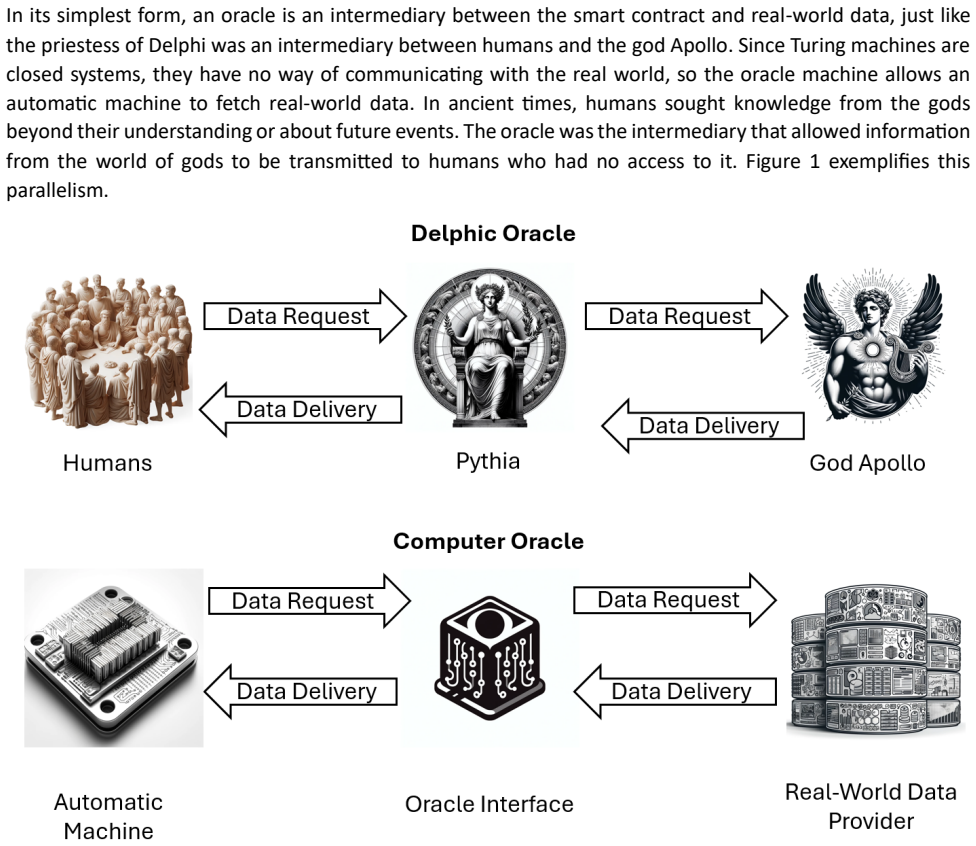
The oracle problem refers to the inability of an agent to know if the information coming from an oracle is authentic and unbiased. In ancient times, philosophers and historians debated on how to evaluate, increase, and secure the reliability of oracle predictions, particularly those from Delphi, which pertained to matters of state. Today, we refer to data carriers for automatic machines as oracles, but establishing a secure channel between these oracles and the real world still represents a challenge. Despite numerous efforts, this problem remains mostly unsolved, and the recent advent of blockchain oracles has added a layer of complexity because of the decentralization of blockchains. This paper conceptually connects Delphic and modern blockchain oracles, developing a comparative framework. Leveraging blockchain oracle taxonomy, lexical analysis is also performed on 167 Delphic queries to shed light on the relationship between oracle answer quality and question type. The presented framework aims first at revealing commonalities between classical and computational oracles and then at enriching the oracle analysis within each field. This study contributes to the computer science literature by proposing strategies to improve the reliability of blockchain oracles based on insights from Delphi and to classical literature by introducing a framework that can also be applied to interpret and classify other ancient oracular mechanisms.
Editorial analysis
A structured set of objections, weighed in public.
Referee Report
Summary. The paper develops a comparative framework connecting ancient Delphic oracles to modern blockchain oracles, performs a lexical analysis of 167 Delphic queries to examine relationships between question types and answer quality, and proposes strategies for improving blockchain oracle reliability based on historical insights. It also presents a framework intended for classifying other ancient oracular mechanisms.
Significance. If the comparative framework and lexical analysis yield demonstrably transferable strategies, the work could provide a distinctive interdisciplinary bridge between classical studies and computer science, enriching oracle taxonomies with historical perspectives. The application of lexical methods to a corpus of 167 queries is a methodological strength that grounds the conceptual claims in empirical historical data.
major comments (2)
- [Lexical analysis section] Lexical analysis section: The manuscript states that lexical analysis was performed on 167 Delphic queries to relate answer quality to question type, yet supplies no description of the query selection process, classification scheme for question types, criteria or coding for assessing answer quality, inter-rater reliability, or any statistical validation. This absence is load-bearing because the claimed relationship is used to support the proposed blockchain strategies.
- [Strategies for blockchain oracles section] Strategies for blockchain oracles section: Commonalities between Delphic practices and oracle designs are identified, but the text does not map these to concrete, falsifiable modifications of existing mechanisms (for example, how Delphic ambiguity handling or interpreter roles would alter multi-source aggregation, reputation systems, or cryptographic verification in adversarial settings). Without such mappings, the central claim of producing actionable improvements beyond current oracle literature remains unsupported.
minor comments (1)
- [Abstract] The abstract and introduction could more explicitly preview the main empirical findings from the 167-query analysis rather than only describing the method.
Simulated Author's Rebuttal
We thank the referee for the constructive review and for recognizing the potential interdisciplinary value of connecting Delphic oracles with blockchain mechanisms. The two major comments identify important gaps in methodological transparency and in the concreteness of the proposed strategies. We address each point below and commit to revisions that strengthen the manuscript without altering its core claims.
read point-by-point responses
-
Referee: [Lexical analysis section] Lexical analysis section: The manuscript states that lexical analysis was performed on 167 Delphic queries to relate answer quality to question type, yet supplies no description of the query selection process, classification scheme for question types, criteria or coding for assessing answer quality, inter-rater reliability, or any statistical validation. This absence is load-bearing because the claimed relationship is used to support the proposed blockchain strategies.
Authors: We agree that the current manuscript lacks sufficient detail on the lexical analysis procedure. In the revised version we will insert a new subsection that explicitly describes: (1) the selection criteria and sources for the 167 queries (primarily from the collections of Fontenrose and Parke & Wormell, with explicit inclusion/exclusion rules); (2) the classification scheme for question types (political, religious, personal, and economic, with examples and decision rules); (3) the coding protocol for answer quality (dimensions of clarity, specificity, and historical corroboration, each scored on a 1–5 scale); (4) the single-author coding process together with a second independent coder for a 20 % subsample and the resulting Cohen’s kappa; and (5) the statistical tests (chi-square and logistic regression) used to relate question type to quality scores. These additions will make the empirical foundation transparent and reproducible. revision: yes
-
Referee: [Strategies for blockchain oracles section] Strategies for blockchain oracles section: Commonalities between Delphic practices and oracle designs are identified, but the text does not map these to concrete, falsifiable modifications of existing mechanisms (for example, how Delphic ambiguity handling or interpreter roles would alter multi-source aggregation, reputation systems, or cryptographic verification in adversarial settings). Without such mappings, the central claim of producing actionable improvements beyond current oracle literature remains unsupported.
Authors: We accept that the strategies section currently remains at a high level of abstraction. In revision we will add a dedicated subsection that translates each historical insight into a specific, testable modification. Examples include: (a) incorporating controlled ambiguity by returning answer distributions rather than single values in multi-source aggregation protocols, with a proposed metric for measuring deviation from ground truth in simulated adversarial environments; (b) introducing an “interpreter layer” analogous to Delphic priests as a lightweight human-audit step within reputation systems, specifying how it would adjust oracle scores and under what cryptographic conditions; and (c) mapping the Delphic practice of multiple independent consultations to a requirement for at least three independent data sources with explicit majority-vote thresholds. Each proposal will be framed as a falsifiable hypothesis that can be evaluated in existing oracle testbeds. revision: yes
Circularity Check
No circularity: conceptual framework and lexical analysis are independent of inputs
full rationale
The paper constructs a comparative framework from external historical sources on Delphi and performs an independent lexical analysis of 167 queries to identify patterns in question types and answer quality. No equations, fitted parameters, or derivations exist that would make any claim equivalent to its inputs by construction. The proposed strategies for blockchain oracles emerge interpretively from the identified commonalities rather than being presupposed or reduced via self-definition, self-citation chains, or renaming of known results. The derivation chain remains self-contained against external benchmarks.
Axiom & Free-Parameter Ledger
axioms (1)
- domain assumption Insights from ancient Delphic oracle evaluation practices can be meaningfully transferred to improve the design of blockchain oracles.
Lean theorems connected to this paper
-
IndisputableMonolith/Foundation/RealityFromDistinction.leanreality_from_one_distinction unclear?
unclearRelation between the paper passage and the cited Recognition theorem.
developing a comparative framework... lexical analysis is also performed on 167 Delphic queries to shed light on the relationship between oracle answer quality and question type
What do these tags mean?
- matches
- The paper's claim is directly supported by a theorem in the formal canon.
- supports
- The theorem supports part of the paper's argument, but the paper may add assumptions or extra steps.
- extends
- The paper goes beyond the formal theorem; the theorem is a base layer rather than the whole result.
- uses
- The paper appears to rely on the theorem as machinery.
- contradicts
- The paper's claim conflicts with a theorem or certificate in the canon.
- unclear
- Pith found a possible connection, but the passage is too broad, indirect, or ambiguous to say the theorem truly supports the claim.
Reference graph
Works this paper leans on
-
[1]
Al-Breiki, H. et al. (2020) ‘Trustworthy Blockchain Oracles: Review, Comparison, and Open Research Challenges’, IEEE Access, 8, pp. 85675–85685. Available at: https://doi.org/10.1109/ACCESS.2020.2992698. Aloni, A. (1989) L’aedo e i tiranni. Ricerche sull’Inno omerico a Apollo. Roma. Amandry, P. (1950) La mantique apollinienne à Delphes. Essai sur le fonct...
-
[2]
IEEE, pp. 1–6. Available at: https://doi.org/10.1109/ICTMOD49425.2020.9380598. Caldarelli, G. (2020b) ‘Understanding the Blockchain Oracle Problem: A Call for Action’, Information, 11(11), p
-
[3]
Available at: https://doi.org/10.3390/info11110509. Caldarelli, G. (2022) ‘Overview of Blockchain Oracle Research’, Future Internet, 14(6), p
-
[4]
Available at: https://doi.org/10.3390/fi14060175. Caldarelli, G. (2023) ‘Before Ethereum. The Origin and Evolution of Blockchain Oracles’, IEEE Access, 11, pp. 50899–50917. Available at: https://doi.org/10.1109/ACCESS.2023.3279106. Caldarelli, G. and Ellul, J. (2021) ‘The Blockchain Oracle Problem in Decentralized Finance—A Multivocal Approach’, Applied S...
-
[5]
Available at: https://doi.org/10.3390/app11167572. Càssola, F. (1975) Inni omerici. Milano. Catenacci, C. (2001) ‘L’oracolo di Delfi e le tradizioni oracolari nella Grecia arcaica e classica. Formazione, prassi, teologia’, in M. Vetta (ed.) La civiltà dei Greci: forme, luoghi, contesti. Roma, pp. 131–184. Cicero (1923) On Old Age. On Friendship. On Divina...
-
[6]
Cambridge, MA: Harvard University Press. Compton, T. (1994) ‘The Herodotean Mantic Session at Delphi’, Rheinisches Museum für Philologie (RhM), 137(3–4), pp. 217–223. Crahay, R. (1974) ‘La bouche de la vérité’, in J.-P. Vernant and others (eds) Divination et rationalité. Paris, pp. 201–219. D-Nice (2017) GitHub - provable-things/oraclize-lib: Oraclize nod...
-
[7]
Harvard University Press. Fairbanks, A. (1906) ‘Herodotus and the Oracle at Delphi’, The Classical Association of the Middle West and South, 1(2), pp. 37–48. Available at: http://www.jstor.org/stable/3287085. Fontenrose, J. (1978) DELPHIC ORACLE : its responses and operations with a catalogue of responses (2021 edition). UNIV OF CALIFORNIA PRESS. Availabl...
-
[8]
Cambrige, MA: Harvard University Press. Poblet, M. et al. (2020) ‘From Athens to the Blockchain: Oracles for Digital Democracy’, Frontiers in Blockchain, 3(September), pp. 1–11. Available at: https://doi.org/10.3389/fbloc.2020.575662. Richardson, N. (ed.) (2010) Three Homeric Hymns: To Apollo, Hermes, and Aphrodite. Cambridge: Cambridge University Press. ...
-
[9]
Harvard University Press. Zhang, F. et al. (2020) ‘DECO: Liberating Web Data Using Decentralized Oracles for TLS’, in Proceedings of the 2020 ACM SIGSAC Conference on Computer and Communications Security. New York, NY, USA: ACM, pp. 1919–1938. Available at: https://doi.org/10.1145/3372297.3417239. Zhao, Y. et al. (2022) ‘Toward Trustworthy DeFi Oracles: P...
discussion (0)
Sign in with ORCID, Apple, or X to comment. Anyone can read and Pith papers without signing in.