AI-enabled gravitational-waves searches for binary neutron stars at optimal sensitivity
Pith reviewed 2026-07-03 19:26 UTC · model grok-4.3
The pith
A neural network achieves sensitivity comparable to matched-filter pipelines for binary neutron star gravitational wave searches at lower computational cost.
A machine-rendered reading of the paper's core claim, the machinery that carries it, and where it could break.
Core claim
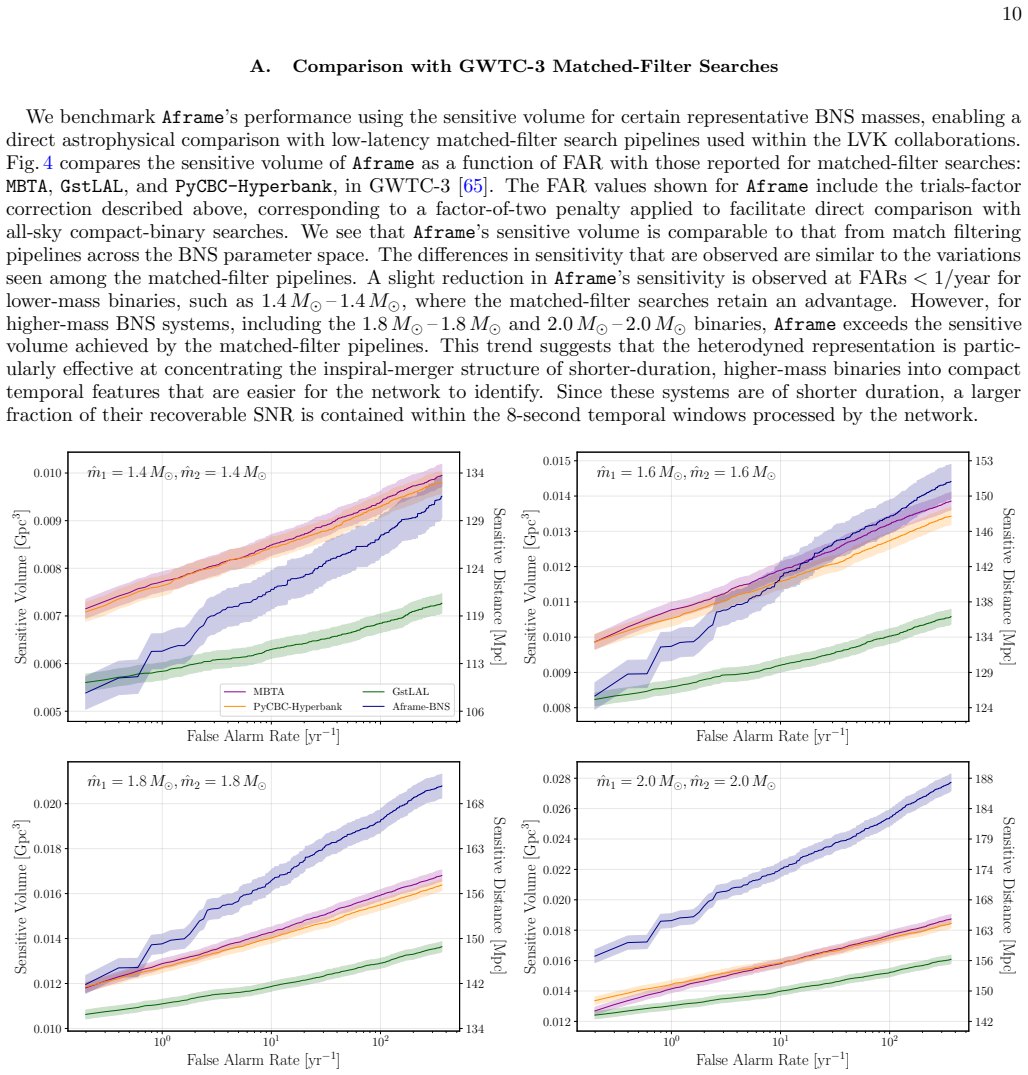
The central claim is that the Aframe neural network, after heterodyning the gravitational-wave strain data, distinguishes binary neutron star signals from background with sensitivity comparable to matched-filter pipelines while operating at substantially lower computational and latency costs; the same network previously used for binary black holes suffices once the data are heterodyned, and the full analysis fits on one non-flagship GPU for online use or on distributed GPUs for archival searches.
What carries the argument
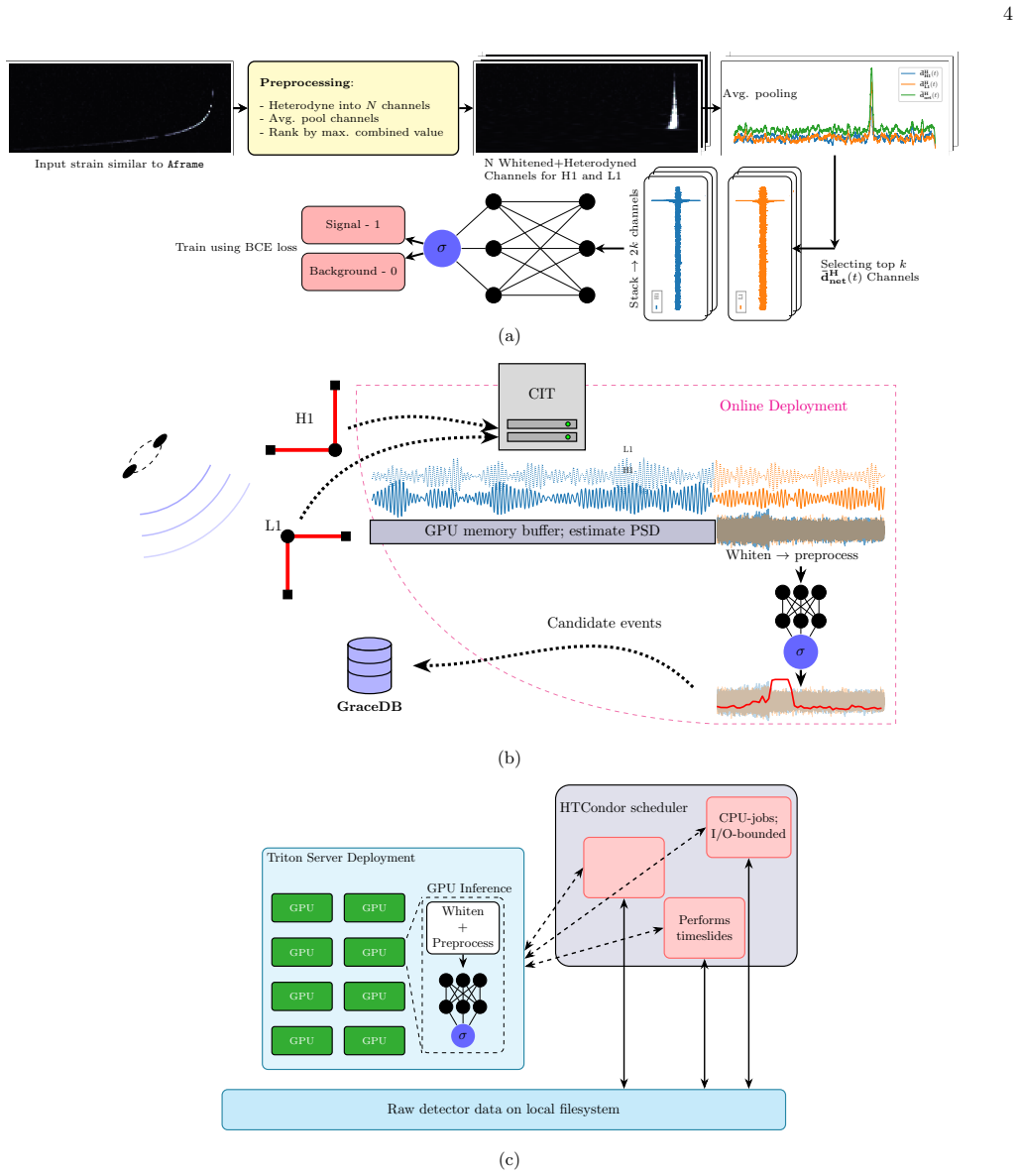
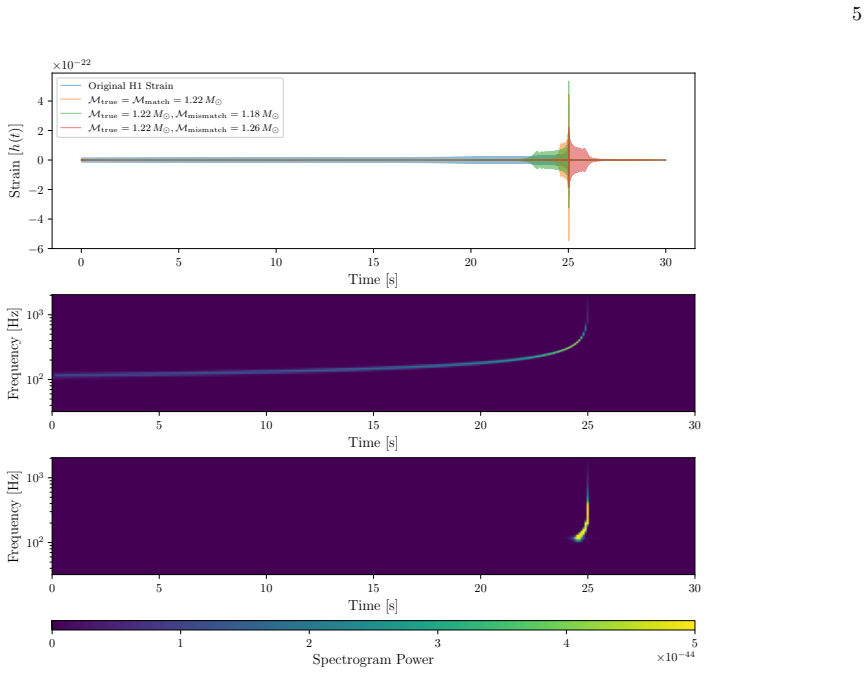
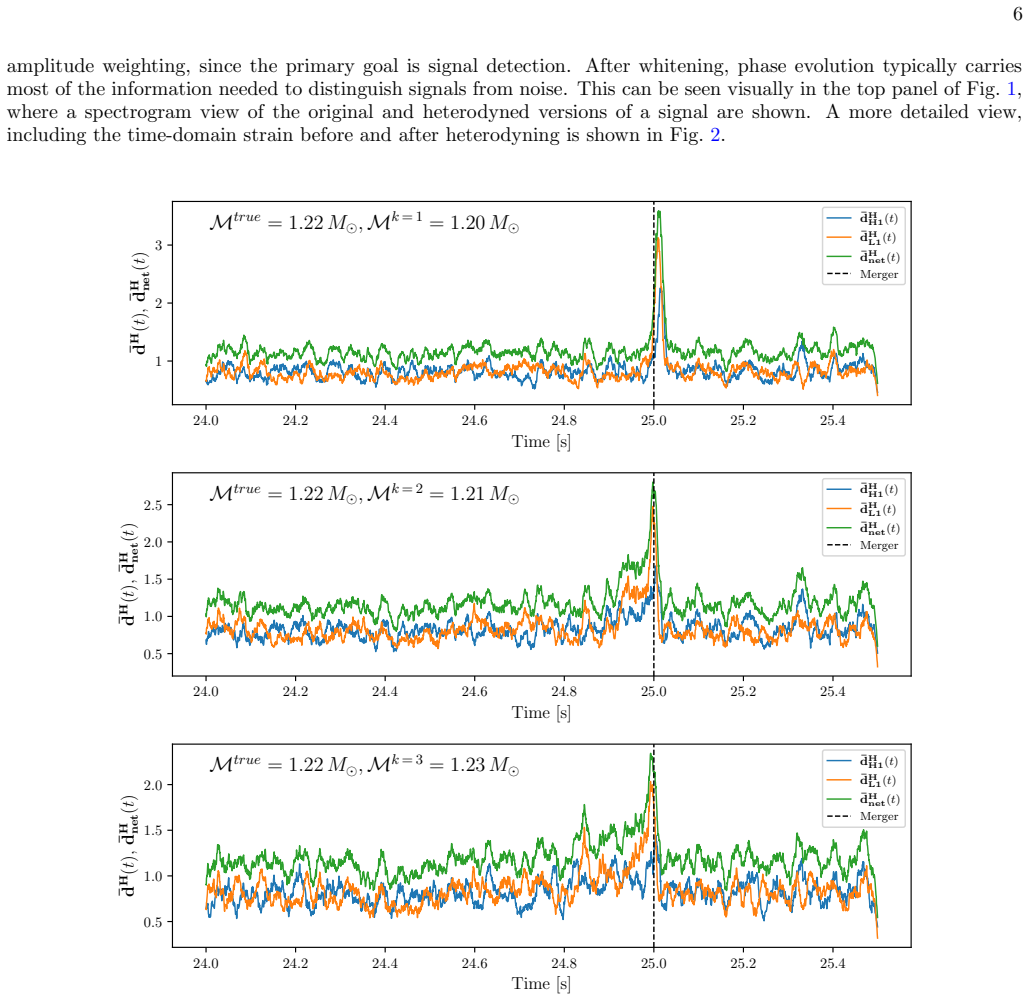
Heterodyning the data to compress the longer-duration binary neutron star signals, allowing reuse of the binary black hole neural network architecture for signal-versus-background classification.
If this is right
- Online BNS searches become feasible on a single GPU rather than a thousand CPU cores.
- Rapid offline archival analysis scales across a distributed pool of GPUs via inference-as-a-service tools.
- The approach extends AI-enabled searches from the binary black hole regime into the lower-mass binary neutron star regime.
- Both real-time and archival analyses can now use the same trained network after the heterodyning step.
Where Pith is reading between the lines
- Similar preprocessing steps might allow the same network to handle other long-duration signals without retraining from scratch.
- Lower per-search compute could support simultaneous searches across more detector combinations or higher sampling rates.
- Faster turnaround from data to candidate list could increase the fraction of events with timely electromagnetic follow-up.
Load-bearing premise
That heterodyning the data followed by the existing BBH network architecture is sufficient to distinguish BNS signal from background without meaningful loss of sensitivity compared to matched filtering.
What would settle it
A side-by-side comparison on the same LIGO-Virgo-KAGRA data segment showing that the Aframe search recovers substantially fewer injections at a fixed false-alarm rate than the matched-filter pipeline would falsify the comparable-sensitivity claim.
Figures
read the original abstract
Gravitational Waves (GWs) represent the newest window of astronomy, furthering our understanding of compact objects like black holes and neutron stars in the Universe. The signal from two merging neutron stars is especially interesting since it brings the prospect of concordant electromagnetic and neutrino emissions. Such multi-messenger observations have a transformational impact on fundamental physics, nuclear matter, astrophysics, and gravity. It was first witnessed in 2017 with the detection of the binary neutron star (BNS) merger GW170817. However, searching for BNS signals in real-time in the LIGO-Virgo-KAGRA (LVK) GW detectors presents a computational challenge, as the data streaming out must be matched against $\sim$ million reference waveforms, which requires up to a thousand CPU cores. We present a different approach using neural networks to learn the presence of a signal in the data. Our algorithm, called Aframe, was deployed in the LVK's fourth observing run and was the first artificial intelligence (AI)-enabled search to detect multiple binary black holes (BBHs) live. In this work, we demonstrate that the approach extends to the lower-mass BNS regime, and is the first AI-enabled search that achieves sensitivity comparable to matched-filter pipelines at lower computational and latency costs. The challenge of the longer-duration BNS signals is addressed by heterodyning the data, following which the network architecture used for BBHs is sufficient to distinguish signal versus background. We also show that this analysis requires a single non-flagship GPU for online deployment. Furthermore, the design and adoption of inference-as-a-service tools allow rapid offline analysis using a distributed pool of GPU resources. Hence, aside from the use case of rapid online data analysis, we also establish the use of Aframe for efficient archival data analysis.
Editorial analysis
A structured set of objections, weighed in public.
Referee Report
Summary. The manuscript presents an extension of the Aframe neural-network search (previously deployed for binary black holes in O4) to binary neutron star (BNS) signals. Heterodyning is used to compress the longer-duration BNS waveforms so that the existing BBH network architecture can be applied directly; the authors claim this yields the first AI-enabled BNS search with sensitivity comparable to matched-filter pipelines at substantially lower computational cost and latency, runnable on a single non-flagship GPU for online operation and on distributed GPUs for offline archival analysis.
Significance. If the quantitative sensitivity claims are substantiated, the result would be significant for real-time multi-messenger astronomy: it would demonstrate that a single preprocessing step plus an existing network suffices to reach matched-filter performance for BNS events, thereby lowering the barrier to continuous low-latency BNS searches and enabling broader use of GPU resources for both live and archival analyses.
major comments (2)
- [Abstract] Abstract: the central claim that the method 'achieves sensitivity comparable to matched-filter pipelines' is asserted without any quantitative metrics (sensitive volume, detection efficiency vs. FAR, ROC curves, or injection-recovery statistics with error bars). Because this comparison is load-bearing for the paper's primary result, the results section must supply direct, side-by-side figures and tables against at least one standard matched-filter pipeline on the same dataset.
- [Methods] Methods / heterodyning description: the claim that heterodyning plus the unmodified BBH network architecture incurs 'no meaningful loss of sensitivity' for BNS signals requires explicit validation. An ablation or sensitivity curve showing the effect of the heterodyning cutoff frequency and any retraining on BNS injections versus the BBH-only network would be needed to confirm the weakest assumption identified in the review.
minor comments (2)
- [Abstract] Abstract: the phrase 'lower computational and latency costs' would be strengthened by a single sentence giving the approximate factor (e.g., 'X-fold reduction in CPU cores and Y ms latency') even if detailed benchmarks appear later.
- [Deployment section] The manuscript should include a short table or paragraph comparing wall-clock time, memory footprint, and GPU model for the online deployment to make the 'single non-flagship GPU' statement reproducible.
Simulated Author's Rebuttal
We thank the referee for their constructive comments, which help clarify the presentation of our results. We address each major comment below and commit to revisions that directly respond to the concerns raised.
read point-by-point responses
-
Referee: [Abstract] Abstract: the central claim that the method 'achieves sensitivity comparable to matched-filter pipelines' is asserted without any quantitative metrics (sensitive volume, detection efficiency vs. FAR, ROC curves, or injection-recovery statistics with error bars). Because this comparison is load-bearing for the paper's primary result, the results section must supply direct, side-by-side figures and tables against at least one standard matched-filter pipeline on the same dataset.
Authors: We agree that the abstract and results section would benefit from more explicit quantitative metrics to support the central claim. The manuscript contains sensitivity comparisons, but they are not presented as direct side-by-side figures and tables with error bars against a standard matched-filter pipeline. In the revised manuscript we will add these elements to the results section (including sensitive volume, detection efficiency vs. FAR, ROC curves, and injection-recovery statistics) and will update the abstract to include key quantitative metrics. revision: yes
-
Referee: [Methods] Methods / heterodyning description: the claim that heterodyning plus the unmodified BBH network architecture incurs 'no meaningful loss of sensitivity' for BNS signals requires explicit validation. An ablation or sensitivity curve showing the effect of the heterodyning cutoff frequency and any retraining on BNS injections versus the BBH-only network would be needed to confirm the weakest assumption identified in the review.
Authors: We accept that an explicit ablation study would strengthen the validation of the heterodyning step. The current manuscript shows overall BNS performance but does not include a dedicated ablation on heterodyning cutoff frequency or direct comparison of the unmodified BBH network on BNS injections. In the revision we will add sensitivity curves and an ablation analysis that quantifies the effect of heterodyning (with and without the step) and compares against the BBH-only network on BNS injections. revision: yes
Circularity Check
No significant circularity identified
full rationale
The paper presents an empirical demonstration: heterodyning BNS data followed by reuse of an existing BBH neural-network architecture, with sensitivity claims based on direct comparison to matched-filter pipelines and live deployment results. No derivation chain, equations, or self-citation is invoked to define or force the reported performance; the central result is an external benchmark outcome rather than a quantity constructed from its own inputs. The approach is self-contained against independent matched-filter references and does not reduce any prediction to a fitted parameter or prior self-citation.
Axiom & Free-Parameter Ledger
Reference graph
Works this paper leans on
-
[1]
The data is resampled to 2048 Hz, and segments that are coincident and analysis-ready be- 2https://gwosc.org/ 8 tween H1 and L1 are retained
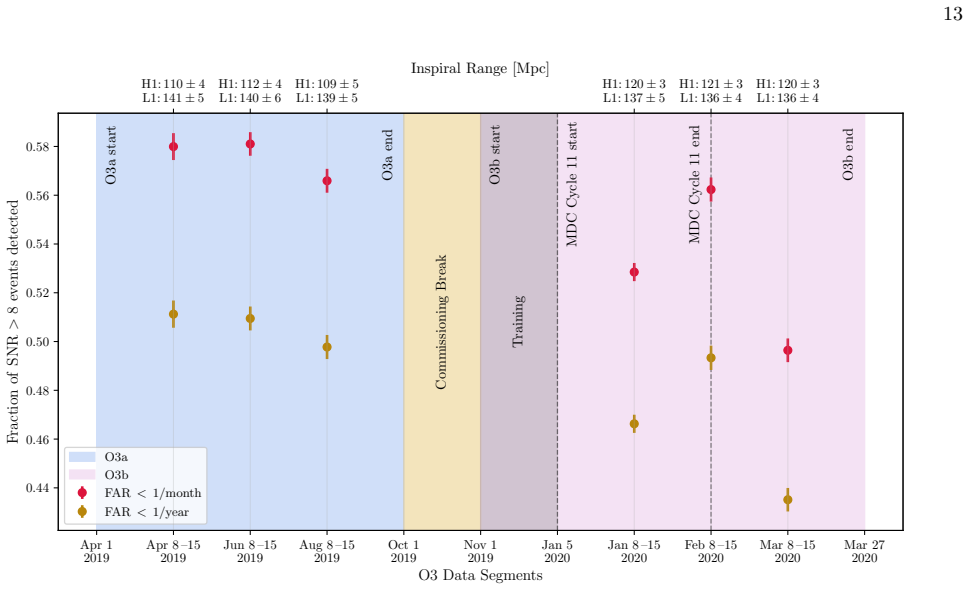
Data We use publicly available strain data from LVK’s O3 observing run from the Gravitational Wave Open Science Center (GWOSC) 2 [84]. The data is resampled to 2048 Hz, and segments that are coincident and analysis-ready be- 2https://gwosc.org/ 8 tween H1 and L1 are retained. In particular, training uses data between 2019-11-01 to 2020-01-05, with 15,000 ...
2048
-
[2]
hopeless
Waveforms We generate 30,000 BNS waveform polarizations, with 25 s of duration sampled at 2048 Hz usingBilbywith the IMRPhenomPv2approximant, of which 10,000 are used for training, and 20,000 are used for validation. The intrinsic and extrinsic source parameters for the waveforms are drawn from astrophysical distributions consistent with those used in GWT...
2048
-
[3]
For every element, the first 20 s are used to calculate a PSD per-channel, that is used to whiten the remaining segment
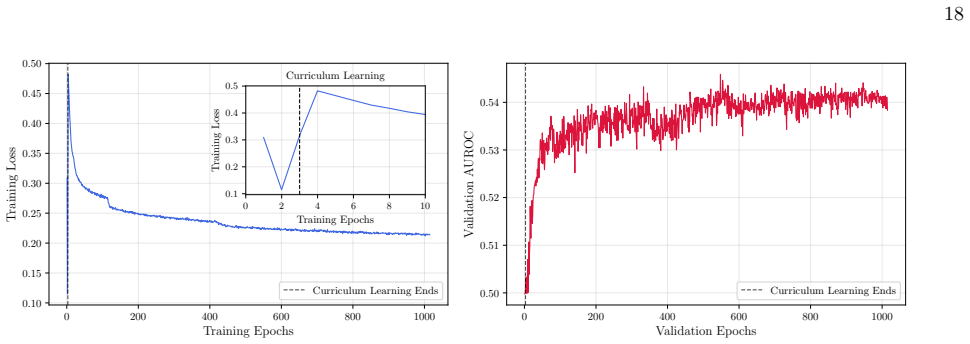
Training Strategy A training batch is constructed dynamically by loading 30-second segments of raw detector data from H1 and L1 with timeslides (see section II C), giving 2-channels input. For every element, the first 20 s are used to calculate a PSD per-channel, that is used to whiten the remaining segment. Simulated waveforms are injected in the remaini...
-
[4]
Segments of detector strains following the training period, along with 20,000 simulated waveforms, are reserved for validation
Validation Strategy We adopt the same validation prescription as used inAframeBBH search [2]. Segments of detector strains following the training period, along with 20,000 simulated waveforms, are reserved for validation. The validation set is prepared similarly as described in [2]. This involves adding simulated signals into noise segments, network-SNR t...
-
[5]
Typical threshold values for considering a candidate of interest is FAR∼1/month≈ 3.9×10 −7 Hz, which was used for sending public alerts in LVK O4 [12]
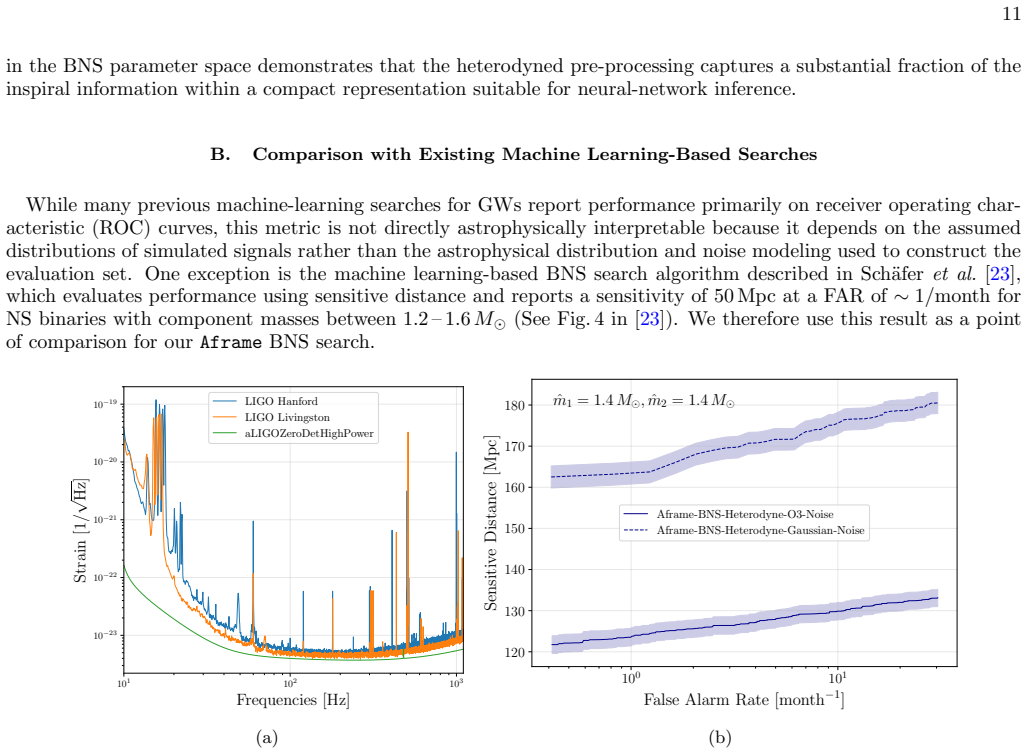
Sensitive Volume One of the key metrics for evaluating the performance of GW search pipelines is its astrophysical sensitive volume at a fixed false alarm rate (FAR). Typical threshold values for considering a candidate of interest is FAR∼1/month≈ 3.9×10 −7 Hz, which was used for sending public alerts in LVK O4 [12]. 3 A candidate with this FAR value indi...
-
[6]
Accelerated AI Algorithms for Data-Driven Discovery (A3D3)
Background Estimation The FAR quantifies the expected rate at which random noise fluctuations produce triggers with a detection statistic exceeding a given threshold. These values are estimated empirically from the background distribution obtained using timeslides that generate a signal-free stream of several years (see section II A). While constructing t...
2019
-
[7]
These binaries remain in the detector band forO(mins.), with the inspiral phase occupying a large fraction of the signal duration
Decimator/Multi-Banding We explored a multi-banding strategy motivated by the time-frequency evolution exhibited by BNS mergers. These binaries remain in the detector band forO(mins.), with the inspiral phase occupying a large fraction of the signal duration. During inspiral, the signal evolves slowly in time while sweeping upward in frequency, implying t...
2048
-
[8]
Motivated by this behavior, we explored a spectrogram-based representation that could expose the signal’s time-frequency structure to the network
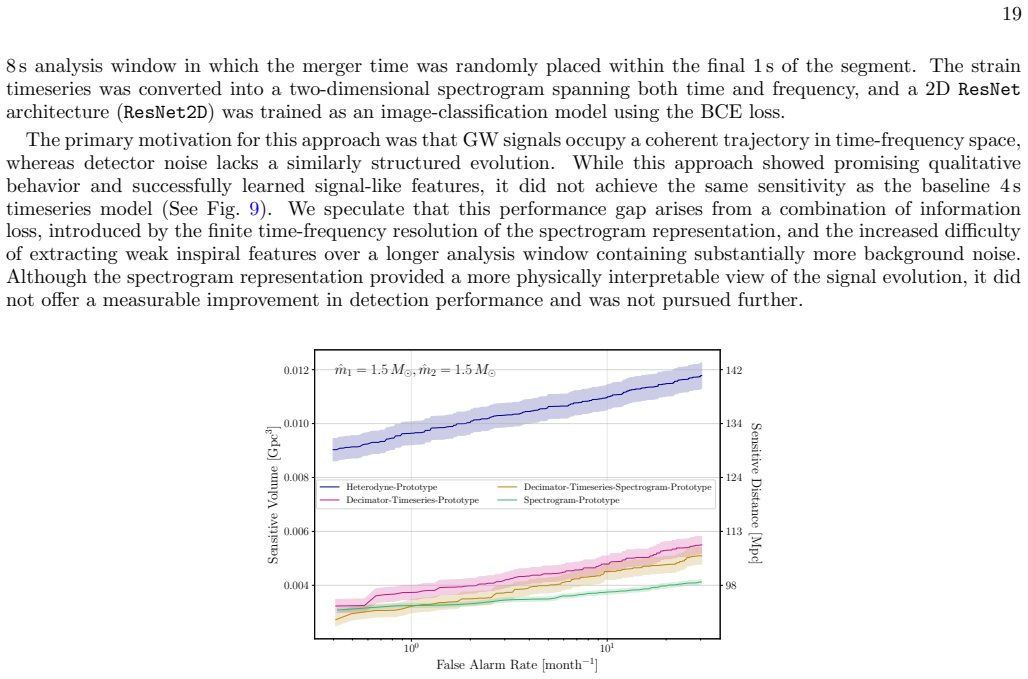
Long Window Spectrogram View As discussed earlier, BNS mergers exhibit a chirp-like evolution in time-frequency space, with the signal frequency increasing as the binary inspirals toward merger. Motivated by this behavior, we explored a spectrogram-based representation that could expose the signal’s time-frequency structure to the network. For this study,...
-
[9]
B. P. Abbottet al., Multi-messenger observations of a binary neutron star merger, The Astrophysical Journal Letters848, L12 (2017)
2017
-
[10]
E. Marxet al., Machine-learning pipeline for real-time detection of gravitational waves from compact binary coalescences, Phys. Rev. D111, 042010 (2025), arXiv:2403.18661 [gr-qc]
-
[11]
J. Aasiet al.(LIGO Scientific), Advanced LIGO, Class. Quant. Grav.32, 074001 (2015), arXiv:1411.4547 [gr-qc]
work page internal anchor Pith review Pith/arXiv arXiv 2015
-
[12]
Advanced Virgo: a 2nd generation interferometric gravitational wave detector
F. Acerneseet al.(VIRGO), Advanced Virgo: a second-generation interferometric gravitational wave detector, Class. Quant. Grav.32, 024001 (2015), arXiv:1408.3978 [gr-qc]
work page internal anchor Pith review Pith/arXiv arXiv 2015
-
[13]
T. Akutsuet al., Overview of kagra: Detector design and construction history, Progress of Theoretical and Experimental Physics2021, 05A101 (2021), https://academic.oup.com/ptep/article-pdf/2021/5/05A101/37974994/ptaa125.pdf
2021
-
[15]
T. L. S. Collaboration, the Virgo Collaboration, the KAGRA Collaboration, A. G. Abac,et al., Gwtc-5.0: An introduction to version 5.0 of the gravitational-wave transient catalog (2026), arXiv:2605.27223 [gr-qc]
work page internal anchor Pith review Pith/arXiv arXiv 2026
-
[16]
T. L. S. Collaboration, the Virgo Collaboration, the KAGRA Collaboration, A. G. Abac,et al., Gwtc-5.0: Methods for identifying and characterizing gravitational-wave transients (2026), arXiv:2605.27224 [gr-qc]
work page internal anchor Pith review Pith/arXiv arXiv 2026
-
[17]
T. L. S. Collaboration, the Virgo Collaboration, the KAGRA Collaboration, A. G. Abac,et al., Gwtc-5.0: Observations 20 from the second part of the fourth ligo-virgo-kagra observing run and updates to the gravitational-wave transient catalog (2026), arXiv:2605.27225 [gr-qc]
work page internal anchor Pith review Pith/arXiv arXiv 2026
-
[18]
T. L. S. Collaboration, the Virgo Collaboration, and the KAGRA Collaboration, Gwtc-5.0: Population properties of merging compact binaries (2026), arXiv:2605.27226 [astro-ph.HE]
work page internal anchor Pith review Pith/arXiv arXiv 2026
-
[19]
T. L. S. Collaboration, the Virgo Collaboration, and the KAGRA Collaboration, Gwtc-5.0: Constraints on the cosmic expansion rate and modified gravitational-wave propagation (2026), arXiv:2605.27227 [astro-ph.CO]
work page internal anchor Pith review Pith/arXiv arXiv 2026
-
[20]
LIGO Scientific Collaboration, Virgo Collaboration, and KAGRA Collaboration,LIGO/Virgo/KAGRA Public Alerts User Guide(2025)
2025
-
[21]
Sachdev, R
S. Sachdev, R. Magee, C. Hanna, K. Cannon, L. Singer, J. R. SK, D. Mukherjee, S. Caudill, C. Chan, J. D. E. Creighton, B. Ewing, H. Fong, P. Godwin, R. Huxford, S. Kapadia, A. K. Y. Li, R. K. Lok Lo, D. Meacher, C. Messick, S. R. Mohite, A. Nishizawa, H. Ohta, A. Pace, A. Reza, B. S. Sathyaprakash, M. Shikauchi, D. Singh, L. Tsukada, D. Tsuna, T. Tsutsui,...
2020
-
[22]
A. H. Nitz, M. Sch¨ afer, and T. D. Canton, Gravitational-wave merger forecasting: Scenarios for the early detection and localization of compact-binary mergers with ground-based observatories, The Astrophysical Journal Letters902, L29 (2020)
2020
-
[23]
All´ en´ e, F
C. All´ en´ e, F. Aubin, I. Bentara, D. Buskulic, G. M. Guidi, V. Juste, M. Lethuillier, F. Marion, L. Mobilia, B. Mours, A. Ouzriat, T. Sainrat, and V. Sordini, The mbta pipeline for detecting compact binary coalescences in the fourth ligo- virgo-kagra observing run, Classical and Quantum Gravity42, 105009 (2025)
2025
-
[24]
Kovalam, M
M. Kovalam, M. A. Kaium Patwary, A. K. Sreekumar, L. Wen, F. H. Panther, and Q. Chu, Early warnings of binary neutron star coalescence using the spiir search, The Astrophysical Journal Letters927, L9 (2022)
2022
-
[25]
S. Sakon, L. Tsukada, H. Fong, J. Kennington, W. Niu, C. Hanna, S. Adhicary, P. Baral, A. Baylor, K. Cannon, S. Caudill, B. Cousins, J. D. Creighton, B. Ewing, R. N. George, P. Godwin, R. Harada, Y.-J. Huang, R. Huxford, P. Joshi, S. Kuwa- hara, A. K. Li, R. Magee, D. Meacher, C. Messick, S. Morisaki, D. Mukherjee, A. Pace, C. Posnansky, A. Ray, S. Sachde...
-
[26]
S. Bagnasco, The Ligo-Virgo-KAGRA Computing Infrastructure for Gravitational-wave Research, in26th International Conference on Computing in High Energy and Nuclear Physics (CHEP 2023), European Physical Journal Web of Confer- ences, Vol. 295 (EDP, 2024) p. 04047
2023
-
[27]
B. J. Owen and B. S. Sathyaprakash, Matched filtering of gravitational waves from inspiraling compact binaries: Compu- tational cost and template placement, Physical Review D60, 10.1103/physrevd.60.022002 (1999)
-
[28]
B. P. Abbottet al., Observation of gravitational waves from a binary black hole merger, Physical Review Letters116, 10.1103/physrevlett.116.061102 (2016)
-
[29]
George and E
D. George and E. A. Huerta, Deep neural networks to enable real-time multimessenger astrophysics, Phys. Rev. D97, 044039 (2018)
2018
-
[30]
Gabbard, M
H. Gabbard, M. Williams, F. Hayes, and C. Messenger, Matching matched filtering with deep networks for gravitational- wave astronomy, Phys. Rev. Lett.120, 141103 (2018)
2018
-
[31]
M. B. Sch¨ afer, F. Ohme, and A. H. Nitz, Detection of gravitational-wave signals from binary neutron star mergers using machine learning, Physical Review D102, 10.1103/physrevd.102.063015 (2020)
-
[32]
M. B. Sch¨ afer, O. c. v. Zelenka, A. H. Nitz, F. Ohme, and B. Br¨ ugmann, Training strategies for deep learning gravitational- wave searches, Phys. Rev. D105, 043002 (2022)
2022
-
[33]
M. B. Sch¨ afer, O. c. v. Zelenka, A. H. Nitz, H. Wang, S. Wu, Z.-K. Guo, Z. Cao, Z. Ren, P. Nousi, N. Stergioulas, P. Iosif, A. E. Koloniari, A. Tefas, N. Passalis, F. Salemi, G. Vedovato, S. Klimenko, T. Mishra, B. Br¨ ugmann, E. Cuoco, E. A. Huerta, C. Messenger, and F. Ohme, First machine learning gravitational-wave search mock data challenge, Phys. R...
2023
-
[34]
Baltus, J
G. Baltus, J. Janquart, M. Lopez, A. Reza, S. Caudill, and J.-R. Cudell, Convolutional neural networks for the detection of the early inspiral of a gravitational-wave signal, Phys. Rev. D103, 102003 (2021)
2021
-
[35]
Baltus, J
G. Baltus, J. Janquart, M. Lopez, H. Narola, and J.-R. Cudell, Convolutional neural network for gravitational-wave early alert: Going down in frequency, Phys. Rev. D106, 042002 (2022)
2022
-
[36]
McLeod, D
A. McLeod, D. Beveridge, L. Wen, and A. Wicenec, Binary neutron star merger search pipeline powered by deep learning, Phys. Rev. D111, 024035 (2025)
2025
-
[37]
E. A. Huerta, A. Khan, X. Huang, M. Tian, M. Levental, R. Chard, W. Wei, M. Heflin, D. S. Katz, V. Kindratenko, D. Mu, B. Blaiszik, and I. Foster, Accelerated, scalable and reproducible ai-driven gravitational wave detection, Nature Astronomy5, 1062 (2021)
2021
-
[38]
D. Chatterjee, E. Marx, W. Benoit, R. Kumar, M. Desai, E. Govorkova, A. Gunny, E. Moreno, R. Omer, R. Raikman, M. Saleem, S. Aggarwal, M. W. Coughlin, P. Harris, and E. Katsavounidis, Rapid likelihood free inference of compact binary coalescences using accelerated hardware, Machine Learning: Science and Technology5, 045030 (2024), arXiv:2407.19048 [gr-qc]
-
[39]
V. Skliris, M. R. K. Norman, and P. J. Sutton, Real-time detection of unmodelled gravitational-wave transients using convolutional neural networks (2022), arXiv:2009.14611 [astro-ph.IM]
-
[40]
LIGO Scientific Collaboration, VIRGO Collaboration, and Kagra Collaboration, LIGO/Virgo/KAGRA S250830m: Iden- tification of a GW compact binary merger candidate, GRB Coordinates Network41601, 1 (2025)
2025
-
[41]
LIGO Scientific Collaboration, VIRGO Collaboration, and Kagra Collaboration, LIGO/Virgo/KAGRA S250830bp: Iden- 21 tification of a GW compact binary merger candidate, GRB Coordinates Network41606, 1 (2025)
2025
-
[42]
LIGO Scientific Collaboration, VIRGO Collaboration, and Kagra Collaboration, LIGO/Virgo/KAGRA S250901cb: Iden- tification of a GW compact binary merger candidate, GRB Coordinates Network41638, 1 (2025)
2025
-
[43]
LIGO Scientific Collaboration, VIRGO Collaboration, and Kagra Collaboration, LIGO/Virgo/KAGRA S250904ae: Iden- tification of a GW compact binary merger candidate, GRB Coordinates Network41689, 1 (2025)
2025
-
[44]
LIGO Scientific Collaboration, VIRGO Collaboration, and Kagra Collaboration, LIGO/Virgo/KAGRA S250904br: Iden- tification of a GW compact binary merger candidate, GRB Coordinates Network41692, 1 (2025)
2025
-
[45]
LIGO Scientific Collaboration, VIRGO Collaboration, and Kagra Collaboration, LIGO/Virgo/KAGRA S250904cv: Iden- tification of a GW compact binary merger candidate, GRB Coordinates Network41700, 1 (2025)
2025
-
[46]
LIGO Scientific Collaboration, VIRGO Collaboration, and Kagra Collaboration, LIGO/Virgo/KAGRA S250911ac: Iden- tification of a GW compact binary merger candidate, GRB Coordinates Network41786, 1 (2025)
2025
-
[47]
LIGO Scientific Collaboration, VIRGO Collaboration, and Kagra Collaboration, LIGO/Virgo/KAGRA S250927ck: Iden- tification of a GW compact binary merger candidate, GRB Coordinates Network42015, 1 (2025)
2025
-
[48]
LIGO Scientific Collaboration, VIRGO Collaboration, and Kagra Collaboration, LIGO/Virgo/KAGRA S250927cy: Iden- tification of a GW compact binary merger candidate, GRB Coordinates Network42016, 1 (2025)
2025
-
[49]
LIGO Scientific Collaboration, VIRGO Collaboration, and Kagra Collaboration, LIGO/Virgo/KAGRA S250929c: Identi- fication of a GW compact binary merger candidate, GRB Coordinates Network42023, 1 (2025)
2025
-
[50]
LIGO Scientific Collaboration, VIRGO Collaboration, and Kagra Collaboration, LIGO/Virgo/KAGRA S251006dd: Iden- tification of a GW compact binary merger candidate, GRB Coordinates Network42134, 1 (2025)
2025
-
[51]
LIGO Scientific Collaboration, VIRGO Collaboration, and Kagra Collaboration, LIGO/Virgo/KAGRA S251013x: Identi- fication of a GW compact binary merger candidate, GRB Coordinates Network42212, 1 (2025)
2025
-
[52]
LIGO Scientific Collaboration, VIRGO Collaboration, and Kagra Collaboration, LIGO/Virgo/KAGRA S251014cn: Iden- tification of a GW compact binary merger candidate, GRB Coordinates Network42255, 1 (2025)
2025
-
[53]
LIGO Scientific Collaboration, VIRGO Collaboration, and Kagra Collaboration, LIGO/Virgo/KAGRA S251018bi: Iden- tification of a GW compact binary merger candidate, GRB Coordinates Network42357, 1 (2025)
2025
-
[54]
LIGO Scientific Collaboration, VIRGO Collaboration, and Kagra Collaboration, LIGO/Virgo/KAGRA S251021u: Identi- fication of a GW compact binary merger candidate, GRB Coordinates Network42373, 1 (2025)
2025
-
[55]
LIGO Scientific Collaboration, VIRGO Collaboration, and Kagra Collaboration, LIGO/Virgo/KAGRA S251026bn: Iden- tification of a GW compact binary merger candidate, GRB Coordinates Network42462, 1 (2025)
2025
-
[56]
LIGO Scientific Collaboration, VIRGO Collaboration, and Kagra Collaboration, LIGO/Virgo/KAGRA S251031cq: Iden- tification of a GW compact binary merger candidate, GRB Coordinates Network42529, 1 (2025)
2025
-
[57]
LIGO Scientific Collaboration, VIRGO Collaboration, and Kagra Collaboration, LIGO/Virgo/KAGRA S251103f: Identi- fication of a GW compact binary merger candidate, GRB Coordinates Network42564, 1 (2025)
2025
-
[58]
LIGO Scientific Collaboration, VIRGO Collaboration, and Kagra Collaboration, LIGO/Virgo/KAGRA S251105aj: Iden- tification of a GW compact binary merger candidate, GRB Coordinates Network42587, 1 (2025)
2025
-
[59]
LIGO Scientific Collaboration, VIRGO Collaboration, and Kagra Collaboration, LIGO/Virgo/KAGRA S251108dn: Iden- tification of a GW compact binary merger candidate, GRB Coordinates Network42619, 1 (2025)
2025
-
[60]
LIGO Scientific Collaboration, VIRGO Collaboration, and Kagra Collaboration, LIGO/Virgo/KAGRA S251108fi: Identi- fication of a GW compact binary merger candidate, GRB Coordinates Network42624, 1 (2025)
2025
-
[61]
LIGO Scientific Collaboration, VIRGO Collaboration, and Kagra Collaboration, LIGO/Virgo/KAGRA S251116en: Iden- tification of a GW compact binary merger candidate, GRB Coordinates Network42708, 1 (2025)
2025
-
[62]
LIGO Scientific Collaboration, VIRGO Collaboration, and Kagra Collaboration, LIGO/Virgo/KAGRA S251117dq: Iden- tification of a GW compact binary merger candidate, GRB Coordinates Network42727, 1 (2025)
2025
-
[63]
N. J. Cornish, Fast fisher matrices and lazy likelihoods (2013), arXiv:1007.4820 [gr-qc]
work page internal anchor Pith review Pith/arXiv arXiv 2013
-
[64]
T. Venumadhav, B. Zackay, J. Roulet, L. Dai, and M. Zaldarriaga, New search pipeline for compact binary mergers: Results for binary black holes in the first observing run of advanced ligo, Physical Review D100, 10.1103/physrevd.100.023011 (2019)
-
[65]
N. J. Cornish, Heterodyned likelihood for rapid gravitational wave parameter inference, Physical Review D104, 10.1103/physrevd.104.104054 (2021)
-
[66]
Venumadhav, B
T. Venumadhav, B. Zackay, J. Roulet, L. Dai, and M. Zaldarriaga, New binary black hole mergers in the second observing run of advanced ligo and advanced virgo, Phys. Rev. D101, 083030 (2020)
2020
-
[67]
labrador: A domain-optimized machine-learning tool for gravitational wave inference
J. Roulet, M. Crisostomi, L. M. Thomas, and K. Chatziioannou, labrador: A domain-optimized machine-learning tool for gravitational wave inference (2026), arXiv:2604.08897 [gr-qc]
work page internal anchor Pith review Pith/arXiv arXiv 2026
-
[68]
A. H. Nitz, K. Kacanja, and K. Soni, Beyond findchirp for gravitational-wave matched-filter searches with ratio-filter dechirping, Physical Review D113, 10.1103/k21q-wp8f (2026)
-
[69]
K. Kacanja, K. Soni, A. Aky¨ uz, and A. H. Nitz, Search for sub-solar mass binaries in the first part of ligo’s fourth observing run (2026), arXiv:2602.12115 [astro-ph.HE]
-
[70]
Y. Murakami, T. Ghosh, and S. Morisaki, Efficient reconstruction of matched-filter signal-to-noise ratio time series from nearby templates for compact binary coalescences searches (2026), arXiv:2511.12894 [gr-qc]
-
[71]
K. W. K. Wong, M. Isi, and T. D. P. Edwards, Fast gravitational-wave parameter estimation without compromises, The Astrophysical Journal958, 129 (2023)
2023
-
[73]
R. Abbottet al.(LIGO Scientific Collaboration, Virgo Collaboration, and KAGRA Collaboration), Gwtc-3: Compact 22 binary coalescences observed by ligo and virgo during the second part of the third observing run, Phys. Rev. X13, 041039 (2023)
2023
-
[74]
S. S. Chaudhary, A. Toivonen, G. Waratkar, G. Mo, D. Chatterjee, S. Antier, P. Brockill, M. W. Coughlin, R. Essick, S. Ghosh, S. Morisaki, P. Baral, A. Baylor, N. Adhikari, P. Brady, G. Cabourn Davies, T. Dal Canton, M. Cavaglia, J. Creighton, S. Choudhary, Y.-K. Chu, P. Clearwater, L. Davis, T. Dent, M. Drago, B. Ewing, P. Godwin, W. Guo, C. Hanna, R. Hu...
-
[75]
Ewing, R
B. Ewing, R. Huxford, D. Singh, L. Tsukada, C. Hanna, Y.-J. Huang, P. Joshi, A. K. Y. Li, R. Magee, C. Messick, A. Pace, A. Ray, S. Sachdev, S. Sakon, R. Tapia, S. Adhicary, P. Baral, A. Baylor, K. Cannon, S. Caudill, S. S. Chaudhary, M. W. Coughlin, B. Cousins, J. D. E. Creighton, R. Essick, H. Fong, R. N. George, P. Godwin, R. Harada, J. Kennington, S. ...
2024
-
[76]
Dal Canton, A
T. Dal Canton, A. H. Nitz, B. Gadre, G. S. Cabourn Davies, V. Villa-Ortega, T. Dent, I. Harry, and L. Xiao, Real-time search for compact binary mergers in advanced ligo and virgo’s third observing run using pycbc live, The Astrophysical Journal923, 254 (2021)
2021
-
[77]
Q. Chu, M. Kovalam, L. Wen, T. Slaven-Blair, J. Bosveld, Y. Chen, P. Clearwater, A. Codoreanu, Z. Du, X. Guo, X. Guo, K. Kim, T. G. F. Li, V. Oloworaran, F. Panther, J. Powell, A. S. Sengupta, K. Wette, and X. Zhu, Spiir online coherent pipeline to search for gravitational waves from compact binary coalescences, Phys. Rev. D105, 024023 (2022)
2022
-
[78]
K. He, X. Zhang, S. Ren, and J. Sun, Deep residual learning for image recognition, in2016 IEEE Conference on Computer Vision and Pattern Recognition (CVPR)(2016) pp. 770–778
2016
-
[79]
G¨ ursel and M
Y. G¨ ursel and M. Tinto, Near optimal solution to the inverse problem for gravitational-wave bursts, Phys. Rev. D40, 3884 (1989)
1989
-
[80]
Abbottet al.(The LIGO Scientific Collaboration, http://www.ligo.org), Search for gravitational waves from binary inspirals in s3 and s4 ligo data, Phys
B. Abbottet al.(The LIGO Scientific Collaboration, http://www.ligo.org), Search for gravitational waves from binary inspirals in s3 and s4 ligo data, Phys. Rev. D77, 062002 (2008)
2008
-
[81]
Benoit, E
W. Benoit, E. Marx, D. Chatterjee, R. Kumar, and A. Gunny, ml4gw: Pytorch utilities for training neural networks in gravitational wave physics applications, Journal of Open Source Software10, 8836 (2025)
2025
-
[82]
Bengio, P
Y. Bengio, P. Simard, and P. Frasconi, Learning long-term dependencies with gradient descent is difficult, IEEE Transac- tions on Neural Networks5, 157 (1994)
1994
discussion (0)
Sign in with ORCID, Apple, or X to comment. Anyone can read and Pith papers without signing in.