Energy-efficient codon optimization on thermodynamic hardware
Pith reviewed 2026-06-27 02:14 UTC · model grok-4.3
The pith
Codon optimization reduces to Ising or Potts model sampling executable on thermodynamic hardware with comparable quality but 10^6 lower energy use.
A machine-rendered reading of the paper's core claim, the machinery that carries it, and where it could break.
Core claim
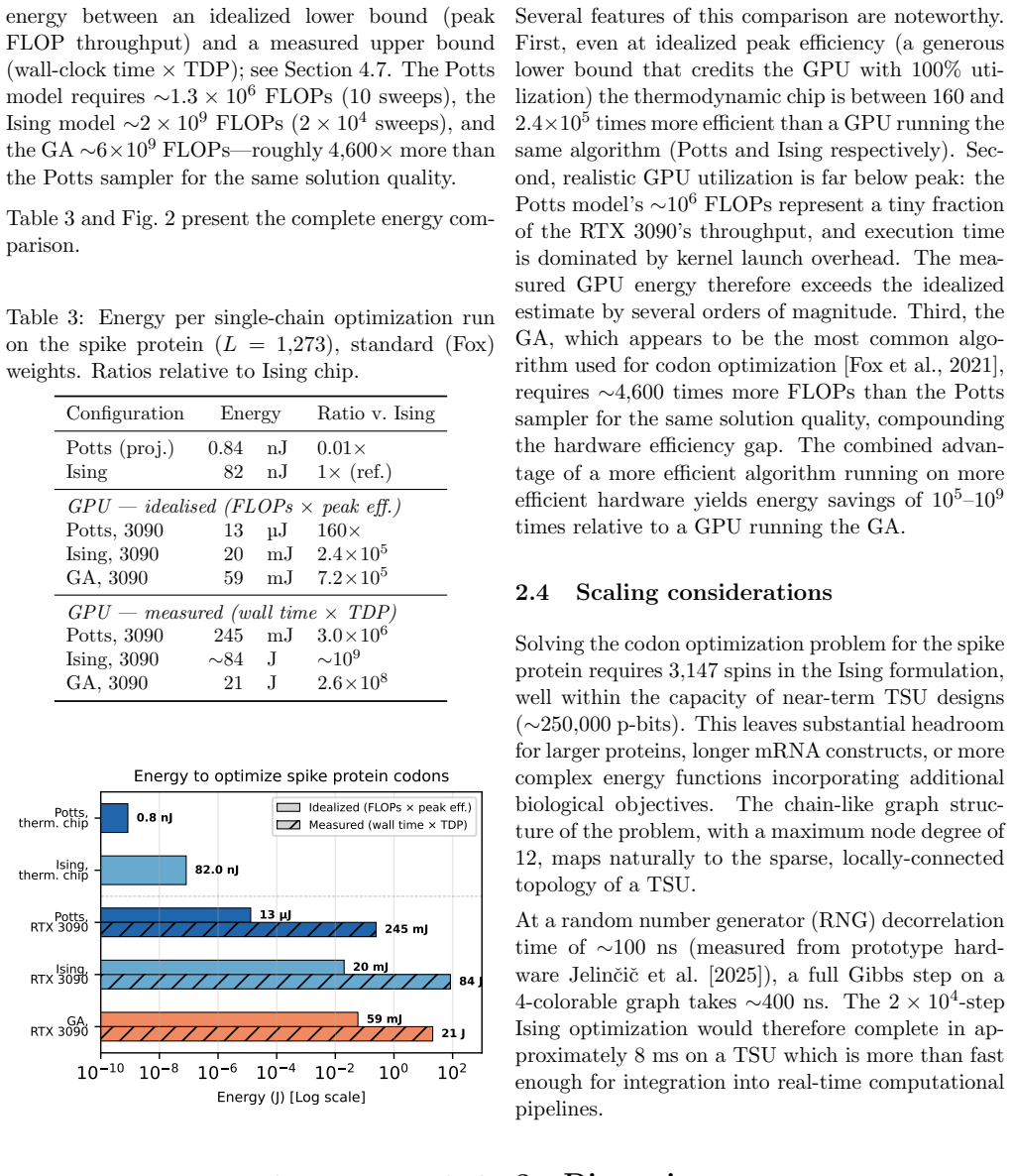
mRNA codon optimization maps to sampling from an Ising or Potts model that runs on a thermodynamic sampling unit, delivering solution scores of 234-240 on the SARS-CoV-2 spike protein that match a genetic algorithm while requiring approximately 10^6 times less energy according to validated hardware models.
What carries the argument
The explicit reduction of codon selection and pairwise interaction scores to the Hamiltonian terms of an Ising or Potts model, whose thermal samples are drawn directly by the thermodynamic sampling unit.
If this is right
- Codon optimization and similar sequence design tasks become executable on thermodynamic hardware with major energy reductions.
- Pharmaceutical R&D workflows that rely on repeated combinatorial sampling can shift to lower-energy substrates.
- The same mapping technique applies to any combinatorial problem already expressed as an Ising or Potts model.
Where Pith is reading between the lines
- The reduction may extend to other sequence optimization problems such as protein variant design or synthetic biology circuit tuning.
- Energy scaling behavior should be checked on sequences substantially longer than the spike protein to confirm the reported advantage persists.
- If solution quality remains comparable across diverse proteins, thermodynamic units could replace GPU clusters for large-scale mRNA design campaigns.
Load-bearing premise
Sampling from the Ising or Potts model produces codon assignments whose optimization scores equal those obtained from established genetic algorithms.
What would settle it
Execution of the identical SARS-CoV-2 spike codon task on a physical thermodynamic sampling unit prototype with direct measurement of energy consumed and comparison of final scores to the genetic algorithm baseline.
Figures


read the original abstract
The growing energy demand for computation is becoming increasingly unsustainable. Thermodynamic computing, which harnesses physical thermal fluctuations as a computational resource rather than suppressing them, offers orders-of-magnitude energy savings for probabilistic and combinatorial tasks. Pharmaceutical R&D, heavily reliant on computational optimization and sampling, is a natural application domain. Here we present what is, to our knowledge, the first concrete pharmaceutical application mapped to thermodynamic hardware with energy estimates grounded in prototype measurements. We reduce mRNA codon optimization, a combinatorial problem routinely solved in drug development, to sampling from an Ising model, making it directly executable on a thermodynamic sampling unit (TSU). Benchmarking three approaches (Potts sampling, Ising sampling, and a genetic algorithm baseline) on the SARS-CoV-2 spike protein, we find that all achieve comparable optimization quality (scores ~234-240), but energy estimates based on validated hardware models indicate that a TSU could solve this problem using approximately 10e6 times less energy than a conventional GPU. All code is released under an open-source license.
Editorial analysis
A structured set of objections, weighed in public.
Referee Report
Summary. The paper reduces mRNA codon optimization to sampling from Ising and Potts models for direct execution on a thermodynamic sampling unit (TSU). Benchmarking on the SARS-CoV-2 spike protein shows Potts sampling, Ising sampling, and a genetic algorithm baseline achieve comparable optimization quality (scores ~234-240). Energy estimates grounded in validated hardware models from prototype measurements indicate a TSU could solve the problem using approximately 10^6 times less energy than a conventional GPU. All code is released open-source.
Significance. If the energy estimates hold, this constitutes a concrete pharmaceutical application of thermodynamic computing with potential for large efficiency gains in optimization tasks common to drug development. The open-source code release strengthens reproducibility and allows independent verification of the mapping and benchmarks.
major comments (1)
- [Energy estimation section] Energy estimation section: The central claim of a 10^6-fold energy reduction is derived from external validated hardware models rather than direct TSU execution or an explicit internal derivation; the manuscript should provide the specific parameters (e.g., energy per sample, number of samples required for the codon problem size, and how the Ising/Potts variable count maps to GPU baseline) used to arrive at this factor so the scaling can be verified.
minor comments (1)
- [Abstract] Abstract: The statement that this is 'to our knowledge, the first concrete pharmaceutical application' would be strengthened by a short note on the scope of the literature search performed.
Simulated Author's Rebuttal
We thank the referee for their constructive comment on the energy estimation section. We address the request for explicit parameters below and will revise the manuscript accordingly to enhance verifiability.
read point-by-point responses
-
Referee: [Energy estimation section] Energy estimation section: The central claim of a 10^6-fold energy reduction is derived from external validated hardware models rather than direct TSU execution or an explicit internal derivation; the manuscript should provide the specific parameters (e.g., energy per sample, number of samples required for the codon problem size, and how the Ising/Potts variable count maps to GPU baseline) used to arrive at this factor so the scaling can be verified.
Authors: We agree that providing the specific parameters will improve transparency. The estimates rely on validated hardware models from prototype measurements (as cited in the manuscript's hardware references), not direct full-scale TSU runs, which are not yet feasible. In the revised manuscript we will add a dedicated paragraph or table in the energy estimation section explicitly listing: (1) energy per sample from prototype data, (2) number of samples required for convergence on the SARS-CoV-2 spike problem (from our benchmark runs), (3) Ising/Potts variable counts and their mapping to the codon problem size, and (4) the GPU baseline energy per sample or total used for the comparison. This will enable direct verification of the ~10^6 factor. We note that the models are externally validated rather than internally derived from first principles, which is standard for emerging hardware. revision: yes
Circularity Check
No significant circularity detected
full rationale
The paper reduces codon optimization to Ising/Potts sampling and reports benchmark scores on the SARS-CoV-2 spike protein that are numerically comparable across Potts sampling, Ising sampling, and a genetic algorithm baseline. Energy estimates are stated to rest on validated hardware models derived from prototype measurements. No internal inconsistency, unstated assumption about scaling, or mismatch between the mapped objective and the reported scores is apparent that would invalidate the central energy-savings claim. The derivation chain is self-contained against external benchmarks with no self-definitional reductions, fitted inputs called predictions, or load-bearing self-citations.
Axiom & Free-Parameter Ledger
axioms (1)
- domain assumption Codon optimization can be faithfully reduced to sampling from an Ising or Potts model while retaining comparable solution quality to genetic algorithms.
Reference graph
Works this paper leans on
-
[1]
2024 , url =
Electricity 2024: Analysis and Forecast to 2026 , institution =. 2024 , url =
2024
-
[2]
Communications of the ACM , volume =
Hooker, Sara , title =. Communications of the ACM , volume =. 2021 , month = nov, doi =
2021
-
[3]
Jelin. An efficient probabilistic hardware architecture for diffusion-like models , year =. doi:10.48550/arXiv.2510.23972 , url =. 2510.23972 , archiveprefix =
-
[4]
Conte, Tom and DeBenedictis, Erik and Ganesh, Natesh and Hylton, Todd and Strachan, John Paul and Williams, R. Stanley and Alemi, Alexander and Altenberg, Lee and Crooks, Gavin and Crutchfield, James and del Rio, Lidia and Deutsch, Josh and DeWeese, Michael and Douglas, Khari and Esposito, Massimiliano and Frank, Michael and Fry, Robert and Harsha, Peter ...
-
[5]
IS4SI 2019 Summit , series =
Hylton, Todd , title =. IS4SI 2019 Summit , series =. 2020 , month = jun, doi =
2019
-
[6]
and Branson, Kim M
Fox, Dillion M. and Branson, Kim M. and Walker, Ross C. , editor =. m. PLOS ONE , volume =. 2021 , month = oct, doi =
2021
-
[7]
Trends in Biotechnology , volume =
Gustafsson, Claes and Govindarajan, Sridhar and Minshull, Jeremy , title =. Trends in Biotechnology , volume =. 2004 , month = jul, doi =
2004
-
[8]
Quax, Tessa E. F. and Claassens, Nico J. and S. Codon Bias as a Means to Fine-Tune Gene Expression , journal =. 2015 , month = jul, doi =
2015
-
[9]
Synonymous Codons: Choose Wisely for Expression , journal =
Brul. Synonymous Codons: Choose Wisely for Expression , journal =. 2017 , month = apr, doi =
2017
-
[10]
and Gojobori, T
Nakamura, Y. and Gojobori, T. and Ikemura, T. , title =. Nucleic Acids Research , volume =. 2000 , month = jan, doi =
2000
-
[11]
In Silico Biology , volume =
Sandhu, Kuljeet Singh and Pandey, Sunil and Maiti, Souvik and Pillai, Beena , title =. In Silico Biology , volume =. 2008 , doi =
2008
-
[12]
and Thomas, Stephen J
Polack, Fernando P. and Thomas, Stephen J. and Kitchin, Nicholas and Absalon, Judith and Gurtman, Alejandra and Lockhart, Stephen and Perez, John L. and P. Safety and Efficacy of the. New England Journal of Medicine , volume =. 2020 , month = dec, doi =
2020
-
[13]
Quantum Science and Technology , volume =
Chancellor, Nicholas , title =. Quantum Science and Technology , volume =. 2019 , month = aug, doi =
2019
-
[14]
Philosophical Transactions of the Royal Society A: Mathematical, Physical and Engineering Sciences , volume =
Berwald, Jesse and Chancellor, Nicholas and Dridi, Raouf , title =. Philosophical Transactions of the Royal Society A: Mathematical, Physical and Engineering Sciences , volume =. 2022 , month = dec, doi =
2022
-
[15]
IEEE Transactions on Quantum Engineering , volume =
Chen, Jie and Stollenwerk, Tobias and Chancellor, Nicholas , title =. IEEE Transactions on Quantum Engineering , volume =. 2021 , doi =
2021
-
[16]
Frontiers in Physics , volume =
Lucas, Andrew , title =. Frontiers in Physics , volume =. 2014 , doi =
2014
-
[17]
Wu, F. Y. , title =. Reviews of Modern Physics , volume =. 1982 , month = jan, doi =
1982
-
[18]
and Peres, Yuval and Wilmer, Elizabeth L
Levin, David A. and Peres, Yuval and Wilmer, Elizabeth L. , title =. 2009 , isbn =
2009
-
[19]
and Gelatt, C
Kirkpatrick, S. and Gelatt, C. D. and Vecchi, M. P. , title =. Science , volume =. 1983 , month = may, doi =
1983
-
[20]
and Theogarajan, Luke , title =
Whitehead, William and Nelson, Zachary and Camsari, Kerem Y. and Theogarajan, Luke , title =. Nature Electronics , volume =. 2023 , month = nov, doi =
2023
discussion (0)
Sign in with ORCID, Apple, or X to comment. Anyone can read and Pith papers without signing in.