Identifiability Limits of Physics-Informed Inference for Spatial Stochastic Dynamics from Static Snapshots
Pith reviewed 2026-07-03 02:27 UTC · model grok-4.3
The pith
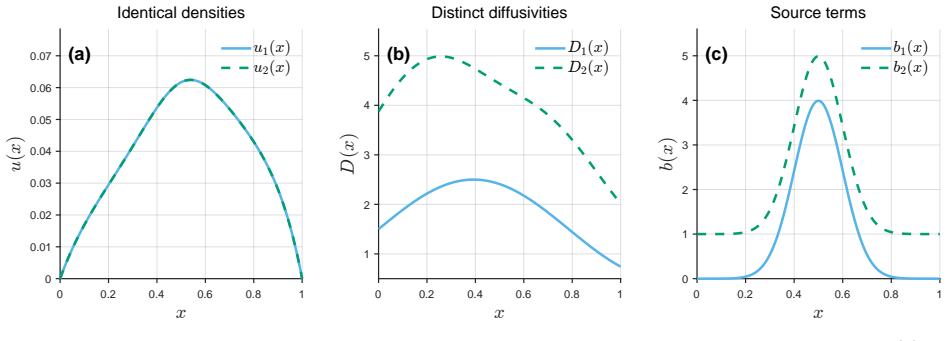
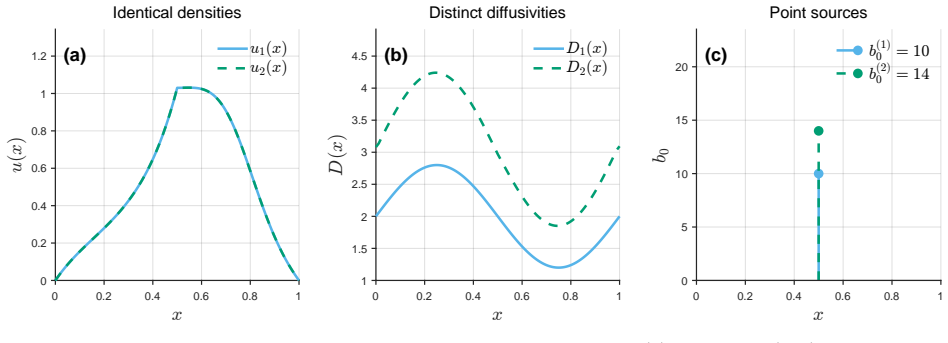
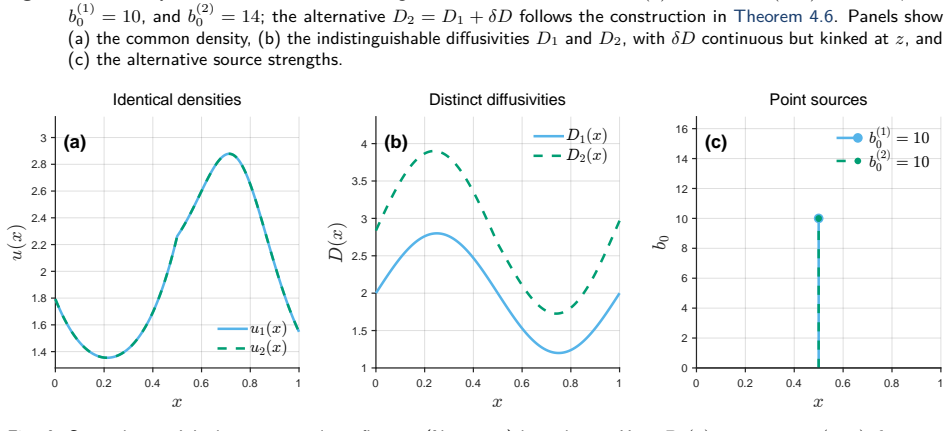
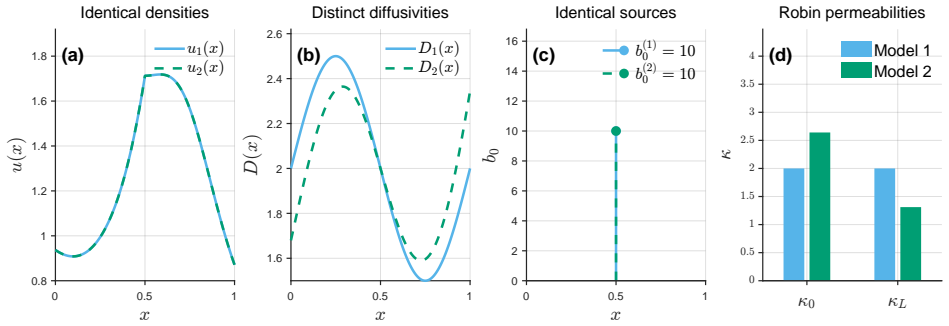
Distributed sources are non-identifiable from static snapshots, but a point source restores identifiability.
A machine-rendered reading of the paper's core claim, the machinery that carries it, and where it could break.
Core claim
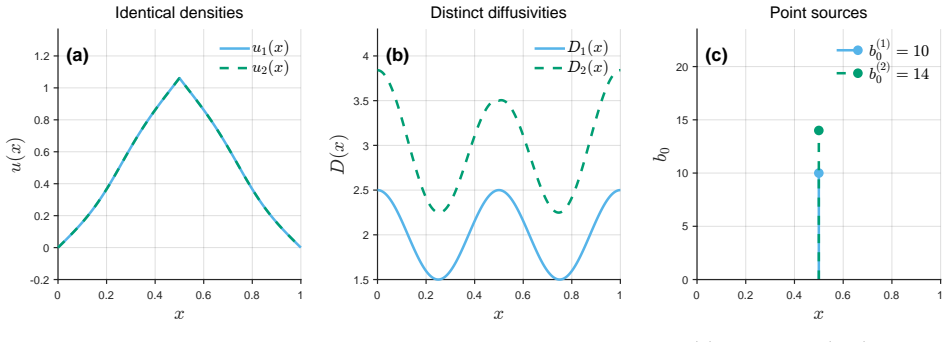
A structural identifiability analysis shows that distributed sources are non-identifiable, whereas a point source such as a transcription site can restore identifiability. These limits are further shaped by boundary conditions, the spatial regularity of the underlying dynamics, and even the stochastic calculus convention. Adapted physics-informed schemes demonstrate effective inference from a single snapshot.
What carries the argument
Structural identifiability analysis for physics-informed inference of spatial stochastic dynamics from static snapshots.
If this is right
- Physics-informed inference can recover spatial heterogeneities from static data if a point source is present.
- Modeling choices like boundary conditions and stochastic calculus affect what can be identified.
- Careful identifiability analysis is required for meaningful interpretation of results from such inference.
- Effective inference is possible from a single snapshot under identifiable conditions.
Where Pith is reading between the lines
- The findings suggest that in gene expression studies, the presence of transcription sites is crucial for inferring dynamics from snapshots.
- Similar identifiability limits may apply to other spatial biological processes without localized sources.
- Adding more data types could potentially overcome the non-identifiability of distributed sources.
Load-bearing premise
The identifiability results depend on specific modeling choices including boundary conditions, spatial regularity of the dynamics, and the stochastic calculus convention used.
What would settle it
Numerical experiments showing unique recovery of distributed source parameters or a change in identifiability when switching the stochastic calculus convention would test the central claims.
Figures
read the original abstract
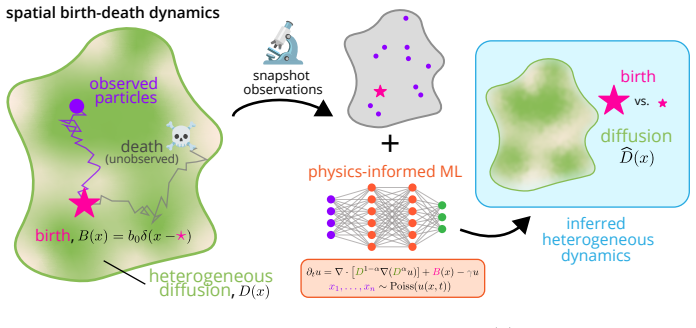
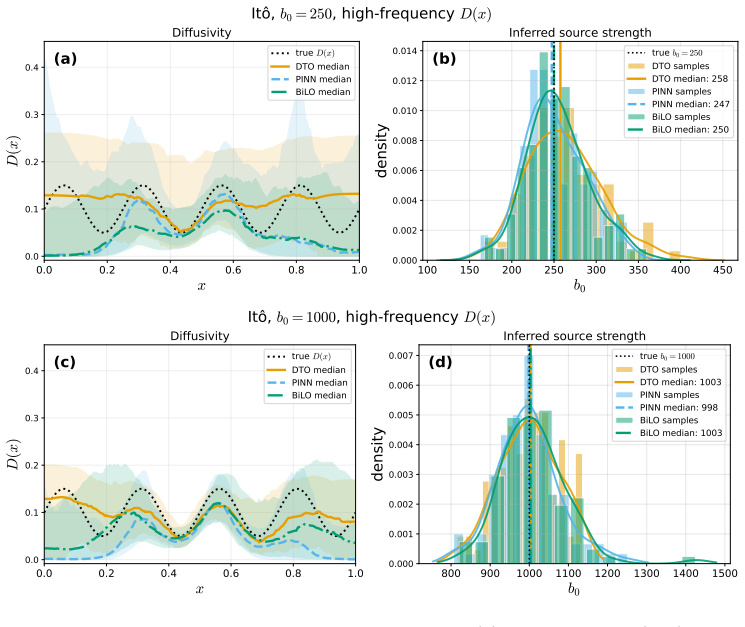
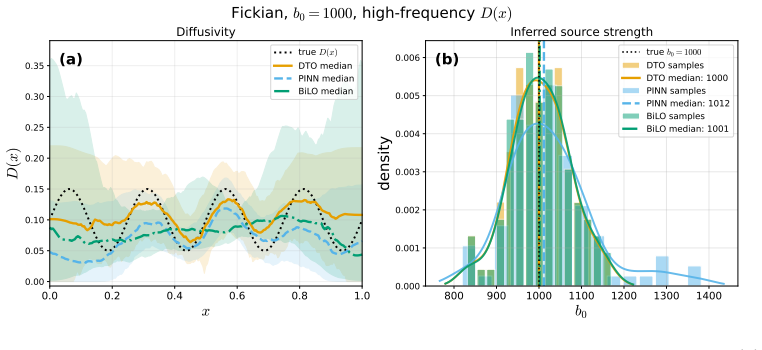
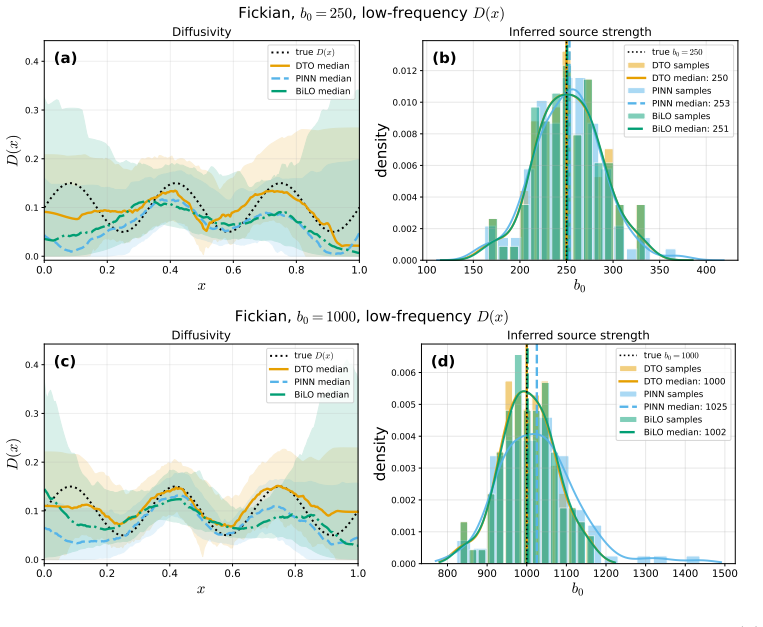
Despite increasing scale and resolution, many biological measurements remain destructive, revealing only spatial information rather than the dynamics it encodes. By combining flexible representations with mechanistic constraints, physics-informed machine learning offers a promising route to inferring these dynamics from static snapshots. Motivated by subcellular imaging of gene expression, we ask when a static spatial pattern of molecules can identify spatially varying diffusivity, creation, destruction, and boundary exchange, and how different inference schemes perform on the task. A structural identifiability analysis shows that distributed sources are non-identifiable, whereas a point source such as a transcription site can restore identifiability. These limits are further shaped by seemingly innocuous modeling choices: the boundary conditions, the spatial regularity of the underlying dynamics, and even the stochastic calculus convention. We then adapt several physics-informed schemes, differing in how they represent the solution and enforce the governing equations, and demonstrate effective inference from a single snapshot. Physics-informed approaches can thus recover spatial heterogeneities of biological dynamics from static data, but their use should be accompanied and guided by careful identifiability analysis for meaningful interpretation of the results.
Editorial analysis
A structured set of objections, weighed in public.
Referee Report
Summary. The manuscript conducts a structural identifiability analysis of physics-informed inference for spatially varying parameters (diffusivity, creation, destruction, boundary exchange) in stochastic dynamics models, using only static spatial snapshots as data. It establishes that distributed sources are non-identifiable while point sources (e.g., transcription sites) can restore identifiability; these limits depend explicitly on boundary conditions, spatial regularity of the dynamics, and the stochastic calculus convention. The authors then adapt multiple physics-informed schemes that differ in solution representation and equation enforcement, and demonstrate that they recover spatial heterogeneities from a single snapshot in the motivating application of subcellular gene-expression imaging.
Significance. If the identifiability results and inference demonstrations hold, the work supplies a needed cautionary framework for physics-informed machine learning in quantitative biology, where destructive measurements often yield only static spatial data. Explicitly mapping how seemingly innocuous modeling choices (boundary conditions, regularity, Itô vs. Stratonovich) alter identifiability is a concrete strength that can guide model selection. The successful single-snapshot inference examples under the identified conditions further increase practical utility for subcellular imaging studies.
minor comments (3)
- The abstract states that identifiability limits depend on the stochastic calculus convention, but the main text should include an explicit side-by-side comparison (e.g., in a dedicated subsection or table) of the two conventions applied to the same model to make the dependence transparent to readers.
- When the different physics-informed schemes are introduced, a brief tabular summary of how each represents the solution and enforces the governing equations would improve readability and allow direct comparison of their performance on the identifiability-restoring point-source case.
- Figure captions should explicitly note which boundary condition and stochastic calculus convention were used for each panel so that readers can immediately connect the visuals to the identifiability claims.
Simulated Author's Rebuttal
We thank the referee for their positive summary and significance assessment of the manuscript, as well as the recommendation for minor revision. We appreciate the recognition that the identifiability results and single-snapshot inference demonstrations provide a useful cautionary framework for physics-informed methods in quantitative biology.
Circularity Check
No significant circularity identified
full rationale
The paper performs a structural identifiability analysis on a physics-informed inference setup for spatial stochastic dynamics, explicitly stating dependence on boundary conditions, spatial regularity, and stochastic calculus convention. No load-bearing steps reduce by construction to fitted parameters, self-citations, or renamed inputs; the central claims about non-identifiability of distributed sources and restoration by point sources follow from the stated modeling choices without self-referential closure. The derivation remains self-contained against external mathematical benchmarks for identifiability.
Axiom & Free-Parameter Ledger
Reference graph
Works this paper leans on
-
[1]
Imaging Individual mRNA Molecules Using Multiple Singly Labeled Probes
A. Raj et al. “Imaging Individual mRNA Molecules Using Multiple Singly Labeled Probes”.Nature Methods5.10 (Oct. 2008), pp. 877–879.doi:10.1038/nmeth.1253
-
[2]
Spatially Resolved, Highly Multiplexed RNA Profiling in Single Cells
K. H. Chen et al. “Spatially Resolved, Highly Multiplexed RNA Profiling in Single Cells”.Science 348.6233 (Apr. 2015), aaa6090.doi:10.1126/science.aaa6090
-
[3]
Transcriptome-Scale Super-Resolved Imaging in Tissues by RNA seqFISH+
C.-H. L. Eng et al. “Transcriptome-Scale Super-Resolved Imaging in Tissues by RNA seqFISH+”. Nature568.7751 (Apr. 2019), pp. 235–239.doi:10.1038/s41586-019-1049-y
-
[4]
Subcellular mRNA Localization Patterns across Tissues Resolved with Spatial Transcriptomics
R. Novoselsky et al. “Subcellular mRNA Localization Patterns across Tissues Resolved with Spatial Transcriptomics”.Nature Communications(Apr. 2026), pp. 1–36.doi:10.1038/s41467-026-72156-7
-
[5]
Dynamics of RNA Localization to Nuclear Speckles Are Connected to Splicing Efficiency
J. Wu et al. “Dynamics of RNA Localization to Nuclear Speckles Are Connected to Splicing Efficiency”. Science Advances10.42 (Oct. 16, 2024), eadp7727.doi:10.1126/sciadv.adp7727
-
[6]
GlobalAnalysisofmRNALocalizationRevealsaProminentRoleinOrganizingCellular Architecture and Function
E.Lécuyeretal.“GlobalAnalysisofmRNALocalizationRevealsaProminentRoleinOrganizingCellular Architecture and Function”.Cell131.1 (Oct. 2007), pp. 174–187.doi:10.1016/j.cell.2007.08.003
-
[7]
In the Right Place at the Right Time: Visualizing and Understanding mRNA Localization
A. R. Buxbaum, G. Haimovich, and R. H. Singer. “In the Right Place at the Right Time: Visualizing and Understanding mRNA Localization”.Nature Reviews Molecular Cell Biology16.2 (Feb. 2015), pp. 95–109.doi:10.1038/nrm3918
-
[8]
Constitutive Splicing and Economies of Scale in Gene Expression
F. Ding and M. B. Elowitz. “Constitutive Splicing and Economies of Scale in Gene Expression”.Nature Structural & Molecular Biology26.6 (June 2019), pp. 424–432.doi:10.1038/s41594-019-0226-x
-
[9]
Mechanism of mRNA Transport in the Nucleus
D. Y. Vargas et al. “Mechanism of mRNA Transport in the Nucleus”.Proceedings of the National Academy of Sciences102.47 (Nov. 2005), pp. 17008–17013.doi:10.1073/pnas.0505580102
-
[10]
Physics-Informed Machine Learning
G. E. Karniadakis et al. “Physics-Informed Machine Learning”.Nature Reviews Physics3.6 (May 24, 2021), pp. 422–440.doi:10.1038/s42254-021-00314-5
-
[11]
Scientific Machine Learning Through Physics–Informed Neural Networks: Where We Are and What’s Next
S. Cuomo et al. “Scientific Machine Learning Through Physics–Informed Neural Networks: Where We Are and What’s Next”.Journal of Scientific Computing92.3 (Sept. 2022), p. 88.doi:10.1007/s10915- 022-01939-z. 26
-
[12]
X.Chenetal.“SolvingInverseStochasticProblemsfromDiscreteParticleObservationsUsingtheFokker– Planck Equation and Physics-Informed Neural Networks”.SIAM Journal on Scientific Computing43.3 (Jan. 2021), B811–B830.doi:10.1137/20M1360153
-
[13]
Encoding Physics to Learn Reaction–Diffusion Processes
C. Rao et al. “Encoding Physics to Learn Reaction–Diffusion Processes”.Nature Machine Intelligence 5.7 (July 2023), pp. 765–779.doi:10.1038/s42256-023-00685-7
-
[14]
Biologically-Informed Neural Networks Guide Mechanistic Modeling from Sparse Experimental Data
J. H. Lagergren et al. “Biologically-Informed Neural Networks Guide Mechanistic Modeling from Sparse Experimental Data”.PLOS Computational Biology16.12 (Dec. 1, 2020), e1008462.doi: 10.1371/ journal.pcbi.1008462
2020
-
[15]
Lavery et al.Physics-Informed Neural Networks for Biological2D +t Reaction-Diffusion Systems
W. Lavery et al.Physics-Informed Neural Networks for Biological2D +t Reaction-Diffusion Systems
-
[16]
Physics-Informed Neural Networks for Biological $2\mathrm{D}{+}t$ Reaction-Diffusion Systems
arXiv:2604.18548 [cs.LG]. Preprint
work page internal anchor Pith review Pith/arXiv arXiv
-
[17]
M. Daneker et al. “Systems Biology: Identifiability Analysis and Parameter Identification via Systems- Biology-Informed Neural Networks”.Computational Modeling of Signaling Networks. Ed. by L. K. Nguyen. New York, NY: Springer US, 2023, pp. 87–105.doi:10.1007/978-1-0716-3008-2_4
-
[18]
Position: Biology Is the Challenge Physics-Informed ML Needs to Evolve
J. Martinelli. “Position: Biology Is the Challenge Physics-Informed ML Needs to Evolve”.Advances in Neural Information Processing Systems. Ed. by D. Belgrave et al. Vol. 38. Curran Associates, Inc., 2025.url: https://proceedings.neurips.cc/paper_files/paper/2025/file/af6c0a1b4a4faf1c 9900d2771bafd672-Paper-Position_Paper_Track.pdf
2025
-
[19]
Inferring Stochastic Rates from Heterogeneous Snapshots of Particle Positions
C. E. Miles et al. “Inferring Stochastic Rates from Heterogeneous Snapshots of Particle Positions”. Bulletin of Mathematical Biology86.6 (June 2024), pp. 74–104.doi:10.1007/s11538-024-01301-4
-
[20]
Incorporating Spatial Diffusion into Models of Bursty Stochastic Transcription
C. E. Miles. “Incorporating Spatial Diffusion into Models of Bursty Stochastic Transcription”.Journal of the Royal Society, Interface22.225 (Apr. 2025), p. 20240739.doi:10.1098/rsif.2024.0739
-
[21]
Y. Lin, H. Lin, and K. D. Welsher.Super-Resolving Particle Diffusion Heterogeneity in Porous Hydrogels via High-Speed 3D Active-Feedback Single-Particle Tracking Microscopy. Mar. 2025.doi:10.1101/ 2025.03.13.643103. Preprint
2025
-
[22]
P. J. Slator, C. W. Cairo, and N. J. Burroughs. “Detection of Diffusion Heterogeneity in Single Particle Tracking Trajectories Using a Hidden Markov Model with Measurement Noise Propagation”.PLOS ONE10.10 (Oct. 16, 2015), e0140759.doi:10.1371/journal.pone.0140759
-
[23]
ejpoleco.2025.102749 Farzanegan, M.R., Gutmann, J.,
V. Kumar et al. “DiffMAP-GP: Continuous 2D Diffusion Maps from Particle Trajectories without Data Binning Using Gaussian Processes”.Biophysical Reports5.1 (Mar. 2025), p. 100194.doi:10.1016/j. bpr.2024.100194
work page doi:10.1016/j 2025
-
[24]
Inferring Pointwise Diffusion Properties of Single Trajectories with Deep Learning
B. Requena et al. “Inferring Pointwise Diffusion Properties of Single Trajectories with Deep Learning”. Biophysical Journal122.22 (Nov. 2023), pp. 4360–4369.doi:10.1016/j.bpj.2023.10.015
-
[25]
Temporal Tissue Dynamics from a Spatial Snapshot
J. Somer, S. Mannor, and U. Alon. “Temporal Tissue Dynamics from a Spatial Snapshot”.Nature 650.8101 (Feb. 2026), pp. 490–499.doi:10.1038/s41586-025-09876-1
-
[26]
Inferring Stochastic Dynamics with Growth from Cross-Sectional Data
S. Y. Zhang et al. “Inferring Stochastic Dynamics with Growth from Cross-Sectional Data”.The Thirty-ninth Annual Conference on Neural Information Processing Systems. Oct. 2025.url:https: //openreview.net/forum?id=MtdC1XS6RN
2025
-
[27]
G. La Manno et al. “RNA Velocity of Single Cells”.Nature560.7719 (Aug. 2018), pp. 494–498.doi: 10.1038/s41586-018-0414-6
-
[28]
G. Schiebinger et al. “Optimal-Transport Analysis of Single-Cell Gene Expression Identifies Develop- mental Trajectories in Reprogramming”.Cell176.4 (Feb. 2019), 928–943.e22.doi:10.1016/j.cell. 2019.01.006
-
[29]
Identifiability and Reconstruction of Biochemical Reaction Networks from Population Snapshot Data
E. Cinquemani. “Identifiability and Reconstruction of Biochemical Reaction Networks from Population Snapshot Data”.Processes6.9 (Aug. 2018), pp. 136–159.doi:10.3390/pr6090136
-
[30]
Guan et al.Identifying Drift, Diffusion, and Causal Structure from Temporal Snapshots
V. Guan et al.Identifying Drift, Diffusion, and Causal Structure from Temporal Snapshots. 2024. arXiv: 2410.22729 [stat]. Preprint
-
[31]
M. J. Simpson and M. J. Plank.When Do Trajectories Matter? Identifiability Analysis for Stochastic Transport Phenomena. 2026. arXiv:2604.15598 [nlin.CG]. Preprint. 27
work page internal anchor Pith review Pith/arXiv arXiv 2026
-
[32]
Fundamental Limits on Dynamic Inference from Single-Cell Snapshots
C. Weinreb et al. “Fundamental Limits on Dynamic Inference from Single-Cell Snapshots”.Proceedings of the National Academy of Sciences115.10 (Mar. 2018), E2467–E2476.doi:10.1073/pnas.1714723115
-
[33]
Electrical Impedance Tomography and Calderón’s Problem
G. Uhlmann. “Electrical Impedance Tomography and Calderón’s Problem”.Inverse Problems25.12 (Dec. 1, 2009), p. 123011.doi:10.1088/0266-5611/25/12/123011
-
[34]
Nonuniqueness in Diffusion-Based Optical Tomography
S. R. Arridge and W. R. B. Lionheart. “Nonuniqueness in Diffusion-Based Optical Tomography”.Optics Letters23.11 (June 1998), p. 882.doi:10.1364/OL.23.000882
-
[35]
Identifiability of Diffusion Coefficients for Source Terms of Non- Uniform Sign
M. Bachmayr and V. K. Nguyen. “Identifiability of Diffusion Coefficients for Source Terms of Non- Uniform Sign”.Inverse Problems and Imaging13.5 (2019), pp. 1007–1021.doi:10.3934/ipi.2019045
-
[36]
Parameter Identifiability in PDE Models of Fluorescence Recovery after Photo- bleaching
M.-V. Ciocanel et al. “Parameter Identifiability in PDE Models of Fluorescence Recovery after Photo- bleaching”.Bulletin of Mathematical Biology86.4 (Apr. 2024), pp. 36–63.doi:10.1007/s11538-024- 01266-4
-
[37]
Cox Process Representation and Inference for Stochastic Reaction–Diffusion Processes
D. Schnoerr, R. Grima, and G. Sanguinetti. “Cox Process Representation and Inference for Stochastic Reaction–Diffusion Processes”.Nature Communications7.1 (May 25, 2016), p. 11729.doi:10.1038/ ncomms11729
2016
-
[38]
Modern Statistics for Spatial Point Processes*
J. Møller and R. P. Waagepetersen. “Modern Statistics for Spatial Point Processes*”.Scandinavian Journal of Statistics34.4 (Dec. 2007), pp. 643–684.doi:10.1111/j.1467-9469.2007.00569.x
-
[39]
Observability and Structural Identifiability of Nonlinear Biological Systems
A. F. Villaverde. “Observability and Structural Identifiability of Nonlinear Biological Systems”.Com- plexity2019.1 (2019), p. 8497093.doi:10.1155/2019/8497093
-
[40]
Effective Drifts in Dynamical Systems with Multiplicative Noise: A Review of Recent Progress
G. Volpe and J. Wehr. “Effective Drifts in Dynamical Systems with Multiplicative Noise: A Review of Recent Progress”.Reports on Progress in Physics79.5 (May 1, 2016), p. 053901.doi:10.1088/0034- 4885/79/5/053901
-
[41]
Langevin Equation in Heterogeneous Landscapes: How to Choose the Interpreta- tion
A. Pacheco-Pozo et al. “Langevin Equation in Heterogeneous Landscapes: How to Choose the Interpreta- tion”.Physical Review Letters133.6 (Aug. 2024), p. 067102.doi:10.1103/PhysRevLett.133.067102
-
[42]
smiFISH and FISH-quant – a Flexible Single RNA Detection Approach with Super- Resolution Capability
N. Tsanov et al. “smiFISH and FISH-quant – a Flexible Single RNA Detection Approach with Super- Resolution Capability”.Nucleic Acids Research44.22 (Dec. 15, 2016), e165–e165.doi:10.1093/nar/ gkw784
-
[43]
Chatain et al.Numerical PDE Solvers Outperform Neural PDE Solvers
P. Chatain et al.Numerical PDE Solvers Outperform Neural PDE Solvers. 2025. arXiv:2507.21269 [math]. Preprint
-
[44]
Weight Initialization Algorithm for Physics-Informed Neural Networks Using Finite Differences
H. Tarbiyati and B. Nemati Saray. “Weight Initialization Algorithm for Physics-Informed Neural Networks Using Finite Differences”.Engineering with Computers40.3 (June 2024), pp. 1603–1619.doi: 10.1007/s00366-023-01883-y
- [45]
-
[46]
Wang et al.An Expert’s Guide to Training Physics-Informed Neural Networks
S. Wang et al.An Expert’s Guide to Training Physics-Informed Neural Networks. 2023. arXiv:2308. 08468 [cs]. Preprint
2023
-
[47]
Single-Molecule Live-Cell RNA Imaging with CRISPR–Csm
C. Xia et al. “Single-Molecule Live-Cell RNA Imaging with CRISPR–Csm”.Nature Biotechnology43.12 (Dec. 2025), pp. 2023–2030.doi:10.1038/s41587-024-02540-5
-
[48]
Mechanistic Inference of Stochastic Gene Expression from Structured Single-Cell Data
C. E. Miles. “Mechanistic Inference of Stochastic Gene Expression from Structured Single-Cell Data”. Current Opinion in Systems Biology42 (Dec. 2025), p. 100555.doi:10.1016/j.coisb.2025.100555
-
[49]
Using Neural Networks to Estimate Parameters in Spatial Point Process Models
N. Vihrs. “Using Neural Networks to Estimate Parameters in Spatial Point Process Models”.Spatial Statistics51 (Oct. 2022), p. 100668.doi:10.1016/j.spasta.2022.100668
-
[50]
Mapping Intracellular Dynamics across the Whole Cell with Spatial Statistics
Y. Okabe et al. “Mapping Intracellular Dynamics across the Whole Cell with Spatial Statistics”. Biophysical Journal124.23 (Dec. 2025), pp. 4205–4214.doi:10.1016/j.bpj.2025.10.005
-
[51]
J. X. Wang and X. Zhou. “ELLA: Modeling Subcellular Spatial Variation of Gene Expression within Cells in High-Resolution Spatial Transcriptomics”.Nature Communications16.1 (Nov. 2025), p. 9920. doi:10.1038/s41467-025-64867-0. 28
-
[52]
Practical Parameter Identifiability for Spatio-Temporal Models of Cell Invasion
M. J. Simpson et al. “Practical Parameter Identifiability for Spatio-Temporal Models of Cell Invasion”. Journal of The Royal Society Interface17.164 (Mar. 2020), p. 20200055.doi:10.1098/rsif.2020.0055
-
[53]
Identifiability Analysis for Stochastic Differential Equation Models in Systems Biology
A. P. Browning et al. “Identifiability Analysis for Stochastic Differential Equation Models in Systems Biology”.Journal of The Royal Society Interface17.173 (Dec. 2020), p. 20200652.doi:10.1098/rsif. 2020.0652
-
[54]
Diffusion Coefficients Estimation for Elliptic Partial Differential Equations
A. Bonito et al. “Diffusion Coefficients Estimation for Elliptic Partial Differential Equations”.SIAM Journal on Mathematical Analysis49.2 (Jan. 2017), pp. 1570–1592.doi:10.1137/16M1094476
-
[55]
H.-R. Tung and S. D. Lawley.Escape from Heterogeneous Diffusion. Dec. 2025. arXiv:2512.19646 [cond-mat.stat-mech]. Preprint
-
[56]
Stochastic search with space-dependent diffusivity
H.-R. Tung and S. D. Lawley. “Stochastic search with space-dependent diffusivity”.Phys. Rev. E113 (6 June 2026), p. 064149.doi:10.1103/cmlr-6yfl
-
[57]
H.-C. Liu et al. “Identifying the Interpretation in Two-Dimensional Diffusion Processes with Power- Law Spatially Dependent Diffusivity”.Physical Review Research8.1 (Feb. 2026), p. 013143.doi: 10.1103/xz7y-n8w2
-
[58]
Separable Nonlinear Least Squares: The Variable Projection Method and Its Applications
G. Golub and V. Pereyra. “Separable Nonlinear Least Squares: The Variable Projection Method and Its Applications”.Inverse Problems19.2 (Apr. 2003), R1–R26.doi:10.1088/0266-5611/19/2/201
-
[59]
R. J. LeVeque and Z. Li. “The Immersed Interface Method for Elliptic Equations with Discontinuous Coefficients and Singular Sources”.SIAM Journal on Numerical Analysis31.4 (Aug. 1994), pp. 1019– 1044.doi:10.1137/0731054
-
[60]
P. Karnakov, S. Litvinov, and P. Koumoutsakos. “Solving Inverse Problems in Physics by Optimizing a Discrete Loss: Fast and Accurate Learning without Neural Networks”.PNAS Nexus3.1 (Dec. 2023). Ed. by D. Abbott, pgae005.doi:10.1093/pnasnexus/pgae005
-
[61]
M. Raissi, P. Perdikaris, and G. E. Karniadakis. “Physics-Informed Neural Networks: A Deep Learning Framework for Solving Forward and Inverse Problems Involving Nonlinear Partial Differential Equations”. Journal of Computational Physics378 (Feb. 2019), pp. 686–707.doi:10.1016/j.jcp.2018.10.045
-
[62]
A Cusp-Capturing PINN for Elliptic Interface Problems
Y.-H. Tseng et al. “A Cusp-Capturing PINN for Elliptic Interface Problems”.Journal of Computational Physics491 (Oct. 2023), p. 112359.doi:10.1016/j.jcp.2023.112359
-
[63]
PyTorch: An Imperative Style, High-Performance Deep Learning Library
A. Paszke et al. “PyTorch: An Imperative Style, High-Performance Deep Learning Library”.Proceedings of the 33rd International Conference on Neural Information Processing Systems. 721. Red Hook, NY, USA: Curran Associates Inc., Dec. 2019, pp. 8026–8037
2019
-
[64]
BiLO: Bilevel Local Operator Learning for PDE Inverse Problems
R. Z. Zhang et al. “BiLO: Bilevel Local Operator Learning for PDE Inverse Problems”.Journal of Computational Physics551 (Apr. 2026), p. 114679.doi:10.1016/j.jcp.2026.114679
- [65]
-
[66]
S. Wang, H. Wang, and P. Perdikaris. “On the Eigenvector Bias of Fourier Feature Networks: From Regression to Solving Multi-Scale PDEs with Physics-Informed Neural Networks”.Computer Methods in Applied Mechanics and Engineering384 (Oct. 2021), p. 113938.doi:10.1016/j.cma.2021.113938. 29
discussion (0)
Sign in with ORCID, Apple, or X to comment. Anyone can read and Pith papers without signing in.