Hot blue progenitors of stellar-mass black holes
Pith reviewed 2026-05-21 01:18 UTC · model grok-4.3
The pith
Massive stars that collapse directly to black holes are mostly hot and blue before they vanish, not red supergiants.
A machine-rendered reading of the paper's core claim, the machinery that carries it, and where it could break.
Core claim
Black hole progenitors are predominantly hot and blue at the pre-collapse stage, with many in Wolf-Rayet phases and luminous in the ultraviolet, while only a minority are red supergiants. The rate of direct-collapse events is estimated to be about 0.4 per century for a galaxy forming stars at 1 solar mass per year.
What carries the argument
Detailed single and binary stellar evolution models combined with prescriptions that link pre-collapse core structure to explosion versus direct collapse, together with stellar atmosphere calculations that generate synthetic photometry in standard filters.
If this is right
- Direct collapse without a supernova occurs at roughly 0.4 events per century in a galaxy forming stars at one solar mass per year.
- Searches limited to red supergiants will miss a substantial fraction of black hole formation events.
- Ultraviolet-sensitive observations of nearby star-forming galaxies offer a route to catching disappearing massive stars and constraining black hole formation channels.
Where Pith is reading between the lines
- If the models are extended to more varied binary mass transfer histories, the predicted fraction of hot blue progenitors could shift and change survey strategies.
- Future ultraviolet detections could be cross-checked against the predicted brightness distribution to test which core-structure rules best match reality.
- The same modeling approach could be applied to lower-metallicity environments to predict how black hole progenitor colors change in early galaxies.
Load-bearing premise
The prescriptions that decide, from the star's pre-collapse core structure, whether it explodes or collapses directly to a black hole.
What would settle it
Detection of several disappearing stars in nearby galaxies that are all red supergiants, or a measured rate of such events that differs substantially from 0.4 per century in a galaxy with a star-formation rate of one solar mass per year.
Figures


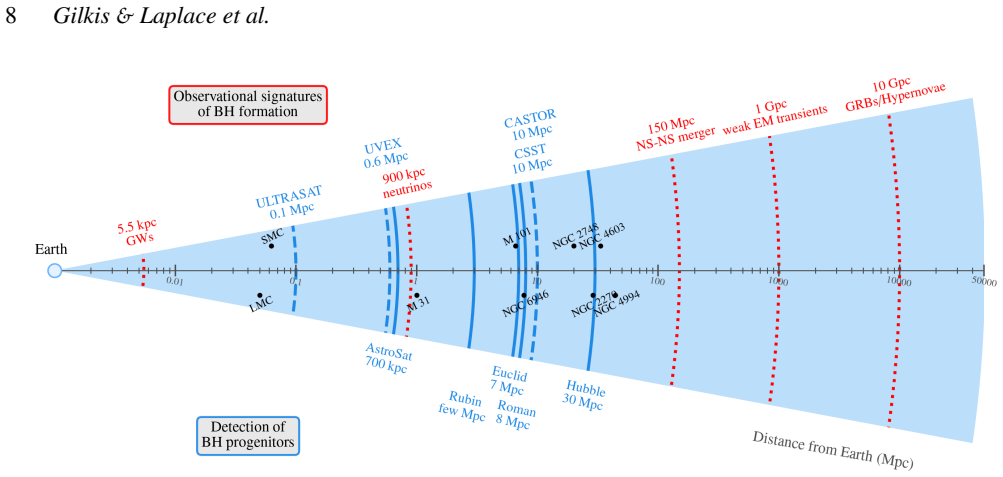
read the original abstract
While the connection between massive stars and supernova explosions is well established observationally, the link between massive stars and black hole formation remains elusive. Some massive stars may collapse directly to black holes without a successful supernova, and may therefore be observed as disappearing stars. We investigate the expected photometric properties of such black hole progenitors by combining detailed single and binary stellar evolution models with physically motivated prescriptions linking pre-collapse core structure to explosion or direct collapse outcome, together with stellar atmosphere calculations, producing synthetic photometry across standard ultraviolet to infrared filters. Weighting by an initial mass function and empirical binary distributions, we predict both the observable distribution of progenitor brightness and colour and the rate of direct-collapse events, which we estimate to be about 0.4 per century for a galaxy forming stars at 1 Msun/yr. We find that black hole progenitors are predominantly hot and blue at the pre-collapse stage, with many in Wolf-Rayet phases and luminous in the ultraviolet, while only a minority are red supergiants. Consequently, searches that focus primarily on red supergiants are likely to miss a substantial fraction of direct-collapse events. Monitoring campaigns that include ultraviolet-sensitive observations of nearby star-forming galaxies therefore provide a promising route to detecting disappearing massive stars, offering a direct observational probe of black hole formation. Our results provide predictions to interpret such surveys and constrain the channels that lead to black hole formation.
Editorial analysis
A structured set of objections, weighed in public.
Referee Report
Summary. The manuscript investigates the photometric properties of progenitors of stellar-mass black holes by combining detailed single and binary stellar evolution models with physically motivated prescriptions that link pre-collapse core structure to the outcome of explosion or direct collapse. Synthetic photometry is generated using stellar atmosphere calculations across UV to IR filters. After weighting by an initial mass function and empirical binary distributions, the authors predict the distribution of progenitor brightness and color, and estimate the rate of direct-collapse events to be approximately 0.4 per century in a galaxy with a star formation rate of 1 M⊙ yr⁻¹. The key finding is that black hole progenitors are predominantly hot and blue at the pre-collapse stage, with many in Wolf-Rayet phases and luminous in the ultraviolet, while only a minority are red supergiants. This leads to the suggestion that searches focused on red supergiants are likely to miss a substantial fraction of direct-collapse events, and that ultraviolet-sensitive monitoring of nearby star-forming galaxies is a promising approach.
Significance. If the central result holds, this study offers important guidance for observational efforts to detect black hole formation through disappearing stars. It highlights that the majority of such progenitors would appear hot and blue rather than as red supergiants, thereby directing attention toward ultraviolet observations and potentially increasing the success rate of identifying direct-collapse candidates. The provision of specific rate estimates and synthetic photometry predictions adds practical value for interpreting survey data and constraining formation channels.
major comments (1)
- [Collapse prescriptions and results sections] The claim that black hole progenitors are predominantly hot and blue rests on the identification of direct-collapse candidates using the authors' physically motivated prescriptions for mapping core structure (e.g., compactness) to collapse outcome. The manuscript does not report a systematic variation of these prescriptions, thresholds, or functional forms, nor the sensitivity to binary-evolution inputs that affect core structure. Different literature choices for the mapping could alter which evolutionary tracks are retained as black-hole progenitors and therefore change the weighted distributions of effective temperatures and colors at the pre-collapse stage. This robustness check is load-bearing for the central claim (see the section describing the collapse prescriptions and the results on progenitor colors).
minor comments (2)
- [Abstract] The abstract refers to 'standard ultraviolet to infrared filters' without listing the specific filters or passbands used for the synthetic photometry; this detail should be added for reproducibility.
- [Rate estimate paragraph] It would be helpful to include a brief discussion of how the empirical binary distributions were selected and any associated uncertainties in the rate estimate.
Simulated Author's Rebuttal
We thank the referee for their constructive and detailed review. The concern regarding robustness of the collapse prescriptions is well taken, and we address it directly below. We will revise the manuscript to include additional discussion and checks that strengthen the central claim without changing our main conclusions.
read point-by-point responses
-
Referee: [Collapse prescriptions and results sections] The claim that black hole progenitors are predominantly hot and blue rests on the identification of direct-collapse candidates using the authors' physically motivated prescriptions for mapping core structure (e.g., compactness) to collapse outcome. The manuscript does not report a systematic variation of these prescriptions, thresholds, or functional forms, nor the sensitivity to binary-evolution inputs that affect core structure. Different literature choices for the mapping could alter which evolutionary tracks are retained as black-hole progenitors and therefore change the weighted distributions of effective temperatures and colors at the pre-collapse stage. This robustness check is load-bearing for the central claim (see the section describing the collapse prescriptions and the results on progenitor colors).
Authors: We agree that explicit robustness checks would improve the manuscript. Our direct-collapse criterion is based on the compactness parameter ξ_{2.5} exceeding a threshold motivated by multi-dimensional core-collapse simulations (high compactness correlating with failed explosions and black-hole formation). The qualitative result that most progenitors are hot and blue arises because stars above ~20–25 M⊙ that satisfy the criterion have typically lost their hydrogen envelopes via winds or binary stripping, placing them on the blue side of the HR diagram (often as Wolf-Rayet stars) at core collapse. To address the referee’s point, we will add a new subsection to the methods and a supplementary figure in the revised version that (i) varies the compactness threshold over the range 0.3–0.6, (ii) compares our mapping to alternative literature prescriptions such as the Ertl criterion, and (iii) briefly explores the effect of binary-evolution parameters (mass-transfer efficiency and common-envelope efficiency) on the final color distribution. In all cases the fraction of hot/blue progenitors remains dominant (>70 %), so the central conclusion is unchanged. These additions will be included in the revised manuscript. revision: yes
Circularity Check
No significant circularity; derivation remains self-contained
full rationale
The paper's chain proceeds from external stellar-evolution tracks and atmosphere models, applies literature-style prescriptions for core compactness to explosion/direct-collapse outcomes, then weights the resulting pre-collapse photometry by an external IMF and empirical binary statistics. None of these steps reduces by construction to a redefinition or refit of the target distribution; the hot/blue dominance is an output of the chosen mapping rather than an input restated. No self-citation load-bearing step, ansatz smuggling, or fitted-input-called-prediction is exhibited in the quoted text. The result is therefore a genuine (if model-dependent) prediction rather than a tautology.
Axiom & Free-Parameter Ledger
free parameters (1)
- collapse outcome prescription
axioms (1)
- domain assumption Initial mass function and empirical binary distributions accurately represent the progenitor population.
Lean theorems connected to this paper
-
IndisputableMonolith/Foundation/RealityFromDistinction.leanreality_from_one_distinction unclear?
unclearRelation between the paper passage and the cited Recognition theorem.
We investigate the expected photometric properties of such black hole progenitors by combining detailed single and binary stellar evolution models with physically motivated prescriptions linking pre-collapse core structure to explosion or direct collapse outcome, together with stellar atmosphere calculations
What do these tags mean?
- matches
- The paper's claim is directly supported by a theorem in the formal canon.
- supports
- The theorem supports part of the paper's argument, but the paper may add assumptions or extra steps.
- extends
- The paper goes beyond the formal theorem; the theorem is a base layer rather than the whole result.
- uses
- The paper appears to rely on the theorem as machinery.
- contradicts
- The paper's claim conflicts with a theorem or certificate in the canon.
- unclear
- Pith found a possible connection, but the passage is too broad, indirect, or ambiguous to say the theorem truly supports the claim.
Reference graph
Works this paper leans on
-
[1]
Abbasi R., et al., 2024, @doi [ ] 10.3847/1538-4357/ad07d1 , https://ui.adsabs.harvard.edu/abs/2024ApJ...961...84A 961, 84
-
[2]
doi:10.1103/PhysRevLett.116.061102 , keywords =
Abbott B. P., et al., 2016, @doi [ ] 10.1103/PhysRevLett.116.061102 , https://ui.adsabs.harvard.edu/abs/2016PhRvL.116f1102A 116, 061102
-
[3]
Abbott B. P., et al., 2017, @doi [ ] 10.3847/2041-8213/aa920c , https://ui.adsabs.harvard.edu/abs/2017ApJ...848L..13A 848, L13
-
[4]
Adams S. M., Kochanek C. S., Gerke J. R., Stanek K. Z., Dai X., 2017a, @doi [ ] 10.1093/mnras/stx816 , https://ui.adsabs.harvard.edu/abs/2017MNRAS.468.4968A 468, 4968
-
[5]
Adams S. M., Kochanek C. S., Gerke J. R., Stanek K. Z., 2017b, @doi [ ] 10.1093/mnras/stx898 , https://ui.adsabs.harvard.edu/abs/2017MNRAS.469.1445A 469, 1445
-
[6]
Antoni A., Quataert E., 2022, @doi [ ] 10.1093/mnras/stab3776 , https://ui.adsabs.harvard.edu/abs/2022MNRAS.511..176A 511, 176
-
[7]
Antoni A., Quataert E., 2023, @doi [ ] 10.1093/mnras/stad2328 , https://ui.adsabs.harvard.edu/abs/2023MNRAS.525.1229A 525, 1229
-
[8]
Antoni A., Jiang Y.-F., Quataert E., 2025, @doi [arXiv e-prints] 10.48550/arXiv.2509.16308 , https://ui.adsabs.harvard.edu/abs/2025arXiv250916308A p. arXiv:2509.16308
-
[9]
Arcavi I., et al., 2017, @doi [ ] 10.1038/nature24291 , https://ui.adsabs.harvard.edu/abs/2017Natur.551...64A 551, 64
-
[10]
Basinger C. M., Kochanek C. S., Adams S. M., Dai X., Stanek K. Z., 2021, @doi [ ] 10.1093/mnras/stab2620 , https://ui.adsabs.harvard.edu/abs/2021MNRAS.508.1156B 508, 1156
-
[11]
Beacom J. F., Boyd R. N., Mezzacappa A., 2001, @doi [ ] 10.1103/PhysRevD.63.073011 , https://ui.adsabs.harvard.edu/abs/2001PhRvD..63g3011B 63, 073011
-
[12]
R., Hosseinzadeh G., Smith N., Davies B., Jencson J
Beasor E. R., Hosseinzadeh G., Smith N., Davies B., Jencson J. E., Pearson J., Sand D. J., 2024, @doi [ ] 10.3847/1538-4357/ad21fa , https://ui.adsabs.harvard.edu/abs/2024ApJ...964..171B 964, 171
-
[13]
R., Smith N., Pearson J., Subrayan B., Berger E., Sand D
Beasor E. R., Smith N., Pearson J., Subrayan B., Berger E., Sand D. J., Strader J., 2026, @doi [ ] 10.1093/mnras/stag052 , https://ui.adsabs.harvard.edu/abs/2026MNRAS.546ag052B 546, stag052
-
[14]
Berger E., 2014, @doi [ ] 10.1146/annurev-astro-081913-035926 , https://ui.adsabs.harvard.edu/abs/2014ARA&A..52...43B 52, 43
-
[15]
Bronner V. A., Laplace E., Schneider F. R. N., Podsiadlowski P., 2025, @doi [ ] 10.1051/0004-6361/202554642 , https://ui.adsabs.harvard.edu/abs/2025A&A...703A..61B 703, A61
-
[16]
Burrows A., Wang T., Vartanyan D., 2025, @doi [ ] 10.3847/1538-4357/addd04 , https://ui.adsabs.harvard.edu/abs/2025ApJ...987..164B 987, 164
-
[17]
Cao Y., et al., 2018, @doi [ ] 10.1093/mnras/sty1980 , https://ui.adsabs.harvard.edu/abs/2018MNRAS.480.2178C 480, 2178
-
[18]
C \^o t \'e P., et al., 2012, in Clampin M. C., Fazio G. G., MacEwen H. A., Oschmann Jr. J. M., eds, Society of Photo-Optical Instrumentation Engineers (SPIE) Conference Series Vol. 8442, Space Telescopes and Instrumentation 2012: Optical, Infrared, and Millimeter Wave. p. 844215, @doi 10.1117/12.926198
-
[19]
C \^o t \'e P., et al., 2025, @doi [Journal of Astronomical Telescopes, Instruments, and Systems] 10.1117/1.JATIS.11.4.042202 , https://ui.adsabs.harvard.edu/abs/2025JATIS..11d2202C 11, 042202
-
[20]
Cowley A. P., 1992, @doi [ ] 10.1146/annurev.aa.30.090192.001443 , https://ui.adsabs.harvard.edu/abs/1992ARA&A..30..287C 30, 287
-
[21]
Davies B., Beasor E. R., 2020, @doi [ ] 10.1093/mnras/staa174 , https://ui.adsabs.harvard.edu/abs/2020MNRAS.493..468D 493, 468
-
[22]
De K., et al., 2026, @doi [Science] 10.1126/science.adt4853 , https://ui.adsabs.harvard.edu/abs/2026Sci...391..689D 391, 689
-
[23]
DeCoursey C., et al., 2025, @doi [ ] 10.3847/1538-4357/ad8fab , https://ui.adsabs.harvard.edu/abs/2025ApJ...979..250D 979, 250
-
[24]
Drout M. R., G \"o tberg Y., Ludwig B. A., Groh J. H., de Mink S. E., O'Grady A. J. G., Smith N., 2023, @doi [Science] 10.1126/science.ade4970 , https://ui.adsabs.harvard.edu/abs/2023Sci...382.1287D 382, 1287
-
[25]
Eggenberger Andersen O., O'Connor E., Andresen H., da Silva Schneider A., Couch S. M., 2025, @doi [ ] 10.3847/1538-4357/ada899 , https://ui.adsabs.harvard.edu/abs/2025ApJ...980...53E 980, 53
-
[26]
Eichler D., Livio M., Piran T., Schramm D. N., 1989, @doi [ ] 10.1038/340126a0 , https://ui.adsabs.harvard.edu/abs/1989Natur.340..126E 340, 126
-
[27]
El-Badry K., 2024, @doi [ ] 10.1016/j.newar.2024.101694 , https://ui.adsabs.harvard.edu/abs/2024NewAR..9801694E 98, 101694
-
[28]
El-Badry K., et al., 2023a, @doi [ ] 10.1093/mnras/stac3140 , https://ui.adsabs.harvard.edu/abs/2023MNRAS.518.1057E 518, 1057
-
[29]
El-Badry K., et al., 2023b, @doi [ ] 10.1093/mnras/stad799 , https://ui.adsabs.harvard.edu/abs/2023MNRAS.521.4323E 521, 4323
-
[30]
Fern \'a ndez R., Quataert E., Kashiyama K., Coughlin E. R., 2018, @doi [ ] 10.1093/mnras/sty306 , https://ui.adsabs.harvard.edu/abs/2018MNRAS.476.2366F 476, 2366
-
[31]
Gaia Collaboration et al., 2024, @doi [ ] 10.1051/0004-6361/202449763 , https://ui.adsabs.harvard.edu/abs/2024A&A...686L...2G 686, L2
-
[32]
Monthly Notices of the Royal Astronomical Society , author =
Gerke J. R., Kochanek C. S., Stanek K. Z., 2015, @doi [ ] 10.1093/mnras/stv776 , https://ui.adsabs.harvard.edu/abs/2015MNRAS.450.3289G 450, 3289
-
[33]
Gilkis A., Arcavi I., 2022, @doi [ ] 10.1093/mnras/stac088 , https://ui.adsabs.harvard.edu/abs/2022MNRAS.511..691G 511, 691
-
[34]
Gilkis A., Soker N., 2014, @doi [ ] 10.1093/mnras/stu257 , https://ui.adsabs.harvard.edu/abs/2014MNRAS.439.4011G 439, 4011
-
[35]
Gilkis A., Soker N., Papish O., 2016, @doi [ ] 10.3847/0004-637X/826/2/178 , https://ui.adsabs.harvard.edu/abs/2016ApJ...826..178G 826, 178
-
[36]
Gilkis A., Laplace E., Arcavi I., Shenar T., Schneider F. R. N., 2025, @doi [ ] 10.1093/mnras/staf884 , https://ui.adsabs.harvard.edu/abs/2025MNRAS.540.3094G 540, 3094
-
[37]
Gofman R. A., Gluck N., Soker N., 2020, @doi [ ] 10.1093/mnras/staa1085 , https://ui.adsabs.harvard.edu/abs/2020MNRAS.494.5230G 494, 5230
-
[38]
G \"o tberg Y., et al., 2023, @doi [ ] 10.3847/1538-4357/ace5a3 , https://ui.adsabs.harvard.edu/abs/2023ApJ...959..125G 959, 125
-
[39]
Gr \"a fener G., Koesterke L., Hamann W. R., 2002, @doi [ ] 10.1051/0004-6361:20020269 , https://ui.adsabs.harvard.edu/abs/2002A&A...387..244G 387, 244
-
[40]
Groh J. H., Meynet G., Ekstr \"o m S., 2013, @doi [ ] 10.1051/0004-6361/201220741 , https://ui.adsabs.harvard.edu/abs/2013A&A...550L...7G 550, L7
-
[41]
Groot P. J., et al., 2024, @doi [ ] 10.1088/1538-3873/ad8b6a , https://ui.adsabs.harvard.edu/abs/2024PASP..136k5003G 136, 115003
-
[42]
Hamann W. R., Gr \"a fener G., 2003, @doi [ ] 10.1051/0004-6361:20031308 , https://ui.adsabs.harvard.edu/abs/2003A&A...410..993H 410, 993
-
[43]
Heger A., M \"u ller B., Mandel I., 2023, in Haiman Z., ed., , The Encyclopedia of Cosmology. Set 2: Frontiers in Cosmology. Volume 3: Black Holes. World Scientific Publishing Co. Pte. Ltd., pp 61--111, @doi 10.1142/9789811282676_0003
-
[44]
Hjorth J., et al., 2003, @doi [ ] 10.1038/nature01750 , https://ui.adsabs.harvard.edu/abs/2003Natur.423..847H 423, 847
-
[45]
Hounsell R., et al., 2018, @doi [ ] 10.3847/1538-4357/aac08b , https://ui.adsabs.harvard.edu/abs/2018ApJ...867...23H 867, 23
-
[46]
Inserra C., et al., 2018, @doi [ ] 10.1051/0004-6361/201731758 , https://ui.adsabs.harvard.edu/abs/2018A&A...609A..83I 609, A83
-
[47]
Ivezi \'c Z ., et al., 2019, @doi [ ] 10.3847/1538-4357/ab042c , https://ui.adsabs.harvard.edu/abs/2019ApJ...873..111I 873, 111
-
[48]
Izzard R. G., Ramirez-Ruiz E., Tout C. A., 2004, @doi [ ] 10.1111/j.1365-2966.2004.07436.x , https://ui.adsabs.harvard.edu/abs/2004MNRAS.348.1215I 348, 1215
-
[49]
Janka H.-T., 2012, @doi [Annual Review of Nuclear and Particle Science] 10.1146/annurev-nucl-102711-094901 , https://ui.adsabs.harvard.edu/abs/2012ARNPS..62..407J 62, 407
-
[50]
Jencson J. E., et al., 2022, @doi [ ] 10.3847/1538-4357/ac626c , https://ui.adsabs.harvard.edu/abs/2022ApJ...930...81J 930, 81
-
[51]
Kashi A., Soker N., 2017, @doi [ ] 10.1093/mnras/stx240 , https://ui.adsabs.harvard.edu/abs/2017MNRAS.467.3299K 467, 3299
-
[52]
Kochanek C. S., Beacom J. F., Kistler M. D., Prieto J. L., Stanek K. Z., Thompson T. A., Y \"u ksel H., 2008, @doi [ ] 10.1086/590053 , https://ui.adsabs.harvard.edu/abs/2008ApJ...684.1336K 684, 1336
-
[53]
Kochanek C. S., Neustadt J. M. M., Stanek K. Z., 2024, @doi [ ] 10.3847/1538-4357/ad18d7 , https://ui.adsabs.harvard.edu/abs/2024ApJ...962..145K 962, 145
-
[54]
Kroupa P., 2001, @doi [ ] 10.1046/j.1365-8711.2001.04022.x , https://ui.adsabs.harvard.edu/abs/2001MNRAS.322..231K 322, 231
-
[55]
Kulkarni S. R., et al., 2021, @doi [arXiv e-prints] 10.48550/arXiv.2111.15608 , https://ui.adsabs.harvard.edu/abs/2021arXiv211115608K p. arXiv:2111.15608
-
[56]
Langer N., et al., 2020, @doi [ ] 10.1051/0004-6361/201937375 , https://ui.adsabs.harvard.edu/abs/2020A&A...638A..39L 638, A39
-
[57]
Lanz T., Hubeny I., 2003, @doi [ ] 10.1086/374373 , https://ui.adsabs.harvard.edu/abs/2003ApJS..146..417L 146, 417
-
[58]
Lanz T., Hubeny I., 2007, @doi [ ] 10.1086/511270 , https://ui.adsabs.harvard.edu/abs/2007ApJS..169...83L 169, 83
-
[59]
Laplace E., Justham S., Renzo M., G \"o tberg Y., Farmer R., Vartanyan D., de Mink S. E., 2021, @doi [ ] 10.1051/0004-6361/202140506 , https://ui.adsabs.harvard.edu/abs/2021A&A...656A..58L 656, A58
-
[60]
Laplace E., Schneider F. R. N., Podsiadlowski P., 2025, @doi [ ] 10.1051/0004-6361/202451077 , https://ui.adsabs.harvard.edu/abs/2025A&A...695A..71L 695, A71
-
[61]
Laplace E., Bronner V. A., Schneider F. R. N., Podsiadlowski P., 2026, @doi [ ] 10.3847/2041-8213/ae3d2e , https://ui.adsabs.harvard.edu/abs/2026ApJ...998L..40L 998, L40
-
[62]
Levan A. J., et al., 2025, @doi [ ] 10.1051/0004-6361/202556581 , https://ui.adsabs.harvard.edu/abs/2025A&A...704L...8L 704, L8
-
[63]
Lovegrove E., Woosley S. E., 2013, @doi [ ] 10.1088/0004-637X/769/2/109 , https://ui.adsabs.harvard.edu/abs/2013ApJ...769..109L 769, 109
-
[64]
Lovegrove E., Woosley S. E., Zhang W., 2017, @doi [ ] 10.3847/1538-4357/aa7b7d , https://ui.adsabs.harvard.edu/abs/2017ApJ...845..103L 845, 103
-
[65]
Ludwig B., Drout M. R., G \"o tberg Y., Lang D., Laroche A., 2026, @doi [ ] 10.3847/1538-4357/ae2d13 , https://ui.adsabs.harvard.edu/abs/2026ApJ...999...73L 999, 73
-
[66]
MacFadyen A. I., Woosley S. E., 1999, @doi [ ] 10.1086/307790 , https://ui.adsabs.harvard.edu/abs/1999ApJ...524..262M 524, 262
work page internal anchor Pith review doi:10.1086/307790 1999
-
[67]
Moe M., Di Stefano R., 2017, @doi [ ] 10.3847/1538-4365/aa6fb6 , https://ui.adsabs.harvard.edu/abs/2017ApJS..230...15M 230, 15
work page internal anchor Pith review doi:10.3847/1538-4365/aa6fb6 2017
-
[68]
M \"u ller B., 2026, @doi [arXiv e-prints] 10.48550/arXiv.2603.24243 , https://ui.adsabs.harvard.edu/abs/2026arXiv260324243M p. arXiv:2603.24243
-
[69]
Monthly Notices of the Royal Astronomical Society , author =
M \"u ller B., Heger A., Liptai D., Cameron J. B., 2016, @doi [ ] 10.1093/mnras/stw1083 , https://ui.adsabs.harvard.edu/abs/2016MNRAS.460..742M 460, 742
-
[70]
Neustadt J. M. M., Kochanek C. S., Stanek K. Z., Basinger C., Jayasinghe T., Garling C. T., Adams S. M., Gerke J., 2021, @doi [ ] 10.1093/mnras/stab2605 , https://ui.adsabs.harvard.edu/abs/2021MNRAS.508..516N 508, 516
-
[71]
Paxton B., Bildsten L., Dotter A., Herwig F., Lesaffre P., Timmes F., 2011, @doi [ ] 10.1088/0067-0049/192/1/3 , https://ui.adsabs.harvard.edu/abs/2011ApJS..192....3P 192, 3
-
[72]
Paxton B., et al., 2013, @doi [ ] 10.1088/0067-0049/208/1/4 , https://ui.adsabs.harvard.edu/abs/2013ApJS..208....4P 208, 4
work page internal anchor Pith review doi:10.1088/0067-0049/208/1/4 2013
-
[73]
Paxton B., et al., 2015, @doi [ ] 10.1088/0067-0049/220/1/15 , https://ui.adsabs.harvard.edu/abs/2015ApJS..220...15P 220, 15
work page internal anchor Pith review doi:10.1088/0067-0049/220/1/15 2015
-
[74]
Paxton B., et al., 2018, @doi [ ] 10.3847/1538-4365/aaa5a8 , https://ui.adsabs.harvard.edu/abs/2018ApJS..234...34P 234, 34
work page internal anchor Pith review doi:10.3847/1538-4365/aaa5a8 2018
-
[75]
Paxton B., et al., 2019, @doi [ ] 10.3847/1538-4365/ab2241 , https://ui.adsabs.harvard.edu/abs/2019ApJS..243...10P 243, 10
-
[76]
Pessi T., et al., 2025, @doi [ ] 10.1051/0004-6361/202556799 , https://ui.adsabs.harvard.edu/abs/2025A&A...703A..34P 703, A34
-
[77]
Pickles A. J., 1998, @doi [ ] 10.1086/316197 , https://ui.adsabs.harvard.edu/abs/1998PASP..110..863P 110, 863
-
[78]
Prajs S., et al., 2017, @doi [ ] 10.1093/mnras/stw1942 , https://ui.adsabs.harvard.edu/abs/2017MNRAS.464.3568P 464, 3568
-
[79]
Quataert E., Lecoanet D., Coughlin E. R., 2019, @doi [ ] 10.1093/mnrasl/slz031 , https://ui.adsabs.harvard.edu/abs/2019MNRAS.485L..83Q 485, L83
-
[80]
M., Yuan F., Akerlof C., Wheeler J
Quimby R. M., Yuan F., Akerlof C., Wheeler J. C., 2013, @doi [ ] 10.1093/mnras/stt213 , https://ui.adsabs.harvard.edu/abs/2013MNRAS.431..912Q 431, 912
discussion (0)
Sign in with ORCID, Apple, or X to comment. Anyone can read and Pith papers without signing in.