Broad-band Spectral Modeling of Large-Scale X-ray Jets in High-Redshift Quasars: An MHD-Informed Approach
Pith reviewed 2026-06-26 04:03 UTC · model grok-4.3
The pith
A self-consistent MHD jet model favors electrons distributed like gas pressure and yields higher powers than one-zone fits.
A machine-rendered reading of the paper's core claim, the machinery that carries it, and where it could break.
Core claim
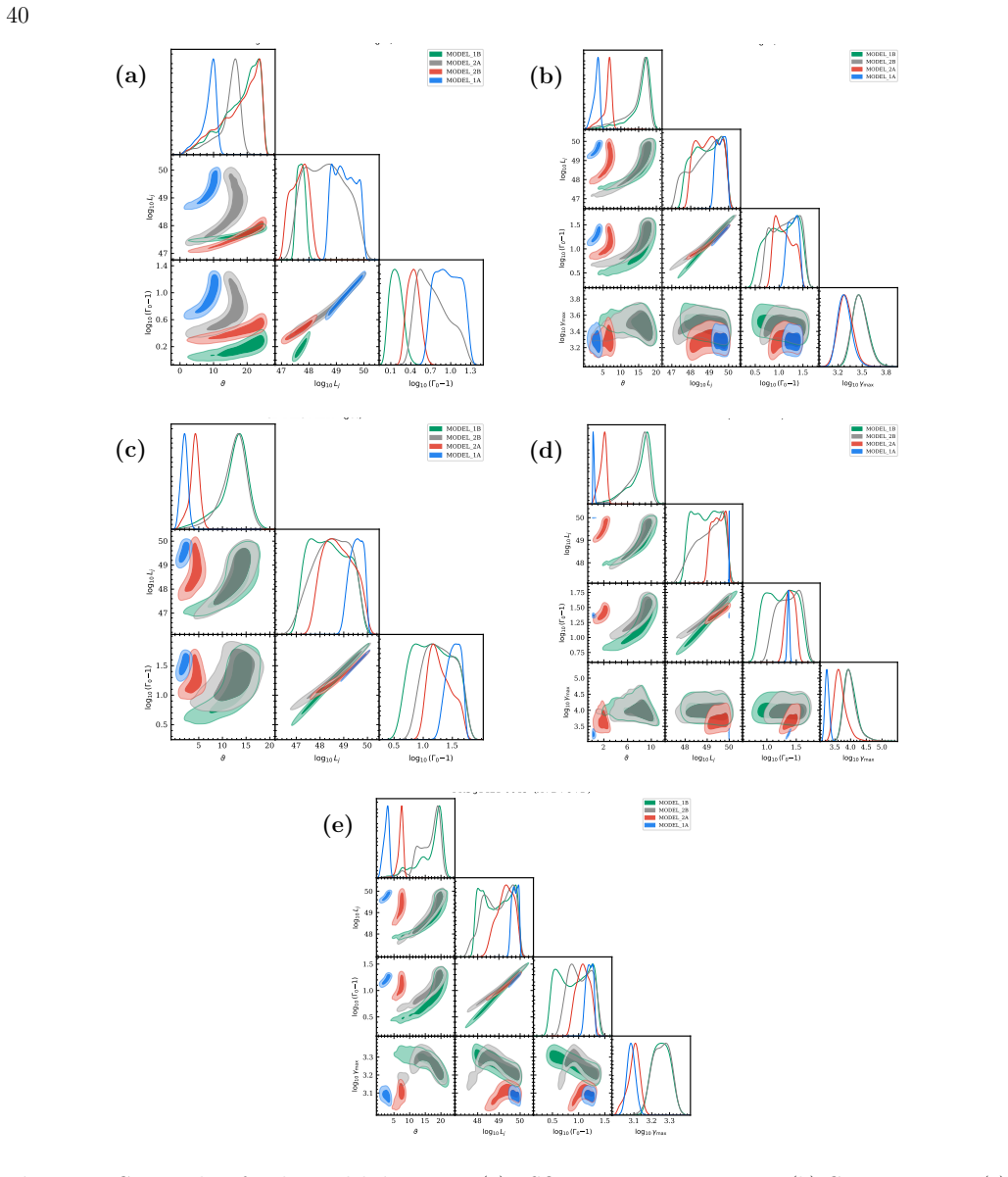
The jet is treated as a current-carrying, axially symmetric outflow with purely toroidal magnetic field in magnetohydrostatic equilibrium and radial velocity shear, so that pressure, magnetic-field, and bulk-velocity profiles are linked self-consistently. Bayesian model comparison on ten Chandra-resolved high-redshift quasar jets shows that electron distributions proportional to gas pressure are systematically preferred, returning jet powers around 10^49 erg s^{-1}, low global magnetization, and no significant monotonic redshift dependence in any derived quantity including the on-axis Lorentz factor of order 10.
What carries the argument
Magnetohydrostatic equilibrium of an axially symmetric current-carrying outflow with purely toroidal magnetic field and radial velocity shear that links pressure, magnetic field, and velocity profiles without additional free parameters.
If this is right
- Jet powers are systematically larger than those recovered from one-zone models applied to the same sources.
- Global jet magnetization parameters remain low across the sample.
- Electron distributions following gas pressure are preferred over those following magnetic energy density.
- No derived quantity, including on-axis Lorentz factor of order ten, shows a significant monotonic trend with redshift.
Where Pith is reading between the lines
- The same equilibrium structure could be tested on lower-redshift jets to check whether the preference for pressure-following electrons is universal.
- Higher power estimates may help reconcile the total energy budget of high-redshift quasars with the observed population of radio galaxies.
- Low magnetization on kiloparsec scales implies that magnetic fields do not dominate the dynamics far from the black hole.
Load-bearing premise
The jet can be treated as a current-carrying axially symmetric outflow with purely toroidal magnetic field in magnetohydrostatic equilibrium and radial velocity shear.
What would settle it
A larger sample of resolved jets showing that one-zone models achieve comparable Bayesian evidence to the structured model while returning similar powers would falsify the claimed advantage of the MHD-informed approach.
Figures



read the original abstract
We present a systematic spectral analysis of kiloparsec-scale jets in high-redshift quasars, modeling their radio-to-X-ray emission as synchrotron radiation and inverse-comptonization of CMB by relativistic electrons. In contrast to the homogeneous one-zone approximation commonly adopted in the literature, we describe the jet as a current-carrying, axially symmetric outflow with a purely toroidal magnetic field in magnetohydrostatic equilibrium and with radial velocity shear. In this framework, the pressure, magnetic-field, and bulk-velocity profiles are linked self-consistently, capturing the radial stratification of the emitting region without introducing additional free parameters. For any individual source, the model effectively retains only a small number of free parameters, including the total jet power, $L_{\rm j}$, and the on-axis bulk Lorentz factor, $\Gamma_0$. We consider two prescriptions for the radial distribution of the radiating electrons -- proportional either to the gas pressure or to the rest-frame magnetic energy density -- and two toroidal-field profiles, yielding four model variants. Applying the model to a sample of ten quasar jets at $z \geq 2.5$ with X-ray features resolved by \textit{Chandra}, we perform Bayesian parameter inference and model comparison. The Bayesian evidence systematically favors electron distributions that follow the gas pressure rather than the magnetic energy density, while the data discriminate only weakly between the assumed field profiles. The inferred jet powers, reaching $L_{\rm j} \sim 10^{49}\,\mathrm{erg\,s^{-1}}$, are systematically larger than those obtained from one-zone models, and the corresponding global jet magnetization parameters are low. None of the derived quantities, including $\Gamma_0 \sim \mathcal{O}(10)$, shows a significant monotonic trend with redshift.
Editorial analysis
A structured set of objections, weighed in public.
Referee Report
Summary. The manuscript develops an MHD-informed model for the radio-to-X-ray spectra of kiloparsec-scale jets in high-redshift quasars. The jet is treated as a current-carrying, axially symmetric outflow with a purely toroidal magnetic field in magnetohydrostatic equilibrium and radial velocity shear, which self-consistently determines the radial profiles of pressure, magnetic field strength, and bulk velocity without additional free parameters. Only two parameters per source (total jet power L_j and on-axis Lorentz factor Γ_0) remain free. Four model variants are compared via Bayesian evidence on a sample of ten Chandra-resolved jets at z ≥ 2.5, differing in whether the radiating electrons scale with gas pressure or magnetic energy density and in the assumed toroidal-field profile. The data favor the gas-pressure scaling for electrons; inferred jet powers reach ~10^49 erg s^{-1} (systematically higher than one-zone results), global magnetization is low, and no significant monotonic redshift trends appear in any derived quantity including Γ_0 ~ O(10).
Significance. If the self-consistent MHD construction holds, the work supplies a parameter-efficient alternative to homogeneous one-zone modeling that yields systematically higher jet powers and low magnetization for high-redshift quasar jets. The quantitative Bayesian model comparison between electron-distribution prescriptions is a methodological strength and could influence how stratified jet emission is interpreted in future multi-wavelength studies.
minor comments (2)
- [Abstract] Abstract: the statement that jet powers are 'systematically larger' than one-zone results would be strengthened by quoting the typical factor or range of difference for the same sources.
- The manuscript should explicitly state the selection criteria and any cuts applied to the ten-source sample, as well as how measurement uncertainties (especially in X-ray fluxes) are propagated into the likelihood.
Simulated Author's Rebuttal
We thank the referee for the detailed and positive assessment of our manuscript, including the recognition of the methodological strengths in our Bayesian model comparison and the self-consistent MHD framework. The recommendation for minor revision is noted. No specific major comments were provided in the report, so we have no points to address point-by-point at this stage. We will incorporate any minor suggestions during revision.
Circularity Check
No significant circularity; derivation self-contained
full rationale
The paper defines an MHD jet model from explicit physical assumptions (axially symmetric current-carrying outflow, purely toroidal B-field, magnetohydrostatic equilibrium, radial velocity shear) that link pressure/B/velocity profiles without extra free parameters. Only L_j and Gamma_0 are fitted per source; two electron-distribution prescriptions are then compared via Bayesian evidence on Chandra data. No step reduces a claimed prediction or first-principles result to a fitted input by construction, no self-citation chain is load-bearing, and no ansatz is smuggled via prior work. The model comparison and reported trends (higher L_j, low magnetization, no redshift trend) follow directly from the stated assumptions plus data, making the derivation independent.
Axiom & Free-Parameter Ledger
free parameters (2)
- total jet power L_j
- on-axis bulk Lorentz factor Gamma_0
axioms (1)
- domain assumption The jet is a current-carrying, axially symmetric outflow with a purely toroidal magnetic field in magnetohydrostatic equilibrium and with radial velocity shear.
Reference graph
Works this paper leans on
-
[1]
2025, Journal of Cosmology and Astroparticle Physics, 2025, 021, doi: 10.1088/1475-7516/2025/02/021
Adame, A., Aguilar, J., Ahlen, S., et al. 2025, Journal of Cosmology and Astroparticle Physics, 2025, 021, doi: 10.1088/1475-7516/2025/02/021
-
[2]
Aharonian, F. A., Kelner, S. R., & Prosekin, A. Y. 2010, PhRvD, 82, 043002, doi: 10.1103/PhysRevD.82.043002
-
[3]
Aloy, M. A., & Mimica, P. 2008, ApJ, 681, 84, doi: 10.1086/588605
-
[4]
2025, A&A, 699, A181, doi: 10.1051/0004-6361/202453555
Alzati, G., Sbarrato, T., & Ghisellini, G. 2025, A&A, 699, A181, doi: 10.1051/0004-6361/202453555
-
[5]
2018, Galaxies, 6, doi: 10.3390/galaxies6010031
Anantua, R., Blandford, R., & Tchekhovskoy, A. 2018, Galaxies, 6, doi: 10.3390/galaxies6010031
-
[6]
1992, A&A, 256, 354
Appl, S., & Camenzind, M. 1992, A&A, 256, 354
1992
-
[7]
doi:10.1103/RevModPhys.56.255 , adsnote =
Begelman, M. C., Blandford, R. D., & Rees, M. J. 1984, Reviews of Modern Physics, 56, 255, doi: 10.1103/RevModPhys.56.255
-
[8]
2022, A&A, 660, A74, doi: 10.1051/0004-6361/202142335
Belladitta, S., Caccianiga, A., Diana, A., et al. 2022, A&A, 660, A74, doi: 10.1051/0004-6361/202142335
-
[9]
Blumenthal, G. R., & Gould, R. J. 1970, Reviews of Modern Physics, 42, 237, doi: 10.1103/RevModPhys.42.237
-
[10]
2018, JAX: composable transformations of Python+NumPy programs,, http://github.com/jax-ml/jax
Bradbury, J., Frostig, R., Hawkins, P., et al. 2018, JAX: composable transformations of Python+NumPy programs,, http://github.com/jax-ml/jax
2018
-
[11]
Breiding, P., Meyer, E. T., Georganopoulos, M., et al. 2023, MNRAS, 518, 3222, doi: 10.1093/mnras/stac3081
-
[12]
Burns, J. O., & Laing, R. A. 1994, AJ, 108, 766, doi: 10.1086/117112
-
[13]
, year = 1984, month = jan, volume =
Bridle, A. H., & Perley, R. A. 1984, ARA&A, 22, 319, doi: 10.1146/annurev.aa.22.090184.001535
-
[14]
Statistics and Computing26(1-2), 383–392 (2016) https://doi.org/10.1007/s11222-014-9512-y
Buchner, J. 2016, Statistics and Computing, 26, 383, doi: 10.1007/s11222-014-9512-y
-
[15]
PASP131(1004), 108005 (2019) https://doi.org/10.1088/1538-3873/aae7fc
Buchner, J. 2019, PASP, 131, 108005, doi: 10.1088/1538-3873/aae7fc
-
[16]
2021, The Journal of Open Source Software, 6, 3001, doi: 10.21105/joss.03001
Buchner, J. 2021, The Journal of Open Source Software, 6, 3001, doi: 10.21105/joss.03001
-
[17]
Cara, M., Perlman, E. S., Uchiyama, Y., et al. 2013, ApJ, 773, 186, doi: 10.1088/0004-637X/773/2/186
-
[18]
Observing and data analysis systems, discovery and timing of 100 pulsars
Celotti, A., Ghisellini, G., & Chiaberge, M. 2001, Monthly Notices of the Royal Astronomical Society, 321, L1, doi: 10.1046/j.1365-8711.2001.04160.x
-
[19]
Cheung, C. C. 2004, ApJL, 600, L23, doi: 10.1086/381366
-
[20]
C., Stawarz, L., & Siemiginowska, A
Cheung, C. C., Stawarz, L., & Siemiginowska, A. 2006, ApJ, 650, 679, doi: 10.1086/506908
-
[21]
C., Stawarz, L., Siemiginowska, A., et al
Cheung, C. C., Stawarz, L., Siemiginowska, A., et al. 2012, ApJL, 756, L20, doi: 10.1088/2041-8205/756/1/L20
-
[22]
Large-Scale Radio and X-ray Jets in the Highest Redshift Quasars
Cheung, C. C., Wardle, J. F. C., & Lee, N. P. 2005, in 22nd Texas Symposium on Relativistic Astrophysics, ed. P. Chen, E. Bloom, G. Madejski, & V. Patrosian, 480–485, doi: 10.48550/arXiv.astro-ph/0606256 34
work page internal anchor Pith review Pith/arXiv arXiv doi:10.48550/arxiv.astro-ph/0606256 2005
-
[23]
2021, ApJ, 911, 120, doi: 10.3847/1538-4357/abe710
Connor, T., Ba˜ nados, E., Stern, D., et al. 2021, ApJ, 911, 120, doi: 10.3847/1538-4357/abe710
-
[24]
1986, A&A, 164, L16
Crusius, A., & Schlickeiser, R. 1986, A&A, 164, L16
1986
-
[25]
Das, U., & Begelman, M. C. 2019, MNRAS, 482, 2107, doi: 10.1093/mnras/sty2675
-
[26]
Dermer, C. D. 1995, ApJL, 446, L63, doi: 10.1086/187931
-
[27]
2018, The Astrophysical Journal, 860, 121
Perucho, M. 2018, The Astrophysical Journal, 860, 121
2018
-
[28]
Ghisellini, G., & Tavecchio, F. 2009, MNRAS, 397, 985, doi: 10.1111/j.1365-2966.2009.15007.x
-
[29]
Dark energy and the accelerating universe,
Harris, D., & Krawczynski, H. 2006, Annual Review of Astronomy and Astrophysics, 44, 463, doi: https://doi.org/10.1146/annurev.astro. 44.051905.092446
-
[30]
Homan, D. C., Cohen, M. H., Hovatta, T., et al. 2021, ApJ, 923, 67, doi: 10.3847/1538-4357/ac27af
-
[31]
2022, A&A, 659, A93, doi: 10.1051/0004-6361/202142676
Ighina, L., Moretti, A., Tavecchio, F., et al. 2022, A&A, 659, A93, doi: 10.1051/0004-6361/202142676
-
[32]
Jones, T. W., Ryu, D., & Engel, A. 1999, The Astrophysical Journal, 512, 105, doi: 10.1086/306772
-
[33]
Kappes, A., Burd, P. R., Kadler, M., et al. 2022, A&A, 663, A44, doi: 10.1051/0004-6361/202141720
-
[34]
Komissarov, S. S. 1999, MNRAS, 308, 1069, doi: 10.1046/j.1365-8711.1999.02783.x Kr´ ol, D. L., Stawarz, L., Begelman, M. C., et al. 2022, ApJ, 929, 181, doi: 10.3847/1538-4357/ac634a
-
[35]
Lind, K. R., & Blandford, R. D. 1985, ApJ, 295, 358, doi: 10.1086/163380
-
[36]
Lyubarskii, Y. E. 1999, MNRAS, 308, 1006, doi: 10.1046/j.1365-8711.1999.02763.x
-
[37]
Maithil, J., Brotherton, M. S., Shemmer, O., et al. 2022, MNRAS, 515, 491, doi: 10.1093/mnras/stac1748
-
[38]
Maithil, J., Schwartz, D. A., Siemiginowska, A., et al. 2025, The Astrophysical Journal, 986, 75, doi: 10.3847/1538-4357/adccc1
-
[39]
Marchenko, V., Harris, D. E., Ostrowski, M., et al. 2017, ApJ, 844, 11, doi: 10.3847/1538-4357/aa755d
-
[40]
McKeough, K., Siemiginowska, A., Cheung, C. C., et al. 2016, ApJ, 833, 123, doi: 10.3847/1538-4357/833/1/123
-
[41]
T., Georganopoulos, M., Sparks, W
Meyer, E. T., Georganopoulos, M., Sparks, W. B., et al. 2015, ApJ, 805, 154, doi: 10.1088/0004-637X/805/2/154
-
[42]
Massaglia, S. 2010, Monthly Notices of the Royal Astronomical Society, 402, 7, doi: 10.1111/j.1365-2966.2009.15642.x
-
[43]
Mullin, L. M., & Hardcastle, M. J. 2009, MNRAS, 398, 1989, doi: 10.1111/j.1365-2966.2009.15232.x
-
[44]
Nakamura, M., & Meier, D. L. 2004, ApJ, 617, 123, doi: 10.1086/425337 35
-
[45]
Nalewajko, K., & Begelman, M. C. 2012, MNRAS, 427, 2480, doi: 10.1111/j.1365-2966.2012.22117.x
-
[46]
2009, ApJ, 697, 1681, doi: 10.1088/0004-637X/697/2/1681 O’Neill, S
Narayan, R., Li, J., & Tchekhovskoy, A. 2009, ApJ, 697, 1681, doi: 10.1088/0004-637X/697/2/1681 O’Neill, S. M., Beckwith, K., & Begelman, M. C. 2012, MNRAS, 422, 1436, doi: 10.1111/j.1365-2966.2012.20721.x
-
[47]
Perger, K., Frey, S., Schwartz, D. A., et al. 2021, ApJ, 915, 98, doi: 10.3847/1538-4357/ac0144
-
[48]
J., Ricarte, A., Natarajan, P., et al
Porras-Valverde, A. J., Ricarte, A., Natarajan, P., et al. 2026, ApJ, 998, 48, doi: 10.3847/1538-4357/ae2fb1
-
[49]
2011, The Astrophysical Journal, 737, 42
Porth, O., Fendt, C., Meliani, Z., & Vaidya, B. 2011, The Astrophysical Journal, 737, 42
2011
-
[50]
Rakshit, S., Stalin, C. S., & Kotilainen, J. 2020, ApJS, 249, 17, doi: 10.3847/1538-4365/ab99c5
-
[51]
Keenan, M., & Kollmann, K. E. 2023, ApJS, 265, 8, doi: 10.3847/1538-4365/aca321
-
[52]
Richards, G. T., Strauss, M. A., Fan, X., et al. 2006, AJ, 131, 2766, doi: 10.1086/503559
-
[53]
Schwartz, D. A. 2002, ApJL, 569, L23, doi: 10.1086/340482
-
[54]
F., Faucher-Gigu` ere, C.-A., et al
Shen, X., Hopkins, P. F., Faucher-Gigu` ere, C.-A., et al. 2020, MNRAS, 495, 3252, doi: 10.1093/mnras/staa1381
-
[55]
Siemiginowska, A., Smith, R. K., Aldcroft, T. L., et al. 2003, ApJL, 598, L15, doi: 10.1086/380497
-
[56]
Siemiginowska, A., Stawarz, L., Cheung, C. C., et al. 2007, ApJ, 657, 145, doi: 10.1086/510898
-
[57]
2016, The Astrophysical Journal Letters, 816, L15, doi: 10.3847/2041-8205/816/1/L15
Simionescu, A., Stawarz, L., Ichinohe, Y., et al. 2016, The Astrophysical Journal Letters, 816, L15, doi: 10.3847/2041-8205/816/1/L15
-
[58]
2004, Bayesian inference and maximum entropy methods in science and engineering, 735, 395
Skilling, J. 2004, Bayesian inference and maximum entropy methods in science and engineering, 735, 395
2004
-
[59]
2006, Bayesian Analysis, 1, 833 , doi: 10.1214/06-BA127
Skilling, J. 2006, Bayesian Analysis, 1, 833 , doi: 10.1214/06-BA127
-
[60]
Snios, B., Schwartz, D. A., Siemiginowska, A., et al. 2021, ApJ, 914, 130, doi: 10.3847/1538-4357/abfe64
-
[61]
Sobacchi, E., & Lyubarsky, Y. E. 2018, MNRAS, 473, 2813, doi: 10.1093/mnras/stx2592
-
[62]
2002, ApJ, 578, 763, doi: 10.1086/342649
Stawarz, L., & Ostrowski, M. 2002, ApJ, 578, 763, doi: 10.1086/342649
-
[63]
Begelman, M. C. 2004, ApJ, 608, 95, doi: 10.1086/392502
-
[64]
2021, MNRAS, 501, 6199, doi: 10.1093/mnras/staa4009
Tavecchio, F. 2021, MNRAS, 501, 6199, doi: 10.1093/mnras/staa4009
-
[65]
Urry, C. M. 2000, ApJL, 544, L23, doi: 10.1086/317292
-
[66]
Tregillis, I. L., Jones, T. W., & Ryu, D. 2001, The Astrophysical Journal, 557, 475, doi: 10.1086/321657
-
[67]
Tregillis, I. L., Jones, T. W., Ryu, D., & Park, C. 2002, New Astronomy Reviews, 46, 387, doi: https://doi.org/10.1016/S1387- 6473(02)00148-3
-
[68]
2008, Contemporary Physics, 49, 71, doi: 10.1080/00107510802066753
Trotta, R. 2008, Contemporary Physics, 49, 71, doi: 10.1080/00107510802066753 36
-
[69]
Varian, H. R. 2014, Intermediate microeconomics with calculus: a modern approach (WW norton & company)
2014
-
[70]
Vestergaard, M., & Peterson, B. M. 2006, ApJ, 641, 689, doi: 10.1086/500572
work page internal anchor Pith review doi:10.1086/500572 2006
-
[71]
Wang, J.-S., Reville, B., Liu, R.-Y., Rieger, F. M., & Aharonian, F. A. 2021, MNRAS, 505, 1334, doi: 10.1093/mnras/stab1458
-
[72]
Wardle, J. F. C., & Aaron, S. E. 1997, MNRAS, 286, 425, doi: 10.1093/mnras/286.2.425
-
[73]
Speybroeck, L. P., & O’Dell, S. L. 2000, in Society of Photo-Optical Instrumentation Engineers (SPIE) Conference Series, Vol. 4012, X-Ray Optics, Instruments, and Missions III, ed. J. E. Truemper & B. Aschenbach, 2–16, doi: 10.1117/12.391545
-
[74]
Worrall, D. M. 2009, A&A Rv, 17, 1, doi: 10.1007/s00159-008-0016-7
-
[75]
M., Birkinshaw, M., Marshall, H
Worrall, D. M., Birkinshaw, M., Marshall, H. L., et al. 2020, Monthly Notices of the Royal Astronomical Society, 497, 988, doi: 10.1093/mnras/staa1975 37 APPENDIX A.JET RADIAL PROFILES In Figures 5 and 6 we present the best-fit transverse (cross-jet) radial profiles of the bulk Lorentz factor Γ(x), the comoving toroidal magnetic fieldB ′(x) =B ϕ(x)/Γ(x), ...
discussion (0)
Sign in with ORCID, Apple, or X to comment. Anyone can read and Pith papers without signing in.