Orchestrating the Twin Transition in Multinational Corporations: Technology Roadmapping for Green and Digital Global Business Services
Pith reviewed 2026-06-27 05:34 UTC · model grok-4.3
The pith
Global Business Services units act as operational airlocks to mediate the green and digital twin transition in multinational corporations.
A machine-rendered reading of the paper's core claim, the machinery that carries it, and where it could break.
Core claim
The paper claims that the GBS unit is a central operational airlock mediating between landscape pressures such as dual mandates and carbon adjustment mechanisms and niche innovations in AI-native workflows, with the synthesis of technology roadmapping and the innovation ecosystem toolkit yielding a data-driven design approach that maps clusters onto a stakeholder engagement canvas and highlights resilient middle power hubs providing a third way for global value chains.
What carries the argument
The operational airlock mechanism in GBS units, which mediates external landscape pressures and internal niche innovations during the twin transition.
If this is right
- Leaders can apply the data-driven design approach to orchestrate talent and supply chain flows.
- Resilient middle power hubs in certain locations bypass the middle-income trap to supply a third way in global value chains.
- The framework enriches the conceptual role of GBS within Industry 5.0 as a mechanism for the multipolar digital economy.
- Entrepreneurial support networks gain tools to align with the evolutionary shift toward sustainable intelligence.
Where Pith is reading between the lines
- The approach might extend to empirical tests in additional multinational corporations beyond the bibliometric clusters to check mediation effects.
- Similar airlock dynamics could appear in other organizational units handling regulatory and technological shifts in different sectors.
- Policy makers in emerging economies might examine support for the identified hubs as a route to stabilize participation in global value chains.
- The canvas could be adapted to track whether the twin transition produces measurable changes in operational resilience over time.
Load-bearing premise
That clusters drawn from research literature accurately mirror real evolutionary changes in GBS practice and that the roadmapping synthesis produces non-circular actionable guidance for leaders.
What would settle it
A direct comparison of GBS operations in selected multinational corporations against the mapped clusters, checking whether the described mediation between regulatory pressures and AI workflow innovations occurs in practice or produces measurable orchestration improvements.
Figures

read the original abstract
Global Business Services (GBS) have emerged as a "living laboratory" for the Twin Transition of Green and Digital Transformation, as multinational corporations (MNCs) face increasing pressure to harmonize digital efficiency with environmental stewardship. Aiming to derive a socio-technical framework, this paper synthesizes Technology Roadmapping (TRM) with the International Telecommunication Union (ITU) ICT-centric innovation ecosystem toolkit. A bibliometric analysis of research clusters reveals an evolutionary shift from basic process automation toward "Sustainable Intelligence," identifying the GBS unit as a central "operational airlock" that mediates between landscape pressures -- such as the EU's dual mandate and Carbon Border Adjustment Mechanisms -- and niche innovations in AI-native workflows. The study further maps these clusters onto a stakeholder engagement canvas, highlighting how resilient "Middle Power" hubs in Poland, Portugal, and Malaysia are bypassing the middle-income trap to provide a "third way" for global value chains amidst a bifurcated geopolitical cloud. The results offer a data-driven design approach for leaders and entrepreneurial support networks to orchestrate talent and supply chain flows, thereby enriching the conceptual understanding of Industry 5.0 and the role of GBS as a primary mechanism for navigating a volatile, multipolar digital economy.
Editorial analysis
A structured set of objections, weighed in public.
Referee Report
Summary. The paper performs a bibliometric analysis of research clusters on Global Business Services (GBS) and the twin (green-digital) transition in MNCs. It synthesizes Technology Roadmapping (TRM) with the ITU ICT-centric innovation ecosystem toolkit to derive a socio-technical framework. Key claims include an evolutionary shift in the literature from process automation to 'Sustainable Intelligence,' identification of the GBS unit as a central 'operational airlock' mediating landscape pressures (EU dual mandate, CBAM) and niche AI innovations, emergence of 'Middle Power' hubs (Poland, Portugal, Malaysia) offering a 'third way' for global value chains, and mapping to a stakeholder canvas that yields a data-driven design approach for orchestrating talent and supply-chain flows in Industry 5.0.
Significance. If the bibliometric clusters and interpretive synthesis are shown to be robust and externally validated, the work could supply a useful conceptual bridge between established roadmapping toolkits and GBS practice, highlighting a potential mediation role for GBS units. The integration of TRM and ITU elements is a constructive synthesis step. However, the absence of any methodological transparency or external anchoring means the 'data-driven' and 'third way' claims currently add little beyond re-interpretation of existing literature.
major comments (3)
- [Abstract / Bibliometric Analysis] Abstract and Bibliometric Analysis section: no search terms, database(s), query strings, inclusion/exclusion criteria, time window, corpus size, or clustering/validation procedure are supplied. Without these, the claimed 'evolutionary shift' to Sustainable Intelligence and the identification of GBS as an operational airlock cannot be evaluated or reproduced.
- [Abstract / Framework Synthesis] Abstract and Framework Synthesis: the mediator role of GBS and the 'third way' for Middle Power hubs are presented as emerging directly from the chosen literature clusters and toolkit combination. No independent test, external benchmark, or operational dataset (talent flows, CBAM compliance, supply-chain metrics) is used to anchor these interpretations, making the central mediation claim circular by construction.
- [Abstract] Abstract: the assertion that the synthesis 'offers a data-driven design approach' is unsupported when the underlying bibliometric procedure itself lacks any reported error assessment, robustness check, or mapping to real-world GBS operational data.
minor comments (2)
- The novel terms 'operational airlock,' 'Sustainable Intelligence,' and 'Middle Power hubs' are introduced without explicit definitions or citations to prior usage; a short definitional paragraph would improve clarity.
- The stakeholder engagement canvas is mentioned but not described or illustrated; adding a figure or table summarizing its dimensions would aid readability.
Simulated Author's Rebuttal
We thank the referee for the constructive and detailed comments, which identify key areas where methodological transparency can be strengthened. We address each major comment point-by-point below, indicating planned revisions where appropriate.
read point-by-point responses
-
Referee: [Abstract / Bibliometric Analysis] Abstract and Bibliometric Analysis section: no search terms, database(s), query strings, inclusion/exclusion criteria, time window, corpus size, or clustering/validation procedure are supplied. Without these, the claimed 'evolutionary shift' to Sustainable Intelligence and the identification of GBS as an operational airlock cannot be evaluated or reproduced.
Authors: We agree that the absence of these details limits reproducibility and evaluation. The revised manuscript will add a dedicated 'Bibliometric Methods' subsection specifying the databases (Scopus), search terms and query strings, time window, inclusion/exclusion criteria, final corpus size, and clustering/validation approach (including software and parameters used). This will directly support assessment of the evolutionary shift and GBS role claims. revision: yes
-
Referee: [Abstract / Framework Synthesis] Abstract and Framework Synthesis: the mediator role of GBS and the 'third way' for Middle Power hubs are presented as emerging directly from the chosen literature clusters and toolkit combination. No independent test, external benchmark, or operational dataset (talent flows, CBAM compliance, supply-chain metrics) is used to anchor these interpretations, making the central mediation claim circular by construction.
Authors: The mediator role and 'third way' are interpretive propositions arising from the TRM-ITU synthesis applied to the identified clusters; the paper does not claim new empirical testing or external datasets. We will revise the text to explicitly label these as conceptual derivations rather than direct empirical findings, add a limitations paragraph acknowledging the lack of independent validation, and note that operational anchoring remains for future research. This addresses the circularity concern by clarifying the interpretive scope without overstating the evidence base. revision: partial
-
Referee: [Abstract] Abstract: the assertion that the synthesis 'offers a data-driven design approach' is unsupported when the underlying bibliometric procedure itself lacks any reported error assessment, robustness check, or mapping to real-world GBS operational data.
Authors: We accept that 'data-driven' overstates the current contribution given the missing robustness details. The abstract and synthesis sections will be revised to describe the output as a 'synthesis-based design approach' derived from bibliometric mapping. We will also add explicit discussion of limitations, including the absence of error assessment and real-world mapping, to avoid unsupported claims. revision: yes
Circularity Check
No significant circularity; derivation relies on independent bibliometric analysis and synthesis of external toolkits
full rationale
The paper conducts a bibliometric analysis on research literature to identify clusters, then applies the external TRM and ITU ICT-centric innovation ecosystem toolkit to interpret those clusters and map them onto a stakeholder canvas. The resulting claims (evolutionary shift to 'Sustainable Intelligence', GBS as 'operational airlock', 'third way' for hubs) are presented as interpretive outputs of this process rather than inputs redefined by construction. No equations, fitted parameters, or self-citations are shown to reduce the central claims to their own inputs; the bibliometric step and toolkit synthesis supply independent content. This is the most common honest finding for papers that perform explicit data analysis and methodological combination without the enumerated circular patterns.
Axiom & Free-Parameter Ledger
axioms (2)
- domain assumption Global Business Services have emerged as a living laboratory for the Twin Transition of Green and Digital Transformation
- domain assumption Bibliometric analysis of research clusters reveals an evolutionary shift from basic process automation toward Sustainable Intelligence
invented entities (3)
-
operational airlock
no independent evidence
-
Sustainable Intelligence
no independent evidence
-
Middle Power hubs
no independent evidence
Reference graph
Works this paper leans on
-
[1]
engine room
Keyword co-occurrence network The keyword co-occurrence network (Fig. 1) reveals five clusters: the Red Cluster anchors the traditional B PO and offshoring narrative, centered on risk and performa nce in established hubs like India and the Philippines. Th e Green Cluster represents the technical "engine room" of p rocess engineering, utilizing simulation ...
1993
-
[2]
conceptual inertia
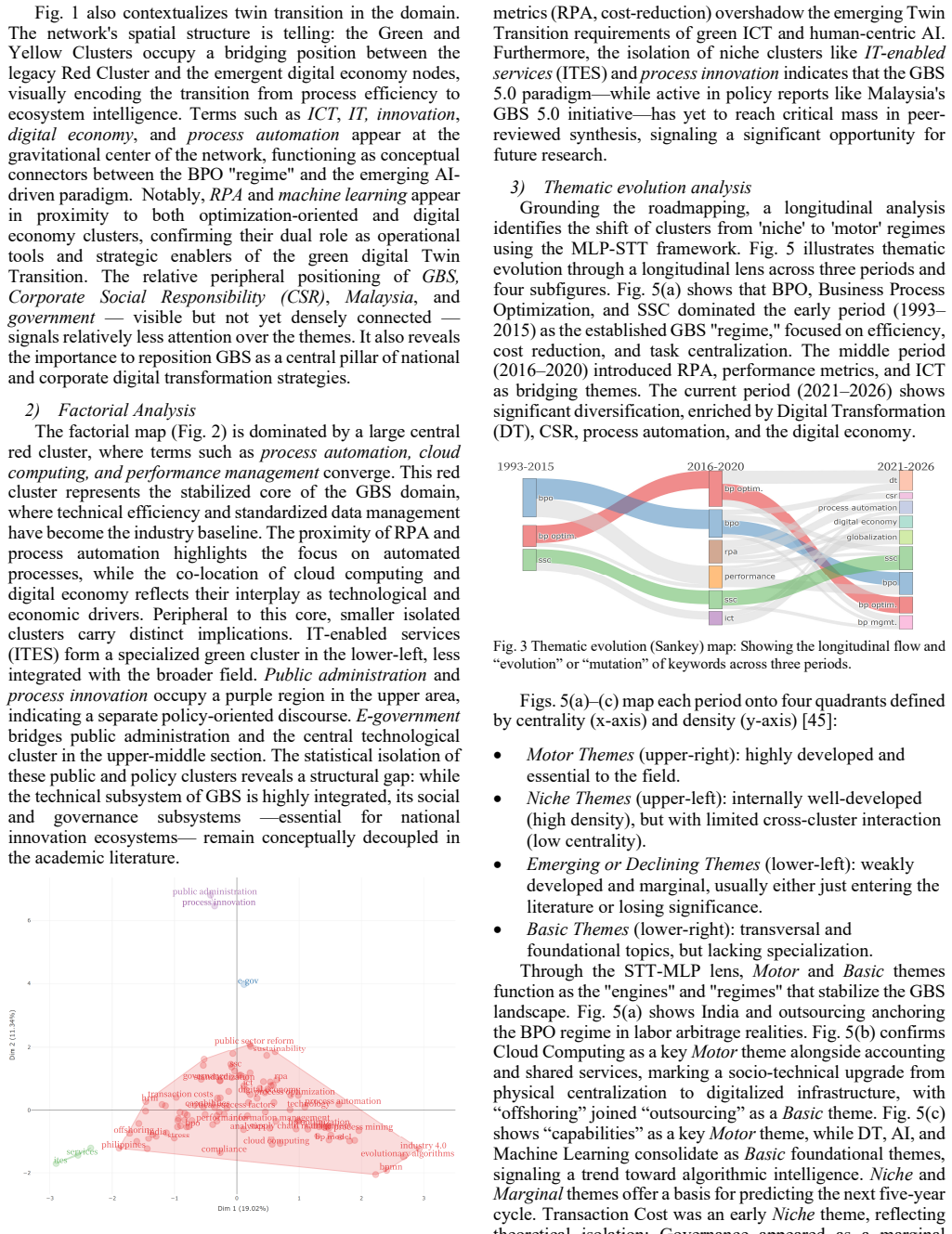
Factorial Analysis The factorial map (Fig. 2) is dominated by a large central red cluster, where terms such as process automation, cloud computing, and performance management converge. This red cluster represents the stabilized core of the GBS d omain, where technical efficiency and standardized data management have become the industry baseline. The proxi...
-
[3]
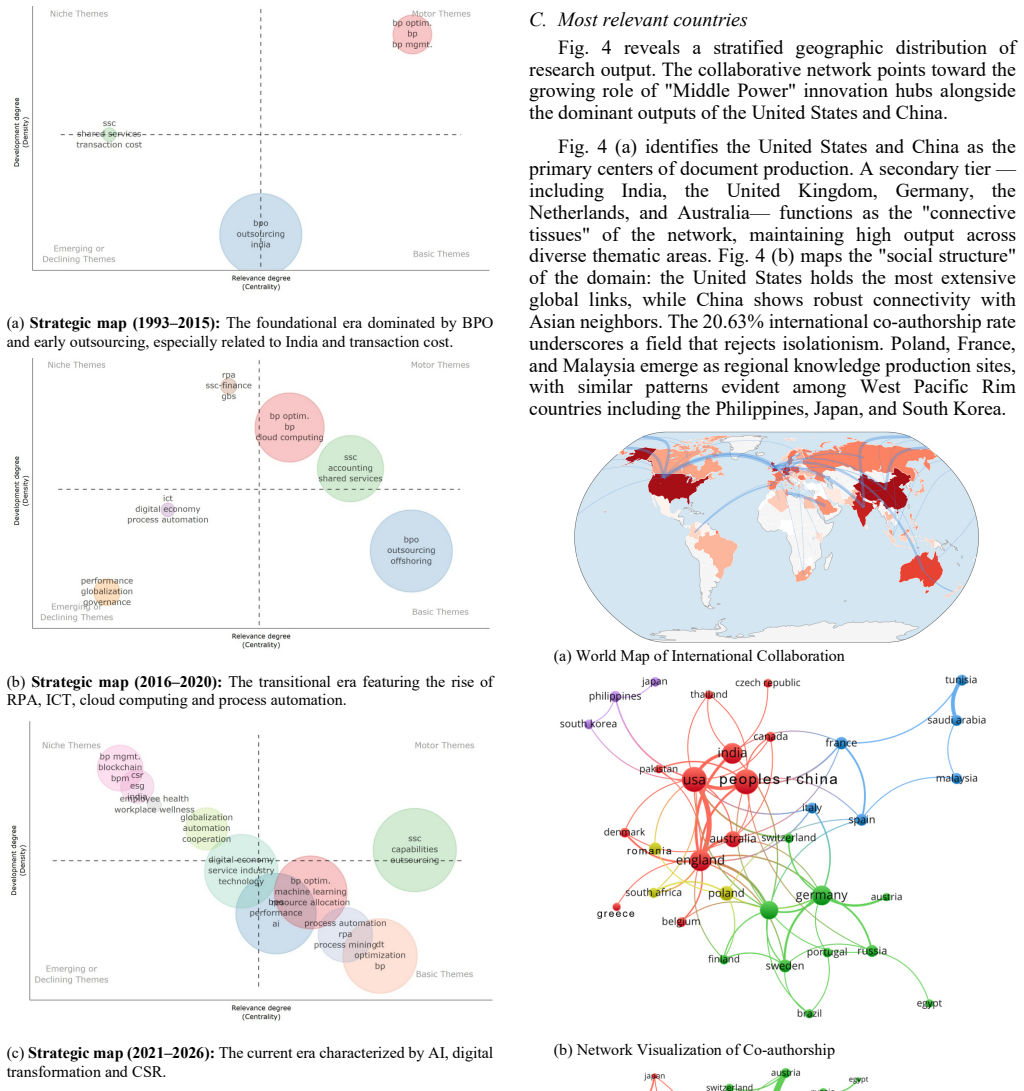
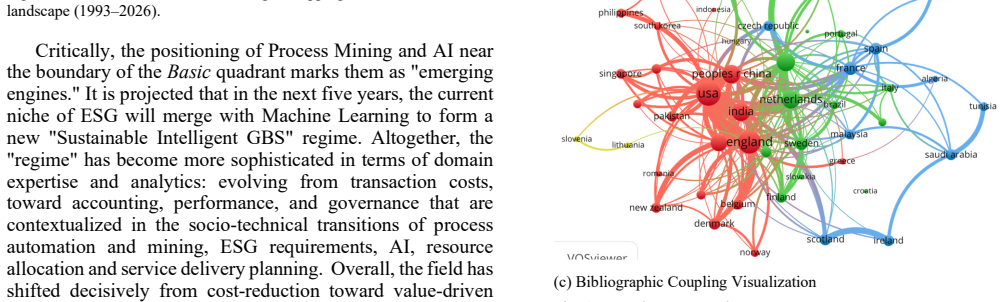
Thematic evolution analysis Grounding the roadmapping, a longitudinal analysis identifies the shift of clusters from 'niche' to 'm otor' regimes using the MLP-STT framework. Fig. 5 illustrates the matic evolution through a longitudinal lens across three periods and four subfigures. Fig. 5(a) shows that BPO, Business Process Optimization, and SSC dominated...
-
[4]
evolution
as the established GBS "regime," focused on efficiency, cost reduction, and task centralization. The middle period (2016–2020) introduced RPA, performance metrics, and ICT as bridging themes. The current period (2021–2026) shows significant diversification, enriched by Digital Transformation (DT), CSR, process automation, and the digital economy. Fig. 3 T...
2016
-
[5]
Co-dependence: Human capital strategy and AI adoption must function as simultaneous, co-dependen t investments rather than sequential tasks
-
[6]
Holistic Design: The Twin Transition is a deliberate socio-technical realignment of GVC—not merely a technical upgrade—, in which human and algorithmic components must be designed together from the outset
-
[7]
Disciplinary Reframing : GBS governance is an inherently socio-technical discipline, transcending its operational or logistical constraints . C. Future Work and Perspectives The integration of bibliometric data with the ITU I CT- Centric Innovation Ecosystem Toolkit provides a rig orous framework for mapping the Twin Transition as a soci o- technical real...
-
[8]
AI and semiconductor roadmaps for regeneratively accountable and environmentally safe supplies
-
[9]
Cognitive Computing Continuum for controlling loops that balance yields with resource circularity
-
[10]
Trustworthy autonomous AI agents , serving as regulatory proxies to secure RegTech innovation usi ng industrial data spaces; and
-
[11]
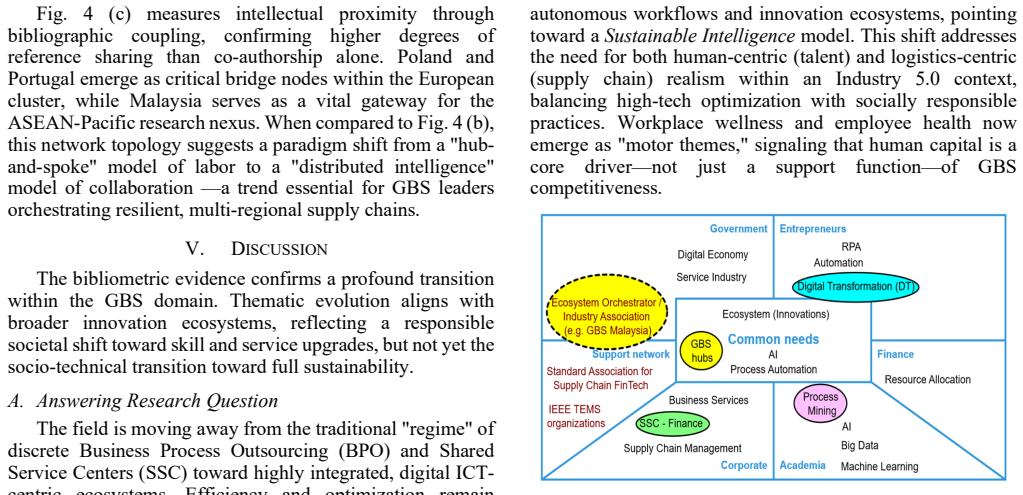
Regenerative socio-technical architecture to support material lifecycle tracking using digital product passports. By deploying the remaining components of the ITU toolkit—the Ecosystem Maturity Map , Sector Development Canvas , and Storytelling Tool —this initiative will document the GBS transition from outsourcing destinations to innovation hubs. Redefin...
-
[12]
Business service centres in Portugal,
I. Oz, “Business service centres in Portugal,” AICEP, Jun. 2025
2025
-
[13]
AI Chatbots as Pro fessional Service Agents: Developing a Professional Identity,
W. Li, K. Shi, and Y. Chai, “AI Chatbots as Pro fessional Service Agents: Developing a Professional Identity,” in Proceedings of the 2025 Conference on Empirical Methods in Natural Lan guage Processing , C. Christodoulopoulos, T. Chakraborty, C. Rose, a nd V. Peng, Eds., Suzhou, China: Association for Computational Linguistics, Nov. 2025, pp. 12912–12925....
-
[14]
Business Services Sector in Poland 2025,
ABSL, “Business Services Sector in Poland 2025, ” Warsaw: Association of Business Service Leaders, May 2025
2025
-
[15]
GBS malays ia strategy mid-term report 2022-2027: unleashing GBS 5.0 – human-centric, AI- driven, impact-focused,
PIKOM, GBS Malaysia, MDEC, and UNM, “GBS malays ia strategy mid-term report 2022-2027: unleashing GBS 5.0 – human-centric, AI- driven, impact-focused,” Selangor: PIKOM (Persatuan Industri Komputer dan Multimedia Malaysia); MDEC (Malaysia D igital Economy Corporation); UNM (University of Nottingham Malaysia), Oct. 2025
2022
-
[16]
28, 2026
ITSelecta, AI & gbs in 2026: what is changing and why it matters? an interview with romek lubaczewski , Jan. 28, 2026. Accessed: Feb. 27,
2026
-
[17]
Available: https://youtu.be/Ji7wxPtzzIY
[Online]. Available: https://youtu.be/Ji7wxPtzzIY
-
[18]
Geneva, Switzerland: International Telecommunication Union (ITU), 2020
ITU-D, Bridging the digital innovation divide: a toolkit for developing sustainable ict-centric ecosystem projects . Geneva, Switzerland: International Telecommunication Union (ITU), 2020. Available: http://handle.itu.int/11.1002/pub/816bc8cc-en
2020
-
[19]
Penang unveils the development o f GBS@technoplex to harness AI growth and cement its position as Mal aysia’s digital innovation hub,
InvestPenang, “Penang unveils the development o f GBS@technoplex to harness AI growth and cement its position as Mal aysia’s digital innovation hub,” Nov. 13, 2025
2025
-
[20]
How AI & Automation are Shaping Tomorrows GBS Landscape,
ABSL Portugal, “How AI & Automation are Shaping Tomorrows GBS Landscape,” 2026. Accessed: Feb. 27, 2026. [Online] . Available: https://www.linkedin.com/posts/absl-portugal_how-ai-automation- are-shaping-tomorrows-activity-7404195003419389952-p84y/
2026
-
[21]
Integrati on management-system for technical-information,
K. Okawa, S. Sato, and T. Haraguchi, “Integrati on management-system for technical-information,” NEC Res. Dev. , vol. 35, no. 2, pp. 205–215, Apr. 1994
1994
-
[22]
Christensen, Digital economics: the digital transformation of global business
J. Christensen, Digital economics: the digital transformation of global business . Copenhagen: BoD, 2016
2016
-
[23]
A. Plugge and S. Nikou, Digitalisation of global business services: orchestrating the enterprise ecosystem . Springer Nature, 2024. doi: 10.1007/978-3-031-51528-6
-
[24]
M. Graham, I. Hjorth, and V. Lehdonvirta, “Dig ital labour and development: impacts of global digital labour platf orms and the gig economy on worker livelihoods,” Transfer: European Review of Labour and Research , vol. 23, no. 2, pp. 135–162, May 2017, doi: 10.1177/1024258916687250
-
[25]
The global platform economy: a new offshoring instituti on enabling emerging-economy microproviders,
V. Lehdonvirta, O. Kässi, I. Hjorth, H. Barnar d, and M. Graham, “The global platform economy: a new offshoring instituti on enabling emerging-economy microproviders,” Journal of Management , vol. 45, no. 2, pp. 567–599, Feb. 2019, doi: 10.1177/0149206318786781
-
[26]
The global polarisation of remote wor k,
F. Braesemann, F. Stephany, O. Teutloff, O. Kässi, M. Graham, and V. Lehdonvirta, “The global polarisation of remote wor k,” PLOS ONE , vol. 17, no. 10, p. e0274630, Oct. 2022, doi: 10.1371/journal.pone.0274630
-
[27]
Digital transformation of global business processes: the ro le of dual embeddedness,
P. Ekman, P. Thilenius, S. Thompson, and J. Wh itaker, “Digital transformation of global business processes: the ro le of dual embeddedness,” Business Process Management Journal , vol. 26, no. 2, pp. 570–592, Sep. 2019, doi: 10.1108/BPMJ-02-2019-0080
-
[28]
H.-T. Liao, C.-L. Pan, and Z. Wu, “Digital tra nsformation and innovation and business ecosystems: a bibliometric analysis for conceptual insights and collaborative practices for ecosystem innovation,” International Journal of Innovation Studies , p. S2096248724000171, Apr. 2024, doi: 10.1016/j.ijis.2024.04.003
-
[29]
Roboti c process automation: strategic transformation lever for global business services?,
L. Willcocks, M. Lacity, and A. Craig, “Roboti c process automation: strategic transformation lever for global business services?,” Journal of Information Technology Teaching Cases , vol. 7, no. 1, pp. 17–28, May 2017, doi: 10.1057/s41266-016-0016-9
-
[30]
Integrating culture and tourism: a resilient scale for digital transformation innovation,
C.-Y. Lin, C. Li, S. Mahmood, F. Guo, and Z. Q ian, “Integrating culture and tourism: a resilient scale for digital transformation innovation,” J. Knowl. Econ. , Jan. 2024, doi: 10.1007/s13132-024- 01753-y
-
[31]
F. He and H. Qin, “Research on impact of digit al economy on real economy based on perspective of coupling and coordi nation of manufacturing and service industries,” Sustainability , vol. 17, no. 2, p. 729, Jan. 2025, doi: 10.3390/su17020729
-
[32]
S. Anagnoste, “Robotic automation process - the next major revolution in terms of back office operations improvement,” in Proceedings of the International Conference on Business Excellence , Warsaw: De Gruyter Poland Sp Zoo, Jul. 2017, pp. 676–686. doi: 10.1515/picbe-2017-0072
-
[33]
External and global, or internal and local? Which main factors shape the organisational culture of shared service centres of transnational corporations in Poland?,
M. Niewierko, “External and global, or internal and local? Which main factors shape the organisational culture of shared service centres of transnational corporations in Poland?,” E-Mentor , no. 4, pp. 48–59, 2022
2022
-
[34]
K. Szortyka, “Intelligent automation of financ ial and accounting processes in business process outsourcing centers i n Poland,” Zesz. Teor. Rachun. , vol. 48, no. 3, 2024, doi: 10.5604/01.3001.0054.7261
-
[35]
Digital transfor mation and corporate performance: evidence from China,
S. Li, Z. Yang, and Y. Tian, “Digital transfor mation and corporate performance: evidence from China,” China Econ. J. , Sep. 2023, doi: 10.1080/17538963.2023.2254138
-
[36]
C. Fu, C. Luo, and Y. Liu, “The impact of stru ctural upgrading of the service industry on regional ecologicalization effi ciency of industry: empirical evidence from 30 Chinese provinces,” Heliyon , vol. 10, no. 1, p. e23817, Jan. 2024, doi: 10.1016/j.heliyon.2023.e23817
-
[37]
The Global Business Services maturity m odel,
KPMG, “The Global Business Services maturity m odel,” Sep. 2016. Available: https://assets.kpmg.com/content/dam/kpmg /xx/ pdf/2016/09/gbs-pov-maturity-model.pdf
2016
-
[38]
Computer world: digital public services and well-being in europe,
P. E. Martinussen, O. Nordheim, and B. Zyzak, “Computer world: digital public services and well-being in europe,” Inf. Polity , Dec. 2025, doi: 10.1177/15701255251401358
-
[39]
H.-T. Liao, C.-L. Pan, and Y. Zhang, “Smart di gital platforms for carbon neutral management and services: business mo dels based on ITU standards for green digital transformation,” Front. Ecol. Evol. , vol. 11, Mar. 2023, doi: 10.3389/fevo.2023.1134381
-
[40]
System of Systems - the meaning of of,
J. Boardman and B. Sauser, “System of Systems - the meaning of of,” in 2006 IEEE/SMC International Conference on System of Systems Engineering , Apr. 2006, p. 6 pp.-. doi: 10.1109/SYSOSE.2006.1652284
-
[41]
F. W. Geels, “Socio-technical transitions to s ustainability: a review of criticisms and elaborations of the Multi-Level Pers pective,” Current Opinion in Environmental Sustainability , vol. 39, pp. 187–201, Aug. 2019, doi: 10.1016/j.cosust.2019.06.009
-
[42]
Using the multi-level perspective on socio-technical transitions to assess innovation policy,
F. Kern, “Using the multi-level perspective on socio-technical transitions to assess innovation policy,” Technological Forecasting and Social Change , vol. 79, no. 2, pp. 298–310, Feb. 2012, doi: 10.1016/j.techfore.2011.07.004
-
[43]
Business models as drivers of the low carbon power system transition: a multi-level p erspective,
M. E. Wainstein and A. G. Bumpus, “Business models as drivers of the low carbon power system transition: a multi-level p erspective,” Journal of Cleaner Production , vol. 126, pp. 572–585, Jul. 2016, doi: 10.1016/j.jclepro.2016.02.095
-
[44]
A socio- technical transition path for new energy vehicles in China: A multi-leve l perspective,
Z. Wu, Q. Shao, Y. Su, and D. Zhang, “A socio- technical transition path for new energy vehicles in China: A multi-leve l perspective,” Technological Forecasting and Social Change , vol. 172, p. 121007, Nov. 2021, doi: 10.1016/j.techfore.2021.121007
-
[45]
Understanding Nigeria’s transition pathway to carbon neutrality using the Multilevel Perspective,
C. G. Ogbonna, C. C. Nwachi, I. O. Okeoma, and O. A. Fagbami, “Understanding Nigeria’s transition pathway to carbon neutrality using the Multilevel Perspective,” Carb Neutrality , vol. 2, no. 1, p. 24, Sep. 2023, doi: 10.1007/s43979-023-00065-5
-
[46]
Roadmap ping for strategy and innovation,
R. Phaal, C. Farrukh, and D. Probert, “Roadmap ping for strategy and innovation,” Aligning technology and markets in a dynamic world. University of Cambridge , 2010
2010
-
[47]
Emerging trends in roadmapping research: A bibliom etric literature review,
S. Vinayavekhin, R. Phaal, T. Thanamaitreejit, and K. Asatani, “Emerging trends in roadmapping research: A bibliom etric literature review,” Technology Analysis & Strategic Management , vol. 35, no. 5, pp. 558–572, May 2023, doi: 10.1080/09537325.2021.1979210
-
[48]
Y. Zhang, Y. Guo, X. Wang, D. Zhu, and A. L. P orter, “A hybrid visualisation model for technology roadmapping: bib liometrics, qualitative methodology and empirical study,” Technology Analysis & Strategic Management , vol. 25, no. 6, pp. 707–724, Jul. 2013, doi: 10.1080/09537325.2013.803064
-
[49]
X. Li, Y. Zhou, L. Xue, and L. Huang, “Integra ting bibliometrics and roadmapping methods: A case of dye-sensitized solar cell technology- based industry in China,” Technological Forecasting and Social Change , vol. 97, pp. 205–222, Aug. 2015, doi: 10.1016/j.techfore.2014.05.007
-
[50]
Technology roadmapping for competitive technical intelligence,
Y. Zhang, D. K. R. Robinson, A. L. Porter, D. Zhu, G. Zhang, and J. Lu, “Technology roadmapping for competitive technical intelligence,” Technological Forecasting and Social Change , vol. 110, pp. 175–186, Sep. 2016, doi: 10.1016/j.techfore.2015.11.029
-
[51]
Y. Zhang, X. Zhou, A. L. Porter, and J. M. V. Gomila, “How to combine term clumping and technology roadmapping fo r newly emerging science & technology competitive intelligence: "problem & solution” pattern based semantic TRIZ tool and case study,” Scientometrics , vol. 101, no. 2, pp. 1375–1389, Nov. 2014, doi: 10.1007/s11192-014-1262-2
-
[52]
Knowledge mapping analysis of intelligent ports: research facing global value cha in challenges,
H.-T. Liao, T.-M. Lo, and C.-L. Pan, “Knowledge mapping analysis of intelligent ports: research facing global value cha in challenges,” Systems , vol. 11, no. 2, p. 88, Feb. 2023, doi: 10.3390/systems11020088
-
[53]
C.-L. Pan, H.-T. Liao, and Y. Zhang, “Knowledg e mapping of resilience and human rights in supply chains: a roadmapping taxonomy for twin green and digital transition design,” Frontiers in Environmental Science , vol. 11, p. 1152345, Apr. 2023, doi: 10.3389/fenvs.2023.1152345
-
[54]
H.-T. Liao, C.-L. Pan, and Y. Zhang, “Collabor ating on ESG consulting, reporting, and communicating education: using partner maps for capability building design,” Front. Environ. Sci. , vol. 11, Mar. 2023, doi: 10.3389/fenvs.2023.1119011
-
[55]
J. W. Schneider and P. Borlund, “Introduction to bibliometrics for construction and maintenance of thesauri: Methodical considerations,” Journal of Documentation , vol. 60, no. 5, pp. 524–549, Jan. 2004, doi: 10.1108/00220410410560609
-
[56]
bibliometrix: an R-tool for comprehensive science mapping analysis,
M. Aria and C. Cuccurullo, “bibliometrix: an R-tool for comprehensive science mapping analysis,” Journal of Informetrics , 2017, doi: 10.1016/j.joi.2017.08.007
-
[57]
Science mapping software tools: review, analysis, and cooperative study among tools,
M. J. Cobo, A. G. Lopez-Herrera, E. Herrera-Vi edma, and F. Herrera, “Science mapping software tools: review, analysis, and cooperative study among tools,” J. Am. Soc. Inf. Sci. Technol. , vol. 62, no. 7, pp. 1382–1402, Jul. 2011, doi: 10.1002/asi.21525
-
[58]
Orchestrating sustaina ble AI and semiconductor ecosystems: RegTech and FinTech frameworks,
H.-T. Liao and K. Ang, “Orchestrating sustaina ble AI and semiconductor ecosystems: RegTech and FinTech frameworks,” 2026, doi: 10.17605/OSF.IO/DPJYN
discussion (0)
Sign in with ORCID, Apple, or X to comment. Anyone can read and Pith papers without signing in.