Lower Your Rates: On Claims of a Binary Black Hole Merger-Rate Crisis
Pith reviewed 2026-06-30 01:10 UTC · model grok-4.3
The pith
Isolated binary evolution models can produce binary black hole merger rates consistent with observations, contrary to claims of a universal crisis.
A machine-rendered reading of the paper's core claim, the machinery that carries it, and where it could break.
Core claim
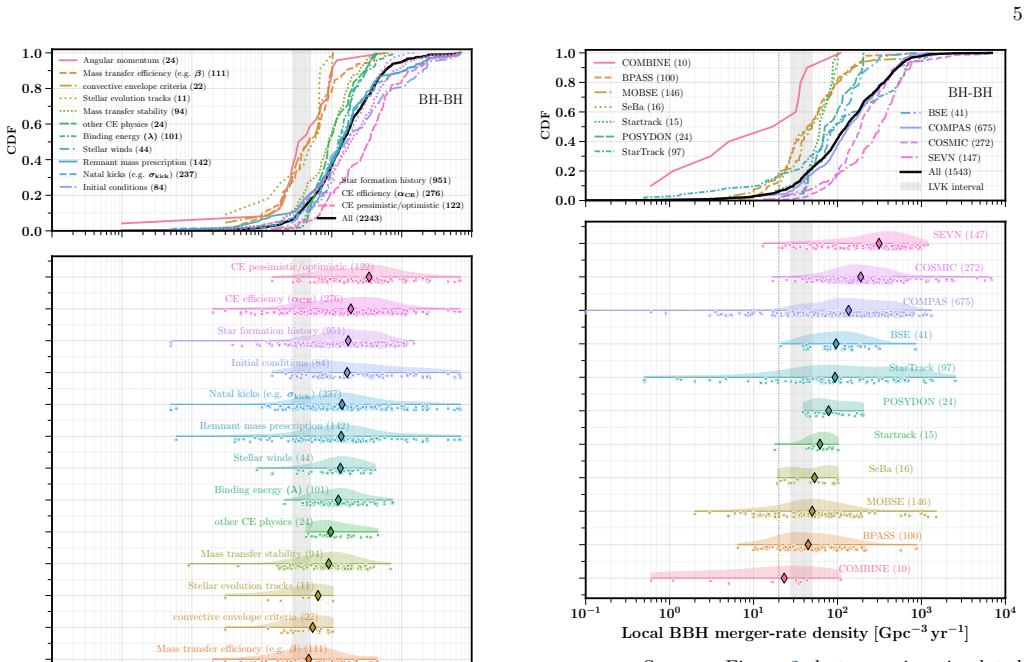
By assembling 1490 BBH merger rates from 57 studies and constructing 2543 pairwise submodel variations that isolate single physical assumptions, the work finds that approximately 80 percent of compiled submodels exceed the GWTC-5 rate interval while a substantial subset matches or underestimates it. Low rates are not uniquely produced by strong natal kicks or reduced low-metallicity star formation; multiple independent choices can each bring simulated rates into agreement with observations. Rates further cluster into simulation silos in which apparent consensus inside one code does not extend to others. Claims of a universal BBH merger-rate crisis are therefore strongly model dependent.
What carries the argument
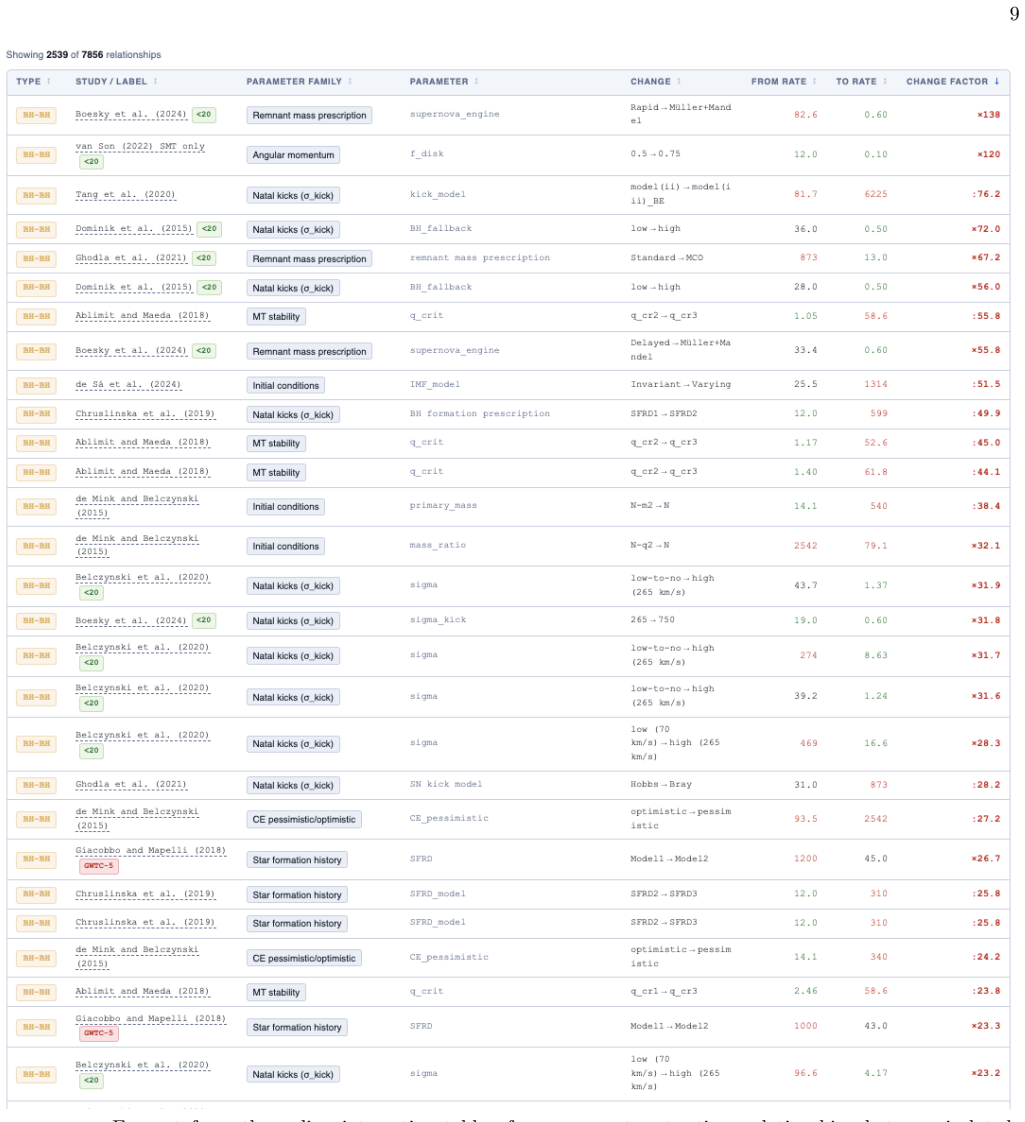
Compilation of 1490 simulated BBH merger rates from 57 studies together with 2543 pairwise submodel variations that isolate the effect of individual physical assumptions.
If this is right
- Low BBH merger rates can arise from several physically motivated assumptions without requiring strong natal kicks or reduced low-metallicity star formation.
- Simulated rates form simulation silos that produce apparent consensus inside one framework but do not generalize across codes.
- Concluding that isolated binary evolution is in tension with gravitational-wave data requires exploring the full parameter space across multiple population-synthesis frameworks.
Where Pith is reading between the lines
- Standardizing output quantities and variation sets across codes would make it easier to separate robust predictions from code-specific behavior.
- Rate constraints from current gravitational-wave catalogs alone may not yet be sufficient to rule out the isolated channel once model diversity is taken into account.
- Similar compilations for other compact-object merger channels could test whether model dependence is equally strong elsewhere.
Load-bearing premise
The 57 studies and 1490 submodels form a representative sample of isolated binary evolution models in the current literature.
What would settle it
A new compilation that includes every published isolated binary evolution code, applies the same set of isolated physical variations, and finds that every resulting rate still exceeds the GWTC-5 interval.
Figures


read the original abstract
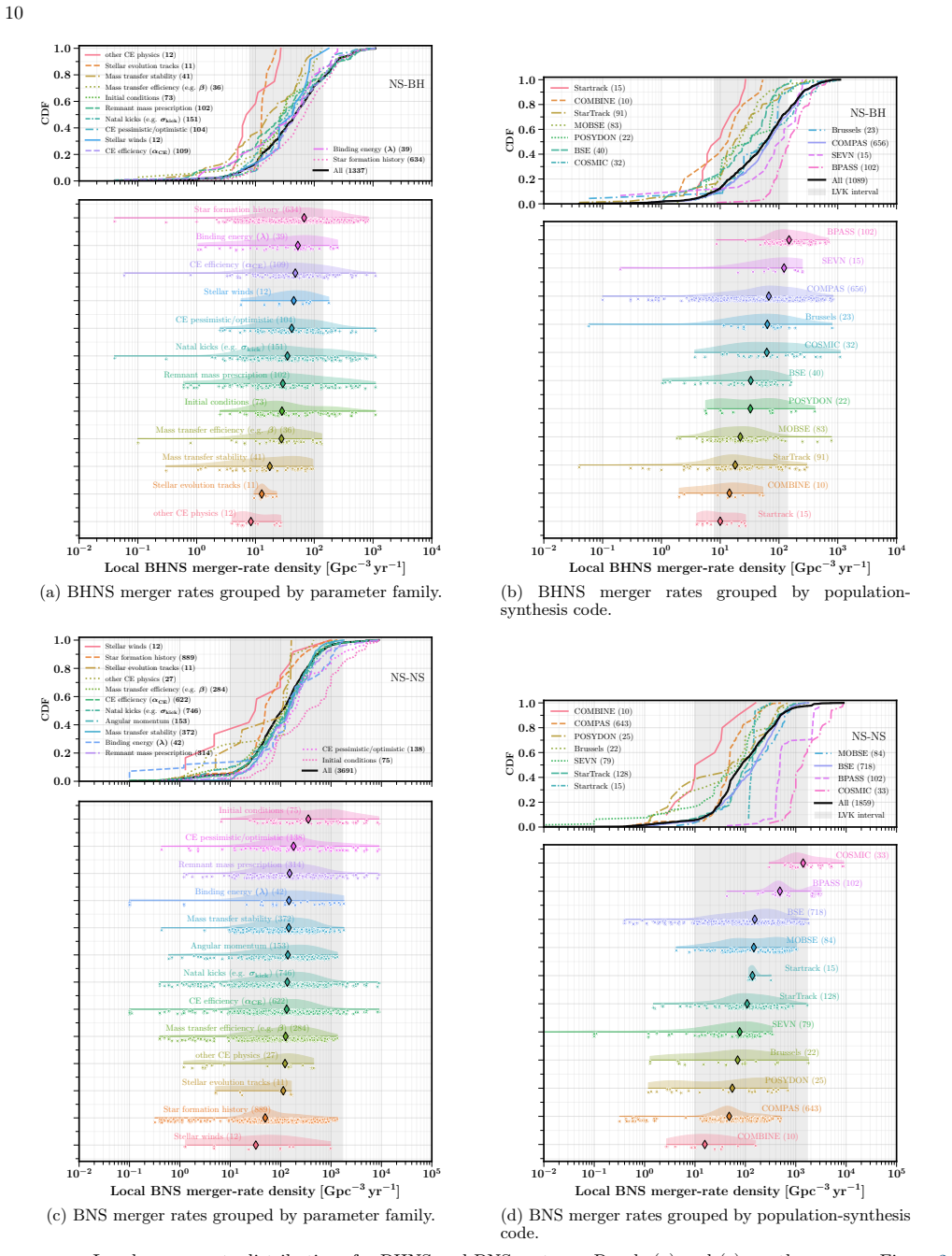
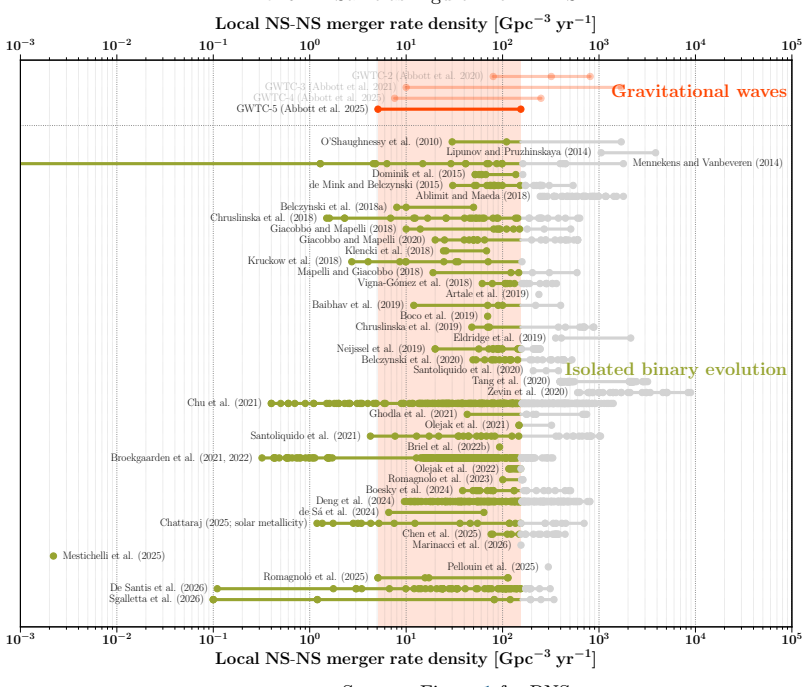
Recent studies have argued that isolated binary evolution simulations generically overestimate the observed local binary black hole (BBH) merger rate, even after adopting observationally motivated variations in the metallicity-dependent cosmic star-formation history, and have interpreted this as motivation for drastic revisions to binary stellar evolution models. We revisit these claims using a compilation of 1490 simulated BBH merger rates from 57 isolated binary-evolution studies, compared to constraints from the LIGO--Virgo--KAGRA Collaboration through GWTC-5. While $\sim$80% of compiled submodels find rates above the GWTC-5 interval, a substantial subset reproduces or underestimates the observed rate. The literature spans several orders of magnitude, reflecting strong sensitivity to assumptions about natal kicks, common-envelope evolution, mass transfer, angular-momentum loss, remnant formation, stellar winds, initial conditions, and star-formation history. Using 2543 pairwise BBH submodel variations constructed to isolate single physical assumptions, we identify which choices most strongly impact the simulated BBH merger rate. Low BBH merger rates are not uniquely associated with strong natal kicks or reduced low-metallicity star formation. Multiple physically motivated assumptions can independently reduce simulated rates to values consistent with observations. We further show that simulated rates cluster into `simulation silos': frameworks producing apparent consensus within a code that does not generalize beyond it. Our results indicate that claims of a universal BBH merger-rate crisis are strongly model dependent, and underscore the importance of exploring the full parameter space across multiple population-synthesis frameworks before concluding that isolated binary evolution is in tension with gravitational-wave observations.
Editorial analysis
A structured set of objections, weighed in public.
Referee Report
Summary. The manuscript compiles 1490 simulated BBH merger rates drawn from 57 isolated binary-evolution studies and compares them against GWTC-5 constraints. While ~80% of submodels exceed the observed local rate interval, a substantial subset match or fall below it. The authors construct 2543 pairwise submodel variations intended to isolate the effect of single physical assumptions (natal kicks, common-envelope efficiency, mass transfer, etc.) and conclude that multiple independent mechanisms can bring rates into agreement with observations; they further report that rates cluster into code-specific 'simulation silos.' The central claim is that assertions of a universal BBH merger-rate crisis are strongly model-dependent.
Significance. If the pairwise isolation is robust, the work supplies a quantitative meta-analysis showing that isolated binary evolution can reproduce GWTC-5 rates under a range of physically motivated choices, thereby weakening claims of generic tension and motivating broader exploration across population-synthesis frameworks. The identification of impactful parameters and the silo phenomenon are useful for guiding future model comparisons.
major comments (1)
- [Pairwise submodel variations (analysis of 2543 pairs)] The load-bearing step is the construction of the 2543 pairwise variations 'to isolate single physical assumptions.' Because these pairs are drawn across 57 distinct codes, residual differences in numerical schemes, wind implementations, or remnant-mass mappings could systematically correlate with the labeled parameter and confound attribution. The manuscript must demonstrate (via explicit selection criteria or cross-code sensitivity tests) that the observed rate shifts are attributable to the intended single assumption rather than code-specific details.
minor comments (1)
- [Abstract] The abstract introduces the term 'simulation silos' without a concise definition; a parenthetical gloss would improve immediate clarity for readers.
Simulated Author's Rebuttal
We thank the referee for their constructive review and for identifying the need for greater clarity on our pairwise analysis. We address the major comment below.
read point-by-point responses
-
Referee: [Pairwise submodel variations (analysis of 2543 pairs)] The load-bearing step is the construction of the 2543 pairwise variations 'to isolate single physical assumptions.' Because these pairs are drawn across 57 distinct codes, residual differences in numerical schemes, wind implementations, or remnant-mass mappings could systematically correlate with the labeled parameter and confound attribution. The manuscript must demonstrate (via explicit selection criteria or cross-code sensitivity tests) that the observed rate shifts are attributable to the intended single assumption rather than code-specific details.
Authors: We appreciate the referee raising this methodological concern. Each of the 2543 pairs was drawn from within a single study and the same simulation code/framework, with the original authors varying only one targeted physical assumption (e.g., natal kick dispersion or common-envelope efficiency) while keeping all other parameters, numerical schemes, wind prescriptions, and remnant-mass mappings fixed. This intra-code construction ensures that code-specific details are identical within each pair, so rate differences can be attributed to the labeled assumption. Pairs were included only when the source paper provided explicit documentation that the variation was isolated. To make this transparent, we will add a new subsection (Section 3.2) in the revised manuscript that states the explicit selection criteria, lists the papers contributing pairs, and provides representative examples of how isolation was verified for each parameter category. revision: yes
Circularity Check
No significant circularity: compilation against external GWTC-5 benchmark
full rationale
The paper is a literature compilation of 1490 rates drawn from 57 external studies, directly compared to independent LIGO-Virgo-KAGRA GWTC-5 constraints. The 2543 pairwise variations are constructed from those published submodels to attribute rate changes; the central claim (that low rates are not uniquely tied to specific assumptions and that crisis claims are model-dependent) rests on this external comparison rather than any internal fit, self-definition, or self-citation chain that reduces the result to the paper's own inputs. No equations or derivations are present that force the output by construction from the inputs.
Axiom & Free-Parameter Ledger
axioms (2)
- domain assumption The GWTC-5 local merger rate interval is an accurate external constraint on the true BBH merger rate.
- domain assumption The 57 studies and their submodels constitute a fair sample of isolated binary evolution frameworks.
Reference graph
Works this paper leans on
-
[1]
IPython: A System for Interactive Scientific Computing. Computing in Science and Engineering , year = "2007", month = "Jan", volume =. doi:10.1109/MCSE.2007.53 , adsurl =
-
[2]
How Common Are Common Envelopes? Quantifying Their Role in Forming Gravitational-Wave Sources
How Common Are Common Envelopes? Quantifying Their Role in Forming Gravitational-Wave Sources. arXiv e-prints , keywords =. doi:10.48550/arXiv.2606.05322 , archivePrefix =. 2606.05322 , primaryClass =
work page internal anchor Pith review Pith/arXiv arXiv doi:10.48550/arxiv.2606.05322
-
[3]
and Haberland, Matt and Reddy, Tyler and Cournapeau, David and Burovski, Evgeni and Peterson, Pearu and Weckesser, Warren and Bright, Jonathan and
Virtanen, Pauli and Gommers, Ralf and Oliphant, Travis E. and Haberland, Matt and Reddy, Tyler and Cournapeau, David and Burovski, Evgeni and Peterson, Pearu and Weckesser, Warren and Bright, Jonathan and. Nature Methods , year =
-
[4]
Observation of Gravitational Waves from Two Neutron Star-Black Hole Coalescences. , keywords =. doi:10.3847/2041-8213/ac082e , archivePrefix =. 2106.15163 , primaryClass =
-
[5]
Monte Carlo Population Synthesis on Massive Star Binaries: Astrophysical Implications for Gravitational-wave Sources. , keywords =. doi:10.3847/1538-4357/aae378 , archivePrefix =. 1710.05504 , primaryClass =
work page internal anchor Pith review Pith/arXiv arXiv doi:10.3847/1538-4357/aae378
-
[6]
Isolated or Dynamical? Tracing Black Hole Binary Formation through the Population of Gravitational-Wave Sources. arXiv e-prints , keywords =. doi:10.48550/arXiv.2603.20430 , archivePrefix =. 2603.20430 , primaryClass =
-
[7]
Host galaxies of merging compact objects: mass, star formation rate, metallicity and colours
Host galaxies of merging compact objects: mass, star formation rate, metallicity, and colours. , keywords =. doi:10.1093/mnras/stz1382 , archivePrefix =. 1903.00083 , primaryClass =
work page internal anchor Pith review Pith/arXiv arXiv doi:10.1093/mnras/stz1382 1903
-
[8]
Astropy: A Community Python Package for Astronomy
doi:10.1051/0004-6361/201322068 , Eid =. arXiv , Author =:1307.6212 , Journal =
work page internal anchor Pith review Pith/arXiv arXiv doi:10.1051/0004-6361/201322068
-
[9]
The Astropy Project: Building an inclusive, open-science project and status of the v2.0 core package
The Astropy Project: Building an Open-science Project and Status of the v2.0 Core Package. , keywords =. doi:10.3847/1538-3881/aabc4f , archivePrefix =. 1801.02634 , primaryClass =
work page internal anchor Pith review Pith/arXiv arXiv doi:10.3847/1538-3881/aabc4f
-
[10]
The Astropy Project: Sustaining and Growing a Community-oriented Open-source Project and the Latest Major Release (v5.0) of the Core Package. , keywords =. doi:10.3847/1538-4357/ac7c74 , archivePrefix =. 2206.14220 , primaryClass =
work page internal anchor Pith review Pith/arXiv arXiv doi:10.3847/1538-4357/ac7c74
-
[11]
doi:10.5281/zenodo.17756022 , url =
Astropy Collaboration , title =. doi:10.5281/zenodo.17756022 , url =
-
[12]
Gravitational-wave detection rates for compact binaries formed in isolation: LIGO / Virgo O3 and beyond. , keywords =. doi:10.1103/PhysRevD.100.064060 , archivePrefix =. 1906.04197 , primaryClass =
-
[13]
The impact of mass-transfer physics on the observable properties of field binary black hole populations. , keywords =. doi:10.1051/0004-6361/202039804 , archivePrefix =. 2010.16333 , primaryClass =
-
[14]
The origin of the first neutron star -- neutron star merger
The origin of the first neutron star - neutron star merger. , keywords =. doi:10.1051/0004-6361/201732428 , archivePrefix =. 1712.00632 , primaryClass =
work page internal anchor Pith review Pith/arXiv arXiv doi:10.1051/0004-6361/201732428
-
[15]
Evolutionary roads leading to low effective spins, high black hole masses, and O1/O2 rates for LIGO / Virgo binary black holes. , keywords =. doi:10.1051/0004-6361/201936528 , archivePrefix =. 1706.07053 , primaryClass =
-
[16]
Merging Rates of Compact Binaries in Galaxies: Perspectives for Gravitational Wave Detections. , keywords =. doi:10.3847/1538-4357/ab328e , archivePrefix =. 1907.06841 , primaryClass =
-
[17]
Can current models predict the local black hole merger rate?
Can current models predict the local black hole merger rate?. arXiv e-prints , keywords =. doi:10.48550/arXiv.2606.02725 , archivePrefix =. 2606.02725 , primaryClass =
work page internal anchor Pith review Pith/arXiv arXiv doi:10.48550/arxiv.2606.02725
-
[18]
The Binary Black Hole Merger Rate Deviates From the Cosmic Star Formation Rate: A Tug of War Between Metallicity and Delay Times. arXiv e-prints , keywords =. doi:10.48550/arXiv.2405.01623 , archivePrefix =. 2405.01623 , primaryClass =
-
[19]
Investigating the Cosmological Rate of Compact Object Mergers from Isolated Massive Binary Stars. arXiv e-prints , keywords =. doi:10.48550/arXiv.2405.01630 , archivePrefix =. 2405.01630 , primaryClass =
-
[20]
New insights on binary black hole formation channels after GWTC-2: young star clusters versus isolated binaries. , keywords =. doi:10.1093/mnras/stab2438 , archivePrefix =. 2102.12495 , primaryClass =
-
[21]
Population Synthesis of Gravitational Wave Sources. arXiv e-prints , keywords =. doi:10.48550/arXiv.2502.03523 , archivePrefix =. 2502.03523 , primaryClass =
-
[22]
Understanding the high-mass binary black hole population from stable mass transfer and super-Eddington accretion in BPASS. , keywords =. doi:10.1093/mnras/stad399 , archivePrefix =. 2206.13842 , primaryClass =
-
[23]
Impact of massive binary star and cosmic evolution on gravitational wave observations I: black hole-neutron star mergers. , keywords =. doi:10.1093/mnras/stab2716 , archivePrefix =. 2103.02608 , primaryClass =
-
[24]
arXiv e-prints , keywords =
Signatures of mass ratio reversal in gravitational waves from merging binary black holes. arXiv e-prints , keywords =
-
[25]
doi:10.5281/zenodo.20936612 , url =
Broekgaarden, Floor , title =. doi:10.5281/zenodo.20936612 , url =
-
[26]
Forming Double Neutron Stars Using Detailed Binary Evolution Models with POSYDON: Comparison to the Galactic Systems. , keywords =. doi:10.3847/1538-4357/ae1f93 , archivePrefix =. 2508.00186 , primaryClass =
work page internal anchor Pith review Pith/arXiv arXiv doi:10.3847/1538-4357/ae1f93
-
[27]
Constraining common envelope evolution in binary neutron star formation with combined galactic and gravitational-wave observations. , keywords =. doi:10.1093/mnrasl/slaf105 , archivePrefix =. 2508.14397 , primaryClass =
-
[28]
Double neutron stars: merger rates revisited
Double neutron stars: merger rates revisited. , keywords =. doi:10.1093/mnras/stx2923 , archivePrefix =. 1708.07885 , primaryClass =
work page internal anchor Pith review Pith/arXiv arXiv doi:10.1093/mnras/stx2923
-
[29]
, archivePrefix = "arXiv", eprint =
The influence of the distribution of cosmic star formation at different metallicities on the properties of merging double compact objects. , archivePrefix = "arXiv", eprint =. doi:10.1093/mnras/sty3087 , adsurl =
-
[30]
Formation and Evolution of Binary Neutron Stars: Mergers and Their Host Galaxies. , keywords =. doi:10.1093/mnras/stab2882 , archivePrefix =. 2110.04687 , primaryClass =
-
[31]
Merger Rates of Double Neutron Stars and Stellar Origin Black Holes: The Impact of Initial Conditions on Binary Evolution Predictions. , keywords =. 2015. doi:10.1088/0004-637X/814/1/58 , archivePrefix =. 1506.03573 , primaryClass =
work page internal anchor Pith review Pith/arXiv arXiv doi:10.1088/0004-637x/814/1/58 2015
-
[32]
On the Formation of Double Neutron Stars in the Milky Way: Influence of Key Parameters. , keywords =. doi:10.3847/1538-4357/ad2357 , archivePrefix =. 2402.04658 , primaryClass =
-
[33]
Compact object merger rates and masses over redshift from varying initial conditions
Compact object populations over cosmic time II. Compact object merger rates and masses over redshift from varying initial conditions. arXiv e-prints , keywords =. doi:10.48550/arXiv.2410.01451 , archivePrefix =. 2410.01451 , primaryClass =
-
[34]
Constraining Binary Neutron Star Populations using Short Gamma-Ray Burst Observations. arXiv e-prints , keywords =. doi:10.48550/arXiv.2602.13391 , archivePrefix =. 2602.13391 , primaryClass =
-
[35]
, archivePrefix = "arXiv", eprint =
Double Compact Objects III: Gravitational-wave Detection Rates. , archivePrefix = "arXiv", eprint =. doi:10.1088/0004-637X/806/2/263 , adsurl =
-
[36]
Importance of stable mass transfer and stellar winds for the formation of gravitational wave sources. , keywords =. doi:10.1093/mnras/stae152 , archivePrefix =. 2207.08837 , primaryClass =
-
[37]
A consistent estimate for Gravitational Wave and Electromagnetic transient rates
A consistent estimate for gravitational wave and electromagnetic transient rates. , keywords =. doi:10.1093/mnras/sty2714 , archivePrefix =. 1807.07659 , primaryClass =
work page internal anchor Pith review Pith/arXiv arXiv doi:10.1093/mnras/sty2714
-
[38]
arXiv e-prints , keywords =
Forward Modelling the LIGO /VIRGO O3a GW transient mass distributions with BPASS. arXiv e-prints , keywords =
-
[39]
The progenitors of compact-object binaries: impact of metallicity, common envelope and natal kicks
The progenitors of compact-object binaries: impact of metallicity, common envelope and natal kicks. , keywords =. 2018. doi:10.1093/mnras/sty1999 , archivePrefix =. 1806.00001 , primaryClass =
work page internal anchor Pith review Pith/arXiv arXiv doi:10.1093/mnras/sty1999 2018
-
[40]
Revising Natal Kick Prescriptions in Population Synthesis Simulations. , keywords =. doi:10.3847/1538-4357/ab7335 , archivePrefix =. 1909.06385 , primaryClass =
-
[41]
GWTC-4.0: Population Properties of Merging Compact Binaries
GWTC-4.0: Population Properties of Merging Compact Binaries. arXiv e-prints , keywords =. doi:10.48550/arXiv.2508.18083 , archivePrefix =. 2508.18083 , primaryClass =
work page internal anchor Pith review Pith/arXiv arXiv doi:10.48550/arxiv.2508.18083
-
[42]
arXiv e-prints , keywords =
GWTC-5.0: Observations from the Second Part of the Fourth LIGO-Virgo-KAGRA Observing Run and Updates to the Gravitational-Wave Transient Catalog. arXiv e-prints , keywords =
-
[43]
arXiv e-prints , keywords =
GWTC-5.0: Population Properties of Merging Compact Binaries. arXiv e-prints , keywords =
-
[44]
GWTC-2: Compact Binary Coalescences Observed by LIGO and Virgo during the First Half of the Third Observing Run. Physical Review X , keywords =. doi:10.1103/PhysRevX.11.021053 , archivePrefix =. 2010.14527 , primaryClass =
work page internal anchor Pith review Pith/arXiv arXiv doi:10.1103/physrevx.11.021053 2010
-
[45]
GWTC-3: Compact Binary Coalescences Observed by LIGO and Virgo during the Second Part of the Third Observing Run. Physical Review X , keywords =. doi:10.1103/PhysRevX.13.041039 , archivePrefix =. 2111.03606 , primaryClass =
work page internal anchor Pith review Pith/arXiv arXiv doi:10.1103/physrevx.13.041039
-
[46]
Pulsational pair-instability supernovae in gravitational-wave and electromagnetic transients. , keywords =. doi:10.1093/mnras/stad2857 , archivePrefix =. 2309.09339 , primaryClass =
-
[47]
A statistical study of 233 pulsar proper motions. , eprint =. doi:10.1111/j.1365-2966.2005.09087.x , adsurl =
-
[48]
Hunter, J. D. , title =. Computing in Science & Engineering , volume =
-
[49]
Impact of inter-correlated initial binary parameters on double black hole and neutron star mergers
Impact of inter-correlated initial binary parameters on double black hole and neutron star mergers. , keywords =. 2018. doi:10.1051/0004-6361/201833025 , archivePrefix =. 1808.07889 , primaryClass =
work page internal anchor Pith review Pith/arXiv arXiv doi:10.1051/0004-6361/201833025 2018
-
[50]
, author=
Jupyter Notebooks-a publishing format for reproducible computational workflows. , author=. ELPUB , pages=
-
[51]
Progenitors of gravitational wave mergers: Binary evolution with the stellar grid-based code ComBinE
Progenitors of gravitational wave mergers: binary evolution with the stellar grid-based code COMBINE. , keywords =. doi:10.1093/mnras/sty2190 , archivePrefix =. 1801.05433 , primaryClass =
work page internal anchor Pith review Pith/arXiv arXiv doi:10.1093/mnras/sty2190
-
[52]
When and where did GW150914 form?
When and where did GW150914 form?. , keywords =. doi:10.1093/mnrasl/slw152 , archivePrefix =. 1605.08783 , primaryClass =
work page internal anchor Pith review Pith/arXiv arXiv doi:10.1093/mnrasl/slw152
-
[53]
From cosmological simulations to binary black hole mergers: The impact of using analytical star formation history models on gravitational-wave source populations. arXiv e-prints , keywords =. doi:10.48550/arXiv.2601.20202 , archivePrefix =. 2601.20202 , primaryClass =
-
[54]
Explanation of the mass distribution of binary black hole mergers. , keywords =. doi:10.1103/drq9-dpy4 , archivePrefix =. 2510.08231 , primaryClass =
-
[55]
, archivePrefix = "arXiv", eprint =
The first gravitational-wave burst GW150914, as predicted by the scenario machine. , archivePrefix = "arXiv", eprint =. doi:10.1016/j.newast.2016.08.017 , adsurl =
-
[56]
Scenario Machine: fast radio bursts, short gamma-ray burst, dark energy and Laser Interferometer Gravitational-wave Observatory silence. , keywords =. doi:10.1093/mnras/stu313 , archivePrefix =. 1312.3143 , primaryClass =
work page internal anchor Pith review Pith/arXiv arXiv doi:10.1093/mnras/stu313
-
[57]
Living Reviews in Relativity , keywords =
Rates of compact object coalescences. Living Reviews in Relativity , keywords =. doi:10.1007/s41114-021-00034-3 , archivePrefix =. 2107.14239 , primaryClass =
-
[58]
The cosmic merger rate of stellar black hole binaries from the Illustris simulation
The cosmic merger rate of stellar black hole binaries from the Illustris simulation. , keywords =. doi:10.1093/mnras/stx2123 , archivePrefix =. 1708.05722 , primaryClass =
work page internal anchor Pith review Pith/arXiv arXiv doi:10.1093/mnras/stx2123
-
[59]
Impact of the Rotation and Compactness of Progenitors on the Mass of Black Holes. , keywords =. doi:10.3847/1538-4357/ab584d , archivePrefix =. 1909.01371 , primaryClass =
-
[60]
The cosmic merger rate of neutron stars and black holes
The cosmic merger rate of neutron stars and black holes. , keywords =. doi:10.1093/mnras/sty1613 , archivePrefix =. 1806.04866 , primaryClass =
work page internal anchor Pith review Pith/arXiv arXiv doi:10.1093/mnras/sty1613
-
[61]
Modeling gravitational wave sources in the MillenniumTNG simulations. , keywords =. doi:10.1051/0004-6361/202557575 , archivePrefix =. 2510.06311 , primaryClass =
-
[62]
, archivePrefix = "arXiv", eprint =
Massive double compact object mergers: gravitational wave sources and r-process element production sites. , archivePrefix = "arXiv", eprint =. doi:10.1051/0004-6361/201322198 , adsurl =
-
[63]
Black hole─neutron star and binary neutron star mergers from Population III and II stars. , keywords =. doi:10.1051/0004-6361/202555951 , archivePrefix =. 2506.13870 , primaryClass =
-
[64]
J., Vigna-G´ omez, A., Stevenson, S., et al
The effect of the metallicity-specific star formation history on double compact object mergers. , keywords =. 2019. doi:10.1093/mnras/stz2840 , archivePrefix =. 1906.08136 , primaryClass =
-
[65]
Chris Colbert and Gael Varoquaux , title =
Stefan Van der Walt and S. Chris Colbert and Gael Varoquaux , title =. Computing in Science & Engineering , volume =. 2011 , doi =
2011
-
[66]
Impact of common envelope development criteria on the formation of LIGO / Virgo sources. , keywords =. doi:10.1051/0004-6361/202140520 , archivePrefix =. 2102.05649 , primaryClass =
-
[67]
arXiv e-prints , keywords =
The role of supernova convection for the lower mass gap and the isolated binary formation of gravitational wave sources. arXiv e-prints , keywords =
-
[68]
, archivePrefix = "arXiv", eprint =
Binary Compact Object Coalescence Rates: The Role of Elliptical Galaxies. , archivePrefix = "arXiv", eprint =. doi:10.1088/0004-637X/716/1/615 , adsurl =
-
[69]
Evolutionary tracks of binary neutron star progenitors across cosmic times. , keywords =. doi:10.1051/0004-6361/202450422 , archivePrefix =. 2411.04563 , primaryClass =
-
[70]
, title =
Plotly Technologies Inc. , title =. 2015 , url =
2015
-
[71]
doi:10.5281/zenodo.14366349 , url =
Plotly , title =. doi:10.5281/zenodo.14366349 , url =
-
[72]
2024 , howpublished =
2024
-
[73]
, title =
Van Rossum, Guido and Drake, Fred L. , title =. 2009 , isbn =
2009
-
[74]
A trifecta of modelling tools: a Bayesian binary black hole model selection combining population synthesis and galaxy formation models. , keywords =. doi:10.1093/mnras/stae2288 , archivePrefix =. 2406.11885 , primaryClass =
-
[75]
Chemically homogeneous evolution: a rapid population synthesis approach. , keywords =. doi:10.1093/mnras/stab1291 , archivePrefix =. 2010.00002 , primaryClass =
-
[76]
URL https://automeris
Webplotdigitizer: Version 4.5 , author=. URL https://automeris. io/WebPlotDigitizer , volume=
-
[77]
The role of stellar expansion on the formation of gravitational wave sources. , keywords =. doi:10.1093/mnras/stad2366 , archivePrefix =. 2211.15800 , primaryClass =
-
[78]
Development of convective envelopes in massive stars: Implications for gravitational wave sources. , keywords =. doi:10.1051/0004-6361/202452169 , archivePrefix =. 2410.17315 , primaryClass =
-
[79]
The Role of Core-collapse Physics in the Observability of Black Hole Neutron Star Mergers as Multimessenger Sources. , keywords =. doi:10.3847/2041-8213/abf42c , archivePrefix =. 2012.02274 , primaryClass =
-
[80]
The Cosmic Merger Rate Density Evolution of Compact Binaries Formed in Young Star Clusters and in Isolated Binaries. , keywords =. doi:10.3847/1538-4357/ab9b78 , archivePrefix =. 2004.09533 , primaryClass =
discussion (0)
Sign in with ORCID, Apple, or X to comment. Anyone can read and Pith papers without signing in.