Efficient Eccentric Effective-One-Body Dynamics via Near-Identity Averaging Transformations
Pith reviewed 2026-06-30 04:38 UTC · model grok-4.3
The pith
Recasting eccentric EOB dynamics in osculating elements and applying near-identity averaging reduces inspiral cost by up to two orders of magnitude.
A machine-rendered reading of the paper's core claim, the machinery that carries it, and where it could break.
Core claim
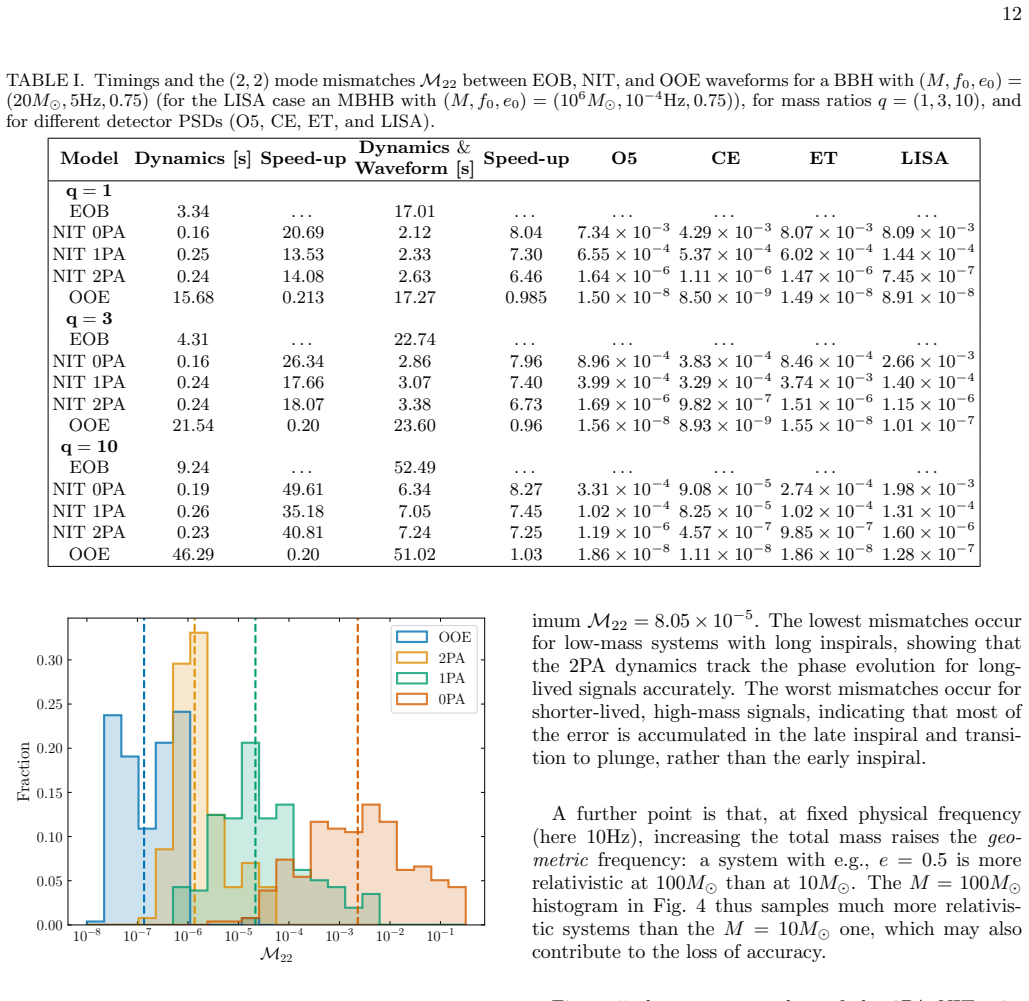
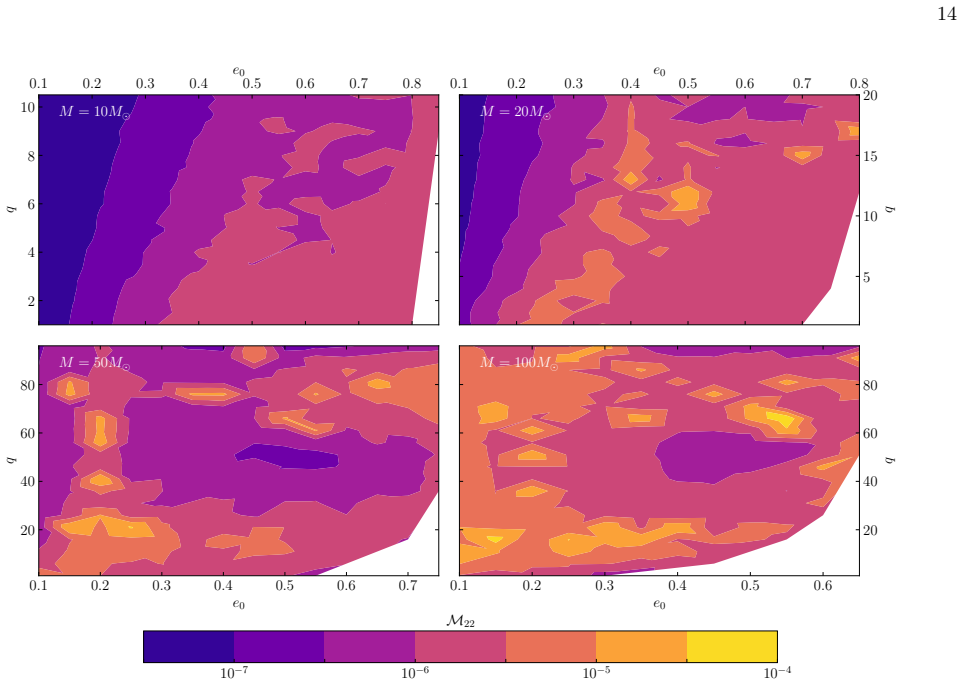
The authors demonstrate that recasting the nonspinning eccentric EOB equations of motion in terms of osculating orbital elements and applying near-identity averaging transformations eliminates the fast orbital-timescale structure during the inspiral. The averaged dynamics are evolved on the radiation-reaction timescale and then mapped back to the full EOB dynamics for the final transition to plunge. This procedure reduces the computational cost of the inspiral by up to two orders of magnitude and yields waveforms with mismatches no larger than 8.05 times 10 to the minus 5 across a broad parameter space when carried to next-to-next-to-leading order for comparable-mass binaries.
What carries the argument
near-identity averaging transformations applied to the nonspinning eccentric EOB equations after recasting them in osculating orbital elements
If this is right
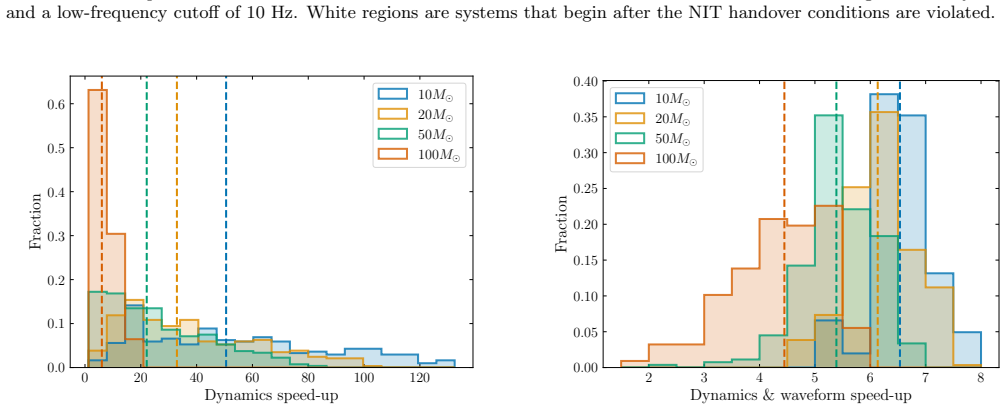
- The inspiral dynamics cost drops by up to two orders of magnitude, removing it as the main bottleneck for long eccentric waveforms.
- Overall waveform generation speeds up by factors between 1.5 and 8.
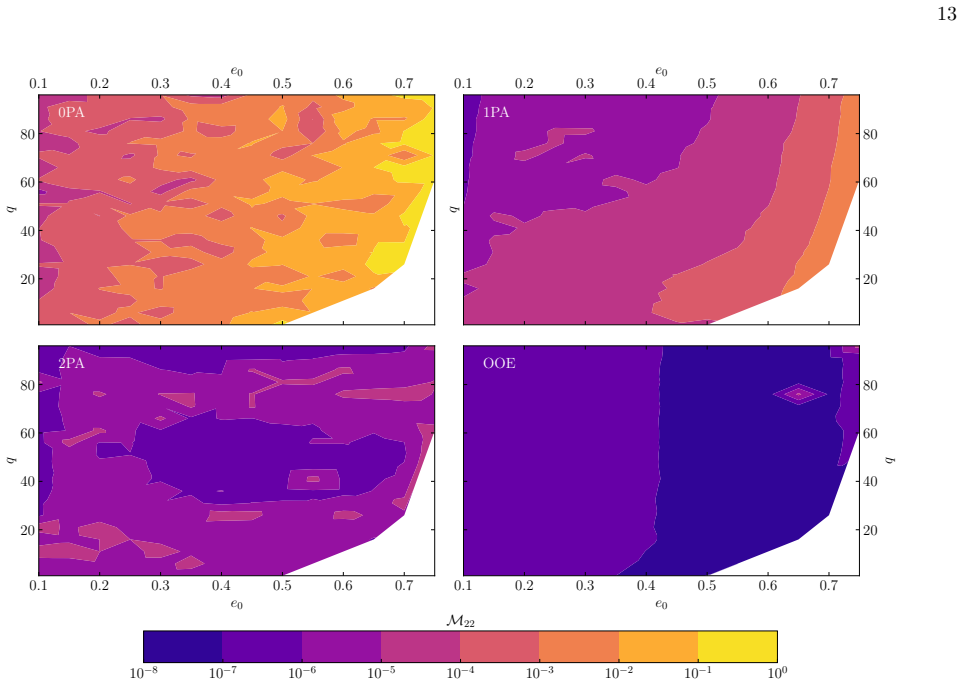
- Next-to-next-to-leading-order averaging is required to reach mismatches of 8.05 times 10 to the minus 5 or better for comparable-mass binaries.
- The method supplies a foundation for extensions to spinning and low-eccentricity models.
Where Pith is reading between the lines
- The same separation-of-timescales approach could be tested on other orbital problems where fast oscillations sit on top of slow secular drift.
- Efficiency gains of this size make it practical to generate large banks of eccentric templates for parameter estimation in future detectors.
- Mapping the averaged solution back to the full dynamics at plunge may be adaptable to hybrid models that switch between different descriptions of the late inspiral.
Load-bearing premise
That recasting the equations in osculating orbital elements and carrying the near-identity averaging to next-to-next-to-leading order preserves the secular evolution and plunge accuracy without introducing unaccounted errors that would spoil the reported mismatches.
What would settle it
A direct mismatch calculation between waveforms from the averaged and full dynamics for a comparable-mass binary at moderate eccentricity that exceeds 8.05 times 10 to the minus 5 would show the averaging order or mapping step is insufficient.
Figures




read the original abstract
Next-generation gravitational-wave detectors, such as LISA, the Einstein Telescope, and Cosmic Explorer, will require accurate and efficient models of long-lived black-hole binary signals, including those with significant eccentricity. A challenge for eccentric effective-one-body models is the cost of resolving rapidly oscillating orbital dynamics over the inspiral, particularly for low mass and large mass-ratio systems. We address this by recasting the nonspinning eccentric effective-one-body equations of motion in terms of osculating orbital elements and then applying near-identity averaging transformations to eliminate the fast orbital-timescale structure during the inspiral. Each order in this procedure suppresses the oscillatory behavior by one factor of the ratio of orbital to radiation-reaction timescales. The resulting averaged dynamics are evolved on the radiation-reaction timescale and then the system is mapped back to the full EOB dynamics for the final transition to plunge. This reduces the cost of the inspiral dynamics by up to two orders of magnitude, eliminating this as the primary bottleneck for long waveforms. The overall waveform-generation speed-up spans $1.5 - 8 \times$, motivating the development of more efficient waveform generation methods. We also validate the accuracy of the method by comparing waveforms generated from the averaged and full effective-one-body dynamics across a broad region of parameter space for moderate to large eccentricities. Carrying out this averaging procedure to next-to-next-to-leading-order is needed to accurately model comparable-mass binaries, yielding mismatches $\leq 8.05 \times 10^{-5}$. These results establish near-identity averaging as a practical route to efficient eccentric effective-one-body inspirals, and provide a foundation for further extensions to low-eccentricity and spinning waveform models.
Editorial analysis
A structured set of objections, weighed in public.
Referee Report
Summary. The manuscript presents a method to accelerate eccentric nonspinning EOB inspirals by recasting the equations of motion in osculating orbital elements, applying near-identity averaging transformations through NNLO to suppress fast orbital oscillations, evolving the slow variables on the radiation-reaction timescale, and switching back to the full EOB dynamics at a transition radius for plunge. It claims this reduces inspiral cost by up to two orders of magnitude (overall waveform speed-up 1.5–8×) while achieving mismatches ≤ 8.05 × 10^{-5} for comparable-mass binaries when NNLO is used, with validation across moderate-to-large eccentricities.
Significance. If the accuracy claims hold, the approach would remove the inspiral as the dominant computational bottleneck for long eccentric waveforms required by LISA, Einstein Telescope, and Cosmic Explorer. The systematic use of near-identity transformations (parameter-free by construction) offers a clean route to averaged dynamics that could extend to spinning and low-eccentricity cases.
major comments (2)
- [Abstract] Abstract: the headline claim that NNLO averaging is required to reach mismatches ≤ 8.05 × 10^{-5} for comparable-mass systems is load-bearing, yet the abstract supplies no details on the sampled parameter space, error bars, data-selection criteria, or comparison baselines, preventing assessment of whether truncation errors in the dissipative sector accumulate to produce secular phase drifts over long inspirals.
- [Abstract] Abstract (method outline): the sequence of recasting in osculating elements, NNLO near-identity averaging, radiation-reaction evolution, and mapping back at a transition radius is central to preserving secular evolution and plunge accuracy, but the abstract does not exhibit the explicit transformation rules or the matching condition at the switch point; without these, it is unclear whether the radiation-reaction force (which depends on instantaneous elements) introduces unaccounted residual oscillations or discontinuities in the constants of motion.
minor comments (1)
- [Abstract] The abstract states validation 'across a broad region of parameter space' but does not quantify the eccentricity or mass-ratio ranges tested.
Simulated Author's Rebuttal
We thank the referee for their positive evaluation of the work's significance and for the detailed comments on the abstract. We address each major comment below and will revise the abstract in the resubmitted manuscript to incorporate additional context while preserving its conciseness.
read point-by-point responses
-
Referee: [Abstract] Abstract: the headline claim that NNLO averaging is required to reach mismatches ≤ 8.05 × 10^{-5} for comparable-mass systems is load-bearing, yet the abstract supplies no details on the sampled parameter space, error bars, data-selection criteria, or comparison baselines, preventing assessment of whether truncation errors in the dissipative sector accumulate to produce secular phase drifts over long inspirals.
Authors: The abstract is a high-level summary; the full validation—including the sampled parameter space (mass ratios 1 ≤ q ≤ 100, eccentricities 0.05 ≤ e ≤ 0.9), mismatch computations against the unaveraged EOB dynamics, and explicit demonstration that lower-order averaging produces secular phase drifts—is presented in Sections 5 and 6 with error bars and selection criteria. We agree the abstract would benefit from a brief qualifier and will revise it to state that NNLO is required specifically for comparable-mass systems (q ∼ 1) to keep mismatches below the reported threshold, with full details in the body. This directly addresses the concern about dissipative truncation errors. revision: yes
-
Referee: [Abstract] Abstract (method outline): the sequence of recasting in osculating elements, NNLO near-identity averaging, radiation-reaction evolution, and mapping back at a transition radius is central to preserving secular evolution and plunge accuracy, but the abstract does not exhibit the explicit transformation rules or the matching condition at the switch point; without these, it is unclear whether the radiation-reaction force (which depends on instantaneous elements) introduces unaccounted residual oscillations or discontinuities in the constants of motion.
Authors: The abstract outlines the overall procedure at the level appropriate for its length; the explicit near-identity transformation rules (constructed order-by-order to eliminate fast oscillations) and the continuity conditions at the transition radius are derived and stated in Sections 3–4. The radiation-reaction force is evaluated on the averaged elements during the inspiral and the mapping is constructed to ensure continuity of the constants of motion, with no residual oscillations introduced (as confirmed by the mismatch results). We will add one clarifying clause to the abstract noting that the switch preserves secular evolution and constants of motion, but the explicit algebraic rules are too lengthy for the abstract itself. revision: partial
Circularity Check
No significant circularity; derivation applies independent averaging to existing EOB equations with direct validation
full rationale
The paper recasts the nonspinning eccentric EOB equations in osculating orbital elements, applies near-identity averaging transformations order-by-order to suppress fast oscillations, evolves the slow variables, and maps back for plunge. Accuracy is established by direct numerical waveform comparison between the averaged and full EOB dynamics across parameter space, producing the stated mismatches. No step reduces by construction to a fitted input, self-defined quantity, or self-citation chain; the transformation is a standard perturbative procedure applied to an externally defined EOB model, and the validation is falsifiable against the unaveraged reference.
Axiom & Free-Parameter Ledger
axioms (2)
- domain assumption Nonspinning eccentric EOB equations of motion can be recast in terms of osculating orbital elements
- domain assumption Near-identity averaging transformations exist and can be applied order-by-order to suppress fast orbital structure by factors of the orbital-to-radiation-reaction timescale ratio
Reference graph
Works this paper leans on
-
[1]
B. P. Abbottet al.(LIGO Scientific, Virgo), Obser- vation of Gravitational Waves from a Binary Black Hole Merger, Phys. Rev. Lett.116, 061102 (2016), arXiv:1602.03837 [gr-qc]
work page internal anchor Pith review Pith/arXiv arXiv 2016
-
[2]
B. P. Abbottet al.(LIGO Scientific, Virgo), GWTC- 1: A Gravitational-Wave Transient Catalog of Compact Binary Mergers Observed by LIGO and Virgo during the First and Second Observing Runs, Phys. Rev. X9, 031040 (2019), arXiv:1811.12907 [astro-ph.HE]
work page internal anchor Pith review Pith/arXiv arXiv 2019
-
[3]
R. Abbottet al.(LIGO Scientific, Virgo), GWTC-2: Compact Binary Coalescences Observed by LIGO and Virgo During the First Half of the Third Observing Run, Phys. Rev. X11, 021053 (2021), arXiv:2010.14527 [gr- qc]
work page internal anchor Pith review Pith/arXiv arXiv 2021
-
[5]
R. Abbottet al.(KAGRA, VIRGO, LIGO Scientific), GWTC-3: Compact Binary Coalescences Observed by LIGO and Virgo during the Second Part of the Third Observing Run, Phys. Rev. X13, 041039 (2023), arXiv:2111.03606 [gr-qc]
work page internal anchor Pith review Pith/arXiv arXiv 2023
-
[6]
A. G. Abacet al.(LIGO Scientific, VIRGO, KAGRA), GWTC-4.0: Updating the Gravitational-Wave Tran- sient Catalog with Observations from the First Part of the Fourth LIGO-Virgo-KAGRA Observing Run, arXiv preprint arXiv:2508.18082 (2025), arXiv:2508.18082 [gr-qc]
work page internal anchor Pith review Pith/arXiv arXiv 2025
-
[7]
GWTC-5.0: Observations from the Second Part of the Fourth LIGO-Virgo-KAGRA Observing Run and Updates to the Gravitational-Wave Transient Catalog, arXiv preprint arXiv:2605.27225 (2026), arXiv:2605.27225 [gr-qc]
work page internal anchor Pith review Pith/arXiv arXiv 2026
-
[8]
The Science of the Einstein Telescope
A. Abacet al.(ET), The Science of the Einstein Telescope, arXiv preprint arXiv:2503.12263 (2025), arXiv:2503.12263 [gr-qc]
work page internal anchor Pith review Pith/arXiv arXiv 2025
-
[9]
Cosmic Explorer: The U.S. Contribution to Gravitational-Wave Astronomy beyond LIGO
D. Reitzeet al., Cosmic Explorer: The U.S. Contribu- tion to Gravitational-Wave Astronomy beyond LIGO, Bull. Am. Astron. Soc.51, 035 (2019), arXiv:1907.04833 [astro-ph.IM]
work page internal anchor Pith review Pith/arXiv arXiv 2019
-
[10]
M. Colpiet al.(LISA), LISA Definition Study Report, arXiv preprint arXiv:2402.07571 (2024), arXiv:2402.07571 [astro-ph.CO]
work page internal anchor Pith review Pith/arXiv arXiv 2024
-
[11]
Waveform Modelling for the Laser Interferometer Space Antenna
N. Afshordiet al.(LISA Consortium Waveform Work- ing Group), Waveform modelling for the Laser Interfer- ometer Space Antenna, Living Rev. Rel.28, 9 (2025), arXiv:2311.01300 [gr-qc]
work page internal anchor Pith review Pith/arXiv arXiv 2025
-
[12]
J. Meiet al., The TianQin project: Cur- rent progress on science and technology, Progress of Theoretical and Experimental Physics2021, 10.1093/ptep/ptaa114 (2020), 05A107, https://academic.oup.com/ptep/article- pdf/2021/5/05A107/37953035/ptaa114.pdf
-
[13]
Z. Luo, Z. Guo, G. Jin, Y. Wu, and W. Hu, A brief anal- ysis to taiji: Science and technology, Results in Physics 16, 102918 (2020)
2020
- [14]
-
[15]
A. Dhani, S. H. V¨ olkel, A. Buonanno, H. Estelles, 24 J. Gair, H. P. Pfeiffer, L. Pompili, and A. Toubiana, Systematic Biases in Estimating the Properties of Black Holes Due to Inaccurate Gravitational-Wave Models, Phys. Rev. X15, 031036 (2025), arXiv:2404.05811 [gr- qc]
-
[16]
V. Gayathri, J. Healy, J. Lange, B. O’Brien, M. Szczep- anczyk, I. Bartos, M. Campanelli, S. Klimenko, C. O. Lousto, and R. O’Shaughnessy, Eccentricity estimate for black hole mergers with numerical relativity simula- tions, Nature Astron.6, 344 (2022), arXiv:2009.05461 [astro-ph.HE]
- [17]
- [18]
- [19]
-
[20]
A. Ramos-Buades, A. Buonanno, and J. Gair, Bayesian inference of binary black holes with inspiral-merger- ringdown waveforms using two eccentric parameters, Phys. Rev. D108, 124063 (2023), arXiv:2309.15528 [gr- qc]
-
[21]
Evidence for eccentricity in the population of binary black holes observed by LIGO-Virgo-KAGRA
N. Gupteet al., Evidence for eccentricity in the population of binary black holes observed by LIGO- Virgo-KAGRA, Phys. Rev. D112, 104045 (2025), arXiv:2404.14286 [gr-qc]
work page internal anchor Pith review Pith/arXiv arXiv 2025
- [22]
-
[23]
M. d. L. Planas, A. Ramos-Buades, C. Garc´ ıa-Quir´ os, H. Estell´ es, S. Husa, and M. Haney, Eccentric or circu- lar? A reanalysis of binary black hole gravitational wave events for orbital eccentricity signatures, arXiv preprint arXiv:2504.15833 (2025), arXiv:2504.15833 [gr-qc]
- [24]
- [25]
-
[26]
Population Properties of Binary Black Holes with Eccentricity
M. Zeeshan, R. O’Shaughnessy, and N. Malagon, Pop- ulation Properties of Binary Black Holes with Ec- centricity, arXiv preprint arXiv:2602.11030 (2026), arXiv:2602.11030 [astro-ph.HE]
work page internal anchor Pith review Pith/arXiv arXiv 2026
-
[27]
P. C. Peters and J. Mathews, Gravitational radiation from point masses in a Keplerian orbit, Phys. Rev.131, 435 (1963)
1963
-
[28]
P. C. Peters, Gravitational Radiation and the Motion of Two Point Masses, Phys. Rev.136, B1224 (1964)
1964
-
[29]
Circularization and Final Spin in Eccentric Binary Black Hole Inspirals
I. Hinder, B. Vaishnav, F. Herrmann, D. Shoemaker, and P. Laguna, Universality and final spin in eccentric binary black hole inspirals, Phys. Rev. D77, 081502 (2008), arXiv:0710.5167 [gr-qc]
work page internal anchor Pith review Pith/arXiv arXiv 2008
-
[30]
Eccentric binary black-hole mergers: The transition from inspiral to plunge in general relativity
U. Sperhake, E. Berti, V. Cardoso, J. A. Gonzalez, B. Bruegmann, and M. Ansorg, Eccentric binary black- hole mergers: The Transition from inspiral to plunge in general relativity, Phys. Rev. D78, 064069 (2008), arXiv:0710.3823 [gr-qc]
work page internal anchor Pith review Pith/arXiv arXiv 2008
-
[31]
J. M. B. Downing, M. J. Benacquista, M. Giersz, and R. Spurzem, Compact binaries in star clusters - i. black hole binaries inside globular clusters: Black hole bina- ries in star clusters, Monthly Notices of the Royal As- tronomical Society407, 1946–1962 (2010)
1946
-
[32]
F. Antonini and H. B. Perets, Secular evolution of com- pact binaries near massive black holes: Gravitational wave sources and other exotica, Astrophys. J.757, 27 (2012), arXiv:1203.2938 [astro-ph.GA]
work page internal anchor Pith review Pith/arXiv arXiv 2012
-
[33]
R. M. O’Leary, B. Kocsis, and A. Loeb, Gravitational waves from scattering of stellar-mass black holes in galactic nuclei, Mon. Not. Roy. Astron. Soc.395, 2127 (2009), arXiv:0807.2638 [astro-ph]
work page internal anchor Pith review Pith/arXiv arXiv 2009
-
[34]
Greatly enhanced merger rates of compact-object binaries in non-spherical nuclear star clusters
C. Petrovich and F. Antonini, Greatly enhanced merger rates of compact-object binaries in non-spherical nu- clear star clusters, Astrophys. J.846, 146 (2017), arXiv:1705.05848 [astro-ph.HE]
work page internal anchor Pith review Pith/arXiv arXiv 2017
-
[35]
L. Gond´ an, B. Kocsis, P. Raffai, and Z. Frei, Eccen- tric Black Hole Gravitational-Wave Capture Sources in Galactic Nuclei: Distribution of Binary Parameters, Astrophys. J.860, 5 (2018), arXiv:1711.09989 [astro- ph.HE]
work page internal anchor Pith review Pith/arXiv arXiv 2018
-
[36]
Eccentricity distributions of eccentric binary black holes in galactic nuclei
J. Tak´ atsy, B. B´ ecsy, and P. Raffai, Eccentricity dis- tributions of eccentric binary black holes in galactic nuclei, Mon. Not. Roy. Astron. Soc.486, 570 (2019), arXiv:1812.04012 [astro-ph.HE]
work page internal anchor Pith review Pith/arXiv arXiv 2019
-
[37]
E. A. Huertaet al., Complete waveform model for com- pact binaries on eccentric orbits, Phys. Rev. D95, 024038 (2017), arXiv:1609.05933 [gr-qc]
work page internal anchor Pith review Pith/arXiv arXiv 2017
-
[38]
E. A. Huertaet al., Eccentric, nonspinning, inspi- ral, Gaussian-process merger approximant for the de- tection and characterization of eccentric binary black hole mergers, Phys. Rev. D97, 024031 (2018), arXiv:1711.06276 [gr-qc]
work page internal anchor Pith review Pith/arXiv arXiv 2018
-
[39]
I. Hinder, L. E. Kidder, and H. P. Pfeiffer, Eccentric bi- nary black hole inspiral-merger-ringdown gravitational waveform model from numerical relativity and post- Newtonian theory, Phys. Rev. D98, 044015 (2018), arXiv:1709.02007 [gr-qc]
work page internal anchor Pith review Pith/arXiv arXiv 2018
-
[40]
A. Chattaraj, T. RoyChowdhury, Divyajyoti, C. K. Mishra, and A. Gupta, High accuracy post-Newtonian and numerical relativity comparisons involving higher modes for eccentric binary black holes and a dominant mode eccentric inspiral-merger-ringdown model, Phys. Rev. D106, 124008 (2022), arXiv:2204.02377 [gr-qc]
- [41]
-
[42]
K. Paul, A. Maurya, Q. Henry, K. Sharma, P. Satheesh, Divyajyoti, P. Kumar, and C. K. Mishra, Eccentric, spinning, inspiral-merger-ringdown waveform model with higher modes for the detection and characteriza- tion of binary black holes, Phys. Rev. D111, 084074 (2025), arXiv:2409.13866 [gr-qc]
-
[43]
T. Islam, S. E. Field, S. A. Hughes, G. Khanna, V. Varma, M. Giesler, M. A. Scheel, L. E. Kidder, 25 and H. P. Pfeiffer, Surrogate model for gravitational wave signals from nonspinning, comparable-to large- mass-ratio black hole binaries built on black hole pertur- bation theory waveforms calibrated to numerical relativ- ity, Phys. Rev. D106, 104025 (2022...
- [44]
-
[45]
A. Maurya, P. Kumar, S. E. Field, C. K. Mishra, P. J. Nee, K. Paul, H. P. Pfeiffer, A. Ravichandran, and V. Varma, Chase Orbits, not Time: A Scalable Paradigm for Long-Duration Eccentric Gravitational- Wave Surrogates, arXiv preprint arXiv:2510.00116 (2025), arXiv:2510.00116 [gr-qc]
- [46]
- [47]
-
[48]
A. Ramos-Buades, Q. Henry, and M. Haney, Fast frequency-domain phenomenological modeling of eccen- tric aligned-spin binary black holes, arXiv preprint arXiv:2601.03340 (2026), arXiv:2601.03340 [gr-qc]
-
[49]
G. Morras, G. Pratten, P. Schmidt, and A. Buonanno, Post-Newtonian inspiral waveform model for eccentric precessing binaries with higher-order modes and mat- ter effects, arXiv preprint arXiv:2604.11903 (2026), arXiv:2604.11903 [gr-qc]
work page internal anchor Pith review Pith/arXiv arXiv 2026
-
[50]
T. Islamet al., Including higher-order modes in a quadrupolar eccentric numerical relativity surrogate using universal eccentric modulation functions, arXiv preprint arXiv:2604.17868 (2026), arXiv:2604.17868 [gr-qc]
work page internal anchor Pith review Pith/arXiv arXiv 2026
-
[51]
Effective one-body approach to general relativistic two-body dynamics
A. Buonanno and T. Damour, Effective one-body ap- proach to general relativistic two-body dynamics, Phys. Rev. D59, 084006 (1999), arXiv:gr-qc/9811091
work page internal anchor Pith review Pith/arXiv arXiv 1999
-
[52]
Transition from inspiral to plunge in binary black hole coalescences
A. Buonanno and T. Damour, Transition from inspiral to plunge in binary black hole coalescences, Phys. Rev. D62, 064015 (2000), arXiv:gr-qc/0001013
work page internal anchor Pith review Pith/arXiv arXiv 2000
- [53]
-
[54]
A. Buonanno, Y. Chen, and T. Damour, Transition from inspiral to plunge in precessing binaries of spinning black holes, Phys. Rev. D74, 104005 (2006), arXiv:gr- qc/0508067
-
[55]
An improved effective-one-body Hamiltonian for spinning black-hole binaries
E. Barausse and A. Buonanno, An Improved effective- one-body Hamiltonian for spinning black-hole binaries, Phys. Rev. D81, 084024 (2010), arXiv:0912.3517 [gr- qc]
work page internal anchor Pith review Pith/arXiv arXiv 2010
-
[56]
A. Nagar, Effective one body Hamiltonian of two spinning black-holes with next-to-next-to-leading or- der spin-orbit coupling, Phys. Rev. D84, 084028 (2011), [Erratum: Phys.Rev.D 88, 089901 (2013)], arXiv:1106.4349 [gr-qc]
work page internal anchor Pith review Pith/arXiv arXiv 2011
-
[57]
Gravitational radiation reaction along general orbits in the effective one-body formalism
D. Bini and T. Damour, Gravitational radiation re- action along general orbits in the effective one- body formalism, Phys. Rev. D86, 124012 (2012), arXiv:1210.2834 [gr-qc]
work page internal anchor Pith review Pith/arXiv arXiv 2012
-
[58]
S. Balmelli and P. Jetzer, Effective-one-body Hamilto- nian with next-to-leading order spin-spin coupling for two nonprecessing black holes with aligned spins, Phys. Rev. D87, 124036 (2013), [Erratum: Phys.Rev.D 90, 089905 (2014)], arXiv:1305.5674 [gr-qc]
work page internal anchor Pith review Pith/arXiv arXiv 2013
-
[59]
Fourth post-Newtonian effective one-body dynamics
T. Damour, P. Jaranowski, and G. Sch¨ afer, Fourth post- Newtonian effective one-body dynamics, Phys. Rev. D 91, 084024 (2015), arXiv:1502.07245 [gr-qc]
work page internal anchor Pith review Pith/arXiv arXiv 2015
- [60]
- [61]
- [62]
-
[63]
A. Antonelli, M. van de Meent, A. Buonanno, J. Stein- hoff, and J. Vines, Quasicircular inspirals and plunges from nonspinning effective-one-body Hamiltonians with gravitational self-force information, Phys. Rev. D101, 024024 (2020), arXiv:1907.11597 [gr-qc]
-
[64]
M. van de Meent, A. Buonanno, D. P. Mihaylov, S. Ossokine, L. Pompili, N. Warburton, A. Pound, B. Wardell, L. Durkan, and J. Miller, Enhancing the SEOBNRv5 effective-one-body waveform model with second-order gravitational self-force fluxes, Phys. Rev. D108, 124038 (2023), arXiv:2303.18026 [gr-qc]
-
[65]
B. Leather, A. Buonanno, and M. van de Meent, Inspiral-merger-ringdown waveforms with gravitational self-force results within the effective-one-body formal- ism, Phys. Rev. D112, 044012 (2025), arXiv:2505.11242 [gr-qc]
-
[66]
Gravitational scattering, post-Minkowskian approximation and Effective One-Body theory
T. Damour, Gravitational scattering, post-Minkowskian approximation and Effective One-Body theory, Phys. Rev. D94, 104015 (2016), arXiv:1609.00354 [gr-qc]
work page internal anchor Pith review Pith/arXiv arXiv 2016
-
[67]
Energetics of two-body Hamiltonians in post-Minkowskian gravity
A. Antonelli, A. Buonanno, J. Steinhoff, M. van de Meent, and J. Vines, Energetics of two-body Hamilto- nians in post-Minkowskian gravity, Phys. Rev. D99, 104004 (2019), arXiv:1901.07102 [gr-qc]
work page internal anchor Pith review Pith/arXiv arXiv 2019
- [68]
-
[69]
A. Buonanno, G. Mogull, R. Patil, and L. Pompili, Post- Minkowskian Theory Meets the Spinning Effective-One- Body Approach for Bound-Orbit Waveforms, Phys. Rev. Lett.133, 211402 (2024), arXiv:2405.19181 [gr- qc]
-
[70]
A. Buonanno, G. U. Jakobsen, and G. Mogull, Post- Minkowskian theory meets the spinning effective-one- body approach for two-body scattering, Phys. Rev. D 110, 044038 (2024), arXiv:2402.12342 [gr-qc]
- [71]
-
[72]
Y. Pan, A. Buonanno, L. T. Buchman, T. Chu, L. E. Kidder, H. P. Pfeiffer, and M. A. Scheel, Effective-one- body waveforms calibrated to numerical relativity simu- lations: coalescence of non-precessing, spinning, equal- mass black holes, Phys. Rev. D81, 084041 (2010), arXiv:0912.3466 [gr-qc]
work page internal anchor Pith review Pith/arXiv arXiv 2010
-
[73]
A. Buonanno, Y. Pan, H. P. Pfeiffer, M. A. Scheel, L. T. Buchman, and L. E. Kidder, Effective-one-body waveforms calibrated to numerical relativity simula- tions: Coalescence of non-spinning, equal-mass black holes, Phys. Rev. D79, 124028 (2009), arXiv:0902.0790 [gr-qc]
work page internal anchor Pith review Pith/arXiv arXiv 2009
-
[74]
A. Boh´ eet al., Improved effective-one-body model of spinning, nonprecessing binary black holes for the era of gravitational-wave astrophysics with advanced detec- tors, Phys. Rev. D95, 044028 (2017), arXiv:1611.03703 [gr-qc]
work page internal anchor Pith review Pith/arXiv arXiv 2017
-
[75]
A. Nagaret al., Time-domain effective-one-body gravi- tational waveforms for coalescing compact binaries with nonprecessing spins, tides and self-spin effects, Phys. Rev. D98, 104052 (2018), arXiv:1806.01772 [gr-qc]
work page internal anchor Pith review Pith/arXiv arXiv 2018
- [76]
- [77]
-
[78]
Prototype effective-one-body model for nonprecessing spinning inspiral-merger-ringdown waveforms
A. Taracchini, Y. Pan, A. Buonanno, E. Barausse, M. Boyle, T. Chu, G. Lovelace, H. P. Pfeiffer, and M. A. Scheel, Prototype effective-one-body model for nonprecessing spinning inspiral-merger-ringdown wave- forms, Phys. Rev. D86, 024011 (2012), arXiv:1202.0790 [gr-qc]
work page internal anchor Pith review Pith/arXiv arXiv 2012
-
[79]
Effective-one-body model for black-hole binaries with generic mass ratios and spins
A. Taracchiniet al., Effective-one-body model for black- hole binaries with generic mass ratios and spins, Phys. Rev. D89, 061502 (2014), arXiv:1311.2544 [gr-qc]
work page internal anchor Pith review Pith/arXiv arXiv 2014
-
[80]
M. P¨ urrer, Frequency domain reduced order model of aligned-spin effective-one-body waveforms with generic mass-ratios and spins, Phys. Rev. D93, 064041 (2016), arXiv:1512.02248 [gr-qc]
work page internal anchor Pith review Pith/arXiv arXiv 2016
-
[81]
S. Babak, A. Taracchini, and A. Buonanno, Validating the effective-one-body model of spinning, precessing bi- nary black holes against numerical relativity, Phys. Rev. D95, 024010 (2017), arXiv:1607.05661 [gr-qc]
work page internal anchor Pith review Pith/arXiv arXiv 2017
discussion (0)
Sign in with ORCID, Apple, or X to comment. Anyone can read and Pith papers without signing in.