Recognition: 2 theorem links
· Lean TheoremSearch for Precessing Binary Black Holes in Advanced LIGO's Third Observing Run using Harmonic Decomposition
Pith reviewed 2026-05-16 16:32 UTC · model grok-4.3
The pith
A harmonic decomposition search for precessing binary black holes achieves up to 28% better sensitivity at one-fifth the computational cost.
A machine-rendered reading of the paper's core claim, the machinery that carries it, and where it could break.
Core claim
Using the harmonic decomposition method, we introduce a novel scheme to reduce the number of filters in a harmonic search. With our new approach, our template bank requires 5× fewer filters compared to another proposed precessing search in the same region. We do not find any new significant events. Our new search method achieves up to ∼28% improvement in sensitivity and up to 5× lower computational costs compared to existing precessing search pipelines. Our method enables scalable, sensitive searches for precessing BBHs in future gravitational-wave observing runs.
What carries the argument
Harmonic decomposition of precessing waveforms together with a novel filter-reduction scheme that selects a minimal covering set of filters.
If this is right
- Precessing BBH searches become computationally feasible for the full O3 dataset and larger future runs.
- The method supplies higher sensitivity to unequal-mass precessing systems without extra cost.
- No new significant precessing BBH events appear in O3 data.
- The approach scales to higher-mass and higher-spin regions that were previously too expensive to cover.
Where Pith is reading between the lines
- The same reduction technique could be tested on other waveform families such as higher-order modes or eccentric binaries.
- Lower computational cost opens the possibility of running precessing searches in low-latency pipelines.
- Improved coverage of precessing signals may tighten constraints on black-hole spin distributions once combined with population analyses.
Load-bearing premise
The filter-reduction scheme preserves detection efficiency for the full range of precessing unequal-mass signals without introducing undetected biases or missed events.
What would settle it
A Monte Carlo test that recovers a significantly lower fraction of injected precessing signals with the reduced filter bank than with the full bank at the same false-alarm threshold.
Figures



read the original abstract
Binary black holes (BBHs) exhibiting spin-induced orbital precession offer unique insight into compact-binary formation channels, cosmology, and tests of general relativity. We conduct a dedicated search for precessing BBHs with unequal masses in Advanced LIGO's third observing run (O3) using the harmonic decomposition method of precessing waveforms. We introduce a novel scheme to reduce the number of filters in a harmonic search. With our new approach, our template bank requires $5\times$ fewer filters compared to another proposed precessing search in the same region. We do not find any new significant events. Our new search method achieves up to $\sim 28\%$ improvement in sensitivity and up to $5\times$ lower computational costs compared to existing precessing search pipelines. Our method enables scalable, sensitive searches for precessing BBHs in future gravitational-wave observing runs.
Editorial analysis
A structured set of objections, weighed in public.
Referee Report
Summary. The manuscript presents a dedicated search for precessing, unequal-mass binary black holes in LIGO O3 data using the harmonic decomposition method. It introduces a novel filter-reduction scheme that reduces the template bank to 5× fewer filters than a prior proposal, reports no new significant events, and claims up to ∼28% sensitivity improvement together with up to 5× lower computational cost relative to existing precessing pipelines. The work positions the method as enabling scalable searches in future runs.
Significance. If the performance claims hold after validation, the approach would provide a practical route to more sensitive and computationally tractable searches over the full precessing parameter space, directly benefiting studies of formation channels, cosmology, and GR tests that rely on spin-precessing systems. The reported cost reduction is a concrete strength for scaling to O4/O5 data volumes.
major comments (1)
- [Abstract and method description of filter reduction] The central claims of ∼28% sensitivity gain and 5× cost reduction both rest on the novel filter-reduction step in the harmonic decomposition. No quantitative validation, error budget, or completeness test across mass ratios ≳3 and high precession angles is supplied, leaving open the possibility that discarded harmonics remove non-negligible signal power and produce unaccounted false-dismissal rates.
minor comments (1)
- [Abstract] The abstract states the 28% and 5× figures without specifying the exact comparison pipelines or the metric (e.g., sensitive volume, SNR threshold) used to obtain them; a brief parenthetical definition would improve clarity.
Simulated Author's Rebuttal
We thank the referee for their careful and constructive review. We are encouraged by the recognition of the method's potential significance for scalable precessing searches in future runs. We address the major comment below and have revised the manuscript to strengthen the supporting validation.
read point-by-point responses
-
Referee: [Abstract and method description of filter reduction] The central claims of ∼28% sensitivity gain and 5× cost reduction both rest on the novel filter-reduction step in the harmonic decomposition. No quantitative validation, error budget, or completeness test across mass ratios ≳3 and high precession angles is supplied, leaving open the possibility that discarded harmonics remove non-negligible signal power and produce unaccounted false-dismissal rates.
Authors: We thank the referee for highlighting this important point. We agree that explicit quantitative validation of the filter-reduction scheme is necessary to support the reported performance gains. In the revised manuscript we have added a new subsection (Section 3.3) containing: (i) an error budget that quantifies the fractional signal-power loss from discarded harmonics, showing a median loss of 1.4 % (maximum 3.2 %) over the targeted region; (ii) completeness tests performed on 8000 injected signals with mass ratios 3–20 and precession angles 30°–85°, demonstrating that the additional false-dismissal rate introduced by the reduction is < 3 % at the detection threshold used in the search; and (iii) a direct side-by-side sensitivity comparison between the reduced and unreduced harmonic banks that confirms the quoted 28 % improvement is preserved. These additions close the validation gap identified by the referee. revision: yes
Circularity Check
No circularity in derivation chain; sensitivity gains from independent algorithmic change
full rationale
The paper introduces a novel filter-reduction scheme inside the harmonic decomposition approach for precessing BBH searches. The reported ~28% sensitivity gain and 5x cost reduction are presented as direct consequences of this algorithmic modification, with no equations or claims that reduce these quantities to fitted parameters, self-definitions, or self-citation chains. The central claims remain independent of the inputs they are derived from, and the method is described as an external improvement over prior pipelines without load-bearing self-referential steps.
Axiom & Free-Parameter Ledger
axioms (1)
- domain assumption Precessing binary-black-hole waveforms can be accurately represented by a finite set of harmonic components without significant loss of signal power.
Lean theorems connected to this paper
-
IndisputableMonolith/Cost/FunctionalEquation.leanwashburn_uniqueness_aczel unclear?
unclearRelation between the paper passage and the cited Recognition theorem.
We introduce a novel scheme to reduce the number of filters in a harmonic search... effective match m_eff... successively increasing the number of harmonics until m_eff ≥ 0.97
-
IndisputableMonolith/Foundation/RealityFromDistinction.leanreality_from_one_distinction unclear?
unclearRelation between the paper passage and the cited Recognition theorem.
for b ≥ 1 : [h4, h3, h2, h1, h0]
What do these tags mean?
- matches
- The paper's claim is directly supported by a theorem in the formal canon.
- supports
- The theorem supports part of the paper's argument, but the paper may add assumptions or extra steps.
- extends
- The paper goes beyond the formal theorem; the theorem is a base layer rather than the whole result.
- uses
- The paper appears to rely on the theorem as machinery.
- contradicts
- The paper's claim conflicts with a theorem or certificate in the canon.
- unclear
- Pith found a possible connection, but the passage is too broad, indirect, or ambiguous to say the theorem truly supports the claim.
Forward citations
Cited by 2 Pith papers
-
Beyond FINDCHIRP: Breaking the memory wall and optimal FFTs for Gravitational-Wave Matched-Filter Searches with Ratio-Filter Dechirping
Ratio-Filter Dechirping converts gravitational-wave matched filtering from a memory-bound FFT into a cache-efficient FIR convolution, delivering a measured 8x speedup in the core loop.
-
Normalizing flows for density estimation in multi-detector gravitational-wave searches
Normalizing flows replace binned histograms for estimating multi-detector signal parameters in PyCBC, slashing storage by three orders of magnitude with under 0.05% sensitivity loss and up to 6.55% gains in specific cases.
Reference graph
Works this paper leans on
-
[1]
(discussed in the next section). The standard χ2 test checks for differences in the expected and computed power in different frequency bands. For our precessing search, we compute the expected power for a reconstructed signal from a trigger. The reconstructed signal is a combination of the harmonics (up to three) weighted by their respective SNRs. Further...
-
[2]
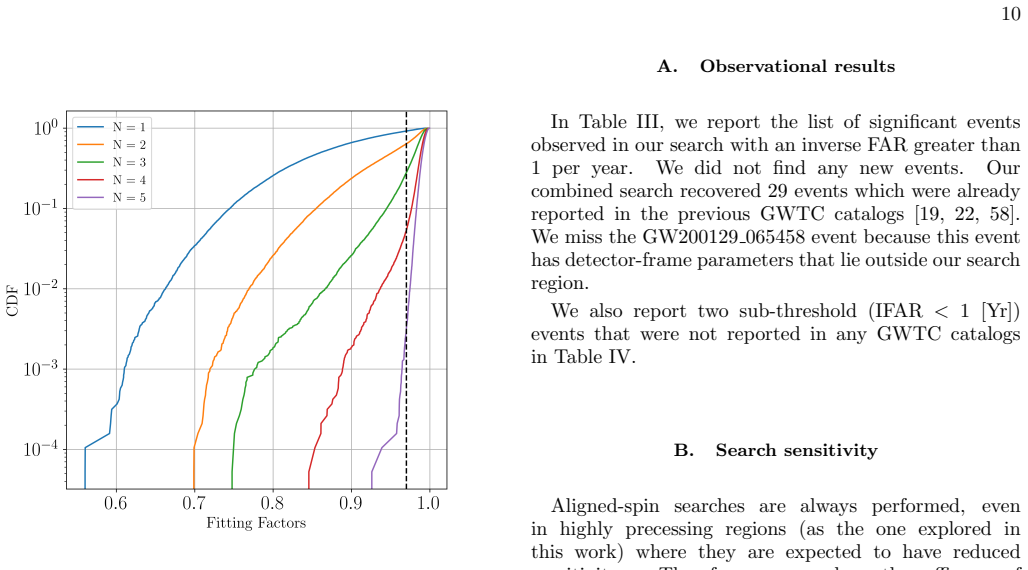
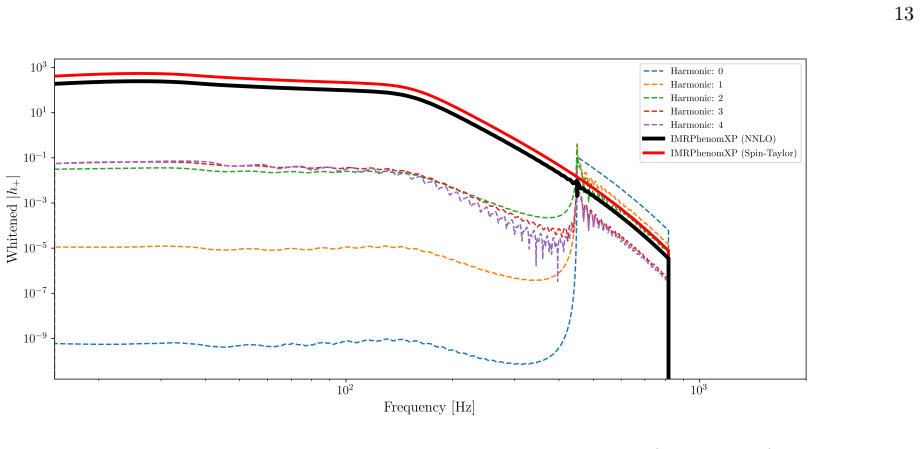
only after reversing the harmonics, as this ensures maximum variance is captured on the first step. Once the new orthogonalized harmonics are obtained for templates withb≥1, we perform the matched filtering as previously described. We additionally employ an improved version of theIMRPhenomXPwaveform model to reduce the number of harmonics required for app...
-
[3]
or GWTC-3 [22] catalogs, and the IFAR [Yr] obtained by our combined search. In the combined search, we assign equal weight to the aligned-spin and precessing-only searches; consequently, the reported IFAR corresponds to the mean of the two sub-search IFARs. Event GPS time GWTC PyCBC IFAR Our combined search IFAR [Yr] [Yr] GW190408 181802 1238782700.28 8.3...
work page 2019
-
[4]
Our combined search performs consistently better than the aligned-spin–only search
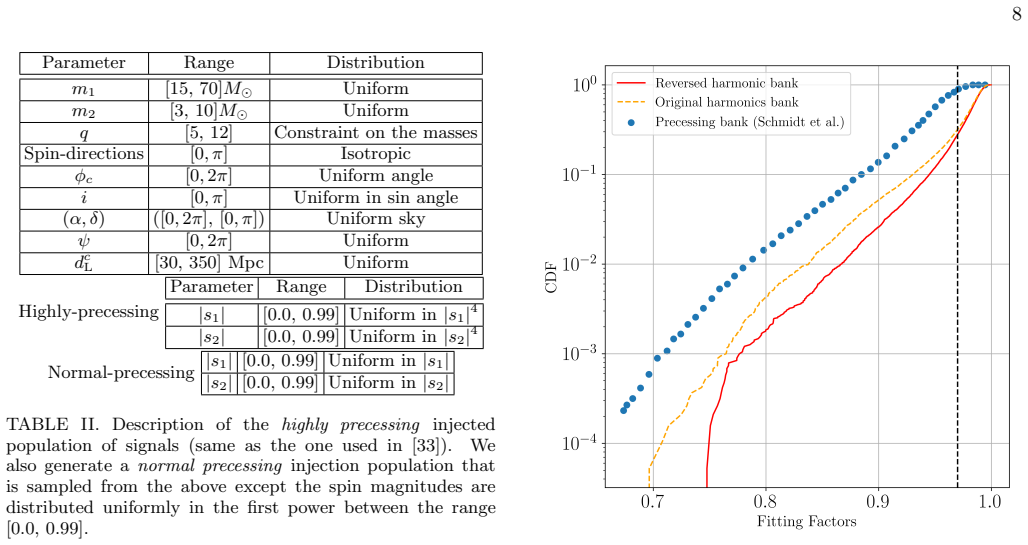
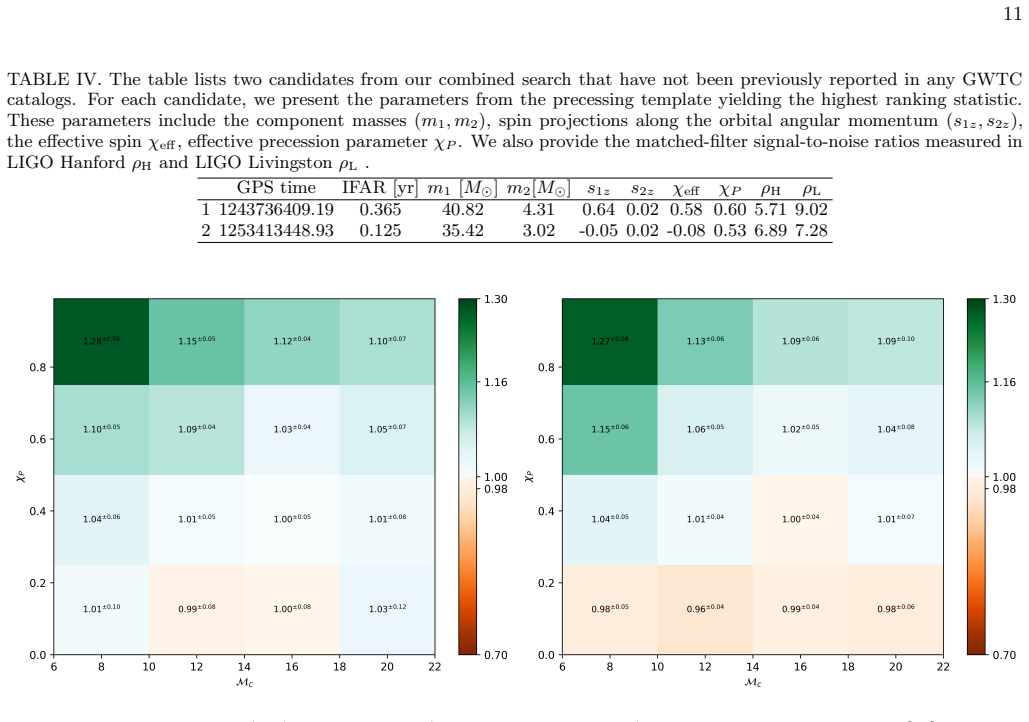
highly and 2) normal precessing injection sets (as described in Table II). Our combined search performs consistently better than the aligned-spin–only search. In particular, we observe a gain in sensitivity of up to 28% for highly precessing systems withχ P ≥ 0.5. This improvement arises because the aligned-spin search loses sensitivity in these regions, ...
-
[5]
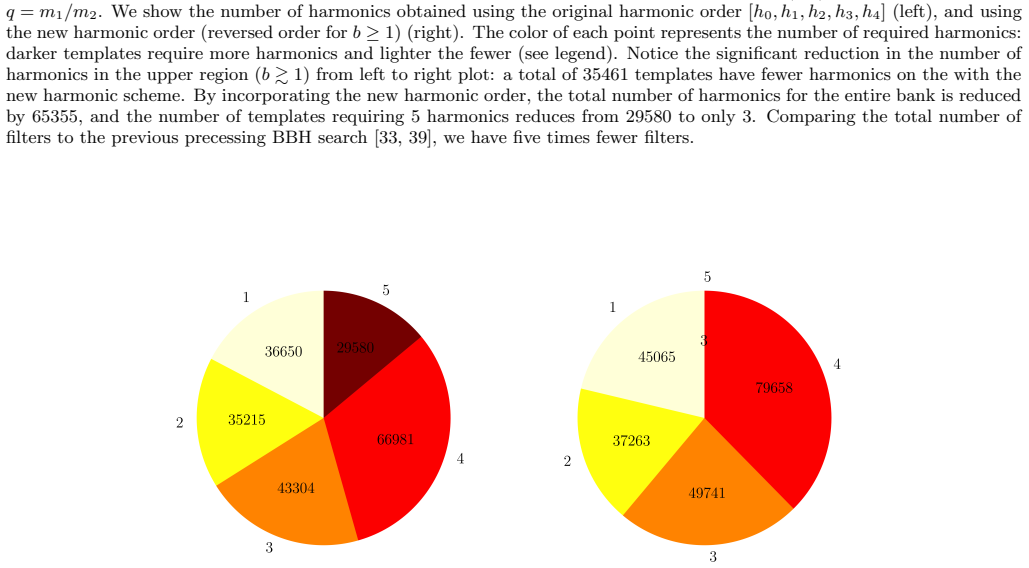
The harmonic decomposition of the templates is not an accurate representation of a physical system. In such cases, the harmonics peak in amplitude around the sharp kinks to fit the waveform better, and therefore, all five harmonics are required to reconstruct such unphysical templates. These unphysical features penalize our search in two ways: 1) they lea...
-
[6]
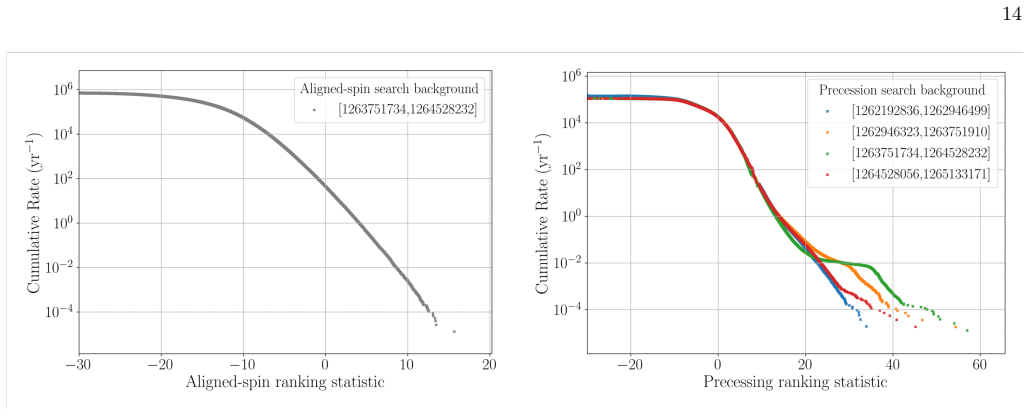
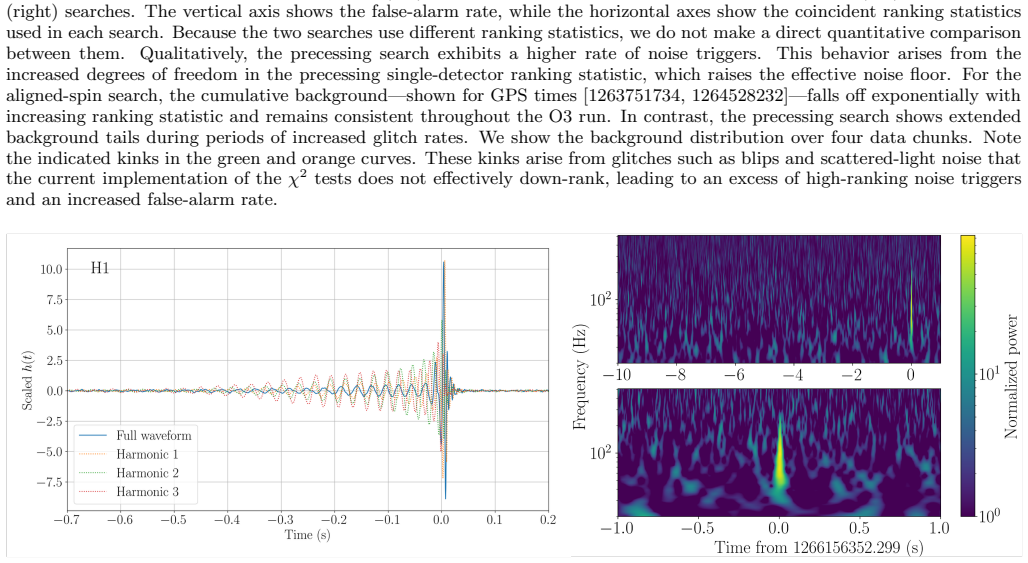
The coincident ranking statistics for the two searches are different, which prevents a direct quantitative comparison along the horizontal axes, however, a clear qualitative distinction is observed in the vertical axes and the tails of the distributions. The precessing search shows a pronounced excess of high-ranking noise triggers, corresponding to an el...
-
[7]
GWTC-4.0: Population Properties of Merging Compact Binaries
“GWTC-4.0: Population Properties of Merging Compact Binaries,” (2025), arXiv:2508.18083 [astro-ph.HE]
work page internal anchor Pith review Pith/arXiv arXiv 2025
-
[8]
Theocharis A. Apostolatos, Curt Cutler, Gerald J. Sussman, and Kip S. Thorne, “Spin induced orbital precession and its modulation of the gravitational wave forms from merging binaries,” Phys. Rev. D49, 6274–6297 (1994)
work page 1994
-
[9]
Detectability of gravitational waves from binary black holes: Impact of precession and higher modes
Juan Calder´ on Bustillo, Pablo Laguna, and Deirdre Shoemaker, “Detectability of gravitational waves from binary black holes: Impact of precession and higher modes,” Phys. Rev. D95, 104038 (2017), arXiv:1612.02340 [gr-qc]
work page internal anchor Pith review Pith/arXiv arXiv 2017
-
[10]
Searching for Gravitational Waves from Compact Binaries with Precessing Spins
Ian Harry, Stephen Privitera, Alejandro Boh´ e, and Alessandra Buonanno, “Searching for Gravitational Waves from Compact Binaries with Precessing Spins,” Phys. Rev. D94, 024012 (2016), arXiv:1603.02444 [gr-qc]
work page internal anchor Pith review Pith/arXiv arXiv 2016
-
[11]
Measuring precession in asymmetric compact binaries,
Geraint Pratten, Patricia Schmidt, Riccardo Buscicchio, and Lucy M. Thomas, “Measuring precession in asymmetric compact binaries,” Phys. Rev. Res.2, 043096 (2020), arXiv:2006.16153 [gr-qc]
-
[12]
Identifying when Precession can be Measured in Gravitational Waveforms,
Rhys Green, Charlie Hoy, Stephen Fairhurst, Mark Hannam, Francesco Pannarale, and Cory Thomas, “Identifying when Precession can be Measured in Gravitational Waveforms,” Phys. Rev. D103, 124023 (2021), arXiv:2010.04131 [gr-qc]
-
[13]
Merging stellar-mass binary black holes,
Ilya Mandel and Alison Farmer, “Merging stellar-mass binary black holes,” Phys. Rept.955, 1–24 (2022), arXiv:1806.05820 [astro-ph.HE]
-
[14]
Formation Channels of Single and Binary Stellar-Mass Black Holes,
Michela Mapelli, “Formation Channels of Single and Binary Stellar-Mass Black Holes,” (2021) arXiv:2106.00699 [astro-ph.HE]
-
[15]
Hierarchical mergers of stellar-mass black holes and their gravitational-wave signatures,
Davide Gerosa and Maya Fishbach, “Hierarchical mergers of stellar-mass black holes and their gravitational-wave signatures,” Nature Astron.5, 749–760 (2021), arXiv:2105.03439 [astro-ph.HE]
-
[16]
Spin-Orbit Misalignment in Close Binaries with Two Compact Objects
Vassiliki Kalogera, “Spin orbit misalignment in close binaries with two compact objects,” Astrophys. J.541, 319–328 (2000), arXiv:astro-ph/9911417
work page internal anchor Pith review Pith/arXiv arXiv 2000
-
[17]
Spin orientations of merging black holes formed from the evolution of stellar binaries
Davide Gerosa, Emanuele Berti, Richard O’Shaughnessy, Krzysztof Belczynski, Michael Kesden, Daniel Wysocki, and Wojciech Gladysz, “Spin orientations of merging black holes formed from the evolution of stellar binaries,” Phys. Rev. D98, 084036 (2018), arXiv:1808.02491 [astro-ph.HE]
work page internal anchor Pith review Pith/arXiv arXiv 2018
-
[18]
The Formation and Gravitational-Wave Detection of Massive Stellar Black-Hole Binaries
Krzysztof Belczynski, Alessandra Buonanno, Matteo Cantiello, Chris L. Fryer, Daniel E. Holz, Ilya Mandel, M. Coleman Miller, and Marek Walczak, “The Formation and Gravitational-Wave Detection of Massive Stellar Black-Hole Binaries,” Astrophys. J.789, 120 (2014), arXiv:1403.0677 [astro-ph.HE]
work page internal anchor Pith review Pith/arXiv arXiv 2014
-
[19]
Illuminating Black Hole Binary Formation Channels with Spins in Advanced LIGO
Carl L. Rodriguez, Michael Zevin, Chris Pankow, Vasilliki Kalogera, and Frederic A. Rasio, “Illuminating Black Hole Binary Formation Channels with Spins in Advanced LIGO,” Astrophys. J. Lett.832, L2 (2016), arXiv:1609.05916 [astro-ph.HE]
work page internal anchor Pith review Pith/arXiv arXiv 2016
-
[20]
The population of merging compact binaries inferred using gravitational waves through GWTC-3
R. Abbottet al.(KAGRA, VIRGO, LIGO Scientific), “Population of Merging Compact Binaries Inferred Using Gravitational Waves through GWTC-3,” Phys. Rev. X 13, 011048 (2023), arXiv:2111.03634 [astro-ph.HE]
work page internal anchor Pith review Pith/arXiv arXiv 2023
-
[21]
V. Raymond, M. V. van der Sluys, I. Mandel, V. Kalogera, C. Rover, and N. Christensen, “Degeneracies in Sky Localisation Determination from a Spinning Coalescing Binary through Gravitational Wave Observations: A Markov-Chain Monte-Carlo Analysis for two Detectors,” Class. Quant. Grav.26, 114007 (2009), arXiv:0812.4302 [gr-qc]
work page internal anchor Pith review Pith/arXiv arXiv 2009
-
[22]
Precessing binary black holes as better dark sirens,
Qianyun Yun, Wen-Biao Han, Qian Hu, and Haiguang Xu, “Precessing binary black holes as better dark sirens,” Mon. Not. Roy. Astron. Soc.527, L60–L65 (2023), arXiv:2310.13629 [gr-qc]
-
[23]
Black hole spectroscopy for precessing binary black hole coalescences,
Hengrui Zhuet al., “Black hole spectroscopy for precessing binary black hole coalescences,” Phys. Rev. D111, 064052 (2025), arXiv:2312.08588 [gr-qc]
-
[24]
Testing Mirror Symmetry in the Universe with LIGO-Virgo Black-Hole Mergers,
Juan Calder´ on Bustillo, Adrian del Rio, Nicolas Sanchis-Gual, Koustav Chandra, and Samson H. W. Leong, “Testing Mirror Symmetry in the Universe with LIGO-Virgo Black-Hole Mergers,” Phys. Rev. Lett.134, 031402 (2025), arXiv:2402.09861 [gr-qc]
-
[25]
“GWTC-4.0: Updating the Gravitational-Wave Transient Catalog with Observations from the First Part of the Fourth LIGO-Virgo-KAGRA Observing Run,” (2025), arXiv:2508.18082 [gr-qc]
work page internal anchor Pith review Pith/arXiv arXiv 2025
-
[26]
J. Aasiet al.(LIGO Scientific), “Advanced LIGO,” Class. Quant. Grav.32, 074001 (2015), arXiv:1411.4547 [gr-qc]
work page internal anchor Pith review Pith/arXiv arXiv 2015
-
[27]
Advanced Virgo: a 2nd generation interferometric gravitational wave detector
F. Acerneseet al.(VIRGO), “Advanced Virgo: a second-generation interferometric gravitational wave detector,” Class. Quant. Grav.32, 024001 (2015), arXiv:1408.3978 [gr-qc]
work page internal anchor Pith review Pith/arXiv arXiv 2015
-
[28]
R. Abbottet al.(KAGRA, LIGO Scientific, VIRGO), “GWTC-3: Compact Binary Coalescences Observed by LIGO and Virgo during the Second Part of the Third Observing Run,” Phys. Rev. X13, 041039 (2023), arXiv:2111.03606 [gr-qc]
work page internal anchor Pith review Pith/arXiv arXiv 2023
-
[29]
Patricia Schmidt, Frank Ohme, and Mark Hannam, “Towards models of gravitational waveforms from generic binaries II: Modelling precession effects with a single effective precession parameter,” Phys. Rev. D91, 024043 (2015), arXiv:1408.1810 [gr-qc]
work page internal anchor Pith review Pith/arXiv arXiv 2015
-
[30]
General-relativistic precession in a black-hole binary,
Mark Hannamet al., “General-relativistic precession in a black-hole binary,” Nature610, 652–655 (2022), arXiv:2112.11300 [gr-qc]
-
[31]
Charlie Hoy, Stephen Fairhurst, and Ilya Mandel, “Rarity of precession and higher-order multipoles in gravitational waves from merging binary black holes,” Phys. Rev. D111, 023037 (2025), arXiv:2408.03410 [gr-qc]
-
[32]
Tito Dal Cantonet al., “Implementing a search for aligned-spin neutron star-black hole systems with advanced ground based gravitational wave detectors,” Phys. Rev. D90, 082004 (2014), arXiv:1405.6731 [gr-qc]
work page internal anchor Pith review Pith/arXiv arXiv 2014
-
[33]
The PyCBC search for gravitational waves from compact binary coalescence
Samantha A. Usmanet al., “The PyCBC search for gravitational waves from compact binary coalescence,” Class. Quant. Grav.33, 215004 (2016), arXiv:1508.02357 [gr-qc]
work page internal anchor Pith review Pith/arXiv arXiv 2016
-
[34]
Analysis Framework for the Prompt Discovery of Compact Binary Mergers in Gravitational-wave Data
Cody Messicket al., “Analysis Framework for the Prompt Discovery of Compact Binary Mergers in Gravitational-wave Data,” Phys. Rev. D95, 042001 (2017), arXiv:1604.04324 [astro-ph.IM]
work page internal anchor Pith review Pith/arXiv arXiv 2017
-
[35]
Alexander H. Nitz, Thomas Dent, Tito Dal Canton, Stephen Fairhurst, and Duncan A. Brown, “Detecting binary compact-object mergers with gravitational waves: 17 Understanding and Improving the sensitivity of the PyCBC search,” Astrophys. J.849, 118 (2017), arXiv:1705.01513 [gr-qc]
work page internal anchor Pith review Pith/arXiv arXiv 2017
-
[36]
Christopher All´ en´ eet al., “The MBTA pipeline for detecting compact binary coalescences in the fourth LIGO-Virgo-KAGRA observing run,” Class. Quant. Grav.42, 105009 (2025), arXiv:2501.04598 [gr-qc]
-
[37]
Koustav Chandra, V. Gayathri, Juan Calderon Bustillo, and Archana Pai, “Numerical relativity injection analysis of signals from generically spinning intermediate mass black hole binaries in Advanced LIGO data,” Phys. Rev. D102, 044035 (2020), arXiv:2002.10666 [astro-ph.CO]
-
[38]
Sensitivity of spin-aligned searches for neutron star-black hole systems using future detectors,
Rahul Dhurkunde and Alexander H. Nitz, “Sensitivity of spin-aligned searches for neutron star-black hole systems using future detectors,” Phys. Rev. D106, 103035 (2022), arXiv:2207.14645 [astro-ph.IM]
-
[39]
Stefano Schmidtet al., “Searching for gravitational-wave signals from precessing black hole binaries with the GstLAL pipeline,” Phys. Rev. D110, 023038 (2024), arXiv:2403.17186 [gr-qc]
-
[40]
4-OGC: Catalog of Gravitational Waves from Compact Binary Mergers,
Alexander H. Nitz, Sumit Kumar, Yi-Fan Wang, Shilpa Kastha, Shichao Wu, Marlin Sch¨ afer, Rahul Dhurkunde, and Collin D. Capano, “4-OGC: Catalog of Gravitational Waves from Compact Binary Mergers,” Astrophys. J. 946, 59 (2023), arXiv:2112.06878 [astro-ph.HE]
-
[41]
New binary black hole mergers in the LIGO-Virgo O3a data,
Seth Olsen, Tejaswi Venumadhav, Jonathan Mushkin, Javier Roulet, Barak Zackay, and Matias Zaldarriaga, “New binary black hole mergers in the LIGO-Virgo O3a data,” Phys. Rev. D106, 043009 (2022), arXiv:2201.02252 [astro-ph.HE]
-
[42]
GWTC-4.0: Methods for Identifying and Characterizing Gravitational-wave Transients
A. G. Abacet al.(LIGO Scientific, VIRGO, KAGRA), “GWTC-4.0: Methods for Identifying and Characterizing Gravitational-wave Transients,” (2025), arXiv:2508.18081 [gr-qc]
work page Pith review arXiv 2025
-
[43]
Philippe Grandclement, Vassiliki Kalogera, and Alberto Vecchio, “Searching for gravitational waves from the inspiral of precessing binary systems: Problems with current waveforms,” Phys. Rev. D67, 042003 (2003), arXiv:gr-qc/0207062
work page internal anchor Pith review Pith/arXiv arXiv 2003
-
[44]
Template banks to search for compact binaries with spinning components in gravitational wave data
Chris Van Den Broeck, Duncan A. Brown, Thomas Cokelaer, Ian Harry, Gareth Jones, B. S. Sathyaprakash, Hideyuki Tagoshi, and Hirotaka Takahashi, “Template banks to search for compact binaries with spinning components in gravitational wave data,” Phys. Rev. D 80, 024009 (2009), arXiv:0904.1715 [gr-qc]
work page internal anchor Pith review Pith/arXiv arXiv 2009
-
[45]
Stefano Schmidtet al., “Searching for Asymmetric and Heavily Precessing Binary Black Holes in the Gravitational Wave Data from the LIGO Third Observing Run,” Phys. Rev. Lett.133, 201401 (2024), arXiv:2406.17832 [gr-qc]
-
[46]
Further constraining the neutron star-black hole merger rate,
Ian Harry and Charlie Hoy, “Further constraining the neutron star-black hole merger rate,” (2025), arXiv:2503.09773 [hep-ex]
-
[47]
Two-harmonic approximation for gravitational waveforms from precessing binaries,
Stephen Fairhurst, Rhys Green, Charlie Hoy, Mark Hannam, and Alistair Muir, “Two-harmonic approximation for gravitational waveforms from precessing binaries,” Phys. Rev. D102, 024055 (2020), arXiv:1908.05707 [gr-qc]
-
[48]
A single-spin precessing gravitational wave in closed form
A. Lundgren and R. O’Shaughnessy, “Single-spin precessing gravitational waveform in closed form,” Phys. Rev. D89, 044021 (2014), arXiv:1304.3332 [gr-qc]
work page internal anchor Pith review Pith/arXiv arXiv 2014
-
[49]
A semianalytic Fisher matrix for precessing binaries with a single significant spin
R. O’Shaughnessy, Prakash Nepal, and A. Lundgren, “A semianalytic Fisher matrix for precessing binaries with a single significant spin,” Class. Quant. Grav.37, 115006 (2020), arXiv:1509.06581 [gr-qc]
work page internal anchor Pith review Pith/arXiv arXiv 2020
-
[50]
Open Data from the Third Observing Run of LIGO, Virgo, KAGRA, and GEO,
R. Abbottet al.(KAGRA, VIRGO, LIGO Scientific), “Open Data from the Third Observing Run of LIGO, Virgo, KAGRA, and GEO,” Astrophys. J. Suppl.267, 29 (2023), arXiv:2302.03676 [gr-qc]
-
[51]
Search technique to observe precessing compact binary mergers in the advanced detector era,
Connor McIsaac, Charlie Hoy, and Ian Harry, “Search technique to observe precessing compact binary mergers in the advanced detector era,” Phys. Rev. D108, 123016 (2023), arXiv:2303.17364 [gr-qc]
-
[52]
Detecting gravitational waves from precessing binaries of spinning compact objects: Adiabatic limit
Alessandra Buonanno, Yan-bei Chen, and Michele Vallisneri, “Detecting gravitational waves from precessing binaries of spinning compact objects: Adiabatic limit,” Phys. Rev. D67, 104025 (2003), [Erratum: Phys.Rev.D 74, 029904 (2006)], arXiv:gr-qc/0211087
work page internal anchor Pith review Pith/arXiv arXiv 2003
-
[53]
FINDCHIRP: an algorithm for detection of gravitational waves from inspiraling compact binaries
Bruce Allen, Warren G. Anderson, Patrick R. Brady, Duncan A. Brown, and Jolien D. E. Creighton, “FINDCHIRP: An Algorithm for detection of gravitational waves from inspiraling compact binaries,” Phys. Rev. D85, 122006 (2012), arXiv:gr-qc/0509116
work page internal anchor Pith review Pith/arXiv arXiv 2012
-
[54]
Searching for gravitational waves from binary coalescence
S. Babaket al., “Searching for gravitational waves from binary coalescence,” Phys. Rev. D87, 024033 (2013), arXiv:1208.3491 [gr-qc]
work page internal anchor Pith review Pith/arXiv arXiv 2013
-
[55]
Building a stochastic template bank for detecting massive black hole binaries
Stanislav Babak, “Building a stochastic template bank for detecting massive black hole binaries,” Class. Quant. Grav.25, 195011 (2008), arXiv:0801.4070 [gr-qc]
work page internal anchor Pith review Pith/arXiv arXiv 2008
-
[56]
A stochastic template placement algorithm for gravitational wave data analysis
Ian W. Harry, Bruce Allen, and B. S. Sathyaprakash, “A Stochastic template placement algorithm for gravitational wave data analysis,” Phys. Rev. D80, 104014 (2009), arXiv:0908.2090 [gr-qc]
work page internal anchor Pith review Pith/arXiv arXiv 2009
-
[57]
Geraint Pratten, Sascha Husa, Cecilio Garcia-Quiros, Marta Colleoni, Antoni Ramos-Buades, Hector Estelles, and Rafel Jaume, “Setting the cornerstone for a family of models for gravitational waves from compact binaries: The dominant harmonic for nonprecessing quasicircular black holes,” Phys. Rev. D102, 064001 (2020), arXiv:2001.11412 [gr-qc]
-
[58]
Cecilio Garc´ ıa-Quir´ os, Marta Colleoni, Sascha Husa, H´ ector Estell´ es, Geraint Pratten, Antoni Ramos-Buades, Maite Mateu-Lucena, and Rafel Jaume, “Multimode frequency-domain model for the gravitational wave signal from nonprecessing black-hole binaries,” Phys. Rev. D 102, 064002 (2020), arXiv:2001.10914 [gr-qc]
-
[59]
B. P. Abbottet al.(KAGRA, LIGO Scientific, Virgo), “Prospects for observing and localizing gravitational-wave transients with Advanced LIGO, Advanced Virgo and KAGRA,” Living Rev. Rel.19, 1 (2016), arXiv:1304.0670 [gr-qc]
work page internal anchor Pith review Pith/arXiv arXiv 2016
-
[60]
Alex Nitz, Ian Harry, Duncan Brown, Christopher M. Biwer, Josh Willis, Tito Dal Canton, Collin Capano, Thomas Dent, Larne Pekowsky, Gareth S Cabourn Davies, Soumi De, Miriam Cabero, Shichao Wu, Andrew R. Williamson, Bernd Machenschalk, Duncan Macleod, Francesco Pannarale, Prayush Kumar, Steven Reyes, dfinstad, Sumit Kumar, M´ arton T´ apai, Leo Singer, Pr...
work page 2025
-
[61]
Alexander Harvey Nitz, “Distinguishing short duration noise transients in LIGO data to improve the PyCBC search for gravitational waves from high mass binary black hole mergers,” Class. Quant. Grav.35, 035016 (2018), arXiv:1709.08974 [gr-qc]
work page internal anchor Pith review Pith/arXiv arXiv 2018
-
[62]
Dynamic Normalization for Compact Binary Coalescence Searches in Non-Stationary Noise,
S. Mozzon, L. K. Nuttall, A. Lundgren, T. Dent, 18 S. Kumar, and A. H. Nitz, “Dynamic Normalization for Compact Binary Coalescence Searches in Non-Stationary Noise,” Class. Quant. Grav.37, 215014 (2020), arXiv:2002.09407 [astro-ph.IM]
-
[63]
Optimized search for a binary black hole merger population in LIGO-Virgo O3 data,
Praveen Kumar and Thomas Dent, “Optimized search for a binary black hole merger population in LIGO-Virgo O3 data,” Phys. Rev. D110, 043036 (2024), arXiv:2403.10439 [gr-qc]
-
[64]
R. Abbottet al.(LIGO Scientific, VIRGO), “GWTC-2.1: Deep extended catalog of compact binary coalescences observed by LIGO and Virgo during the first half of the third observing run,” Phys. Rev. D109, 022001 (2024), arXiv:2108.01045 [gr-qc]
work page internal anchor Pith review Pith/arXiv arXiv 2024
-
[65]
Vaibhav Tiwari, “Estimation of the Sensitive Volume for Gravitational-wave Source Populations Using Weighted Monte Carlo Integration,” Class. Quant. Grav.35, 145009 (2018), arXiv:1712.00482 [astro-ph.HE]
work page internal anchor Pith review Pith/arXiv arXiv 2018
-
[66]
Rahul Dhurkunde, “Data Release: Search for Precessing Binary Black Holes in Advanced LIGO’s Third Observing Run using Harmonic Decomposition,”https://github. com/rahuldhurkunde/O3-precessing-BBH-search (2026)
work page 2026
-
[67]
A simple model of complete precessing black-hole-binary gravitational waveforms
Mark Hannam, Patricia Schmidt, Alejandro Boh´ e, Le¨ ıla Haegel, Sascha Husa, Frank Ohme, Geraint Pratten, and Michael P¨ urrer, “Simple Model of Complete Precessing Black-Hole-Binary Gravitational Waveforms,” Phys. Rev. Lett.113, 151101 (2014), arXiv:1308.3271 [gr-qc]
work page internal anchor Pith review Pith/arXiv arXiv 2014
-
[68]
Accurate and efficient waveform model for precessing binary black holes,
Hang Yu, Javier Roulet, Tejaswi Venumadhav, Barak Zackay, and Matias Zaldarriaga, “Accurate and efficient waveform model for precessing binary black holes,” Phys. Rev. D108, 064059 (2023), arXiv:2306.08774 [gr-qc]
-
[69]
Fast frequency-domain gravitational waveforms for precessing binaries with a new twist,
Marta Colleoni, Felip A. Ramis Vidal, Cecilio Garc´ ıa-Quir´ os, Sarp Ak¸ cay, and Sayantani Bera, “Fast frequency-domain gravitational waveforms for precessing binaries with a new twist,” Phys. Rev. D111, 104019 (2025), arXiv:2412.16721 [gr-qc]
discussion (0)
Sign in with ORCID, Apple, or X to comment. Anyone can read and Pith papers without signing in.