Recognition: unknown
Normalizing flows for density estimation in multi-detector gravitational-wave searches
Pith reviewed 2026-05-07 12:47 UTC · model grok-4.3
The pith
Normalizing flows replace histograms in multi-detector gravitational-wave searches and cut storage needs by more than 1000 times with almost no loss in sensitivity.
A machine-rendered reading of the paper's core claim, the machinery that carries it, and where it could break.
Core claim
Replacing Monte-Carlo histogram density estimators with normalizing flows reduces storage requirements by over three orders of magnitude while recovering simulated signals with less than a 0.05 percent drop at fixed false-alarm rate; relaxing prior simplifying assumptions also yields up to a 6.55 percent increase in recovered signals for certain detector combinations when applied to third-observing-run LIGO-Virgo data.
What carries the argument
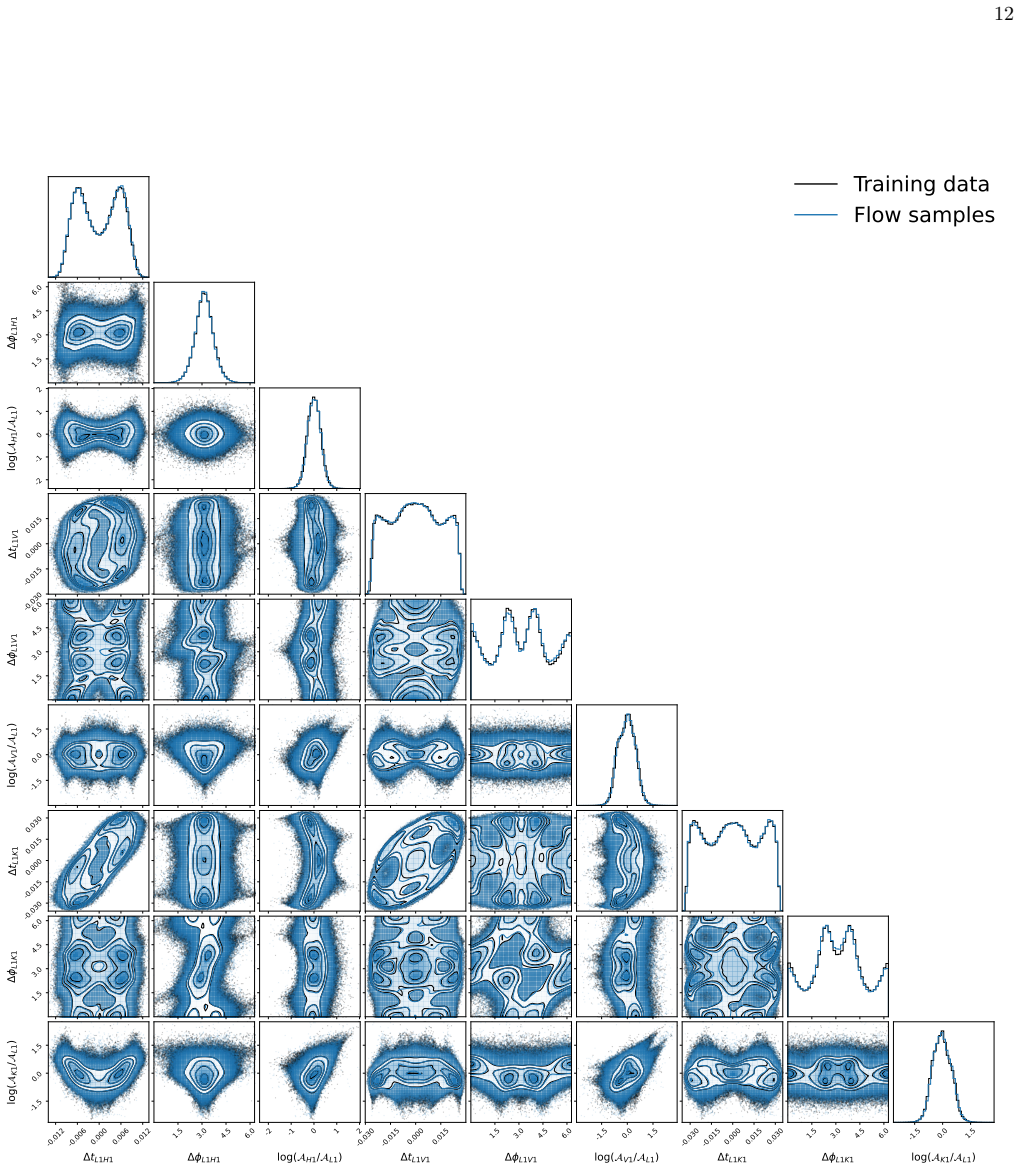
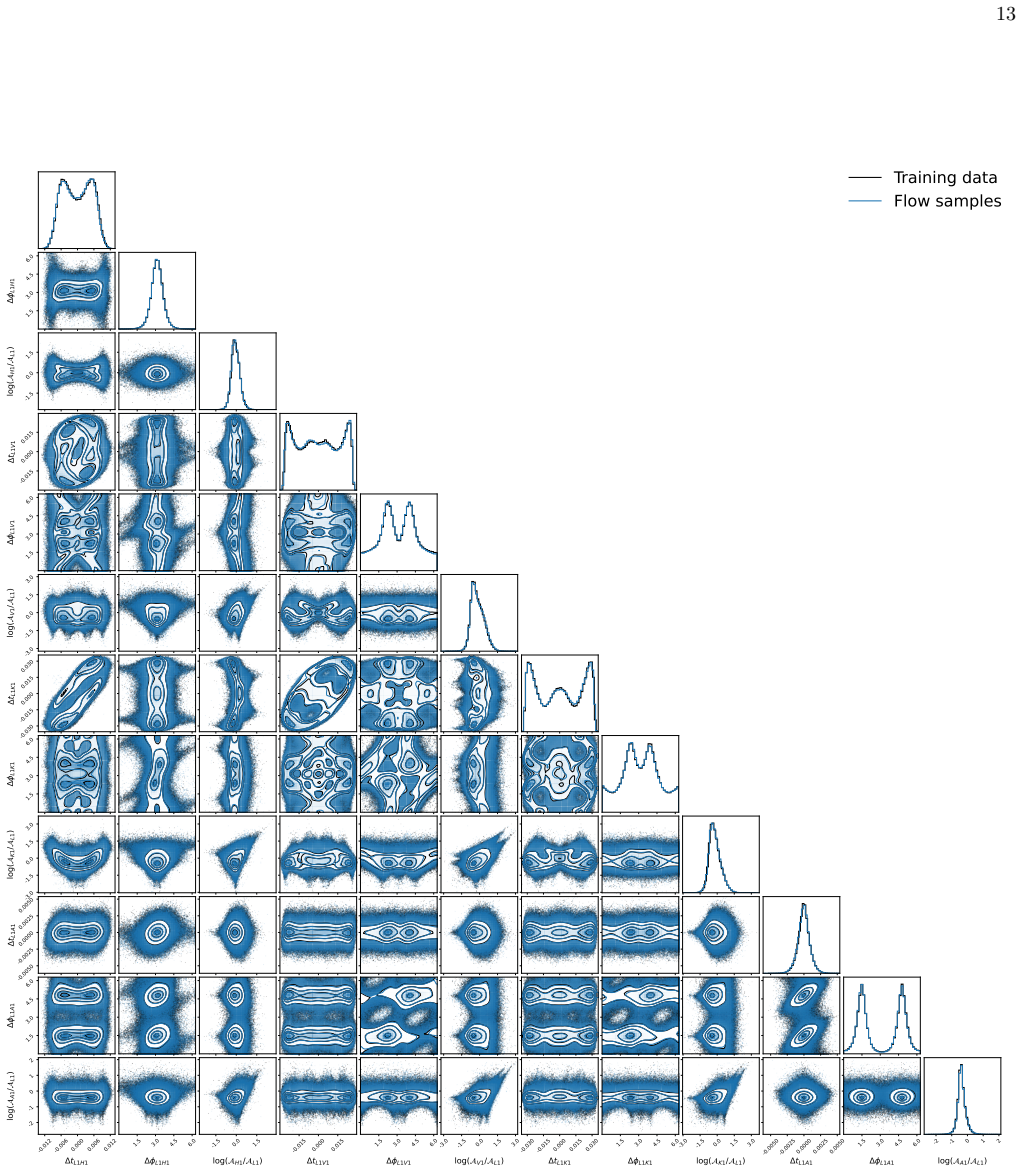
Normalizing flows that learn the joint distribution of relative arrival times, phase delays, and amplitude ratios across detectors, replacing precomputed binned histograms for ranking-statistic background estimation.
If this is right
- PyCBC can analyze data from four or more detectors without the storage scaling that currently blocks it.
- The same framework can be extended to searches for precessing or higher-mode signals that require more parameter dimensions.
- Background estimation becomes feasible for longer data stretches or finer binning without memory limits.
- Real-time or low-latency searches gain from the reduced storage and faster lookup times.
Where Pith is reading between the lines
- The approach could be retrained on actual background triggers instead of pure Monte-Carlo simulations to reduce any residual mismatch with real noise.
- Similar density-estimation swaps could replace histograms in other multi-detector pipelines that face the same storage wall.
- Because the flows are differentiable, they might allow gradient-based optimization of the ranking statistic itself rather than post-hoc fixes.
Load-bearing premise
The flows trained on Monte-Carlo simulations will accurately capture the true joint distribution of signal parameters in real non-Gaussian, non-stationary detector noise without introducing biases at the tails that affect event ranking.
What would settle it
A direct comparison, on the same third-observing-run data, between the ranking statistics produced by the normalizing-flow model and the existing histogram model for a large set of simulated signals injected into real noise, checking whether the recovered-signal fraction at any chosen false-alarm rate differs by more than 0.1 percent.
Figures


read the original abstract
Identifying compact binary coalescences buried within the non-Gaussian and non-stationary data taken by gravitational-wave interferometers requires sophisticated search pipelines, such as the PyCBC analysis. A critical task for these pipelines is determining the statistical significance of candidate events by comparing a "ranking statistic" against a large background set. Currently, PyCBC's ranking statistic incorporates the joint probability of the relative arrival times, phase delays and amplitude ratios of the signals seen in different detectors. These parameters are tightly constrained for physical signals but are more broadly distributed for noise. PyCBC currently relies on precomputed binned histogram-based density estimators using Monte-Carlo simulations to obtain these probabilities. However, the storage requirements for these histograms scale prohibitively with the size of the detector network, preventing PyCBC from effectively analyzing four or more detectors. In this paper, we demonstrate that these histograms can be replaced with normalizing flows, a machine learning approach to density estimation. Applying this method to data from the third observing run of Advanced LIGO and Virgo, we demonstrate that normalizing flows reduce storage requirements by over three orders of magnitude. Furthermore, our approach maintains high sensitivity, with less than a 0.05% drop in the recovery of simulated signals at a fixed false-alarm rate. By relaxing several simplifying assumptions previously required by Monte-Carlo methods, we also achieved up to a 6.55% increase in recovered signals for specific detector combinations. These results suggest that normalizing flows provide a scalable, flexible framework for the PyCBC pipeline as it expands to include four or more detectors, or to extend to searches for precessing or higher-mode signals, in future observing runs.
Editorial analysis
A structured set of objections, weighed in public.
Referee Report
Summary. The manuscript proposes replacing binned-histogram density estimators in the PyCBC gravitational-wave search pipeline with normalizing flows to model the joint distribution of inter-detector parameters (relative arrival times, phase delays, and amplitude ratios). Using O3 LIGO-Virgo data, the authors report that the flows reduce storage requirements by more than three orders of magnitude while incurring less than a 0.05% drop in simulated-signal recovery at fixed false-alarm rate; relaxing prior Monte-Carlo assumptions yields up to a 6.55% increase in recovered signals for selected detector combinations.
Significance. If the density estimates are accurate in the tails that determine false-alarm-rate thresholds, the approach would enable scalable multi-detector searches for networks of four or more instruments and for more complex signal models (precessing or higher-mode waveforms) without prohibitive storage costs. The empirical demonstration on real O3 data is a concrete strength.
major comments (2)
- [§4.2, §5.1] §4.2 and §5.1: The sensitivity comparisons are performed at fixed FAR using the NF-derived ranking statistic, but no direct quantitative comparison (e.g., Kolmogorov-Smirnov statistic or survival-function ratio) is shown between the NF and histogram background densities for the rarest events that set the FAR thresholds. This is load-bearing for the claim that the <0.05% sensitivity loss is free of tail-induced bias.
- [§3.1] §3.1: The training set is generated from Monte-Carlo simulations of the background; the manuscript does not report an explicit test of whether the trained flow reproduces the histogram density on an independent background realization drawn from the same distribution, which would be required to rule out overfitting or mode collapse affecting the tails.
minor comments (2)
- [Figure 3] Figure 3: The caption should explicitly state whether the plotted background density is evaluated on the training set or on a held-out validation set.
- [§2.2] §2.2: The notation for the amplitude-ratio parameters is introduced without a reference to the exact definition used in the PyCBC ranking statistic; a short equation or citation would improve clarity.
Simulated Author's Rebuttal
We thank the referee for their thorough review and constructive feedback on our manuscript. We address each major comment in detail below and agree that incorporating additional validation will strengthen the presentation of our results.
read point-by-point responses
-
Referee: [§4.2, §5.1] §4.2 and §5.1: The sensitivity comparisons are performed at fixed FAR using the NF-derived ranking statistic, but no direct quantitative comparison (e.g., Kolmogorov-Smirnov statistic or survival-function ratio) is shown between the NF and histogram background densities for the rarest events that set the FAR thresholds. This is load-bearing for the claim that the <0.05% sensitivity loss is free of tail-induced bias.
Authors: We agree that an explicit comparison of the background density estimates in the tails would provide stronger support for the absence of tail-induced bias. The near-equivalent sensitivity at fixed FAR already serves as an empirical validation, since any significant discrepancy in the high-ranking-statistic tails would shift the assigned false-alarm rates and thereby alter the number of recovered signals; the observed <0.05% difference indicates consistency in the relevant regime. Nevertheless, to address the referee's point directly, we will add in the revised manuscript a quantitative tail comparison (e.g., survival-function ratios and a Kolmogorov-Smirnov statistic restricted to the upper tail) between the NF and histogram densities evaluated on the O3 background data. This will appear in §4.2. revision: partial
-
Referee: [§3.1] §3.1: The training set is generated from Monte-Carlo simulations of the background; the manuscript does not report an explicit test of whether the trained flow reproduces the histogram density on an independent background realization drawn from the same distribution, which would be required to rule out overfitting or mode collapse affecting the tails.
Authors: We concur that an out-of-sample test on an independent Monte-Carlo realization is the appropriate way to confirm that the flow has not overfit or collapsed in the tails. The current manuscript demonstrates agreement between the NF and histogram on the training distribution, but does not include a held-out realization. In the revision we will generate an independent background realization from the same Monte-Carlo procedure, evaluate both the precomputed histogram and the trained normalizing flow on this realization, and report density-agreement metrics (including tail-specific log-likelihood and quantile-quantile comparisons). These results will be added to §3.1. revision: yes
Circularity Check
No circularity: empirical comparison of density estimators on shared Monte-Carlo data
full rationale
The paper's central claims rest on direct empirical measurements: normalizing flows are trained on the same Monte-Carlo simulations used to build the baseline histograms, then both estimators are evaluated on identical O3 background data and signal injections for storage cost and sensitivity at fixed false-alarm rate. No equation or result is obtained by re-fitting a parameter to a subset of the target quantity and relabeling it a prediction; no uniqueness theorem or ansatz is imported via self-citation; and the reported gains (storage reduction, <0.05% sensitivity loss, up to 6.55% recovery increase) are external performance metrics rather than algebraic identities. The derivation chain is therefore self-contained against the provided benchmarks.
Axiom & Free-Parameter Ledger
free parameters (1)
- normalizing flow architecture hyperparameters
axioms (1)
- domain assumption Monte-Carlo simulations faithfully represent the statistical properties of real detector noise for the purpose of density estimation.
Reference graph
Works this paper leans on
-
[1]
The component masses and distances of the simulated signals are sampled from uniform distributions in the ranges [0,80]M ⊙ and [0,5000] Mpc respectively
Uncertainty Correlations To measure the correlation between the noise-induced measurement uncertainties ont,ϕandAwe simulate 10,000 iterations of colored noise with a simulated signal added to the noise. The component masses and distances of the simulated signals are sampled from uniform distributions in the ranges [0,80]M ⊙ and [0,5000] Mpc respectively....
-
[2]
Bothµ t andµ ϕ are taken to be zero as the uncertainties will be centered on the sampled values
Phase and time uncertainty To be able to draw the phase and time uncertainty from a bivariate Gaussian we need to define it’s mean and covariance as given by µ= µt µϕ ,Σ = σ2 t rσtσϕ rσtσϕ σ2 ϕ ,(2) where (µt,µ ϕ) and (σ t,σ ϕ) are the means and standard deviations ofδ t andδ ϕ, hereris the correlation coefficient given in Table II. Bothµ t andµ ϕ are tak...
2009
-
[3]
Signal-to-noise ratio uncertainty Finally, we defineδA. In matched-filter searches the signal-to-noise ratio is commonly expressed as ρ(t)2 = (s|ˆh+)2 + (s|ˆh×)2,(5) where we use the standard definition of the inner product (a|b) = 4Re Z ∞ 0 ˜a(f)˜b∗(f) S(f) e2πif df.(6) HereS(f) is the one-sided power spectral density of the detector noise and ˜s(f) is t...
2020
-
[4]
Since the normalizing flow was trained on the modified sampling methodology, this is our main point of comparison. We find that for two detector cases we observe only small perturbations≲0.05% in the number of recovered injections when compared to the results using the modified sampling methodology indicating that the new flow-based methodology maintains ...
-
[5]
Observation of Gravitational Waves from a Binary Black Hole Merger
B. P. Abbottet al.(LIGO Scientific, Virgo), “Observation of Gravitational Waves from a Binary Black Hole Merger,” Phys. Rev. Lett.116, 061102 (2016), arXiv:1602.03837 [gr-qc]
work page internal anchor Pith review arXiv 2016
-
[6]
J. Aasiet al.(LIGO Scientific), “Advanced LIGO,” Class. Quant. Grav.32, 074001 (2015), arXiv:1411.4547 [gr-qc]
work page internal anchor Pith review arXiv 2015
-
[7]
Advanced Virgo: a 2nd generation interferometric gravitational wave detector
F. Acerneseet al.(VIRGO), “Advanced Virgo: a second-generation interferometric gravitational wave detector,” Class. Quant. Grav.32, 024001 (2015), arXiv:1408.3978 [gr-qc]
work page internal anchor Pith review arXiv 2015
-
[8]
T. Akutsuet al.(KAGRA), “Overview of KAGRA: Detector design and construction history,” PTEP2021, 05A101 (2021), arXiv:2005.05574 [physics.ins-det]
-
[9]
C. S. Unnikrishnan, “IndIGO and LIGO-India: Scope and plans for gravitational wave research and precision metrology in India,” Int. J. Mod. Phys. D22, 1341010 (2013), arXiv:1510.06059 [physics.ins-det]
-
[10]
Ligo-india tech. rep
B Iyeret al., “Ligo-india tech. rep.” (2011),https:// dcc.ligo.org/LIGO-M1100296/public
2011
-
[11]
B. P. Abbottet al.(KAGRA, LIGO Scientific, Virgo), “Prospects for observing and localizing gravitational-wave transients with Advanced LIGO, Advanced Virgo and KAGRA,” Living Rev. Rel.19, 1 (2016), arXiv:1304.0670 [gr-qc]
-
[12]
A. G. Abacet al.(LIGO Scientific, VIRGO, KAGRA), “GWTC-4.0: Updating the Gravitational-Wave Transient Catalog with Observations from the First Part of the Fourth LIGO-Virgo-KAGRA Observing Run,” (2025), arXiv:2508.18082 [gr-qc]
work page internal anchor Pith review arXiv 2025
- [13]
- [14]
-
[15]
Tito Dal Cantonet al., “Implementing a search for aligned-spin neutron star-black hole systems with advanced ground based gravitational wave detectors,” Phys. Rev. D90, 082004 (2014), arXiv:1405.6731 [gr-qc]
work page Pith review arXiv 2014
-
[16]
Alexander H. Nitz, Thomas Dent, Tito Dal Canton, Stephen Fairhurst, and Duncan A. Brown, “Detecting binary compact-object mergers with gravitational waves: Understanding and Improving the sensitivity of the PyCBC search,” Astrophys. J.849, 118 (2017), arXiv:1705.01513 [gr-qc]
-
[17]
The PyCBC search for gravitational waves from compact binary coalescence
Samantha A. Usmanet al., “The PyCBC search for gravitational waves from compact binary coalescence,” Class. Quant. Grav.33, 215004 (2016), arXiv:1508.02357 [gr-qc]
work page Pith review arXiv 2016
-
[18]
B. P. Abbottet al.(LIGO Scientific, Virgo), “GWTC-1: A Gravitational-Wave Transient Catalog of Compact Binary Mergers Observed by LIGO and Virgo during the First and Second Observing Runs,” Phys. Rev. X 9, 031040 (2019), arXiv:1811.12907 [astro-ph.HE]
work page internal anchor Pith review arXiv 2019
-
[19]
R. Abbottet al.(LIGO Scientific, Virgo), “GWTC-2: Compact Binary Coalescences Observed by LIGO and Virgo During the First Half of the Third Observing Run,” Phys. Rev. X11, 021053 (2021), arXiv:2010.14527 [gr-qc]
work page internal anchor Pith review arXiv 2021
-
[20]
R. Abbottet al.(KAGRA, VIRGO, LIGO Scientific), “GWTC-3: Compact Binary Coalescences Observed by LIGO and Virgo during the Second Part of the Third Observing Run,” Phys. Rev. X13, 041039 (2023), arXiv:2111.03606 [gr-qc]
work page internal anchor Pith review arXiv 2023
-
[21]
GWTC-4.0: Methods for Identifying and Characterizing Gravitational-wave Transients,
A. G. Abacet al.(LIGO Scientific, VIRGO, KAGRA), “GWTC-4.0: Methods for Identifying and Characterizing Gravitational-wave Transients,” (2025), arXiv:2508.18081 [gr-qc]
-
[22]
Alexander H. Nitz, Collin Capano, Alex B. Nielsen, Steven Reyes, Rebecca White, Duncan A. Brown, and Badri Krishnan, “1-OGC: The first open gravitational-wave catalog of binary mergers from analysis of public Advanced LIGO data,” Astrophys. J. 872, 195 (2019), arXiv:1811.01921 [gr-qc]
-
[23]
Alexander H. Nitz, Thomas Dent, Gareth S. Davies, Sumit Kumar, Collin D. Capano, Ian Harry, Simone Mozzon, Laura Nuttall, Andrew Lundgren, and M´ arton T´ apai, “2-OGC: Open Gravitational-wave Catalog of binary mergers from analysis of public Advanced LIGO and Virgo data,” Astrophys. J.891, 123 (2020), arXiv:1910.05331 [astro-ph.HE]
-
[24]
3-OGC: Catalog of Gravitational Waves from Compact-binary Mergers,
Alexander H. Nitz, Collin D. Capano, Sumit Kumar, Yi-Fan Wang, Shilpa Kastha, Marlin Sch¨ afer, Rahul Dhurkunde, and Miriam Cabero, “3-OGC: Catalog of Gravitational Waves from Compact-binary Mergers,” Astrophys. J.922, 76 (2021), arXiv:2105.09151 [astro-ph.HE]
-
[25]
4-OGC: Catalog of gravitational waves from compact-binary mergers,
Alexander H. Nitz, Sumit Kumar, Yi-Fan Wang, Shilpa Kastha, Shichao Wu, Marlin Sch¨ afer, Rahul Dhurkunde, and Collin D. Capano, “4-OGC: Catalog of gravitational waves from compact-binary mergers,” (2021), arXiv:2112.06878 [astro-ph.HE]
-
[26]
A chi-squared time-frequency discriminator for gravitational wave detection
Bruce Allen, “χ 2 time-frequency discriminator for gravitational wave detection,” Phys. Rev. D71, 062001 (2005), arXiv:gr-qc/0405045
work page Pith review arXiv 2005
-
[27]
Alexander Harvey Nitz, “Distinguishing short duration noise transients in LIGO data to improve the PyCBC search for gravitational waves from high mass binary black hole mergers,” Class. Quant. Grav.35, 035016 (2018), arXiv:1709.08974 [gr-qc]
-
[28]
Extending the PyCBC search for gravitational waves from compact binary mergers to a global network,
Gareth S. Davies, Thomas Dent, M´ arton T´ apai, Ian Harry, Connor McIsaac, and Alexander H. Nitz, “Extending the PyCBC search for gravitational waves from compact binary mergers to a global network,” Phys. Rev. D102, 022004 (2020), arXiv:2002.08291 [astro-ph.HE]
-
[29]
GW150914: First results from the search for binary black hole coalescence with Advanced LIGO
B. P. Abbottet al.(LIGO Scientific, Virgo), “GW150914: First results from the search for binary black hole coalescence with Advanced LIGO,” Phys. Rev. D93, 122003 (2016), arXiv:1602.03839 [gr-qc]
work page Pith review arXiv 2016
-
[30]
Optimized search for a binary black hole merger population in LIGO-Virgo O3 data,
Praveen Kumar and Thomas Dent, “Optimized search for a binary black hole merger population in LIGO-Virgo O3 data,” Phys. Rev. D110, 043036 (2024), arXiv:2403.10439 [gr-qc]
-
[31]
Normalizing Flows: An Introduction and Review of Current Methods,
Ivan Kobyzev, Simon J. D. Prince, and Marcus A. Brubaker, “Normalizing Flows: An Introduction and Review of Current Methods,” IEEE Trans. Pattern Anal. Machine Intell.43, 3964–3979 (2021), arXiv:1908.09257 [stat.ML]. 15
-
[32]
George Papamakarios, Eric Nalisnick, Danilo Jimenez Rezende, Shakir Mohamed, and Balaji Lakshminarayanan, “Normalizing Flows for Probabilistic Modeling and Inference,” J. Machine Learning Res.22, 2617–2680 (2021), arXiv:1912.02762 [stat.ML]
-
[33]
Gravitational-wave parameter estimation with autoregressive neural network flows,
Stephen R. Green, Christine Simpson, and Jonathan Gair, “Gravitational-wave parameter estimation with autoregressive neural network flows,” Phys. Rev. D102, 104057 (2020)
2020
-
[34]
Nested sampling with normalizing flows for gravitational-wave inference,
Michael J. Williams, John Veitch, and Chris Messenger, “Nested sampling with normalizing flows for gravitational-wave inference,” Phys. Rev. D103, 103006 (2021), arXiv:2102.11056 [gr-qc]
-
[35]
Real-Time Gravitational Wave Science with Neural Posterior Estimation,
Maximilian Dax, Stephen R. Green, Jonathan Gair, Jakob H. Macke, Alessandra Buonanno, and Bernhard Sch¨ olkopf, “Real-Time Gravitational Wave Science with Neural Posterior Estimation,” Phys. Rev. Lett.127, 241103 (2021), arXiv:2106.12594 [gr-qc]
-
[36]
Normalizing Flows for Hierarchical Bayesian Analysis: A Gravitational Wave Population Study,
David Ruhe, Kaze Wong, Miles Cranmer, and Patrick Forr´ e, “Normalizing Flows for Hierarchical Bayesian Analysis: A Gravitational Wave Population Study,” (2022), arXiv:2211.09008 [astro-ph.IM]
-
[37]
Cosmological inference using gravitational waves and normalizing flows,
Federico Stachurski, Christopher Messenger, and Martin Hendry, “Cosmological inference using gravitational waves and normalizing flows,” Phys. Rev. D109, 123547 (2024), arXiv:2310.13405 [gr-qc]
-
[38]
Gravitational Radiation,
Kip S. Thorne, “Gravitational Radiation,” inThree Hundred Years of Gravitation, edited by Stephen W. Hawking and Werner Israel (Cambridge University Press, Cambridge, England, 1987) Chap. 9, pp. 330–458
1987
-
[39]
Wide Band Laser Interferometer Gravitational Radiation Experiment,
R. L. Forward, “Wide Band Laser Interferometer Gravitational Radiation Experiment,” Phys. Rev. D17, 379–390 (1978)
1978
-
[40]
Triangulation of gravitational wave sources with a network of detectors,
Stephen Fairhurst, “Triangulation of gravitational wave sources with a network of detectors,” New J. Phys. 11, 123006 (2009), [Erratum: New J.Phys. 13, 069602 (2011)], arXiv:0908.2356 [gr-qc]
-
[41]
Abbottet al.(KAGRA, VIRGO, LIGO Scientific), Astrophys
R. Abbottet al.(KAGRA, VIRGO, LIGO Scientific), “Open Data from the Third Observing Run of LIGO, Virgo, KAGRA, and GEO,” Astrophys. J. Suppl.267, 29 (2023), arXiv:2302.03676 [gr-qc]
- [42]
-
[43]
Density estimation by dual ascent of the log-likelihood,
Esteban G. Tabak and Eric Vanden-Eijnden, “Density estimation by dual ascent of the log-likelihood,” Communications in Mathematical Sciences8, 217–233 (2010)
2010
-
[44]
A Family of Nonparametric Density Estimation Algorithms,
E. G. Tabak and Cristina V. Turner, “A Family of Nonparametric Density Estimation Algorithms,” Commun. Pure Appl. Math.66, 145–164 (2013)
2013
- [45]
-
[46]
NICE: Non-linear independent components estimation,
Laurent Dinh, David Krueger, and Yoshua Bengio, “NICE: Non-linear independent components estimation,” inInternational Conference on Learning Representations Workshop(2015)
2015
-
[47]
uofgravity/glasflow: v0.4.1,
Michael J. Williams, J. McGinn, Federico Stak, and John Veitch, “uofgravity/glasflow: v0.4.1,” (2024)
2024
-
[48]
nflows: normalizing flows in PyTorch,
Conor Durkan, Artur Bekasov, Iain Murray, and George Papamakarios, “nflows: normalizing flows in PyTorch,” (2020)
2020
-
[49]
Adam: A Method for Stochastic Optimization
Diederik P. Kingma and Jimmy Ba, “Adam: A Method for Stochastic Optimization,” (2014) arXiv:1412.6980 [cs.LG]
work page internal anchor Pith review arXiv 2014
-
[50]
Rahul Dhurkunde and Ian Harry, “Search for Precessing Binary Black Holes in Advanced LIGO’s Third Observing Run using Harmonic Decomposition,” (2026), arXiv:2601.04276 [astro-ph.IM]
work page internal anchor Pith review arXiv 2026
-
[51]
First demonstration of early warning gravitational wave alerts,
Ryan Mageeet al., “First demonstration of early warning gravitational wave alerts,” Astrophys. J. Lett.910, L21 (2021), arXiv:2102.04555 [astro-ph.HE]
-
[52]
Alexander H. Nitz, Marlin Sch¨ afer, and Tito Dal Canton, “Gravitational-wave Merger Forecasting: Scenarios for the Early Detection and Localization of Compact-binary Mergers with Ground-based Observatories,” Astrophys. J. Lett.902, L29 (2020), arXiv:2009.04439 [astro-ph.HE]
discussion (0)
Sign in with ORCID, Apple, or X to comment. Anyone can read and Pith papers without signing in.