Recognition: 2 theorem links
· Lean TheoremMemMachine: A Ground-Truth-Preserving Memory System for Personalized AI Agents
Pith reviewed 2026-05-10 20:16 UTC · model grok-4.3
The pith
MemMachine stores entire conversational episodes to maintain accurate long-term memory for personalized LLM agents.
A machine-rendered reading of the paper's core claim, the machinery that carries it, and where it could break.
Core claim
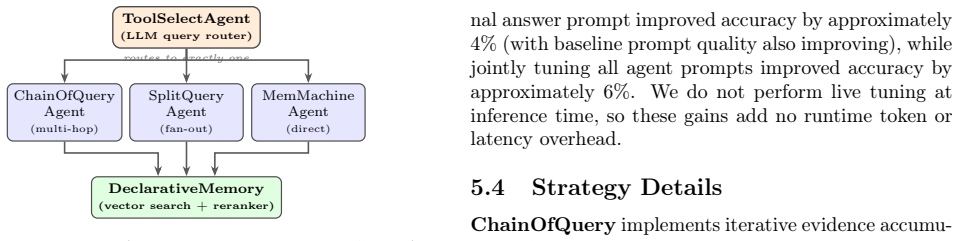
MemMachine integrates short-term, long-term episodic, and profile memory through a ground-truth-preserving design that stores complete conversational episodes rather than performing lossy LLM-based extraction. Contextualized retrieval expands nucleus matches with surrounding dialogue turns to improve recall when evidence spans multiple exchanges. A companion Retrieval Agent adaptively selects among direct retrieval, parallel decomposition, or iterative chain-of-query strategies. On LoCoMo the system reaches 0.9169 accuracy with gpt4.1-mini, while on LongMemEvalS it attains 93.0 percent accuracy after retrieval-stage optimizations that outperform ingestion changes. It also uses roughly 80% of
What carries the argument
The ground-truth-preserving architecture that stores entire conversational episodes and applies contextualized retrieval, paired with an adaptive Retrieval Agent that routes queries among direct, decomposed, or iterative strategies.
If this is right
- Accuracy reaches 0.9169 on LoCoMo and 93.0 percent on LongMemEvalS after targeted retrieval optimizations.
- Token consumption drops by about 80 percent relative to extraction-based baselines under matched conditions.
- Contextual expansion of matches improves recall for facts distributed across dialogue turns.
- The Retrieval Agent delivers 93.2 percent on HotpotQA-hard and 92.6 percent on WikiMultiHop under added noise.
- Retrieval-stage changes such as depth tuning and prompt design produce larger gains than changes at the ingestion stage.
Where Pith is reading between the lines
- The design implies that future agent memory systems may need specialized indexes or compression to handle growing volumes of raw episode data without prohibitive costs.
- It raises the question of whether similar raw-preservation principles could apply to non-dialogue histories such as task logs or sensor streams.
- If contradictions appear in stored episodes, an explicit conflict-resolution layer would likely become necessary to keep retrieval reliable.
- The adaptive routing mechanism could transfer to other multi-step reasoning settings beyond memory retrieval.
Load-bearing premise
Storing and retrieving full conversational episodes remains computationally and storage-feasible at scale even when user data contains noise or contradictions.
What would settle it
Measure accuracy and storage cost when the system runs on a large set of real multi-session user logs that include deliberate contradictions or noisy turns and check whether performance falls below the reported benchmark levels.
Figures

read the original abstract
Large Language Model (LLM) agents require persistent memory to maintain personalization, factual continuity, and long-horizon reasoning, yet standard context-window and retrieval-augmented generation (RAG) pipelines degrade over multi-session interactions. We present MemMachine, an open-source memory system that integrates short-term, long-term episodic, and profile memory within a ground-truth-preserving architecture that stores entire conversational episodes and reduces lossy LLM-based extraction. MemMachine uses contextualized retrieval that expands nucleus matches with surrounding context, improving recall when relevant evidence spans multiple dialogue turns. Across benchmarks, MemMachine achieves strong accuracy-efficiency tradeoffs: on LoCoMo it reaches 0.9169 using gpt4.1-mini; on LongMemEvalS (ICLR 2025), a six-dimension ablation yields 93.0 percent accuracy, with retrieval-stage optimizations -- retrieval depth tuning (+4.2 percent), context formatting (+2.0 percent), search prompt design (+1.8 percent), and query bias correction (+1.4 percent) -- outperforming ingestion-stage gains such as sentence chunking (+0.8 percent). GPT-5-mini exceeds GPT-5 by 2.6 percent when paired with optimized prompts, making it the most cost-efficient setup. Compared to Mem0, MemMachine uses roughly 80 percent fewer input tokens under matched conditions. A companion Retrieval Agent adaptively routes queries among direct retrieval, parallel decomposition, or iterative chain-of-query strategies, achieving 93.2 percent on HotpotQA-hard and 92.6 percent on WikiMultiHop under randomized-noise conditions. These results show that preserving episodic ground truth while layering adaptive retrieval yields robust, efficient long-term memory for personalized LLM agents.
Editorial analysis
A structured set of objections, weighed in public.
Referee Report
Summary. The paper introduces MemMachine, an open-source memory system for LLM agents that preserves ground truth by storing complete conversational episodes instead of lossy extractions. It integrates short-term, long-term episodic, and profile memory with contextualized retrieval (expanding nucleus matches with surrounding context) and a Retrieval Agent for adaptive routing among direct, decomposed, or iterative strategies. Empirical results include 0.9169 accuracy on LoCoMo (gpt4.1-mini), 93.0% on LongMemEvalS with a six-dimension ablation showing retrieval-stage gains (depth tuning +4.2%, formatting +2.0%, prompt design +1.8%, bias correction +1.4%) outperforming ingestion changes, 80% fewer tokens than Mem0 under matched conditions, and 93.2%/92.6% on HotpotQA-hard/WikiMultiHop under randomized noise.
Significance. If the results hold under scrutiny, this could meaningfully advance reliable long-term memory for personalized LLM agents by showing that full-episode storage plus adaptive retrieval can deliver strong accuracy-efficiency tradeoffs on multi-session benchmarks. The explicit ablation demonstrating larger gains from retrieval optimizations than ingestion-stage changes is a useful empirical insight, and the open-source claim supports reproducibility. However, the absence of scaling analysis limits broader significance for real-world deployment.
major comments (4)
- [Experimental Results] Experimental Results: The central accuracy figures (0.9169 on LoCoMo, 93.0% on LongMemEvalS) and ablation deltas (+4.2% depth tuning etc.) are reported as point estimates without error bars, number of runs, or data-split details, which is load-bearing for verifying the accuracy-efficiency claim and distinguishing benchmark artifacts from robust gains.
- [Architecture and Evaluation] Architecture and Evaluation: The core claim rests on storing entire episodes to avoid lossy extraction and enable long-horizon memory, yet no storage growth curves, retrieval latency measurements, or scaling tests for accumulating episodes (e.g., thousands of sessions) are provided, directly affecting feasibility of the ground-truth-preserving approach.
- [Ablation Study on LongMemEvalS] Ablation Study on LongMemEvalS: Retrieval-stage optimizations are stated to outperform ingestion-stage ones (e.g., +4.2% vs. +0.8% chunking), but without statistical significance tests or variance, the comparison cannot reliably support the conclusion that retrieval changes are the dominant factor.
- [Baseline Comparison] Baseline Comparison: The 80% token reduction versus Mem0 is measured under matched short conditions, but the manuscript does not specify controls for episode length or history accumulation, which is central to the efficiency advantage for long-term use.
minor comments (4)
- Clarify model nomenclature (gpt4.1-mini, GPT-5-mini, GPT-5) and their exact capabilities in the comparisons.
- Add full citations and dataset characterizations for LoCoMo, LongMemEvalS, HotpotQA-hard, and WikiMultiHop, including episode counts and cleanliness.
- Resolve the mismatch between the stated 'six-dimension ablation' and the four listed optimizations; specify the remaining dimensions.
- If architecture diagrams exist, ensure they clearly label the integration of short-term, episodic, and profile memory components.
Simulated Author's Rebuttal
We thank the referee for the constructive and detailed feedback. We address each major comment below and will revise the manuscript to improve experimental rigor, clarify controls, and discuss scalability.
read point-by-point responses
-
Referee: Experimental Results: The central accuracy figures (0.9169 on LoCoMo, 93.0% on LongMemEvalS) and ablation deltas (+4.2% depth tuning etc.) are reported as point estimates without error bars, number of runs, or data-split details, which is load-bearing for verifying the accuracy-efficiency claim and distinguishing benchmark artifacts from robust gains.
Authors: We agree that point estimates alone limit robustness assessment. In the revision we will rerun the LoCoMo and LongMemEvalS experiments over five independent runs (varying seeds where applicable), report means with standard deviations, and specify the exact data splits and evaluation protocols used. This will strengthen verification of the accuracy and efficiency claims. revision: yes
-
Referee: Architecture and Evaluation: The core claim rests on storing entire episodes to avoid lossy extraction and enable long-horizon memory, yet no storage growth curves, retrieval latency measurements, or scaling tests for accumulating episodes (e.g., thousands of sessions) are provided, directly affecting feasibility of the ground-truth-preserving approach.
Authors: We acknowledge that scaling analysis is important for real-world feasibility. The revised manuscript will add storage growth curves (linear in episode count), retrieval latency numbers on current benchmarks, and a discussion of projected costs for larger session counts. Full empirical tests at thousands of sessions are beyond the present scope and will be noted as future work. revision: partial
-
Referee: Ablation Study on LongMemEvalS: Retrieval-stage optimizations are stated to outperform ingestion-stage ones (e.g., +4.2% vs. +0.8% chunking), but without statistical significance tests or variance, the comparison cannot reliably support the conclusion that retrieval changes are the dominant factor.
Authors: We will extend the ablation study to multiple runs, report variance for each dimension, and apply paired t-tests to assess whether retrieval-stage gains are statistically larger than ingestion-stage gains. This will provide stronger evidence for the relative importance of retrieval optimizations. revision: yes
-
Referee: Baseline Comparison: The 80% token reduction versus Mem0 is measured under matched short conditions, but the manuscript does not specify controls for episode length or history accumulation, which is central to the efficiency advantage for long-term use.
Authors: We will revise the baseline section to explicitly document the matching controls: identical episode lengths, the same number of accumulated sessions, and consistent history truncation policies were applied to both systems. This will confirm that the reported token savings arise from our architecture. revision: yes
Circularity Check
No circularity: empirical system with benchmark measurements
full rationale
The paper presents MemMachine as an architectural system for preserving episodic ground truth via full-episode storage and contextualized retrieval, evaluated through direct accuracy measurements (0.9169 on LoCoMo, 93.0% on LongMemEvalS) and ablation deltas on retrieval optimizations. These are reported as observed performance gains on fixed benchmarks rather than any derivation, prediction, or first-principles result that reduces to the inputs by construction. No equations, uniqueness theorems, ansatzes, or self-citations appear as load-bearing steps in the provided text; the central claims rest on experimental comparisons (including vs. Mem0) that remain externally falsifiable.
Axiom & Free-Parameter Ledger
free parameters (2)
- retrieval depth
- context formatting and search prompt variants
invented entities (1)
-
MemMachine architecture
no independent evidence
Lean theorems connected to this paper
-
IndisputableMonolith/Cost/FunctionalEquation.leanwashburn_uniqueness_aczel unclear?
unclearRelation between the paper passage and the cited Recognition theorem.
stores raw conversational episodes and indexes them at the sentence level, minimizing LLM dependence for routine memory operations and preserving factual integrity
-
IndisputableMonolith/Foundation/ArithmeticFromLogic.leanembed_strictMono_of_one_lt unclear?
unclearRelation between the paper passage and the cited Recognition theorem.
contextualized retrieval that expands nucleus episodes with neighboring context to form episode clusters
What do these tags mean?
- matches
- The paper's claim is directly supported by a theorem in the formal canon.
- supports
- The theorem supports part of the paper's argument, but the paper may add assumptions or extra steps.
- extends
- The paper goes beyond the formal theorem; the theorem is a base layer rather than the whole result.
- uses
- The paper appears to rely on the theorem as machinery.
- contradicts
- The paper's claim conflicts with a theorem or certificate in the canon.
- unclear
- Pith found a possible connection, but the passage is too broad, indirect, or ambiguous to say the theorem truly supports the claim.
Forward citations
Cited by 2 Pith papers
-
Knowledge Compounding: An Empirical Economic Analysis of Self-Evolving Knowledge Wikis under the Agentic ROI Framework
A four-query experiment demonstrates 84.6% token savings through knowledge compounding in self-evolving wikis compared to standard RAG, by amortizing ingestion costs and reusing synthesized knowledge over time.
-
Memory as Metabolism: A Design for Companion Knowledge Systems
This paper designs a companion knowledge system with TRIAGE, DECAY, CONTEXTUALIZE, CONSOLIDATE, and AUDIT operations plus memory gravity and minority-hypothesis retention to give contradictory evidence a path to updat...
Reference graph
Works this paper leans on
-
[1]
MemGPT: Towards LLMs as Operating Systems
Charles Packer, Sarah Wooders, Kevin Lin, Vivian Fang, Shishir G. Patil, Ion Stoica, and Joseph E. Gonzalez. MemGPT: Towards LLMs as Operating Systems.arXiv preprint arXiv:2310.08560, 2024
work page internal anchor Pith review Pith/arXiv arXiv 2024
-
[2]
Generative Agents: Interactive Simulacra of Human Behavior
Joon Sung Park, Joseph C. O’Brien, Carrie J. Cai, Meredith Ringel Morris, Percy Liang, and Michael S. Bernstein. Generative Agents: Interac- tive Simulacra of Human Behavior.arXiv preprint arXiv:2304.03442, 2023
work page internal anchor Pith review arXiv 2023
-
[3]
Retrieval-Augmented Generation for Knowledge- Intensive NLP Tasks
Patrick Lewis, Ethan Perez, Aleksandra Piktus, Fabio Petroni, Vladimir Karpukhin, Naman Goyal, Heinrich Küttler, Mike Lewis, Wen-tau Yih, Tim Rocktäschel, Sebastian Riedel, and Douwe Kiela. Retrieval-Augmented Generation for Knowledge- Intensive NLP Tasks. InNeurIPS, 2020
2020
-
[4]
Mem0: Building Production-Ready AI Agents with Scalable Long-Term Memory
PrateekChhikara, DevKhant, Saket Aryan, Taran- jeet Singh, and Deshraj Yadav. Mem0: Building Production-Ready AI Agents with Scalable Long- Term Memory.arXiv preprint arXiv:2504.19413, 2025
work page internal anchor Pith review arXiv 2025
-
[5]
Zep: A Temporal Knowledge Graph Architecture for Agent Memory
Preston Rasmussen, Pavlo Paliychuk, Travis Beau- vais, Jack Ryan, and Daniel Chalef. Zep: A Tempo- ral Knowledge Graph Architecture for Agent Mem- ory.arXiv preprint arXiv:2501.13956, 2025
work page internal anchor Pith review arXiv 2025
-
[6]
Evaluating Very Long-Term Conversational Memory of LLM Agents
Adyasha Maharana, Dong-Ho Lee, Sergey Tulyakov, Mohit Bansal, Francesco Barbieri, and Yuwei Fang. Evaluating Very Long-Term Conversational Memory of LLM Agents.arXiv preprint arXiv:2402.17753, 2024
work page internal anchor Pith review arXiv 2024
-
[7]
LongMemEval: Benchmarking Chat Assistants on Long-Term Interactive Memory
Di Wu, Hongwei Wang, Wenhao Yu, Yuwei Zhang, Kai-Wei Chang, and Dong Yu. Long- MemEval: Benchmarking Chat Assistants on Long-Term Interactive Memory.arXiv preprint arXiv:2410.10813, 2024. Accepted at ICLR 2025
work page internal anchor Pith review arXiv 2024
-
[8]
Episodic Memories Generation and Evaluation Benchmark for Large Language Models
Alexis Huet, Zied Ben Houidi, and Dario Rossi. Episodic Memories Generation and Evaluation Benchmark for Large Language Models. InInter- national Conference on Learning Representations (ICLR), 2025
2025
-
[9]
Yuyang Hu, Shichun Liu, Yue Yue,et al.Memory in the Age of AI Agents: A Survey.arXiv preprint arXiv:2512.13564, 2025
work page internal anchor Pith review arXiv 2025
-
[10]
Episodic and Semantic Memory
Endel Tulving. Episodic and Semantic Memory. In E. Tulving and W. Donaldson, editors,Organiza- tion of Memory, pages 381–403. Academic Press, 1972
1972
-
[11]
Atkinson and Richard M
Richard C. Atkinson and Richard M. Shiffrin. Hu- man Memory: A Proposed System and Its Control Processes. In K. W. Spence and J. T. Spence, ed- itors,The Psychology of Learning and Motivation, volume 2, pages 89–195. Academic Press, 1968
1968
-
[12]
Unsupervised Multilin- gual Sentence Boundary Detection.Computational Linguistics, 32(4):485–525, 2006
Tibor Kiss and Jan Strunk. Unsupervised Multilin- gual Sentence Boundary Detection.Computational Linguistics, 32(4):485–525, 2006
2006
-
[13]
Liu, Kevin Lin, John Hewitt, Ashwin Paranjape, Michele Bevilacqua, Fabio Petroni, and Percy Liang
Nelson F. Liu, Kevin Lin, John Hewitt, Ashwin Paranjape, Michele Bevilacqua, Fabio Petroni, and Percy Liang. Lost in the Middle: How Language Models Use Long Contexts.Transactions of the Association for Computational Linguistics, 12:157– 173, 2024
2024
-
[14]
Towards LifeSpan Cognitive Systems
Yu Wang, Chi Han, Tongtong Wu, Xiaoxin He, Wangchunshu Zhou, Nafis Sadeq, Xiusi Chen, Zexue He, Wei Wang, Gholamreza Haffari,et al. Towards Lifespan Cognitive Systems.arXiv preprint arXiv:2409.13265, 2024
-
[15]
Observational Memory: A Human-Inspired Memory System for AI Agents
Tyler Barnes and Sam Bhagwat. Observational Memory: A Human-Inspired Memory System for AI Agents. Mastra Technical Report, 2026.https: //mastra.ai/research
2026
-
[16]
MemOS: A Memory OS for AI System
Zhiyu Li, Chenyang Xi, Chunyu Li, Ding Chen, Boyu Chen, Shichao Song, Simin Niu, Hanyu Wang, et al. MemOS: A Memory OS for AI System. arXiv preprint arXiv:2507.03724, 2025
work page internal anchor Pith review arXiv 2025
-
[17]
Zhiyu Li, Shichao Song, Hanyu Wang, Simin Niu, Ding Chen, Jiawei Yang, Chenyang Xi, et al. MemOS: An Operating System for Memory- Augmented Generation (MAG) in Large Language Models.arXiv preprint arXiv:2505.22101, 2025
-
[18]
Agent lightning: Train any ai agents with reinforcement learning,
Xiao Luo, Yuxuan Zhang, Zheng He, Zifeng Wang, Sixun Zhao, Dongming Li, Long K. Qiu, and Yang Yang. Agent Lightning: Train ANY AI Agents with Reinforcement Learning.arXiv preprint arXiv:2508.03680, 2025
-
[19]
Code execution with MCP
Anthropic. Code execution with MCP. Engi- neering blog, 2025.https://www.anthropic.com/ engineering/code-execution-with-mcp. 17
2025
-
[20]
Introducing Code Mode for MCP servers
Cloudflare. Introducing Code Mode for MCP servers. Cloudflare blog, 2025.https://blog. cloudflare.com/code-mode-mcp/
2025
-
[21]
Cohen, Ruslan Salakhutdi- nov, and Christopher D
Zhilin Yang, Peng Qi, Saizheng Zhang, Yoshua Bengio, William W. Cohen, Ruslan Salakhutdi- nov, and Christopher D. Manning. HotpotQA: A Dataset for Diverse, Explainable Multi-hop Ques- tion Answering. InProceedings of EMNLP, 2018. 18
2018
discussion (0)
Sign in with ORCID, Apple, or X to comment. Anyone can read and Pith papers without signing in.