Recognition: no theorem link
Understanding Data Collection, Brokerage, and Spam in the Lead Marketing Ecosystem
Pith reviewed 2026-05-10 17:43 UTC · model grok-4.3
The pith
Health lead websites share sensitive data with over 70 third parties, generating thousands of spam calls.
A machine-rendered reading of the paper's core claim, the machinery that carries it, and where it could break.
Core claim
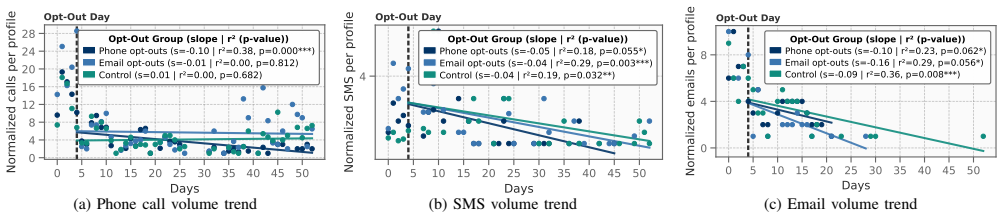
By instrumenting over 100 health lead-generation websites and monitoring 200 controlled contacts, the authors trace data flows showing sharing of highly personal health information to more than 70 distinct third parties. Purchasing leads reveals deceptive practices including selling to unvetted buyers and fabricating attributes like health status. Consumers received over 8,000 telemarketing calls, 600 texts, and 200 emails, with calls often using VoIP spoofing, and opt-outs proving ineffective at stopping all communications. Analysis of BBB complaints supports these observations from the consumer side.
What carries the argument
An end-to-end measurement framework that instruments lead websites and uses controlled contact points to trace data sharing and downstream spam practices.
If this is right
- Sensitive health data is monetized by being sold across many parties without strong compliance.
- Lead platforms engage in deceptive practices by augmenting or fabricating consumer attributes.
- High-frequency dialing and neighbor spoofing make phones unusable for many consumers.
- Existing opt-out mechanisms fail to fully protect consumers from marketing.
- Consumer complaints to BBB align with the measured spam volumes.
Where Pith is reading between the lines
- Similar measurement approaches could help identify and regulate data brokers in other industries.
- The rapid start of calls suggests automated systems that could be targeted by enforcement.
- Consumers may need stronger rights to control data after submission to prevent fabrication.
- This ecosystem's non-compliance highlights gaps in current privacy laws enforcement.
Load-bearing premise
The chosen health-related websites and controlled contacts accurately reflect the typical experiences and data flows for average consumers in the lead marketing ecosystem.
What would settle it
Finding that similar lead generation sites share data with few or no third parties and generate minimal spam after form submissions would contradict the reported scale of sharing and aggressive marketing.
Figures





read the original abstract
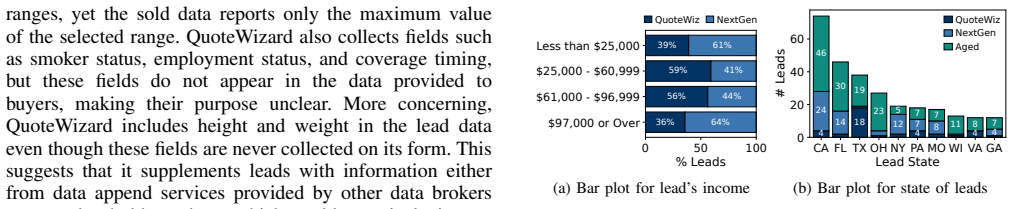
The lead marketing ecosystem enables collection, sale, and use of personal data submitted via web forms to deliver personalized quotes in high-value verticals such as insurance. Despite its scale and sensitivity of the collected data, this ecosystem remains largely unexplored by the research community. We present the first empirical study of privacy and spam risks in lead marketing, developing an end-to-end measurement framework to trace data flows from data collection to consumer contact. Our setup instruments over 100 health-related lead-generation websites and monitors 200 controlled phone numbers and email addresses to understand downstream marketing practices. We observe sharing of highly personal and sensitive health information to more than 70 distinct third parties on these lead generation websites. By purchasing our own and other organic leads from three major lead platforms, we uncover deceptive brokerage practices, where consumer data is sold to unvetted buyers and often augmented or fabricated with attributes such as health status and weight. We received a total of over 8,000 telemarketing phone calls, 600 text messages, and 200 emails, where calls often began within seconds of form submission. Many campaigns relied on VoIP-based neighbor spoofing and high-frequency dialing, at times rendering phones unusable. Our experiments with phone and email opt-outs suggest phone-based opt-outs to help the most, although all were ineffective at completely stopping marketing communications. Analysis of 7,432 Better Business Bureau (BBB) complaints and reviews corroborates these findings from the consumer perspective. Overall, our results reveal a highly interconnected and non-compliant lead marketing ecosystem that aggressively monetizes sensitive consumer data.
Editorial analysis
A structured set of objections, weighed in public.
Referee Report
Summary. The paper presents the first empirical study of privacy and spam risks in the lead marketing ecosystem. It instruments over 100 health-related lead-generation websites, monitors 200 controlled phone numbers and email addresses, purchases leads from three major platforms, and analyzes 7,432 BBB complaints. Key observations include sharing of sensitive health data to more than 70 third parties, deceptive brokerage practices involving fabricated attributes, over 8,000 telemarketing calls (often starting within seconds and using VoIP spoofing), 600 texts, and 200 emails, with opt-outs proving largely ineffective. The authors conclude that the ecosystem is highly interconnected, non-compliant, and aggressively monetizes sensitive consumer data across high-value verticals.
Significance. If the empirical observations hold and the scope limitations are addressed, this would be a significant contribution as the first end-to-end measurement of data flows from collection through brokerage to consumer contact in lead marketing. The multi-method design, including real lead purchases and controlled contact monitoring, provides concrete evidence of privacy harms and spam tactics that could inform policy and future research on data brokerage.
major comments (1)
- [Abstract] Abstract: The central claim that the results reveal a 'highly interconnected and non-compliant lead marketing ecosystem' operating across 'high-value verticals such as insurance' rests on an untested uniformity assumption. All primary measurements (instrumentation of 100+ sites, lead purchases, contact monitoring, and third-party observations) are confined to health-related websites, with no data, overlap statistics, or sampling argument provided for other verticals despite the abstract's broader framing.
minor comments (2)
- The methodology lacks explicit details on site selection criteria for the 100+ health websites and potential selection biases.
- Discussion of how the 200 controlled contacts and purchased leads were chosen to represent typical consumer experiences would improve clarity.
Simulated Author's Rebuttal
We thank the referee for their constructive review and for highlighting the need to align the abstract's claims more closely with the empirical scope of the study. We address the major comment below and have revised the manuscript to improve precision without altering the core contributions.
read point-by-point responses
-
Referee: [Abstract] Abstract: The central claim that the results reveal a 'highly interconnected and non-compliant lead marketing ecosystem' operating across 'high-value verticals such as insurance' rests on an untested uniformity assumption. All primary measurements (instrumentation of 100+ sites, lead purchases, contact monitoring, and third-party observations) are confined to health-related websites, with no data, overlap statistics, or sampling argument provided for other verticals despite the abstract's broader framing.
Authors: We agree that the abstract's phrasing risks implying uniform findings across all verticals without direct empirical support from non-health sites. Our instrumentation, lead purchases, and contact monitoring were performed exclusively on health-related lead-generation websites, as stated in the methods and results sections. While the lead marketing ecosystem exhibits structural similarities across verticals (e.g., form-based collection, brokerage platforms, and aggressive outbound contact), we did not collect or analyze data from insurance or other non-health sites and therefore cannot claim direct evidence of uniformity. To address this, we will revise the abstract to explicitly scope the claims to the health vertical studied, qualify the broader ecosystem description as contextual rather than empirically demonstrated across verticals, and add a limitations paragraph discussing the absence of cross-vertical sampling. This revision preserves the paper's focus on the measured health data flows while correcting the overgeneralization. revision: yes
Circularity Check
No circularity: purely observational empirical study with no derivations or self-referential predictions
full rationale
The paper reports direct measurements from instrumenting 100+ health websites, purchasing leads, monitoring 200 contacts, and analyzing 7,432 BBB complaints. No equations, fitted parameters, predictions, or mathematical derivations appear in the abstract or described methodology. Claims about interconnection and non-compliance rest on observed data flows and consumer reports rather than any reduction to inputs by construction or self-citation chains. Generalization from health vertical to broader ecosystem is a representativeness issue, not circularity per the defined patterns.
Axiom & Free-Parameter Ledger
Forward citations
Cited by 2 Pith papers
-
Tracking Conversations: Measuring Content and Identity Exposure on AI Chatbots
17 of 20 AI chatbots share conversation content or identifiers with third parties, including plaintext text sent to Microsoft Clarity via session replay in three cases.
-
Tracking Conversations: Measuring Content and Identity Exposure on AI Chatbots
17 of 20 AI chatbots share conversation content or identifiers with third parties, including plaintext prompt and response text with Microsoft Clarity in three cases.
Reference graph
Works this paper leans on
-
[1]
Public Law 63–203, 38 Stat
Federal trade commission act. Public Law 63–203, 38 Stat. 717,
-
[2]
§§ 41-58
Codified at 15 U.S.C. §§ 41-58
-
[3]
Technical report, U.S
The belmont report: Ethical principles and guidelines for the protec- tion of human subjects of research. Technical report, U.S. Department of Health, Education, and Welfare, 1979
1979
-
[4]
Technical report, U.S
The menlo report: Ethical principles guiding information and com- munication technology research. Technical report, U.S. Department of Homeland Security, 2012
2012
-
[5]
https://leginfo.legislature.ca
California consumer privacy act of 2018. https://leginfo.legislature.ca. gov/faces/codes displayText.xhtml?division=3.&part=4.&lawCode= CIV&title=1.81.5, 2018. California Civil Code §1798.100–1798.199
2018
-
[6]
No bound- aries: data exfiltration by third parties embedded on web pages
Gunes Acar, Steven Englehardt, and Arvind Narayanan. No bound- aries: data exfiltration by third parties embedded on web pages. Proceedings on Privacy Enhancing Technologies, 2020(4):220–238
2020
-
[7]
Leadconduit’s ping post
ActiveProspect. Leadconduit’s ping post. https://activeprospect.com/ blog/leadconduit-now-offers-real-time-ping-post-bidding/, 2020
2020
-
[8]
Discover leadconduit & automate your lead flows
ActiveProspect. Discover leadconduit & automate your lead flows. https://activeprospect.com/leadconduit/, 2025. Accessed: 2025-09-22
2025
-
[9]
How does Ping-post work in lead generation? Ac- tiveProspect Glossary, 2025
ActiveProspect. How does Ping-post work in lead generation? Ac- tiveProspect Glossary, 2025. Accessed: 2025-09-22
2025
-
[10]
J ¨ager: Automated telephone call traceback
David Adei, Varun Madathil, Sathvik Prasad, Bradley Reaves, and Alessandra Scafuro. J ¨ager: Automated telephone call traceback. In Proceedings of the 2024 on ACM SIGSAC Conference on Computer and Communications Security, pages 2042–2056, 2024
2024
-
[11]
Advances in lead generation and mar- keting efficiency through predictive campaign analytics.IJMRGE, 3(1):1143–1154, 2022
Oluwademilade Aderemi Agboola, Jeffrey Chidera Ogeawuchi, Abra- ham Ayodeji Abayomi, Abiodun Yusuf Onifade, OO George, and Remolekun Enitan Dosumu. Advances in lead generation and mar- keting efficiency through predictive campaign analytics.IJMRGE, 3(1):1143–1154, 2022
2022
-
[12]
Machine learning techniques for spam detection in email and iot platforms: analysis and research challenges
Naeem Ahmed, Rashid Amin, Hamza Aldabbas, Deepika Koundal, Bader Alouffi, and Tariq Shah. Machine learning techniques for spam detection in email and iot platforms: analysis and research challenges. Security and Communication Networks, 2022(1):1862888, 2022
2022
-
[13]
10 top states where health insurers dominate: New study
American Medical Association. 10 top states where health insurers dominate: New study. American Medical Association, 2021
2021
-
[14]
Educational data brokers: Using the walkthrough method to identify data brokering by edtech platforms.Learning, Media and Technology, 49(2):320–333, 2024
Janine Arantes. Educational data brokers: Using the walkthrough method to identify data brokering by edtech platforms.Learning, Media and Technology, 49(2):320–333, 2024
2024
-
[15]
How to verify leads: A guide for lead buyers, 2025
Andrew Bailey. How to verify leads: A guide for lead buyers, 2025
2025
-
[16]
Modern lead generation in internet marketing for the development of enter- prise potential
Svitlana Bondarenko, Olena Laburtseva, Olena V Sadchenko, Vira Lebedieva, Oleksandra Haidukova, and Tetyana Kharchenko. Modern lead generation in internet marketing for the development of enter- prise potential. 2019
2019
-
[17]
Using thematic analysis in psychology.Qualitative research in psychology, 3(2):77–101, 2006
Virginia Braun and Victoria Clarke. Using thematic analysis in psychology.Qualitative research in psychology, 3(2):77–101, 2006
2006
-
[18]
A survey on web tracking: Mechanisms, implications, and defenses.Proceedings of the IEEE, 105(8):1476–1510, 2017
Tomasz Bujlow, Valent´ın Carela-Espa˜nol, Josep Sole-Pareta, and Pere Barlet-Ros. A survey on web tracking: Mechanisms, implications, and defenses.Proceedings of the IEEE, 105(8):1476–1510, 2017
2017
-
[19]
9 trends driving historic aca enrollment growth
Terry Burke, Shyam Vichare, Travis Kistler, and Ali Mar. 9 trends driving historic aca enrollment growth. Oliver Wyman, 2024. Ac- cessed: 2025-09-24
2024
-
[20]
Reflexive thematic analysis for applied qualitative health research.The Qualitative Report, 26(6):2011–2028, 2021
Karen A Campbell, Elizabeth Orr, Pamela Durepos, Linda Nguyen, Lin Li, Carly Whitmore, Paige Gehrke, Leslie Graham, and Susan M Jack. Reflexive thematic analysis for applied qualitative health research.The Qualitative Report, 26(6):2011–2028, 2021
2011
-
[21]
Optimizing insurance sales through automated lead management.NAJER, 4(4), 2023
Rahul Deb Chakladar. Optimizing insurance sales through automated lead management.NAJER, 4(4), 2023
2023
-
[22]
You shall not register! detecting privacy leaks across registration forms
Manolis Chatzimpyrros, Konstantinos Solomos, and Sotiris Ioannidis. You shall not register! detecting privacy leaks across registration forms. InInternational Workshop on Information and Operational Technology Security Systems, pages 91–104. Springer, 2019
2019
-
[23]
Lead generation m&a fall 2024
COLADV . Lead generation m&a fall 2024. COLADV Report, 2024
2024
-
[24]
Rules and regulations imple- menting the telephone consumer protection act of 1991 (tcpa)
Federal Communications Commission. Rules and regulations imple- menting the telephone consumer protection act of 1991 (tcpa). Federal Register document, November 2024
1991
-
[25]
Strengthening the abil- ity of consumers to stop robocalls.Federal Register, 89(2024- 04587):15756–15763, 2024
Federal Communications Commission. Strengthening the abil- ity of consumers to stop robocalls.Federal Register, 89(2024- 04587):15756–15763, 2024. Rule; CG Docket No. 02-278; FCC 24- 24; 47 CFR 64
2024
-
[26]
Lead generation: When the “product” is personal data
Federal Trade Commission. Lead generation: When the “product” is personal data. Business Guidance / FTC blog, July 2017
2017
-
[27]
California-based lead generator agrees to settlement banning it from making or assisting others in making telemarketing calls, including robocalls
Federal Trade Commission. California-based lead generator agrees to settlement banning it from making or assisting others in making telemarketing calls, including robocalls. Press release, January 2024
2024
-
[28]
The limits of transparency: Data brokers and com- modification.New media & society, 20(1):88–104, 2018
Matthew Crain. The limits of transparency: Data brokers and com- modification.New media & society, 20(1):88–104, 2018
2018
-
[29]
Un- derstanding privacy norms through web forms.arXiv preprint arXiv:2408.16304, 2024
Hao Cui, Rahmadi Trimananda, and Athina Markopoulou. Un- derstanding privacy norms through web forms.arXiv preprint arXiv:2408.16304, 2024
-
[30]
Reproducibility and replicability of web measurement studies
Nurullah Demir, Matteo Große-Kampmann, Tobias Urban, Christian Wressnegger, Thorsten Holz, and Norbert Pohlmann. Reproducibility and replicability of web measurement studies. InProceedings of the ACM Web Conference 2022, pages 533–544, 2022
2022
-
[31]
A study on the opportunities and challenges of digital insurance marketing.Turkish Online Journal of Qualitative Inquiry, 12(7), 2021
Uma Dubey and Madhu Dixit. A study on the opportunities and challenges of digital insurance marketing.Turkish Online Journal of Qualitative Inquiry, 12(7), 2021
2021
-
[32]
Fcc confirms that tcpa applies to ai technologies that generate human voices, 2024
Federal Communications Commission. Fcc confirms that tcpa applies to ai technologies that generate human voices, 2024
2024
-
[33]
In the matter of rules and regulations implementing the telephone consumer protection act of 1991
Federal Communications Commission. In the matter of rules and regulations implementing the telephone consumer protection act of 1991. https://docs.fcc.gov/public/attachments/FCC-24-24A1.pdf,
1991
-
[34]
Rules and regulations im- plementing the tcpa act of 1991
Federal Communications Commission. Rules and regulations im- plementing the tcpa act of 1991. https://www.fcc.gov/document/ rules-and-regulations-implementing-tcpa-act-1991-0, 2025
1991
-
[35]
National do not call registry data book: Fiscal year 2024
Federal Trade Commission. National do not call registry data book: Fiscal year 2024. Technical report, Federal Trade Commission, Washington, DC, November 2024
2024
-
[36]
2021 florida statutes (including 2021b session)
Florida Senate. 2021 florida statutes (including 2021b session). https: //www.flsenate.gov/laws/statutes/2021/501.616, 2021
2021
-
[37]
Leaky autofill: An empirical study on the privacy threat of password managers’ autofill functionality
Yanduo Fu and Ding Wang. Leaky autofill: An empirical study on the privacy threat of password managers’ autofill functionality. In 2024 Annual Computer Security Applications Conference (ACSAC), pages 288–303. IEEE, 2024
2024
-
[38]
Abdullah Ghani, Yash Vekaria, and Zubair Shafiq. Pixelconfig: Longitudinal measurement and reverse-engineering of meta pixel configurations.arXiv preprint arXiv:2603.09380, 2026
-
[39]
Jiahui He, Pete Snyder, Hamed Haddadi, Fabi ´an E Bustamante, and Gareth Tyson. Measuring the accuracy and effectiveness of pii removal services.arXiv preprint arXiv:2505.06989, 2025
-
[40]
Hanging up too early: remedies to reduce robocalls
Maria G Hibbard. Hanging up too early: remedies to reduce robocalls. Case W. Res. JL Tech. & Internet, 5:79, 2014
2014
-
[41]
Cloak of Visibility: Detecting When Machines Browse a Different Web
Luca Invernizzi, Kurt Thomas, Alexandros Kapravelos, Oxana Co- manescu, Jean-Michel Picod, and Elie Bursztein. Cloak of Visibility: Detecting When Machines Browse a Different Web. S&P, 2016
2016
-
[42]
A review of spam email detection: analysis of spammer strategies and the dataset shift problem.Artificial Intelligence Review, 56(2):1145–1173, 2023
Francisco J ´a˜nez-Martino, Roc ´ıo Alaiz-Rodr´ıguez, V´ıctor Gonz´alez- Castro, Eduardo Fidalgo, and Enrique Alegre. A review of spam email detection: analysis of spammer strategies and the dataset shift problem.Artificial Intelligence Review, 56(2):1145–1173, 2023
2023
-
[43]
What are the largest lead generation niches? MonetizePros, 2021
Michael Johnston. What are the largest lead generation niches? MonetizePros, 2021
2021
-
[44]
Spamalytics: An empirical analysis of spam marketing conversion
Chris Kanich, Christian Kreibich, Kirill Levchenko, Brandon Enright, Geoffrey M V oelker, Vern Paxson, and Stefan Savage. Spamalytics: An empirical analysis of spam marketing conversion. InProceed- ings of the 15th ACM conference on Computer and communications security, pages 3–14, 2008
2008
-
[45]
Tracking the surveillance and information practices of data brokers: A report
Rahul Kanwal and Kevin Walby. Tracking the surveillance and information practices of data brokers: A report. 2024
2024
-
[46]
Measuring biases in a data broker’s coverage
Levi Kaplan, Alan Mislove, and Piotr Sapie ˙zy´nski. Measuring biases in a data broker’s coverage. InAMC IMC, 2021
2021
-
[47]
Julia B Kieserman, Athanasios Andreou, Chris Geeng, Tobias Lauinger, and Damon McCoy. Tracker installations are not created equal: Understanding tracker configuration of form data collection. arXiv preprint arXiv:2506.16891, 2025
-
[48]
Data brokers and the sale of americans’ mental health data.Durham: Duke Sanford School of Public Policy, 2023
Joanne Kim. Data brokers and the sale of americans’ mental health data.Durham: Duke Sanford School of Public Policy, 2023
2023
-
[49]
Generative artificial intelligence in marketing: Applications, opportunities, challenges, and research agenda, 2024
Nir Kshetri, Yogesh K Dwivedi, Thomas H Davenport, and Niki Panteli. Generative artificial intelligence in marketing: Applications, opportunities, challenges, and research agenda, 2024
2024
-
[50]
Fill in the blanks: Empirical analysis of the privacy threats of browser form autofill
Xu Lin, Panagiotis Ilia, and Jason Polakis. Fill in the blanks: Empirical analysis of the privacy threats of browser form autofill. InProceedings of the 2020 ACM SIGSAC Conference on Computer and Communications Security, pages 507–519, 2020
2020
-
[51]
Selling consumers not lists: The new world of digital decision-making and the role of the fair credit reporting act.Suffolk UL Rev., 46:845, 2013
Ed Mierzwinski and Jeff Chester. Selling consumers not lists: The new world of digital decision-making and the role of the fair credit reporting act.Suffolk UL Rev., 46:845, 2013
2013
-
[52]
E-mail marketing at the crossroads: A stakeholder analysis of unsolicited commercial e-mail (spam).Internet research, 16(1):38–52, 2006
Evangelos Moustakas, C Ranganathan, and Penny Duquenoy. E-mail marketing at the crossroads: A stakeholder analysis of unsolicited commercial e-mail (spam).Internet research, 16(1):38–52, 2006
2006
-
[53]
Every keystroke you make: A tech-law measurement and analysis of event listeners for wiretapping,
Shaoor Munir, Nurullah Demir, Qian Li, Konrad Kollnig, and Zubair Shafiq. Every keystroke you make: A tech-law measurement and analysis of event listeners for wiretapping.arXiv preprint arXiv:2508.19825, 2025
-
[54]
Data deserts and black boxes: The impact of socio-economic status on consumer profiling.Management Science, 70(11):8003–8029, 2024
Nico Neumann, Catherine E Tucker, Levi Kaplan, Alan Mislove, and Piotr Sapiezynski. Data deserts and black boxes: The impact of socio-economic status on consumer profiling.Management Science, 70(11):8003–8029, 2024
2024
-
[55]
Fron- tiers: How effective is third-party consumer profiling? evidence from field studies.Marketing Science, 38(6):918–926, 2019
Nico Neumann, Catherine E Tucker, and Timothy Whitfield. Fron- tiers: How effective is third-party consumer profiling? evidence from field studies.Marketing Science, 38(6):918–926, 2019
2019
-
[56]
Nathan Sosa, Rep
Offices of Rep. Nathan Sosa, Rep. Farrah Chaichi, and Rep. David Gomberg. Oregon house passes telemarketing modernization act. Press release, April 2025. HB 3865 A
2025
-
[57]
Why Johnny Can’t Browse in Peace: On the Uniqueness of Web Browsing History Patterns
Lukasz Olejnik, Claude Castelluccia, and Artur Janc. Why Johnny Can’t Browse in Peace: On the Uniqueness of Web Browsing History Patterns. PETS, 2012
2012
-
[58]
Who’s calling? characterizing robocalls through audio and metadata analysis
Sathvik Prasad, Elijah Bouma-Sims, Athishay Kiran Mylappan, and Bradley Reaves. Who’s calling? characterizing robocalls through audio and metadata analysis. In29th USENIX Security Symposium (USENIX Security 20), pages 397–414, 2020
2020
-
[59]
Diving into robocall content with{SnorCall}
Sathvik Prasad, Trevor Dunlap, Alexander Ross, and Bradley Reaves. Diving into robocall content with{SnorCall}. In32nd USENIX Security Symposium (USENIX Security 23), pages 427–444, 2023
2023
-
[60]
Char- acterizing robocalls with multiple vantage points
Sathvik Prasad, Aleksandr Nahapetyan, and Bradley Reaves. Char- acterizing robocalls with multiple vantage points. In2025 IEEE Symposium on Security and Privacy (SP), pages 19–36. IEEE, 2025
2025
-
[61]
A study on utility and feasibility of digital marketing tools with lead acquisition, lead nurturing and client engagement
U Prasanna Kumar and R Arthi. A study on utility and feasibility of digital marketing tools with lead acquisition, lead nurturing and client engagement. InInternational conference on economics, business and sustainability, pages 198–204. Springer, 2023
2023
-
[62]
Wiley, 2014
Dayna Rothman.Lead generation for dummies. Wiley, 2014
2014
-
[63]
The sales lead black hole: On sales reps’ follow-up of marketing leads.Journal of marketing, 77(1):52–67, 2013
Gaurav Sabnis, Sharmila C Chatterjee, Rajdeep Grewal, and Gary L Lilien. The sales lead black hole: On sales reps’ follow-up of marketing leads.Journal of marketing, 77(1):52–67, 2013
2013
-
[64]
Using chatbots against voice spam: Analyzing{Lenny’s}effectiveness
Merve Sahin, Marc Relieu, and Aur ´elien Francillon. Using chatbots against voice spam: Analyzing{Lenny’s}effectiveness. InSOUPS 2017, pages 319–337, 2017
2017
-
[65]
What is lead generation? guide & best practices
Salesforce. What is lead generation? guide & best practices. https: //www.salesforce.com/marketing/lead-generation-guide/, 2025
2025
-
[66]
AMACOM Div AMA, 2013
David T Scott.The new rules of Lead Generation: proven strategies to maximize marketing ROI. AMACOM Div AMA, 2013
2013
-
[67]
Leaky forms: A study of email and password exfiltration before form submission
Asuman Senol, Gunes Acar, Mathias Humbert, and Fred- erik Zuiderveen Borgesius. Leaky forms: A study of email and password exfiltration before form submission. In31st USENIX Security Symposium (USENIX Security 22), pages 1813–1830, 2022
2022
-
[68]
Advertising in health insurance markets.Market- ing Science, 39(3):587–611, 2020
Bradley T Shapiro. Advertising in health insurance markets.Market- ing Science, 39(3):587–611, 2020
2020
-
[69]
Lead generation market overview
Ronit Sharma and Neha Kashyap. Lead generation market overview. Technical report, Roots Analysis, November 2024
2024
-
[70]
Data brokers and sensitive data on us individuals
Justin Sherman. Data brokers and sensitive data on us individuals. Duke University Sanford Cyber Policy Program, 9, 2021
2021
-
[71]
Data brokers and the sale of data on us military personnel, 2023
Justin Sherman, Hayley Barton, Aden Klein, Brady Kruse, and Anushka Srinivasan. Data brokers and the sale of data on us military personnel, 2023
2023
-
[72]
Are you sure you want to contact us? quantifying the leakage of pii via website contact forms.Proceedings on Privacy Enhancing Technologies, 2016
Oleksii Starov, Phillipa Gill, and Nick Nikiforakis. Are you sure you want to contact us? quantifying the leakage of pii via website contact forms.Proceedings on Privacy Enhancing Technologies, 2016
2016
-
[73]
Pearson Education, 2012
Ruth Stevens.Maximizing lead generation: The complete guide for B2B marketers. Pearson Education, 2012
2012
-
[74]
Online lead generation: An emerging industry.Mar- keting Review St
Simon Stolz, Kilian C Wisskirchen, Christian Schlereth, and Alexan- der Hoffmann. Online lead generation: An emerging industry.Mar- keting Review St. Gallen, 38(4):32–39, 2021
2021
-
[75]
a how website owners face privacy issues: Thematic analysis of responses from a covert notification study reveals diverse circumstances and challenges
Alina St ¨over, Nina Gerber, Henning Prid ¨ohl, Max Maass, Sebastian Bretthauer, I Spiecker, M Hollick, and D Herrmann. a how website owners face privacy issues: Thematic analysis of responses from a covert notification study reveals diverse circumstances and challenges. Proc Priv Enhanc Technol, 2023
2023
-
[76]
Lead generation strategies for financial services and institutions, June 4 2025
Martyna Targosz. Lead generation strategies for financial services and institutions, June 4 2025. Accessed 2025-11-04
2025
-
[77]
Quickstart for number lookup
Telnyx LLC. Quickstart for number lookup. https://developers.telnyx. com/docs/identity/number-lookup/quickstart, 2025
2025
-
[78]
Sok: Everyone hates robocalls: A survey of techniques against telephone spam
Huahong Tu, Adam Doup ´e, Ziming Zhao, and Gail-Joon Ahn. Sok: Everyone hates robocalls: A survey of techniques against telephone spam. In2016 IEEE Symposium on Security and Privacy (SP), pages 320–338. IEEE, 2016
2016
-
[79]
Beyond the Front Page: Measuring Third Party Dynamics in the Field
Tobias Urban, Martin Degeling, Thorsten Holz, and Norbert Pohlmann. Beyond the Front Page: Measuring Third Party Dynamics in the Field. Inwww, TheWebConf, 2020
2020
-
[80]
Census Bureau
U.S. Census Bureau. Income in the united states: 2023. Technical Report P60-282, U.S. Department of Commerce, Economics and Statistics Administration, 2024
2023
discussion (0)
Sign in with ORCID, Apple, or X to comment. Anyone can read and Pith papers without signing in.