REVIEW 3 major objections 2 minor 2 cited by
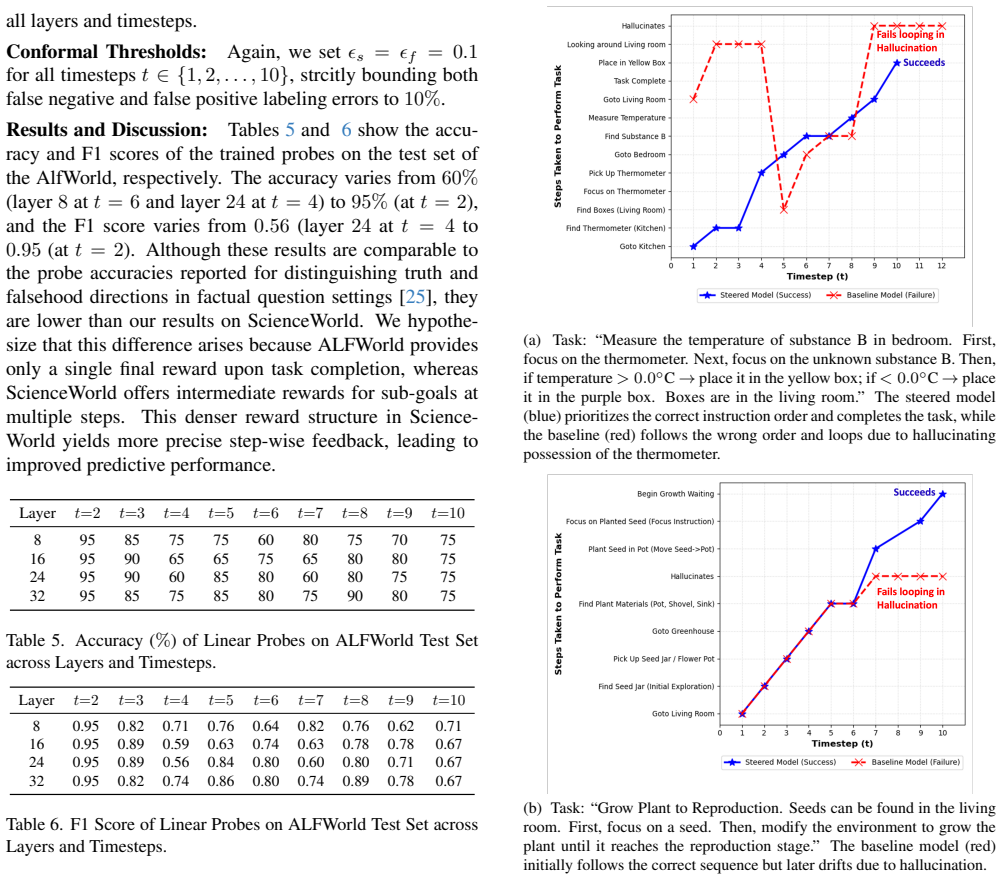
Step-wise conformal labels make success, failure, and reasoning drift in LLM agents linearly readable in activation space, enabling early detection and steering.
Reviewed by Pith at T0; open to challenge. T0 means a machine referee read the full paper against a public rubric. the ladder, T0–T4 →
T0 review · grok-4.5
2026-07-13 17:16 UTC pith:UG5FKO4W
load-bearing objection We do not have the conformal-agent paper: the full text is ESGLens (2604.19779), so 2604.19775 cannot be audited from this packet. the 3 major comments →
From Actions to Understanding: Conformal Interpretability of Temporal Concepts in LLM Agents
The pith
A machine-rendered reading of the paper's core claim, the machinery that carries it, and where it could break.
Core claim
When each agent step is labeled by step-wise rewards under conformal prediction, the resulting labels support linear probes that isolate latent directions in the model’s activations corresponding to temporal notions of success, failure, and reasoning drift; those directions are separable on ScienceWorld and AlfWorld and can be steered to improve agent performance.
What carries the argument
The conformal interpretability framework for temporal tasks: step-wise reward modeling plus conformal prediction produces statistical success/failure labels on internal activations at each step; linear probes then recover the temporal-concept directions used for detection and steering.
Load-bearing premise
That step-wise rewards plus conformal labels truly mark the agent’s internal sense of trajectory success or failure, rather than environment reward artifacts or probe overfitting, so the recovered directions are causally meaningful for intervention.
What would settle it
On held-out ScienceWorld or AlfWorld trajectories, intervene only along the recovered “success” direction at early steps and check whether final task success rates rise while reverse steering along the failure direction lowers them; if neither rate moves, the directions are not causally useful.
If this is right
- Mid-trajectory activations can be monitored for statistically calibrated early failure signals without waiting for episode end.
- Linear success directions become a practical control knob for intervening in agent behavior during multi-step plans.
- Interpretability of sequential agents can be stated as linear separability of temporal concepts rather than only final-answer probes.
- Trustworthy deployment of LLM agents in interactive settings can rest on detection-plus-steering loops built from the same labels.
Where Pith is reading between the lines
- If the same conformal labels transfer across environments, a shared library of temporal-concept directions could serve as a portable safety layer for new agent tasks.
- Reasoning-drift directions may flag planning loops or goal abandonment before reward collapses, which would matter for long-horizon agents beyond the two simulators tested.
- Combining these directions with existing activation-steering methods could turn post-hoc interpretability into online closed-loop control for agents.
Editorial analysis
A structured set of objections, weighed in public.
Referee Report
Summary. The submission under review is identified as arXiv:2604.19775, 'From Actions to Understanding: Conformal Interpretability of Temporal Concepts in LLM Agents.' Its abstract proposes a conformal interpretability framework for temporal tasks in LLM agents: step-wise reward modeling combined with conformal prediction to label internal representations as successful or failing, linear probes to recover directions for success/failure/reasoning drift, experiments on ScienceWorld and AlfWorld claiming linear separability, and preliminary steering of success directions to improve agent performance. The body supplied as the full manuscript, however, is an entirely different paper—ESGLens (arXiv:2604.19779, Yang & Chen)—a RAG pipeline for GRI-guided ESG report extraction and regression-based score prediction against LSEG scores, with no conformal prediction, no agent trajectories, no activation probes, and no ScienceWorld/AlfWorld results.
Significance. If the abstract’s claims were substantiated—statistically valid step-wise conformal labels, linearly separable temporal concepts in agent activations, and causal gains from steering—the work would be a meaningful contribution to trustworthy LLM agents and mechanistic interpretability under sequential decision-making. That significance cannot be assessed from the supplied manuscript: none of the abstract’s methods, environments, or results appear in the ESGLens text. The ESGLens pipeline itself is a domain-specific RAG+regression prototype with modest reported correlation (r≈0.48 on ~300 environmental-pillar reports) and released code, but it is not the paper under review.
major comments (3)
- Manuscript identity mismatch (title/abstract vs. full text): The abstract and paper_id describe a conformal interpretability framework for LLM agents (step-wise rewards, conformal labeling, linear probes for temporal concepts, ScienceWorld/AlfWorld, steering). The full manuscript text is ESGLens—an LLM RAG framework for ESG report analysis and score prediction (GRI extraction, FAISS retrieval, ChatGPT/BERT/RoBERTa embeddings, NN/LightGBM regression vs. LSEG). No section of the body implements or evaluates the abstract’s claims. The central scientific claims are therefore not present in the document under review and cannot be audited.
- Unauditable experimental claims: Linear separability of temporal concepts, conformal coverage/validity of step-wise labels, and steering performance gains are asserted only in the abstract. The body contains no agent environments, activation collection protocol, conformal procedure, probe training details, baselines, ablations, error bars, or intervention results. Without the correct manuscript, soundness of the load-bearing premise—that conformal labels reflect internal success/failure rather than reward artifacts—cannot be checked.
- If the ESGLens body were instead the intended submission, its own central scoring claim remains limited: ChatGPT embeddings + Neural Network achieve Pearson r≈0.48 (R²≈0.23) on ~300 reports restricted to the environmental pillar (Conclusion and §Limitations). That is a modest signal; MAE/RMSE are deferred, social/governance pillars are omitted, and multimodal table/chart content is not extracted—so the quantitative prediction claim is under-supported for a strong accept even on its own terms.
minor comments (2)
- Even within the ESGLens text, figure/table numbering and residual OCR artifacts (e.g., 'F AISS', broken ligatures) reduce clarity; Table 4–6 and the emissions summary are useful but disconnected from any conformal/agent narrative.
- Related-work positioning in ESGLens is reasonable for late-2024/early-2025 concurrent systems, but does not substitute for the missing agent-interpretability literature that the abstract would require.
Circularity Check
No circular derivation in the supplied full text; manuscript is ESGLens (score-prediction pipeline), not the conformal-agent paper, so the abstract's claimed chain cannot be reduced or audited.
full rationale
The load-bearing issue is manuscript mismatch, not circularity. The abstract and paper_id describe a conformal interpretability framework for LLM agents (step-wise reward labeling, conformal prediction, linear probes for success/failure/drift, ScienceWorld/AlfWorld, steering). The full manuscript text is a different paper—ESGLens (Yang & Chen), an empirical RAG + GRI extraction + regression pipeline that predicts LSEG ESG scores from report embeddings. That pipeline has no first-principles derivation that reduces to its inputs by construction: PDF chunking, retrieval, prompt extraction, and supervised regression against external LSEG labels are standard engineering steps; the reported Pearson r≈0.48 is a performance metric against an external score source, not a quantity defined by the fit itself. There are no uniqueness theorems, self-citation load-bearing premises, or ansatz-via-citation steps. Because the conformal-agent derivation chain is absent from the supplied full text, no equation-level circular reduction can be exhibited for the abstract's claims either (Hard Rule 1). Honest finding: score 0, no circular steps.
Axiom & Free-Parameter Ledger
free parameters (4)
- conformal significance / coverage level
- step-wise reward model definition
- probe training and layer selection hyperparameters
- steering strength / intervention scale
axioms (4)
- domain assumption Internal residual-stream (or similar) activations of the LLM agent encode linearly readable notions of trajectory success/failure at each step.
- domain assumption Conformal prediction applied to step-wise scores yields statistically valid success/failure labels usable as supervision for interpretability.
- domain assumption ScienceWorld and AlfWorld trajectories are representative enough interactive settings for the claimed temporal concepts.
- ad hoc to paper Steering along probe-identified success directions causally improves agent behavior rather than only correlating with success labels.
invented entities (2)
-
temporal concepts (latent directions for success, failure, reasoning drift)
no independent evidence
-
conformal interpretability framework for temporal tasks
no independent evidence
Cite this review
Pith. "Pith review of From Actions to Understanding: Conformal Interpretability of Temporal Concepts in LLM Agents." pith.science (2026). https://pith.science/paper/UG5FKO4W
@misc{pith2026260419775,
  author       = {Pith},
  title        = {Pith review of: From Actions to Understanding: Conformal Interpretability of Temporal Concepts in LLM Agents},
  year         = {2026},
  howpublished = {\url{https://pith.science/paper/UG5FKO4W}},
  note         = {Machine review of arXiv:2604.19775}
}
read the original abstract
Large Language Models (LLMs) are increasingly deployed as autonomous agents capable of reasoning, planning, and acting within interactive environments. Despite their growing capability to perform multi-step reasoning and decision-making tasks, internal mechanisms guiding their sequential behavior remain opaque. This paper presents a framework for interpreting the temporal evolution of concepts in LLM agents through a step-wise conformal lens. We introduce the conformal interpretability framework for temporal tasks, which combines step-wise reward modeling with conformal prediction to statistically label model's internal representation at each step as successful or failing. Linear probes are then trained on these representations to identify directions of temporal concepts - latent directions in the model's activation space that correspond to consistent notions of success, failure or reasoning drift. Experimental results on two simulated interactive environments, namely ScienceWorld and AlfWorld, demonstrate that these temporal concepts are linearly separable, revealing interpretable structures aligned with task success. We further show preliminary results on improving an LLM agent's performance by leveraging the proposed framework for steering the identified successful directions inside the model. The proposed approach, thus, offers a principled method for early failure detection as well as intervention in LLM-based agents, paving the path towards trustworthy autonomous language models in complex interactive settings.
Figures


Forward citations
Cited by 2 Pith papers
-
Doomed from the Start: Early Abort of LLM Agent Episodes via a Recall-Controlled Probe Cascade
A cascade of recall-calibrated gates on LLM agent hidden states aborts doomed episodes early, saving up to 47% compute at a 90% global success-recall target.
-
Doomed from the Start: Early Abort of LLM Agent Episodes via a Recall-Controlled Probe Cascade
Hidden-state probes can flag doomed LLM-agent episodes from the first round, and a recall-calibrated cascade of abort gates cuts generated tokens by up to 60% while preserving a chosen success-recall target.
Reference graph
Works this paper leans on
-
[1]
A brief history of ESG: From pioneer to mainstream
Dan Byrne. A brief history of ESG: From pioneer to mainstream. The Corporate Governance Institute,
-
[2]
Accessed: May 22, 2024
URL https://www.thecorporategovernanceinstitute.com/insights/guides/a-brief-his tory-of-esg-from-pioneer-to-mainstream/ . Accessed: May 22, 2024
2024
-
[3]
The history of ESG: A journey towards sustainable investing
Tom Krantz. The history of ESG: A journey towards sustainable investing. IBM Think, 2024. URL https://www.ibm.com/think/topics/environmental-social-and-governance-history . Accessed: March 27, 2026
2024
-
[4]
Environmental, social, and corporate governance: A history of ESG standardization from 1970s to the present, 4 2023
Minzhi Luna Wang. Environmental, social, and corporate governance: A history of ESG standardization from 1970s to the present, 4 2023. URL https://sites.asit.columbia.edu/historydept/wp-con tent/uploads/sites/29/2023/05/Wang-Luna_thesis.pdf . Seminar Advisor: Elizabeth Blackmar; Second Reader: Kimberly Phillips-Fein
2023
-
[5]
Evolution of esg reporting frameworks
Satyajit Bose. Evolution of esg reporting frameworks. Values at work: Sustainable investing and ESG reporting, pages 13–33, 2020. URL https://theesgexchange.org/wp-content/uploads/2023/03/E volution-of-ESG-Reporting-Frameworks.pdf
2020
-
[6]
The evolution of esg reports and the role of voluntary standards
Ethan Rouen, Kunal Sachdeva, and Aaron Yoon. The evolution of esg reports and the role of voluntary standards. A vailable at SSRN 4227934, 2023. URL https://www.hbs.edu/ris/Publication%20File s/23-024_5d9ec300-5c37-4cac-9edb-bcf59650ceb4.pdf
2023
-
[7]
Esg standards: Looming challenges and pathways forward
Todd Cort and Daniel Esty. Esg standards: Looming challenges and pathways forward. Organization & Environment, 33(4):491–510, 2020. doi: 10.1177/1086026620945342. URL https://www.jstor.or g/stable/27001593
-
[8]
The impact of unstandardized data on ESG reporting
Julian Göbel. The impact of unstandardized data on ESG reporting. Envoria Insights, May 2022. URL https://envoria.com/insights-news/the-impact-of-unstandardized-data-on-esg-reporting . Accessed: March 27, 2026
2022
-
[9]
The 5 Main Challenges of ESG Reporting and Best Practices
EcoActive. The 5 Main Challenges of ESG Reporting and Best Practices. EcoActive Blog, February
-
[10]
Accessed: March 27, 2026
URL https://ecoactivetech.com/the-5-main-challenges-of-esg-reporting-and-best-p ractices/ . Accessed: March 27, 2026
2026
-
[11]
Euleresg: Automating esg disclosure analysis with llms, 2025
Yi Ding, Xushuo Tang, Zhengyi Yang, Wenqian Zhang, Simin Wu, Yuxin Huang, Lingjing Lan, Weiyuan Li, Yin Chen, Mingchen Ju, Wenke Yang, Thong Hoang, Mykhailo Klymenko, Xiwei Zu, and Wenjie Zhang. Euleresg: Automating esg disclosure analysis with llms, 2025. URL https://arxiv.org/abs/ 2511.21712
arXiv 2025
-
[12]
Developing retrieval augmented generation (rag) based llm systems from pdfs: An experience report,
Ayman Asad Khan, Md Toufique Hasan, Kai Kristian Kemell, Jussi Rasku, and Pekka Abrahamsson. Developing retrieval augmented generation (rag) based llm systems from pdfs: An experience report,
-
[13]
URL https://arxiv.org/abs/2410.15944
-
[14]
Zukang Yang, Zixuan Zhu, and Xuan Zhu. Curiousllm: Elevating multi-document question answering with llm-enhanced knowledge graph reasoning, 2025. URL https://arxiv.org/abs/2404.09077
Pith/arXiv arXiv 2025
-
[15]
Large language models for sus- tainability reporting: A systematic review and research agenda
Seyed Alireza Mousavian Anaraki, Danilo Croce, and Roberto Basili. Large language models for sus- tainability reporting: A systematic review and research agenda. Sustainable Futures, 10:101494, 2025. doi: 10.1016/j.sftr.2025.101494. URL https://doi.org/10.1016/j.sftr.2025.101494
-
[16]
Chatreport: De- mocratizing sustainability disclosure analysis through llm-based tools
Jingwei Ni, Julia Bingler, Chiara Colesanti-Senni, Mathias Kraus, Glen Gostlow, Tobias Schimanski, Dominik Stammbach, Saeid Ashraf Vaghefi, Qian Wang, Nicolas Webersinke, et al. Chatreport: De- mocratizing sustainability disclosure analysis through llm-based tools. arXiv preprint arXiv:2307.15770,
-
[17]
URL https://doi.org/10.48550/arXiv.2307.15770
doi: 10.48550/arXiv.2307.15770. URL https://doi.org/10.48550/arXiv.2307.15770
-
[18]
Esgreveal: An llm-based approach for extracting structured data from esg reports
Yi Zou, Mengying Shi, Zhongjie Chen, Zhu Deng, ZongXiong Lei, Zihan Zeng, Shiming Yang, HongX- iang Tong, Lei Xiao, and Wenwen Zhou. Esgreveal: An llm-based approach for extracting structured data from esg reports. arXiv preprint arXiv:2312.17264, 2023. doi: 10.48550/arXiv.2312.17264. URL https://doi.org/10.48550/arXiv.2312.17264
-
[19]
Retrieval-augmented generation for knowledge-intensive NLP tasks
Patrick Lewis, Ethan Perez, Aleksandra Piktus, Fabio Petroni, Vladimir Karpukhin, Naman Goyal, Heinrich Küttler, Mike Lewis, Wen-tau Yih, Tim Rocktäschel, Sebastian Riedel, and Douwe Kiela. Retrieval-augmented generation for knowledge-intensive NLP tasks. In Advances in Neural Information Processing Systems, volume 33, pages 9459–9474. Curran Associates, ...
2020
discussion (0)
Sign in with ORCID, Apple, or X to comment. Anyone can read and Pith papers without signing in.