Recognition: unknown
Geometric densities and compression radii of knot types
Pith reviewed 2026-05-07 06:03 UTC · model grok-4.3
The pith
A factorization of ropelength into D-density and D-compression radius separates the optimization problems for knotted curves.
A machine-rendered reading of the paper's core claim, the machinery that carries it, and where it could break.
Core claim
Given a Euclidean-invariant and scale-covariant size functional D, the D-density of a curve is length over D and the D-compression radius is D over thickness; their product recovers the ropelength. Within each knot type the four problems (density, compression, packing, ropelength) generally possess distinct minimizing sequences. This follows from the basic optimized inequality and its equality case, from explicit evaluation on the unknot, and from convergence results for polygonal approximations when D is diameter or minimal enclosing radius.
What carries the argument
The factorization of ropelength as D-density times D-compression radius, which decouples the four optimization problems after minimization inside a fixed knot type.
If this is right
- For the unknot the optimal D-density and D-compression radius are attained and can be computed explicitly when D is the diameter or the minimal enclosing radius.
- Polygonal curves converge to smooth curves in compression radius for D equal to diameter or minimal enclosing radius, using standard convergence of polygonal thickness.
- The same factorization and inequality apply to general L^p-type size functionals once suitable convergence hypotheses are verified.
- The factorization relates to other geometric invariants such as distortion, trunk, and supertrunk through the common use of scale-covariant size measures.
- New lower bounds on ropelength still require independent estimates of the density factor and the compression factor; the factorization by itself supplies none.
Where Pith is reading between the lines
- Searches for geometrically ideal representatives of a knot type may need to optimize density and compression separately rather than stopping at a single ropelength minimum.
- The separation suggests that different physical or geometric constraints on knotted objects (packing versus thickness versus total length) are not automatically aligned even at optimality.
- The framework could be tested numerically by comparing minimizing sequences obtained from independent optimization routines for each factor on the same knot type.
- Analogous factorizations might be formulated for embeddings in higher dimensions or for other notions of thickness, provided the size functional remains scale-covariant.
Load-bearing premise
That minimizing sequences exist inside each fixed knot type for the D-density, D-compression radius, and ropelength defined from any given Euclidean-invariant and scale-covariant size functional D.
What would settle it
An explicit knot type together with a scale-covariant D for which the same sequence of curves simultaneously minimizes both ropelength and D-density (or both ropelength and D-compression radius).
Figures



read the original abstract
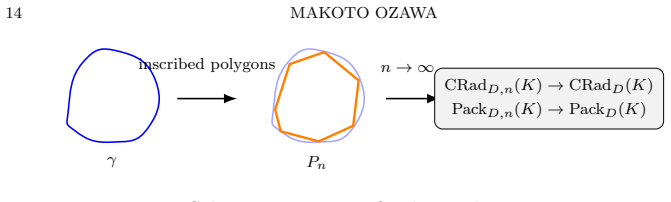
We study scale-invariant geometric quantities associated with embedded closed curves in Euclidean three-space, with an emphasis on their behavior under optimization within a fixed knot type. Given a Euclidean-invariant and scale-covariant size functional \(D\), we define the \(D\)-density of a curve \(\gamma\) by \(\len(\gamma)/D(\gamma)\), the \(D\)-compression radius by \(D(\gamma)/\Thi(\gamma)\), and the corresponding packing ratio as its reciprocal. For a single representative, ropelength factors as the product of the \(D\)-density and the \(D\)-compression radius. The main point is not this formal cancellation, but the separation it suggests after optimization: the density, compression, packing, and ropelength problems generally have different minimizing sequences. We develop this factorization framework for general scale-covariant size functionals. We prove the basic optimized inequality, give a criterion for equality after optimization, and compute the unknot case for the diameter and the minimal enclosing radius. We also prove polygonal approximation results for compression radii when \(D=\diam\) and when \(D=R_{\min}\), using standard convergence properties of polygonal thickness, and formulate the corresponding hypotheses for other \(L^p\)-type size functionals. Finally, we discuss relations with distortion, trunk, and supertrunk. The framework is intended as a structural companion to density-type invariants, rather than as an immediate source of stronger ropelength lower bounds. In particular, the optimized factorization by itself does not yield new ropelength bounds; such bounds require independent estimates for the density and compression factors.
Editorial analysis
A structured set of objections, weighed in public.
Referee Report
Summary. The manuscript defines D-density as len(γ)/D(γ) and D-compression radius as D(γ)/Thi(γ) for a Euclidean-invariant, scale-covariant size functional D on embedded curves. It observes that ropelength factors as the product of these two quantities for any single curve. The central results are an optimized inequality relating the three infima (of ropelength, density, and compression) over a fixed knot type, together with a criterion for equality after optimization; explicit evaluation of the unknot case for D equal to diameter and to minimal enclosing radius; and polygonal approximation theorems for the compression radii when D is diameter or minimal radius, relying on standard convergence of polygonal thickness. Hypotheses are formulated for other L^p-type functionals, and relations to distortion, trunk, and supertrunk are discussed. The framework is presented as a structural companion that suggests the density, compression, packing, and ropelength problems generally possess distinct minimizing sequences.
Significance. If the central claims hold, the work supplies a clean factorization that separates several related geometric optimization problems within knot types and supplies a criterion for when their infima coincide after optimization. The proofs of the inequality and equality criterion, the explicit unknot computations, and the approximation theorems constitute concrete, parameter-free contributions that can serve as a reference point for future studies of ropelength-type invariants. The general treatment for arbitrary scale-covariant D is a strength. However, the assertion that the problems “generally have different minimizing sequences” rests on the equality criterion failing outside the unknot; without either a non-trivial example or a general argument that simultaneous minimization is exceptional, the separation claim remains suggestive rather than demonstrated. The framework does not claim new ropelength bounds, which is appropriately cautious.
major comments (2)
- [§3] §3 (optimized inequality and equality criterion): The equality criterion after optimization is stated in terms of the existence of a single sequence that simultaneously realizes the infima of D-density and D-compression radius. The manuscript supplies no argument showing that this simultaneous realization fails for typical non-trivial knot types, nor any explicit computation for a non-trivial knot that would exhibit strict inequality between the three infima. The only concrete evaluation is the unknot (§4), where the round circle achieves all three infima simultaneously. This gap directly affects the load-bearing claim that the density, compression, packing, and ropelength problems generally possess different minimizing sequences.
- [§5] §5 (polygonal approximation theorems): Theorems 5.1 and 5.2 establish convergence of the compression radii for D = diam and D = R_min under polygonal approximations, invoking standard convergence properties of polygonal thickness. These results address existence and limits but do not connect the approximating sequences to the question of whether the infima of density and compression are attained by the same or distinct curves, leaving the separation of the optimization problems without direct support from the approximation framework.
minor comments (2)
- [§2] §2 (definitions): The scale-covariance property of D is invoked repeatedly but is not given an explicit one-line verification for a general functional D; adding this would improve readability without altering the argument.
- [Discussion] Discussion section: The relations to distortion, trunk, and supertrunk are sketched but lack precise statements of how the new quantities compare numerically or asymptotically with these existing invariants; a short table or remark would clarify the distinctions.
Simulated Author's Rebuttal
We thank the referee for the careful reading and constructive comments on our manuscript. We address the major comments point by point below. Where the comments identify a need for clarification, we have revised the text to tone down suggestive language and to make the status of the equality criterion explicit. We have not added new examples or proofs, as these would require work outside the scope of the present paper.
read point-by-point responses
-
Referee: [§3] §3 (optimized inequality and equality criterion): The equality criterion after optimization is stated in terms of the existence of a single sequence that simultaneously realizes the infima of D-density and D-compression radius. The manuscript supplies no argument showing that this simultaneous realization fails for typical non-trivial knot types, nor any explicit computation for a non-trivial knot that would exhibit strict inequality between the three infima. The only concrete evaluation is the unknot (§4), where the round circle achieves all three infima simultaneously. This gap directly affects the load-bearing claim that the density, compression, packing, and ropelength problems generally possess different minimizing sequences.
Authors: We agree that the manuscript provides neither a general argument nor an explicit non-trivial example demonstrating that simultaneous realization of the two infima fails outside the unknot. The equality criterion is a sufficient condition under which the optimized inequality becomes an equality; the unknot computation in §4 shows that this sufficient condition can be satisfied. The statement that the problems “generally” possess distinct minimizing sequences is therefore based on the factorization together with the expectation that the equality case is exceptional, but remains conjectural. In the revised manuscript we have changed the abstract and the closing paragraph of §3 to read that the framework “suggests” distinct minimizing sequences and that whether the equality criterion holds for non-trivial knots is an open question left for future work. No new example or proof has been added. revision: yes
-
Referee: [§5] §5 (polygonal approximation theorems): Theorems 5.1 and 5.2 establish convergence of the compression radii for D = diam and D = R_min under polygonal approximations, invoking standard convergence properties of polygonal thickness. These results address existence and limits but do not connect the approximating sequences to the question of whether the infima of density and compression are attained by the same or distinct curves, leaving the separation of the optimization problems without direct support from the approximation framework.
Authors: The polygonal approximation theorems establish that the D-compression radii (for D equal to diameter and to minimal enclosing radius) are limits of sequences of polygonal curves, using the standard convergence of polygonal thickness. Their purpose is to guarantee that the infima of the compression factor are approachable by finite polygons, which may be useful for numerical work. We agree that these results do not address whether the minimizing sequences for D-density and D-compression radius coincide. The separation of the optimization problems is indicated by the factorization and the equality criterion of §3 rather than by the approximation theorems. No revision to §5 is required. revision: no
- Constructing or exhibiting an explicit non-trivial knot type for which the infima of D-density and D-compression radius are realized by distinct sequences (i.e., for which the equality criterion fails) would require either a new theoretical argument or substantial numerical optimization and lies outside the results of the current manuscript.
Circularity Check
No circularity: definitions and inequalities are direct from standard infima and pointwise factorization
full rationale
The paper defines D-density as len(γ)/D(γ) and D-compression radius as D(γ)/Thi(γ) for any Euclidean-invariant scale-covariant D. It notes the pointwise algebraic identity ropelength(γ) = density(γ) × compression(γ), then states the standard inequality inf(ropelength) ≥ inf(density) × inf(compression) over a fixed knot type together with a criterion for equality (existence of a sequence simultaneously attaining both infima). These relations follow immediately from the definitions and the general property that inf(fg) ≥ inf(f)·inf(g) when f,g > 0; no fitted parameters, self-referential equations, or load-bearing self-citations appear. Explicit evaluation is performed only for the unknot (where equality holds for the round circle), but this is an application rather than a reduction of the framework itself. Polygonal approximation results invoke standard convergence of polygonal thickness and do not close any loop. The derivation chain is therefore self-contained and non-circular.
Axiom & Free-Parameter Ledger
axioms (2)
- domain assumption The size functional D is Euclidean-invariant and scale-covariant
- domain assumption Minimizing sequences exist within each fixed knot type for the quantities considered
Forward citations
Cited by 1 Pith paper
-
Swept-Area Pseudometrics on Ropelength-Filtered Knot Spaces
Defines swept-area pseudometrics on ropelength-filtered knot spaces, proves non-degeneracy on polygonal strata, exact distances for concentric unknots and ellipses, and rigidity of the ideal unknot.
Reference graph
Works this paper leans on
-
[1]
Ashton, J
T. Ashton, J. Cantarella, M. Piatek, and E. J. Rawdon,Knot tightening by constrained gradient descent, Experimental Mathematics20(2011), no. 1, 57–90
2011
-
[2]
Blair and M
R. Blair and M. Ozawa,Height, trunk and representativity of knots, J. Math. Soc. Japan71(2019), no. 4, 1223–1242
2019
-
[3]
Cantarella, R
J. Cantarella, R. B. Kusner, and J. M. Sullivan,On the minimum ropelength of knots and links, Invent. Math.150(2002), 257–286
2002
-
[4]
Buck and J
G. Buck and J. Simon,Thickness and crossing number of knots, Topology Appl.91 (1999), no. 3, 245–257
1999
-
[5]
Denne, Y
E. Denne, Y. Diao, and J. M. Sullivan,Quadrisecants give new lower bounds for the ropelength of a knot, Geom. Topol.10(2006), 1–26
2006
-
[6]
Denne and J
E. Denne and J. M. Sullivan,The distortion of a knotted curve, Proc. Amer. Math. Soc.132(2004), no. 4, 1139–1148
2004
-
[7]
Diao,The lower bounds of the lengths of thick knots, J
Y. Diao,The lower bounds of the lengths of thick knots, J. Knot Theory Ramifications 12(2003), no. 1, 1–16
2003
-
[8]
Diao,The ropelength conjecture of alternating knots, Math
Y. Diao,The ropelength conjecture of alternating knots, Math. Proc. Cambridge Phi- los. Soc.177(2024), no. 2, 367–369
2024
-
[9]
Y. Diao, C. Ernst, A. Por, and U. Ziegler,The ropelengths of knots are almost linear in terms of their crossing numbers, J. Knot Theory Ramifications28(2019), no. 14, 1950085
2019
-
[10]
Y. Huh, H. Kim, and S. Oh,Ropelength of superhelices and(2, n)-torus knots, J. Phys. A: Math. Theor.51(2018), 485203. 22 MAKOTO OZA W A
2018
-
[11]
H. Kim, S. Oh, and Y. Huh,Efficiency of non-identical double helix patterns in minimizing ropelength of torus knots, Physica Scripta99(2024), no. 7, 075240
2024
-
[12]
A. R. Klotz and M. Maldonado,The ropelength of complex knots, J. Phys. A: Math. Theor.54(2021), 445201
2021
- [13]
- [14]
-
[15]
N. H. Kuiper,A new knot invariant, Math. Ann.278(1987), 193–209
1987
-
[16]
Pardon,On the distortion of knots on embedded surfaces, Ann
J. Pardon,On the distortion of knots on embedded surfaces, Ann. of Math. (2)174 (2011), no. 1, 637–646
2011
-
[17]
E. J. Rawdon and J. K. Simon,Polygonal approximation and energy of smooth knots, J. Knot Theory Ramifications15(2006), no. 4, 429–451. Department of Natural Sciences, Komazawa University, Tokyo, Japan Email address:w3c@komazawa-u.ac.jp
2006
discussion (0)
Sign in with ORCID, Apple, or X to comment. Anyone can read and Pith papers without signing in.