REVIEW 3 major objections 2 minor 2 cited by
Jets shaped the narrow pipe structures seen across some planetary nebulae and core-collapse supernova remnants.
Reviewed by Pith at T0; open to challenge. T0 means a machine referee read the full paper against a public rubric. the ladder, T0–T4 →
T0 review · grok-4.3
2026-06-30 23:46 UTC pith:AF2FUD3M
load-bearing objection This is incremental work in the JJEM series that adds a few PNe examples and one simulation but stays at visual resemblance without numbers or alternative checks. the 3 major comments →
The jet-shaped pipe morphology in planetary nebulae and core-collapse supernova remnants
The pith
A machine-rendered reading of the paper's core claim, the machinery that carries it, and where it could break.
Core claim
Qualitative similarity between the pipe morphology in two CCSNRs and jet-shaped PNe, together with a hydrodynamic simulation of three jet pairs that produces merging narrow lobes, indicates that jets shaped the pipes in both classes of objects and thereby supports the jittering jets explosion mechanism as the primary process for core-collapse supernovae.
What carries the argument
The pipe, defined as a narrow faint zone extending from side to side, formed when opposite jet-driven lobes merge.
Load-bearing premise
Visual resemblance between observed pipe and lobe shapes and the output of one jet simulation means the same jet process actually created the observed features rather than other mechanisms or projection effects.
What would settle it
Finding a CCSNR with a clear pipe but no morphological or kinematic signatures of jets, or a simulation of non-jet processes that still produces a comparable pipe.
If this is right
- More CCSNRs should exhibit pipe or lobe structures traceable to jet activity.
- The two opposite narrow lobes seen in some PNe can evolve into a single pipe through later merging.
- Morphological comparisons between PNe and CCSNRs can serve as a diagnostic for the explosion mechanism in supernovae.
Where Pith is reading between the lines
- If jets dominate the shaping, kinematic maps of CCSNRs should show velocity signatures aligned with the pipe axis.
- The same jet-pair geometry might appear in other supernova remnant classes if the mechanism is general.
- Future high-resolution imaging surveys could test whether pipe frequency correlates with progenitor mass or rotation.
Editorial analysis
A structured set of objections, weighed in public.
Referee Report
Summary. The paper compares 'pipe' morphologies (narrow faint zones extending side-to-side) in two core-collapse supernova remnants (CCSNRs) with similar features in jet-shaped planetary nebulae (PNe), presents additional PNe with opposite narrow lobes, and reports a 3D hydrodynamic simulation of a massive-star explosion using three pairs of jets in the jittering jets explosion mechanism (JJEM). It concludes from qualitative image similarity that jets shaped the pipes in the CCSNRs and PNe, and that this supports JJEM as the primary CCSN explosion mechanism.
Significance. If the morphological analogy were supported by quantitative metrics and exclusion of alternatives, the work would add incremental morphological evidence for jet activity in CCSNRs and contribute to the ongoing debate on CCSN mechanisms. As presented, the qualitative nature of the comparisons limits its ability to distinguish JJEM from other processes.
major comments (3)
- [Abstract and simulation section] Abstract and the section on the hydrodynamic simulation: the claim that the three-pair jet run 'reproduces two opposite narrow lobes' that 'can merge later to form a pipe' rests on visual inspection alone; no quantitative similarity metrics (aspect ratios, surface-brightness profiles, spatial scales, or shape descriptors), parameter values, resolution tests, or time-sequence overlays are reported, rendering the match non-falsifiable.
- [Morphology comparison section] The section comparing CCSNR and PN morphologies: the inference that jets shaped the observed pipes in the two CCSNRs is drawn directly from qualitative resemblance to the PNe and the JJEM simulation, without any statistical test or error analysis on the morphological match and without addressing whether Rayleigh-Taylor/Kelvin-Helmholtz instabilities, asymmetric ejecta, or line-of-sight projection could produce comparable faint zones.
- [Discussion section] Discussion section: the paper interprets the pipe features inside the JJEM framework advocated in prior works by the same authors, but provides no independent test (e.g., predicted velocity fields, abundance patterns, or multi-wavelength signatures) that would break the interpretive loop between assumed jet origin and observed morphology.
minor comments (2)
- [Abstract] The abstract states that 'in some cases the two opposite narrow lobes might merge,' but the manuscript does not specify the fraction of PNe for which this occurs or provide observational examples of intermediate stages.
- [Figure captions] Figure captions and text should clarify whether the displayed images are in the same wavelength band and whether any processing (e.g., continuum subtraction) was applied uniformly to CCSNRs and PNe.
Simulated Author's Rebuttal
We thank the referee for the thoughtful report. We address each major comment below, indicating revisions where appropriate. Our responses focus on the manuscript's scope as a qualitative morphological study within an ongoing series of papers.
read point-by-point responses
-
Referee: [Abstract and simulation section] Abstract and the section on the hydrodynamic simulation: the claim that the three-pair jet run 'reproduces two opposite narrow lobes' that 'can merge later to form a pipe' rests on visual inspection alone; no quantitative similarity metrics (aspect ratios, surface-brightness profiles, spatial scales, or shape descriptors), parameter values, resolution tests, or time-sequence overlays are reported, rendering the match non-falsifiable.
Authors: We agree that the simulation comparison is presented qualitatively. In revision we will expand the simulation section to report the specific jet parameters (velocities, opening angles, durations), grid resolution, and a brief description of the time evolution showing lobe formation and potential merging. Quantitative metrics such as aspect ratios are not reported because the simulation and observations operate at vastly different physical scales and involve projection effects that preclude direct numerical comparison; we will add an explicit statement to this effect. The match remains visual by design, consistent with the paper's morphological focus. revision: partial
-
Referee: [Morphology comparison section] The section comparing CCSNR and PN morphologies: the inference that jets shaped the observed pipes in the two CCSNRs is drawn directly from qualitative resemblance to the PNe and the JJEM simulation, without any statistical test or error analysis on the morphological match and without addressing whether Rayleigh-Taylor/Kelvin-Helmholtz instabilities, asymmetric ejecta, or line-of-sight projection could produce comparable faint zones.
Authors: We acknowledge the absence of statistical tests and alternative explanations. In the revised manuscript we will add a dedicated paragraph discussing why Rayleigh-Taylor or Kelvin-Helmholtz instabilities are unlikely to produce the observed narrow, side-to-side faint zones (based on their typical morphology in CCSNR simulations) and briefly address projection effects. Statistical tests on small samples with heterogeneous image quality are not feasible here; we will note this limitation explicitly rather than claim a statistical demonstration. revision: yes
-
Referee: [Discussion section] Discussion section: the paper interprets the pipe features inside the JJEM framework advocated in prior works by the same authors, but provides no independent test (e.g., predicted velocity fields, abundance patterns, or multi-wavelength signatures) that would break the interpretive loop between assumed jet origin and observed morphology.
Authors: The manuscript's stated goal is morphological comparison to strengthen the case for JJEM as one element in a series of papers; it does not claim to provide independent tests such as velocity fields or abundance patterns. Such tests lie outside the present scope and would require new observational data or separate simulations. We will revise the discussion to clarify the paper's limited but complementary role within the broader JJEM argument rather than implying it stands alone. revision: no
Circularity Check
No circularity; morphological analogy stands as independent interpretive step
full rationale
The paper advances its claim solely through qualitative comparison of observed pipe and lobe morphologies in CCSNRs and PNe against a single hydrodynamic simulation initialized with three jet pairs inside the JJEM framework. No equations, fitted parameters, uniqueness theorems, or self-citations are invoked as load-bearing premises that reduce the final suggestion (jets shaped the pipes) back to the inputs by construction. The simulation output is presented as a demonstration that such features are possible under jets, not as a statistical prediction or renamed empirical pattern. The series reference is contextual framing rather than the sole justification for the analogy. The derivation chain therefore remains self-contained against external image data and does not match any enumerated circularity pattern.
Axiom & Free-Parameter Ledger
axioms (1)
- domain assumption Morphological similarity to a jet simulation implies that jets physically shaped the observed pipe and lobe structures.
read the original abstract
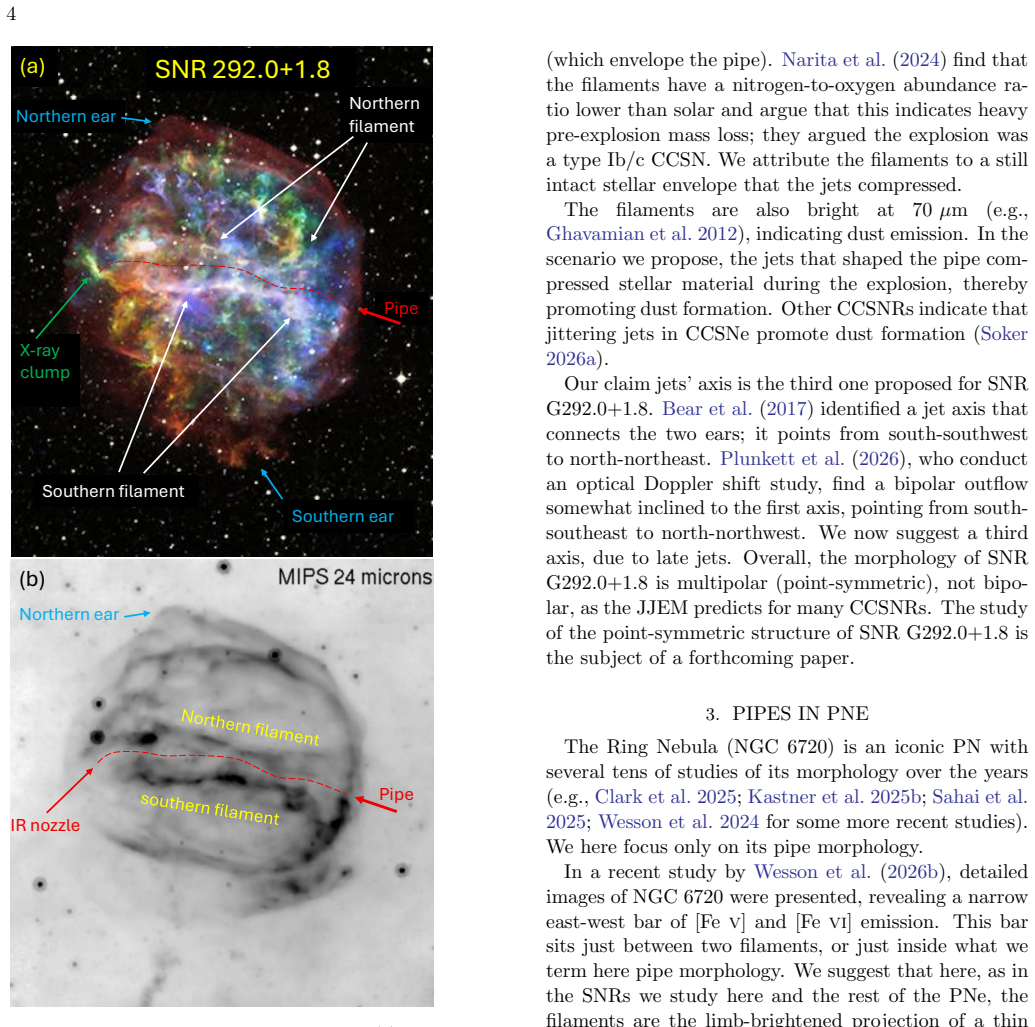
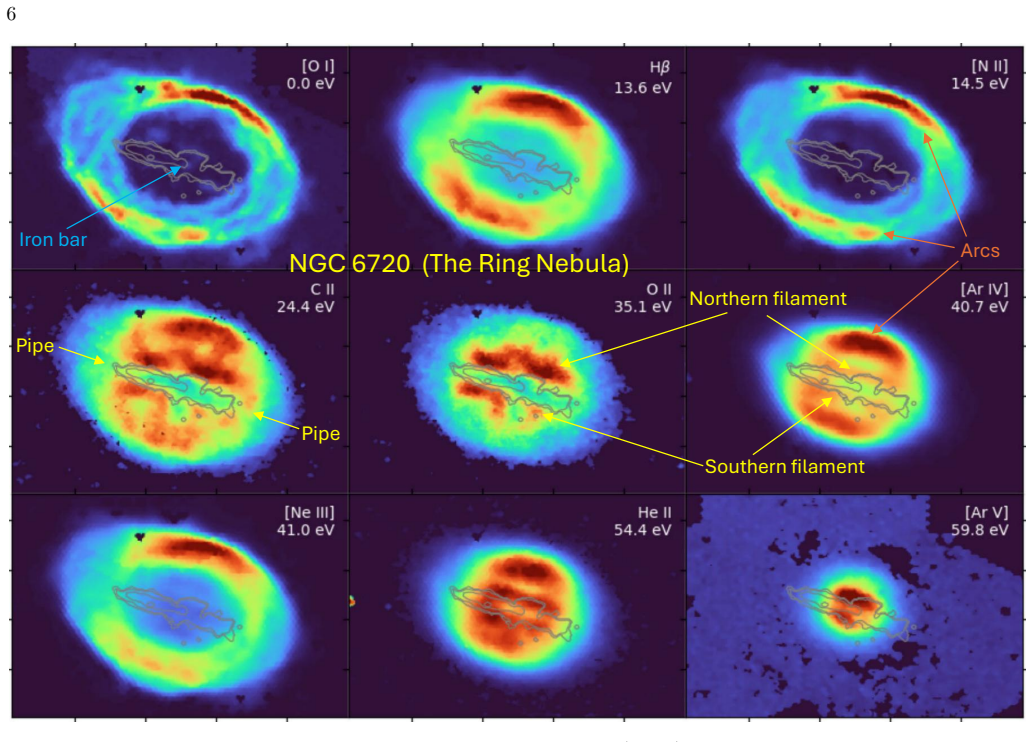
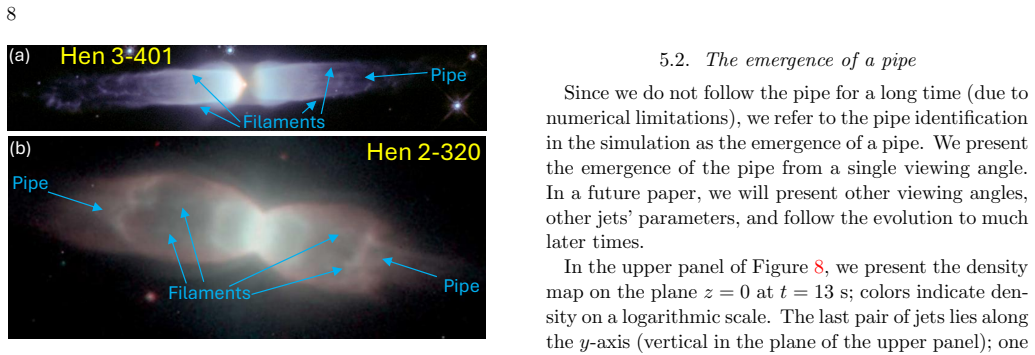
We compare images of core-collapse supernova (CCSN) remnants (CCSNRs) and jet-shaped planetary nebulae (PNe) that have a narrow, faint zone extending from side to side, termed a pipe, with a hydrodynamical numerical simulation exploding a massive star with three pairs of jets in the framework of the jittering jets explosion mechanism (JJEM), and conclude that jets shaped the pipes in these CCSNRs and PNe. We present two jet-shaped PNe with a pipe and three PNe with two opposite narrow jet-shaped lobes, and argue that in some cases the two opposite narrow lobes might merge to form one long, faint zone extending from side to side of the PN, namely, a pipe. From the qualitative similarity of the pipe morphology of the two CCSNRs we analyze with the pipe of the PNe, we suggest that jets also shaped the pipe of these CCSNRs. We strengthen this conclusion with a three-dimensional hydrodynamic simulation that reproduces two opposite narrow lobes, similar to those observed in PNe with lobes. These lobes can merge later to form a pipe. This paper is another in a series that strengthen the case for the JJEM as the primary explosion mechanism of CCSNe by comparing CCSNR morphologies with those of jet-shaped PNe.
Figures





Forward citations
Cited by 2 Pith papers
-
Long-lived intermittent accretion disks in the jittering jets explosion mechanism (JJEM) of core-collapse supernovae
Viscous angular-momentum transport and jet feedback can keep intermittent accretion disks around newborn neutron stars alive long enough to launch the energetic jet pairs seen in some supernova remnants.
-
JWST observations of a planetary nebula support jet-driven explosion of core-collapse supernova remnant RCW 103
Morphological similarity between JWST images of planetary nebula PMR 1 and X-ray images of CCSN remnant RCW 103 indicates that two pairs of jets shaped RCW 103, supporting the jittering-jets explosion mechanism.
Reference graph
Works this paper leans on
-
[1]
Ablimit, I. 2024, arXiv e-prints, arXiv:2407.03985, doi: 10.48550/arXiv.2407.03985
work page internal anchor Pith review Pith/arXiv arXiv doi:10.48550/arxiv.2407.03985 2024
-
[2]
2018, MNRAS, 475, 4794, doi: 10.1093/mnras/sty029 —
Akashi, M., Bear, E., & Soker, N. 2018, MNRAS, 475, 4794, doi: 10.1093/mnras/sty029 —. 2025, The Open Journal of Astrophysics, 8, 137, doi: 10.33232/001c.144674
-
[3]
2018, MNRAS, 481, 2754, doi: 10.1093/mnras/sty2479 —
Akashi, M., & Soker, N. 2018, MNRAS, 481, 2754, doi: 10.1093/mnras/sty2479 —. 2026a, arXiv e-prints, arXiv:2603.29527. https://arxiv.org/abs/2603.29527 —. 2026b, in preparation
-
[4]
Akhmetali, A., Sultan Abylkairov, Y., Orel, D., et al. 2026, arXiv e-prints, arXiv:2605.04896. https://arxiv.org/abs/2605.04896
work page internal anchor Pith review Pith/arXiv arXiv 2026
-
[5]
2022, Galaxies, 10, 47, doi: 10.3390/galaxies10020047
Alcolea, J., Ag´ undez, M., Bujarrabal, V., et al. 2022, Galaxies, 10, 47, doi: 10.3390/galaxies10020047
-
[6]
1987, AJ, 94, 671, doi: 10.1086/114504
Balick, B. 1987, AJ, 94, 671, doi: 10.1086/114504
-
[7]
2020, ApJ, 889, 13, doi: 10.3847/1538-4357/ab5651
Balick, B., Frank, A., & Liu, B. 2020, ApJ, 889, 13, doi: 10.3847/1538-4357/ab5651
-
[8]
2017, MNRAS, 472, 1770, doi: 10.1093/mnras/stx2125
Bear, E., Grichener, A., & Soker, N. 2017, MNRAS, 472, 1770, doi: 10.1093/mnras/stx2125
-
[9]
2025, Research in Astronomy and Astrophysics, 25, 045008, doi: 10.1088/1674-4527/adc24e
Bear, E., Shishkin, D., & Soker, N. 2025, Research in Astronomy and Astrophysics, 25, 045008, doi: 10.1088/1674-4527/adc24e
-
[10]
2017, MNRAS, 468, 140, doi: 10.1093/mnras/stx431 —
Bear, E., & Soker, N. 2017, MNRAS, 468, 140, doi: 10.1093/mnras/stx431 —. 2018, MNRAS, 478, 682, doi: 10.1093/mnras/sty1053
-
[11]
Bhalerao, J., Park, S., Schenck, A., Post, S., & Hughes, J. P. 2019, ApJ, 872, 31, doi: 10.3847/1538-4357/aafafd
-
[12]
Boffin, H. M. J., Miszalski, B., Rauch, T., et al. 2012, Science, 338, 773, doi: 10.1126/science.1225386
-
[13]
2025, PASP, 137, 054201, doi: 10.1088/1538-3873/add08e —
Braudo, J., Michaelis, A., Akashi, M., & Soker, N. 2025, PASP, 137, 054201, doi: 10.1088/1538-3873/add08e —. 2026, in preparation
-
[14]
Impacts of Multidimensional Progenitor Perturbations on Core-Collapse Supernova Explosions
Chen, C.-H., Lentz, E. J., Hix, W. R., et al. 2026, arXiv e-prints, arXiv:2604.09906. https://arxiv.org/abs/2604.09906
work page internal anchor Pith review Pith/arXiv arXiv 2026
-
[15]
2022, MNRAS, 516, 2711, doi: 10.1093/mnras/stac2375
Clairmont, R., Steffen, W., & Koning, N. 2022, MNRAS, 516, 2711, doi: 10.1093/mnras/stac2375
-
[16]
Clark, N., Peeters, E., Cox, N. L. J., et al. 2025, MNRAS, 540, 1984, doi: 10.1093/mnras/staf826
-
[17]
2022, ApJS, 260, 14, doi: 10.3847/1538-4365/ac5cca
Danehkar, A. 2022, ApJS, 260, 14, doi: 10.3847/1538-4365/ac5cca
-
[18]
Derlopa, S., Akras, S., Amram, P., et al. 2024, MNRAS, 530, 3327, doi: 10.1093/mnras/stae1013 Eggenberger Andersen, O., O’Connor, E., Kovalenko, L.,
-
[19]
Andresen, H., & Couch, S. M. 2026, arXiv e-prints, arXiv:2605.01405. https://arxiv.org/abs/2605.01405
work page internal anchor Pith review Pith/arXiv arXiv 2026
-
[20]
Estrella-Trujillo, D., Hern´ andez-Mart´ ınez, L., Vel´ azquez, P. F., Esquivel, A., & Raga, A. C. 2019, ApJ, 876, 29, doi: 10.3847/1538-4357/ab12e1
-
[21]
Fryxell, B., Olson, K., Ricker, P., et al. 2000, ApJS, 131, 273, doi: 10.1086/317361 12 Garc´ ıa-Segura, G., Manchado, A., Toal´ a, J. A., Guerrero, M. A., & Castro-Tirado, A. J. 2025, MNRAS, 543, 3867, doi: 10.1093/mnras/staf1744 Garc´ ıa-Segura, G., Taam, R. E., & Ricker, P. M. 2020, ApJ, 893, 150, doi: 10.3847/1538-4357/ab8006 —. 2021, ApJ, 914, 111, d...
-
[22]
Ghavamian, P., Hughes, J. P., & Williams, T. B. 2005, ApJ, 635, 365, doi: 10.1086/497283
-
[23]
Ghavamian, P., Long, K. S., Blair, W. P., et al. 2012, ApJ, 750, 39, doi: 10.1088/0004-637X/750/1/39
-
[24]
2025, arXiv e-prints, arXiv:2511.11796
Giudici, B., Gabler, M., & Janka, H.-T. 2025, arXiv e-prints, arXiv:2511.11796. https://arxiv.org/abs/2511.11796 G´ omez-Gonz´ alez, V. M. A., Toal´ a, J. A., Guerrero, M. A., et al. 2020, MNRAS, 496, 959, doi: 10.1093/mnras/staa1542
-
[25]
2003, ApJL, 583, L91, doi: 10.1086/368122
Gonzalez, M., & Safi-Harb, S. 2003, ApJL, 583, L91, doi: 10.1086/368122
-
[26]
2023, MNRAS, 523, 221, doi: 10.1093/mnras/stad1449
Grichener, A. 2023, MNRAS, 523, 221, doi: 10.1093/mnras/stad1449
-
[27]
2017, MNRAS, 468, 1226, doi: 10.1093/mnras/stx534
Grichener, A., & Soker, N. 2017, MNRAS, 468, 1226, doi: 10.1093/mnras/stx534
-
[28]
A., Cazzoli, S., Rechy-Garc´ ıa, J
Guerrero, M. A., Cazzoli, S., Rechy-Garc´ ıa, J. S., et al. 2021, ApJ, 909, 44, doi: 10.3847/1538-4357/abe2aa
-
[29]
Guerrero, M. A., & Manchado, A. 1998, ApJ, 508, 262, doi: 10.1086/306407
-
[30]
Hrivnak, B. J., Smith, N., Su, K. Y. L., & Sahai, R. 2008, ApJ, 688, 327, doi: 10.1086/591960
-
[31]
2014, ApJ, 787, 25, doi: 10.1088/0004-637X/787/1/25
Hsia, C.-H., Chau, W., Zhang, Y., & Kwok, S. 2014, ApJ, 787, 25, doi: 10.1088/0004-637X/787/1/25
-
[32]
Janka, H.-T. 2025, Annual Review of Nuclear and Particle Science, 75, 425, doi: 10.1146/annurev-nucl-121423-100945
-
[33]
2020, Galaxies, 8, 28, doi: 10.3390/galaxies8020028 —
Jones, D. 2020, Galaxies, 8, 28, doi: 10.3390/galaxies8020028 —. 2025, Contributions of the Astronomical Observatory Skalnate Pleso, 55, 200, doi: 10.31577/caosp.2025.55.3.200
-
[34]
H., Moraga Baez, P., Balick, B., et al
Kastner, J. H., Moraga Baez, P., Balick, B., et al. 2025a, ApJ, 993, 79, doi: 10.3847/1538-4357/ae0706
-
[35]
Kastner, J. H., Wilner, D. J., Ryder, D., et al. 2025b, ApJ, 981, 46, doi: 10.3847/1538-4357/adace1
-
[36]
2025, NewA, 116, 102346, doi: 10.1016/j.newast.2024.102346 37
Kumar, A. 2025, NewA, 116, 102346, doi: 10.1016/j.newast.2024.102346
-
[37]
2024, Galaxies, 12, 39, doi: 10.3390/galaxies12040039
Kwok, S. 2024, Galaxies, 12, 39, doi: 10.3390/galaxies12040039
-
[38]
Current Unsolved Problems in Planetary Nebulae Research
Kwok, S., Balick, B., Chu, Y.-H., et al. 2026, arXiv e-prints, arXiv:2604.22999. https://arxiv.org/abs/2604.22999
work page internal anchor Pith review Pith/arXiv arXiv 2026
-
[39]
2009, ApJ, 706, 441, doi: 10.1088/0004-637X/706/1/441
Lee, H.-G., Koo, B.-C., Moon, D.-S., et al. 2009, ApJ, 706, 441, doi: 10.1088/0004-637X/706/1/441
-
[40]
Lee, J.-J., Park, S., Hughes, J. P., et al. 2010, ApJ, 711, 861, doi: 10.1088/0004-637X/711/2/861 Lemi` ere, A., Castelletti, G., & Maza, N. L. 2026, A&A, 705, A218, doi: 10.1051/0004-6361/202556224
-
[41]
Li, Y. Q., Morris, M. R., & Sahai, R. 2024, Galaxies, 12, 44, doi: 10.3390/galaxies12040044
-
[42]
Li, Z., Wei, D., Jia, S., et al. 2026, arXiv e-prints, arXiv:2604.10440, doi: 10.48550/arXiv.2604.10440 Liebend¨ orfer, M., Rampp, M., Janka, H. T., &
work page internal anchor Pith review Pith/arXiv arXiv doi:10.48550/arxiv.2604.10440 2026
-
[43]
2005, ApJ, 620, 840, doi: 10.1086/427203
Mezzacappa, A. 2005, ApJ, 620, 840, doi: 10.1086/427203
-
[44]
Long, X., Patnaude, D. J., Plucinsky, P. P., & Gaetz, T. J. 2022, ApJ, 932, 117, doi: 10.3847/1538-4357/ac704b
-
[45]
2026, PhRvD, 113, 023024, doi: 10.1103/7ytg-wzl8
Luo, Y., Zha, S., & Kajino, T. 2026, PhRvD, 113, 023024, doi: 10.1103/7ytg-wzl8
-
[46]
Masa, E., Alcolea, J., Santander-Garc´ ıa, M., et al. 2024, Galaxies, 12, 63, doi: 10.3390/galaxies12050063 —. 2026, arXiv e-prints, arXiv:2604.12569. https://arxiv.org/abs/2604.12569
work page internal anchor Pith review Pith/arXiv arXiv doi:10.3390/galaxies12050063 2024
-
[47]
Core Collapse Supernova Modeling: The Next Ten Years
Mezzacappa, A. 2026, arXiv e-prints, arXiv:2604.24970. https://arxiv.org/abs/2604.24970
work page internal anchor Pith review Pith/arXiv arXiv 2026
-
[48]
doi:10.1046/j.1365-8711.1998.01589.x , keywords =
Miranda, L. F., Torrelles, J. M., Guerrero, M. A., Aaquist, O. B., & Eiroa, C. 1998, MNRAS, 298, 243, doi: 10.1046/j.1365-8711.1998.01611.x
-
[49]
F., V´ azquez, R., Olgu´ ın, L., Guill´ en, P
Miranda, L. F., V´ azquez, R., Olgu´ ın, L., Guill´ en, P. F., & Mat´ ıas, J. M. 2024, A&A, 687, A123, doi: 10.1051/0004-6361/202348173
-
[50]
2019, MNRAS, 487, 1040, doi: 10.1093/mnras/stz1315 Moraga Baez, P., Kastner, J
Miszalski, B., Manick, R., Van Winckel, H., & Miko lajewska, J. 2019, MNRAS, 487, 1040, doi: 10.1093/mnras/stz1315 Moraga Baez, P., Kastner, J. H., Balick, B., Montez, R., &
-
[51]
2023, ApJ, 942, 15, doi: 10.3847/1538-4357/aca401
Bublitz, J. 2023, ApJ, 942, 15, doi: 10.3847/1538-4357/aca401
-
[52]
1987, PASP, 99, 1115, doi: 10.1086/132089
Morris, M. 1987, PASP, 99, 1115, doi: 10.1086/132089
-
[53]
D., Brinkman, E., Richardson, C
Murphy, R. D., Brinkman, E., Richardson, C. J., et al. 2025, arXiv e-prints, arXiv:2511.21895, doi: 10.48550/arXiv.2511.21895
-
[54]
2024, ApJ, 976, 146, doi: 10.3847/1538-4357/ad7e17
Narita, T., Uchida, H., Vink, J., et al. 2024, ApJ, 976, 146, doi: 10.3847/1538-4357/ad7e17
-
[55]
2026, arXiv e-prints, arXiv:2601.17499, doi: 10.48550/arXiv.2601.17499
Orlando, S. 2026, arXiv e-prints, arXiv:2601.17499, doi: 10.48550/arXiv.2601.17499
-
[56]
2025a, A&A, 696, A108, doi: 10.1051/0004-6361/202553833 —
Orlando, S., Janka, H.-T., Wongwathanarat, A., et al. 2025a, A&A, 696, A108, doi: 10.1051/0004-6361/202553833 —. 2025b, A&A, 696, A188, doi: 10.1051/0004-6361/202553902
-
[57]
2025c, A&A, 699, A305, doi: 10.1051/0004-6361/202554862
Orlando, S., Miceli, M., Ono, M., et al. 2025c, A&A, 699, A305, doi: 10.1051/0004-6361/202554862
-
[58]
2026, arXiv e-prints, arXiv:2603.25846
Pan, K.-C., & Li, Y.-F. 2026, arXiv e-prints, arXiv:2603.25846. https://arxiv.org/abs/2603.25846 13
-
[59]
2014, MNRAS, 443, 664, doi: 10.1093/mnras/stu1129
Papish, O., & Soker, N. 2014, MNRAS, 443, 664, doi: 10.1093/mnras/stu1129
-
[60]
On the Origin of Mass Ejection in Failed Supernovae
Paradiso, D. A., Vallejo, S., & Coughlin, E. R. 2026, arXiv e-prints, arXiv:2605.05289. https://arxiv.org/abs/2605.05289
work page internal anchor Pith review Pith/arXiv arXiv 2026
-
[61]
Park, S., Hughes, J. P., Slane, P. O., et al. 2007, ApJL, 670, L121, doi: 10.1086/524406 —. 2004, ApJL, 602, L33, doi: 10.1086/382276
-
[62]
Park, S., Roming, P. W. A., Hughes, J. P., et al. 2002, ApJL, 564, L39, doi: 10.1086/338861
-
[63]
Parker, Q. A., Acker, A., Frew, D. J., et al. 2006, MNRAS, 373, 79, doi: 10.1111/j.1365-2966.2006.10950.x
-
[64]
Plunkett, A. L., Winkler, P. F., Long, K. S., & Milisavljevic, D. 2026, ApJ, 1000, 44, doi: 10.3847/1538-4357/ae469f
-
[65]
Raymond, J. C., Seok, J. Y., Koo, B.-C., et al. 2023, ApJ, 954, 34, doi: 10.3847/1538-4357/ace692 Rechy-Garc´ ıa, J. S., Guerrero, M. A., Duarte Puertas, S., et al. 2020, MNRAS, 492, 1957, doi: 10.1093/mnras/stz3326 Rechy-Garc´ ıa, J. S., Pe˜ na, M., & Vel´ azquez, P. F. 2019, MNRAS, 482, 1163, doi: 10.1093/mnras/sty2758
-
[66]
Rusakov, A., Burrows, A. S., Wang, T., & Vartanyan, D. 2026, arXiv e-prints, arXiv:2602.09025. https://arxiv.org/abs/2602.09025
work page internal anchor Pith review Pith/arXiv arXiv 2026
-
[67]
Campbell, R. D., & Chaffee, F. H. 2005, ApJL, 622, L53, doi: 10.1086/429586
-
[68]
2007, AJ, 134, 2200, doi: 10.1086/522944
Sahai, R., Morris, M., S´ anchez Contreras, C., & Claussen, M. 2007, AJ, 134, 2200, doi: 10.1086/522944
-
[69]
Sahai, R., & Trauger, J. T. 1998, AJ, 116, 1357, doi: 10.1086/300504
-
[70]
2024, arXiv e-prints, arXiv:2409.06038
Sahai, R., Alcolea, J., Balick, B., et al. 2024, arXiv e-prints, arXiv:2409.06038. https://arxiv.org/abs/2409.06038
-
[71]
Sahai, R., Van de Steene, G., van Hoof, P. A. M., et al. 2025, ApJ, 985, 101, doi: 10.3847/1538-4357/adc91c
- [72]
-
[73]
2024, Research in Astronomy and Astrophysics, 24, 125018, doi: 10.1088/1674-4527/ad8ead
Shen, J.-Y., Bao, B.-W., & Zhang, L. 2024, Research in Astronomy and Astrophysics, 24, 125018, doi: 10.1088/1674-4527/ad8ead
-
[74]
2025, ApJ, 992, 190, doi: 10.3847/1538-4357/ae0332
Shishkin, D., Bear, E., & Soker, N. 2025, ApJ, 992, 190, doi: 10.3847/1538-4357/ae0332
-
[75]
2024, ApJ, 975, 281, doi: 10.3847/1538-4357/ad8138
Shishkin, D., Kaye, R., & Soker, N. 2024, ApJ, 975, 281, doi: 10.3847/1538-4357/ad8138
-
[76]
Quantifying Symmetry: Transformation Information for Planetary Nebulae and Supernova Remnants
Shishkin, D., & Michaelis, A. 2026, arXiv e-prints, arXiv:2601.07913, doi: 10.48550/arXiv.2601.07913
work page internal anchor Pith review Pith/arXiv arXiv doi:10.48550/arxiv.2601.07913 2026
-
[77]
1990, AJ, 99, 1869, doi: 10.1086/115465 —
Soker, N. 1990, AJ, 99, 1869, doi: 10.1086/115465 —. 2022a, Research in Astronomy and Astrophysics, 22, 122003, doi: 10.1088/1674-4527/ac9782 —. 2022b, Research in Astronomy and Astrophysics, 22, 035019, doi: 10.1088/1674-4527/ac49e6 —. 2024a, The Open Journal of Astrophysics, 7, 31, doi: 10.33232/001c.117147 —. 2024b, Galaxies, 12, 29, doi: 10.3390/galax...
-
[78]
2025, The Open Journal of Astrophysics, 8, 54770, doi: 10.33232/001c.154770
Soker, N., & Akashi, M. 2025, The Open Journal of Astrophysics, 8, 54770, doi: 10.33232/001c.154770
-
[79]
Soker, N., & Bisker, G. 2006, MNRAS, 369, 1115, doi: 10.1111/j.1365-2966.2006.10313.x
-
[80]
2017, ApJ, 851, 95, doi: 10.3847/1538-4357/aa9c83
Soker, N., & Gilkis, A. 2017, ApJ, 851, 95, doi: 10.3847/1538-4357/aa9c83
discussion (0)
Sign in with ORCID, Apple, or X to comment. Anyone can read and Pith papers without signing in.