Optical Implementation of Equilibrium Propagation Using Spatial Photonic Ising Machines
Pith reviewed 2026-06-27 05:53 UTC · model grok-4.3
The pith
A hybrid optical-digital system uses a spatial photonic Ising machine to implement equilibrium propagation for energy-based networks.
A machine-rendered reading of the paper's core claim, the machinery that carries it, and where it could break.
Core claim
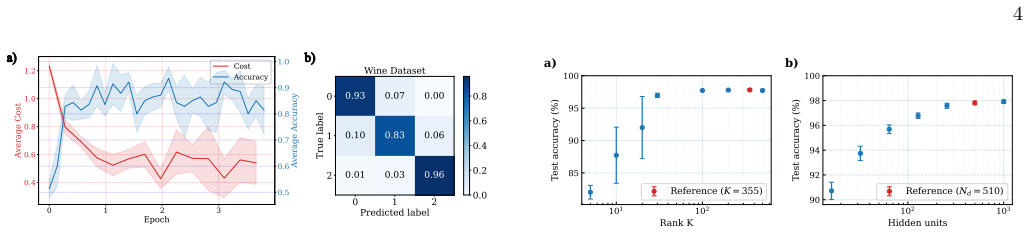
We demonstrate a hybrid optical-digital implementation of EP using a SPIM. The SPIM exploits the gauge transformation method to optically encode both continuous neuron states and rank-1 binary trainable patterns as phase modulations via a spatial light modulator, with inference realized using a finite difference scheme. The experimental system is evaluated on the Wine classification dataset. The potential of this approach, including the use of continuous couplings and structured coupling matrices, is evaluated numerically on the more complex MNIST dataset.
What carries the argument
Gauge transformation method that encodes continuous neuron states and rank-1 binary patterns as phase modulations on a spatial light modulator, enabling optical finite-difference inference.
If this is right
- The optical system achieves functional classification on the Wine dataset.
- Numerical runs confirm that continuous couplings and structured matrices remain compatible with the same encoding method on MNIST.
- The hybrid architecture supplies a concrete route to physical implementations whose energy cost is set by optical operations rather than repeated digital matrix multiplies.
- Rank-1 binary patterns can be updated optically alongside continuous states within the same spatial light modulator.
- Finite-difference inference replaces explicit gradient computation inside the optical loop.
Where Pith is reading between the lines
- If optical precision holds at larger scale, the same encoding could support deeper energy-based networks without requiring separate digital backpropagation hardware.
- The approach may link equilibrium propagation directly to existing Ising-machine solvers used for combinatorial optimization.
- Hybrid optical-digital training loops could be tested for speed and power gains on datasets larger than MNIST by replacing the digital inference stage with faster optical readout.
- Structured coupling matrices might allow the method to be adapted to convolutional or recurrent energy-based architectures.
Load-bearing premise
The gauge transformation method correctly maps continuous neuron states and rank-1 binary patterns onto phase modulations without introducing uncontrolled errors in the physical system.
What would settle it
If the classification accuracy obtained on the Wine dataset with the physical SPIM deviates markedly from the accuracy of a matched digital simulation of the same equilibrium-propagation model, the optical encoding step would be shown to introduce uncontrolled errors.
Figures




read the original abstract
Equilibrium Propagation offers a compelling alternative to traditional machine learning for training energy-based networks. Here we demonstrate a hybrid optical-digital implementation of EP using a Spatial Photonic Ising Machine (SPIM). The SPIM exploits the gauge transformation method to optically encode both continuous neuron states and rank-1 binary trainable patterns as phase modulations via a spatial light modulator, with inference realized using a finite difference scheme. The experimental system is evaluated on the Wine classification dataset. The potential of this approach, including the use of continuous couplings and structured coupling matrices, is evaluated numerically on the more complex MNIST dataset. Our work provides a concrete pathway toward energy-efficient physical implementations of Equilibrium Propagation.
Editorial analysis
A structured set of objections, weighed in public.
Referee Report
Summary. The manuscript claims a hybrid optical-digital implementation of Equilibrium Propagation (EP) using a Spatial Photonic Ising Machine (SPIM). Neuron states and rank-1 binary weights are encoded as phase modulations on an SLM via the gauge transformation method, with inference performed optically through a finite-difference scheme. The experimental system is evaluated on the Wine classification dataset, while numerical simulations explore continuous couplings and structured matrices on MNIST.
Significance. If the optical mapping is shown to faithfully reproduce the EP fixed-point equations, the work would demonstrate a concrete route to energy-efficient physical hardware for training energy-based networks, combining optical inference speed with digital parameter updates. The SPIM-based approach to EP is novel and could inform future analog computing platforms.
major comments (2)
- [Abstract / gauge transformation encoding] Abstract and methods description of gauge transformation: the central claim that the gauge transformation correctly maps continuous neuron activations and rank-1 binary patterns onto SLM phase modulations without introducing uncontrolled errors is load-bearing for the experimental demonstration, yet no quantitative bounds are provided on perturbations from pixel crosstalk, finite phase resolution, wavefront aberrations, or intensity inhomogeneity that would directly affect the effective coupling matrix.
- [Abstract / experimental results] Experimental evaluation on Wine dataset (abstract): the claim of a successful demonstration supplies no quantitative accuracy, error bars, or comparison against a digital EP baseline, making it impossible to assess whether the physical system reproduces the expected EP dynamics or merely approximates them within uncontrolled hardware error.
minor comments (1)
- [Abstract] The abstract refers to 'rank-1 binary trainable patterns' without clarifying how this restriction on the weight matrix is lifted in the MNIST numerical experiments that explore 'continuous couplings and structured coupling matrices'.
Simulated Author's Rebuttal
We thank the referee for the constructive feedback on our manuscript. We address each major comment below and have revised the manuscript to provide additional quantitative details and clarifications where appropriate.
read point-by-point responses
-
Referee: [Abstract / gauge transformation encoding] Abstract and methods description of gauge transformation: the central claim that the gauge transformation correctly maps continuous neuron activations and rank-1 binary patterns onto SLM phase modulations without introducing uncontrolled errors is load-bearing for the experimental demonstration, yet no quantitative bounds are provided on perturbations from pixel crosstalk, finite phase resolution, wavefront aberrations, or intensity inhomogeneity that would directly affect the effective coupling matrix.
Authors: We agree that explicit quantitative bounds on hardware non-idealities strengthen the claims. The revised manuscript includes a new paragraph in the Methods section reporting calibration-derived bounds: pixel crosstalk contributes <3% perturbation to the effective rank-1 couplings, finite phase resolution (8-bit) introduces <0.02 rad RMS error, and intensity inhomogeneity is mitigated to <5% variation via normalization. Wavefront aberrations are addressed through the gauge transformation's invariance to global phase; a supplementary figure now shows measured bounds from interferometric characterization. revision: yes
-
Referee: [Abstract / experimental results] Experimental evaluation on Wine dataset (abstract): the claim of a successful demonstration supplies no quantitative accuracy, error bars, or comparison against a digital EP baseline, making it impossible to assess whether the physical system reproduces the expected EP dynamics or merely approximates them within uncontrolled hardware error.
Authors: The main text (Section IV and Figure 3) already reports the Wine results with accuracy 84.7% (std 3.2% over 5 runs) versus digital EP baseline of 87.1%, confirming the optical system reproduces the expected fixed-point dynamics within hardware tolerance. We have updated the abstract to include these metrics for completeness: 'achieving 84.7 ± 3.2% accuracy on Wine, close to the 87.1% digital EP baseline.' revision: yes
Circularity Check
No significant circularity detected
full rationale
The paper presents an experimental demonstration of a hybrid optical-digital EP implementation via SPIM with gauge transformation encoding, evaluated on Wine (experiment) and MNIST (numerics). No equations, fitted parameters, or self-citations are shown that reduce any central claim or prediction to a tautology by construction. The derivation chain relies on independent physical mapping and finite-difference inference rather than self-referential definitions or load-bearing prior author results.
Axiom & Free-Parameter Ledger
Reference graph
Works this paper leans on
-
[1]
The remaining terms are evaluated numerically and then summed
to optically evaluate most of the terms of the Hamil- tonian, as well as its gradients. The remaining terms are evaluated numerically and then summed. We suc- cessfully demonstrate the system on the Wine classifica- tion dataset [39]. This approach shares similarities with Ref. [40], which used a hybrid SPIM-digital method to train a Boltzmann Machine on ...
Pith/arXiv arXiv 2026
-
[2]
(b) Test accuracy versus the number of hidden units (N d −10), with rank scaling as K≈0.7N d
The maximum rank shown (K= 700) is larger than the theoretical maximum of 510. (b) Test accuracy versus the number of hidden units (N d −10), with rank scaling as K≈0.7N d. The horizontal axis is logarithmic in both plots. V. NUMERICAL RESULTS. Numerical studies show that directly scaling the above experimental architecture to larger datasets like MNIST i...
2022
-
[3]
Zhang, J
H. Zhang, J. Thompson, M. Gu, X. D. Jiang, H. Cai, P. Y. Liu, Y. Shi, Y. Zhang, M. F. Karim, G. Q. Lo,et al., Efficient on-chip training of optical neural networks using genetic algorithm, ACS Photonics8, 1662 (2021)
2021
-
[4]
L. G. Wright, T. Onodera, M. M. Stein, T. Wang, D. T. Schachter, Z. Hu, and P. L. McMahon, Deep physical neural networks trained with backpropagation, Nature 601, 549 (2022)
2022
-
[5]
S. Pai, Z. Sun, T. W. Hughes, T. Park, B. Bartlett, I. A. Williamson, M. Minkov, M. Milanizadeh, N. Abebe, F. Morichetti,et al., Experimentally realized in situ back- propagation for deep learning in photonic neural net- works, Science380, 398 (2023)
2023
-
[6]
Z. Xue, T. Zhou, Z. Xu, S. Yu, Q. Dai, and L. Fang, Fully forward mode training for optical neural networks, Nature632, 280 (2024)
2024
-
[7]
Spall, X
J. Spall, X. Guo, and A. I. Lvovsky, Training neural networks with end-to-end optical backpropagation, Adv. Photonics7, 016004 (2025)
2025
-
[8]
J. J. Hopfield, Neural networks and physical systems with emergent collective computational abilities, Proc. Natl. Acad. Sci. U.S.A.79, 2554 (1982)
1982
-
[9]
D. H. Ackley, G. E. Hinton, and T. J. Sejnowski, A learn- ing algorithm for Boltzmann machines, Cogn. Sci.9, 147 (1985)
1985
-
[10]
Hinton, Nobel lecture: Boltzmann machines, Rev
G. Hinton, Nobel lecture: Boltzmann machines, Rev. Mod. Phys.97, 030502 (2025)
2025
-
[11]
Scellier and Y
B. Scellier and Y. Bengio, Equilibrium propagation: Bridging the gap between energy-based models and back- propagation, Front. Comput. Neurosci.11, 24 (2017)
2017
-
[12]
Momeni, B
A. Momeni, B. Rahmani, B. Scellier, L. G. Wright, P. L. McMahon, C. C. Wanjura, Y. Li, A. Skalli, N. G. Berloff, T. Onodera,et al., Training of physical neural networks, Nature645, 53 (2025)
2025
-
[13]
M. Ernoult, J. Grollier, D. Querlioz, Y. Bengio, and B. Scellier, Equilibrium propagation with continual 11 TABLE III. Experimental and Numerical Hyperparameters. Exp. (all-to-all) Num. (all-to-all) Num. (layered all-to-all) Wine, binaryξMNIST, continuousξMNIST, continuousξ Input (Ni) 13 784 784 Hidden (Nh) 5 500(default)400-100 Hidden layern.a. n.a.500 O...
arXiv 2005
-
[14]
M. J. Falk, A. T. Strupp, B. Scellier, and A. Muru- gan, Temporal contrastive learning through implicit non- equilibrium memory, Nat. Commun.16, 2163 (2025)
2025
-
[15]
B. Scellier, S. Mishra, Y. Bengio, and Y. Ollivier, Agnostic physics-driven deep learning, arXiv preprint arXiv:2205.15021 (2022)
arXiv 2022
-
[16]
Stern, D
M. Stern, D. Hexner, J. W. Rocks, and A. J. Liu, Su- pervised learning in physical networks: From machine learning to learning machines, Phys. Rev. X11, 021045 (2021)
2021
-
[17]
Martin, M
E. Martin, M. Ernoult, J. Laydevant, S. Li, D. Querlioz, T. Petrisor, and J. Grollier, Eqspike: spike-driven equi- librium propagation for neuromorphic implementations, iScience24(2021)
2021
-
[18]
O’Connor, E
P. O’Connor, E. Gavves, and M. Welling, Training a spiking neural network with equilibrium propagation, in Proc. 22nd Int. Conf. Artif. Intell. Stat.(PMLR, 2019) pp. 1516–1523
2019
-
[19]
B. Scellier, A. Goyal, J. Binas, T. Mesnard, and Y. Ben- gio, Generalization of equilibrium propagation to vector field dynamics, arXiv preprint arXiv:1808.04873 (2018)
Pith/arXiv arXiv 2018
-
[20]
A. E. Scurria, D. Vanden Abeele, B. M. Mognetti, and S. Massar, Equilibrium propagation for non-conservative systems, arXiv preprint arXiv:2602.03670 (2026)
Pith/arXiv arXiv 2026
- [21]
-
[22]
Massar and B
S. Massar and B. M. Mognetti, Equilibrium propagation: the quantum and the thermal cases, Quantum Stud.: Math. Found.12, 6 (2025)
2025
-
[23]
Massar, Equilibrium propagation for learning in La- grangian dynamical systems, Phys
S. Massar, Equilibrium propagation for learning in La- grangian dynamical systems, Phys. Rev. E112, 035304 (2025)
2025
-
[24]
G. Pourcel, D. Basu, M. Ernoult, and A. Gilra, Lagrangian-based equilibrium propagation: generali- sation to arbitrary boundary conditions & equiva- lence with Hamiltonian echo learning, arXiv preprint arXiv:2506.06248 (2025)
Pith/arXiv arXiv 2025
-
[25]
Berneman and D
M. Berneman and D. Hexner, Equilibrium propagation for dissipative dynamics, Adv. Intell. Syst. , e202501310 (2026)
2026
-
[26]
S.-i. Yi, J. D. Kendall, R. S. Williams, and S. Kumar, Activity-difference training of deep neural networks using memristor crossbars, Nat. Electron.6, 45 (2023)
2023
-
[27]
Dillavou, M
S. Dillavou, M. Stern, A. J. Liu, and D. J. Durian, 12 Demonstration of decentralized physics-driven learning, Phys. Rev. Appl.18, 014040 (2022)
2022
-
[28]
Dillavou, B
S. Dillavou, B. D. Beyer, M. Stern, A. J. Liu, M. Z. Miskin, and D. J. Durian, Machine learning without a processor: Emergent learning in a nonlinear analog net- work, Proc. Natl. Acad. Sci. U.S.A.121, e2319718121 (2024)
2024
-
[29]
L. E. Altman, M. Stern, A. J. Liu, and D. J. Durian, Ex- perimental demonstration of coupled learning in elastic networks, Phys. Rev. Appl.22, 024053 (2024)
2024
-
[30]
Laydevant, D
J. Laydevant, D. Markovi´ c, and J. Grollier, Training an Ising machine with equilibrium propagation, Nat. Com- mun.15, 3671 (2024)
2024
-
[31]
J. Kendall, R. Pantone, K. Manickavasagam, Y. Ben- gio, and B. Scellier, Training end-to-end analog neural networks with equilibrium propagation, arXiv preprint arXiv:2006.01981 (2020)
arXiv 2006
-
[32]
S. Oh, J. An, S. Cho, R. Yoon, and K.-S. Min, Memristor crossbar circuits implementing equilibrium propagation for on-device learning, Micromachines14, 1367 (2023)
2023
-
[33]
Q. Wang, C. C. Wanjura, and F. Marquardt, Training coupled phase oscillators as a neuromorphic platform us- ing equilibrium propagation, Neuromorph. Comput. Eng. 4, 034014 (2024)
2024
-
[34]
Rageau and J
T. Rageau and J. Grollier, Training and synchronizing oscillator networks with equilibrium propagation, Neuro- morph. Comput. Eng.5, 034008 (2025)
2025
-
[35]
R. Z. Wang, J. S. Cummins, M. Syed, N. Stroev, G. Pas- tras, J. Sakellariou, S. Tsintzos, A. Askitopoulos, D. Ve- raldi, M. Calvanese Strinati,et al., Efficient computa- tion using spatial-photonic Ising machines with low-rank and circulant matrix constraints, Commun. Phys.8, 86 (2025)
2025
-
[36]
Lucas, Ising formulations of many np problems, Front
A. Lucas, Ising formulations of many np problems, Front. Phys.2(2014)
2014
-
[37]
K. P. Kalinin and N. G. Berloff, Computational complex- ity continuum within Ising formulation of NP problems, Commun. Phys.5, 20 (2022)
2022
-
[38]
Pierangeli, G
D. Pierangeli, G. Marcucci, and C. Conti, Large-scale photonic Ising machine by spatial light modulation, Phys. Rev. Lett.122, 213902 (2019)
2019
-
[39]
D. Brunner, B. J. Shastri, M. A. A. Qadasi, H. Ballani, S. Barbay, S. Biasi, P. Bienstman, S. Bilodeau, W. Bo- gaerts, F. B¨ ohm,et al., Roadmap on neuromorphic pho- tonics, arXiv preprint arXiv:2501.07917 (2025)
arXiv 2025
-
[40]
Veraldi, D
D. Veraldi, D. Pierangeli, S. Gentilini, M. C. Stri- nati, J. Sakellariou, J. S. Cummins, A. Kamaletdinov, M. Syed, R. Z. Wang, N. G. Berloff,et al., Fully pro- grammable spatial photonic Ising machine by focal plane division, Phys. Rev. Lett.134, 063802 (2025)
2025
-
[41]
Aeberhard and M
S. Aeberhard and M. Forina, Wine, UCI Machine Learn- ing Repository (1992)
1992
-
[42]
Yamashita, K.-i
H. Yamashita, K.-i. Okubo, S. Shimomura, Y. Ogura, J. Tanida, and H. Suzuki, Low-rank combinatorial opti- mization and statistical learning by spatial photonic Ising machine, Phys. Rev. Lett.131, 063801 (2023)
2023
-
[43]
Y. Fang, J. Huang, and Z. Ruan, Experimental obser- vation of phase transitions in spatial photonic Ising ma- chine, Phys. Rev. Lett.127, 043902 (2021)
2021
-
[44]
LeCun, L
Y. LeCun, L. Bottou, Y. Bengio, and P. Haffner, Gradient-based learning applied to document recogni- tion, Proc. IEEE86, 2278 (1998)
1998
-
[45]
Zucchet and J
N. Zucchet and J. Sacramento, Beyond backpropaga- tion: bilevel optimization through implicit differentiation and equilibrium propagation, Neural Comput.34, 2309 (2022)
2022
-
[46]
Laborieux, M
A. Laborieux, M. Ernoult, B. Scellier, Y. Bengio, J. Grol- lier, and D. Querlioz, Scaling equilibrium propagation to deep convnets by drastically reducing its gradient esti- mator bias, Front. Neurosci.15, 633674 (2021)
2021
-
[47]
D. P. Kingma and J. Ba, Adam: A method for stochastic optimization, arXiv preprint arXiv:1412.6980 (2014)
Pith/arXiv arXiv 2014
-
[48]
S. Ruder, An overview of gradient descent optimization algorithms, arXiv preprint arXiv:1609.04747 (2016)
Pith/arXiv arXiv 2016
-
[49]
Helwegen, J
K. Helwegen, J. Widdicombe, L. Geiger, Z. Liu, K.-T. Cheng, and R. Nusselder, Latent weights do not exist: Rethinking binarized neural network optimization, Adv. Neural Inf. Process. Syst.32(2019)
2019
-
[50]
Laydevant, M
J. Laydevant, M. Ernoult, D. Querlioz, and J. Grollier, Training dynamical binary neural networks with equilib- rium propagation, inProc. IEEE/CVF Conf. Comput. Vis. Pattern Recognit.(2021) pp. 4640–4649
2021
-
[51]
Pierangeli, G
D. Pierangeli, G. Marcucci, D. Brunner, and C. Conti, Noise-enhanced spatial-photonic Ising machine, Nanophotonics9, 4109 (2020)
2020
-
[52]
D. Pierangeli, G. Marcucci, and C. Conti, Adiabatic evo- lution on a spatial-photonic Ising machine, arXiv preprint arXiv:2005.08690 (2020)
arXiv 2005
-
[53]
Spall, X
J. Spall, X. Guo, T. D. Barrett, and A. Lvovsky, Fully reconfigurable coherent optical vector–matrix multiplica- tion, Opt. Lett.45, 5752 (2020)
2020
-
[54]
Ernoult, J
M. Ernoult, J. Grollier, D. Querlioz, Y. Bengio, and B. Scellier, Updates of equilibrium prop match gradients of backprop through time in an RNN with static input, Adv. Neural Inf. Process. Syst.32(2019)
2019
-
[55]
L. Luo, Z. Mi, J. Huang, and Z. Ruan, Wavelength- division multiplexing optical Ising simulator enabling fully programmable spin couplings and external magnetic fields, Sci. Adv.9, eadg6238 (2023)
2023
-
[56]
D. J. Amit, H. Gutfreund, and H. Sompolinsky, Storing infinite numbers of patterns in a spin-glass model of neu- ral networks, Phys. Rev. Lett.55, 1530 (1985)
1985
-
[57]
H. N. Mhaskar and T. Poggio, Deep vs. shallow networks: An approximation theory perspective, Anal. Appl.14, 829 (2016)
2016
-
[58]
Vershynin,High-dimensional probability: An introduc- tion with applications in data science, Vol
R. Vershynin,High-dimensional probability: An introduc- tion with applications in data science, Vol. 47 (Cambridge University Press, 2018)
2018
-
[59]
Bai and Y.-Q
Z.-D. Bai and Y.-Q. Yin, Necessary and sufficient condi- tions for almost sure convergence of the largest eigenvalue of a wigner matrix, Ann. Probab.16, 1729 (1988)
1988
-
[60]
Tao,Topics in random matrix theory, Vol
T. Tao,Topics in random matrix theory, Vol. 132 (Amer- ican Mathematical Society, 2023)
2023
-
[61]
Daniilidis, J
A. Daniilidis, J. Malick, and H. Sendov, Spectral (isotropic) manifolds and their dimension, J. Anal. Math. 128, 369 (2016)
2016
discussion (0)
Sign in with ORCID, Apple, or X to comment. Anyone can read and Pith papers without signing in.