The Laser Interferometer Space Antenna: Unveiling the Millihertz Gravitational Wave Sky
Pith reviewed 2026-05-24 21:18 UTC · model grok-4.3
The pith
LISA will conduct the first survey of the millihertz gravitational wave sky by detecting tens of thousands of sources from white-dwarf binaries to distant black hole mergers.
A machine-rendered reading of the paper's core claim, the machinery that carries it, and where it could break.
Core claim
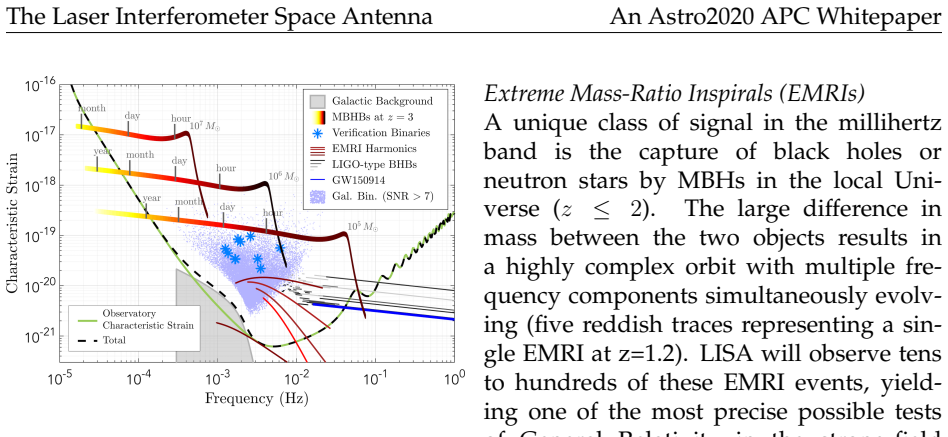
LISA will broaden gravitational wave astronomy by conducting the first survey of the millihertz gravitational wave sky, detecting tens of thousands of individual astrophysical sources ranging from white-dwarf binaries in our own galaxy to mergers of massive black holes at redshifts extending beyond the epoch of reionization, thereby informing our understanding of the end state of stellar evolution, massive black hole birth, and the co-evolution of galaxies and black holes through cosmic time, while also offering the possibility of detecting signals from intermediate-mass black holes and exotic cosmological sources such as inflationary fields and cosmic string cusps.
What carries the argument
The LISA space-based interferometer array, which measures gravitational wave strains in the millihertz band inaccessible to ground-based detectors.
Load-bearing premise
The mission will be funded, launched, and will reach the sensitivity and operational performance needed to detect the projected sources.
What would settle it
If LISA launches but detects far fewer than tens of thousands of sources or none of the high-redshift massive black hole mergers after several years of operation, the survey projections would be falsified.
Figures


read the original abstract
The first terrestrial gravitational wave interferometers have dramatically underscored the scientific value of observing the Universe through an entirely different window, and of folding this new channel of information with traditional astronomical data for a multimessenger view. The Laser Interferometer Space Antenna (LISA) will broaden the reach of gravitational wave astronomy by conducting the first survey of the millihertz gravitational wave sky, detecting tens of thousands of individual astrophysical sources ranging from white-dwarf binaries in our own galaxy to mergers of massive black holes at redshifts extending beyond the epoch of reionization. These observations will inform - and transform - our understanding of the end state of stellar evolution, massive black hole birth, and the co-evolution of galaxies and black holes through cosmic time. LISA also has the potential to detect gravitational wave emission from elusive astrophysical sources such as intermediate-mass black holes as well as exotic cosmological sources such as inflationary fields and cosmic string cusps.
Editorial analysis
A structured set of objections, weighed in public.
Referee Report
Summary. The manuscript is an overview of the LISA space-based gravitational-wave mission. It claims that LISA will perform the first survey of the millihertz gravitational-wave sky, detecting tens of thousands of individual sources (galactic white-dwarf binaries, massive black-hole mergers out to high redshift, and potentially intermediate-mass black holes or cosmological sources) and thereby transforming understanding of stellar evolution, black-hole formation, and galaxy-black-hole co-evolution.
Significance. If the stated sensitivity and operational performance are achieved, the projected observations would open a new observational window complementary to ground-based detectors and enable multimessenger studies across a wide range of astrophysical and cosmological topics. The paper synthesizes prior design studies into a coherent science case; its value lies in this consolidation rather than in new derivations or data.
minor comments (1)
- [Abstract] Abstract: the detection numbers and redshift reach are presented as firm outcomes; a short parenthetical noting that they derive from earlier population-synthesis and sensitivity studies would make the conditional character of the projections explicit without altering the central message.
Simulated Author's Rebuttal
We thank the referee for their positive assessment of the manuscript and for recommending acceptance. The referee accurately characterizes the paper as a synthesis of prior LISA design studies into a coherent science case, with its primary value lying in consolidation rather than new derivations.
Circularity Check
No significant circularity; descriptive mission concept with no derivations
full rationale
The paper is a mission concept white paper whose central content consists of conditional projections for LISA performance and science return. No equations, fitted parameters, or derivation chains appear in the provided abstract or framing. Claims are explicitly framed as expected outcomes assuming the instrument meets its design specifications, with no self-referential reduction of predictions to inputs, no self-citation load-bearing on uniqueness theorems, and no renaming of known results as new derivations. The structure is self-contained as a forward-looking description rather than an empirical or mathematical derivation.
Axiom & Free-Parameter Ledger
Forward citations
Cited by 15 Pith papers
-
Cosmic Collider Gravitational Waves sourced by Right-handed Neutrino production from Bubbles: Testing Seesaw, Leptogenesis and Dark Matter
Bubble collisions in a seesaw model produce right-handed neutrinos that source novel gravitational waves detectable by LISA, ET, and LVK while allowing the lightest RHN to explain dark matter or enable leptogenesis.
-
New Sensitivity Curves for Gravitational-Wave Signals from Cosmological Phase Transitions
Defines peak-integrated sensitivity curves (PISCs) that fold in the expected spectral shape of gravitational waves from cosmological phase transitions and supplies semianalytical fits plus public data for major detectors.
-
Primordial Black Hole from Tensor-induced Density Fluctuation: First-order Phase Transitions and Domain Walls
Tensor perturbations from first-order phase transitions and domain wall annihilation induce curvature fluctuations at second order that form primordial black holes, allowing asteroid-mass PBHs to comprise all dark mat...
-
Prospects for multi-messenger discovery of the gravitational-wave background anisotropies via cross-correlation with galaxies
New simulations show that cross-correlating gravitational wave background anisotropies with galaxy distributions can enable discovery at angular scales of 4-6 degrees with next-generation observatories.
-
Irreducible Gravitational Wave Background as a Particle Detector
Spectral features imprinted by long-lived BSM particles on any primordial GWB directly determine the particles' mass and decay rate once the model and initial abundance are specified.
-
Isotropy, anisotropies and non-Gaussianity in the scalar-induced gravitational-wave background: diagrammatic approach for primordial non-Gaussianity up to arbitrary order
Extends diagrammatic approach for scalar-induced gravitational waves to arbitrary-order local PNG, deriving semi-analytic spectra for energy density, anisotropies, bispectrum and trispectrum up to quartic terms.
-
Recombination Thickness as an Uncertainty in Inflationary Observables
Finite recombination thickness introduces Gaussian smoothing in ln k to the primordial power spectrum, producing non-trivial differences between TT and EE spectral indices that may be detectable in future CMB data.
-
Positive Running of the Spectral Index for Scalar Theory and Modified Gravity
Positive running of the spectral index is achievable in Einstein-Gauss-Bonnet gravity with viable inflation, unlike standard scalar field and F(R) models which face challenges.
-
Electro-Weak Phase Transitions and Collider Signals in the Aligned 2-Higgs Doublet Model
The Aligned 2HDM supports strong first-order electroweak phase transitions that yield LISA-detectable gravitational waves together with LHC-accessible signals from additional neutral and charged Higgs states.
-
Probing High-Quality Axions with Gravitational Waves
High-quality axion models with N_DW=1 and dark matter abundance requirement restrict the gauge breaking scale to 1.6e11-1e16 GeV, yielding a band of gravitational wave signals from two-step phase transitions consisten...
-
Uncool soft-wall transitions and gravitational waves
Soft-wall warped geometries yield rapid, mildly supercooled phase transitions whose TeV-scale gravitational wave signals are accessible to space-based interferometers.
-
Isotropic stochastic gravitational wave background reconstruction for Taiji constellation
A trans-dimensional MCMC pipeline recovers parameters of injected SGWB signals in Taiji simulations and reconstructs backgrounds with unknown spectral shapes.
-
Estimating galactic foreground with the population of resolved galactic binaries
Population properties of resolved galactic binaries can be used to model and subtract the confusion foreground, yielding feasible detection of stochastic gravitational wave backgrounds in Taiji simulations under stati...
-
Sensitivity of Weak Lensing Surveys to Gravitational Waves from Inspiraling Supermassive Black Hole Binaries
Weak lensing surveys cannot detect nanohertz-microhertz gravitational waves from supermassive black hole binaries under realistic conditions; only unattainable idealized surveys could probe this band.
-
Gauge-independent Gravitational Waves from Cogenesis in a $B-L$ Conserving Universe
In a B-L conserving SM extension with U(1)_x dark sector, CP-violating Yukawas generate opposite lepton asymmetries in visible and hidden sectors that sphalerons convert to baryon asymmetry, with gauge-independent bub...
Reference graph
Works this paper leans on
-
[1]
B. P . Abbott, R. Abbott, T. D. Abbott, M. R. Abernathy, F. Acernese, K. Ackley, C. Adams, T. Adams, P . Addesso, and R. X. Adhikari. Observation of Gravitational Waves from a Binary Black Hole Merger. Phys. Rev. Lett., 116(6):061102, Feb 2016
work page 2016
-
[2]
The LIGO Scientific Collaboration, the Virgo Collaboration, B. P . Abbott, R. Abbott, T. D. Abbott, S. Abraham, F. Acernese, K. Ackley, C. Adams, and R. X. Adhikari. GWTC-1: A Gravitational-Wave Transient Catalog of Compact Binary Mergers Ob- served by LIGO and Virgo during the First and Second Observing Runs. arXiv e- prints, page arXiv:1811.12907, Nov 2018
work page internal anchor Pith review Pith/arXiv arXiv 2018
-
[3]
B. P . Abbott, R. Abbott, T. D. Abbott, F. Acernese, K. Ackley, C. Adams, T. Adams, P . Addesso, R. X. Adhikari, and V . B. Adya. Multi-messenger Observations of a Binary Neutron Star Merger. ApJ, 848(2):L12, Oct 2017
work page 2017
-
[4]
B. P . Abbott, R. Abbott, T. D. Abbott, F. Acernese, K. Ackley, C. Adams, T. Adams, P . Addesso, R. X. Adhikari, and V . B. Adya. GW170817: Measurements of Neutron Star Radii and Equation of State. Phys. Rev. Lett., 121(16):161101, Oct 2018
work page 2018
-
[5]
Origin of the heavy elements in binary neutron-star mergers from a gravitational-wave event
Daniel Kasen, Brian Metzger, Jennifer Barnes, Eliot Quataert, and Enrico Ramirez- Ruiz. Origin of the heavy elements in binary neutron-star mergers from a gravitational-wave event. Nature, 551(7678):80–84, Nov 2017
work page 2017
-
[6]
B. P . Abbott, R. Abbott, T. D. Abbott, F. Acernese, K. Ackley, C. Adams, T. Adams, P . Addesso, R. X. Adhikari, and V . B. Adya. A gravitational-wave standard siren measurement of the Hubble constant. Nature, 551(7678):85–88, Nov 2017
work page 2017
-
[7]
New Worlds, New Horizons in Astronomy and Astrophysics
National Research Council. New Worlds, New Horizons in Astronomy and Astrophysics . The National Academies Press, Washington, DC, 2010
work page 2010
-
[8]
New Worlds, New Hori- zons: A Midterm Assessment
Engineering National Academies of Sciences and Medicine. New Worlds, New Hori- zons: A Midterm Assessment . The National Academies Press, Washington, DC, 2016
work page 2016
-
[9]
eLISA Consortium, P . Amaro Seoane, S. Aoudia, H. Audley, G. Auger, S. Babak, J. Baker, E. Barausse, S. Barke, and M. Bassan. The Gravitational Universe. arXiv e-prints, page arXiv:1305.5720, May 2013
work page internal anchor Pith review Pith/arXiv arXiv 2013
-
[10]
Gravitational-Wave Astronomy in the 2020s and Beyond: A view across the gravitational wave spectrum
David Shoemaker, Maura McLaughlin, James Ira Thorpe, and Gravitational Wave International Committee. Gravitational-Wave Astronomy in the 2020s and Beyond: A view across the gravitational wave spectrum. In BAAS, volume 51, page 232, May 2019
work page 2019
-
[11]
LISA science requirements document
LISA Science Study Team. LISA science requirements document. Technical Report ESA-L3-EST-SCI-RS-001, European Space Agency, 2018
work page 2018
-
[12]
C. J. Moore, R. H. Cole, and C. P . L. Berry. Gravitational-wave sensitivity curves. Classical and Quantum Gravity , 32(1):015014, Jan 2015. 11 The Laser Interferometer Space Antenna An Astro2020 APC Whitepaper
work page 2015
-
[13]
Laser Interferometer Space Antenna
Pau Amaro-Seoane, Heather Audley, Stanislav Babak, John Baker, Enrico Barausse, Peter Bender, Emanuele Berti, Pierre Binetruy, Michael Born, and Daniele Bortoluzzi. Laser Interferometer Space Antenna. arXiv e-prints, page arXiv:1702.00786, Feb 2017
work page internal anchor Pith review Pith/arXiv arXiv 2017
- [14]
-
[15]
Predicting the LISA white dwarf binary pop- ulation in the Milky Way with cosmological simulations
Astrid Lamberts, Sarah Blunt, Tyson Littenberg, Shea Garrison-Kimmel, Thomas Kupfer, and Robyn Sanderson. Predicting the LISA white dwarf binary pop- ulation in the Milky Way with cosmological simulations. arXiv e-prints , page arXiv:1907.00014, Jun 2019
- [16]
-
[17]
Astro2020 Decadal Science White Paper: Gravitational Wave Survey of Galactic Ultra Compact Binaries
Tyson B. Littenberg, Katelyn Breivik, Warren R. Brown, Michael Eracleous, J. J. Her- mes, Kelly Holley-Bockelmann, Kyle Kremer, Thomas Kupfer, and Shane L. Larson. Astro2020 Decadal Science White Paper: Gravitational Wave Survey of Galactic Ul- tra Compact Binaries. arXiv e-prints, page arXiv:1903.05583, Mar 2019
work page internal anchor Pith review Pith/arXiv arXiv 1903
-
[18]
Prospects for Multiband Gravitational-Wave Astronomy after GW150914
Alberto Sesana. Prospects for Multiband Gravitational-Wave Astronomy after GW150914. Phys. Rev. Lett., 116(23):231102, Jun 2016
work page 2016
-
[19]
Curt Cutler, Emanuele Berti, Kelly Holley-Bockelmann, Karan Jani, Ely D. Kovetz, Shane L. Larson, Tyson Littenberg, Sean T. McWilliams, Guido Mueller, and Lisa Randall. What can we learn from multi-band observations of black hole binaries? In BAAS, volume 51, page 109, May 2019
work page 2019
-
[20]
The unique potential of extreme mass-ratio inspirals for gravitational-wave astron- omy
Christopher Berry, Scott Hughes, Carlos Sopuerta, Alvin Chua, Anna Heffernan, Kelly Holley-Bockelmann, Deyan Mihaylov, Coleman Miller, and Alberto Sesana. The unique potential of extreme mass-ratio inspirals for gravitational-wave astron- omy. In BAAS, volume 51, page 42, May 2019
work page 2019
-
[21]
Michael Eracleous, Suvi Gezari, Alberto Sesana, Tamara Bogdanovic, Morgan MacLeod, Nathaniel Roth, and Lixin Dai. An Arena for Multi-Messenger Astro- physics: Inspiral and Tidal Disruption of White Dwarfs by Massive Black Holes. In BAAS, volume 51, page 10, May 2019
work page 2019
-
[22]
Disentangling nature from nurture: tracing the ori- gin of seed black holes
Priyamvada Natarajan, Vivienne Baldassare, Jillian Bellovary, Peter Bender, Emanuele Berti, Nico Cappelluti, Andrea Ferrara, Jenny Greene, Zoltan Haiman, and Kelly Holley-Bockelmann. Disentangling nature from nurture: tracing the ori- gin of seed black holes. In BAAS, volume 51, page 73, May 2019
work page 2019
-
[23]
Astro2020 science white paper: The gravitational wave view of massive black holes
Monica Colpi, Kelly Holley-Bockelmann, Tamara Bogdanovic, Priya Natarajan, Jil- lian Bellovary, Alberto Sesana, Michael Tremmel, Jeremy Schnittman, Julia Comer- ford, and Enrico Barausse. Astro2020 science white paper: The gravitational wave view of massive black holes. arXiv e-prints, page arXiv:1903.06867, Mar 2019. 12 The Laser Interferometer Space Ant...
work page internal anchor Pith review Pith/arXiv arXiv 1903
- [24]
-
[25]
The Discovery Potential of Space-Based Gravitational Wave Astronomy
Neil Cornish, Emanuele Berti, Kelly Holley-Bockelmann, Shane Larson, Sean McWilliams, Guido Mueller, Priyamvada Natarajan, and Michele Vallisneri. The Discovery Potential of Space-Based Gravitational Wave Astronomy. In BAAS, vol- ume 51, page 76, May 2019
work page 2019
-
[26]
Where are the Intermediate Mass Black Holes? In BAAS, vol- ume 51, page 175, May 2019
Jillian Bellovary, Alyson Brooks, Monica Colpi, Michael Eracleous, Kelly Holley- Bockelmann, Ann Hornschemeier, Lucio Mayer, Priya Natarajan, Jacob Slutsky, and Michael Tremmel. Where are the Intermediate Mass Black Holes? In BAAS, vol- ume 51, page 175, May 2019
work page 2019
-
[27]
Astro2020 Science White Paper: Cosmology with a Space-Based Gravitational Wave Observatory
Robert Caldwell, Mustafa Amin, Craig Hogan, Kelly Holley-Bockelmann, Daniel Holz, Philippe Jetzer, Ely Kovitz, Priya Natarajan, David Shoemaker, and Tristan Smith. Astro2020 Science White Paper: Cosmology with a Space-Based Gravitational Wave Observatory. In BAAS, volume 51, page 67, May 2019
work page 2019
- [28]
-
[29]
G. Anderson, J. Anderson, M. Anderson, G. Aveni, D. Bame, P . Barela, K. Blackman, A. Carmain, L. Chen, and M. Cherng. Experimental results from the ST7 mission on LISA Pathfinder. Phys. Rev. D, 98(10):102005, Nov 2018
work page 2018
- [30]
- [31]
- [32]
- [33]
-
[34]
LIGO Scientific Collaboration, J. Aasi, B. P . Abbott, R. Abbott, T. Abbott, M. R. Aber- nathy, K. Ackley, C. Adams, T. Adams, and P . Addesso. Advanced LIGO. Classical and Quantum Gravity, 32(7):074001, Apr 2015. 13 The Laser Interferometer Space Antenna An Astro2020 APC Whitepaper
work page 2015
-
[35]
F. Acernese, M. Agathos, K. Agatsuma, D. Aisa, N. Allemandou, A. Allocca, J. Amarni, P . Astone, G. Balestri, and G. Ballardin. Advanced Virgo: a second- generation interferometric gravitational wave detector. Classical and Quantum Grav- ity, 32(2):024001, Jan 2015
work page 2015
-
[36]
W. M. Folkner, F. Hechler, T. H. Sweetser, M. A. Vincent, and P . L. Bender. LISA orbit selection and stability. Classical and Quantum Gravity , 14(6):1405–1410, Jun 1997
work page 1997
-
[37]
J. W. Armstrong, F. B. Estabrook, and Massimo Tinto. Time-Delay Interferometry for Space-based Gravitational Wave Searches. ApJ, 527(2):814–826, Dec 1999
work page 1999
-
[38]
D. A. Shaddock, B. Ware, R. E. Spero, and M. Vallisneri. Postprocessed time-delay interferometry for LISA. Phys. Rev. D, 70(8):081101, Oct 2004
work page 2004
-
[39]
Geometric time delay interferometry
Michele Vallisneri. Geometric time delay interferometry. Phys. Rev. D, 72(4):042003, Aug 2005
work page 2005
-
[40]
On orbit performance of the GRACE Follow-On Laser Ranging Interferometer
Klaus Abich, Claus Braxmaier, Martin Gohlke, Josep Sanjuan, Alexander Abramovici, Brian Bachman Okihiro, David C. Barr, Maxime P . Bize, Michael J. Burke, and Ken C. Clark. On orbit performance of the GRACE Follow-On Laser Ranging Interferometer. arXiv e-prints, page arXiv:1907.00104, Jun 2019
work page internal anchor Pith review Pith/arXiv arXiv 1907
-
[41]
Michele Vallisneri. A LISA data-analysis primer. Classical and Quantum Gravity , 26(9):094024, May 2009
work page 2009
-
[42]
Arnaud, Stanislav Babak, John G
Keith A. Arnaud, Stanislav Babak, John G. Baker, Matthew J. Benacquista, Neil J. Cornish, Curt Cutler, Shane L. Larson, B. S. Sathyaprakash, Michele Vallisneri, and Alberto Vecchio. An Overview of the Mock LISA Data Challenges. In Stephen M. Merkovitz and Jeffrey C. Livas, editors, Laser Interferometer Space Antenna: 6th Inter- national LISA Symposium, vo...
work page 2006
-
[43]
Stanislav Babak, John G. Baker, Matthew J. Benacquista, Neil J. Cornish, Jeff Crow- der, Curt Cutler, Shane L. Larson, Tyson B. Littenberg, Edward K. Porter, and Michele Vallisneri. Report on the second Mock LISA data challenge. Classical and Quantum Gravity, 25(11):114037, Jun 2008
work page 2008
-
[44]
NASA L3 Study Team. L3 Study Team Interim Report. Technical report, National Aeronautics and Space Agency, 2016
work page 2016
-
[45]
NASA LISA Study Office Technology Plan
NASA LISA Study Office. NASA LISA Study Office Technology Plan. Technical report, National Aeronautics and Space Agency, 2019
work page 2019
- [46]
-
[47]
NASA’s Beyond Einstein Program: An Architecture for Im- plementation
National Research Council. NASA’s Beyond Einstein Program: An Architecture for Im- plementation. The National Academies Press, Washington, DC, 2007. 14
work page 2007
discussion (0)
Sign in with ORCID, Apple, or X to comment. Anyone can read and Pith papers without signing in.