Parameter Estimation with Targeted Eccentric Numerical-Relativity Simulations for GW200208₂2 and GW190620
Pith reviewed 2026-05-19 02:46 UTC · model grok-4.3
The pith
Targeted numerical relativity simulations confirm eccentricity around 0.2 for GW200208_22
A machine-rendered reading of the paper's core claim, the machinery that carries it, and where it could break.
Core claim
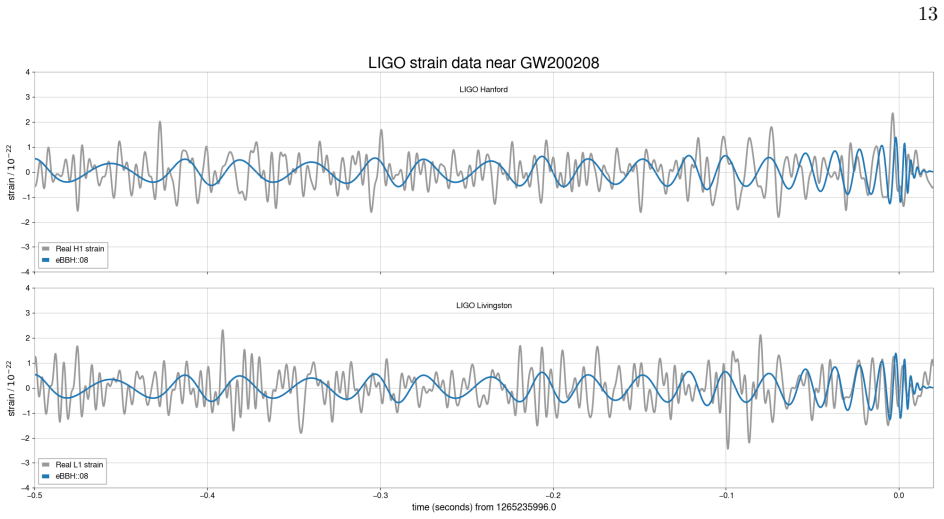
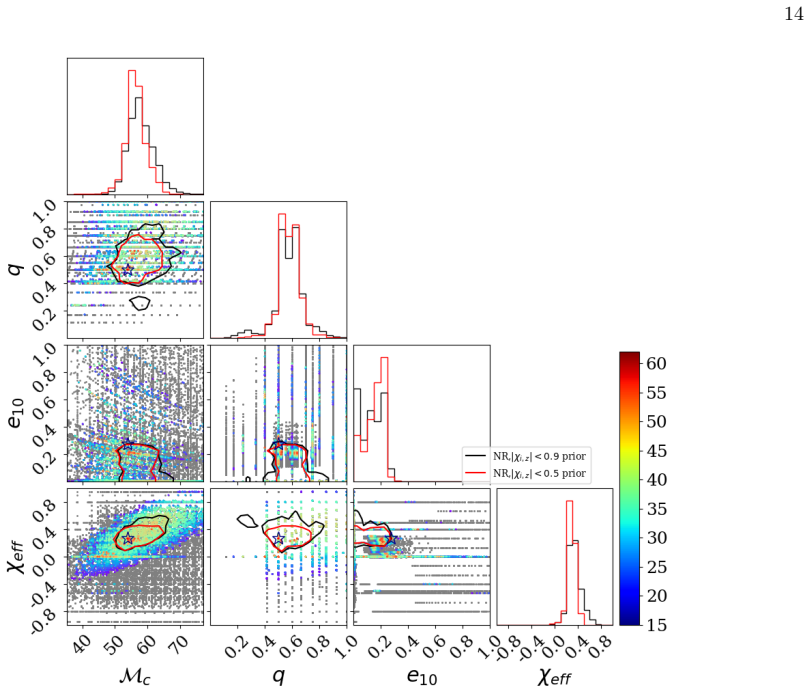
By confronting the LVK data for GW200208_22 with a bank of full numerical relativity waveforms that includes 42 newly generated targeted eccentric simulations, the RIFT analysis produces a KDE posterior that favors e20 = 0.198 with uncertainties -0.180 to +0.119 at 20 Hz; the highest-likelihood waveform has e20 = 0.200. The same approach applied to GW190620 yields a KDE estimate e10 = 0.190 with uncertainties -0.186 to +0.046 at 10 Hz. The authors note that additional targeted simulations will be needed to tighten these ranges.
What carries the argument
A bank of nearly two thousand numerical relativity simulations of eccentric binary black holes, augmented with 42 event-specific targeted runs, inserted into the RIFT Bayesian parameter estimation pipeline to produce KDE posteriors and maximum-likelihood waveform matches.
If this is right
- GW200208_22 data are better matched by an eccentric numerical waveform than by previous model-based circular or low-eccentricity assumptions.
- The eccentricity hypothesis for GW200208_22 is independently reinforced by direct comparison to full numerical solutions rather than approximate models alone.
- GW190620 shows a similar but broader preference for eccentricity near 0.19 at 10 Hz.
- Further targeted numerical relativity runs are required before the eccentricity intervals can be narrowed.
Where Pith is reading between the lines
- The method supplies an independent cross-check on eccentricity estimates obtained from effective-one-body or phenomenological models.
- Repeating the targeted-simulation approach on additional candidate eccentric events would test how often such signals appear in the current catalog.
- Narrower eccentricity posteriors would sharpen constraints on the relative contribution of dynamical versus isolated binary formation channels.
Load-bearing premise
The 42 new targeted numerical relativity simulations cover the relevant parameter space around the candidate eccentric values without gaps that could bias the maximum-likelihood selection or the KDE posterior.
What would settle it
A re-analysis with a denser set of eccentric or circular numerical relativity simulations that produces a significantly higher likelihood for a waveform with eccentricity below 0.05 would falsify the current eccentric preference.
Figures



read the original abstract
We have analyzed LVK gravitational wave events that show some evidence of eccentricity from TEOBResumS modeling parameter estimations and have confronted them independently with full numerical generated waveforms from our bank of nearly two thousand simulations of binary black holes. We have used RIFT for Bayesian parameter estimation and found that GW200208_22 KDE estimates favor eccentricities $e_{20} = 0.198_{-0.180}^{+0.119}$ upon entering the LVK band at $\sim20$Hz within a $90\%$ confidence interval. Within this event analysis we employed 42 new targeted full numerical relativity simulations and we have thus found a top improved likelihood $\ln\mathcal{L}$ matching waveform, compared to model-based analysis, with an estimated eccentricity at 20Hz, $e_{20}=0.200$, thus reinforcing the eccentric hypothesis of the binary. We have also used our full bank of numerical waveforms on GW190620 finding that the KDE estimate favors eccentricities at 10 Hz in $e_{10}=0.190_{-0.186}^{+0.046}$. New specifically targeted simulations will be required to narrow these eccentricity ranges.
Editorial analysis
A structured set of objections, weighed in public.
Referee Report
Summary. The manuscript analyzes two LVK gravitational-wave events, GW200208_22 and GW190620, that previously showed eccentricity indications under TEOBResumS modeling. Using a bank of nearly 2000 binary black hole numerical relativity simulations (supplemented by 42 new targeted runs for the first event) and the RIFT Bayesian inference code, the authors derive KDE posteriors on eccentricity at a reference frequency, reporting e_{20} = 0.198_{-0.180}^{+0.119} (90% CI) for GW200208_22 at 20 Hz and e_{10} = 0.190_{-0.186}^{+0.046} for GW190620 at 10 Hz. For GW200208_22 the best-matching targeted NR waveform yields an improved ln L and an eccentricity e_{20}=0.200, which the authors interpret as reinforcing the eccentric hypothesis; they note that further targeted simulations will be required to narrow the ranges.
Significance. If the 42 targeted NR simulations provide adequate coverage and the likelihood improvement is robust to interpolation and error budgets, the work would supply an independent NR-based check on eccentricity for specific events, complementing model-based analyses and demonstrating the utility of hybrid NR banks for parameter estimation. The scale of the existing simulation bank and the direct use of RIFT on discrete NR waveforms are positive features that could be strengthened by explicit validation.
major comments (2)
- [§3 and §4] §3 (Targeted NR Simulations) and §4 (Parameter Estimation): the manuscript states that 42 new targeted simulations were generated around candidate eccentric values from prior TEOBResumS results, yet provides no quantitative description of the selection grid, spacing in the (mass, spin, eccentricity) space, or mismatch-based coverage tests. Because RIFT selects or interpolates from the discrete bank, insufficient sampling could bias the reported maximum-likelihood waveform and distort the KDE posterior; this is load-bearing for the central claim of an improved ln L at e_{20}=0.200.
- [§4.1] §4.1 (Results for GW200208_22): the reported KDE interval e_{20} = 0.198_{-0.180}^{+0.119} and the best-match eccentricity e_{20}=0.200 rest on the assumption that the true parameters lie inside the volume covered by the 42 simulations; without reported validation (e.g., waveform mismatch surfaces or recovery tests on injected signals), the possibility remains that unsampled regions hide higher-likelihood solutions.
minor comments (2)
- [Abstract and §2] The notation e_{20} and e_{10} is introduced without an explicit definition of the reference frequency or the exact eccentricity measure (e.g., at a fixed time or frequency); a brief clarifying sentence would improve readability.
- [Figure 1 and §4] Figure captions and text should state the total number of simulations actually used in the RIFT runs for each event (bank size versus the 42 targeted subset) to allow readers to assess effective sampling density.
Simulated Author's Rebuttal
We thank the referee for their constructive comments and positive evaluation of the potential significance of our work. We address each major comment below and describe the revisions we will make.
read point-by-point responses
-
Referee: [§3 and §4] §3 (Targeted NR Simulations) and §4 (Parameter Estimation): the manuscript states that 42 new targeted simulations were generated around candidate eccentric values from prior TEOBResumS results, yet provides no quantitative description of the selection grid, spacing in the (mass, spin, eccentricity) space, or mismatch-based coverage tests. Because RIFT selects or interpolates from the discrete bank, insufficient sampling could bias the reported maximum-likelihood waveform and distort the KDE posterior; this is load-bearing for the central claim of an improved ln L at e_{20}=0.200.
Authors: We agree that a quantitative description of the targeted simulation selection is needed to fully support the robustness of the RIFT results. In the revised manuscript we will add an explicit description of the grid in (mass, spin, eccentricity) space, the spacing used, and any mismatch-based coverage tests that were performed on the 42 new runs. This addition will directly address the concern about possible bias in the maximum-likelihood waveform and KDE posterior. revision: yes
-
Referee: [§4.1] §4.1 (Results for GW200208_22): the reported KDE interval e_{20} = 0.198_{-0.180}^{+0.119} and the best-match eccentricity e_{20}=0.200 rest on the assumption that the true parameters lie inside the volume covered by the 42 simulations; without reported validation (e.g., waveform mismatch surfaces or recovery tests on injected signals), the possibility remains that unsampled regions hide higher-likelihood solutions.
Authors: We acknowledge that explicit validation would strengthen the claim that the sampled volume contains the relevant high-likelihood region. In the revised manuscript we will include waveform mismatch surfaces and/or recovery tests on injected signals to demonstrate coverage and to show that no substantially higher-likelihood solutions exist outside the targeted grid. revision: yes
Circularity Check
No significant circularity in the derivation chain
full rationale
The paper selects LVK events showing eccentricity evidence from prior TEOBResumS modeling and then performs independent Bayesian parameter estimation using RIFT on a bank of full numerical-relativity waveforms, including 42 newly generated targeted simulations. The reported KDE posteriors (e.g., e20 = 0.198 with uncertainties) and best-match likelihoods are obtained directly from comparisons to these NR waveforms rather than by re-deriving or fitting to the TEOBResumS results. No equations or steps reduce the final eccentricity estimates to the input selection by construction, and the approach relies on first-principles NR simulations as an external benchmark. The derivation is therefore self-contained with no self-definitional, fitted-prediction, or load-bearing self-citation patterns.
Axiom & Free-Parameter Ledger
axioms (2)
- domain assumption Numerical relativity waveforms accurately represent the true gravitational wave signal for eccentric binary black holes within the parameter range explored.
- domain assumption The RIFT Bayesian sampler correctly marginalizes over the parameters when comparing to the discrete NR waveform bank.
Lean theorems connected to this paper
-
IndisputableMonolith/Foundation/RealityFromDistinction.leanreality_from_one_distinction unclear?
unclearRelation between the paper passage and the cited Recognition theorem.
We have used RIFT for Bayesian parameter estimation and found that GW200208_22 KDE estimates favor eccentricities e20 = 0.198... with an estimated eccentricity at 20Hz, e20=0.200
-
IndisputableMonolith/Cost/FunctionalEquation.leanwashburn_uniqueness_aczel unclear?
unclearRelation between the paper passage and the cited Recognition theorem.
42 new targeted full numerical relativity simulations... top improved likelihood ln L matching waveform
What do these tags mean?
- matches
- The paper's claim is directly supported by a theorem in the formal canon.
- supports
- The theorem supports part of the paper's argument, but the paper may add assumptions or extra steps.
- extends
- The paper goes beyond the formal theorem; the theorem is a base layer rather than the whole result.
- uses
- The paper appears to rely on the theorem as machinery.
- contradicts
- The paper's claim conflicts with a theorem or certificate in the canon.
- unclear
- Pith found a possible connection, but the passage is too broad, indirect, or ambiguous to say the theorem truly supports the claim.
Forward citations
Cited by 4 Pith papers
-
Population Properties of Binary Black Holes with Eccentricity
First joint population inference on binary black hole eccentricity from GWTC-4 bounds the eccentric branching ratio below 5% at 90% confidence, with results consistent with quasi-circular models but highly model-dependent.
-
Including higher-order modes in a quadrupolar eccentric numerical relativity surrogate using universal eccentric modulation functions
The gwNRHME framework constructs a multi-modal non-spinning eccentric gravitational waveform surrogate by modulating quasi-circular models with universal eccentric functions, achieving median mismatches of ~9e-5 again...
-
Assessing the imprint of eccentricity in GW signatures using two independent waveform models
Dual-model analysis of 162 GW sources disfavors eccentricity for most events but finds potential evidence in GW200129, GW231001, and GW231123.
-
Biased parameter inference of eccentric, spin-precessing binary black holes
Eccentric BBH signals recovered with quasi-circular precessing models show biases in chirp mass and χ_p; Bayes factors favor eccentric aligned-spin models when both eccentricity and precession are present.
Reference graph
Works this paper leans on
-
[1]
and Virgo [2], now joined by KAGRA [3] con- tinue to identify coalescing compact binaries [4–9]. Their properties are understood by comparing gravi- tational wave (GW) observations to estimates of the radiation emitted from merging binary black holes, produced by detailed numerical calculations or phe- nomenological estimates. Most compact binaries that e...
work page internal anchor Pith review Pith/arXiv arXiv 2020
-
[2]
Model Based RIFT In the second iterative stage for a model-based run, RIFT first approximates L(λ) based on the set of evaluations {(λα, Lα)}. Then, using this approxi- mation, RIFT generates a full posterior distribution over the intrinsic parameters ppost(λλλ) = Lmarg(λλλ)p(λλλ)R dλλλLmarg(λλλ)p(λλλ) (4) where p(λλλ) is the prior on the intrinsic parame...
-
[3]
NR Based RIFT The second phase of RIFT must be slightly differ- ent when using numerical relativity simulations as grid points. Each NR simulation corresponds to a particular combination of the intrinsic parameters λλλ (mass ratio, spin components, and eccentricity) but can be scaled to any value of total mass. Therefore the second phase of RIFT instead m...
-
[4]
is χeff = 0.45+0.43 −0.44 Figure 2 shows our analysis of GW200208 22 us- ing direct comparison to nonprecessing numerical relativity simulations, as described in Section II E. While our underlying catalog of nonprecessing ec- centric NR simulations has only a few simulations which have optimal e and χeff, our catalog and thus analysis specifically include...
work page 2000
-
[5]
GW190620 an event with SNR 12 .1+0.3 −0.4 where the component masses, mass ratio and chirp mass in the detector frame as reported in [82] are: m1 = 84.6+20.0 −15.4, m2 = 53.1+17.1 −19.7, q = 0.62+0.33 −0.27, and Mc = 57.6+9.0 −11.2. This event also has significant support for positive effective spin where the reported effective spin from Table VI of [8] i...
-
[6]
we have found a simulation with an even higher likelihood than any of the 39 targeted simulations. In summary, we have found strong support to the second case (after GW190521) of clear non negligible eccentricity in a BBH entering the sensitivity band of LVK with the studies performed on GW200208 22. This result is supported by waveform models and indepen...
work page 2000
- [7]
- [8]
-
[9]
Akutsuet al.(KAGRA), PTEP2021, 05A101 (2021), arXiv:2005.05574 [physics.ins-det]
T. Akutsu, M. Ando, K. Arai, Y. Arai, S. Araki, A. Araya, N. Aritomi, Y. Aso, S. Bae, Y. Bae, L. Baiotti, R. Bajpai, M. A. Barton, K. Cannon, E. Capocasa, M. Chan, C. Chen, K. Chen, Y. Chen, 18 TABLE IV. Properties of the sequence of simulations described in Sec.II C. We report the remnant mass Mf /M and spin χf, the radiated energy δM = MADM − Mf, merger...
-
[10]
B. Abbott et al. (The LIGO Scientific Collaboration and the Virgo Collaboration), Phys. Rev. Lett 116, 061102 (2016)
work page 2016
-
[11]
Binary Black Hole Mergers in the first Advanced LIGO Observing Run
B. Abbott et al. (The LIGO Scientific Collabora- tion and the Virgo Collaboration), Phys. Rev. X 6, 041015 (2016), arXiv:1606.04856 [gr-qc]
work page internal anchor Pith review Pith/arXiv arXiv 2016
-
[12]
The LIGO Scientific Collaboration, the Virgo Col- laboration, B. P. Abbott, R. Abbott, T. D. Ab- bott, F. Acernese, K. Ackley, C. Adams, T. Adams, P. Addesso, and et al., Phys. Rev. Lett 119, 161101 (2017)
work page 2017
-
[13]
Abbottet al.(LIGO Scientific, KAGRA, VIRGO), As- trophys
R. Abbott, T. D. Abbott, S. Abraham, F. Acer- nese, K. Ackley, A. Adams, C. Adams, R. X. Ad- hikari, V. B. Adya, C. Affeldt, and et al., Astro- physical Journal 915, L5 (2021), arXiv:2106.15163 [astro-ph.HE]
- [14]
-
[15]
R. Abbott, T. D. Abbott, F. Acernese, K. Ackley, C. Adams, N. Adhikari, R. X. Adhikari, V. B. Adya, C. Affeldt, D. Agarwal, and et al., Physical Review X 13, 041039 (2023), arXiv:2111.03606 [gr-qc]
work page internal anchor Pith review Pith/arXiv arXiv 2023
-
[16]
H. A. Bethe and G. E. Brown, The Astrophysical Journal 506, 780–789 (1998)
work page 1998
-
[17]
K. Belczynski, V. Kalogera, and T. Bulik, The As- trophysical Journal 572, 407–431 (2002)
work page 2002
-
[18]
S. Stevenson, A. Vigna-G´ omez, I. Mandel, J. W. Barrett, C. J. Neijssel, D. Perkins, and S. E. de Mink, Nature Communications 8 (2017), 10.1038/ncomms14906
-
[19]
I. Mandel and R. O 'Shaughnessy, Classical and Quantum Gravity 27, 114007 (2010)
work page 2010
-
[20]
The Total Merger Rate of Compact Object Binaries In The Local Universe
A. Sadowski et al., Astrophys. J. 676, 1162 (2008), arXiv:0710.0878 [astro-ph]
work page internal anchor Pith review Pith/arXiv arXiv 2008
-
[21]
C. L. Rodriguez, P. Amaro-Seoane, S. Chatterjee, and F. A. Rasio, Phys. Rev. Lett. 120, 151101 (2018)
work page 2018
-
[22]
2019, ApJ, 871, 91, doi: 10.3847/1538-4357/aaf6ec
M. Zevin, J. Samsing, C. Rodriguez, C.-J. Haster, and E. Ramirez-Ruiz, Astrophysical Journal 871 (2019), 10.3847/1538-4357/aaf6ec
-
[23]
G. Fragione and J. Silk, Monthly Notices of the Royal Astronomical Society 498, 4591 (2020), https://academic.oup.com/mnras/article- pdf/498/4/4591/33798574/staa2629.pdf
work page 2020
-
[24]
J. Samsing, M. MacLeod, and E. Ramirez-Ruiz, The Astrophysical Journal 784, 71 (2014)
work page 2014
-
[25]
Close encounters of three black holes
M. Campanelli, C. O. Lousto, and Y. Zlochower, Phys. Rev. D77, 101501(R) (2008), arXiv:0710.0879 [gr-qc]
work page internal anchor Pith review Pith/arXiv arXiv 2008
-
[26]
C. O. Lousto and Y. Zlochower, Phys. Rev. D77, 024034 (2008), arXiv:0711.1165 [gr-qc]
work page internal anchor Pith review Pith/arXiv arXiv 2008
-
[27]
Close encounter of three black holes revisited,
G. Ficarra, A. Ciarfella, and C. O. Lousto, Phys. Rev. D 108, 064045 (2023), arXiv:2308.07365 [gr- qc]
-
[28]
Close en- counter of three black holes. III,
G. Ficarra and C. O. Lousto, Phys. Rev. D 110, 084072 (2024), arXiv:2406.11985 [gr-qc]
-
[29]
C. L. Rodriguez, P. Amaro-Seoane, S. Chatterjee, K. Kremer, F. A. Rasio, J. Samsing, C. S. Ye, and M. Zevin, Phys. Rev. D 98, 123005 (2018)
work page 2018
-
[30]
I. Romero-Shaw, P. D. Lasky, E. Thrane, and J. C. Bustillo, The Astrophysical Journal Letters 903, L5 (2020)
work page 2020
-
[31]
I. Romero-Shaw, P. D. Lasky, and E. Thrane, As- trophysical Journal 921, L31 (2021)
work page 2021
- [32]
-
[33]
I. M. Romero-Shaw, P. D. Lasky, and E. Thrane, Monthly Notices of the Royal Astronomical Society 490, 5210–5216 (2019)
work page 2019
- [34]
-
[35]
S. Khan, S. Husa, M. Hannam, F. Ohme, M. P¨ urrer, X. Jim´ enez Forteza, and A. Boh´ e, Phys. Rev.D93, 044007 (2016), arXiv:1508.07253 [gr-qc]
work page internal anchor Pith review Pith/arXiv arXiv 2016
- [36]
-
[37]
X. Liu, Z. Cao, and L. Shao, Phys. Rev. D 101, 044049 (2020)
work page 2020
-
[38]
I. Romero-Shaw, P. D. Lasky, and E. Thrane, The Astrophysical Journal 940, 171 (2022)
work page 2022
-
[39]
Evidence for eccentricity in the population of binary black holes observed by LIGO-Virgo-KAGRA
N. Gupte et al., (2024), arXiv:2404.14286 [gr-qc]
work page internal anchor Pith review Pith/arXiv arXiv 2024
-
[40]
M. Dax, S. R. Green, J. Gair, J. H. Macke, A. Buo- nanno, and B. Sch¨ olkopf, Physical Review Letters 127 (2021), 10.1103/physrevlett.127.241103
-
[41]
A. Boh´ e et al. , Phys. Rev. D95, 044028 (2017), arXiv:1611.03703 [gr-qc]
work page internal anchor Pith review Pith/arXiv arXiv 2017
-
[42]
R. Cotesta, A. Buonanno, A. Boh´ e, A. Taracchini, I. Hinder, and S. Ossokine, Physical Review D 98 (2018), 10.1103/physrevd.98.084028
-
[43]
A. Ramos-Buades, A. Buonanno, M. Khalil, and S. Ossokine, Physical Review D 105 (2022), 10.1103/physrevd.105.044035
-
[45]
I. Romero-Shaw, J. Stegmann, H. Tagawa, D. Gerosa, J. Samsing, N. Gupte, and S. R. Green, “Gw200208 222617 as an eccentric black-hole bi- nary merger: properties and astrophysical implica- tions,” (2025), arXiv:2506.17105 [astro-ph.HE]
- [46]
-
[47]
A. Nagar, S. Bernuzzi, W. D. Pozzo, G. Riemen- schneider, S. Akcay, G. Carullo, P. Fleig, S. Babak, K. W. Tsang, M. Colleoni, F. Messina, G. Pratten, D. Radice, P. Rettegno, M. Agathos, E. Fauchon- Jones, M. Hannam, S. Husa, T. Dietrich, P. Cerd´ a- Duran, J. A. Font, F. Pannarale, P. Schmidt, and T. Damour, Phys. Rev. D 98 (2018), 10.1103/phys- revd.98.104052
- [48]
-
[49]
S. Albanesi, A. Placidi, A. Nagar, M. Orselli, and S. Bernuzzi, Phys. Rev. D 105, L121503 (2022), arXiv:2203.16286 [gr-qc]
-
[50]
Rapid and accurate parameter inference for coalescing, precessing compact binaries
J. Lange, R. O’Shaughnessy, and M. Rizzo, arXiv e- prints , arXiv:1805.10457 (2018), arXiv:1805.10457 [gr-qc]
work page internal anchor Pith review Pith/arXiv arXiv 2018
- [51]
-
[52]
J. Healy and C. O. Lousto, Phys. Rev. D 102, 104018 (2020), arXiv:2007.07910 [gr-qc]
-
[53]
K. Chatziioannou et al. , Phys. Rev. D100, 104015 (2019), arXiv:1903.06742 [gr-qc]
-
[54]
Modeling the source of GW150914 with targeted numerical-relativity simulations
G. Lovelace et al. , Class. Quant. Grav. 33, 244002 (2016), arXiv:1607.05377 [gr-qc]
work page internal anchor Pith review Pith/arXiv arXiv 2016
-
[55]
V. Gayathri, J. Healy, J. Lange, B. O’Brien, M. Szczepanczyk, I. Bartos, M. Campanelli, S. Kli- menko, C. O. Lousto, and R. O’Shaughnessy, Na- ture Astron. 6, 344 (2022), arXiv:2009.05461 [astro- ph.HE]
- [56]
-
[57]
D. Chiaramello and A. Nagar, Phys. Rev. D 101, 101501 (2020), arXiv:2001.11736 [gr-qc]
- [58]
-
[59]
J. Healy, C. O. Lousto, J. Lange, R. O’Shaughnessy, Y. Zlochower, and M. Campanelli, Physical Review D 100 (2019), 10.1103/physrevd.100.024021
-
[60]
J. Healy and C. O. Lousto, Physical Review D 102 (2020), 10.1103/physrevd.102.104018
-
[61]
J. Healy and C. O. Lousto, Physical Review D 105 (2022), 10.1103/physrevd.105.124010
-
[62]
Accurate black hole evolutions by fourth-order numerical relativity
Y. Zlochower, J. G. Baker, M. Campanelli, and C. O. Lousto, Phys. Rev. D72, 024021 (2005), arXiv:gr-qc/0505055
work page internal anchor Pith review Pith/arXiv arXiv 2005
-
[63]
Accuracy Issues for Numerical Waveforms
Y. Zlochower, M. Ponce, and C. O. Lousto, Phys. Rev. D86, 104056 (2012), arXiv:1208.5494 [gr-qc]
work page internal anchor Pith review Pith/arXiv arXiv 2012
-
[64]
A simple construction of initial data for multiple black holes
S. Brandt and B. Br¨ ugmann, Phys. Rev. Lett. 78, 3606 (1997), gr-qc/9703066
work page internal anchor Pith review Pith/arXiv arXiv 1997
-
[65]
A single-domain spectral method for black hole puncture data
M. Ansorg, B. Br¨ ugmann, and W. Tichy, Phys. Rev. D70, 064011 (2004), gr-qc/0404056
work page internal anchor Pith review Pith/arXiv arXiv 2004
-
[66]
A Fast Apparent-Horizon Finder for 3-Dimensional Cartesian Grids in Numerical Relativity
J. Thornburg, Class. Quant. Grav. 21, 743 (2004), gr-qc/0306056
work page internal anchor Pith review Pith/arXiv arXiv 2004
-
[67]
Isolated and dynamical horizons and their applications
A. Ashtekar and B. Krishnan, Living Rev. Rel. 7, 10 (2004), gr-qc/0407042
work page internal anchor Pith review Pith/arXiv arXiv 2004
-
[68]
Spin Flips and Precession in Black-Hole-Binary Mergers
M. Campanelli, C. O. Lousto, Y. Zlochower, B. Kr- ishnan, and D. Merritt, Phys. Rev. D75, 064030 (2007), gr-qc/0612076
work page internal anchor Pith review Pith/arXiv arXiv 2007
-
[69]
Evolutions in 3D numerical relativity using fixed mesh refinement
E. Schnetter, S. H. Hawley, and I. Hawke, Class. Quant. Grav. 21, 1465 (2004), gr-qc/0310042
work page internal anchor Pith review Pith/arXiv arXiv 2004
- [70]
-
[71]
Second order gauge invariant gravitational perturbations of a Kerr black hole
M. Campanelli and C. O. Lousto, Phys. Rev. D59, 124022 (1999), arXiv:gr-qc/9811019 [gr-qc]
work page internal anchor Pith review Pith/arXiv arXiv 1999
-
[72]
C. O. Lousto and Y. Zlochower, Phys. Rev. D76, 041502(R) (2007), gr-qc/0703061
work page internal anchor Pith review Pith/arXiv arXiv 2007
-
[73]
Perturbative extraction of gravitational waveforms generated with Numerical Relativity
H. Nakano, J. Healy, C. O. Lousto, and Y. Zlochower, Phys. Rev. D91, 104022 (2015), arXiv:1503.00718 [gr-qc]
work page internal anchor Pith review Pith/arXiv arXiv 2015
-
[74]
G. Ficarra and C. O. Lousto, Phys. Rev. D 111, 044015 (2025), arXiv:2409.18728 [gr-qc]
-
[75]
A. Ciarfella, J. Healy, C. O. Lousto, and H. Nakano, Phys. Rev. D 106, 104035 (2022), arXiv:2206.13532 [gr-qc]
-
[76]
J. Healy and C. O. Lousto, Phys. Rev. D 105, 124010 (2022), arXiv:2202.00018 [gr-qc]
-
[77]
Coalescence of Two Spinning Black Holes: An Effective One-Body Approach
T. Damour, Phys. Rev. D64, 124013 (2001), arXiv:gr-qc/0103018
work page internal anchor Pith review Pith/arXiv arXiv 2001
-
[78]
J. Healy and C. O. Lousto, Phys. Rev. D97, 084002 (2018), arXiv:1801.08162 [gr-qc]
work page internal anchor Pith review Pith/arXiv arXiv 2018
-
[79]
D. Wysocki, R. O’Shaughnessy, J. Lange, and Y.-L. L. Fang, Physical Review D 99 (2019), 10.1103/physrevd.99.084026
-
[80]
J. Wofford, A. B. Yelikar, H. Gallagher, E. Cham- pion, D. Wysocki, V. Delfavero, J. Lange, C. Rose, V. Valsan, S. Morisaki, J. Read, C. Henshaw, and R. O’Shaughnessy, Phys. Rev. D 107, 024040 (2023)
work page 2023
-
[81]
Narrowing rift: Focused simulation-based-inference for interpreting exceptional gw sources,
K. J. Wagner, R. O’Shaughnessy, A. Yelikar, N. Manning, D. Fernando, J. Lange, V. Tiwari, A. Fernando, and D. Williams, “Narrowing rift: Focused simulation-based-inference for interpreting exceptional gw sources,” (2025), arXiv:2505.11655 [astro-ph.IM]
discussion (0)
Sign in with ORCID, Apple, or X to comment. Anyone can read and Pith papers without signing in.