Biased parameter inference of eccentric, spin-precessing binary black holes
Pith reviewed 2026-05-18 09:47 UTC · model grok-4.3
The pith
Eccentric binary black hole signals recovered with circular-orbit models produce large biases in inferred masses and spins.
A machine-rendered reading of the paper's core claim, the machinery that carries it, and where it could break.
Core claim
When signals from highly-eccentric binary black holes, generated with no spins, aligned spins, or precessing spins, are recovered using a quasi-circular precessing-spin waveform model, the resulting posteriors for source parameters such as chirp mass and the spin-precession parameter exhibit significant biases; Bayes factor calculations further establish that an eccentric aligned-spin model is preferred over a quasi-circular precessing-spin model for signals containing both effects.
What carries the argument
Parameter estimation and Bayes-factor model comparison between an eccentric aligned-spin recovery waveform and a quasi-circular precessing-spin recovery waveform when applied to injected eccentric spin-precessing signals.
If this is right
- Chirp-mass and spin-precession inferences will be systematically offset for any real event whose eccentricity is ignored.
- Model selection will favor eccentricity over precession when both effects are genuinely present in the data.
- Formation-channel interpretations that rely on measured spins or masses can be misleading for eccentric systems.
- Current quasi-circular analyses may misclassify some events as precessing when they are actually eccentric.
- Ready-to-use inspiral-merger-ringdown waveforms that include both eccentricity and spin precession are required for unbiased results.
Where Pith is reading between the lines
- If real events show the same model preference, some signals currently interpreted as spin-precessing may instead be eccentric.
- The observed bias pattern suggests that eccentricity and precession can produce similar waveform features, creating a practical degeneracy in existing analyses.
- Higher-sensitivity detectors could break this degeneracy by resolving higher-order harmonics that distinguish the two effects.
- Extending the study to a broader range of eccentricities and mass ratios would map the region where the bias becomes negligible.
Load-bearing premise
The simulated signals with eccentricity and precession are treated as faithful stand-ins for real gravitational waves, so that any biases seen with the simpler model arise from the model mismatch rather than from inaccuracies in the simulations themselves.
What would settle it
Recovering an actual LIGO-Virgo event with both an eccentric aligned-spin model and a quasi-circular precessing model and finding that the parameter shifts and model preference match the pattern seen in the injected simulations would support the central claim.
Figures


read the original abstract
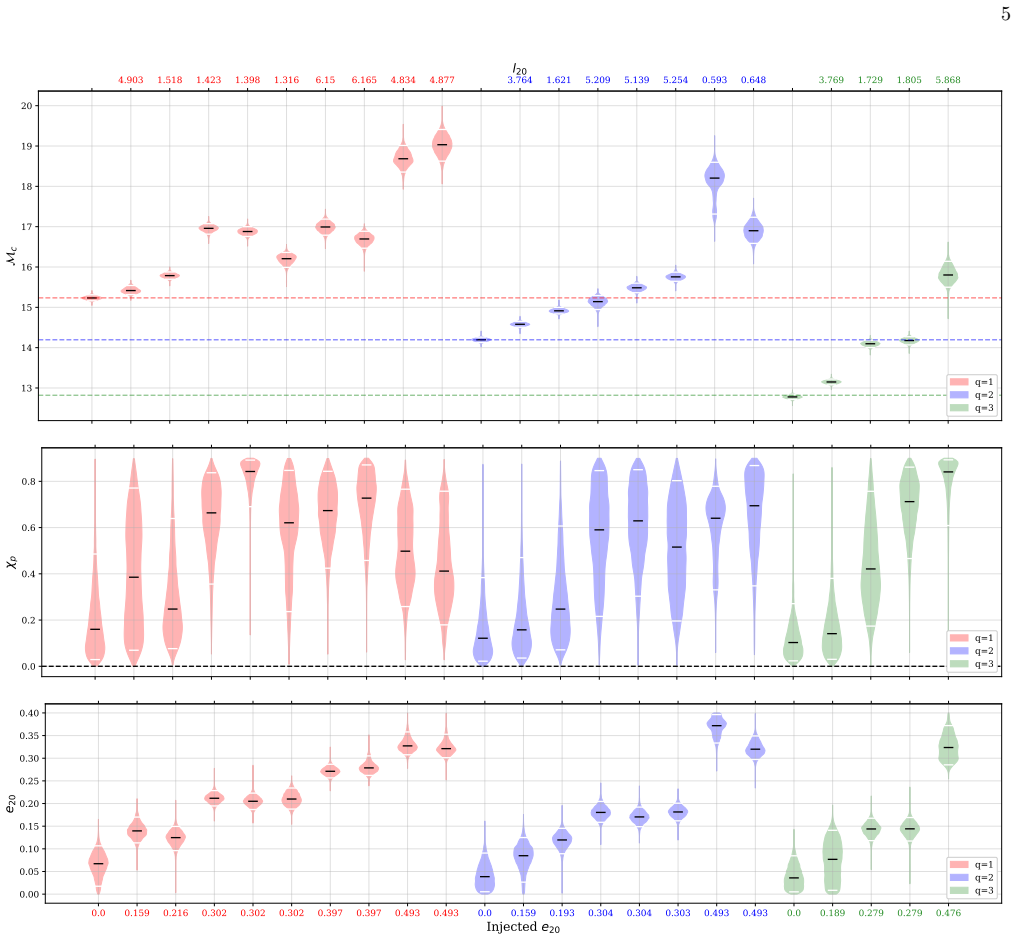
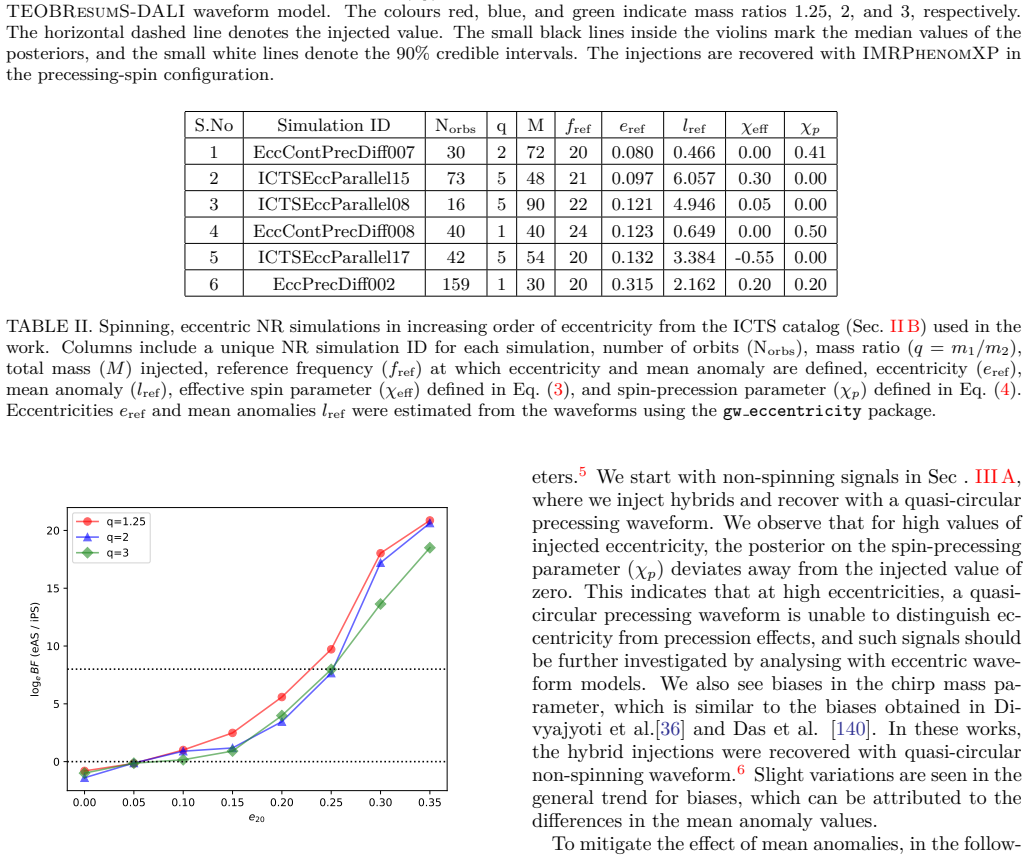
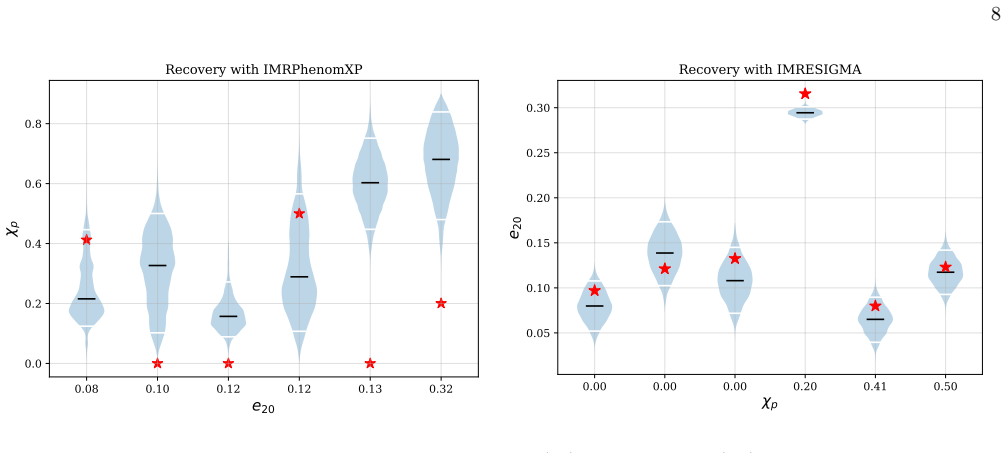
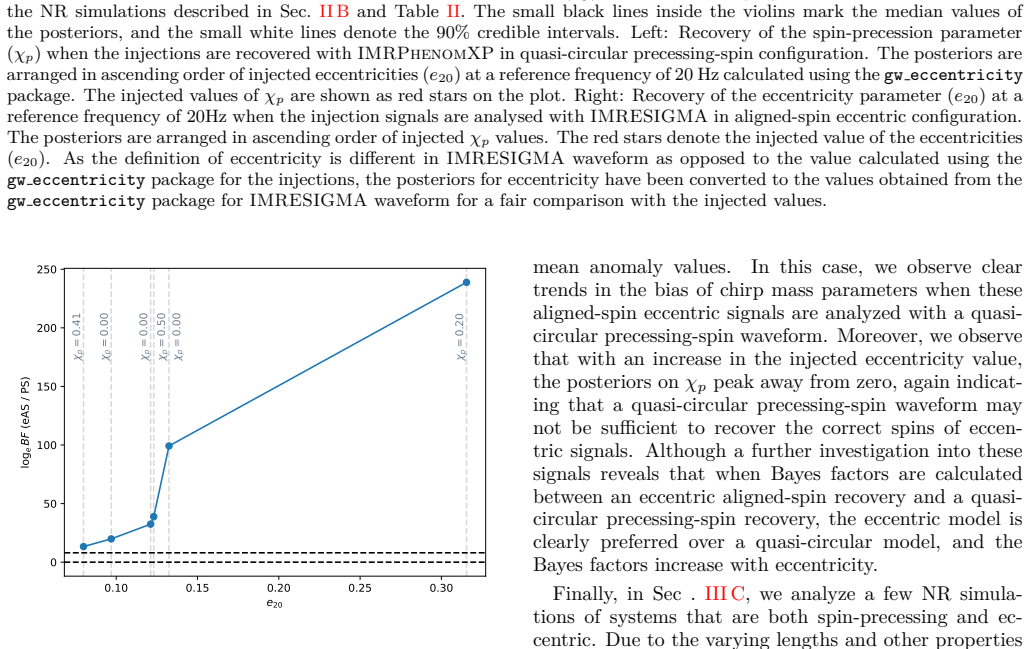
While the majority of gravitational wave (GW) events observed by the LIGO and Virgo detectors are consistent with mergers of binary black holes (BBHs) on quasi-circular orbits, some events are also consistent with non-zero orbital eccentricity, indicating that the binaries could have formed via dynamical interactions. Moreover, there may be GW events which show support for spin-precession, eccentricity, or both. In this work, we study the interplay of spins and eccentricity on the parameter estimation of GW signals from BBH mergers. We inject eccentric signals with no spins, aligned spins, and precessing spins using hybrids, TEOBResumS-DALI, and new Numerical Relativity (NR) simulations, respectively, and study the biases in the posteriors of source parameters when these signals are recovered with a quasi-circular precessing-spin waveform model, as opposed to an aligned-spin eccentric waveform model. We find significant biases in the source parameters, such as chirp mass and spin-precession ($\chi_p$), when signals from highly-eccentric BBHs are recovered with a quasi-circular waveform model. Moreover, we find that for signals with both eccentricity and spin-precession effects, Bayes factor calculations confirm that an eccentric, aligned-spin model is preferred over a quasi-circular precessing-spin model. Our study highlights the complex nature of GW signals from eccentric, precessing-spin binaries and the need for readily usable inspiral-merger-ringdown eccentric, spin-precessing waveform models for unbiased parameter estimation.
Editorial analysis
A structured set of objections, weighed in public.
Referee Report
Summary. The paper investigates biases in gravitational-wave parameter estimation for eccentric binary black hole signals recovered with a quasi-circular precessing-spin waveform model. Eccentric injections with no spins, aligned spins, and precessing spins are generated using hybrid waveforms, TEOBResumS-DALI, and new numerical relativity simulations, respectively. The authors report significant biases in parameters such as chirp mass and the spin-precession parameter χ_p, and find via Bayes factor comparisons that an eccentric aligned-spin model is preferred over the quasi-circular precessing model when both eccentricity and precession are present in the signal.
Significance. If the reported biases and model preferences are shown to be robust against injection-generator systematics, the result would be significant for LIGO/Virgo/KAGRA analyses of dynamically formed binaries. It provides concrete motivation for the development of eccentric, spin-precessing inspiral-merger-ringdown waveform models to avoid systematic errors in mass, spin, and formation-channel inference.
major comments (2)
- Methods section: The central claims rest on injections generated with three distinct families (hybrids for non-spinning eccentric, TEOBResumS-DALI for aligned-spin eccentric, and new NR for precessing eccentric). Because these families differ in eccentricity handling, spin modeling fidelity, and overall accuracy—especially at high eccentricity—the observed posterior shifts in chirp mass and χ_p, as well as the Bayes-factor preference, cannot be unambiguously attributed to the eccentricity–precession interplay rather than generator-specific mismatches. A controlled comparison that holds the injection method fixed while varying only the spin configuration is required to support the attribution in the strongest claim.
- Results section (Bayes-factor analysis): The statement that 'an eccentric, aligned-spin model is preferred over a quasi-circular precessing-spin model' for signals with both effects is load-bearing for the paper's conclusion about model selection. Without reported quantitative Bayes-factor values, the number of injections, or the specific eccentricity and spin magnitudes at which the preference appears, it is difficult to assess whether the preference is decisive or sensitive to the choice of prior and noise realization.
minor comments (2)
- Abstract: The phrase 'new Numerical Relativity (NR) simulations' should be accompanied by at least a brief statement of the number of simulations, their eccentricity range, and mass ratios to allow readers to gauge the scope of the study.
- Figure captions and text: Several references to 'significant biases' would be clearer if accompanied by explicit statements of the bias magnitude relative to the 90 % credible-interval width or the number of standard deviations from the injected value.
Simulated Author's Rebuttal
We thank the referee for their careful reading of the manuscript and for the constructive comments, which help clarify the presentation of our results. We address each major comment below.
read point-by-point responses
-
Referee: Methods section: The central claims rest on injections generated with three distinct families (hybrids for non-spinning eccentric, TEOBResumS-DALI for aligned-spin eccentric, and new NR for precessing eccentric). Because these families differ in eccentricity handling, spin modeling fidelity, and overall accuracy—especially at high eccentricity—the observed posterior shifts in chirp mass and χ_p, as well as the Bayes-factor preference, cannot be unambiguously attributed to the eccentricity–precession interplay rather than generator-specific mismatches. A controlled comparison that holds the injection method fixed while varying only the spin configuration is required to support the attribution in the strongest claim.
Authors: We acknowledge the potential for generator-specific systematics when employing distinct waveform families. This choice reflects current limitations in available models: hybrid waveforms are established for non-spinning eccentric signals, TEOBResumS-DALI accurately models aligned-spin eccentric cases, and NR simulations are required to capture the full precessing eccentric dynamics at the eccentricities of interest. No single family presently supports all configurations with equivalent fidelity. In the revised manuscript we will expand the Methods section to explicitly discuss these model limitations and the rationale for our selections, and we will add a brief assessment of possible systematics arising from the different generators. revision: partial
-
Referee: Results section (Bayes-factor analysis): The statement that 'an eccentric, aligned-spin model is preferred over a quasi-circular precessing-spin model' for signals with both effects is load-bearing for the paper's conclusion about model selection. Without reported quantitative Bayes-factor values, the number of injections, or the specific eccentricity and spin magnitudes at which the preference appears, it is difficult to assess whether the preference is decisive or sensitive to the choice of prior and noise realization.
Authors: We agree that quantitative details strengthen the interpretability of the Bayes-factor results. In the revised manuscript we will report the specific Bayes-factor values obtained for each relevant injection, the total number of injections performed, and the eccentricity and spin-magnitude ranges at which the model preference is observed. These additions will enable readers to evaluate the decisiveness and robustness of the preference with respect to prior choices and noise realizations. revision: yes
Circularity Check
No significant circularity in simulation-based parameter estimation study
full rationale
The paper's central claims arise from direct numerical experiments: injecting eccentric signals (no-spin via hybrids, aligned-spin via TEOBResumS-DALI, precessing via new NR) and recovering with a quasi-circular precessing model, followed by posterior bias measurements and Bayes factor comparisons. No mathematical derivation chain exists that reduces any result to its own inputs by construction, no parameters are fitted and then relabeled as predictions, and no self-citation or uniqueness theorem is invoked as load-bearing justification. The work is self-contained against external benchmarks via the reported simulation outputs.
Axiom & Free-Parameter Ledger
axioms (1)
- standard math Standard assumptions of general relativity and numerical-relativity techniques for generating binary-black-hole waveforms.
Forward citations
Cited by 3 Pith papers
-
Constants of motion and fundamental frequencies for elliptic orbits at fourth post-Newtonian order
Derives the 4PN conservative map between constants of motion and fundamental frequencies for eccentric orbits, resummed over eccentricity and validated against circular-orbit and self-force results.
-
Measuring Eccentricity and Addressing Waveform Systematics in GW231123
Reanalysis of GW231123 shows no significant eccentricity, with parameter estimate differences explained by waveform model disagreements at strong spin precession.
-
Mitigating Systematic Errors in Parameter Estimation of Binary Black Hole Mergers in O1-O3 LIGO-Virgo Data
Parametric models incorporating waveform phase and amplitude uncertainties mitigate systematic errors in gravitational wave parameter estimation, producing consistent results across models and raw/deglitched data for ...
Reference graph
Works this paper leans on
-
[1]
demonstrate that an eccentric or precessing signal can be confidently and correctly identified via compari- son of Bayes factors as long as the signal is of adequate length. Xu et al. [35] show that for high-mass, short sig- nals, eccentricity lower than 0.2 at 10 Hz is insufficient to mimic precession. Divyajyotiet al.[36] find that for low-mass systems,...
work page 2022
-
[2]
J. Aasiet al.(LIGO Scientific), Class. Quant. Grav.32, 074001 (2015), arXiv:1411.4547 [gr-qc]
work page internal anchor Pith review Pith/arXiv arXiv 2015
-
[3]
Akutsuet al.(KAGRA), PTEP2021, 05A101 (2020), arXiv:2005.05574 [physics.ins-det]
T. Akutsuet al.(KAGRA), PTEP2021, 05A101 (2020), arXiv:2005.05574 [physics.ins-det]
-
[4]
Advanced Virgo: a 2nd generation interferometric gravitational wave detector
F. Acerneseet al.(VIRGO), Class. Quant. Grav.32, 024001 (2015), arXiv:1408.3978 [gr-qc]
work page internal anchor Pith review Pith/arXiv arXiv 2015
-
[5]
A. G. Abacet al.(LIGO Scientific, VIRGO, KAGRA), (2025), arXiv:2508.18082 [gr-qc]
work page internal anchor Pith review Pith/arXiv arXiv 2025
-
[6]
A. G. Abacet al.(LIGO Scientific, VIRGO, KAGRA), (2025), arXiv:2508.18083 [astro-ph.HE]
work page internal anchor Pith review Pith/arXiv arXiv 2025
-
[7]
C. Kimball, C. Talbot, C. P. L. Berry, M. Zevin, E. Thrane, V. Kalogera, R. Buscicchio, M. Carney, T. Dent, H. Middleton, E. Payne, J. Veitch, and D. Williams, ApJ915, L35 (2021), arXiv:2011.05332 [astro-ph.HE]
-
[8]
F. Antonini, I. M. Romero-Shaw, and T. Callister, Phys. Rev. Lett.134, 011401 (2025), arXiv:2406.19044 [astro-ph.HE]
- [9]
-
[10]
I. Maga˜ na Hernandez and A. Palmese, (2025), arXiv:2508.19208 [astro-ph.HE]
-
[11]
Gravitational-wave constraints on the pair-instability mass gap and nuclear burning in massive stars
F. Antonini, I. Romero-Shaw, T. Callister, F. Dosopoulou, D. Chattopadhyay, M. Gieles, and M. Mapelli, (2025), arXiv:2509.04637 [astro-ph.HE]
work page internal anchor Pith review Pith/arXiv arXiv 2025
-
[12]
Evidence of the pair instability gap from black hole masses
H. Tonget al., (2025), arXiv:2509.04151 [astro-ph.HE]
work page internal anchor Pith review Pith/arXiv arXiv 2025
-
[13]
GW231123: a Binary Black Hole Merger with Total Mass 190-265 $M_{\odot}$
T. L. collaboration, “Gw231123: a binary black hole merger with total mass 190-265m ⊙,” (2025), arXiv:2507.08219 [astro-ph.HE]
work page internal anchor Pith review Pith/arXiv arXiv 2025
-
[14]
M. Mapelliet al., Mon. Not. Roy. Astron. Soc.505, 339 (2021), arXiv:2103.05016 [astro-ph.HE]
-
[15]
D. Gerosa and M. Fishbach, Nature Astron.5, 749 (2021), arXiv:2105.03439 [astro-ph.HE]
-
[16]
S. Torniamenti, M. Mapelli, C. P´ erigois, M. A. Sedda, M. C. Artale, M. Dall’Amico, and M. P. Vaccaro, As- tron. Astrophys.688, A148 (2024), arXiv:2401.14837 [astro-ph.HE]
-
[17]
S. Banagiri, E. Thrane, and P. D. Lasky, (2025), arXiv:2509.15646 [astro-ph.HE]
- [18]
-
[19]
C. L. Rodriguez, P. Amaro-Seoane, S. Chatterjee, and F. A. Rasio, Phys. Rev. Lett.120, 151101 (2018), arXiv:1712.04937 [astro-ph.HE]
work page internal anchor Pith review Pith/arXiv arXiv 2018
-
[20]
M. Dall’Amico, M. Mapelli, S. Torniamenti, and M. A. Sedda, Astron. Astrophys.683, A186 (2024), arXiv:2303.07421 [astro-ph.HE]
-
[21]
J. Samsing, I. Bartos, D. J. D’Orazio, Z. Haiman, B. Kocsis, N. W. C. Leigh, B. Liu, M. E. Pessah, and H. Tagawa, Nature603, 237 (2022), arXiv:2010.09765 [astro-ph.HE]
-
[22]
P. C. Peters, Phys. Rev.136, B1224 (1964)
work page 1964
-
[23]
C. L. Rodriguez and F. Antonini, Astrophys. J.863, 7 (2018), arXiv:1805.08212 [astro-ph.HE]
work page internal anchor Pith review Pith/arXiv arXiv 2018
-
[24]
B. Liu, D. Lai, and Y.-H. Wang, (2019), 10.3847/1538- 4357/ab2dfb, arXiv:1905.00427 [astro-ph.HE]
-
[25]
A. Dorozsmai, I. M. Romero-Shaw, A. Vijaykumar, S. Toonen, F. Antonini, K. Kremer, M. Zevin, and E. Grishin, (2025), arXiv:2507.23212 [astro-ph.GA]
- [26]
- [27]
-
[28]
V. Gayathri, J. Healy, J. Lange, B. O’Brien, M. Szczep- anczyk, I. Bartos, M. Campanelli, S. Klimenko, C. O. Lousto, and R. O’Shaughnessy, Nature Astron.6, 344 (2022), arXiv:2009.05461 [astro-ph.HE]
- [29]
-
[30]
I. Romero-Shaw, P. D. Lasky, and E. Thrane, ApJ940, 171 (2022), arXiv:2206.14695 [astro-ph.HE]
-
[31]
Evidence for eccentricity in the population of binary black holes observed by LIGO-Virgo-KAGRA
N. Gupteet al., (2024), arXiv:2404.14286 [gr-qc]
work page internal anchor Pith review Pith/arXiv arXiv 2024
- [32]
-
[33]
I. Romero-Shaw, J. Stegmann, H. Tagawa, D. Gerosa, J. Samsing, N. Gupte, and S. R. Green, (2025), arXiv:2506.17105 [astro-ph.HE]
-
[34]
P. McMillin, K. J. Wagner, G. Ficarra, C. O. Lousto, and R. O’Shaughnessy, (2025), arXiv:2507.22862 [gr- qc]
work page internal anchor Pith review Pith/arXiv arXiv 2025
- [35]
- [36]
- [37]
-
[38]
B. Abbottet al.(LIGO Scientific, Virgo), Phys. Rev. X 9, 031040 (2019), arXiv:1811.12907 [astro-ph.HE]
work page internal anchor Pith review Pith/arXiv arXiv 2019
-
[39]
R. Abbottet al.(LIGO Scientific, Virgo), Physical Re- view X11, 021053 (2021), arXiv:2010.14527 [gr-qc]
work page internal anchor Pith review Pith/arXiv arXiv 2021
-
[40]
R. Abbottet al.(LIGO Scientific, VIRGO), Phys. Rev. D109, 022001 (2024), arXiv:2108.01045 [gr-qc]
work page internal anchor Pith review Pith/arXiv arXiv 2024
-
[41]
R. Abbottet al.(KAGRA, VIRGO, LIGO Scientific), Phys. Rev. X13, 041039 (2023), arXiv:2111.03606 [gr- qc]
work page internal anchor Pith review Pith/arXiv arXiv 2023
- [42]
- [43]
-
[44]
M. de Lluc Planas, A. Ramos-Buades, C. Garc´ ıa-Quir´ os, H. Estell´ es, S. Husa, and M. Haney, arXiv e-prints , arXiv:2503.13062 (2025), arXiv:2503.13062 [gr-qc]
-
[45]
Fourier domain gravitational waveforms for precessing eccentric binaries
A. Klein, Y. Boetzel, A. Gopakumar, P. Jetzer, and L. de Vittori, Phys. Rev. D98, 104043 (2018), arXiv:1801.08542 [gr-qc]
work page internal anchor Pith review Pith/arXiv arXiv 2018
-
[46]
Klein, (2021), arXiv:2106.10291 [gr-qc]
A. Klein, (2021), arXiv:2106.10291 [gr-qc]
-
[47]
A. Klein, N. Cornish, and N. Yunes, Phys. Rev. D88, 124015 (2013), arXiv:1305.1932 [gr-qc]. 11
work page internal anchor Pith review Pith/arXiv arXiv 2013
-
[48]
E. A. Huerta, P. Kumar, S. T. McWilliams, R. O’Shaughnessy, and N. Yunes, Phys. Rev. D90, 084016 (2014), arXiv:1408.3406 [gr-qc]
work page internal anchor Pith review Pith/arXiv arXiv 2014
-
[49]
A Fourier Domain Waveform for Non-Spinning Binaries with Arbitrary Eccentricity
B. Moore, T. Robson, N. Loutrel, and N. Yunes, Class. Quant. Grav.35, 235006 (2018), arXiv:1807.07163 [gr- qc]
work page internal anchor Pith review Pith/arXiv arXiv 2018
- [50]
- [51]
-
[52]
S. Tiwari and A. Gopakumar, Phys. Rev. D102, 084042 (2020), arXiv:2009.11333 [gr-qc]
-
[53]
S. Albanesi, S. Bernuzzi, T. Damour, A. Nagar, and A. Placidi, Phys. Rev. D108, 084037 (2023), arXiv:2305.19336 [gr-qc]
-
[54]
A. Albertini, R. Gamba, A. Nagar, and S. Bernuzzi, Phys. Rev. D109, 044022 (2024), arXiv:2310.13578 [gr- qc]
- [55]
-
[56]
E. A. Huertaet al., Phys. Rev. D95, 024038 (2017), arXiv:1609.05933 [gr-qc]
work page internal anchor Pith review Pith/arXiv arXiv 2017
-
[57]
Foundations of an effective-one-body model for coalescing binaries on eccentric orbits
T. Hinderer and S. Babak, Phys. Rev. D96, 104048 (2017), arXiv:1707.08426 [gr-qc]
work page internal anchor Pith review Pith/arXiv arXiv 2017
-
[58]
I. Hinder, L. E. Kidder, and H. P. Pfeiffer, Phys. Rev. D98, 044015 (2018), arXiv:1709.02007 [gr-qc]
work page internal anchor Pith review Pith/arXiv arXiv 2018
-
[59]
Z. Cao and W.-B. Han, Phys. Rev. D96, 044028 (2017), arXiv:1708.00166 [gr-qc]
work page internal anchor Pith review Pith/arXiv arXiv 2017
-
[60]
D. Chiaramello and A. Nagar, Phys. Rev. D101, 101501 (2020), arXiv:2001.11736 [gr-qc]
- [61]
-
[62]
A. Ramos-Buades, A. Buonanno, M. Khalil, and S. Ossokine, Phys. Rev. D105, 044035 (2022), arXiv:2112.06952 [gr-qc]
- [63]
-
[64]
G. Carullo, S. Albanesi, A. Nagar, R. Gamba, S. Bernuzzi, T. Andrade, and J. Trenado, Phys. Rev. Lett.132, 101401 (2024), arXiv:2309.07228 [gr-qc]
-
[65]
Carullo, JCAP10, 061 (2024), arXiv:2406.19442 [gr- qc]
G. Carullo, JCAP10, 061 (2024), arXiv:2406.19442 [gr- qc]
- [66]
- [67]
-
[68]
H. Estell´ es, A. Ramos-Buades, S. Husa, C. Garc´ ıa- Quir´ os, M. Colleoni, L. Haegel, and R. Jaume, Phys. Rev. D103, 124060 (2021), arXiv:2004.08302 [gr-qc]
-
[69]
R. Cotesta, A. Buonanno, A. Boh´ e, A. Taracchini, I. Hinder, and S. Ossokine, Phys. Rev. D98, 084028 (2018), arXiv:1803.10701 [gr-qc]
-
[70]
A. Ramos-Buades, S. Husa, G. Pratten, H. Estell´ es, C. Garc´ ıa-Quir´ os, M. Mateu-Lucena, M. Colleoni, and R. Jaume, Phys. Rev. D101, 083015 (2020), arXiv:1909.11011 [gr-qc]
-
[71]
T. Islam and T. Venumadhav, Phys. Rev. D111, L081503 (2025), arXiv:2408.14654 [gr-qc]
- [72]
-
[73]
Islam, (2024), arXiv:2403.15506 [astro-ph.HE]
T. Islam, (2024), arXiv:2403.15506 [astro-ph.HE]
- [74]
- [75]
-
[76]
J. Stegmann, D. Gerosa, I. Romero-Shaw, G. Fumagalli, H. Tagawa, and L. Zwick, (2025), arXiv:2505.13589 [astro-ph.HE]
-
[77]
A. Chattaraj, T. RoyChowdhury, Divyajyoti, C. K. Mishra, and A. Gupta, Phys. Rev. D106, 124008 (2022), arXiv:2204.02377 [gr-qc]
-
[78]
M. Boyleet al., Class. Quant. Grav.36, 195006 (2019), arXiv:1904.04831 [gr-qc]
-
[79]
L. T. Buchman, H. P. Pfeiffer, M. A. Scheel, and B. Szi- lagyi, Phys. Rev.D86, 084033 (2012), arXiv:1206.3015 [gr-qc]
work page internal anchor Pith review Pith/arXiv arXiv 2012
-
[80]
T. Chu, H. P. Pfeiffer, and M. A. Scheel, Phys. Rev. D80, 124051 (2009), arXiv:0909.1313 [gr-qc]
work page internal anchor Pith review Pith/arXiv arXiv 2009
discussion (0)
Sign in with ORCID, Apple, or X to comment. Anyone can read and Pith papers without signing in.