A Bounded-Confidence Model of Opinion Dynamics with Adaptive Interaction Probabilities
Pith reviewed 2026-05-25 06:31 UTC · model grok-4.3
The pith
An adaptive edge-weighted Deffuant-Weisbuch model converges while its interaction probabilities evolve to define a time-dependent effective graph of receptive agent pairs.
A machine-rendered reading of the paper's core claim, the machinery that carries it, and where it could break.
Core claim
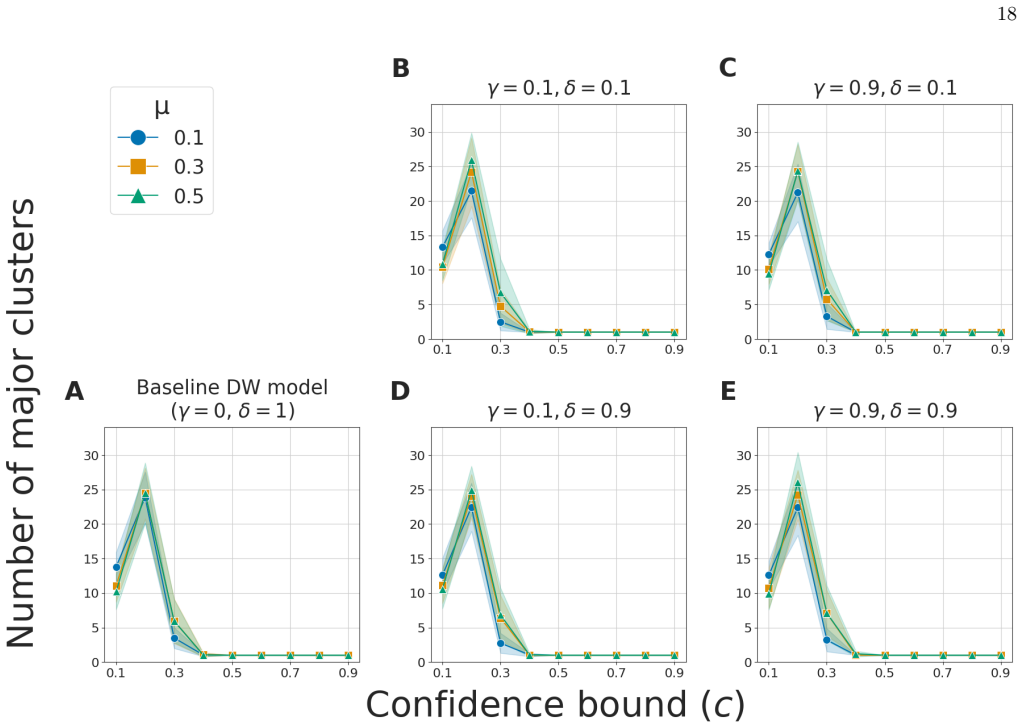
The authors introduce an adaptive edge-weighted version of the Deffuant-Weisbuch model in which edge weights increase after compromise according to a positive-feedback rule. They prove that the opinions converge, that the edge weights reach a long-time limit, and that the system is equivalent to a time-dependent effective graph consisting solely of edges between agents whose opinions lie within the confidence bound. Numerical experiments on various networks confirm that the adaptive weights produce qualitatively different convergence times depending on network density.
What carries the argument
The adaptive edge-weight update rule that raises interaction probability after compromise and thereby generates the effective graph of receptive pairs.
If this is right
- Opinions reach stable clusters whose sizes depend on the final effective graph.
- The effective graph becomes fixed once all edge weights have converged.
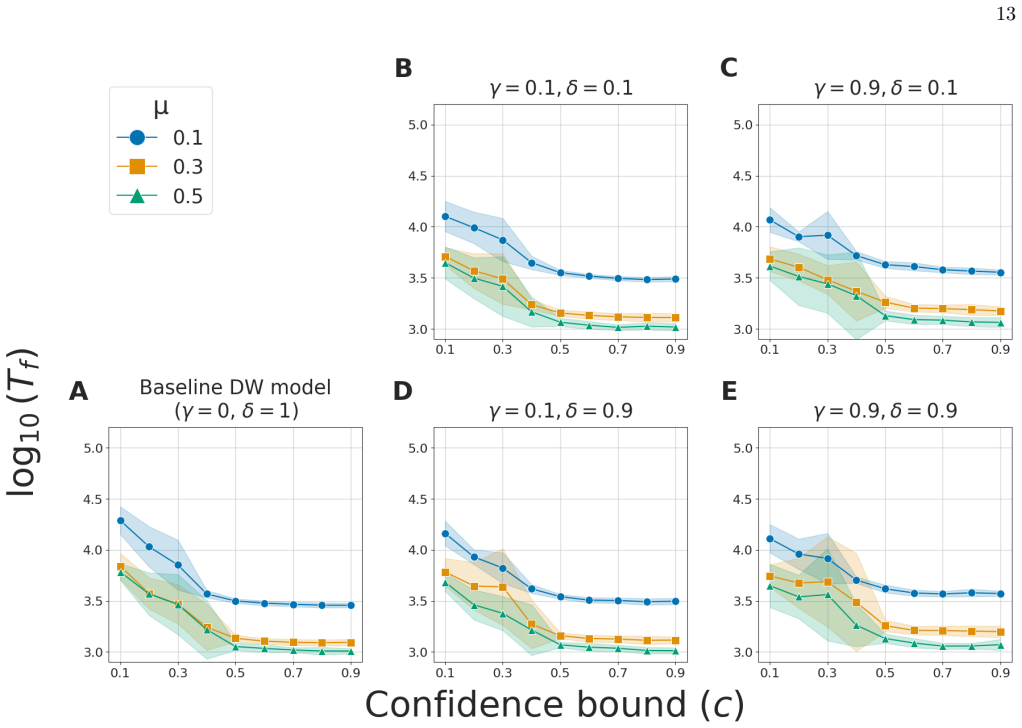
- Convergence time decreases with adaptive weights on dense networks.
- Convergence time increases with adaptive weights on sparse networks for small confidence bounds.
Where Pith is reading between the lines
- The mechanism suggests that real social networks with strong positive feedback from agreement may reach consensus faster than static models predict when connectivity is high.
- One could replace the update rule with a version that also allows weight decreases after disagreement and check whether the convergence proofs still hold.
- The effective-graph reduction might be used to analyze other bounded-confidence variants without resimulating every interaction.
Load-bearing premise
The model assumes that edge weights increase after every compromise according to one specific positive-feedback rule.
What would settle it
Running the model on a small complete graph with a fixed small confidence bound and observing that the edge weights fail to stabilize or that the set of active edges does not match the predicted effective graph after a long time.
Figures





read the original abstract
Models of opinion dynamics aim to capture how individuals' opinions change when they interact with each other. One well-known model of opinion dynamics is the Deffuant--Weisbuch (DW) model, which is a type of bounded-confidence model (BCM). In the DW model, agents have pairwise interactions, and they are receptive to other agents' opinions when their opinions are sufficiently close to each other. In this paper, we extend the DW model by studying it on networks with heterogeneous and adaptive edge weights between pairs of agents. These edge weights govern the interaction probabilities between the agents and thereby encode the idea that people are more likely to communicate with individuals with whom they have previously compromised or had other positive interactions. We prove theoretical guarantees of our adaptive edge-weighted DW model's convergence properties, the long-time dynamics of its edge weights, and the model's associated ``effective graph", which is a time-dependent subgraph that includes edges only between agents that are receptive to each other's opinions. We support our theoretical results with numerical simulations of our adaptive edge-weighted DW model on a variety of networks and find that including adaptive edge weights yields different qualitative dynamics for different types of networks. In particular, for small confidence bounds, we observe that incorporating adaptive edge weights decreases the convergence time for dense networks but increases the convergence time for sparse networks.
Editorial analysis
A structured set of objections, weighed in public.
Referee Report
Summary. The paper extends the Deffuant-Weisbuch bounded-confidence model to networks with heterogeneous, adaptive edge weights that increase interaction probability after compromise. It claims to prove convergence of opinions to clusters, the long-time dynamics of the edge weights under a positive-feedback update rule, and the structure of a time-dependent effective graph (the subgraph of receptive pairs). Simulations on multiple network classes are presented to show that adaptive weights decrease convergence time on dense networks but increase it on sparse networks for small confidence bounds.
Significance. If the proofs are correct, the work supplies a rigorous analytic framework for adaptive interaction probabilities in BCMs, with the effective-graph construction offering a useful reduction for long-time analysis. The topology-dependent simulation results are a concrete, falsifiable prediction that distinguishes the model from the static-weight DW case. Explicit model equations and proof strategy are supplied, which is a strength.
minor comments (3)
- The abstract states the adaptive rule only qualitatively; a one-sentence description of the positive-feedback update (e.g., the functional form of the weight increment) would improve readability without lengthening the abstract appreciably.
- Figure captions for the simulation panels should explicitly state the network size N, number of Monte-Carlo realizations, and the precise values of the confidence bound ε and the adaptation rate used in each panel.
- Notation for the effective graph G_eff(t) is introduced in the text but never appears in a displayed equation; adding a compact definition (e.g., Eq. (X)) would aid cross-referencing in the proofs.
Simulated Author's Rebuttal
We thank the referee for the positive assessment of our manuscript, the accurate summary of its contributions, and the recommendation for minor revision. No specific major comments were provided in the report.
Circularity Check
No significant circularity detected
full rationale
The paper defines an explicit positive-feedback adaptive rule for edge weights as an independent modeling choice and then derives convergence properties, long-time edge-weight evolution, and effective-graph structure via direct proofs from the stated model equations. No fitted parameters are renamed as predictions, no self-citation chains bear the central claims, and no ansatz or uniqueness result is smuggled in. The theoretical guarantees are self-contained against the model definition; simulations are presented only as supporting evidence. This is the standard case of an internally consistent derivation with no reduction to inputs by construction.
Axiom & Free-Parameter Ledger
invented entities (1)
-
adaptive edge weights
no independent evidence
Lean theorems connected to this paper
-
IndisputableMonolith/Cost/FunctionalEquation.leanwashburn_uniqueness_aczel unclear?
unclearRelation between the paper passage and the cited Recognition theorem.
We increase the edge weight between two nodes after each interaction in which they update their opinions (this is a 'positive' interaction) and we decrease the edge weight after an interaction that does not lead to opinion updates (i.e., a 'negative' interaction).
-
IndisputableMonolith/Foundation/RealityFromDistinction.leanreality_from_one_distinction unclear?
unclearRelation between the paper passage and the cited Recognition theorem.
Theorem 2... each edge weight z_ij(t) almost surely converges to 0 or 1... when lim x_i(t)=lim x_j(t) then z_ij→1, otherwise z_ij→0.
-
IndisputableMonolith/Foundation/AlexanderDuality.leanalexander_duality_circle_linking unclear?
unclearRelation between the paper passage and the cited Recognition theorem.
the effective graph G_eff(t) is the time-dependent subgraph... that includes only the edges... between agents that are receptive to each other
What do these tags mean?
- matches
- The paper's claim is directly supported by a theorem in the formal canon.
- supports
- The theorem supports part of the paper's argument, but the paper may add assumptions or extra steps.
- extends
- The paper goes beyond the formal theorem; the theorem is a base layer rather than the whole result.
- uses
- The paper appears to rely on the theorem as machinery.
- contradicts
- The paper's claim conflicts with a theorem or certificate in the canon.
- unclear
- Pith found a possible connection, but the passage is too broad, indirect, or ambiguous to say the theorem truly supports the claim.
Reference graph
Works this paper leans on
-
[1]
studied a BCM with a neighborhood-based network adaptivity, in which agents rewire preferentially to other agents whose neighbors’ opinions are close to their own. Agostinelli et al. [30] examined a BCM on an adaptive network with polyadic interactions to analyze the im- portance of group interactions in opinion dynamics. Re- searchers have also examined ...
work page 2005
-
[2]
M. O. Jackson,Social and Economic Networks, Social and Economic Networks (Princeton University Press, Princeton, NJ, USA, 2008)
work page 2008
-
[3]
S. Wasserman and K. Faust,Social Network Analysis: Methods and Applications(Cambridge University Press, Cambridge, UK, 1994)
work page 1994
-
[4]
E. C. Baek, R. Hyon, K. L´ opez, M. A. Porter, and C. Parkinson, Perceived community alignment increases information sharing, Nature Comm.16, 5864 (2025)
work page 2025
-
[5]
H. Noorazar, K. R. Vixie, A. Talebanpour, and Y. Hu, From classical to modern opinion dynamics, Int. J. Mod- ern Phys. C31, 2050101 (2020)
work page 2020
-
[6]
Opinion dynamics: Statistical physics and beyond
M. Starnini, F. Baumann, T. Galla, D. Garcia, G. I˜ niguez, M. Karsai, J. Lorenz, and K. Sznajd- Weron, Opinion dynamics: Statistical physics and be- yond, arXiv:2507.11521 (2025)
work page internal anchor Pith review Pith/arXiv arXiv 2025
-
[7]
G. Caldarelli, O. Artime, G. Fischetti, A. N. Stefano Guarino, F. Saracco, P. Holme, and M. de Domenico, The physics of news, rumors, and opinions, arXiv:2510.15053 (2025)
-
[8]
M. Newman,Networks, 2nd ed. (Oxford University Press, Oxford, UK, 2018)
work page 2018
-
[9]
D. Chandler and R. Munday,A Dictionary of Media and Communication, 3rd ed. (Oxford University Press, Ox- ford, UK, 2020)
work page 2020
- [10]
-
[11]
C. Bernardo, C. Altafini, A. Proskurnikov, and F. Vasca, Bounded confidence opinion dynamics: A survey, Auto- matica159, 111302 (2024)
work page 2024
-
[12]
X. F. Meng, R. A. Van Gorder, and M. A. Porter, Opin- ion formation and distribution in a bounded-confidence model on various networks, Phys. Rev. E97, 022312 (2018)
work page 2018
-
[13]
R. Hegselmann and U. Krause, Opinion dynamics and bounded confidence models, analysis and simulation, J. Artif. Soc. Soc. Simul.5(3), 2 (2002)
work page 2002
-
[14]
G. Deffuant, D. Neau, F. Amblard, and G. Weisbuch, Mixing beliefs among interacting agents, Adv. Cplx. Sys. 3, 87 (2000)
work page 2000
-
[15]
J. Lorenz, Heterogeneous bounds of confidence: Meet, discuss and find consensus!, Complexity15, 43 (2010). 21 FIG. 10. The number of major opinion clusters in simulations of our adaptive edge-weighted DW model versus the confidence boundcfor different values of the edge-weight increase parameterγand the edge-weight decrease parameterδon the Smith College ...
work page 2010
-
[16]
W. Su, G. Chen, and Y. Hong, Noise leads to quasi- consensus of Hegselmann–Krause opinion dynamics, Au- tomatica85, 448 (2017)
work page 2017
-
[17]
T. Vaz Martins, M. Pineda, and R. Toral, Mass media and repulsive interactions in continuous-opinion dynam- ics, Europhys. Lett.91, 48003 (2010)
work page 2010
-
[18]
C. Kann and M. Feng, Repulsive bounded-confidence model of opinion dynamics in polarized communities (2023), arXiv:2301.02210
- [19]
-
[20]
H. Schawe and L. Hern´ andez, Higher order interactions destroy phase transitions in deffuant opinion dynamics model, Comm. Phys.5, 32 (2022)
work page 2022
-
[21]
G. J. Li and M. A. Porter, Bounded-confidence model of opinion dynamics with heterogeneous node-activity lev- els, Phys. Rev. Res.5, 023179 (2023)
work page 2023
-
[22]
A. Sˆ ırbu, D. Pedreschi, F. Giannotti, and J. Kert´ esz, Al- gorithmic bias amplifies opinion fragmentation and po- larization: A bounded confidence model, PLoS ONE14, e0213246 (2019)
work page 2019
- [23]
-
[24]
K. Sugishita, M. A. Porter, M. Beguerisse-D´ ıaz, and N. Masuda, Opinion dynamics on tie-decay networks, Phys. Rev. Res.3, 023249 (2021)
work page 2021
- [25]
-
[26]
B. Kozma and A. Barrat, Consensus formation on adap- tive networks, Phys. Rev. E77, 016102 (2008)
work page 2008
-
[27]
B. Kozma and A. Barrat, Consensus formation on coe- volving networks: Groups’ formation and structure, J. Phys. A. Math. Theor.41, 224020 (2008)
work page 2008
-
[28]
U. Kan, M. Feng, and M. A. Porter, An adaptive bounded-confidence model of opinion dynamics on net- works, J. Cplx. Net.11, cnac055 (2023)
work page 2023
-
[29]
M. Brede, How does active participation affect consen- sus: Adaptive network model of opinion dynamics and in- fluence maximizing rewiring, Complexity2019, 1486909 (2019)
work page 2019
-
[30]
S. Krishnagopal and M. A. Porter, Bounded-confidence models of opinion dynamics with neighborhood effects, Phys. Rev. E112, 054317 (2025)
work page 2025
-
[31]
C. Agostinelli, M. Mancastroppa, and A. Barrat, Group adaptation drives opinion dynamics in higher-order net- works, arXiv:2602.19684 (2026). 22
work page internal anchor Pith review arXiv 2026
-
[32]
G. J. Li, J. Luo, and M. A. Porter, Bounded-confidence models of opinion dynamics with adaptive confidence bounds, SIAM J. App. Dyn. Sys.24, 994 (2025)
work page 2025
-
[33]
P. Holme and M. E. J. Newman, Nonequilibrium phase transition in the coevolution of networks and opinions, Phys. Rev. E74, 056108 (2006)
work page 2006
-
[34]
R. T. Durrett, J. P. Gleeson, A. L. Lloyd, P. J. Mucha, F. Shi, D. Sivakoff, J. E. S. Socolar, and C. Varghese, Graph fission in an evolving voter model, Proc. Natl. Acad. Sci. U.S.A.109, 3682 (2012)
work page 2012
-
[35]
Y. H. Kureh and M. A. Porter, Fitting in and breaking up: A nonlinear version of coevolving voter models, Phys. Rev. E101, 062303 (2020)
work page 2020
-
[36]
A. Golovin, J. M¨ olter, and C. Kuehn, Polyadic opinion formation: The adaptive voter model on a hypergraph, Ann. der Physik536, 2300342 (2024)
work page 2024
- [37]
- [38]
-
[39]
K. S. Cook, Exchange: Social, inInternational Encyclo- pedia of the Social & Behavioral Sciences, edited by J. D. Wright (Elsevier, Amsterdam, The Netherlands, 2015) 2nd ed., pp. 482–488
work page 2015
-
[40]
Lorenz, A stabilization theorem for dynamics of con- tinuous opinions, Physica A355, 217 (2005)
J. Lorenz, A stabilization theorem for dynamics of con- tinuous opinions, Physica A355, 217 (2005)
work page 2005
-
[41]
M. E. J. Newman, Finding community structure in net- works using the eigenvectors of matrices, Phy. Rev. E74, 036104 (2006)
work page 2006
-
[42]
A. L. Traud, P. J. Mucha, and M. A. Porter, Social struc- ture of Facebook networks, Physica A391, 4165 (2012)
work page 2012
-
[43]
M. F. Laguna, G. Abramson, and D. H. Zanette, Minori- ties in a model for opinion formation, Complexity9, 31 (2004)
work page 2004
-
[44]
W. Han, Y. Feng, X. Qian, Q. Yang, and C. Huang, Clusters and the entropy in opinion dynamics on complex networks, Physica A559, 125033 (2020)
work page 2020
-
[45]
A bounded-confidence model of opinion dynamics with adaptive edge probabilities
L. Thompsky and Y. Wu, Code and figure repository for “A bounded-confidence model of opinion dynamics with adaptive edge probabilities” (2026), available athttps: //github.com/Yolandayx929/adaptive-edge-BCM
work page 2026
-
[46]
H. Z. Brooks and M. A. Porter, A model for the influ- ence of media on the ideology of content in online social networks, Phys. Rev. Res.2, 023041 (2020)
work page 2020
-
[47]
B. Smith, How TikTok reads your mind (2021), The New York Times, available athttps://www.nytimes.com/ 2021/12/05/business/media/tiktok-algorithm.html; 5 December 2021
work page 2021
-
[48]
A. Mosseri, Instagram ranking explained (2023), Insta- gram blog, available athttps://about.instagram.com/ blog/announcements/instagram-ranking-explained/; 31 May 2023
work page 2023
- [49]
discussion (0)
Sign in with ORCID, Apple, or X to comment. Anyone can read and Pith papers without signing in.