Eccentric mergers of binary Proca stars
Pith reviewed 2026-05-22 20:13 UTC · model grok-4.3
The pith
The relative phase between two merging Proca stars controls whether the outcome is prompt black-hole formation, a hypermassive remnant, or an unstable spinning m-bar=2 star, and can generate odd-mode gravitational waves absent from black-hp
A machine-rendered reading of the paper's core claim, the machinery that carries it, and where it could break.
Core claim
Systematic variation of the relative phase and orbital boost in eccentric equal-mass m-bar=1 Proca-star binaries shows that the phase exerts paramount control over the nonlinear evolution: prompt black-hole formation with a transient Proca remnant, formation of a hypermassive m-bar=1 Proca star, or emergence of a dynamically unstable spinning m-bar=2 Proca star can all occur. Under certain phase alignments the emitted gravitational waves contain significant odd modes (for example the l=m=3 mode) that are absent in black-hole mergers and may serve as unique identifiers of these objects.
What carries the argument
The relative phase between the Proca fields of the two stars, which sets the interference pattern that governs the nonlinear post-merger dynamics and the selection of gravitational-wave multipoles.
If this is right
- Different relative phases produce qualitatively distinct remnants: black holes with transient Proca clouds, long-lived hypermassive m-bar=1 stars, or spinning m-bar=2 stars that are dynamically unstable.
- Gravitational-wave signals from some mergers contain odd multipoles such as the l=m=3 mode that do not appear in black-hole mergers.
- The internal phase structure of the Proca field can therefore act as an additional degree of freedom that shapes both the final object and the observable waveform.
- These mergers enlarge the known phenomenology of bosonic-star collisions and the possible astrophysical roles of ultralight bosonic fields.
Where Pith is reading between the lines
- If ultralight bosonic fields constitute dark matter, phase-dependent merger outcomes could produce a subpopulation of compact objects whose stability and spin properties differ from those formed by ordinary stellar collapse.
- Detection of odd-mode gravitational waves in a merger event without an electromagnetic counterpart might indicate a Proca-star origin even when the remnant itself is not directly resolved.
- The same phase-sensitivity mechanism may operate in mergers of other self-interacting scalar or vector boson stars, suggesting a broader class of phase-controlled exotic compact-object collisions.
Load-bearing premise
The chosen numerical code and initial-data construction faithfully reproduce the nonlinear Proca-field evolution without dominant discretization or gauge artifacts when the relative phase is altered.
What would settle it
A set of otherwise identical simulations in which changing only the relative phase produces no measurable difference in remnant type or in the amplitude of the l=m=3 gravitational-wave mode.
Figures




read the original abstract
We present a numerical relativity study of eccentric mergers of equal-mass rotating $\bar m=1$ Proca stars, focusing on their gravitational-wave (GW) emission. By systematically varying key binary parameters, such as the initial orbital boost, which determines the orbital angular momentum, and the relative phase between the stars, we examine how the internal phase structure of the Proca field influences the merger dynamics and the properties of the emitted GWs. Our simulations demonstrate that the relative phase has paramount impact on the post-merger evolution, resulting in prompt black hole formation accompanied by a transient Proca remnant, the formation of a hypermassive $\bar m=1$ Proca star or even the emergence of a dynamically-unstable spinning $\bar m=2$ Proca star. Under certain conditions, the GW signal exhibits significant odd-modes (e.g., the $\ell=m=3$ mode) that are absent in conventional black hole mergers, potentially serving as unique signatures of these exotic objects. Our findings offer new insights into the phenomenology of bosonic star mergers and the potential astrophysical role of ultralight bosonic fields.
Editorial analysis
A structured set of objections, weighed in public.
Referee Report
Summary. The paper presents a numerical relativity study of eccentric mergers of equal-mass rotating m-bar=1 Proca stars. By varying the initial orbital boost (controlling orbital angular momentum) and the relative phase between the two stars, the authors investigate how the internal phase structure of the Proca vector field affects merger dynamics and gravitational-wave emission. The central results are that the relative phase has a dominant effect on post-merger evolution, producing outcomes ranging from prompt black-hole formation with a transient Proca remnant, to a hypermassive m-bar=1 Proca star, or a dynamically unstable spinning m-bar=2 Proca star; under some conditions the GW signal contains significant odd modes (e.g., the l=m=3 mode) absent from conventional black-hole mergers.
Significance. If the reported phase-dependent phenomenology is confirmed to be free of numerical artifacts, the work would be significant for the phenomenology of bosonic-star mergers. It identifies potential unique GW signatures (odd-parity modes) that could serve as observational discriminants for ultralight vector fields and adds concrete examples of how internal field structure influences the remnant and waveform in exotic compact-object mergers.
major comments (1)
- [Numerical Methods and Results sections] The manuscript provides no information on grid resolution, convergence tests, or error budgets for the family of simulations in which the relative phase is varied. Because the headline claim is that constructive/destructive interference in the massive vector field produces qualitatively different post-merger fates (prompt collapse, hypermassive m-bar=1 remnant, or unstable m-bar=2 star) and excites odd GW modes, the absence of these tests leaves open the possibility that the reported differences arise from phase-dependent numerical dissipation, constraint violation, or gauge drift rather than from the physics of the Proca field.
minor comments (1)
- [Abstract] The notation m-bar=1 and m-bar=2 is used without an explicit definition or reference to prior Proca-star literature in the abstract; a brief parenthetical clarification would aid readers.
Simulated Author's Rebuttal
We thank the referee for their thorough review and for recognizing the potential significance of the phase-dependent phenomenology in Proca-star mergers. We address the single major comment below and will revise the manuscript accordingly to strengthen the numerical validation.
read point-by-point responses
-
Referee: [Numerical Methods and Results sections] The manuscript provides no information on grid resolution, convergence tests, or error budgets for the family of simulations in which the relative phase is varied. Because the headline claim is that constructive/destructive interference in the massive vector field produces qualitatively different post-merger fates (prompt collapse, hypermassive m-bar=1 remnant, or unstable m-bar=2 star) and excites odd GW modes, the absence of these tests leaves open the possibility that the reported differences arise from phase-dependent numerical dissipation, constraint violation, or gauge drift rather than from the physics of the Proca field.
Authors: We agree that explicit documentation of resolutions, convergence tests, and error estimates for the phase-variation suite is essential to rule out numerical artifacts. The current Numerical Methods section outlines the Einstein Toolkit infrastructure and Proca implementation but does not tabulate the specific grid parameters or present dedicated tests across relative phases. In the revised manuscript we will add a new subsection (Numerical Methods, §3.3) that (i) lists the finest-grid spacing, number of refinement levels, and domain sizes used for each relative-phase run, (ii) shows convergence of the L2 norm of the Hamiltonian constraint and of the extracted (ℓ,m)=(2,2) and (3,3) GW amplitudes for representative cases at three resolutions, and (iii) reports the estimated truncation error on remnant mass and spin. These tests will demonstrate that the qualitative distinctions in post-merger fate and the appearance of odd modes remain robust under refinement, thereby confirming that the reported behavior originates from the vector-field interference rather than from phase-dependent dissipation or gauge effects. revision: yes
Circularity Check
No significant circularity; results from direct numerical evolution
full rationale
The paper reports outcomes from numerical relativity simulations of eccentric mergers of equal-mass rotating m-bar=1 Proca stars. Central claims concern the impact of relative phase and orbital boost on post-merger fates (prompt black hole formation with transient remnant, hypermassive m-bar=1 star, or dynamically unstable spinning m-bar=2 star) and the excitation of odd-parity GW modes such as l=m=3. These are obtained by evolving the Einstein-Proca system under varied initial data rather than any closed analytical derivation, fitted parameter renamed as prediction, or load-bearing self-citation chain. No equations reduce the reported phenomenology to its inputs by construction; the work is self-contained against external benchmarks of the NR code and initial-data construction.
Axiom & Free-Parameter Ledger
free parameters (2)
- initial orbital boost
- relative phase
axioms (1)
- domain assumption The dynamics of Proca stars are governed by the Einstein equations coupled to a massive vector field.
invented entities (1)
-
m-bar=2 Proca star
no independent evidence
Reference graph
Works this paper leans on
-
[1]
5 0 1 2 3 4 5 6 ×10⁻¹⁶ ||H||2 µ 2 ||Mx||2 µ 2 × 100 ||My||2 µ 2 ||Mz||2 µ 2 × 10 ∆ǫ Figure 1. Difference with respect to the zero-dephase config- uration of the L2-norm of the Hamiltonian constraint (black) and of the momentum constraint ( x component in blue, y component in green and z component in red) for equal- mass Proca star mergers with ω/µ = 0 .83...
-
[2]
030 Mass tµ 1 × 10⁻¹⁰ 1 × 10⁻⁹ 1 × 10⁻⁸ 1 × 10⁻⁷ 1 × 10⁻⁶ 1 × 10⁻⁵
8 0 500 1000 1500 2000 2500 3000 ∆ǫ = 0, v/c = 0. 030 Mass tµ 1 × 10⁻¹⁰ 1 × 10⁻⁹ 1 × 10⁻⁸ 1 × 10⁻⁷ 1 × 10⁻⁶ 1 × 10⁻⁵
work page 2000
-
[3]
030 Re(rΨl=m=2 4 /µ ) uµ (retarded time) Figure 6
001 −100 400 900 1400 1900 2400 2900 ∆ǫ = 0, v/c = 0. 030 Re(rΨl=m=2 4 /µ ) uµ (retarded time) Figure 6. Top panel: Evolution of the integrated mass on the full radial extend of the grid for model 87C0. Bottom panel: rΨ22 4 mode for the same model. The vertical dashed black line indicates the merger time (u µ ∼ 360). A. The role of the orbital angular mom...
work page 1900
-
[4]
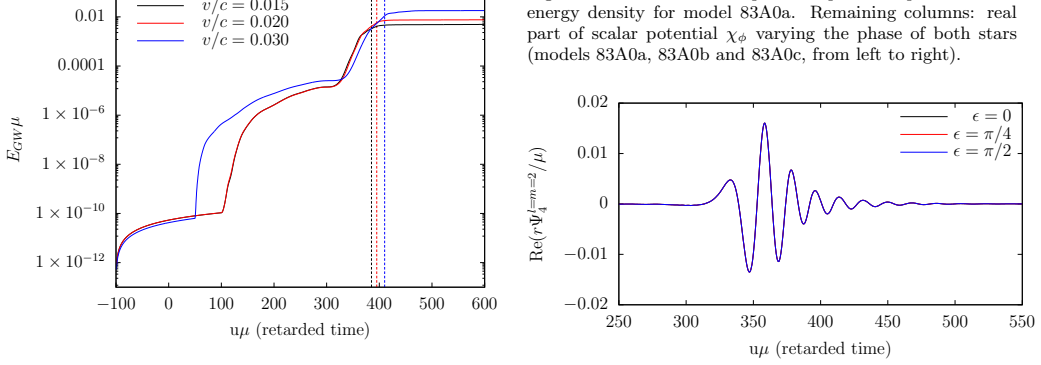
02 250 300 350 400 450 500 550 ǫ = 0 ǫ = π/ 4 ǫ = π/ 2 Re(rΨl=m=2 4 /µ ) uµ (retarded time) Figure 9. Evolution of rΨ22 4 for models 83A0a (black), 83A0b (red) and 83A0c (blue) with zero relative phase, showing that the waveforms perfectly overlap. gular momentum result in a more luminous event with more energy emitted through GW. B. The role of the compa...
-
[5]
06 300 350 400 450 500 550 600 ∆ǫ = π/ 2 ∆ǫ = 3π/ 2 Re(rΨl=m=2 4 /µ ) uµ (retarded time) −0. 06 −0. 03 0
-
[6]
06 300 350 400 450 500 550 600 ∆ǫ = 0 ∆ǫ = π Re(rΨl=m=2 4 /µ ) uµ (retarded time) Figure 10. l = m = 2 modes of rΨlm 4 comparing the period- icity of the relative phase (∆ϵ) for simulation 85C0 and 85C6 (top panel) and 85C3 and 85C9 (bottom panel) equal-mass merger (ω/µ = 0.8500) comparing for periodic relative phase (∆ϵ) for initial boost of 0 .030. sion...
-
[7]
06 300 400 500 600 700 800 ∆ǫ = 0 Re(rΨl=m=2 4 /µ ) uµ (retarded time) −0. 02 −0. 01 0
-
[8]
02 300 400 500 600 700 800 ∆ǫ = 0 Re(rΨl=m=3 4 /µ ) uµ (retarded time) −0. 06 −0. 03 0
-
[9]
06 300 400 500 600 700 800 ∆ǫ = π/ 3 Re(rΨl=m=2 4 /µ ) uµ (retarded time) −0. 02 −0. 01 0
-
[10]
02 300 400 500 600 700 800 ∆ǫ = π/ 3 Re(rΨl=m=3 4 /µ ) uµ (retarded time) −0. 06 −0. 03 0
-
[11]
06 300 400 500 600 700 800 ∆ǫ = 5π/ 6 Re(rΨl=m=2 4 /µ ) uµ (retarded time) −0. 02 −0. 01 0
-
[12]
02 300 400 500 600 700 800 ∆ǫ = 5π/ 6 Re(rΨl=m=3 4 /µ ) uµ (retarded time) −0. 06 −0. 03 0
-
[13]
06 300 400 500 600 700 800 ∆ǫ = π Re(rΨl=m=2 4 /µ ) uµ (retarded time) −0. 02 −0. 01 0
-
[14]
02 300 400 500 600 700 800 ∆ǫ = π Re(rΨl=m=3 4 /µ ) uµ (retarded time) Figure 11. Left column: rΨ22 4 waveforms for equal-mass mergers with ω/µ = 0.87 and initial boost v/c = 0.020 (models 87B0, 87B2, 87B5 and 87B6). Right column: rΨ33 4 waveforms for the same set of models. 11 1 × 10⁻¹⁸ 1 × 10⁻¹⁶ 1 × 10⁻¹⁴ 1 × 10⁻¹² 1 × 10⁻¹⁰ 1 × 10⁻⁸ 1 × 10⁻⁶ 1 × 10⁻⁴ −...
-
[15]
03 −0. 03 −0. 02 −0. 01 0
-
[16]
03 250 300 350 400 450 500 550 600 ∆ǫ = 0 Re(rΨl=m=2 4 /µ ) ∆ǫ = π Re(rΨl=m=2 4 /µ ) uµ (retarded time) Figure 13. Evolution of rΨ22 4 for models 83B0 (in-phase on top panel) and 83B6 (in-phase on bottom panel), both with ω/µ = 0.83. difference between the binary components and a signa- ture of exotic physics, since equal-mass BBH mergers do not produce s...
-
[17]
01 −100 150 400 650 900 1150 1400 1650 ∆ǫ = 5π/ 6 Re(rΨl=m=2 4 /µ ) uµ (retarded time) 0
-
[18]
Formation of a hypermassive Proca star for model 87C5
8 0 250 500 750 1000 1250 1500 1750 ∆ǫ = 5π/ 6 Mass tµ Figure 16. Formation of a hypermassive Proca star for model 87C5. Top panel: Evolution of rΨ22 4 . Bottom panel: Evo- lution of the integrated mass on the entire spherical volume of the computational grid. The dashed black line indicates the merger time (u µ ∼ 390), while the dashed red line corre- sp...
-
[19]
8300 Re(rΨl=m=2 4 /µ ) uµ (retarded time) −0
08 −100 100 300 500 700 900 1100 ∆ǫ = π, ω/µ = 0. 8300 Re(rΨl=m=2 4 /µ ) uµ (retarded time) −0. 03 −0. 02 −0. 01 0
-
[20]
8700 Re(rΨl=m=2 4 /µ ) uµ (retarded time) Figure 17
03 −100 150 400 650 900 1150 1400 1650 1900 2150 ∆ǫ = π, ω/µ = 0. 8700 Re(rΨl=m=2 4 /µ ) uµ (retarded time) Figure 17. Eccentric anti-phase models may yield more than one encounter. Evolution of rΨ22 4 for models 83C6 (left) and 87C6 (right). See also Fig. 4 for an illustration of the trajectories. −0. 02 −0. 01 0
work page 1900
-
[21]
02 −100 150 400 650 900 1150 1400 1650 1900 2150 ∆ǫ = 5π/ 6 ∆ǫ = π Re(rΨl=m=3 4 /µ ) uµ (retarded time) Figure 18. rΨ33 4 GW modes for models 87C5 (red solid line) and 87C6 (black solid line). system can either undergo prompt collapse to a black hole with an accreting Proca cloud (not in equilibrium), as in the case of models 87C0 and 87C3, or experience ...
work page 1900
-
[22]
040 Re(rΨl=m=2 4 /µ ) uµ (retarded time) −1 −0
5 −100 300 700 1100 1500 1900 2300 2700 ×10−2 ∆ǫ = π, v/c = 0. 040 Re(rΨl=m=2 4 /µ ) uµ (retarded time) −1 −0. 5 0
work page 1900
-
[23]
5 1 −100 300 700 1100 1500 1900 2300 2700 ×10−2 ∆ǫ = π, v/c = 0. 040 Re(rΨl=m=3 4 /µ ) uµ (retarded time) 0 1.5 3 4.5 0 400 800 1200 1600 2000 2400 2800 Proca mass Proca angular momentum Mass tµ Figure 19. l = m = 2 (top panel) and l = m = 3 (middle panel) modes of rΨlm 4 and angular momentum and integrated Proca mass on spherical volume of radius equals ...
work page 1900
-
[24]
050 Re(rΨl=m=2 4 /µ ) uµ (retarded time) Figure 21
5 1 −100 400 900 1400 1900 2400 2900 3400 3900 ×10−3 ∆ǫ = π, v/c = 0. 050 Re(rΨl=m=2 4 /µ ) uµ (retarded time) Figure 21. rΨ22 4 waveform for model 87E6. complex amplitude of the Proca field reads |A|2 = Re(A)2 + Im(A)2 ∼ 4 cos2 (ω1 − ω2) 2 t + ∆ϵ = = 2 1 + cos (ω1 − ω2)t + ∆ϵ 2 . (16) The square of the amplitude of the Proca field is propor- tional to th...
work page 1900
-
[25]
6 5 0 0 . 5 1 1 . 5 2 ×10−3×10−3×10⁻³ v/c = 0. 015, ω/µ = 0. 8700 EGW µ ∆ǫ/π 0 1 2 3 4 0 0 . 5 1 1 . 5 2 ×10⁻² v/c = 0. 020, ω/µ = 0. 8700 EGW µ ∆ǫ/π 0 1 2 3 4 5 0 0 . 5 1 1 . 5 2 ×10⁻¹ v/c = 0. 030, ω/µ = 0. 8700 EGW µ ∆ǫ/π Figure 23. Dependence of the GW energy on the relative phase for equal-mass Proca star mergers with ω/µ = 0 .8500 (top row) and 0.87...
-
[26]
01 0 . 1 ∆ǫ = 0 ∆ǫ = 1π/ 6 ∆ǫ = π/ 3 ∆ǫ = π/ 2 ∆ǫ = 2π/ 3 ∆ǫ = 5π/ 6 ∆ǫ = π | ˜Ψl=m=2 4 | µf /µ Figure 24. Absolute value of the Fourier transform of the l = m = 2 mode of Ψ4 for equal-mass PSs orbital merger with ω/µ = 0.8300 and initial boost v/c = 0.020 as a function of the relative phase of the two stars. much longer and even experiences a recoil kick...
-
[27]
B. P. Abbott, R. Abbott, T. D. Abbott, S. Abraham, F. Acernese, K. Ackley, C. Adams, LIGO Scientific Collaboration, and Virgo Collaboration, GWTC-1: A Gravitational-Wave Transient Catalog of Compact Bi- nary Mergers Observed by LIGO and Virgo during the First and Second Observing Runs, Physical Review X 9, 031040 (2019), arXiv:1811.12907 [astro-ph.HE]
work page internal anchor Pith review Pith/arXiv arXiv 2019
-
[28]
R. Abbott, T. D. Abbott, S. Abraham, F. Acernese, K. Ackley, A. Adams, C. Adams, LIGO Scientific Collab- oration, and Virgo Collaboration, GWTC-2: Compact Binary Coalescences Observed by LIGO and Virgo dur- ing the First Half of the Third Observing Run, Physical Review X 11, 021053 (2021), arXiv:2010.14527 [gr-qc]
work page internal anchor Pith review Pith/arXiv arXiv 2021
-
[29]
R. Abbott, T. D. Abbott, F. Acernese, K. Ackley, C. Adams, LIGO Scientific Collaboration, and the Virgo Collaboration, GWTC-2.1: Deep extended catalog of compact binary coalescences observed by LIGO and Virgo during the first half of the third observing run, Phys. Rev. D 109, 022001 (2024), arXiv:2108.01045 [gr- qc]
work page internal anchor Pith review Pith/arXiv arXiv 2024
-
[30]
R. Abbott, T. D. Abbott, F. Acernese, K. Ackley, C. Adams, V. C. Ligo Scientific Collaboration, and Kagra Collaboration, GWTC-3: Compact Binary Coalescences Observed by LIGO and Virgo during the Second Part of 18 the Third Observing Run, Physical Review X 13, 041039 (2023), arXiv:2111.03606 [gr-qc]
work page internal anchor Pith review Pith/arXiv arXiv 2023
-
[31]
B. Abbott, R. Abbott, T. Abbott, S. Abraham, F. Ac- ernese, K. Ackley, C. Adams, R. X. Adhikari, V. Adya, C. Affeldt, et al., Binary black hole population properties inferred from the first and second observing runs of ad- vanced ligo and advanced virgo, The Astrophysical Jour- nal Letters 882, L24 (2019)
work page 2019
-
[32]
R. Abbott, T. D. Abbott, F. Acernese, K. Ackley, C. Adams, N. Adhikari, R. X. Adhikari, V. B. Adya, C. Affeldt, D. Agarwal, et al. , Search for intermediate- mass black hole binaries in the third observing run of advanced ligo and advanced virgo, Astronomy & Astro- physics 659, A84 (2022)
work page 2022
- [33]
-
[34]
M. Punturo, M. Abernathy, F. Acernese, B. Allen, N. Andersson, K. Arun, F. Barone, B. Barr, M. Bar- suglia, M. Beker, N. Beveridge, S. Birindelli, S. Bose, L. Bosi, S. Braccini, C. Bradaschia, T. Bulik, E. Cal- loni, G. Cella, E. Chassande Mottin, S. Chelkowski, A. Chincarini, J. Clark, E. Coccia, C. Colacino, J. Co- las, A. Cumming, L. Cunningham, E. Cuo...
work page 2010
-
[35]
A. Abac, R. Abramo, S. Albanesi, A. Albertini, A. Agapito, M. Agathos, C. Albertus, N. Andersson, T. Andrade, I. Andreoni, et al. , The science of the ein- stein telescope, arXiv preprint arXiv:2503.12263 (2025)
work page internal anchor Pith review Pith/arXiv arXiv 2025
-
[36]
Cosmic Explorer: The U.S. Contribution to Gravitational-Wave Astronomy beyond LIGO
D. Reitze, R. X. Adhikari, S. Ballmer, B. Barish, L. Bar- sotti, G. Billingsley, D. A. Brown, Y. Chen, D. Coyne, R. Eisenstein, et al. , Cosmic explorer: the us contribu- tion to gravitational-wave astronomy beyond ligo, arXiv preprint arXiv:1907.04833 (2019)
work page internal anchor Pith review Pith/arXiv arXiv 1907
-
[37]
A Horizon Study for Cosmic Explorer: Science, Observatories, and Community
M. Evans, R. X. Adhikari, C. Afle, S. W. Ballmer, S. Biscoveanu, S. Borhanian, D. A. Brown, Y. Chen, R. Eisenstein, A. Gruson, A. Gupta, E. D. Hall, R. Hux- ford, B. Kamai, R. Kashyap, J. S. Kissel, K. Kuns, P. Landry, A. Lenon, G. Lovelace, L. McCuller, K. K. Y. Ng, A. H. Nitz, J. Read, B. S. Sathyaprakash, D. H. Shoemaker, B. J. J. Slagmolen, J. R. Smit...
work page internal anchor Pith review Pith/arXiv arXiv 2021
-
[38]
M. Bezares and N. Sanchis-Gual, Exotic compact objects: a recent numerical-relativity perspective, arXiv preprint arXiv:2406.04901 (2024)
-
[39]
J. Veltmaat, J. C. Niemeyer, and B. Schwabe, Formation and structure of ultralight bosonic dark matter halos, Physical Review D 98, 043509 (2018)
work page 2018
-
[40]
E. G. Ferreira, Ultra-light dark matter, The Astronomy and Astrophysics Review 29, 1 (2021)
work page 2021
- [41]
-
[42]
V. Cardoso, ´O. J. Dias, G. S. Hartnett, M. Middle- ton, P. Pani, and J. E. Santos, Constraining the mass of dark photons and axion-like particles through black-hole superradiance, Journal of Cosmology and Astroparticle Physics 2018 (03), 043
work page 2018
-
[43]
W. E. East and F. Pretorius, Superradiant instability and backreaction of massive vector fields around kerr black holes, Physical review letters 119, 041101 (2017)
work page 2017
-
[44]
C. A. R. Herdeiro and E. Radu, Kerr black holes with scalar hair, Phys. Rev. Lett. 112, 221101 (2014), arXiv:1403.2757 [gr-qc]
work page internal anchor Pith review Pith/arXiv arXiv 2014
-
[45]
Kerr black holes with Proca hair
C. Herdeiro, E. Radu, and H. R´ unarsson, Kerr black holes with Proca hair, Class. Quant. Grav. 33, 154001 (2016), arXiv:1603.02687 [gr-qc]
work page internal anchor Pith review Pith/arXiv arXiv 2016
-
[46]
R. Abbott et al. , All-sky search for gravitational wave emission from scalar boson clouds around spinning black holes in LIGO O3 data, Phys. Rev. D105, 102001 (2022), arXiv:2111.15507 [astro-ph.HE]
-
[47]
F. E. Schunck and E. W. Mielke, General relativis- tic boson stars, Class. Quant. Grav. 20, R301 (2003), arXiv:0801.0307 [astro-ph]
work page internal anchor Pith review Pith/arXiv arXiv 2003
- [48]
-
[49]
J. C. Bustillo, N. Sanchis-Gual, A. Torres-Forn´ e, J. A. Font, A. Vajpeyi, R. Smith, C. Herdeiro, E. Radu, and S. H. W. Leong, Gw190521 as a merger of proca stars: A potential new vector boson of 8.7 ×10⁻¹³ eV, Phys. Rev. Lett. 126, 081101 (2021)
work page 2021
-
[50]
J. Calder´ on Bustillo, N. Sanchis-Gual, S. H. W. Leong, K. Chandra, A. Torres-Forn´ e, J. A. Font, C. Herdeiro, E. Radu, I. C. F. Wong, and T. G. F. Li, Search- ing for vector boson-star mergers within LIGO-Virgo intermediate-mass black-hole merger candidates, Phys. Rev. D 108, 123020 (2023), arXiv:2206.02551 [gr-qc]
-
[51]
R. Luna, M. Llorens-Monteagudo, A. Lorenzo-Medina, J. C. Bustillo, N. Sanchis-Gual, A. Torres-Forn´ e, J. A. Font, C. A. Herdeiro, and E. Radu, Numerical relativity surrogate waveform models for exotic compact objects: The case of head-on mergers of equal-mass proca stars, Physical Review D 110, 024004 (2024)
work page 2024
-
[52]
T. Evstafyeva, U. Sperhake, I. M. Romero-Shaw, and 19 M. Agathos, Gravitational-wave data analysis with high- precision numerical relativity simulations of boson star mergers, Physical Review Letters 133, 131401 (2024)
work page 2024
-
[53]
C. Palenzuela, P. Pani, M. Bezares, V. Cardoso, L. Lehner, and S. Liebling, Gravitational wave signatures of highly compact boson star binaries, Physical Review D 96, 104058 (2017)
work page 2017
-
[54]
N. Sanchis-Gual, J. C. Bustillo, C. Herdeiro, E. Radu, J. A. Font, S. H. W. Leong, and A. Torres-Forn´ e, Im- pact of the wavelike nature of proca stars on their gravitational-wave emission, Phys. Rev. D 106, 124011 (2022)
work page 2022
- [55]
-
[56]
C. Palenzuela, L. Lehner, and S. L. Liebling, Orbital dy- namics of binary boson star systems, Phys. Rev. D 77, 044036 (2008)
work page 2008
-
[57]
M. Bezares and C. Palenzuela, Gravitational waves from dark boson star binary mergers, Classical and Quantum Gravity 35, 234002 (2018)
work page 2018
-
[58]
N. Sanchis-Gual, C. Herdeiro, J. A. Font, E. Radu, and F. Di Giovanni, Head-on collisions and orbital mergers of proca stars, Phys. Rev. D 99, 024017 (2019)
work page 2019
-
[59]
V. Jaramillo, N. Sanchis-Gual, J. Barranco, A. Bernal, J. C. Degollado, C. Herdeiro, M. Megevand, and D. N´ u˜ nez, Head-on collisions of l-boson stars, Physical Review D 105, 104057 (2022)
work page 2022
- [60]
- [61]
-
[62]
J. C. Aurrekoetxea, K. Clough, and E. A. Lim, Cttk: a new method to solve the initial data constraints in nu- merical relativity, Classical and Quantum Gravity 40, 075003 (2023)
work page 2023
-
[63]
N. Siemonsen and W. E. East, Binary boson stars: Merger dynamics and formation of rotating rem- nant stars, Phys. Rev. D 107, 124018 (2023), arXiv:2302.06627 [gr-qc]
-
[64]
N. Siemonsen and W. E. East, Generic initial data for binary boson stars, Phys. Rev. D 108, 124015 (2023), arXiv:2306.17265 [gr-qc]
-
[65]
F. Atteneder, H. R. R¨ uter, D. Cors, R. Rosca-Mead, D. Hilditch, and B. Br¨ ugmann, Boson star head-on colli- sions with constraint-violating and constraint-satisfying initial data, Physical Review D 109, 044058 (2024)
work page 2024
- [66]
-
[67]
N. Sanchis-Gual, F. Di Giovanni, M. Zilh˜ ao, C. Herdeiro, P. Cerd´ a-Dur´ an, J. A. Font, and E. Radu, Nonlinear dy- namics of spinning bosonic stars: Formation and stabil- ity, Phys. Rev. Lett. 123, 221101 (2019)
work page 2019
-
[68]
N. Sanchis-Gual, M. Zilh˜ ao, C. Herdeiro, F. Di Gio- vanni, J. A. Font, and E. Radu, Synchronized gravita- tional atoms from mergers of bosonic stars, Phys. Rev. D 102, 101504 (2020)
work page 2020
-
[69]
N. Siemonsen and W. E. East, Stability of rotating scalar boson stars with nonlinear interactions, Physical Review D 103, 044022 (2021)
work page 2021
-
[70]
N. Sanchis-Gual, F. Di Giovanni, C. Herdeiro, E. Radu, and J. A. Font, Multifield, multifrequency bosonic stars and a stabilization mechanism, Physical Review Letters 126, 241105 (2021)
work page 2021
-
[71]
V. Jaramillo, D. N´ u˜ nez, M. Ruiz, and M. Zilh˜ ao, Full 3d nonlinear dynamics of charged and magnetized boson stars, Physical Review D 111, 024070 (2025)
work page 2025
-
[72]
C. Herdeiro, I. Perapechka, E. Radu, and Y. Shnir, Asymptotically flat spinning scalar, Dirac and Proca stars, Phys. Lett. B 797, 134845 (2019), arXiv:1906.05386 [gr-qc]
- [73]
-
[74]
P. V. P. Cunha, E. Berti, and C. A. R. Herdeiro, Light- ring stability for ultracompact objects, Phys. Rev. Lett. 119, 251102 (2017)
work page 2017
-
[75]
P. V. P. Cunha, C. Herdeiro, E. Radu, and N. Sanchis- Gual, Exotic compact objects and the fate of the light- ring instability, Phys. Rev. Lett. 130, 061401 (2023)
work page 2023
-
[76]
F. Di Giovanni, N. Sanchis-Gual, P. Cerd´ a-Dur´ an, M. Zil- hao, C. Herdeiro, J. A. Font, and E. Radu, Dynamical bar-mode instability in spinning bosonic stars, Physical Review D 102, 124009 (2020)
work page 2020
-
[77]
F. L¨ offler, J. Faber, E. Bentivegna, T. Bode, P. Di- ener, R. Haas, I. Hinder, B. C. Mundim, C. D. Ott, E. Schnetter, G. Allen, M. Campanelli, and P. Laguna, The einstein toolkit: a community computational infras- tructure for relativistic astrophysics, Classical and Quan- tum Gravity 29, 115001 (2012)
work page 2012
-
[78]
M. Zilh˜ ao, H. Witek, and V. Cardoso, Nonlinear interac- tions between black holes and proca fields, Classical and Quantum Gravity 32, 234003 (2015)
work page 2015
- [79]
- [80]
discussion (0)
Sign in with ORCID, Apple, or X to comment. Anyone can read and Pith papers without signing in.