Culinary Crossroads: A RAG Framework for Enhancing Diversity in Cross-Cultural Recipe Adaptation
Pith reviewed 2026-05-19 02:16 UTC · model grok-4.3
The pith
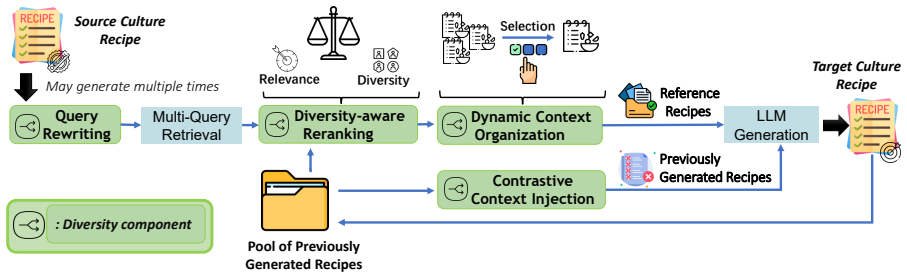
CARRIAGE RAG framework produces more diverse cross-cultural recipe adaptations than standard LLMs while holding quality steady.
A machine-rendered reading of the paper's core claim, the machinery that carries it, and where it could break.
Core claim
CARRIAGE is a RAG framework that improves diversity in retrieval and context organization for cross-cultural recipe adaptation. It is the first RAG method explicitly designed to produce highly varied outputs that accommodate multiple user preferences and dietary needs. When tested, CARRIAGE reaches Pareto efficiency: it improves measured diversity while maintaining or improving quality relative to closed-book LLMs.
What carries the argument
CARRIAGE, a plug-and-play RAG framework that diversifies both the retrieval step and the organization of retrieved context before generation.
If this is right
- Recipe adaptations can now be generated with explicit variety to suit different dietary restrictions and tastes.
- The same retrieval and context-organization steps can be used to keep the original dish recognizable while shifting it into another cuisine.
- RAG no longer has to collapse to low-diversity outputs in tasks that admit many equally valid answers.
- Systems built on CARRIAGE can serve users who want several options rather than a single suggested adaptation.
Where Pith is reading between the lines
- The same diversity-enhancing retrieval and organization steps could be applied to other open-ended generation tasks such as story continuation or travel itinerary creation.
- If the limitation of RAG over-relying on narrow context is general, then similar plug-and-play fixes might raise diversity in non-culinary cultural adaptation settings.
- Deploying CARRIAGE at scale could support personalized cooking assistants that routinely offer multiple culturally shifted versions of one dish.
Load-bearing premise
The chosen diversity metrics and human ratings of cultural appropriateness actually measure the intended improvements rather than reflecting selection or annotation artifacts.
What would settle it
A follow-up experiment that measures diversity on many independent generations from CARRIAGE versus baselines and finds no reliable increase in variety or human preference for the new method.
Figures



read the original abstract
In cross-cultural recipe adaptation, the goal is not only to ensure cultural appropriateness and retain the original dish's essence, but also to provide diverse options for various dietary needs and preferences. Retrieval Augmented Generation (RAG) is a promising approach, combining the retrieval of real recipes from the target cuisine for cultural adaptability with large language models (LLMs) for relevance. However, it remains unclear whether RAG can generate diverse adaptation results. Our analysis shows that RAG tends to overly rely on a limited portion of the context across generations, failing to produce diverse outputs even when provided with varied contextual inputs. This reveals a key limitation of RAG in creative tasks with multiple valid answers: it fails to leverage contextual diversity for generating varied responses. To address this issue, we propose CARRIAGE, a plug-and-play RAG framework for cross-cultural recipe adaptation that enhances diversity in both retrieval and context organization. To our knowledge, this is the first RAG framework that explicitly aims to generate highly diverse outputs to accommodate multiple user preferences. Our experiments show that CARRIAGE achieves Pareto efficiency in terms of diversity and quality of recipe adaptation compared to closed-book LLMs.
Editorial analysis
A structured set of objections, weighed in public.
Referee Report
Summary. The paper proposes CARRIAGE, a plug-and-play RAG framework for enhancing diversity in cross-cultural recipe adaptation. It argues that standard RAG fails to produce diverse outputs due to over-reliance on limited context portions, and introduces modifications to retrieval and context organization. Experiments are reported to demonstrate that CARRIAGE achieves Pareto efficiency in diversity and quality compared to closed-book LLMs.
Significance. If the experimental results hold under rigorous scrutiny, the work would contribute to the field by addressing a limitation in RAG for creative tasks with multiple valid solutions, offering a way to generate diverse adaptations for different dietary needs and preferences. The plug-and-play nature could make it widely applicable. Credit is due for identifying the context-reliance issue in RAG.
major comments (2)
- The central claim of achieving Pareto efficiency is stated without any accompanying details on the diversity metrics (e.g., how diversity is quantified), quality metrics, baselines used, or statistical tests performed. This omission makes it impossible to verify if the modifications truly cross the Pareto frontier without hidden costs.
- The human evaluation for cultural appropriateness and recipe quality may be susceptible to post-hoc selection effects if raters were not blinded or if only selected examples were presented; the manuscript should clarify the evaluation protocol, including blinding, number of raters, and inter-rater agreement to support the no-trade-off claim.
Simulated Author's Rebuttal
We thank the referee for their valuable comments on our paper. We address the major comments point by point below and have updated the manuscript to incorporate clarifications where needed.
read point-by-point responses
-
Referee: The central claim of achieving Pareto efficiency is stated without any accompanying details on the diversity metrics (e.g., how diversity is quantified), quality metrics, baselines used, or statistical tests performed. This omission makes it impossible to verify if the modifications truly cross the Pareto frontier without hidden costs.
Authors: We thank the referee for pointing this out. The details on diversity metrics (lexical and semantic), quality metrics (human ratings and automatic), baselines (including closed-book LLMs), and statistical tests are provided in the Experiments section. However, to improve readability and directly address verification concerns, we will revise the text to include a more explicit summary of these aspects at the beginning of the results section. revision: yes
-
Referee: The human evaluation for cultural appropriateness and recipe quality may be susceptible to post-hoc selection effects if raters were not blinded or if only selected examples were presented; the manuscript should clarify the evaluation protocol, including blinding, number of raters, and inter-rater agreement to support the no-trade-off claim.
Authors: We agree that the evaluation protocol should be described in full detail. The manuscript outlines the human evaluation process, but we will expand it to explicitly state that raters were blinded to the generation method, specify the number of raters and examples, and report inter-rater agreement statistics to substantiate the claims regarding no trade-off between diversity and quality. revision: yes
Circularity Check
No circularity: empirical framework proposal with independent experimental validation
full rationale
The paper introduces CARRIAGE as a plug-and-play RAG framework that modifies retrieval and context organization to increase output diversity in cross-cultural recipe adaptation. The central claim of Pareto efficiency versus closed-book LLMs rests on reported experiments using diversity metrics, quality judgments, and human evaluations rather than any mathematical derivation or self-referential definition. No equations appear that would allow a result to reduce to a fitted parameter or renamed input by construction. The stated limitation of standard RAG (over-reliance on limited context) is diagnosed from analysis and addressed by design choices whose effects are measured externally. Any self-citations present in the full text are not load-bearing for the efficiency result, which is benchmarked against independent baselines and human raters. The work is therefore self-contained against external evaluation and receives the default non-circularity finding.
Axiom & Free-Parameter Ledger
axioms (1)
- domain assumption Modifying retrieval and context organization in RAG can increase output diversity while preserving relevance and cultural appropriateness
invented entities (1)
-
CARRIAGE framework
no independent evidence
Reference graph
Works this paper leans on
-
[1]
Bge m3-embedding: Multi-lingual, multi-functionality, multi-granularity text embeddings through self-knowledge distillation. Preprint, arXiv:2402.03216. Jacob Devlin, Ming-Wei Chang, Kenton Lee, and Kristina Toutanova
work page internal anchor Pith review Pith/arXiv arXiv
-
[2]
Bert: Pre-training of deep bidirectional transformers for language understand- ing. In Proceedings of the 2019 conference of the North American chapter of the association for com- putational linguistics: human language technologies, volume 1 (long and short papers), pages 4171–4186. Angela Fan, Mike Lewis, and Yann Dauphin
work page 2019
-
[3]
Hierarchical Neural Story Generation
Hierarchical neural story generation. arXiv preprint arXiv:1805.04833. Yunfan Gao, Yun Xiong, Xinyu Gao, Kangxiang Jia, Jinliu Pan, Yuxi Bi, Yi Dai, Jiawei Sun, Meng Wang, and Haofen Wang
work page internal anchor Pith review Pith/arXiv arXiv
-
[4]
Retrieval-Augmented Generation for Large Language Models: A Survey
Retrieval-augmented gener- ation for large language models: A survey. Preprint, arXiv:2312.10997. Aaron Grattafiori, Abhimanyu Dubey, Abhinav Jauhri, Abhinav Pandey, Abhishek Kadian, Ahmad Al- Dahle, Aiesha Letman, Akhil Mathur, Alan Schelten, Alex Vaughan, and 1 others
work page internal anchor Pith review Pith/arXiv arXiv
-
[5]
The llama 3 herd of models. arXiv preprint arXiv:2407.21783. Yanzhu Guo, Guokan Shang, and Chloé Clavel
work page internal anchor Pith review Pith/arXiv arXiv
-
[6]
arXiv preprint arXiv:2412.10271
Benchmarking linguistic diversity of large language models. arXiv preprint arXiv:2412.10271. Anna Hauser
-
[7]
The Curious Case of Neural Text Degeneration
The curious case of neural text degeneration. arXiv preprint arXiv:1904.09751. Tianyi Hu, Maria Maistro, and Daniel Hershcovich
work page internal anchor Pith review Pith/arXiv arXiv 1904
-
[8]
Bridging cultures in the kitchen: A framework and benchmark for cross-cultural recipe retrieval. In Proceedings of the 2024 Conference on Empir- ical Methods in Natural Language Processing, pages 1068–1080. Wendell Johnson
work page 2024
-
[9]
Understanding the Effects of RLHF on LLM Generalisation and Diversity
Understanding the ef- fects of rlhf on llm generalisation and diversity.arXiv preprint arXiv:2310.06452. Ralf Krestel and Peter Fankhauser
work page internal anchor Pith review arXiv
-
[10]
arXiv preprint arXiv:2501.18101
Diverse preference optimization. arXiv preprint arXiv:2501.18101. Patrick Lewis, Ethan Perez, Aleksandra Piktus, Fabio Petroni, Vladimir Karpukhin, Naman Goyal, Hein- rich Küttler, Mike Lewis, Wen-tau Yih, Tim Rock- täschel, and 1 others
-
[11]
Lost in the Middle: How Language Models Use Long Contexts
Lost in the middle: How lan- guage models use long contexts. arXiv preprint arXiv:2307.03172. Jabez Magomere, Shu Ishida, Tejumade Afonja, Aya Salama, Daniel Kochin, Foutse Yuehgoh, Imane Hamzaoui, Raesetje Sefala, Aisha Alaagib, Elizaveta Semenova, and 1 others
work page internal anchor Pith review Pith/arXiv arXiv
-
[12]
arXiv preprint arXiv:2406.09496
You are what you eat? feeding foundation models a regionally diverse food dataset of world wide dishes. arXiv preprint arXiv:2406.09496. Maryann McCabe and Timothy de Waal Malefyt
-
[13]
arXiv preprint arXiv:2402.17016
Multi-task contrastive learning for 8192- token bilingual text embeddings. arXiv preprint arXiv:2402.17016. Andrea Morales-Garzón, Oscar A. Rocha, Sara Benel Ramirez, Gabriel Tuco Casquino, and Alberto Med- ina
-
[14]
arXiv preprint arXiv:2407.01082
Turning up the heat: Min-p sampling for creative and coherent llm outputs. arXiv preprint arXiv:2407.01082. Saurabh Kumar Pandey, Harshit Budhiraja, Sougata Saha, and Monojit Choudhury
-
[15]
Sentence-BERT: Sentence Embeddings using Siamese BERT-Networks
Sentence-bert: Sentence embeddings using siamese bert-networks. arXiv preprint arXiv:1908.10084. Mohammad Reza Rezaei and Adji Bousso Dieng
work page internal anchor Pith review Pith/arXiv arXiv 1908
-
[16]
arXiv preprint arXiv:2502.11228
Vendi-rag: Adaptively trading-off diversity and qual- ity significantly improves retrieval augmented gener- ation with llms. arXiv preprint arXiv:2502.11228. Chufan Shi, Haoran Yang, Deng Cai, Zhisong Zhang, Yifan Wang, Yujiu Yang, and Wai Lam
-
[17]
arXiv preprint arXiv:2402.06925
A thorough examination of decoding methods in the era of llms. arXiv preprint arXiv:2402.06925. Katherine Stasaski and Marti A. Hearst
-
[18]
Pragmat- ically appropriate diversity for dialogue evaluation. Preprint, arXiv:2304.02812. Gemma Team, Morgane Riviere, Shreya Pathak, Pier Giuseppe Sessa, Cassidy Hardin, Surya Bhupati- raju, Léonard Hussenot, Thomas Mesnard, Bobak Shahriari, Alexandre Ramé, and 1 others
-
[19]
Gemma 2: Improving Open Language Models at a Practical Size
Gemma 2: Improving open language models at a practical size. arXiv preprint arXiv:2408.00118. Qwen Team
work page internal anchor Pith review Pith/arXiv arXiv
-
[20]
arXiv preprint arXiv:2502.09017
Diversity enhances an llm’s performance in rag and long-context task. arXiv preprint arXiv:2502.09017. Tianyi Zhang*, Varsha Kishore*, Felix Wu*, Kilian Q. Weinberger, and Yoav Artzi
-
[21]
arXiv preprint arXiv:2408.13534
Cultural adaptation of menus: A fine- grained approach. arXiv preprint arXiv:2408.13534. A Details of CARRIAGE Implements A.1 Query Rewriting The model used here is Llama3.1, with the same configuration as in the main experiments. Query Rewriting Prompt1: Regenerating A Title for a recipe Here is a recipe without a title; please create a short Spanish tit...
discussion (0)
Sign in with ORCID, Apple, or X to comment. Anyone can read and Pith papers without signing in.