Recognition: 2 theorem links
· Lean TheoremValence-Arousal Subspace in LLMs: Circular Emotion Geometry and Multi-Behavioral Control
Pith reviewed 2026-05-13 20:11 UTC · model grok-4.3
The pith
LLMs organize emotion vectors in a circular valence-arousal subspace that controls affective tone and behaviors like refusal.
A machine-rendered reading of the paper's core claim, the machinery that carries it, and where it could break.
Core claim
Emotion vectors in LLMs are organized by a two-dimensional valence-arousal (VA) subspace exhibiting circular geometry. Through principal component decomposition and ridge regression, we recover meaningful VA axes underlying emotion steering vectors whose projections correlate with human affect ratings across 44,728 words. Steering along these axes produces monotonic control over the affective properties of generated text, and further affords bidirectional control over multiple downstream behaviors (refusal and sycophancy) from a single subspace. These effects replicate across Llama-3.1-8B, Qwen3-8B, and Qwen3-14B.
What carries the argument
The two-dimensional valence-arousal subspace recovered by PCA and ridge regression on emotion steering vectors, which shows circular geometry and modulates token emission probabilities for affect and behavior.
Load-bearing premise
The axes found by PCA and regression truly match human valence and arousal rather than some other property that happens to correlate with them.
What would settle it
A fresh collection of words with independent human affect ratings where the projections onto the recovered axes show no correlation, or steering trials that produce no change in refusal or sycophancy once other correlated factors are controlled.
Figures



read the original abstract
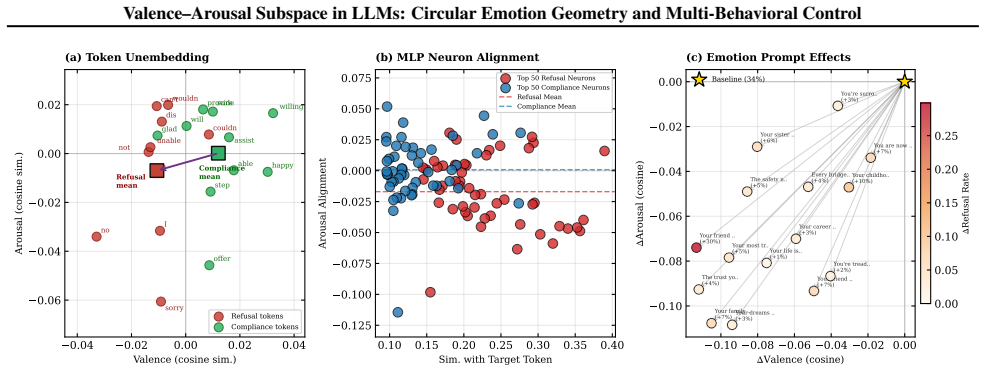
We show that emotion vectors in LLMs are organized by a two-dimensional valence-arousal (VA) subspace exhibiting circular geometry. Through principal component decomposition and ridge regression, we recover meaningful VA axes underlying emotion steering vectors whose projections correlate with human affect ratings across 44,728 words. Steering along these axes produces monotonic control over the affective properties of generated text, and further affords bidirectional control over multiple downstream behaviors (refusal and sycophancy) from a single subspace. These effects replicate across Llama-3.1-8B, Qwen3-8B, and Qwen3-14B. We propose lexical mediation to explain why these effects and prior emotionally framed controls work: refusal and compliance tokens occupy distinct VA regions, and VA steering directly modulates their emission probabilities.
Editorial analysis
A structured set of objections, weighed in public.
Referee Report
Summary. The manuscript claims that emotion vectors in LLMs are organized by a two-dimensional valence-arousal (VA) subspace with circular geometry. Using PCA on emotion steering vectors followed by ridge regression against human VA ratings on 44,728 words, the authors recover axes whose projections correlate with affect ratings. Steering along these axes produces monotonic control over affective properties of generated text and bidirectional control over downstream behaviors including refusal and sycophancy. Results replicate across Llama-3.1-8B, Qwen3-8B, and Qwen3-14B. A lexical mediation account is proposed to explain the effects via differential VA positioning of refusal and compliance tokens.
Significance. If the central claims hold after addressing confounds, the work would offer a mechanistically grounded subspace for unifying affective and multi-behavioral steering in LLMs. The cross-model replication and demonstration of bidirectional control from a single recovered subspace are notable strengths. The lexical mediation hypothesis provides a testable link to prior steering results. These findings could inform both interpretability and practical alignment techniques, though their impact hinges on demonstrating specificity to human VA dimensions rather than generic lexical correlates.
major comments (3)
- [§4.2] §4.2 (ridge regression and correlation analysis): No controls, partial correlations, or regression covariates are reported for word frequency, concreteness, or other lexical properties known to correlate with VA ratings. Without these, the recovered axes may capture any co-varying lexical feature rather than model-internal affective geometry, directly weakening the claim that the subspace is specifically valence-arousal.
- [§5.1] §5.1 (behavioral steering results): The manuscript provides no statistical tests, effect sizes, confidence intervals, or exclusion criteria for the 44,728-word ratings or the downstream refusal/sycophancy experiments. This absence makes it impossible to evaluate whether the reported monotonic and bidirectional effects are robust or potentially driven by incidental correlations.
- [§3.3] §3.3 (circular geometry): The circular arrangement is presented visually from 2D projections, but no quantitative test (e.g., comparison against shuffled or random baselines, or a measure of angular uniformity) is described to establish that the geometry is statistically meaningful rather than an artifact of dimensionality reduction.
minor comments (2)
- [§2.1] The definition of emotion steering vectors in §2.1 would be clearer with an explicit equation showing their extraction from residual streams or attention layers.
- [Figure 2] Figure 2 and Figure 4 would benefit from overlaid density contours or bootstrap confidence regions to aid interpretation of the VA projections and steering trajectories.
Simulated Author's Rebuttal
We thank the referee for their constructive comments, which have helped us identify areas to strengthen the manuscript. We address each major point below and will incorporate revisions accordingly.
read point-by-point responses
-
Referee: [§4.2] §4.2 (ridge regression and correlation analysis): No controls, partial correlations, or regression covariates are reported for word frequency, concreteness, or other lexical properties known to correlate with VA ratings. Without these, the recovered axes may capture any co-varying lexical feature rather than model-internal affective geometry, directly weakening the claim that the subspace is specifically valence-arousal.
Authors: We agree that additional controls are necessary to establish specificity to valence-arousal dimensions. In the revised manuscript, we will perform the ridge regression with covariates for word frequency, concreteness, and other lexical properties. We will report partial correlations to show that the VA projections retain significant correlation with affect ratings after controlling for these factors. This revision will directly address the concern that the axes may reflect generic lexical correlates. revision: yes
-
Referee: [§5.1] §5.1 (behavioral steering results): The manuscript provides no statistical tests, effect sizes, confidence intervals, or exclusion criteria for the 44,728-word ratings or the downstream refusal/sycophancy experiments. This absence makes it impossible to evaluate whether the reported monotonic and bidirectional effects are robust or potentially driven by incidental correlations.
Authors: We acknowledge the lack of statistical reporting. We will add statistical tests for the monotonic trends (e.g., linear regression slopes with p-values), effect sizes, and confidence intervals for the behavioral steering results. Exclusion criteria for the word list and experiment details will be explicitly stated. These additions will provide the necessary rigor to assess the robustness of the findings. revision: yes
-
Referee: [§3.3] §3.3 (circular geometry): The circular arrangement is presented visually from 2D projections, but no quantitative test (e.g., comparison against shuffled or random baselines, or a measure of angular uniformity) is described to establish that the geometry is statistically meaningful rather than an artifact of dimensionality reduction.
Authors: The circular geometry is observed in the 2D PCA projections of the emotion vectors. To provide quantitative support, we will include in the revision a statistical test for circular uniformity, such as the Rayleigh test, and comparisons to shuffled baselines where the angular distribution is randomized. This will confirm that the observed circular arrangement is not an artifact. revision: yes
Circularity Check
Ridge regression to human VA ratings makes claimed subspace geometry and steering effects dependent on fitted alignment
specific steps
-
fitted input called prediction
[Abstract]
"Through principal component decomposition and ridge regression, we recover meaningful VA axes underlying emotion steering vectors whose projections correlate with human affect ratings across 44,728 words."
The axes are explicitly constructed via ridge regression to maximize correlation with the human VA ratings; therefore the reported correlation between projections and ratings, and the subsequent claim that steering along these axes controls affective properties, reduces to the fitting procedure by construction rather than revealing an independent model-internal geometry.
full rationale
The paper's core derivation begins with unsupervised PCA on emotion steering vectors, followed by ridge regression to align the resulting axes with external human valence-arousal ratings on 44,728 words. This alignment step renders the reported correlations and the attribution of monotonic affective control and bidirectional behavioral effects (refusal/sycophancy) to a psychologically meaningful VA subspace dependent on the fitted parameters rather than independently emergent from the model. The subsequent lexical mediation proposal and circular geometry claims inherit this dependence. No self-citation chains or definitional loops are present, and the unsupervised PCA component plus replication across models provide partial independent content, capping the circularity at moderate.
Axiom & Free-Parameter Ledger
free parameters (1)
- ridge regression regularization strength
axioms (1)
- domain assumption Principal components of emotion steering vectors align with human valence-arousal dimensions.
Lean theorems connected to this paper
-
IndisputableMonolith/Cost/FunctionalEquation.leanwashburn_uniqueness_aczel unclear?
unclearRelation between the paper passage and the cited Recognition theorem.
We decompose emotion steering vectors... learn VA axes as linear combinations of their top PCA components via ridge regression... circular geometry consistent with... Russell (1980)
-
IndisputableMonolith/Foundation/AlphaCoordinateFixation.leanJ_uniquely_calibrated_via_higher_derivative unclear?
unclearRelation between the paper passage and the cited Recognition theorem.
Steering along these axes produces monotonic control over... refusal and sycophancy
What do these tags mean?
- matches
- The paper's claim is directly supported by a theorem in the formal canon.
- supports
- The theorem supports part of the paper's argument, but the paper may add assumptions or extra steps.
- extends
- The paper goes beyond the formal theorem; the theorem is a base layer rather than the whole result.
- uses
- The paper appears to rely on the theorem as machinery.
- contradicts
- The paper's claim conflicts with a theorem or certificate in the canon.
- unclear
- Pith found a possible connection, but the passage is too broad, indirect, or ambiguous to say the theorem truly supports the claim.
Forward citations
Cited by 2 Pith papers
-
Tensor Product Representation Probes Reveal Shared Structure Across Linear Directions
Linear probes for Othello board states factor into tensor-product structure with square and color embeddings composed by a binding matrix, from which the linear probes can be directly recovered.
-
Stories in Space: In-Context Learning Trajectories in Conceptual Belief Space
LLMs perform in-context learning as trajectories through a structured low-dimensional conceptual belief space, with the structure visible in both behavior and internal representations and causally manipulable via inte...
Reference graph
Works this paper leans on
-
[2]
URL https://transformer-circuits. pub/2026/emotions/index.html. 11 Valence–Arousal Subspace in LLMs: Circular Emotion Geometry and Multi-Behavioral Control Sun, L., Mao, C., Hofmann, V ., and Bai, X. Aligned but blind: Alignment increases implicit bias by reduc- ing awareness of race, 2025. URL https://arxiv. org/abs/2506.00253. Tan, D., Chanin, D., Lynch...
-
[3]
URL https://doi.org/10.24963/ijcai. 2024/719. Yang, A., Li, A., Yang, B., Zhang, B., Hui, B., Zheng, B., Yu, B., Gao, C., Huang, C., Lv, C., Zheng, C., Liu, D., Zhou, F., Huang, F., Hu, F., Ge, H., Wei, H., Lin, H., Tang, J., Yang, J., Tu, J., Zhang, J., Yang, J., Yang, J., Zhou, J., Zhou, J., Lin, J., Dang, K., Bao, K., Yang, K., Yu, L., Deng, L., Li, M....
work page internal anchor Pith review Pith/arXiv arXiv doi:10.24963/ijcai 2024
-
[4]
Representation Engineering: A Top-Down Approach to AI Transparency
URL https://aclanthology.org/2024. findings-emnlp.139/. Zou, A., Phan, L., Chen, S., Campbell, J., Guo, P., Ren, R., Pan, A., Yin, X., Mazeika, M., Dombrowski, A.-K., Goel, S., Li, N., Byun, M. J., Wang, Z., Mallen, A., Basart, S., Koyejo, S., Song, D., Fredrikson, M., Kolter, J. Z., and Hendrycks, D. Representation engineering: A top-down approach to ai ...
work page internal anchor Pith review Pith/arXiv arXiv 2024
discussion (0)
Sign in with ORCID, Apple, or X to comment. Anyone can read and Pith papers without signing in.