Recognition: 2 theorem links
· Lean TheoremGenerative AI for Video Trailer Synthesis: From Extractive Heuristics to Autoregressive Creativity
Pith reviewed 2026-05-13 20:17 UTC · model grok-4.3
The pith
Video trailer systems are shifting from selecting existing clips to generating new coherent narratives with AI.
A machine-rendered reading of the paper's core claim, the machinery that carries it, and where it could break.
Core claim
The paper establishes a new taxonomy for AI-driven trailer generation by tracing the move from Graph Convolutional Networks and heuristic extraction to Trailer Generation Transformers, LLM-orchestrated pipelines, and text-to-video foundation models, which enable systems to construct coherent, emotionally resonant narratives through controllable generative editing and semantic reconstruction rather than simple shot selection.
What carries the argument
The progression from extractive heuristics to autoregressive Transformers and text-to-video foundation models, which perform semantic reconstruction to build full narratives instead of selecting clips.
If this is right
- Automated generation increases content velocity on UGC platforms.
- High-fidelity neural synthesis introduces new ethical challenges around synthetic media.
- Future systems move toward controllable generative editing of trailers.
- The proposed taxonomy organizes techniques around foundation-model capabilities.
Where Pith is reading between the lines
- Hybrid systems combining extraction with generation may stay useful while coherence limits persist.
- Integration with multimodal models could allow real-time adaptation of trailers to specific audience data.
- Scalability claims could be tested by measuring production time and engagement metrics on live platforms.
Load-bearing premise
Current generative models can reliably produce coherent and emotionally resonant video narratives at scale.
What would settle it
A controlled comparison where trailers generated by current text-to-video models are shown to human viewers alongside traditional ones and consistently score lower on measures of narrative coherence or emotional impact.
Figures

read the original abstract
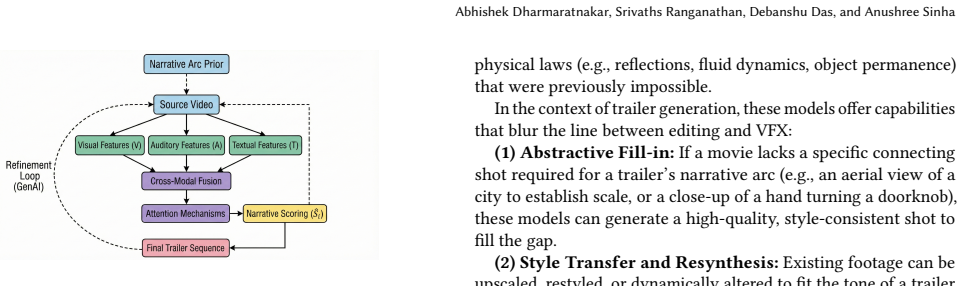
The domain of automatic video trailer generation is currently undergoing a profound paradigm shift, transitioning from heuristic-based extraction methods to deep generative synthesis. While early methodologies relied heavily on low-level feature engineering, visual saliency, and rule-based heuristics to select representative shots, recent advancements in Large Language Models (LLMs), Multimodal Large Language Models (MLLMs), and diffusion-based video synthesis have enabled systems that not only identify key moments but also construct coherent, emotionally resonant narratives. This survey provides a comprehensive technical review of this evolution, with a specific focus on generative techniques including autoregressive Transformers, LLM-orchestrated pipelines, and text-to-video foundation models like OpenAI's Sora and Google's Veo. We analyze the architectural progression from Graph Convolutional Networks (GCNs) to Trailer Generation Transformers (TGT), evaluate the economic implications of automated content velocity on User-Generated Content (UGC) platforms, and discuss the ethical challenges posed by high-fidelity neural synthesis. By synthesizing insights from recent literature, this report establishes a new taxonomy for AI-driven trailer generation in the era of foundation models, suggesting that future promotional video systems will move beyond extractive selection toward controllable generative editing and semantic reconstruction of trailers.
Editorial analysis
A structured set of objections, weighed in public.
Referee Report
Summary. The manuscript is a comprehensive survey on the evolution of video trailer synthesis, detailing the shift from extractive heuristics relying on low-level features, visual saliency, and GCNs to generative approaches using LLMs, MLLMs, autoregressive Transformers, and foundation models like Sora and Veo. It establishes a taxonomy for AI-driven trailer generation, analyzes economic implications for UGC platforms, and discusses ethical challenges, positing that future systems will emphasize controllable generative editing over extractive selection.
Significance. If the synthesized narrative holds, the paper offers a timely taxonomy and forward-looking perspective on generative AI applications in media production, potentially influencing research directions toward semantic reconstruction techniques. The inclusion of economic and ethical analyses enhances its relevance, though the lack of original experiments or quantitative meta-analysis tempers its immediate impact.
major comments (1)
- [Abstract] The assertion of a 'profound paradigm shift' and the ability of generative models to produce 'coherent, emotionally resonant narratives' is presented without addressing the documented limitations in coherence and long-term consistency of current text-to-video models such as Sora and Veo; this weakens the support for the central claim of moving beyond extractive methods.
minor comments (2)
- The manuscript would benefit from a table or figure summarizing key methods, their architectures, and reported performance metrics from the cited literature to make the architectural progression clearer.
- [Abstract] Expand the acronym UGC on first mention for accessibility.
Simulated Author's Rebuttal
We thank the referee for their positive assessment of our survey and for the constructive feedback on the abstract. We address the single major comment below and will incorporate revisions to improve balance and precision.
read point-by-point responses
-
Referee: [Abstract] The assertion of a 'profound paradigm shift' and the ability of generative models to produce 'coherent, emotionally resonant narratives' is presented without addressing the documented limitations in coherence and long-term consistency of current text-to-video models such as Sora and Veo; this weakens the support for the central claim of moving beyond extractive methods.
Authors: We agree that the abstract phrasing is overly concise and would benefit from explicit acknowledgment of current limitations to better support the central narrative. The full manuscript already reviews documented shortcomings in coherence, temporal consistency, and controllability for models such as Sora and Veo (particularly in the foundation-model sections and the discussion of autoregressive versus diffusion-based approaches). In the revised version we will adjust the abstract to frame the paradigm shift as an ongoing transition: generative methods enable semantic reconstruction and narrative synthesis beyond pure extraction, yet they still face the very consistency challenges noted in the literature. This revision preserves the survey's forward-looking taxonomy while strengthening the evidential grounding of the claim. revision: yes
Circularity Check
No significant circularity detected
full rationale
The manuscript is a literature survey synthesizing external prior work on the transition from extractive heuristics (GCNs, saliency methods) to generative pipelines (autoregressive Transformers, LLMs, text-to-video models like Sora and Veo). No original equations, derivations, fitted parameters, or self-referential constructions appear; the taxonomy and forward claims rest on cited trends rather than reducing to the paper's own inputs by definition or self-citation chains.
Axiom & Free-Parameter Ledger
axioms (1)
- domain assumption The reviewed literature on LLMs, diffusion models, and prior trailer systems is representative and up-to-date
Lean theorems connected to this paper
-
IndisputableMonolith/Foundation/RealityFromDistinction.leanreality_from_one_distinction unclear?
unclearRelation between the paper passage and the cited Recognition theorem.
taxonomy ... Heuristic, Affective, Graph-Based, LLM-Agent, Autoregressive, Foundation-Diffusion
What do these tags mean?
- matches
- The paper's claim is directly supported by a theorem in the formal canon.
- supports
- The theorem supports part of the paper's argument, but the paper may add assumptions or extra steps.
- extends
- The paper goes beyond the formal theorem; the theorem is a base layer rather than the whole result.
- uses
- The paper appears to rely on the theorem as machinery.
- contradicts
- The paper's claim conflicts with a theorem or certificate in the canon.
- unclear
- Pith found a possible connection, but the passage is too broad, indirect, or ambiguous to say the theorem truly supports the claim.
Reference graph
Works this paper leans on
-
[1]
Rehusevych, O.: movie2trailer: Unsupervised trailer generation using anomaly detection. (2019)
work page 2019
-
[2]
et al.: Vision-to-Music Generation: A Survey
Wang, Z. et al.: Vision-to-Music Generation: A Survey. arXiv preprint arXiv:2503.21254 (2025)
- [3]
-
[4]
Singh, H., Kaur, K., Singh, P.P.: Artificial intelligence as a facilitator for film production process. In: 2023 Int. Conf. on Artificial Intelligence and Smart Communication (AISC), pp. 969–972. IEEE (2023)
work page 2023
-
[5]
Praveen, P., et al.: Video Trailer Generation using Multimodal Data Analysis. In: 2025 IEEE 14th CSNT, pp. 604–609 (2025)
work page 2025
-
[6]
Mishra, P., et al.: A semi-automatic approach for generating video trailers for learning pathways. In: Int. Conf. on AI in Education, pp. 302–305. Springer (2022)
work page 2022
-
[7]
CSI Transactions on ICT 11(4), 193–201 (2023)
Mishra, P., et al.: AI based approach to trailer generation for online educational courses. CSI Transactions on ICT 11(4), 193–201 (2023)
work page 2023
-
[8]
Balestri, R., Cascarano, P., Degli Esposti, M., Pescatore, G.: An Auto- matic Deep Learning Approach for Trailer Generation through Large Language Models. In: 2024 9th Int. Conf. on Frontiers of Signal Pro- cessing (ICFSP), pp. 93–100. IEEE (2024)
work page 2024
- [9]
-
[10]
Scientific Reports 15(1), 7819 (2025)
Yao, X., Du, W., Sun, L., Hu, B.: Automatic trailer generation for movies using convolutional neural network. Scientific Reports 15(1), 7819 (2025)
work page 2025
-
[11]
Shambharkar, P.G., Anand, A., Kumar, A.: A survey paper on movie trailer genre detection. In: 2020 Int. Conf. on Computing and Data Science (CDS), pp. 238–244. IEEE (2020)
work page 2020
-
[12]
ACM Computing Surveys 55(13s), 1–31 (2023)
Liu, C., Yu, H.: AI-empowered persuasive video generation: A survey. ACM Computing Surveys 55(13s), 1–31 (2023)
work page 2023
-
[13]
arXiv preprint arXiv:2404.16038 (2024)
Zhou, P., et al.: A survey on generative ai and llm for video generation, understanding, and streaming. arXiv preprint arXiv:2404.16038 (2024)
-
[14]
Applied Sciences 14(13), 5770 (2024)
Yu, T., Yang, W., Xu, J., Pan, Y.: Barriers to industry adoption of AI video generation tools. Applied Sciences 14(13), 5770 (2024)
work page 2024
-
[15]
arXiv preprint arXiv:2502.12489 (2025)
Ji, S., et al.: A Comprehensive Survey on Generative AI for Video-to- Music Generation. arXiv preprint arXiv:2502.12489 (2025)
- [16]
- [17]
-
[18]
Balestri, R., Pescatore, G., Cascarano, P.: Trailer Reimagined: An In- novative, LLM-Driven, Expressive Automated Movie Summary frame- work. (2024)
work page 2024
-
[19]
Applied Sciences 14(11), 4400 (2024)
Peronikolis, M., Panagiotakis, C.: Personalized Video Summarization: a comprehensive survey of methods and datasets. Applied Sciences 14(11), 4400 (2024)
work page 2024
-
[20]
Workie, A., Sharma, R., Chung, Y.K.: Digital video summarization techniques: A survey. Int. J. Eng. Technol 9(1), 81–85 (2020)
work page 2020
-
[21]
arXiv preprint arXiv:2407.20962 (2024)
Chi, X., et al.: Mmtrail: A multimodal trailer video dataset with lan- guage and music descriptions. arXiv preprint arXiv:2407.20962 (2024)
- [22]
-
[23]
arXiv preprint arXiv:1909.12948 (2019)
Sen, D., Raman, B.: Video skimming: Taxonomy and comprehensive survey. arXiv preprint arXiv:1909.12948 (2019)
-
[24]
Multimedia Tools and Applications 80(18), 27187–27221 (2021)
Tiwari, V., Bhatnagar, C.: A survey of recent work on video summariza- tion: approaches and techniques. Multimedia Tools and Applications 80(18), 27187–27221 (2021)
work page 2021
-
[25]
Xu, W., et al.: TeaserGen: Generating Teasers for Long Documentaries. arXiv preprint arXiv:2410.05586 (2024) Generative AI for Video Trailer Synthesis: From Extractive Heuristics to Autoregressive Creativity
-
[26]
IEEE Signal Processing Magazine 23(2), 79–89 (2006)
Li, Y., et al.: Techniques for movie content analysis and skimming: tutorial and overview on video abstraction techniques. IEEE Signal Processing Magazine 23(2), 79–89 (2006)
work page 2006
- [27]
-
[28]
Tank, D.: A survey on sport video summarization. Int. J. Sci. Adv. Res. Technol 2(10), 435–439 (2016)
work page 2016
- [29]
-
[30]
Sora: A Review on Background, Technology, Limitations, and Opportunities of Large Vision Models
Liu, Y., et al.: Sora: A review on background, technology, limi- tations, and opportunities of large vision models. arXiv preprint arXiv:2402.17177 (2024)
work page internal anchor Pith review Pith/arXiv arXiv 2024
-
[31]
arXiv preprint arXiv:2403.14665 (2024)
Mogavi, R.H., et al.: Sora OpenAI’s Prelude: Social media perspectives on Sora OpenAI. arXiv preprint arXiv:2403.14665 (2024)
-
[32]
Ehtesham, A., et al.: Movie Gen: SWOT Analysis of Meta’s Generative AI. In: 2025 IEEE 15th CCWC, pp. 189–195 (2025)
work page 2025
-
[33]
Temsah, M.H., et al.: OpenAI’s Sora and Google’s Veo 2 in Action: A Narrative Review. Cureus 17(1) (2025)
work page 2025
-
[34]
Romanian Journal of Petroleum & Gas Technology 5, 131–144 (2024)
Ros,ca, C.M., et al.: Artificial intelligence-powered video content gen- eration tools. Romanian Journal of Petroleum & Gas Technology 5, 131–144 (2024)
work page 2024
-
[35]
Hesham, M., et al.: Smart trailer: Automatic generation of movie trailer using only subtitles. In: 2018 1st Int. Workshop on Deep and Represen- tation Learning, pp. 26–30. IEEE (2018)
work page 2018
-
[36]
Journal of Marketing 82(4), 86–101 (2018)
Liu, X., Shi, S.W., Teixeira, T., Wedel, M.: Video content marketing: The making of clips. Journal of Marketing 82(4), 86–101 (2018)
work page 2018
-
[37]
Xu, H., Zhen, Y., Zha, H.: Trailer Generation via a Point Process-Based Visual Attractiveness Model. In: IJCAI, pp. 2198–2204 (2015)
work page 2015
-
[38]
Product review based on optimized facial expression de- tection,
V. Chaugule, D. Abhishek, A. Vijayakumar, P. B. Ramteke, and S. G. Koolagudi, “Product review based on optimized facial expression de- tection, ” in2016 Ninth International Conference on Contemporary Com- puting (IC3), pp. 1–6. IEEE, 2016
work page 2016
-
[39]
Zero-shot Cross-domain Knowledge Distilla- tion: A Case study on YouTube Music,
S. Ranganathan et al., “Zero-shot Cross-domain Knowledge Distilla- tion: A Case study on YouTube Music, ” inProceedings of the Nineteenth ACM Conference on Recommender Systems (RecSys ’25), pp. 1122–1125. ACM, 2025
work page 2025
-
[40]
DSL Approach for Development of Gaming Applications,
A. Vijayakumar, D. Abhishek, and K. Chandrasekaran, “DSL Approach for Development of Gaming Applications, ” inInformation Systems Design and Intelligent Applications, vol. 433, pp. 1–9. Springer, 2016
work page 2016
-
[41]
Multi-Agent Video Recommenders: Evo- lution, Patterns, and Open Challenges,
S. Ranganathan et al., “Multi-Agent Video Recommenders: Evo- lution, Patterns, and Open Challenges, ”TechRxiv, 2025. doi: 10.36227/techrxiv.176471435.56211583/v1
discussion (0)
Sign in with ORCID, Apple, or X to comment. Anyone can read and Pith papers without signing in.