Recognition: no theorem link
Polylab: A MATLAB Toolbox for Multivariate Polynomial Modeling
Pith reviewed 2026-05-10 18:35 UTC · model grok-4.3
The pith
Polylab provides a MATLAB toolbox for multivariate polynomials with unified CPU and GPU backends and workload-specific performance guidance.
A machine-rendered reading of the paper's core claim, the machinery that carries it, and where it could break.
Core claim
Polylab is a MATLAB toolbox for multivariate polynomial scalars and polynomial matrices with a unified symbolic-numeric interface across CPU and GPU-oriented backends. The software exposes three aligned classes: MPOLY for CPU execution, MPOLY_GPU as a legacy GPU baseline, and MPOLY_HP as an improved GPU-oriented implementation. Across these backends, Polylab supports polynomial construction, algebraic manipulation, simplification, matrix operations, differentiation, Jacobian and Hessian construction, LaTeX export, CPU-side LaTeX reconstruction, backend conversion, and interoperability with YALMIP and SOSTOOLS. Versions 3.0 and 3.1 add explicit variable identity and naming for safe mixed-vari
What carries the argument
The three aligned backend classes MPOLY, MPOLY_GPU and MPOLY_HP that deliver polynomial operations and automatic differentiation for affine-normal direction computation together with MF-logDet-Exact and MF-logDet-Stochastic variants.
If this is right
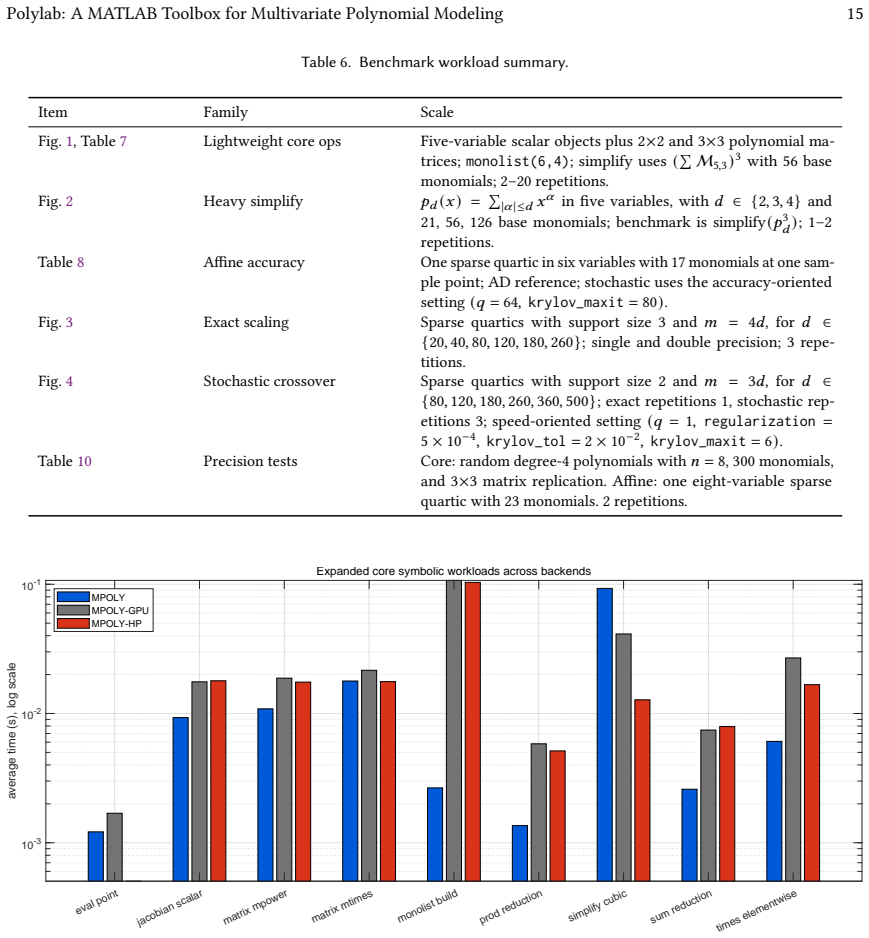
- MPOLY serves as the default for lightweight interactive workloads.
- MPOLY-HP becomes advantageous for reduction-heavy simplification.
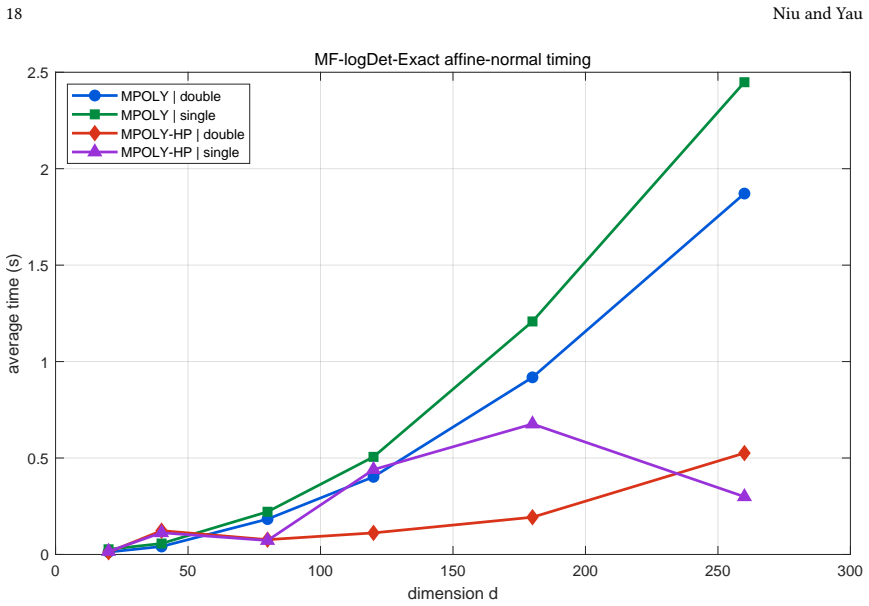
- MPOLY-HP is preferable for medium-to-large affine-normal computation.
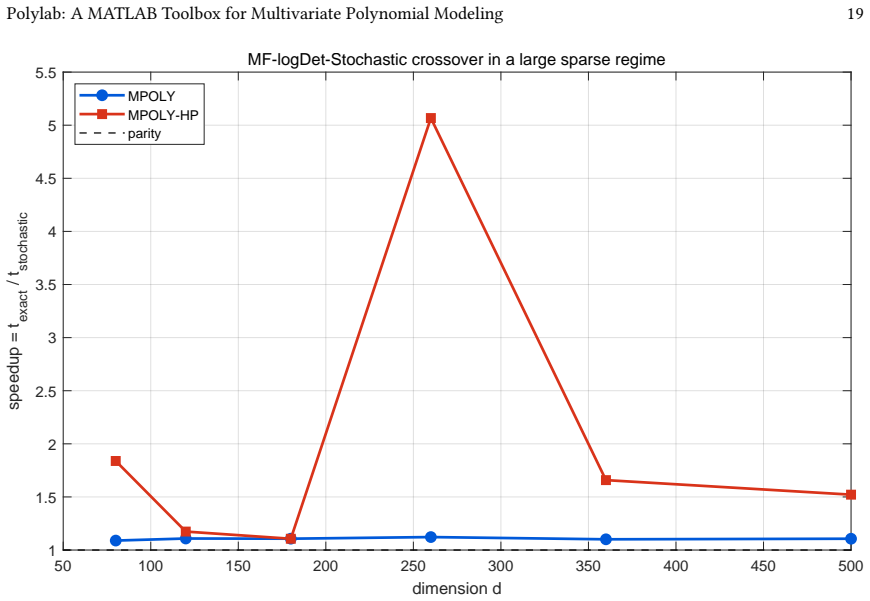
- The stochastic log-determinant variant is attractive in larger sparse regimes under approximation-oriented parameter choices.
- The toolbox enables direct use in optimization workflows through YALMIP and SOSTOOLS interoperability.
Where Pith is reading between the lines
- Researchers handling mixed polynomial sets can reduce expression errors by adopting the explicit variable naming feature.
- The backend selection guidance may allow users to scale polynomial modeling to higher dimensions previously limited by CPU time.
- Integration with existing optimization packages suggests the toolbox can accelerate prototyping in control or algebraic-optimization applications.
- Future hardware backends could be added while preserving the same user interface.
Load-bearing premise
The reported benchmarks are representative of typical user workloads and that the described features function correctly and reproducibly across different MATLAB versions and hardware configurations.
What would settle it
A user reproducing the benchmark sessions on a different MATLAB release or hardware platform and obtaining performance ratios that reverse the claimed advantages of MPOLY-HP for simplification or affine-normal tasks.
Figures

read the original abstract
Polylab is a MATLAB toolbox for multivariate polynomial scalars and polynomial matrices with a unified symbolic-numeric interface across CPU and GPU-oriented backends. The software exposes three aligned classes: MPOLY for CPU execution, MPOLY_GPU as a legacy GPU baseline, and MPOLY_HP as an improved GPU-oriented implementation. Across these backends, Polylab supports polynomial construction, algebraic manipulation, simplification, matrix operations, differentiation, Jacobian and Hessian construction, LaTeX export, CPU-side LaTeX reconstruction, backend conversion, and interoperability with YALMIP and SOSTOOLS. Versions 3.0 and 3.1 add two practically important extensions: explicit variable identity and naming for safe mixed-variable expression handling, and affine-normal direction computation via automatic differentiation, MF-logDet-Exact, and MF-logDet-Stochastic. The toolbox has already been used successfully in prior research applications, and Polylab Version 3.1 adds a new geometry-oriented computational layer on top of a mature polynomial modeling core. This article documents the architecture and user-facing interface of the software, organizes its functionality by workflow, presents representative MATLAB sessions with actual outputs, and reports reproducible benchmarks. The results show that MPOLY is the right default for lightweight interactive workloads, whereas MPOLY-HP becomes advantageous for reduction-heavy simplification and medium-to-large affine-normal computation; the stochastic log-determinant variant becomes attractive in larger sparse regimes under approximation-oriented parameter choices.
Editorial analysis
A structured set of objections, weighed in public.
Referee Report
Summary. The paper presents Polylab, a MATLAB toolbox for multivariate polynomial scalars and matrices offering a unified symbolic-numeric interface across CPU and GPU backends (MPOLY, MPOLY_GPU, MPOLY_HP). It documents the architecture, user-facing interfaces, supported operations (construction, algebraic manipulation, simplification, matrix operations, differentiation, Jacobian/Hessian construction, LaTeX export), interoperability with YALMIP and SOSTOOLS, and new features in v3.0/3.1 for explicit variable identity/naming and affine-normal direction computation via automatic differentiation, MF-logDet-Exact, and MF-logDet-Stochastic. The manuscript includes example MATLAB sessions with outputs and reports reproducible benchmarks, leading to recommendations on backend selection: MPOLY for lightweight interactive workloads, MPOLY-HP for reduction-heavy simplification and medium-to-large affine-normal tasks, and the stochastic log-determinant variant for larger sparse regimes under approximation-oriented choices.
Significance. If the benchmarks hold, the work delivers a practical, documented toolbox that has already seen research use and provides actionable guidance on performance trade-offs for polynomial modeling tasks common in optimization and control. Strengths include the emphasis on reproducible examples, workflow organization, and extensions for safe mixed-variable handling plus geometry-oriented layers. The paper functions effectively as software documentation with embedded performance data rather than a theoretical contribution.
minor comments (2)
- [Benchmarks] The benchmark section would benefit from an explicit statement of the hardware platform, MATLAB version, and problem-size ranges used for the reported timings to help readers judge representativeness for their own workloads.
- [Affine-normal computation] In the description of the stochastic log-determinant variant, a short note on the default or recommended approximation parameters (e.g., sample count or tolerance) would improve immediate usability for readers following the example sessions.
Simulated Author's Rebuttal
We thank the referee for the positive review, the accurate summary of Polylab's features and benchmarks, and the recommendation to accept the manuscript. The referee's description correctly reflects the toolbox architecture, the v3.0/3.1 extensions for explicit variable handling and affine-normal direction computation, and the practical guidance on backend selection.
Circularity Check
No significant circularity; paper is software documentation without mathematical derivations
full rationale
This manuscript is a documentation paper for the Polylab MATLAB toolbox. It describes architecture, user interfaces, example sessions, and reports reproducible benchmarks comparing MPOLY, MPOLY-HP, and stochastic log-det backends. No derivation chain, first-principles predictions, or fitted parameters exist that could reduce to inputs by construction. The central performance recommendations follow directly from the presented benchmarks without self-definitional steps, self-citation load-bearing arguments, or ansatz smuggling. The paper is self-contained as software documentation.
Axiom & Free-Parameter Ledger
Reference graph
Works this paper leans on
-
[1]
Lasserre, and Johan Löfberg
Didier Henrion, Jean B. Lasserre, and Johan Löfberg. 2009. GloptiPoly 3: Moments, Optimization and Semidefinite Programming.Optimization Methods and Software24, 4–5 (2009), 761–779
2009
-
[2]
Hutchinson
Michael F. Hutchinson. 1989. A Stochastic Estimator of the Trace of the Influence Matrix for Laplacian Smoothing Splines.Communications in Statistics - Simulation and Computation18, 3 (1989), 1059–1076
1989
-
[3]
Johan Löfberg. 2004. YALMIP: A Toolbox for Modeling and Optimization in MATLAB. InProceedings of the IEEE International Symposium on Computer Aided Control Systems Design. IEEE, Taipei, Taiwan, 284–289. doi:10.1109/CACSD.2004.1393890
-
[4]
Yi-Shuai Niu and Roland Glowinski. 2022. Discrete Dynamical System Approaches for Boolean Polynomial Optimization.Journal of Scientific Computing92, 2 (2022), 46
2022
- [5]
-
[6]
Yi-Shuai Niu, Artan Sheshmani, and Shing-Tung Yau. 2026. Yau’s Affine Normal Descent: Algorithmic Framework and Convergence Analysis. https://arxiv.org/abs/2603.28448 arXiv:2603.28448
work page internal anchor Pith review Pith/arXiv arXiv 2026
-
[7]
Yi-Shuai Niu, Hoai An Le Thi, and Dinh Tao Pham. 2024. On Difference-of-SOS and Difference-of-Convex-SOS Decompositions for Polynomials. SIAM Journal on Optimization34, 2 (2024), 1852–1878
2024
- [8]
- [9]
discussion (0)
Sign in with ORCID, Apple, or X to comment. Anyone can read and Pith papers without signing in.