Recognition: unknown
TorchUMM: A Unified Multimodal Model Codebase for Evaluation, Analysis, and Post-training
Pith reviewed 2026-05-10 15:28 UTC · model grok-4.3
The pith
TorchUMM supplies the first unified codebase for evaluating, analyzing, and post-training diverse unified multimodal models.
A machine-rendered reading of the paper's core claim, the machinery that carries it, and where it could break.
Core claim
TorchUMM is the first unified codebase that supports comprehensive evaluation, analysis, and post-training across diverse UMM backbones, tasks, and datasets by providing a unified interface and standardized evaluation protocols for multimodal understanding, generation, and editing.
What carries the argument
The unified interface and standardized evaluation protocols that integrate heterogeneous model backbones and remove implementation-specific differences.
If this is right
- Fair and reproducible comparisons become possible across models of different scales and designs.
- Insights into specific strengths and limitations emerge from tests on perception, reasoning, compositionality, and instruction following.
- Post-training can be applied uniformly to any supported backbone.
- New datasets can be added to the same evaluation pipeline without rewriting per-model code.
Where Pith is reading between the lines
- The codebase could serve as a common platform where new models are added and tested immediately upon release.
- Patterns of failure that appear across many architectures may become visible for the first time.
- The same structure could later incorporate additional modalities such as audio or video with minimal redesign.
Load-bearing premise
The chosen models, tasks, and datasets are representative and the shared interface does not change how any model actually performs.
What would settle it
A model that scores consistently higher or lower when run through TorchUMM than when run in its original dedicated implementation.
Figures

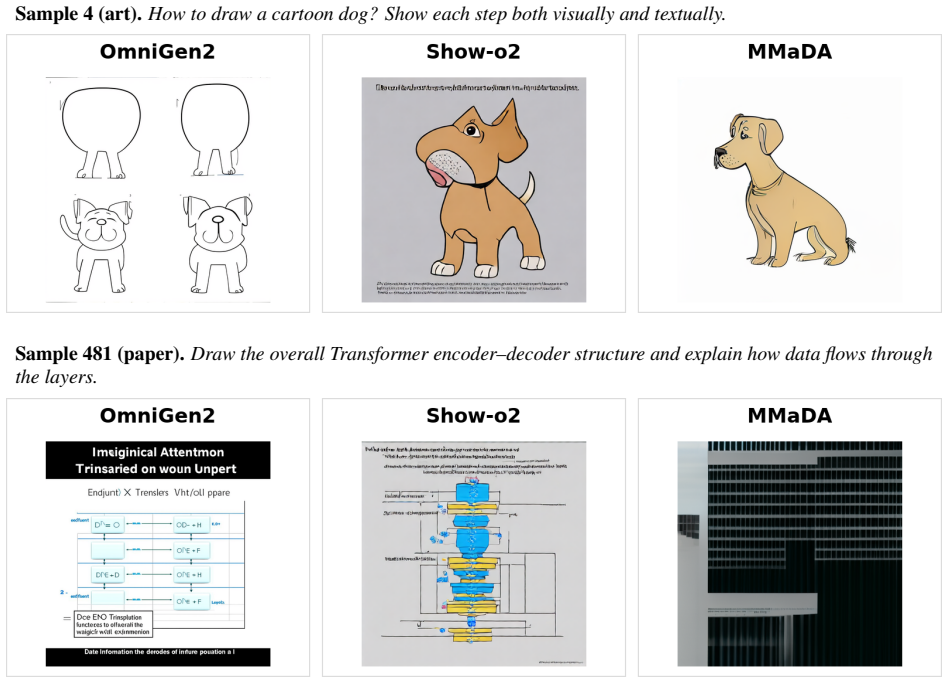

read the original abstract
Recent advances in unified multimodal models (UMMs) have led to a proliferation of architectures capable of understanding, generating, and editing across visual and textual modalities. However, developing a unified framework for UMMs remains challenging due to the diversity of model architectures and the heterogeneity of training paradigms and implementation details. In this paper, we present TorchUMM, the first unified codebase for comprehensive evaluation, analysis, and post-training across diverse UMM backbones, tasks, and datasets. TorchUMM supports a broad spectrum of models covering a wide range of scales and design paradigms. Our benchmark encompasses three core task dimensions: multimodal understanding, generation, and editing, and integrates both established and novel datasets to evaluate perception, reasoning, compositionality, and instruction-following abilities. By providing a unified interface and standardized evaluation protocols, TorchUMM enables fair and reproducible comparisons across heterogeneous models and fosters deeper insights into their strengths and limitations, facilitating the development of more capable unified multimodal systems. Code is available at: https://github.com/AIFrontierLab/TorchUMM.
Editorial analysis
A structured set of objections, weighed in public.
Referee Report
Summary. The manuscript introduces TorchUMM, described as the first unified codebase supporting comprehensive evaluation, analysis, and post-training of unified multimodal models (UMMs) across diverse architectures, scales, and design paradigms. It covers three core task dimensions—multimodal understanding, generation, and editing—while integrating established and novel datasets to assess perception, reasoning, compositionality, and instruction-following. The central contribution is a unified interface and standardized evaluation protocols intended to enable fair, reproducible comparisons across heterogeneous models.
Significance. If the implementations deliver the promised standardized interfaces and protocols without introducing model-specific biases, the release would provide a useful practical tool for the multimodal AI community. Standardized benchmarking frameworks can reduce fragmentation in UMM research and support more reliable insights into model capabilities, with the public GitHub release aiding reproducibility.
minor comments (2)
- Abstract: The claim that TorchUMM is 'the first' unified codebase for this purpose would be strengthened by an explicit related-work discussion comparing it to prior efforts (e.g., existing multimodal toolkits or evaluation suites); without this, the novelty statement remains unsubstantiated in the provided text.
- Abstract: No concrete usage examples, code snippets, supported model lists, or sample benchmark outputs are supplied. Including at least one illustrative workflow or table of covered models/tasks/datasets in the main text would improve clarity and allow readers to assess the scope directly.
Simulated Author's Rebuttal
We thank the referee for the constructive review and for recommending minor revision. We appreciate the recognition of TorchUMM's potential value as a standardized benchmarking framework for unified multimodal models. No major comments were raised in the report, so we have no specific points to address point-by-point. We will incorporate any minor suggestions during the revision process to further strengthen the manuscript and codebase documentation.
Circularity Check
No significant circularity
full rationale
The paper is a tool-release description of the TorchUMM codebase and its standardized interfaces for evaluating UMMs across understanding, generation, and editing tasks. No mathematical derivations, equations, fitted parameters, or load-bearing self-citations appear in the provided text or abstract. The central claim is the existence and public release of the framework itself, which does not reduce to any input by construction or self-reference. Representativeness of models and datasets is noted as an external concern but does not create internal circularity in any derivation chain.
Axiom & Free-Parameter Ledger
Forward citations
Cited by 1 Pith paper
-
UniPath: Adaptive Coordination of Understanding and Generation for Unified Multimodal Reasoning
UniPath adaptively models coordination-path diversity in unified multimodal models by training a path-conditioned executor and using a lightweight planner for input-dependent selection, improving performance over fixe...
Reference graph
Works this paper leans on
-
[1]
Josh Achiam, Steven Adler, Sandhini Agarwal, Lama Ahmad, Ilge Akkaya, Florencia Leoni Aleman, Diogo Almeida, Janko Altenschmidt, Sam Altman, Shyamal Anadkat, et al. Gpt-4 technical report.arXiv preprint arXiv:2303.08774,
work page internal anchor Pith review Pith/arXiv arXiv
-
[2]
Shuai Bai, Yuxuan Cai, Ruizhe Chen, Keqin Chen, Xionghui Chen, Zesen Cheng, Lianghao Deng, Wei Ding, Chang Gao, Chunjiang Ge, et al. Qwen3-vl technical report.arXiv preprint arXiv:2511.21631,
work page internal anchor Pith review Pith/arXiv arXiv
-
[3]
BLIP3-o: A Family of Fully Open Unified Multimodal Models-Architecture, Training and Dataset
Jiuhai Chen, Zhiyang Xu, Xichen Pan, Yushi Hu, Can Qin, Tom Goldstein, Lifu Huang, Tianyi Zhou, Saining Xie, Silvio Savarese, et al. Blip3-o: A family of fully open unified multimodal models-architecture, training and dataset.arXiv preprint arXiv:2505.09568, 2025a. Lin Chen, Jinsong Li, Xiaoyi Dong, Pan Zhang, Yuhang Zang, Zehui Chen, Haodong Duan, Jiaqi ...
-
[4]
Janus-Pro: Unified Multimodal Understanding and Generation with Data and Model Scaling
Xiaokang Chen, Zhiyu Wu, Xingchao Liu, Zizheng Pan, Wen Liu, Zhenda Xie, Xingkai Yu, and Chong Ruan. Janus-pro: Unified multimodal understanding and generation with data and model scaling.arXiv preprint arXiv:2501.17811, 2025b. OpenCompass Contributors. Opencompass: a universal evaluation platform for foundation models (2023). URL https://github. com/open...
work page internal anchor Pith review arXiv 2023
- [5]
-
[6]
Emerging Properties in Unified Multimodal Pretraining
Chaorui Deng, Deyao Zhu, Kunchang Li, Chenhui Gou, Feng Li, Zeyu Wang, Shu Zhong, Weihao Yu, Xiaonan Nie, Ziang Song, et al. Emerging properties in unified multimodal pretraining.arXiv preprint arXiv:2505.14683,
work page internal anchor Pith review arXiv
-
[7]
From multimodal llm to human-level ai: Modality, instruction, reasoning, efficiency and beyond
Hao Fei, Yuan Yao, Zhuosheng Zhang, Fuxiao Liu, Ao Zhang, and Tat-Seng Chua. From multimodal llm to human-level ai: Modality, instruction, reasoning, efficiency and beyond. InProceedings of the 2024 Joint International Conference on Computational Linguistics, Language Resources and Evaluation (LREC-COLING 2024): Tutorial Summaries, pages 1–8,
2024
-
[8]
Benjamin Feuer, Micah Goldblum, Teresa Datta, Sanjana Nambiar, Raz Besaleli, Samuel Dooley, Max Cembalest, and John P Dickerson. Style outweighs substance: Failure modes of llm judges in alignment benchmarking.arXiv preprint arXiv:2409.15268,
-
[9]
MME: A Comprehensive Evaluation Benchmark for Multimodal Large Language Models
15 Chaoyou Fu, Peixian Chen, Yunhang Shen, Yulei Qin, Mengdan Zhang, Xu Lin, Jinrui Yang, Xiawu Zheng, Ke Li, Xing Sun, et al. Mme: A comprehensive evaluation benchmark for multimodal large language models.arXiv preprint arXiv:2306.13394,
work page internal anchor Pith review arXiv
-
[10]
Tokenflow: Con- sistent diffusion features for consistent video editing,
Michal Geyer, Omer Bar-Tal, Shai Bagon, and Tali Dekel. Tokenflow: Consistent diffusion features for consistent video editing.arXiv preprint arXiv:2307.10373,
-
[11]
Ruiyan Han, Zhen Fang, XinYu Sun, Yuchen Ma, Ziheng Wang, Yu Zeng, Zehui Chen, Lin Chen, Wenxuan Huang, Wei-Jie Xu, et al. Unicorn: Towards self-improving unified multimodal models through self- generated supervision.arXiv preprint arXiv:2601.03193,
-
[12]
ELLA: Equip Diffusion Models with LLM for Enhanced Semantic Alignment
Xiwei Hu, Rui Wang, Yixiao Fang, Bin Fu, Pei Cheng, and Gang Yu. Ella: Equip diffusion models with llm for enhanced semantic alignment.arXiv preprint arXiv:2403.05135,
work page internal anchor Pith review arXiv
-
[13]
Interleaving reasoning for better text-to-image generation
Wenxuan Huang, Shuang Chen, Zheyong Xie, Shaosheng Cao, Shixiang Tang, Yufan Shen, Qingyu Yin, Wenbo Hu, Xiaoman Wang, Yuntian Tang, et al. Interleaving reasoning for better text-to-image generation. arXiv preprint arXiv:2509.06945,
-
[14]
Ueval: A benchmark for unified multimodal generation.arXiv preprint arXiv:2601.22155,
Bo Li, Yida Yin, Wenhao Chai, Xingyu Fu, and Zhuang Liu. Ueval: A benchmark for unified multimodal generation.arXiv preprint arXiv:2601.22155,
-
[15]
Step1X-Edit: A Practical Framework for General Image Editing
Shiyu Liu, Yucheng Han, Peng Xing, Fukun Yin, Rui Wang, Wei Cheng, Jiaqi Liao, Yingming Wang, Honghao Fu, Chunrui Han, et al. Step1x-edit: A practical framework for general image editing.arXiv preprint arXiv:2504.17761,
work page internal anchor Pith review arXiv
-
[16]
MathVista: Evaluating Mathematical Reasoning of Foundation Models in Visual Contexts
Pan Lu, Hritik Bansal, Tony Xia, Jiacheng Liu, Chunyuan Li, Hannaneh Hajishirzi, Hao Cheng, Kai-Wei Chang, Michel Galley, and Jianfeng Gao. Mathvista: Evaluating mathematical reasoning of foundation models in visual contexts.arXiv preprint arXiv:2310.02255,
work page internal anchor Pith review arXiv
-
[17]
16 Prateek Munjal, Clement Christophe, Ronnie Rajan, and Praveenkumar Kanithi. Do instruction-tuned models always perform better than base models? evidence from math and domain-shifted benchmarks.arXiv preprint arXiv:2601.13244,
-
[18]
Yuwei Niu, Munan Ning, Mengren Zheng, Weiyang Jin, Bin Lin, Peng Jin, Jiaqi Liao, Chaoran Feng, Kunpeng Ning, Bin Zhu, et al. Wise: A world knowledge-informed semantic evaluation for text-to-image generation.arXiv preprint arXiv:2503.07265,
-
[19]
Luozheng Qin, Jia Gong, Yuqing Sun, Tianjiao Li, Mengping Yang, Xiaomeng Yang, Chao Qu, Zhiyu Tan, and Hao Li. Uni-cot: Towards unified chain-of-thought reasoning across text and vision.arXiv preprint arXiv:2508.05606,
-
[20]
arXiv preprint arXiv:2508.13073 , year=
Qwen Team. Qwen3.5: Towards native multimodal agents, February 2026a. URL https://qwen.ai/ blog?id=qwen3.5. Qwen Team. Qwen3-vl-embedding-8b, 2026b. URL https://huggingface.co/Qwen/ Qwen3-VL-Embedding-8B. Hugging Face model card. Rui Shao, Wei Li, Lingsen Zhang, Renshan Zhang, Zhiyang Liu, Ran Chen, and Liqiang Nie. Large vlm- based vision-language-action...
-
[21]
OpenWorldLib: A Unified Codebase and Definition of Advanced World Models
DataFlow Team et al. Openworldlib: A unified codebase and definition of advanced world models.arXiv preprint arXiv:2604.04707,
work page internal anchor Pith review Pith/arXiv arXiv
-
[22]
Gemini: A Family of Highly Capable Multimodal Models
Gemini Team, Rohan Anil, Sebastian Borgeaud, Jean-Baptiste Alayrac, Jiahui Yu, Radu Soricut, Johan Schalkwyk, Andrew M Dai, Anja Hauth, Katie Millican, et al. Gemini: a family of highly capable multimodal models.arXiv preprint arXiv:2312.11805,
work page internal anchor Pith review Pith/arXiv arXiv
-
[23]
Chenlong Wang, Yuhang Chen, Zhihan Hu, Dongping Chen, Wenhu Chen, Sarah Wiegreffe, and Tianyi Zhou. Quantifying the gap between understanding and generation within unified multimodal models.arXiv preprint arXiv:2602.02140, 2026a. Dianyi Wang, Ruihang Li, Feng Han, Chaofan Ma, Wei Song, Siyuan Wang, Yibin Wang, Yi Xin, Hongjian Liu, Zhixiong Zhang, et al. ...
-
[24]
Qwen2.5 Technical Report.arXiv preprint arXiv:2410.13848, 2024
Chengyue Wu, Xiaokang Chen, Zhiyu Wu, Yiyang Ma, Xingchao Liu, Zizheng Pan, Wen Liu, Zhenda Xie, Xingkai Yu, Chong Ruan, et al. Janus: Decoupling visual encoding for unified multimodal understanding and generation.arXiv preprint arXiv:2410.13848,
-
[25]
OmniGen2: Towards Instruction-Aligned Multimodal Generation
Chenyuan Wu, Pengfei Zheng, Ruiran Yan, Shitao Xiao, Xin Luo, Yueze Wang, Wanli Li, Xiyan Jiang, Yexin Liu, Junjie Zhou, et al. Omnigen2: Exploration to advanced multimodal generation.arXiv preprint arXiv:2506.18871, 2025a. Mingrui Wu, Hang Liu, Jiayi Ji, Xiaoshuai Sun, and Rongrong Ji. Micon-bench: Benchmarking and enhancing multi-image context image gen...
work page internal anchor Pith review Pith/arXiv arXiv
-
[26]
Size Wu, Zhonghua Wu, Zerui Gong, Qingyi Tao, Sheng Jin, Qinyue Li, Wei Li, and Chen Change Loy. Openuni: A simple baseline for unified multimodal understanding and generation.arXiv preprint arXiv:2505.23661, 2025b. Ji Xie, Trevor Darrell, Luke Zettlemoyer, and XuDong Wang. Reconstruction alignment improves unified multimodal models. InICLR,
-
[27]
Show-o: One Single Transformer to Unify Multimodal Understanding and Generation
Jinheng Xie, Weijia Mao, Zechen Bai, David Junhao Zhang, Weihao Wang, Kevin Qinghong Lin, Yuchao Gu, Zhijie Chen, Zhenheng Yang, and Mike Zheng Shou. Show-o: One single transformer to unify multimodal understanding and generation.arXiv preprint arXiv:2408.12528,
work page internal anchor Pith review arXiv
-
[28]
Show-o2: Improved Native Unified Multimodal Models
Jinheng Xie, Zhenheng Yang, and Mike Zheng Shou. Show-o2: Improved native unified multimodal models. arXiv preprint arXiv:2506.15564,
work page internal anchor Pith review arXiv
-
[29]
Mmada: Multimodal large diffusion language models.arXiv preprint arXiv:2505.15809,
Ling Yang, Ye Tian, Bowen Li, Xinchen Zhang, Ke Shen, Yunhai Tong, and Mengdi Wang. Mmada: Multimodal large diffusion language models.arXiv preprint arXiv:2505.15809,
-
[30]
ImgEdit: A Unified Image Editing Dataset and Benchmark
Yang Ye, Xianyi He, Zongjian Li, Bin Lin, Shenghai Yuan, Zhiyuan Yan, Bohan Hou, and Li Yuan. Imgedit: A unified image editing dataset and benchmark.arXiv preprint arXiv:2505.20275,
work page internal anchor Pith review arXiv
-
[31]
MM-Vet: Evaluating Large Multimodal Models for Integrated Capabilities
Weihao Yu, Zhengyuan Yang, Linjie Li, Jianfeng Wang, Kevin Lin, Zicheng Liu, Xinchao Wang, and Lijuan Wang. Mm-vet: Evaluating large multimodal models for integrated capabilities.arXiv preprint arXiv:2308.02490,
work page internal anchor Pith review arXiv
-
[32]
Lmms-eval: Reality check on the evaluation of large multimodal models
Kaichen Zhang, Bo Li, Peiyuan Zhang, Fanyi Pu, Joshua Adrian Cahyono, Kairui Hu, Shuai Liu, Yuanhan Zhang, Jingkang Yang, Chunyuan Li, et al. Lmms-eval: Reality check on the evaluation of large multimodal models. InFindings of the Association for Computational Linguistics: NAACL 2025, pages 881–916,
2025
-
[33]
Shanshan Zhao, Xinjie Zhang, Jintao Guo, Jiakui Hu, Lunhao Duan, Minghao Fu, Yong Xien Chng, Guo- Hua Wang, Qing-Guo Chen, Zhao Xu, et al. Unified multimodal understanding and generation models: Advances, challenges, and opportunities.arXiv preprint arXiv:2505.02567,
-
[34]
Uni-MMMU: A Massive Multi-discipline Multimodal Unified Benchmark
Kai Zou, Ziqi Huang, Yuhao Dong, Shulin Tian, Dian Zheng, Hongbo Liu, Jingwen He, Bin Liu, Yu Qiao, and Ziwei Liu. Uni-mmmu: A massive multi-discipline multimodal unified benchmark.arXiv preprint arXiv:2510.13759,
work page internal anchor Pith review Pith/arXiv arXiv
-
[35]
Table 7: Geneval sub-score. model single_object two_object counting colors position color_attr overall bagel(w/o think) 99.38 94.19 78.75 87.77 51 61.75 78.81 blip3o 98.12 93.18 73.44 86.17 72.75 64.5 81.36 show_o2(7B) 97.81 71.46 48.75 78.46 20 42.75 59.87 show_o2(1.5B) 96.88 64.39 46.88 76.06 16.75 32 55.49 Janus_pro 97.81 86.62 57.5 89.36 76 66.25 78.9...
1905
discussion (0)
Sign in with ORCID, Apple, or X to comment. Anyone can read and Pith papers without signing in.