Recognition: unknown
JWST and Keck observations of the off-nuclear tidal disruption event TDE 2025abcr: An evolving reprocessing layer
Pith reviewed 2026-05-10 07:46 UTC · model grok-4.3
The pith
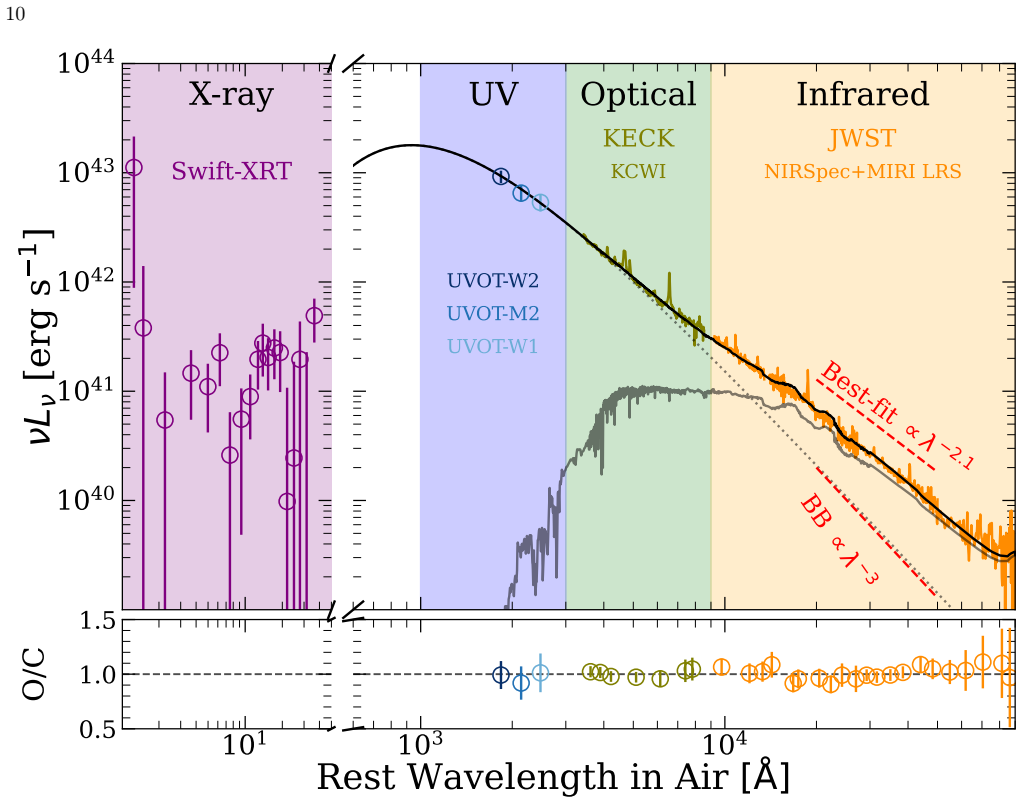
Observations of off-nuclear TDE 2025abcr show emission-line velocity shifts from an evolving reprocessing layer and an infrared excess from either reprocessed gas or a stripped stellar cluster.
A machine-rendered reading of the paper's core claim, the machinery that carries it, and where it could break.
Core claim
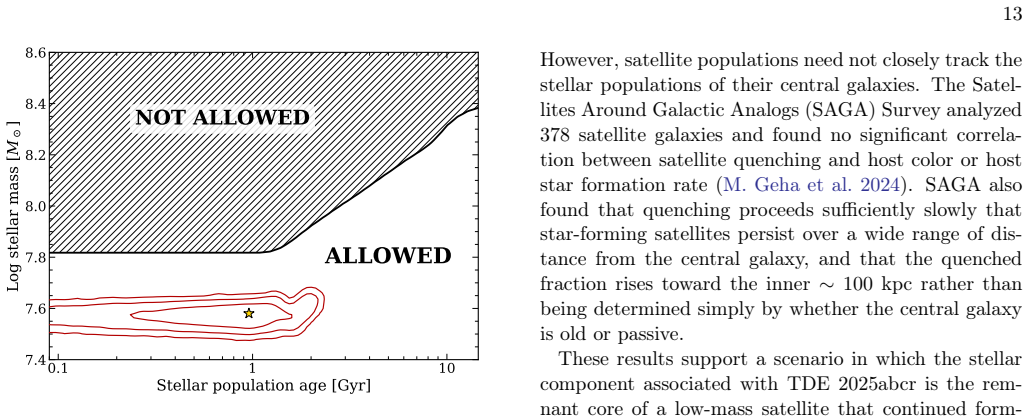
The central claim is that velocity evolution in the N III + He II complex, shifting from -500 km s^{-1} at day -7 to +1000 km s^{-1} by day +29, arises from radiative transfer effects in an evolving reprocessing layer, while the IR SED with νL_ν ∝ λ^{-2.13 ± 0.04} is explained by either free-free emission from that same reprocessing gas or an unresolved stellar cluster of mass log(M_*/M_⊙) = 7.57 ± 0.02 and age less than 2 Gyr, consistent with a stripped satellite remnant around a wandering black hole of 10^6-10^7 solar masses.
What carries the argument
The evolving reprocessing layer, which produces the observed line velocity shifts through changing radiative transfer conditions and supplies the free-free emission that accounts for the infrared excess.
If this is right
- The disrupting black hole has a mass of 10^6-10^7 solar masses, substantially smaller than the 10^8.35 solar-mass black hole in the host nucleus.
- The 9 kpc offset implies the black hole is wandering and most likely arrived via a minor merger that left a stripped satellite remnant.
- Reprocessed emission provides a consistent explanation for the infrared excess without requiring dust.
- If the stellar-cluster solution holds, the cluster mass and age indicate a young, stripped satellite galaxy remnant at the TDE site.
Where Pith is reading between the lines
- Similar velocity evolution should be detectable in other well-observed TDEs if reprocessing layers are common.
- High-resolution imaging or spectroscopy could distinguish a stellar cluster from reprocessing by revealing absorption features or spatial extent.
- Off-nuclear TDEs may serve as tracers for the population of wandering massive black holes produced by minor mergers.
Load-bearing premise
The observed velocity shift in the emission lines is produced by radiative transfer in an evolving reprocessing layer rather than by bulk motion of the gas or other dynamical effects.
What would settle it
High-resolution spectroscopy that resolves bulk velocity gradients without corresponding changes in line optical depth, or an infrared spectrum that fits a dust model better than free-free emission, would falsify the reprocessing-layer interpretation.
Figures






read the original abstract
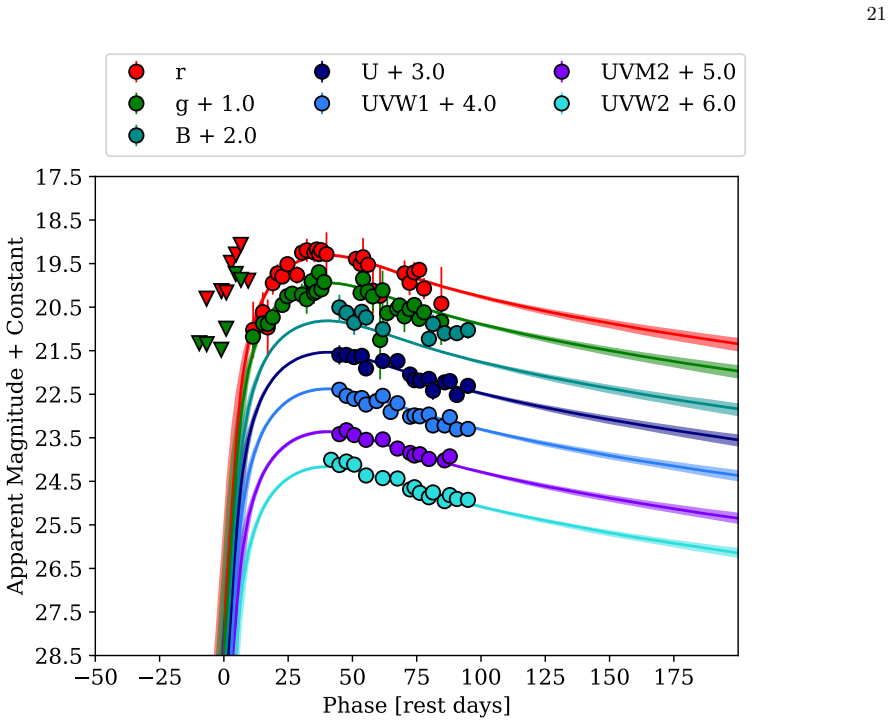
Off-nuclear tidal disruption events (TDEs) provide a rare probe of massive black holes (MBHs) outside galactic nuclei. Only a handful are known, including five X-ray-selected candidates and two optically selected events. We present observations of TDE 2025abcr, the second optically selected off-nuclear TDE, discovered at a projected offset of $9.08 \pm 0.02$ kpc from the nucleus of its host galaxy. We analyze X-ray, UV, optical, and infrared (IR) data from Swift, Keck, ZTF, and JWST. Broad H and He emission lines in the optical and IR confirm a TDE-H-He classification. From luminosity scaling relations and MOSFiT modeling, we infer a BH mass of $10^{6}$-$10^{7}\,M_{\odot}$, substantially smaller than the $10^{8.35 \pm 0.41}\,M_{\odot}$ BH inferred for the host-galaxy nucleus. We observe velocity evolution in the N III + He II emission complex, shifting from $-500$ km s$^{-1}$ at day $-7$ to $+1000$ km s$^{-1}$ by day $+29$, which we interpret as radiative transfer effects in an evolving reprocessing layer. The IR SED deviates from a thermal blackbody, with $\nu L_{\nu} \propto \lambda^{-2.13 \pm 0.04}$, significantly shallower than the Rayleigh-Jeans slope of $\lambda^{-3}$. We rule out dust as the source of this IR excess. Two possibilities remain: free-free emission from reprocessing gas, or an unresolved stellar cluster at the TDE location. Reprocessed emission provides a natural explanation for the IR excess but an underlying stellar cluster of mass $\log(M_{*}/M_{\odot}) = 7.57 \pm 0.02$ and age $<$2 Gyr is also consistent with the data. If interpreted as a stellar cluster, the inferred mass suggests a stripped remnant of a satellite galaxy. The wandering MBH most likely originated in a minor merger with a smaller galaxy, although dynamical ejection from the host nucleus cannot yet be ruled out.
Editorial analysis
A structured set of objections, weighed in public.
Referee Report
Summary. The manuscript reports multi-wavelength observations of the off-nuclear TDE 2025abcr at 9.08 kpc projected offset, using Swift, Keck, ZTF, and JWST data. It classifies the event as TDE-H-He based on broad H and He lines, infers a BH mass of 10^6-10^7 M_sun via luminosity scaling and MOSFiT (distinct from the host nucleus mass of 10^8.35 M_sun), documents velocity evolution in the N III + He II complex from -500 km s^{-1} (day -7) to +1000 km s^{-1} (day +29), and fits an IR SED with νL_ν ∝ λ^{-2.13 ± 0.04}. Dust is ruled out; the IR excess is attributed to either free-free emission from an evolving reprocessing layer or an unresolved stellar cluster (log(M_*/M_⊙) = 7.57 ± 0.02, age <2 Gyr), with the latter suggesting a stripped satellite remnant from a minor merger.
Significance. If the central interpretations are substantiated, the work contributes a rare, well-observed optically selected off-nuclear TDE that expands the sample of wandering MBHs and highlights potential reprocessing physics. The JWST IR photometry and Keck spectroscopy provide high-quality data on velocity shifts and SED shape that could constrain TDE emission models, with the dual interpretation (reprocessing vs. cluster) offering testable predictions for future monitoring.
major comments (3)
- [Abstract] Abstract and optical spectroscopy section: The central claim that the N III + He II velocity evolution (from -500 km s^{-1} to +1000 km s^{-1}) arises from radiative transfer effects in an evolving reprocessing layer is stated directly but lacks any quantitative RT modeling, optical-depth calculations, or line-profile synthesis to distinguish it from bulk-motion alternatives such as outflows or orbital dynamics around the inferred 10^6-10^7 M_⊙ BH.
- [IR SED analysis] IR SED analysis section: The power-law index νL_ν ∝ λ^{-2.13 ± 0.04} is used to exclude dust (contrasted with Rayleigh-Jeans λ^{-3}), yet the manuscript simultaneously leaves open an unresolved stellar cluster without presenting the full χ² fits, parameter covariances, or error budgets that would demonstrate whether free-free emission from reprocessing gas is statistically preferred over the cluster solution.
- [BH mass inference] BH mass inference paragraph: The 10^6-10^7 M_⊙ range is derived from luminosity scaling relations and MOSFiT, but the text provides no tabulated error budgets, full data-reduction pipeline details, or sensitivity tests to host contamination, which are load-bearing for the claim that this is a distinct wandering MBH rather than nuclear activity.
minor comments (2)
- [Abstract] The abstract references 'five X-ray-selected candidates' without citations; adding specific references to prior off-nuclear TDE literature would improve context.
- [IR SED analysis] Notation for the IR spectral index (νL_ν ∝ λ^{-2.13 ± 0.04}) should be cross-checked against the exact wavelength range and filter transmission used in the fit for clarity.
Simulated Author's Rebuttal
We thank the referee for their thorough and constructive review, which has helped us identify areas for clarification and improvement. We address each major comment point by point below, providing the strongest honest defense of our interpretations while noting where additional details or caveats will be incorporated in revision.
read point-by-point responses
-
Referee: [Abstract] Abstract and optical spectroscopy section: The central claim that the N III + He II velocity evolution (from -500 km s^{-1} to +1000 km s^{-1}) arises from radiative transfer effects in an evolving reprocessing layer is stated directly but lacks any quantitative RT modeling, optical-depth calculations, or line-profile synthesis to distinguish it from bulk-motion alternatives such as outflows or orbital dynamics around the inferred 10^6-10^7 M_⊙ BH.
Authors: We acknowledge that our interpretation relies on qualitative consistency with the observed temporal evolution of the line complex, its correlation with continuum changes, and precedents in the TDE literature rather than new quantitative radiative transfer calculations. Full RT modeling or line-profile synthesis is beyond the scope of this primarily observational manuscript. In revision we will expand the discussion to explicitly address alternative explanations (outflows, orbital motion) and articulate why the reprocessing-layer scenario remains our favored reading of the data, while adding a clear caveat that detailed modeling is required for definitive distinction. This is a partial revision. revision: partial
-
Referee: [IR SED analysis] IR SED analysis section: The power-law index νL_ν ∝ λ^{-2.13 ± 0.04} is used to exclude dust (contrasted with Rayleigh-Jeans λ^{-3}), yet the manuscript simultaneously leaves open an unresolved stellar cluster without presenting the full χ² fits, parameter covariances, or error budgets that would demonstrate whether free-free emission from reprocessing gas is statistically preferred over the cluster solution.
Authors: We agree that the statistical details of the two SED models should be presented explicitly. In the revised manuscript we will add the χ² values, best-fit parameters, and associated error budgets for both the free-free reprocessing and stellar-cluster solutions. With only a small number of IR photometric points, both models remain statistically acceptable, which is why we present them as viable alternatives; the added information will allow readers to evaluate the relative fits directly. revision: yes
-
Referee: [BH mass inference] BH mass inference paragraph: The 10^6-10^7 M_⊙ range is derived from luminosity scaling relations and MOSFiT, but the text provides no tabulated error budgets, full data-reduction pipeline details, or sensitivity tests to host contamination, which are load-bearing for the claim that this is a distinct wandering MBH rather than nuclear activity.
Authors: We will incorporate the requested transparency in revision. A new table or dedicated subsection will tabulate the error budgets from both the luminosity scaling relations and the MOSFiT fits, summarize the relevant data-reduction steps, and include sensitivity tests to possible host-galaxy contamination. These additions will strengthen the case that the inferred mass is distinct from the nuclear BH mass. revision: yes
Circularity Check
No circularity: all central claims are direct measurements or applications of external standard tools.
full rationale
The paper reports observed line velocities from Keck spectra, fits an IR power-law index to JWST photometry, and applies the external MOSFiT code plus published luminosity scaling relations to estimate BH mass. None of these steps define a quantity in terms of itself, rename a fitted parameter as a prediction, or rest on a self-citation chain whose validity depends on the present work. The interpretive statement that the velocity shift arises from radiative transfer in a reprocessing layer is presented as a qualitative reading of the data rather than a derived result from the paper's own equations. The IR excess analysis compares the measured slope to the known Rayleigh-Jeans value and leaves two physical possibilities open, without forcing one by construction. The derivation chain is therefore self-contained against external benchmarks and contains no load-bearing circular steps.
Axiom & Free-Parameter Ledger
free parameters (3)
- Black hole mass =
10^6 - 10^7 M_sun
- IR spectral index =
-2.13 +/- 0.04
- Stellar cluster mass and age =
log(M*/M_sun) = 7.57 +/- 0.02, age < 2 Gyr
axioms (2)
- domain assumption Standard luminosity scaling relations for TDEs apply to off-nuclear events
- domain assumption MOSFiT modeling yields reliable black-hole masses for TDE light curves
invented entities (2)
-
Evolving reprocessing layer
no independent evidence
-
Unresolved stellar cluster
no independent evidence
Reference graph
Works this paper leans on
-
[1]
Angus, C. R., Smith, A. J., Magill, D., et al. 2026, arXiv e-prints, arXiv:2601.04406, doi: 10.48550/arXiv.2601.04406
-
[2]
Arnaud, K. A. 1996, in Astronomical Society of the Pacific Conference Series, Vol. 101, Astronomical Data Analysis Software and Systems V, ed. G. H. Jacoby & J. Barnes, 17
1996
-
[3]
2017, ApJ, 838, 149, doi: 10.3847/1538-4357/aa633b
Auchettl, K., Guillochon, J., & Ramirez-Ruiz, E. 2017, ApJ, 838, 149, doi: 10.3847/1538-4357/aa633b
-
[4]
2011, Astronomy & Astrophysics, 531, A109, doi: 10.1051/0004-6361/201016323
Beifiori, A., Maraston, C., Thomas, D., & Johansson, J. 2011, Astronomy & Astrophysics, 531, A109, doi: 10.1051/0004-6361/201016323
-
[5]
Bellm, E. C., Kulkarni, S. R., Graham, M. J., et al. 2019, PASP, 131, 018002, doi: 10.1088/1538-3873/aaecbe 18
-
[6]
Blecha, L., Sijacki, D., Kelley, L. Z., et al. 2016, MNRAS, 456, 961, doi: 10.1093/mnras/stv2646
-
[7]
Blumenthal, G. R., Faber, S. M., Primack, J. R., & Rees, M. J. 1984, Nature, 311, 517, doi: 10.1038/311517a0 Böker, T., Sarzi, M., McLaughlin, D. E., et al. 2004, AJ, 127, 105, doi: 10.1086/380231
-
[8]
2018, MNRAS, 477, 3910, doi: 10.1093/mnras/sty896
Bonetti, M., Haardt, F., Sesana, A., & Barausse, E. 2018, MNRAS, 477, 3910, doi: 10.1093/mnras/sty896
-
[9]
Burrows, D. N., Hill, J. E., Nousek, J. A., et al. 2005, Space Science Reviews, 120, 165, doi: 10.1007/s11214-005-5097-2
-
[10]
2023, Zenodo, doi: 10.5281/zenodo.10022973
Bushouse, H., Eisenhamer, J., Dencheva, N., et al. 2023,, 1.12.5 Zenodo, doi: 10.5281/zenodo.10022973
-
[11]
2012,, Astrophysics Source Code Library, record ascl:1210.002
Cappellari, M. 2012,, Astrophysics Source Code Library, record ascl:1210.002
2012
-
[12]
2017, MNRAS, 466, 798, doi: 10.1093/mnras/stw3020
Cappellari, M. 2017, MNRAS, 466, 798, doi: 10.1093/mnras/stw3020
work page internal anchor Pith review doi:10.1093/mnras/stw3020 2017
-
[13]
Cardelli, J. A., Clayton, G. C., & Mathis, J. S. 1989, ApJ, 345, 245, doi: 10.1086/167900
-
[14]
Charalampopoulos, P., Leloudas, G., Malesani, D. B., et al. 2022, A&A, 659, A34, doi: 10.1051/0004-6361/202142122
-
[15]
Cluver, M. E., Jarrett, T. H., Hopkins, A. M., et al. 2014, The Astrophysical Journal, 782, 90, doi: 10.1088/0004-637X/782/2/90
-
[16]
Dey, A., Schlegel, D. J., Lang, D., et al. 2019, AJ, 157, 168, doi: 10.3847/1538-3881/ab089d
-
[17]
Ramirez-Ruiz, E., & Foley, R. J. 2021, ApJL, 907, L21, doi: 10.3847/2041-8213/abd852
-
[18]
A., Nukala, A., Connor, I., et al
Dodd, S. A., Nukala, A., Connor, I., et al. 2023, ApJL, 959, L19, doi: 10.3847/2041-8213/ad1112
-
[19]
Evans, C. R., & Kochanek, C. S. 1989, ApJL, 346, L13, doi: 10.1086/185567
-
[20]
Foreman-Mackey, D., Hogg, D. W., Lang, D., & Goodman, J. 2013, PASP, 125, 306, doi: 10.1086/670067
-
[21]
Fried, D. L. 1966, Journal of the Optical Society of America (1917-1983), 56, 1372, doi: 10.1364/JOSA.56.001372 Gaia Collaboration, Vallenari, A., Brown, A. G. A., et al. 2023, A&A, 674, A1, doi: 10.1051/0004-6361/202243940
-
[22]
Geha, M., Mao, Y.-Y., Wechsler, R. H., et al. 2024, ApJ, 976, 118, doi: 10.3847/1538-4357/ad61e7
-
[23]
Gelman, A., & Rubin, D. B. 1992, Statistical Science, 7, 457, doi: 10.1214/ss/1177011136
-
[25]
2021, ARA&A, 59, 21, doi: 10.1146/annurev-astro-111720-030029
Gezari, S. 2021b, ARA&A, 59, 21, doi: 10.1146/annurev-astro-111720-030029
-
[26]
2008, ApJ, 678, 780, doi: 10.1086/586877
Gualandris, A., & Merritt, D. 2008, ApJ, 678, 780, doi: 10.1086/586877
-
[27]
A., Mockler B., Narayan G., Mandel K
Guillochon, J., Nicholl, M., Villar, V. A., et al. 2018, ApJS, 236, 6, doi: 10.3847/1538-4365/aab761
-
[28]
2013, ApJ, 767, 25, doi: 10.1088/0004-637X/767/1/25 —
Guillochon, J., & Ramirez-Ruiz, E. 2013, ApJ, 767, 25, doi: 10.1088/0004-637X/767/1/25
-
[29]
2026, arXiv e-prints, arXiv:2602.12272, doi: 10.48550/arXiv.2602.12272
Guolo, M., Mummery, A., van Velzen, S., et al. 2026, arXiv e-prints, arXiv:2602.12272, doi: 10.48550/arXiv.2602.12272
-
[31]
2023a, ApJ, 942, 9, doi: 10.3847/1538-4357/aca283 —
Hammerstein, E., van Velzen, S., Gezari, S., et al. 2023b, ApJ, 942, 9, doi: 10.3847/1538-4357/aca283 HI4PI Collaboration, Ben Bekhti, N., Flöer, L., et al. 2016, A&A, 594, A116, doi: 10.1051/0004-6361/201629178
-
[32]
Hills, J. G. 1975, Nature, 254, 295, doi: 10.1038/254295a0
-
[34]
Hoffman, L., & Loeb, A. 2007b, MNRAS, 377, 957, doi: 10.1111/j.1365-2966.2007.11694.x
-
[35]
Holoien, T. W.-S., Huber, M. E., Shappee, B. J., et al. 2019, ApJ, 880, 120, doi: 10.3847/1538-4357/ab2ae1
-
[36]
F., Croton, D., Bundy, K., et al
Hopkins, P. F., Croton, D., Bundy, K., et al. 2010, ApJ, 724, 915, doi: 10.1088/0004-637X/724/2/915
-
[37]
2017, ApJ, 842, 29, doi: 10.3847/1538-4357/aa7337
Hung, T., Gezari, S., Blagorodnova, N., et al. 2017, ApJ, 842, 29, doi: 10.3847/1538-4357/aa7337
-
[38]
2022, A&A, 661, A80, doi: 10.1051/0004-6361/202142663
Jakobsen, P., Ferruit, P., Alves de Oliveira, C., et al. 2022, A&A, 661, A80, doi: 10.1051/0004-6361/202142663
work page internal anchor Pith review doi:10.1051/0004-6361/202142663 2022
-
[39]
H., Chester, T., Cutri, R., et al
Jarrett, T. H., Chester, T., Cutri, R., et al. 2000, The Astronomical Journal, 119, 2498, doi: 10.1086/301330
-
[40]
2016, ApJL, 828, L14, doi: 10.3847/2041-8205/828/1/L14
Jiang, N., Dou, L., Wang, T., et al. 2016, ApJL, 828, L14, doi: 10.3847/2041-8205/828/1/L14
-
[41]
2021, ApJ, 911, 31, doi: 10.3847/1538-4357/abe772
Jiang, N., Wang, T., Hu, X., et al. 2021, ApJ, 911, 31, doi: 10.3847/1538-4357/abe772
-
[42]
Jin, C. C., Li, D. Y., Jiang, N., et al. 2025, arXiv e-prints, arXiv:2501.09580, doi: 10.48550/arXiv.2501.09580
-
[43]
2009, MNRAS, 398, 2122, doi: 10.1111/j.1365-2966.2009.15261.x
Jones, D. H., Read, M. A., Saunders, W., et al. 2009, MNRAS, 399, 683, doi: 10.1111/j.1365-2966.2009.15338.x
-
[44]
2012, PhRvD, 86, 064026, doi: 10.1103/PhysRevD.86.064026
Kesden, M. 2012, PhRvD, 86, 064026, doi: 10.1103/PhysRevD.86.064026
-
[45]
Kochanek, C. S., Shappee, B. J., Stanek, K. Z., et al. 2017, PASP, 129, 104502, doi: 10.1088/1538-3873/aa80d9
-
[46]
2012, Advances in Astronomy, 2012, 364973, doi: 10.1155/2012/364973
Komossa, S. 2012, Advances in Astronomy, 2012, 364973, doi: 10.1155/2012/364973
-
[47]
Kormendy, J., & Ho, L. C. 2013, ARA&A, 51, 511, doi: 10.1146/annurev-astro-082708-101811
work page internal anchor Pith review doi:10.1146/annurev-astro-082708-101811 2013
-
[48]
Kroupa, P. 2001, MNRAS, 322, 231, doi: 10.1046/j.1365-8711.2001.04022.x
-
[49]
2017a, ApJ, 841, 132, doi: 10.3847/1538-4357/aa6ffb
Ramirez-Ruiz, E. 2017, ApJ, 841, 132, doi: 10.3847/1538-4357/aa6ffb 19
-
[50]
2019, ApJ, 887, 218, doi: 10.3847/1538-4357/ab5792
Leloudas, G., Dai, L., Arcavi, I., et al. 2019, ApJ, 887, 218, doi: 10.3847/1538-4357/ab5792
-
[51]
Liepold, E. R., & Ma, C.-P. 2024, The Astrophysical Journal, 971, L29, doi: 10.3847/2041-8213/ad66b8
-
[52]
arXiv , author =:2302.07884 , journal =
Liepold, E. R., Ma, C.-P., & Walsh, J. L. 2023, The Astrophysical Journal Letters, 945, L35, doi: 10.3847/2041-8213/acbbcf
-
[53]
Liepold, E. R., Ma, C.-P., & Walsh, J. L. 2025, The Astrophysical Journal, 980, 58, doi: 10.3847/1538-4357/ada4b0
-
[54]
Lin, D., Strader, J., Carrasco, E. R., et al. 2018, Nature Astronomy, 2, 656, doi: 10.1038/s41550-018-0493-1
-
[55]
Lin, D., Strader, J., Romanowsky, A. J., et al. 2020, ApJL, 892, L25, doi: 10.3847/2041-8213/ab745b
-
[56]
2020, MNRAS, 492, 686, doi: 10.1093/mnras/stz3405
Lu, W., & Bonnerot, C. 2020, MNRAS, 492, 686, doi: 10.1093/mnras/stz3405
-
[58]
2012, ApJ, 757, 134, doi: 10.1088/0004-637X/757/2/134
MacLeod, M., Guillochon, J., & Ramirez-Ruiz, E. 2012b, ApJ, 757, 134, doi: 10.1088/0004-637X/757/2/134
-
[59]
2016, ApJ, 819, 3, doi: 10.3847/0004-637X/819/1/3
MacLeod, M., Guillochon, J., Ramirez-Ruiz, E., Kasen, D., & Rosswog, S. 2016, ApJ, 819, 3, doi: 10.3847/0004-637X/819/1/3
-
[60]
Magorrian, J., & Tremaine, S. 1999, MNRAS, 309, 447, doi: 10.1046/j.1365-8711.1999.02853.x
-
[61]
Maksym, W. P., Ulmer, M. P., Eracleous, M. C., Guennou, L., & Ho, L. C. 2013, MNRAS, 435, 1904, doi: 10.1093/mnras/stt1379
-
[62]
2024, MNRAS, 531, 1256, doi: 10.1093/mnras/stae927
Malyali, A., Rau, A., Bonnerot, C., et al. 2024, MNRAS, 531, 1256, doi: 10.1093/mnras/stae927
-
[63]
Margutti, R., Metzger, B. D., Chornock, R., et al. 2019, ApJ, 872, 18, doi: 10.3847/1538-4357/aafa01
-
[64]
McConnell, N. J., & Ma, C.-P. 2013, ApJ, 764, 184, doi: 10.1088/0004-637X/764/2/184
-
[65]
2024, ApJ, 960, 39, doi: 10.3847/1538-4357/acfee0
Ramirez-Ruiz, E. 2024, ApJ, 960, 39, doi: 10.3847/1538-4357/acfee0
-
[66]
2019, ApJ, 872, 151, doi: 10.3847/1538-4357/ab010f
Mockler, B., Guillochon, J., & Ramirez-Ruiz, E. 2019, ApJ, 872, 151, doi: 10.3847/1538-4357/ab010f
-
[67]
Moffat, A. F. J. 1969, A&A, 3, 455
1969
-
[68]
Morrissey, P., Matuszewski, M., Martin, D. C., et al. 2018, ApJ, 864, 93, doi: 10.3847/1538-4357/aad597
-
[69]
Morton, D. C. 1991, ApJS, 77, 119, doi: 10.1086/191601
-
[70]
Mummery, A., & Balbus, S. A. 2021, MNRAS, 504, 4730, doi: 10.1093/mnras/stab1184
-
[71]
2024a, arXiv e-prints, arXiv:2408.15048, doi: 10.48550/arXiv.2408.15048
Mummery, A., Nathan, E., Ingram, A., & Gardner, M. 2024a, arXiv e-prints, arXiv:2408.15048, doi: 10.48550/arXiv.2408.15048
-
[72]
2025, MNRAS, 541, 429, doi: 10.1093/mnras/staf938
Mummery, A., & van Velzen, S. 2025, MNRAS, 541, 429, doi: 10.1093/mnras/staf938
-
[73]
2024, MNRAS, 527, 2452, doi: 10.1093/mnras/stad3001
Mummery, A., van Velzen, S., Nathan, E., et al. 2024b, MNRAS, 527, 2452, doi: 10.1093/mnras/stad3001
-
[74]
Naab, T., Johansson, P. H., & Ostriker, J. P. 2009, ApJL, 699, L178, doi: 10.1088/0004-637X/699/2/L178
-
[75]
Naoz, S., Will, C. M., Ramirez-Ruiz, E., et al. 2020, ApJL, 888, L8, doi: 10.3847/2041-8213/ab5e3b
-
[76]
2023,, Astrophysics Source Code Library, record ascl:2301.019 http://ascl.net/2301.019
Rizzi, L. 2023,, Astrophysics Source Code Library, record ascl:2301.019 http://ascl.net/2301.019
2023
-
[77]
2020, A&A Rv, 28, 4, doi: 10.1007/s00159-020-00125-0
Neumayer, N., Seth, A., & Böker, T. 2020, A&A Rv, 28, 4, doi: 10.1007/s00159-020-00125-0
-
[78]
Nicholl, M., Wevers, T., Oates, S. R., et al. 2020, MNRAS, 499, 482, doi: 10.1093/mnras/staa2824
-
[79]
Onori, F., Cannizzaro, G., Jonker, P. G., et al. 2019, MNRAS, 489, 1463, doi: 10.1093/mnras/stz2053
-
[80]
Parkinson, E. J., Knigge, C., Matthews, J. H., et al. 2022, MNRAS, 510, 5426, doi: 10.1093/mnras/stac027
-
[81]
Patra, K. C., Foley, R. J., Earl, N., et al. 2025, https://arxiv.org/abs/2510.12572
-
[82]
2024, STPSF, 2.2.0 doi: 10.5281/zenodo.15747364
Perrin, M., Long, J., Osborne, S., et al. 2025,, 2.1.0 Zenodo, doi: 10.5281/zenodo.15747364
-
[83]
Pfister, H., Volonteri, M., Dai, J. L., & Colpi, M. 2020, MNRAS, 497, 2276, doi: 10.1093/mnras/staa1962
-
[84]
Quenneville, M. E., Liepold, E. R., & Ma, C.-P. 2022, The Astrophysical Journal, 926, 30, doi: 10.3847/1538-4357/ac3e68
discussion (0)
Sign in with ORCID, Apple, or X to comment. Anyone can read and Pith papers without signing in.