Recognition: 2 theorem links
· Lean TheoremGeometric coherence of single-cell CRISPR perturbations reveals regulatory architecture and predicts cellular stress
Pith reviewed 2026-05-13 07:40 UTC · model grok-4.3
The pith
A geometric coherence metric for CRISPR perturbations correlates with effect size yet independently flags cellular stress and regulatory type.
A machine-rendered reading of the paper's core claim, the machinery that carries it, and where it could break.
Core claim
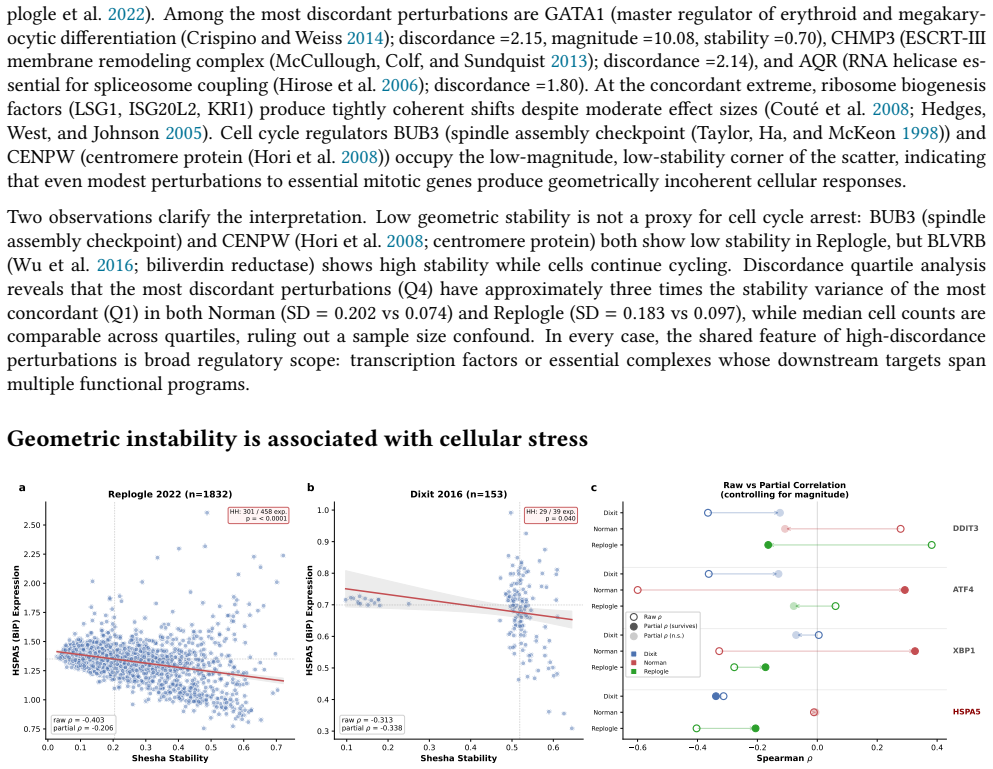
Perturbation stability, quantified as the mean cosine similarity between individual cell shift vectors and the mean perturbation direction, correlates strongly with effect magnitude across CRISPRa, CRISPRi, and pooled screens. When the two metrics diverge, pleiotropic master regulators such as CEBPA and GATA1 generate large yet directionally incoherent responses, whereas factors such as KLF1 produce tightly coordinated ones. After statistical control for magnitude, lower stability independently associates with elevated chaperone activation, and the high-stability high-stress quadrant is depleted; the relationship survives in scGPT embeddings.
What carries the argument
Shesha, the geometric stability metric defined as the mean cosine similarity of each cell's expression shift vector to the average shift vector for that perturbation; it quantifies directional coherence of the cellular response.
If this is right
- Pleiotropic regulators incur a geometric tax by driving large but scattered responses, while lineage-specific regulators produce aligned ones.
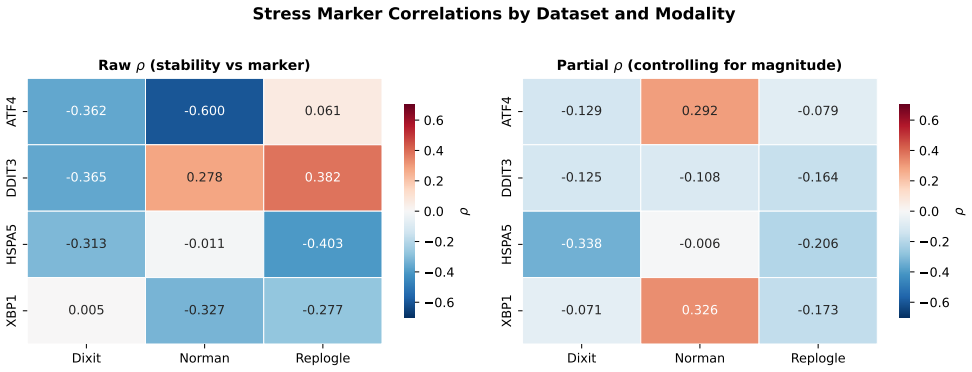
- Geometric instability remains linked to chaperone activation even after magnitude is accounted for.
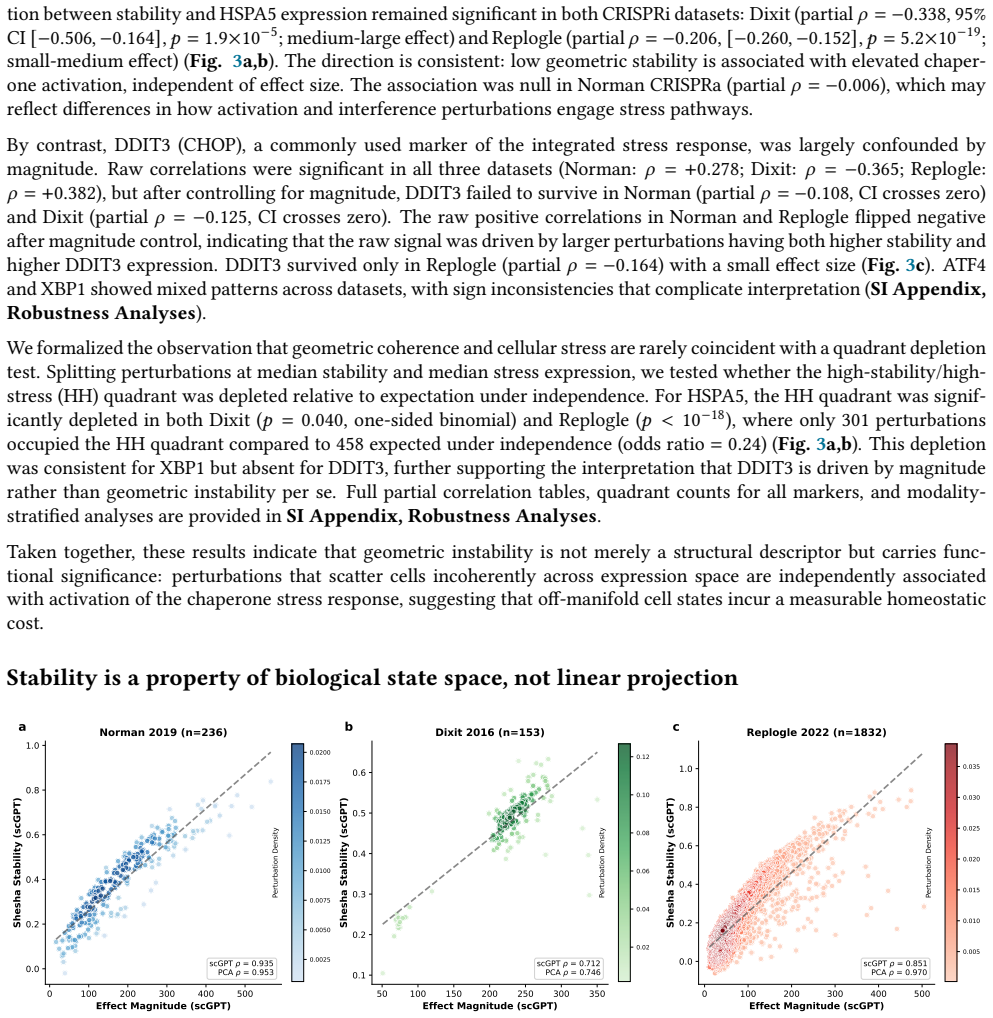
- The magnitude-stability relationship holds inside learned embeddings, showing the pattern belongs to biological state space.
- Stability supplies a second axis for hit prioritization in screens and for quality control in engineered cell populations.
Where Pith is reading between the lines
- The same coherence measure could be computed on non-CRISPR perturbations to test whether the magnitude-stability link is general.
- In silico perturbation models could be scored not only on predicted average shift but also on how coherently their simulated cells move.
- Absence of a high-stability high-stress region may indicate that coherent large shifts are buffered against stress responses.
Load-bearing premise
That the average shift vector across cells is a biologically meaningful reference direction and that cosine similarity on expression changes measures genuine coherence rather than technical noise or normalization artifacts.
What would settle it
A fresh single-cell CRISPR dataset in which the partial correlation between stability and stress-marker expression (after controlling for magnitude) is statistically indistinguishable from zero, or in which the rank correlation between magnitude and stability drops below 0.5.
Figures




read the original abstract
Genome engineering has achieved remarkable sequence-level precision, yet predicting the transcriptomic state that a cell will occupy after perturbation remains an open problem. Single-cell CRISPR screens measure how far cells move from their unperturbed state, but this effect magnitude ignores a fundamental question: do the cells move together? Two perturbations with identical magnitude can produce qualitatively different outcomes if one drives cells coherently along a shared trajectory while the other scatters them across expression space. We introduce a geometric stability metric, Shesha, that quantifies the directional coherence of single-cell perturbation responses as the mean cosine similarity between individual cell shift vectors and the mean perturbation direction. Across five CRISPR datasets (2,200+ perturbations spanning CRISPRa, CRISPRi, and pooled screens), stability correlates strongly with effect magnitude (Spearman $\rho=0.75-0.97$), with a calibrated cross-dataset correlation of 0.97. Crucially, discordant cases where the two metrics decouple expose regulatory architecture: pleiotropic master regulators such as CEBPA and GATA1 pay a "geometric tax," producing large but incoherent shifts, while lineage-specific factors such as KLF1 produce tightly coordinated responses. After controlling for magnitude, geometric instability is independently associated with elevated chaperone activation (HSPA5/BiP; $\rho_{partial}=-0.34$ and $-0.21$ across datasets), and the high-stability/high-stress quadrant is systematically depleted. The magnitude-stability relationship persists in scGPT foundation model embeddings, confirming it is a property of biological state space rather than linear projection. Perturbation stability provides a complementary axis for hit prioritization in screens, phenotypic quality control in cell manufacturing, and evaluation of in silico perturbation predictions.
Editorial analysis
A structured set of objections, weighed in public.
Referee Report
Summary. The manuscript introduces Shesha, a geometric stability metric defined as the mean cosine similarity between individual cell perturbation shift vectors and the mean perturbation direction. Across five CRISPR datasets, it reports strong Spearman correlations (ρ=0.75-0.97) between Shesha and effect magnitude, identifies discordant cases that reveal regulatory architecture (e.g., pleiotropic factors like CEBPA incur a geometric tax while lineage-specific factors like KLF1 produce coherent responses), and shows that geometric instability is independently associated with elevated stress (partial ρ with HSPA5 of -0.34 and -0.21) after controlling for magnitude. The magnitude-stability relationship persists in scGPT embeddings, supporting the claim that it reflects properties of biological state space rather than linear projection artifacts.
Significance. If the metric proves robust, it supplies a useful orthogonal axis to effect magnitude for interpreting single-cell CRISPR screens, enabling better distinction between coherent and scattered responses and linking instability to chaperone activation. The cross-dataset replication and persistence in foundation-model embeddings strengthen the case for biological relevance, with potential applications in hit prioritization, cell-manufacturing QC, and benchmarking in silico perturbation models.
major comments (1)
- [Methods] Methods section (Shesha definition and vector construction): The computation of per-cell shift vectors is not described with respect to library-size normalization, log-transform base, centering, or batch correction, nor is the exact procedure for obtaining the mean perturbation direction specified. Because Shesha is the average cosine similarity to this mean and the mean itself is estimated from modest numbers of cells per perturbation, the reported Spearman range (0.75-0.97) and partial correlations with HSPA5 could partly arise from shared sensitivity to the same preprocessing pipeline rather than intrinsic coherence. This detail is load-bearing for the central claim that the relationship is a property of biological state space.
Simulated Author's Rebuttal
We thank the referee for their constructive feedback, which highlights an important area for improving methodological transparency. We address the single major comment below and will revise the manuscript to incorporate the requested details.
read point-by-point responses
-
Referee: [Methods] Methods section (Shesha definition and vector construction): The computation of per-cell shift vectors is not described with respect to library-size normalization, log-transform base, centering, or batch correction, nor is the exact procedure for obtaining the mean perturbation direction specified. Because Shesha is the average cosine similarity to this mean and the mean itself is estimated from modest numbers of cells per perturbation, the reported Spearman range (0.75-0.97) and partial correlations with HSPA5 could partly arise from shared sensitivity to the same preprocessing pipeline rather than intrinsic coherence. This detail is load-bearing for the central claim that the relationship is a property of biological state space.
Authors: We agree that the Methods section must be expanded for full reproducibility. In the revised manuscript we will add an explicit subsection on shift-vector construction: library-size normalization to 10,000 counts per cell, log1p transformation (natural base), centering by subtraction of the per-gene mean across control cells within each dataset, and no additional batch correction beyond the preprocessing supplied by the original dataset authors. The mean perturbation direction is defined as the arithmetic average of the individual cell shift vectors for that perturbation. To address the concern that correlations could be preprocessing artifacts, we note that the magnitude-stability relationship is reproduced in scGPT embeddings, which are generated by a transformer model operating on tokenized counts and do not rely on the same linear normalization and centering steps. We will include pseudocode and a supplementary table enumerating the exact preprocessing choices for each of the five datasets. revision: yes
Circularity Check
No circularity: metric definition and empirical correlations are independent
full rationale
The paper introduces Shesha explicitly as a new geometric metric (mean cosine similarity of per-cell shift vectors to the empirical mean perturbation direction) and then computes all downstream results—Spearman correlations with effect magnitude (ρ=0.75-0.97), partial correlations with HSPA5, quadrant depletion, and persistence in scGPT embeddings—as direct statistical summaries of the observed data vectors. No equation reduces the reported associations to the definition by algebraic identity, no parameter is fitted on a subset and then relabeled as a prediction, and no self-citation chain or uniqueness theorem is invoked to justify the metric or its relationships. The derivation chain therefore consists of definition followed by independent empirical measurement, satisfying the self-contained criterion.
Axiom & Free-Parameter Ledger
axioms (1)
- domain assumption Expression changes can be represented as vectors whose cosine similarity to their mean is a valid measure of directional coherence.
invented entities (1)
-
Shesha metric
no independent evidence
Lean theorems connected to this paper
-
IndisputableMonolith/Cost/FunctionalEquation.leanwashburn_uniqueness_aczel unclearShesha stability S_p = (1/n_p) Σ (d_i · d-bar) / (‖d_i‖ ‖d-bar‖)
-
IndisputableMonolith/Foundation/AlexanderDuality.leanalexander_duality_circle_linking unclearmagnitude-stability relationship persists in scGPT embeddings
Reference graph
Works this paper leans on
-
[1]
Britt Adamson, Thomas M. Norman, Marco Jost, Min Y. Cho, James K. Nuñez, Yuwen Chen, Jacqueline E. Villalta, Luke A. Gilbert, Max A. Horlbeck, Marco Y. Hein, Ryan A. Pak, Andrew N. Gray, Carol A. Gross, Atray Dixit, Oren Parnas, Aviv Regev, and Jonathan S. Weissman. “A Multiplexed Single-Cell CRISPR Screening Platform Enables Systematic Dissection of the ...
-
[2]
Expression and regulation of C/EBP𝛼in normal myelopoiesis and in malignant transformation
Roberto Avellino and Ruud Delwel. “Expression and regulation of C/EBP𝛼in normal myelopoiesis and in malignant transformation”. In:Blood129.15 (2017), pp. 2083–2091.issn: 1528-0020.doi:10.1182/blood-2016-09-687822. 12
-
[3]
Christopher A. Bravery, Jessica Carmen, Timothy Fong, Wanda Oprea, Karin H. Hoogendoorn, Juliana Woda, Scott R. Burger, Jon A. Rowley, Mark L. Bonyhadi, and Wouter Van’t Hof. “Potency assay development for cellular therapy products: an ISCT review of the requirements and experiences in the industry”. In:Cytotherapy15.1 (Jan. 2013), 9– 19.e9.issn: 1465-324...
work page doi:10.1016/j.jcyt.2012.10.008.url:http://dx.doi.org/10.1016/j.jcyt.2012 2013
-
[4]
Easy quantitative assessment of genome editing by sequence trace decomposition
Eva K. Brinkman, Tao Chen, Mario Amendola, and Bas van Steensel. “Easy quantitative assessment of genome editing by sequence trace decomposition”. In:Nucleic Acids Research42.22 (Oct. 2014), e168–e168.issn: 0305-1048. doi:10.1093/nar/gku936.url:http://dx.doi.org/10.1093/nar/gku936
work page doi:10.1093/nar/gku936.url:http://dx.doi.org/10.1093/nar/gku936 2014
-
[5]
ISG20L2, a Novel Vertebrate Nucleolar Exoribonuclease Involved in Ribosome Biogenesis
Yohann Couté, Karine Kindbeiter, Stéphane Belin, Régis Dieckmann, Laurent Duret, Laurent Bezin, Jean-Charles Sanchez, and Jean-Jacques Diaz. “ISG20L2, a Novel Vertebrate Nucleolar Exoribonuclease Involved in Ribosome Biogenesis”. In:Molecular & Cellular Proteomics7.3 (Mar. 2008), pp. 546–559.issn: 1535-9476.doi:10.1074/mcp. m700510-mcp200.url:http://dx.do...
work page doi:10.1074/mcp 2008
-
[6]
Erythro-megakaryocytic transcription factors associated with hereditary anemia
John D. Crispino and Mitchell J. Weiss. “Erythro-megakaryocytic transcription factors associated with hereditary anemia”. In:Blood123.20 (May 2014), pp. 3080–3088.issn: 1528-0020.doi:10.1182/blood-2014-01-453167.url: http://dx.doi.org/10.1182/blood-2014-01-453167
-
[7]
scGPT: toward building a foundation model for single-cell multi-omics using generative AI
Haotian Cui, Chloe Wang, Hassaan Maan, Kuan Pang, Fengning Luo, Nan Duan, and Bo Wang. “scGPT: toward building a foundation model for single-cell multi-omics using generative AI”. In:Nature Methods21.8 (Feb. 2024), pp. 1470–1480.issn: 1548-7105.doi:10.1038/s41592-024-02201-0
-
[8]
Jose Davila-Velderrain, Juan C. Martinez-Garcia, and Elena R. Alvarez-Buylla. “Modeling the epigenetic attractors landscape: toward a post-genomic mechanistic understanding of development”. In:Frontiers in Genetics6 (Apr. 2015).issn: 1664-8021.doi:10.3389/fgene.2015.00160.url:http://dx.doi.org/10.3389/fgene.2015.00160
work page doi:10.3389/fgene.2015.00160.url:http://dx.doi.org/10.3389/fgene.2015.00160 2015
-
[9]
Pattern Recog- nition153, 110500 (2024).https://doi.org/https://doi.org/10.1016/j
Atray Dixit, Oren Parnas, Biyu Li, Jenny Chen, Charles P. Fulco, Livnat Jerby-Arnon, Nemanja D. Marjanovic, Danielle Dionne, Tyler Burks, Raktima Raychowdhury, Britt Adamson, Thomas M. Norman, Eric S. Lander, Jonathan S. Weissman, Nir Friedman, and Aviv Regev. “Perturb-Seq: dissecting molecular circuits with scalable single-cell RNA profiling of pooled ge...
work page doi:10.1016/j 2016
-
[10]
The new frontier of genome engineering with CRISPR-Cas9
Jennifer A. Doudna and Emmanuelle Charpentier. “The new frontier of genome engineering with CRISPR-Cas9”. In:Science346.6213 (Nov. 2014).issn: 1095-9203.doi:10.1126/science.1258096.url:http://dx.doi.org/10. 1126/science.1258096
work page doi:10.1126/science.1258096.url:http://dx.doi.org/10 2014
-
[11]
Stem Cell States, Fates, and the Rules of At- traction
Tariq Enver, Martin Pera, Carsten Peterson, and Peter W. Andrews. “Stem Cell States, Fates, and the Rules of At- traction”. In:Cell Stem Cell4.5 (May 2009), pp. 387–397.issn: 1934-5909.doi:10.1016/j.stem.2009.04.011.url: http://dx.doi.org/10.1016/j.stem.2009.04.011
-
[12]
Atefeh Taherian Fard, Sriganesh Srihari, Jessica C Mar, and Mark A Ragan. “Not just a colourful metaphor: modelling the landscape of cellular development using Hopfield networks”. In:npj Systems Biology and Applications2.1 (Feb. 2016).issn: 2056-7189.doi:10.1038/npjsba.2016.1.url:http://dx.doi.org/10.1038/npjsba.2016.1
work page doi:10.1038/npjsba.2016.1.url:http://dx.doi.org/10.1038/npjsba.2016.1 2016
-
[13]
Bistability, Bifurcations, and Waddington’s Epigenetic Landscape
James E. Ferrell. “Bistability, Bifurcations, and Waddington’s Epigenetic Landscape”. In:Current Biology22.11 (June 2012), R458–R466.issn: 0960-9822.doi:10.1016/j.cub.2012.03.045.url:http://dx.doi.org/10.1016/j. cub.2012.03.045
work page doi:10.1016/j.cub.2012.03.045.url:http://dx.doi.org/10.1016/j 2012
-
[14]
Joseph A. Fraietta, Simon F. Lacey, Elena J. Orlando, Iulian Pruteanu-Malinici, Mercy Gohil, Stefan Lundh, Alina C. Boesteanu, Yan Wang, Roddy S. O’Connor, Wei-Ting Hwang, Edward Pequignot, David E. Ambrose, Changfeng Zhang, Nicholas Wilcox, Felipe Bedoya, Corin Dorfmeier, Fang Chen, Lifeng Tian, Harit Parakandi, Minnal Gupta, Regina M. Young, F. Brad Joh...
work page doi:10.1038/s41591-018-0010-1.url:http://dx.doi.org/10.1038/s41591- 2018
-
[15]
C/ebp𝛼induces pu.1 and interacts with ap-1 and nf-𝜅b to regulate myeloid development
Alan D. Friedman. “C/ebp𝛼induces pu.1 and interacts with ap-1 and nf-𝜅b to regulate myeloid development”. In: Blood Cells, Molecules, and Diseases39.3 (2007), pp. 340–343.issn: 1079-9796.doi:10.1016/j.bcmd.2007.06.010
-
[16]
Jacques Galipeau, Mauro Krampera, John Barrett, Francesco Dazzi, Robert J. Deans, Joost DeBruijn, Massimo Do- minici, Willem E. Fibbe, Adrian P. Gee, Jeffery M. Gimble, Peiman Hematti, Mickey B.C. Koh, Katarina LeBlanc, Ivan Martin, Ian K. McNiece, Michael Mendicino, Steve Oh, Luis Ortiz, Donald G. Phinney, Valerie Planat, Yufang Shi, David F. Stroncek, S...
-
[17]
John Hedges, Matthew West, and Arlen W Johnson. “Release of the export adapter, Nmd3p, from the 60S ribosomal subunit requires Rpl10p and the cytoplasmic GTPase Lsg1p”. In:The EMBO Journal24.3 (Jan. 2005), pp. 567–579. issn: 1460-2075.doi:10.1038/sj.emboj.7600547.url:http://dx.doi.org/10.1038/sj.emboj.7600547
work page doi:10.1038/sj.emboj.7600547.url:http://dx.doi.org/10.1038/sj.emboj.7600547 2005
-
[18]
The unfolded protein response: controlling cell fate decisions under ER stress and beyond
Claudio Hetz. “The unfolded protein response: controlling cell fate decisions under ER stress and beyond”. In: Nature Reviews Molecular Cell Biology13.2 (Jan. 2012), pp. 89–102.issn: 1471-0080.doi:10.1038/nrm3270.url: http://dx.doi.org/10.1038/nrm3270
-
[19]
Pertpy: an end-to-end framework for perturbation analysis
Lukas Heumos, Yuge Ji, Lilly May, Tessa D. Green, Stefan Peidli, Xinyue Zhang, Xichen Wu, Johannes Ostner, Antonia Schumacher, Karin Hrovatin, Michaela Müller, Faye Chong, Gregor Sturm, Alejandro Tejada, Emma Dann, Mingze Dong, Gonçalo Pinto, Mojtaba Bahrami, Ilan Gold, Sergei Rybakov, Altana Namsaraeva, Amir Ali Moinfar, Zihe Zheng, Eljas Roellin, Isra M...
work page doi:10.1038/s41592-025-02909-7.url:http://dx.doi.org/10.1038/s41592-025-02909-7 2025
-
[20]
Tetsuro Hirose, Takashi Ideue, Misato Nagai, Masatoshi Hagiwara, Mei-Di Shu, and Joan A. Steitz. “A Spliceosomal Intron Binding Protein, IBP160, Links Position-Dependent Assembly of Intron-Encoded Box C/D snoRNP to Pre- mRNA Splicing”. In:Molecular Cell23.5 (Sept. 2006), pp. 673–684.issn: 1097-2765.doi:10.1016/j.molcel.2006. 07.011.url:http://dx.doi.org/1...
-
[21]
Tetsuya Hori, Miho Amano, Aussie Suzuki, Chelsea B. Backer, Julie P. Welburn, Yimin Dong, Bruce F. McEwen, Wei-Hao Shang, Emiko Suzuki, Katsuya Okawa, Iain M. Cheeseman, and Tatsuo Fukagawa. “CCAN Makes Multiple Contacts with Centromeric DNA to Provide Distinct Pathways to the Outer Kinetochore”. In:Cell135.6 (Dec. 2008), pp. 1039–1052.issn: 0092-8674.doi...
work page doi:10.1016/j.cell.2008.10.019.url:http://dx.doi.org/10.1016/j 2008
-
[22]
Reprogramming cell fates: reconciling rarity with robustness
Sui Huang. “Reprogramming cell fates: reconciling rarity with robustness”. In:BioEssays31.5 (Apr. 2009), pp. 546– 560.issn: 1521-1878.doi:10.1002/bies.200800189.url:http://dx.doi.org/10.1002/bies.200800189
work page doi:10.1002/bies.200800189.url:http://dx.doi.org/10.1002/bies.200800189 2009
-
[23]
CRISPR-Cas9 Structures and Mechanisms
Fuguo Jiang and Jennifer A. Doudna. “CRISPR-Cas9 Structures and Mechanisms”. In:Annual Review of Biophysics 46.1 (May 2017), pp. 505–529.issn: 1936-1238.doi:10 . 1146 / annurev - biophys - 062215 - 010822.url:http : //dx.doi.org/10.1146/annurev-biophys-062215-010822
-
[24]
A Programmable Dual-RNA–Guided DNA Endonuclease in Adaptive Bacterial Immunity
Martin Jinek, Krzysztof Chylinski, Ines Fonfara, Michael Hauer, Jennifer A. Doudna, and Emmanuelle Charpentier. “A Programmable Dual-RNA–Guided DNA Endonuclease in Adaptive Bacterial Immunity”. In:Science337.6096 (Aug. 2012), pp. 816–821.issn: 1095-9203.doi:10.1126/science.1225829.url:http://dx.doi.org/10.1126/ science.1225829
work page doi:10.1126/science.1225829.url:http://dx.doi.org/10.1126/ 2012
-
[25]
Dissecting cell identity via network inference and in silico gene perturbation
Kenji Kamimoto, Blerta Stringa, Christy M. Hoffmann, Kunal Jindal, Lilianna Solnica-Krezel, and Samantha A. Mor- ris. “Dissecting cell identity via network inference and in silico gene perturbation”. In:Nature614.7949 (Feb. 2023), pp. 742–751.issn: 1476-4687.doi:10.1038/s41586-022-05688-9.url:http://dx.doi.org/10.1038/s41586- 022-05688-9
work page doi:10.1038/s41586-022-05688-9.url:http://dx.doi.org/10.1038/s41586- 2023
-
[26]
Hiroaki Kitano. “Biological robustness”. In:Nature Reviews Genetics5.11 (2004), pp. 826–837.issn: 1471-0064.doi: 10.1038/nrg1471
-
[27]
Michael Kosicki, Kärt Tomberg, and Allan Bradley. “Repair of double-strand breaks induced by CRISPR-Cas9 leads to large deletions and complex rearrangements”. In:Nature Biotechnology36.8 (July 2018), pp. 765–771.issn: 1546- 1696.doi:10.1038/nbt.4192.url:http://dx.doi.org/10.1038/nbt.4192
work page doi:10.1038/nbt.4192.url:http://dx.doi.org/10.1038/nbt.4192 2018
-
[28]
The ER chaperone and signaling regulator GRP78/BiP as a monitor of endoplasmic reticulum stress
Amy S. Lee. “The ER chaperone and signaling regulator GRP78/BiP as a monitor of endoplasmic reticulum stress”. In:Methods35.4 (Apr. 2005), pp. 373–381.issn: 1046-2023.doi:10 . 1016 / j . ymeth . 2004 . 10 . 010.url:http : //dx.doi.org/10.1016/j.ymeth.2004.10.010
-
[29]
Chromothripsis as an on-target consequence of CRISPR–Cas9 genome editing
Mitchell L. Leibowitz, Stamatis Papathanasiou, Phillip A. Doerfler, Logan J. Blaine, Lili Sun, Yu Yao, Cheng-Zhong Zhang, Mitchell J. Weiss, and David Pellman. “Chromothripsis as an on-target consequence of CRISPR–Cas9 genome editing”. In:Nature Genetics53.6 (Apr. 2021), pp. 895–905.issn: 1546-1718.doi:10.1038/s41588-021-00838-7. url:http://dx.doi.org/10....
-
[30]
Qin Li, Anders Wennborg, Erik Aurell, Erez Dekel, Jie-Zhi Zou, Yuting Xu, Sui Huang, and Ingemar Ernberg. “Dy- namics inside the cancer cell attractor reveal cell heterogeneity, limits of stability, and escape”. In:Proceedings of the National Academy of Sciences113.10 (Feb. 2016), pp. 2672–2677.issn: 1091-6490.doi:10.1073/pnas.1519210113. url:http://dx.do...
-
[31]
Quality cell therapy manufacturing by design
Yonatan Y Lipsitz, Nicholas E Timmins, and Peter W Zandstra. “Quality cell therapy manufacturing by design”. In:Nature Biotechnology34.4 (Apr. 2016), pp. 393–400.issn: 1546-1696.doi:10 . 1038 / nbt . 3525.url:http : //dx.doi.org/10.1038/nbt.3525
-
[32]
Predicting cellular responses to complex perturbations in high-throughput screens
Mohammad Lotfollahi, Anna Klimovskaia Susmelj, Carlo De Donno, Leon Hetzel, Yuge Ji, Ignacio L Ibarra, Sanjay R Srivatsan, Mohsen Naghipourfar, Riza M Daza, Beth Martin, Jay Shendure, Jose L McFaline-Figueroa, Pierre Boyeau, F Alexander Wolf, Nafissa Yakubova, Stephan Günnemann, Cole Trapnell, David Lopez-Paz, and Fabian J Theis. “Predicting cellular resp...
work page doi:10.15252/msb.202211517.url:http://dx.doi.org/10.15252/msb 2023
-
[33]
John McCullough, Leremy A. Colf, and Wesley I. Sundquist. “Membrane Fission Reactions of the Mammalian ESCRT Pathway”. In:Annual Review of Biochemistry82.1 (June 2013), pp. 663–692.issn: 1545-4509.doi:10.1146/annurev- biochem-072909-101058.url:http://dx.doi.org/10.1146/annurev-biochem-072909-101058
-
[34]
Leland McInnes, John Healy, Nathaniel Saul, and Lukas Großberger. “UMAP: Uniform Manifold Approximation and Projection”. In:Journal of Open Source Software3.29 (Sept. 2018), p. 861.issn: 2475-9066.doi:10.21105/joss. 00861.url:http://dx.doi.org/10.21105/joss.00861
-
[35]
I J Miller and J J Bieker. “A novel, erythroid cell-specific murine transcription factor that binds to the CACCC element and is related to the Krüppel family of nuclear proteins.” In:Molecular and Cellular Biology13.5 (1993), pp. 2776–2786.issn: 1098-5549.doi:10.1128/mcb.13.5.2776
-
[36]
Visualizing structure and transitions in high-dimensional biological data
Kevin R. Moon, David van Dijk, Zheng Wang, Scott Gigante, Daniel B. Burkhardt, William S. Chen, Kristina Yim, An- tonia van den Elzen, Matthew J. Hirn, Ronald R. Coifman, Natalia B. Ivanova, Guy Wolf, and Smita Krishnaswamy. “Visualizing structure and transitions in high-dimensional biological data”. In:Nature Biotechnology37.12 (Dec. 2019), pp. 1482–1492...
work page doi:10.1038/s41587-019-0336-3.url:http://dx.doi.org/10.1038/ 2019
-
[37]
Dissecting Engineered Cell Types and Enhancing Cell Fate Conversion via CellNet
Samantha A. Morris, Patrick Cahan, Hu Li, Anna M. Zhao, Adrianna K. San Roman, Ramesh A. Shivdasani, James J. Collins, and George Q. Daley. “Dissecting Engineered Cell Types and Enhancing Cell Fate Conversion via CellNet”. In:Cell158.4 (Aug. 2014), pp. 889–902.issn: 0092-8674.doi:10.1016/j.cell.2014.07.021.url:http://dx. doi.org/10.1016/j.cell.2014.07.021
-
[38]
Transcriptome-wide analysis of differential expression in perturbation atlases
Ajay Nadig, Joseph M. Replogle, Angela N. Pogson, Mukundh Murthy, Steven A. McCarroll, Jonathan S. Weissman, Elise B. Robinson, and Luke J. O’Connor. “Transcriptome-wide analysis of differential expression in perturbation atlases”. In:Nature Genetics57.5 (Apr. 2025), pp. 1228–1237.issn: 1546-1718.doi:10.1038/s41588-025-02169-3. url:http://dx.doi.org/10.10...
-
[39]
Gopika G. Nair, Jennifer S. Liu, Holger A. Russ, Stella Tran, Michael S. Saxton, Richard Chen, Charity Juang, Mei- lan Li, Vinh Q. Nguyen, Simone Giacometti, Sapna Puri, Yuan Xing, Yong Wang, Gregory L. Szot, Jose Oberholzer, Anil Bhushan, and Matthias Hebrok. “Recapitulating endocrine cell clustering in culture promotes maturation of human stem-cell-deri...
-
[40]
Exploring genetic interaction manifolds constructed from rich single-cell phenotypes
Thomas M Norman, Max A Horlbeck, Joseph M Replogle, Y Alexander Ge, Alex Xu, Marco Jost, Luke A Gilbert, and Jonathan S Weissman. “Exploring genetic interaction manifolds constructed from rich single-cell phenotypes”. In:Science365.6455 (2019), pp. 786–793.issn: 1095-9203.doi:10.1126/science.aax4438
-
[41]
Roles of CHOP/GADD153 in endoplasmic reticulum stress
S Oyadomari and M Mori. “Roles of CHOP/GADD153 in endoplasmic reticulum stress”. In:Cell Death & Differenti- ation11.4 (Dec. 2003), pp. 381–389.issn: 1476-5403.doi:10.1038/sj.cdd.4401373.url:http://dx.doi.org/ 10.1038/sj.cdd.4401373
work page doi:10.1038/sj.cdd.4401373.url:http://dx.doi.org/ 2003
-
[42]
Efthymia Papalexi, Eleni P. Mimitou, Andrew W. Butler, Samantha Foster, Bernadette Bracken, William M. Mauck, Hans-Hermann Wessels, Yuhan Hao, Bertrand Z. Yeung, Peter Smibert, and Rahul Satija. “Characterizing the molec- ular regulation of inhibitory immune checkpoints with multimodal single-cell screens”. In:Nature Genetics53.3 (2021), pp. 322–331.issn:...
-
[43]
scPerturb: harmonized single-cell perturbation data
Stefan Peidli, Tessa D. Green, Ciyue Shen, Torsten Gross, Joseph Min, Samuele Garda, Bo Yuan, Linus J. Schumacher, Jake P. Taylor-King, Debora S. Marks, Augustin Luna, Nils Blüthgen, and Chris Sander. “scPerturb: harmonized single-cell perturbation data”. In:Nature Methods21.3 (Jan. 2024), pp. 531–540.issn: 1548-7105.doi:10 . 1038 / s41592-023-02144-y.url...
-
[44]
Chromatin states define tumour-specific T cell dysfunction and reprogramming
Mary Philip, Lauren Fairchild, Liping Sun, Ellen L. Horste, Steven Camara, Mojdeh Shakiba, Andrew C. Scott, Agnes Viale, Peter Lauer, Taha Merghoub, Matthew D. Hellmann, Jedd D. Wolchok, Christina S. Leslie, and Andrea Schietinger. “Chromatin states define tumour-specific T cell dysfunction and reprogramming”. In:Nature545.7655 15 (May 2017), pp. 452–456....
work page 2017
-
[45]
Andre M. Pilon, Murat O. Arcasoy, Holly K. Dressman, Serena E. Vayda, Yelena D. Maksimova, Jose I. Sangerman, Patrick G. Gallagher, and David M. Bodine. “Failure of Terminal Erythroid Differentiation in EKLF-Deficient Mice Is Associated with Cell Cycle Perturbation and Reduced Expression of E2F2”. In:Molecular and Cellular Biology28.24 (2008), pp. 7394–74...
-
[46]
Geometric Stability: The Missing Axis of Representations
Prashant C. Raju. “Geometric Stability: The Missing Axis of Representations”. In:arXiv preprint arXiv:2601.09173 (2026)
work page internal anchor Pith review Pith/arXiv arXiv 2026
-
[47]
Raju.Shesha: Self-Consistency Metrics for Representational Stability
Prashant C. Raju.Shesha: Self-Consistency Metrics for Representational Stability. 2026.doi:10 . 5281 / zenodo . 18227453.url:https://doi.org/10.5281/zenodo.18227453
-
[48]
Geometry of gene regulatory dynamics
David A. Rand, Archishman Raju, Meritxell Sáez, Francis Corson, and Eric D. Siggia. “Geometry of gene regulatory dynamics”. In:Proceedings of the National Academy of Sciences118.38 (Sept. 2021).issn: 1091-6490.doi:10.1073/ pnas.2109729118.url:http://dx.doi.org/10.1073/pnas.2109729118
-
[49]
Mapping information-rich genotype-phenotype landscapes with genome-scale Perturb-seq
Joseph M. Replogle, Reuben A. Saunders, Angela N. Pogson, Jeffrey A. Hussmann, Alexander Lenail, Alina Guna, Lauren Mascibroda, Eric J. Wagner, Karen Adelman, Gila Lithwick-Yanai, Nika Iremadze, Florian Oberstrass, Doron Lipson, Jessica L. Bonnar, Marco Jost, Thomas M. Norman, and Jonathan S. Weissman. “Mapping information-rich genotype-phenotype landscap...
-
[50]
Signal integration in the endoplasmic reticulum unfolded protein response
David Ron and Peter Walter. “Signal integration in the endoplasmic reticulum unfolded protein response”. In:Nature Reviews Molecular Cell Biology8.7 (July 2007), pp. 519–529.issn: 1471-0080.doi:10.1038/nrm2199.url:http: //dx.doi.org/10.1038/nrm2199
-
[51]
Predicting transcriptional outcomes of novel multigene perturba- tions with GEARS
Yusuf Roohani, Kexin Huang, and Jure Leskovec. “Predicting transcriptional outcomes of novel multigene perturba- tions with GEARS”. In:Nature Biotechnology42.6 (Aug. 2023), pp. 927–935.issn: 1546-1696.doi:10.1038/s41587- 023-01905-6.url:http://dx.doi.org/10.1038/s41587-023-01905-6
-
[52]
Universal Cell Embeddings: A Foundation Model for Cell Biology
Yanay Rosen, Yusuf Roohani, Ayush Agrawal, Leon Samotorcan, Tabula Sapiens Consortium, Stephen R. Quake, and Jure Leskovec. “Universal Cell Embeddings: A Foundation Model for Cell Biology”. In:bioRxiv(2023).doi: 10.1101/2023.11.28.568918
-
[53]
Potency testing of cell and gene therapy products
Paula Salmikangas, Björn Carlsson, Christophe Klumb, Tatiana Reimer, and Steffen Thirstrup. “Potency testing of cell and gene therapy products”. In:Frontiers in Medicine10 (May 2023).issn: 2296-858X.doi:10 . 3389 / fmed . 2023.1190016.url:http://dx.doi.org/10.3389/fmed.2023.1190016
-
[54]
The multifunctional role of EKLF/KLF1 during erythropoiesis
Miroslawa Siatecka and James J. Bieker. “The multifunctional role of EKLF/KLF1 during erythropoiesis”. In:Blood 118.8 (2011), pp. 2044–2054.issn: 1528-0020.doi:10.1182/blood-2011-03-331371
-
[55]
Waddington’s canalization revisited: Developmental stability and evolution
Mark L. Siegal and Aviv Bergman. “Waddington’s canalization revisited: Developmental stability and evolution”. In:Proceedings of the National Academy of Sciences99.16 (June 2002), pp. 10528–10532.issn: 1091-6490.doi:10. 1073/pnas.102303999.url:http://dx.doi.org/10.1073/pnas.102303999
-
[56]
Mechanism of action, potency and efficacy: considerations for cell therapies
Carl G. Simon, Erich H. Bozenhardt, Christina M. Celluzzi, David Dobnik, Melanie L. Grant, Uma Lakshmipathy, Thiana Nebel, Linda Peltier, Anthony Ratcliffe, James L. Sherley, Glyn N. Stacey, Rouzbeh R. Taghizadeh, Eddie H. P. Tan, and Sandrine Vessillier. “Mechanism of action, potency and efficacy: considerations for cell therapies”. In:Journal of Transla...
-
[57]
Conrad Hal Waddington: the last Renaissance biologist?
Jonathan M. W. Slack. “Conrad Hal Waddington: the last Renaissance biologist?” In:Nature Reviews Genetics3.11 (Nov. 2002), pp. 889–895.issn: 1471-0064.doi:10.1038/nrg933.url:http://dx.doi.org/10.1038/nrg933
work page doi:10.1038/nrg933.url:http://dx.doi.org/10.1038/nrg933 2002
-
[58]
Decoding heterogeneous single-cell perturbation responses
Bicna Song, Dingyu Liu, Weiwei Dai, Natalie F. McMyn, Qingyang Wang, Dapeng Yang, Adam Krejci, Anatoly Vasilyev, Nicole Untermoser, Anke Loregger, Dongyuan Song, Breanna Williams, Bess Rosen, Xiaolong Cheng, Lumen Chao, Hanuman T. Kale, Hao Zhang, Yarui Diao, Tilmann Bürckstümmer, Janet D. Siliciano, Jingyi Jessica Li, Robert F. Siliciano, Danwei Huangfu,...
-
[59]
Pancreatic𝛽Cell Dedifferentiation as a Mechanism of Diabetic𝛽Cell Failure
Chutima Talchai, Shouhong Xuan, Hua V. Lin, Lori Sussel, and Domenico Accili. “Pancreatic𝛽Cell Dedifferentiation as a Mechanism of Diabetic𝛽Cell Failure”. In:Cell150.6 (Sept. 2012), pp. 1223–1234.issn: 0092-8674.doi:10.1016/ j.cell.2012.07.029.url:http://dx.doi.org/10.1016/j.cell.2012.07.029
-
[60]
KLF1 directly coordinates almost all aspects of terminal erythroid differentiation
Michael R. Tallack and Andrew C. Perkins. “KLF1 directly coordinates almost all aspects of terminal erythroid differentiation”. In:IUBMB Life62.12 (2010), pp. 886–890.issn: 1521-6551.doi:10.1002/iub.404. 16
-
[61]
A global role for KLF1 in erythropoiesis revealed by ChIP-seq in primary erythroid cells
Michael R. Tallack, Tom Whitington, Wai Shan Yuen, Elanor N. Wainwright, Janelle R. Keys, Brooke B. Gardiner, Ehsan Nourbakhsh, Nicole Cloonan, Sean M. Grimmond, Timothy L. Bailey, and Andrew C. Perkins. “A global role for KLF1 in erythropoiesis revealed by ChIP-seq in primary erythroid cells”. In:Genome Research20.8 (2010), pp. 1052–1063.issn: 1088-9051....
-
[62]
Stephen S. Taylor, Edward Ha, and Frank McKeon. “The Human Homologue of Bub3 Is Required for Kinetochore Localization of Bub1 and a Mad3/Bub1-related Protein Kinase”. In:The Journal of Cell Biology142.1 (July 1998), pp. 1–11.issn: 1540-8140.doi:10.1083/jcb.142.1.1.url:http://dx.doi.org/10.1083/jcb.142.1.1
work page doi:10.1083/jcb.142.1.1.url:http://dx.doi.org/10.1083/jcb.142.1.1 1998
-
[63]
Transfer learning enables predictions in network biology
Christina V. Theodoris, Ling Xiao, Anant Chopra, Mark D. Chaffin, Zeina R. Al Sayed, Matthew C. Hill, Helene Mantineo, Elizabeth M. Brydon, Zexian Zeng, X. Shirley Liu, and Patrick T. Ellinor. “Transfer learning enables predictions in network biology”. In:Nature618.7965 (May 2023), pp. 616–624.issn: 1476-4687.doi:10 . 1038 / s41586-023-06139-9
work page 2023
-
[64]
GUIDE-seq enables genome-wide profiling of off-target cleavage by CRISPR-Cas9 nucleases
Shengdar Q Tsai, Zongli Zheng, Nhu T Nguyen, Matthew Liebers, Ved V Topkar, Vishal Thapar, Nicolas Wyvekens, Cyd Khayter, A John Iafrate, Long P Le, Martin J Aryee, and J Keith Joung. “GUIDE-seq enables genome-wide profiling of off-target cleavage by CRISPR-Cas9 nucleases”. In:Nature Biotechnology33.2 (Dec. 2014), pp. 187–197. issn: 1546-1696.doi:10.1038/...
work page doi:10.1038/nbt.3117.url:http://dx.doi.org/10.1038/nbt.3117 2014
-
[65]
Benchmarking principal component analysis for large-scale single-cell RNA-sequencing
Koki Tsuyuzaki, Hiroyuki Sato, Kenta Sato, and Itoshi Nikaido. “Benchmarking principal component analysis for large-scale single-cell RNA-sequencing”. In:Genome Biology21.1 (Jan. 2020).issn: 1474-760X.doi:10 . 1186 / s13059-019-1900-3.url:http://dx.doi.org/10.1186/s13059-019-1900-3
-
[66]
The scverse project provides a computational ecosystem for single-cell omics data analysis
Isaac Virshup, Danila Bredikhin, Lukas Heumos, Giovanni Palla, Gregor Sturm, Adam Gayoso, Ilia Kats, Mikaela Koutrouli, Philipp Angerer, Volker Bergen, Pierre Boyeau, Maren Büttner, Gokcen Eraslan, David Fischer, Max Frank, Justin Hong, Michal Klein, Marius Lange, Romain Lopez, Mohammad Lotfollahi, Malte D. Luecken, Fidel Ramirez, Jeffrey Regier, Sergei R...
-
[67]
Journal of Open Source Software9(101), 4371 (2024) https://doi.org/10.21105/joss.04371
Isaac Virshup, Sergei Rybakov, Fabian J. Theis, Philipp Angerer, and F. Alexander Wolf. “anndata: Access and store annotated data matrices”. In:Journal of Open Source Software9.101 (Sept. 2024), p. 4371.issn: 2475-9066.doi:10. 21105/joss.04371.url:http://dx.doi.org/10.21105/joss.04371
-
[68]
A guide to manufacturing CAR T cell therapies
Philipp Vormittag, Rebecca Gunn, Sara Ghorashian, and Farlan S Veraitch. “A guide to manufacturing CAR T cell therapies”. In:Current Opinion in Biotechnology53 (Oct. 2018), pp. 164–181.issn: 0958-1669.doi:10 . 1016 / j . copbio.2018.01.025.url:http://dx.doi.org/10.1016/j.copbio.2018.01.025
-
[69]
London: George Allen & Unwin, 1957
Conrad Hal Waddington.The Strategy of the Genes: A Discussion of Some Aspects of Theoretical Biology. London: George Allen & Unwin, 1957
work page 1957
-
[70]
The Unfolded Protein Response: From Stress Pathway to Homeostatic Regulation
Peter Walter and David Ron. “The Unfolded Protein Response: From Stress Pathway to Homeostatic Regulation”. In:Science334.6059 (Nov. 2011), pp. 1081–1086.issn: 1095-9203.doi:10 . 1126 / science . 1209038.url:http : //dx.doi.org/10.1126/science.1209038
-
[71]
Quantifying the Waddington landscape and biological paths for development and differentiation
Jin Wang, Kun Zhang, Li Xu, and Erkang Wang. “Quantifying the Waddington landscape and biological paths for development and differentiation”. In:Proceedings of the National Academy of Sciences108.20 (May 2011), pp. 8257– 8262.issn: 1091-6490.doi:10.1073/pnas.1017017108.url:http://dx.doi.org/10.1073/pnas.1017017108
work page doi:10.1073/pnas.1017017108.url:http://dx.doi.org/10.1073/pnas.1017017108 2011
-
[72]
Transient rest restores functionality in exhausted CAR-T cells through epigenetic remodeling
Evan W. Weber, Kevin R. Parker, Elena Sotillo, Rachel C. Lynn, Hima Anbunathan, John Lattin, Zinaida Good, Julia A. Belk, Bence Daniel, Dorota Klysz, Meena Malipatlolla, Peng Xu, Malek Bashti, Sabine Heitzeneder, Louai Labanieh, Panayiotis Vandris, Robbie G. Majzner, Yanyan Qi, Katalin Sandor, Ling-Chun Chen, Snehit Prabhu, Andrew J. Gentles, Thomas J. Wa...
work page doi:10.1126/science.aba1786.url:http://dx.doi.org/10.1126/science.aba1786 2021
-
[73]
Lineage tracing on tran- scriptional landscapes links state to fate during differentiation
Caleb Weinreb, Alejo Rodriguez-Fraticelli, Fernando D. Camargo, and Allon M. Klein. “Lineage tracing on tran- scriptional landscapes links state to fate during differentiation”. In:Science367.6479 (Feb. 2020).issn: 1095-9203. doi:10.1126/science.aaw3381.url:http://dx.doi.org/10.1126/science.aaw3381
work page doi:10.1126/science.aaw3381.url:http://dx.doi.org/10.1126/science.aaw3381 2020
-
[74]
Alexander Wolf, Philipp Angerer, and Fabian J
F. Alexander Wolf, Philipp Angerer, and Fabian J. Theis. “SCANPY: large-scale single-cell gene expression data analysis”. In:Genome Biology19.1 (2018).issn: 1474-760X.doi:10.1186/s13059-017-1382-0
-
[75]
Song Wu, Zongdong Li, Dmitri V. Gnatenko, Beibei Zhang, Lu Zhao, Lisa E. Malone, Nedialka Markova, Timothy J. Mantle, Natasha M. Nesbitt, and Wadie F. Bahou. “BLVRB redox mutation defines heme degradation in a metabolic 17 pathway of enhanced thrombopoiesis in humans”. In:Blood128.5 (Aug. 2016), pp. 699–709.issn: 1528-0020.doi: 10.1182/blood-2016-02-69699...
work page doi:10.1182/blood-2016-02-696997.url:http://dx.doi.org/10.1182/blood-2016-02-696997 2016
-
[76]
Predicting Pancreas Cell Fate Decisions and Reprogramming with a Hierarchical Multi-Attractor Model
Joseph Xu Zhou, Lutz Brusch, and Sui Huang. “Predicting Pancreas Cell Fate Decisions and Reprogramming with a Hierarchical Multi-Attractor Model”. In:PLoS ONE6.3 (Mar. 2011). Ed. by Kumar Selvarajoo, e14752.issn: 1932-6203. doi:10.1371/journal.pone.0014752.url:http://dx.doi.org/10.1371/journal.pone.0014752
work page doi:10.1371/journal.pone.0014752.url:http://dx.doi.org/10.1371/journal.pone.0014752 2011
-
[77]
Hyperbolic geometry of gene expression
Yuansheng Zhou and Tatyana O. Sharpee. “Hyperbolic geometry of gene expression”. In:iScience24.3 (Mar. 2021), p. 102225.issn: 2589-0042.doi:10.1016/j.isci.2021.102225.url:http://dx.doi.org/10.1016/j.isci. 2021.102225. 18 Extended Methods Datasets and preprocessing Five single-cell CRISPR perturbation datasets were accessed via the pertpy Python package (v...
work page doi:10.1016/j.isci.2021.102225.url:http://dx.doi.org/10.1016/j.isci 2021
-
[78]
Quality filtering: cells with fewer than 100 detected genes were removed
-
[79]
Library-size normalization (Wolf, Angerer, and Theis 2018):scanpy.pp.normalize_total()with default param- eters (Norman, Dixit, Papalexi) ortarget_sum=1e4(Replogle, Adamson)
work page 2018
-
[80]
Log transformation:scanpy.pp.log1p()
discussion (0)
Sign in with ORCID, Apple, or X to comment. Anyone can read and Pith papers without signing in.