Recognition: unknown
GOALS-JWST: Resolved multi-phase molecular gas in IRAS 20551-4250 using JWST and ALMA
Pith reviewed 2026-05-10 04:09 UTC · model grok-4.3
The pith
Molecular gas in IRAS 20551-4250 is dominated by cold CO with no outflows detected, leaving star formation unquenched by the observed ionised gas feedback.
A machine-rendered reading of the paper's core claim, the machinery that carries it, and where it could break.
Core claim
The molecular gas composition in IRAS20551-4250 is consistent with ongoing star formation in the host galaxy, with warm H2 rotational lines revealing tidal tails and UV-dominated heating, the CO-based cold component accounting for the vast majority of the mass, and velocity fields showing non-rotational motions matching the merger, while ionised outflows remain too weak to expel the molecular gas.
What carries the argument
Spatially resolved JWST/MIRI-MRS maps of warm H2 rotational transitions combined with ALMA CO imaging to trace excitation, mass distribution, and kinematics across multiple gas phases.
Load-bearing premise
The mid-infrared line ratios and excitation diagrams correctly attribute the warm gas heating to UV radiation from stars rather than shocks or AGN, and standard CO-to-H2 conversion factors apply uniformly across the observed region.
What would settle it
Detection of molecular outflows in CO or H2 with mass outflow rates comparable to or exceeding the star formation rate would show that feedback is expelling gas after all.
Figures





read the original abstract
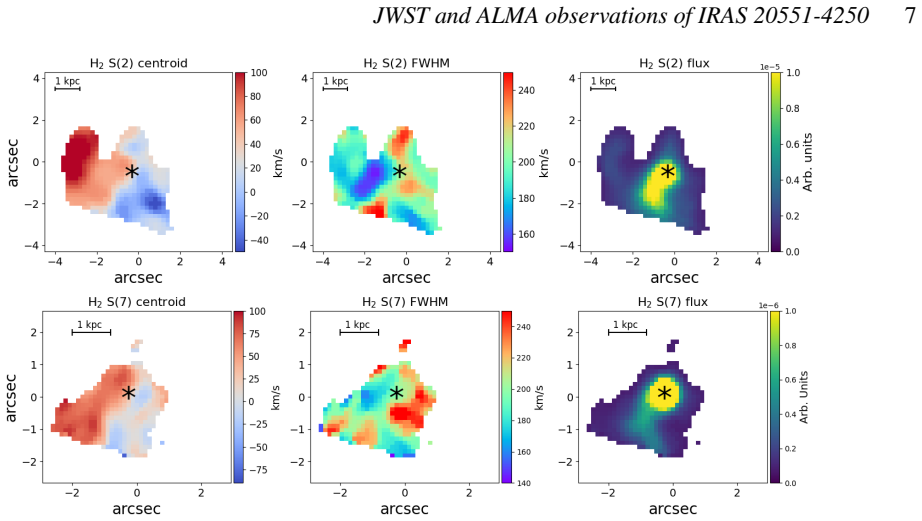
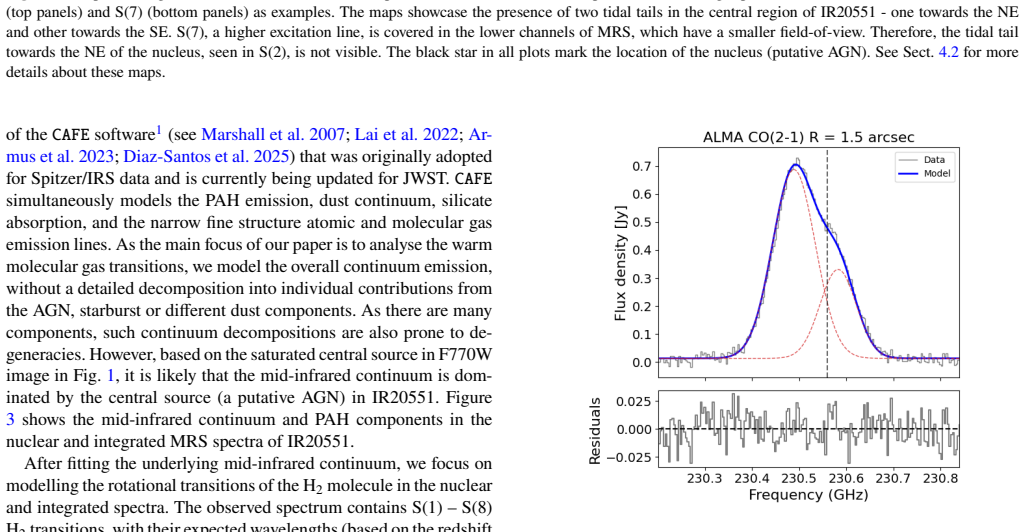
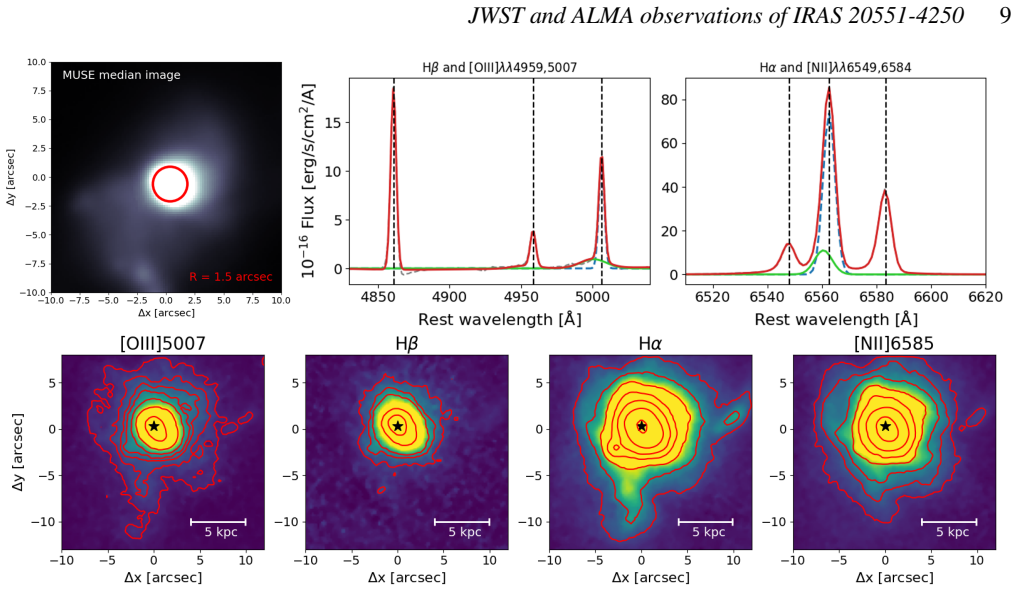
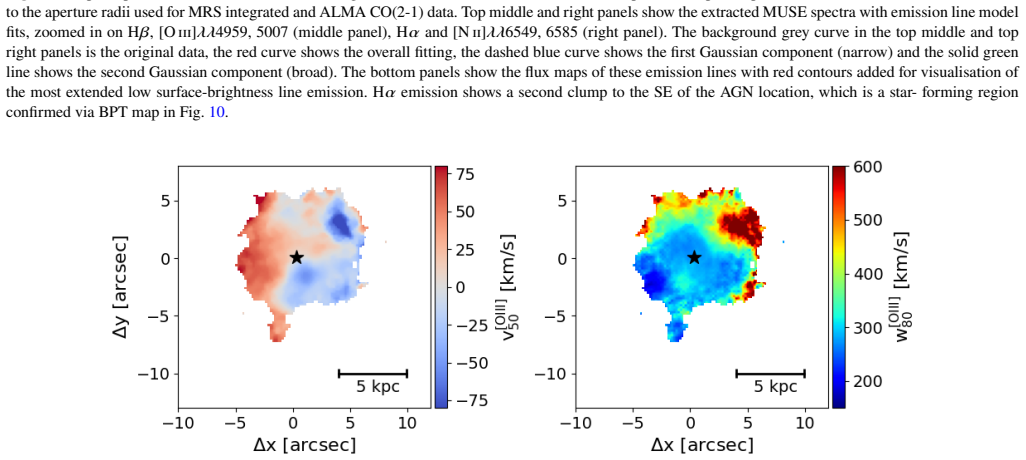
Studying the content and distribution of molecular gas provides key insights into how feedback from Active Galactic Nuclei (AGN) and star formation influences galaxy evolution, since molecular gas is the primary fuel for star formation. Ultra-Luminous Infrared Galaxies (ULIRGs) are ideal candidates to study how AGN and/or starbursts affect the interstellar medium due to their intense AGN and star forming activity. We present spatially-resolved multi-phase molecular gas study of IRAS20551-4250, a nearby ($z=0.0429$) ULIRG, using JWST/MIRI-MRS and ALMA. Mid-infrared diagnostics do not rule out the presence of AGN in IRAS20551-4250. [OIII]$\lambda$5007 in VLT/MUSE data reveal ionised gas outflows with $w_{80}^{\rm [OIII]} \sim 790$ km s$^{-1}$ and $\dot{M}_{\rm out}^{\rm[OIII]}<0.01$ M$_{\odot}$ yr$^{-1}$. No outflows are observed in either molecular phases. JWST/MIRI-MRS data reveal several rotational transitions of warm H$_{2}$ (T$\sim500-1400$ K) within the central $\sim4\times4$ kpc$^{2}$ region. Excitation temperature maps suggest that the warm H$_{2}$ is primarily heated by UV radiation from the central source. The CO-based cold molecular component dominates the molecular gas mass, accounting for $>$95% of the total molecular gas mass. Warm H$_{2}$ maps show two tidal tails and the velocity centroid maps show disturbed, non-rotational motions and a systematic gradient across the field-of-view, similar to that of ALMA CO-based cold molecular gas and consistent with a late-stage merger. Together, our analysis indicate that the molecular gas composition in IRAS20551-4250 is consistent with ongoing star formation in the host galaxy and the outflows observed in ionised gas phase appear insufficient to expel the molecular gas or quench ongoing star formation.
Editorial analysis
A structured set of objections, weighed in public.
Referee Report
Summary. The manuscript presents a spatially-resolved study of multi-phase molecular gas in the ULIRG IRAS 20551-4250 at z=0.0429 using JWST/MIRI-MRS for warm H2 rotational lines, ALMA for cold CO, and VLT/MUSE for ionized gas. Key findings include warm H2 temperatures of 500-1400 K within the central 4 kpc, excitation maps suggesting UV heating from the central source, cold molecular gas comprising over 95% of the total molecular mass, disturbed non-rotational kinematics consistent with a late-stage merger, no detected molecular outflows, and an ionized outflow with w80 ~790 km/s and mass rate <0.01 Msun/yr. The authors conclude that the molecular gas is consistent with ongoing star formation and that the observed outflows are insufficient to quench it.
Significance. If the attribution of H2 heating to UV radiation holds, this study offers important resolved insights into the multi-phase ISM in merging ULIRGs, demonstrating the persistence of a dominant cold molecular reservoir alongside limited ionized outflows, with implications for feedback and quenching models in galaxy evolution.
major comments (3)
- [H2 excitation analysis] In the analysis of the H2 rotational lines and excitation temperature maps: the claim that warm H2 (T~500-1400 K) is primarily heated by UV radiation from the central source rests on excitation diagrams without a quantitative comparison (e.g., chi-squared or evidence ratios) to shock-heating models such as C-shocks. This is load-bearing for the central conclusion that the gas composition is consistent with ongoing star formation, especially given the late-stage merger kinematics and tidal features where mechanical heating is plausible.
- [Outflow analysis] In the outflow rate derivation: the upper limit on the ionized outflow rate (<0.01 M_sun/yr) is reported without a full error budget or explicit discussion of assumptions on geometry, filling factor, and electron density used to convert the [OIII] w80 measurement. This directly affects the robustness of the claim that outflows are insufficient to expel the molecular gas or quench star formation.
- [Molecular gas mass estimation] In the molecular gas mass budget: the statement that the CO-based cold component accounts for >95% of the total molecular gas mass assumes standard CO-to-H2 conversion factors without addressing potential spatial variations or merger-induced changes in the central 4 kpc region, which could impact the reported mass fractions and multi-phase composition.
minor comments (3)
- The abstract states that mid-infrared diagnostics do not rule out AGN but does not list the specific diagnostics or line ratios used; this should be expanded in the main text for clarity.
- [Figure captions] Figure captions for the excitation temperature and velocity maps lack explicit mention of beam sizes, resolution, or contour levels, hindering assessment of the spatial scales of features such as the tidal tails.
- Minor notation inconsistencies appear in outflow rate symbols (e.g., dot{M} vs Mdot) and temperature units across sections; standardize for readability.
Simulated Author's Rebuttal
We thank the referee for their thorough and constructive review of our manuscript. We address each major comment in detail below, providing clarifications and committing to revisions that enhance the robustness of our analysis while preserving the core conclusions regarding the multi-phase gas in IRAS 20551-4250.
read point-by-point responses
-
Referee: [H2 excitation analysis] In the analysis of the H2 rotational lines and excitation temperature maps: the claim that warm H2 (T~500-1400 K) is primarily heated by UV radiation from the central source rests on excitation diagrams without a quantitative comparison (e.g., chi-squared or evidence ratios) to shock-heating models such as C-shocks. This is load-bearing for the central conclusion that the gas composition is consistent with ongoing star formation, especially given the late-stage merger kinematics and tidal features where mechanical heating is plausible.
Authors: We appreciate the referee's emphasis on strengthening the heating mechanism attribution. Our excitation diagrams, derived from multiple H2 rotational transitions observed with JWST/MIRI-MRS, yield temperatures (500-1400 K) that align with expectations for UV-heated gas in photodissociation regions associated with star formation, and the spatial distribution correlates with the central source rather than extended tidal features. However, we acknowledge that a quantitative model comparison would better rule out contributions from C-shocks in the merger environment. In the revised manuscript, we will add a dedicated paragraph (or subsection) performing a simple comparison of observed line ratios to literature C-shock predictions (e.g., from models like those in Flower & Pineau des Forêts), including a qualitative assessment of fit quality. This will support our UV-heating interpretation while noting that the lack of molecular outflows reduces the likelihood of widespread shock heating. The main conclusion on ongoing star formation remains unchanged. revision: partial
-
Referee: [Outflow analysis] In the outflow rate derivation: the upper limit on the ionized outflow rate (<0.01 M_sun/yr) is reported without a full error budget or explicit discussion of assumptions on geometry, filling factor, and electron density used to convert the [OIII] w80 measurement. This directly affects the robustness of the claim that outflows are insufficient to expel the molecular gas or quench star formation.
Authors: We agree that expanding the outflow analysis will improve transparency and robustness. The current upper limit is derived from the [OIII] w80 ~790 km/s and luminosity using standard conversion methods, but we will revise the manuscript to include: a complete error budget propagating uncertainties from w80, line luminosity, and distance; explicit assumptions on outflow geometry (biconical with opening angle informed by MUSE morphology); a conservative filling factor of 0.01-0.1 with literature justification; and electron density (assumed 100-1000 cm^{-3}, with notes on [SII]-based estimates where available). Even under varied assumptions, the rate remains <0.01-0.1 M_sun/yr, reinforcing that ionized outflows are insufficient to quench the dominant molecular reservoir. This addition will directly address the concern. revision: yes
-
Referee: [Molecular gas mass estimation] In the molecular gas mass budget: the statement that the CO-based cold component accounts for >95% of the total molecular gas mass assumes standard CO-to-H2 conversion factors without addressing potential spatial variations or merger-induced changes in the central 4 kpc region, which could impact the reported mass fractions and multi-phase composition.
Authors: We thank the referee for noting this assumption. We adopted the standard Galactic X_CO for the ALMA CO(1-0) mass estimate, as is common for such studies, yielding the >95% cold fraction when combined with the independently derived warm H2 mass from JWST lines. In the revision, we will add a paragraph discussing merger/ULIRG-specific X_CO variations (typically factors of 0.2-1 times Galactic in central regions per literature), including a sensitivity test showing the cold fraction under reduced X_CO (e.g., by factors of 2-5). Even in the most conservative case, cold gas remains the dominant component (>85%), and the multi-phase conclusion is unaffected. We will also clarify that warm H2 mass is not reliant on X_CO. revision: partial
Circularity Check
No circularity: purely observational data analysis
full rationale
The manuscript reports direct JWST/MIRI-MRS and ALMA observations of line fluxes, constructs excitation temperature maps from measured rotational transitions of H2, applies standard CO-to-H2 conversion factors, and compares observed kinematics and mass budgets to expectations for ongoing star formation. No derivation reduces to a fitted parameter renamed as a prediction, no self-citation chain supports a load-bearing uniqueness claim, and no ansatz is smuggled in. Conclusions are interpretive summaries of the data products rather than tautological restatements of inputs.
Axiom & Free-Parameter Ledger
axioms (2)
- domain assumption Local thermodynamic equilibrium (LTE) for deriving excitation temperatures from H2 rotational lines
- domain assumption Standard CO-to-H2 conversion factor applies across the observed region
Reference graph
Works this paper leans on
-
[1]
Monthly Notices of the Royal Astronomical Society , author =
Searching for evidence of energetic feedback in distant galaxies: a galaxy wide outflow in a z \ 2 ultraluminous infrared galaxy. , archivePrefix = "arXiv", eprint =. doi:10.1111/j.1365-2966.2009.16046.x , adsurl =
-
[2]
A Spitzer High-resolution Mid-Infrared Spectral Atlas of Starburst Galaxies. , keywords =. doi:10.1088/0067-0049/184/2/230 , archivePrefix =. 0908.2812 , primaryClass =
-
[3]
Star Formation in the Milky Way and Nearby Galaxies
Star Formation in the Milky Way and Nearby Galaxies. , keywords =. doi:10.1146/annurev-astro-081811-125610 , archivePrefix =. 1204.3552 , primaryClass =
work page internal anchor Pith review doi:10.1146/annurev-astro-081811-125610
-
[4]
Low Accretion Rates in Black Holes in Late-stage Merger Ultraluminous Infrared Galaxies. , keywords =. doi:10.3847/1538-4357/add2fd , adsurl =
-
[5]
Mid-Infrared Spectra of Classical AGNs Observed with the Spitzer Space Telescope. , keywords =. doi:10.1086/466520 , archivePrefix =. astro-ph/0507423 , primaryClass =
-
[6]
Observations of Ultraluminous Infrared Galaxies with the Infrared Spectrograph on the Spitzer Space Telescope. II. The IRAS Bright Galaxy Sample. , keywords =. doi:10.1086/510107 , archivePrefix =. astro-ph/0610218 , primaryClass =
-
[7]
A MeerKAT 1.28 GHz Atlas of Southern Sources in the IRAS Revised Bright Galaxy Sample. , keywords =. doi:10.3847/1538-4365/ac1f17 , archivePrefix =. 2108.07891 , primaryClass =
-
[8]
, keywords =
Ten new southern galaxies with broad emission lines. , keywords =
-
[9]
The Nuclear Structure in Nearby Luminous Infrared Galaxies: Hubble Space Telescope NICMOS Imaging of the GOALS Sample. , keywords =. doi:10.1088/0004-6256/141/3/100 , archivePrefix =. 1012.4012 , primaryClass =
-
[10]
ALMA Investigation of Vibrationally Excited HCN/HCO ^ + /HNC Emission Lines in the AGN-Hosting Ultraluminous Infrared Galaxy IRAS 20551-4250. , keywords =. doi:10.3847/0004-637X/825/1/44 , archivePrefix =. 1605.00644 , primaryClass =
-
[11]
2020, Nature Reviews Physics, 2, 42, doi: 10.1038/s42254-019-0127-2
Cosmological simulations of galaxy formation. Nature Reviews Physics , keywords =. doi:10.1038/s42254-019-0127-2 , archivePrefix =. 1909.07976 , primaryClass =
-
[12]
FIRE-2 Simulations: Physics versus Numerics in Galaxy Formation
FIRE-2 simulations: physics versus numerics in galaxy formation. , keywords =. doi:10.1093/mnras/sty1690 , archivePrefix =. 1702.06148 , primaryClass =
-
[13]
A general model for the CO-H _ 2 conversion factor in galaxies with applications to the star formation law. , keywords =. doi:10.1111/j.1365-2966.2012.20536.x , archivePrefix =. 1110.3791 , primaryClass =
-
[14]
First Results from the JWST Early Release Science Program Q3D: Powerful Quasar-driven Galactic Scale Outflow at z = 3. , keywords =. doi:10.3847/1538-4357/ad0be9 , archivePrefix =. 2307.13751 , primaryClass =
-
[15]
The MOSDEF survey: properties of warm ionized outflows at z = 1.4-3.8. , keywords =. doi:10.1093/mnras/stae1428 , archivePrefix =. 2404.05725 , primaryClass =
-
[16]
Evidence for Wide-spread Active Galactic Nucleus-driven Outflows in the Most Massive z -0.5ex 1-2 Star-forming Galaxies. , keywords =. doi:10.1088/0004-637X/796/1/7 , archivePrefix =. 1406.0183 , primaryClass =
-
[17]
The FLAMINGO project: cosmological hydrodynamical simulations for large-scale structure and galaxy cluster surveys. , keywords =. doi:10.1093/mnras/stad2419 , archivePrefix =. 2306.04024 , primaryClass =
-
[18]
Advances in Astronomy , keywords =
The Circumnuclear Environment of IRAS 20551-4250: A Case Study of AGN/Starburst Connection for JWST. Advances in Astronomy , keywords =. doi:10.1155/2012/783451 , archivePrefix =. 1112.5170 , primaryClass =
-
[19]
High-Resolution Mid-Infrared Spectroscopy of Ultraluminous Infrared Galaxies. , keywords =. doi:10.1086/520834 , archivePrefix =. 0706.0513 , primaryClass =
-
[20]
An XMM-Newton hard X-ray survey of ultraluminous infrared galaxies. , keywords =. doi:10.1046/j.1365-8711.2003.06744.x , archivePrefix =. astro-ph/0304529 , primaryClass =
-
[21]
Advances in Space Research , year = 1999, month = jan, volume =
An x-ray study of luminous infrared galaxies observed with ASCA. Advances in Space Research , year = 1999, month = jan, volume =. doi:10.1016/S0273-1177(99)00243-4 , adsurl =
-
[22]
1998, ApJ, 498, 579, doi: 10.1086/305576
What Powers Ultraluminous IRAS Galaxies?. , keywords =. doi:10.1086/305576 , archivePrefix =. astro-ph/9711255 , primaryClass =
-
[23]
Blowing Star Formation Away in Active Galactic Nuclei Hosts. I. Observation of Warm Molecular Outflows with JWST MIRI. , keywords =. doi:10.3847/1538-4357/ad702a , archivePrefix =. 2408.06100 , primaryClass =
-
[24]
GOALS-JWST: Hidden Star Formation and Extended PAH Emission in the Luminous Infrared Galaxy VV 114. , keywords =. doi:10.3847/2041-8213/ac9971 , archivePrefix =. 2208.14507 , primaryClass =
-
[25]
A Chandra Survey of the Nearest Ultraluminous Infrared Galaxies: Obscured Active Galactic Nuclei or Superstarbursts?. , keywords =. doi:10.1086/375766 , archivePrefix =. astro-ph/0304222 , primaryClass =
-
[26]
, keywords =
The extremely luminous galaxy merger ESO 286-IG 19. , keywords =
-
[27]
GOALS: The Great Observatories All-Sky LIRG Survey. , keywords =. doi:10.1086/600092 , archivePrefix =. 0904.4498 , primaryClass =
-
[28]
S.-Y ., Armus, L., U, V ., et al
GOALS-JWST: Tracing AGN Feedback on the Star-forming Interstellar Medium in NGC 7469. , keywords =. doi:10.3847/2041-8213/ac9ebf , archivePrefix =. 2209.06741 , primaryClass =
-
[29]
Decomposing Dusty Galaxies. I. Multicomponent Spectral Energy Distribution Fitting. , keywords =. doi:10.1086/521588 , archivePrefix =. 0707.2962 , primaryClass =
-
[30]
Optical structure and star formation in blue compact dwarf galaxies. I. Observations and profile decomposition. , keywords =
-
[31]
Deep GALEX Imaging of the COSMOS HST Field: A First Look at the Morphology of z -0.5ex 0.7 Star-forming Galaxies. , keywords =. doi:10.1086/516593 , archivePrefix =. astro-ph/0701478 , primaryClass =
-
[32]
J., Milvang-Jensen, B., Dunlop, J., et al
UltraVISTA: a new ultra-deep near-infrared survey in COSMOS. , keywords =. doi:10.1051/0004-6361/201219507 , archivePrefix =. 1204.6586 , primaryClass =
-
[33]
Spitzer Matching Survey of the UltraVISTA Ultra-deep Stripes (SMUVS): Full-mission IRAC Mosaics and Catalogs. , keywords =. doi:10.3847/1538-4365/aad4fb , archivePrefix =. 1801.02660 , primaryClass =
-
[34]
The morphological mix of dwarf galaxies in the nearby Universe. , keywords =. doi:10.1093/mnras/stae510 , archivePrefix =. 2402.12440 , primaryClass =
-
[35]
The Subaru COSMOS 20: Subaru optical imaging of the HST COSMOS field with 20 filters*. , keywords =. doi:10.1093/pasj/psv106 , archivePrefix =. 1510.00550 , primaryClass =
-
[36]
Second data release of the Hyper Suprime-Cam Subaru Strategic Program. , keywords =. doi:10.1093/pasj/psz103 , archivePrefix =. 1905.12221 , primaryClass =
-
[37]
Weak Gravitational Lensing with COSMOS: Galaxy Selection and Shape Measurements. , keywords =. doi:10.1086/516598 , archivePrefix =. astro-ph/0702359 , primaryClass =
-
[38]
2019, MNRAS, 489, 5202, doi: 10.1093/mnras/stz2522
The CFHT large area U-band deep survey (CLAUDS). , keywords =. doi:10.1093/mnras/stz2522 , archivePrefix =. 1909.05898 , primaryClass =
-
[39]
COSMOS2020: A Panchromatic View of the Universe to z 10 from Two Complementary Catalogs. , keywords =. doi:10.3847/1538-4365/ac3078 , archivePrefix =. 2110.13923 , primaryClass =
-
[40]
Are disappearing dwarfs just lying low?. , keywords =. doi:10.1093/mnras/274.3.832 , archivePrefix =. astro-ph/9511133 , primaryClass =
-
[41]
SRG/eROSITA catalogue of X-ray active SDSS dwarf galaxies. , keywords =. doi:10.1093/mnras/stad3355 , archivePrefix =. 2310.00303 , primaryClass =
-
[42]
A new sample of AGNs in dwarf galaxies with spatially-resolved spectroscopy
MaNGA AGN dwarf galaxies (MAD) - I. A new sample of AGNs in dwarf galaxies with spatially-resolved spectroscopy. , keywords =. doi:10.1093/mnras/stae292 , archivePrefix =. 2401.15152 , primaryClass =
-
[43]
AGN in dwarf galaxies: frequency, triggering processes and the plausibility of AGN feedback. , keywords =. doi:10.1093/mnrasl/slz102 , archivePrefix =. 1906.10697 , primaryClass =
-
[44]
Shock excitation of H _ 2 in the James Webb Space Telescope era. , keywords =. doi:10.1051/0004-6361/202346254 , archivePrefix =. 2307.04178 , primaryClass =
-
[45]
GOALS-JWST: The Warm Molecular Outflows of the Merging Starburst Galaxy NGC 3256. , keywords =. doi:10.3847/1538-4357/ad87d3 , archivePrefix =. 2403.14751 , primaryClass =
-
[46]
Turbulent and fast motions of H _ 2 gas in active galactic nuclei. , keywords =. doi:10.1051/0004-6361/201117730 , archivePrefix =. 1108.2888 , primaryClass =
-
[47]
Cold and warm molecular gas in the outflow of 4C 12.50. , keywords =. doi:10.1051/0004-6361/201219229 , archivePrefix =. 1203.3452 , primaryClass =
-
[48]
JWST Discovery of a Very Fast Biconical Outflow of Warm Molecular Gas in the Nearby Ultraluminous Infrared Galaxy F08572+3915 NW. , keywords =. doi:10.3847/1538-4357/ad9a50 , archivePrefix =. 2412.05859 , primaryClass =
-
[49]
Unveiling the warm molecular outflow component of type-2 quasars with SINFONI. , keywords =. doi:10.1051/0004-6361/202453224 , archivePrefix =. 2502.12800 , primaryClass =
-
[50]
The First Data Release of the Sloan Digital Sky Survey. , keywords =. doi:10.1086/378165 , archivePrefix =. astro-ph/0305492 , primaryClass =
-
[51]
A preview of the low surface brightness Universe to be unveiled by LSST
Introducing the LBT Imaging of Galactic Halos and Tidal Structures (LIGHTS) survey. A preview of the low surface brightness Universe to be unveiled by LSST. , keywords =. doi:10.1051/0004-6361/202141603 , archivePrefix =. 2109.07478 , primaryClass =
-
[52]
2009, Annual Review of Astronomy and Astrophysics, 47, 371, doi:10.1146/annurev-astro-082708-101650
Star-Formation Histories, Abundances, and Kinematics of Dwarf Galaxies in the Local Group. , keywords =. doi:10.1146/annurev-astro-082708-101650 , archivePrefix =. 0904.4505 , primaryClass =
-
[53]
Properties of the Dwarf Galaxy Population in Galaxy Clusters. , keywords =. doi:10.1086/589617 , archivePrefix =. 0804.4390 , primaryClass =
-
[54]
Galaxy And Mass Assembly (GAMA): the galaxy stellar mass function to z = 0.1 from the r-band selected equatorial regions. , keywords =. doi:10.1093/mnras/stx1149 , archivePrefix =. 1705.04074 , primaryClass =
-
[55]
Astronomical Data Analysis Software and Systems XX , year = 2011, editor =
Automated Morphometry with SExtractor and PSFEx. Astronomical Data Analysis Software and Systems XX , year = 2011, editor =
2011
-
[56]
2003, PASP, 115, 763, doi: 10.1086/376392
Galactic Stellar and Substellar Initial Mass Function. , keywords =. doi:10.1086/376392 , archivePrefix =. astro-ph/0304382 , primaryClass =
work page internal anchor Pith review Pith/arXiv arXiv doi:10.1086/376392
-
[57]
Stellar population synthesis at the resolution of 2003. , keywords =. doi:10.1046/j.1365-8711.2003.06897.x , archivePrefix =. astro-ph/0309134 , primaryClass =
-
[58]
CIGALE: a python Code Investigating GALaxy Emission
CIGALE: a python Code Investigating GALaxy Emission. , keywords =. doi:10.1051/0004-6361/201834156 , archivePrefix =. 1811.03094 , primaryClass =
work page internal anchor Pith review Pith/arXiv arXiv doi:10.1051/0004-6361/201834156
-
[59]
SExtractor: Software for source extraction. , keywords =. doi:10.1051/aas:1996164 , adsurl =
-
[60]
The M_ BH -M_* relation up to z 2 through decomposition of COSMOS-Web NIRCam images. arXiv e-prints , keywords =. doi:10.48550/arXiv.2401.13742 , archivePrefix =. 2401.13742 , primaryClass =
-
[61]
The Chemical Composition of the Sun. , archivePrefix = "arXiv", eprint =. doi:10.1146/annurev.astro.46.060407.145222 , adsurl =
-
[62]
Classification parameters for the emission-line spectra of extragalactic objects. , keywords =. doi:10.1086/130766 , adsurl =
-
[63]
Science , year = 2003, month = jun, volume = 300, pages =
Evidence for Black Holes. Science , year = 2003, month = jun, volume = 300, pages =. doi:10.1126/science.1085334 , adsurl =
-
[64]
Size and properties of the narrow-line region in Seyfert-1 galaxies from spatially-resolved optical spectroscopy. , eprint =. doi:10.1051/0004-6361:20065477 , adsurl =
-
[65]
Accreting supermassive black holes in the COSMOS field and the connection to their host galaxies. , archivePrefix = "arXiv", eprint =. doi:10.1111/j.1365-2966.2012.22089.x , adsurl =
-
[66]
, archivePrefix = "arXiv", eprint =
The M _ BH -M _ * relation for X-ray-obscured, red QSOs at 1.2 z 2.6. , archivePrefix = "arXiv", eprint =. doi:10.1093/mnras/stu1248 , adsurl =
-
[67]
The sub-mJy radio sky in the Extended Chandra Deep Field-South: source population. , archivePrefix = "arXiv", eprint =. doi:10.1093/mnras/stt1879 , adsurl =
-
[68]
, archivePrefix = "arXiv", eprint =
Star formation properties of sub-mJy radio sources. , archivePrefix = "arXiv", eprint =. doi:10.1093/mnras/stv1675 , adsurl =
-
[69]
Breaking the hierarchy of galaxy formation. , eprint =. doi:10.1111/j.1365-2966.2006.10519.x , adsurl =
-
[70]
, archivePrefix = "arXiv", eprint =
The XMM-Newton Wide-field Survey in the Cosmos Field (XMM-COSMOS): Demography and Multiwavelength Properties of Obscured and Unobscured Luminous Active Galactic Nuclei. , archivePrefix = "arXiv", eprint =. doi:10.1088/0004-637X/716/1/348 , adsurl =
-
[71]
, archivePrefix = "arXiv", eprint =
X-shooter reveals powerful outflows in z 1.5 X-ray selected obscured quasi-stellar objects. , archivePrefix = "arXiv", eprint =. doi:10.1093/mnras/stu2117 , adsurl =
-
[72]
, archivePrefix = "arXiv", eprint =
Evidence for feedback in action from the molecular gas content in the z \ 1.6 outflowing QSO XID2028. , archivePrefix = "arXiv", eprint =. doi:10.1051/0004-6361/201425491 , adsurl =
-
[73]
, archivePrefix = "arXiv", eprint =
Ionised outflows in z \ 2.4 quasar host galaxies. , archivePrefix = "arXiv", eprint =. doi:10.1051/0004-6361/201526557 , adsurl =
-
[74]
Observational evidence of quasar feedback quenching star formation at high redshift. , archivePrefix = "arXiv", eprint =. doi:10.1051/0004-6361/201118358 , adsurl =
-
[75]
The point-like X-ray source catalogue
The XMM-Newton wide-field survey in the COSMOS field. The point-like X-ray source catalogue. , archivePrefix = "arXiv", eprint =. doi:10.1051/0004-6361/200810794 , adsurl =
-
[76]
, archivePrefix = "arXiv", eprint =
A Powerful AGN Outburst in RBS 797. , archivePrefix = "arXiv", eprint =. doi:10.1088/0004-637X/732/2/71 , adsurl =
-
[77]
CHANDRA Detects Relativistic Broad Absorption Lines from APM 08279+5255. , eprint =. doi:10.1086/342744 , adsurl =
-
[78]
G., Staveley-Smith, L., de Blok, W
Nebular emission from star-forming galaxies. , eprint =. doi:10.1046/j.1365-8711.2001.04260.x , adsurl =
-
[79]
2014, A&A, 562, A21, doi: 10.1051/0004-6361/201322464
Massive molecular outflows and evidence for AGN feedback from CO observations. , archivePrefix = "arXiv", eprint =. doi:10.1051/0004-6361/201322464 , adsurl =
-
[80]
The Chandra COSMOS Survey. III. Optical and Infrared Identification of X-Ray Point Sources. , archivePrefix = "arXiv", eprint =. doi:10.1088/0067-0049/201/2/30 , adsurl =
discussion (0)
Sign in with ORCID, Apple, or X to comment. Anyone can read and Pith papers without signing in.