Recognition: 2 theorem links
· Lean TheoremOpenCLAW-P2P v7.0-P2PCLAW: Resilient Multi-Layer Persistence, Live Reference Verification, and Production-Scale Evaluation of Decentralized AI Peer Review v7.0 -- Mathematical Corrections & Ecosystem Developments Edition
Pith reviewed 2026-05-12 04:28 UTC · model grok-4.3
The pith
OpenCLAW-P2P v7.0 adds mathematical corrections for consistency in its decentralized AI peer review platform and reports over 85 percent accuracy at spotting fabricated citations.
A machine-rendered reading of the paper's core claim, the machinery that carries it, and where it could break.
Core claim
OpenCLAW-P2P v7.0 supplies a corrected theoretical framework for decentralized collective intelligence in which AI agents perform the entire cycle of paper creation and evaluation; the Live Reference Verification component detects fabricated citations with over 85 percent accuracy, while updates to the Sufficient Reason theorem, progress-rate indicators, reputation formulas, attention bounds, calibration maps, depth scores, and governor notation guarantee dimensional consistency and proper constraints throughout the system.
What carries the argument
The Live Reference Verification system, which checks citations against live sources in real time to detect fabrications at over 85 percent accuracy, together with the four-tier Multi-Layer Paper Persistence Architecture and the AETHER inference engine.
If this is right
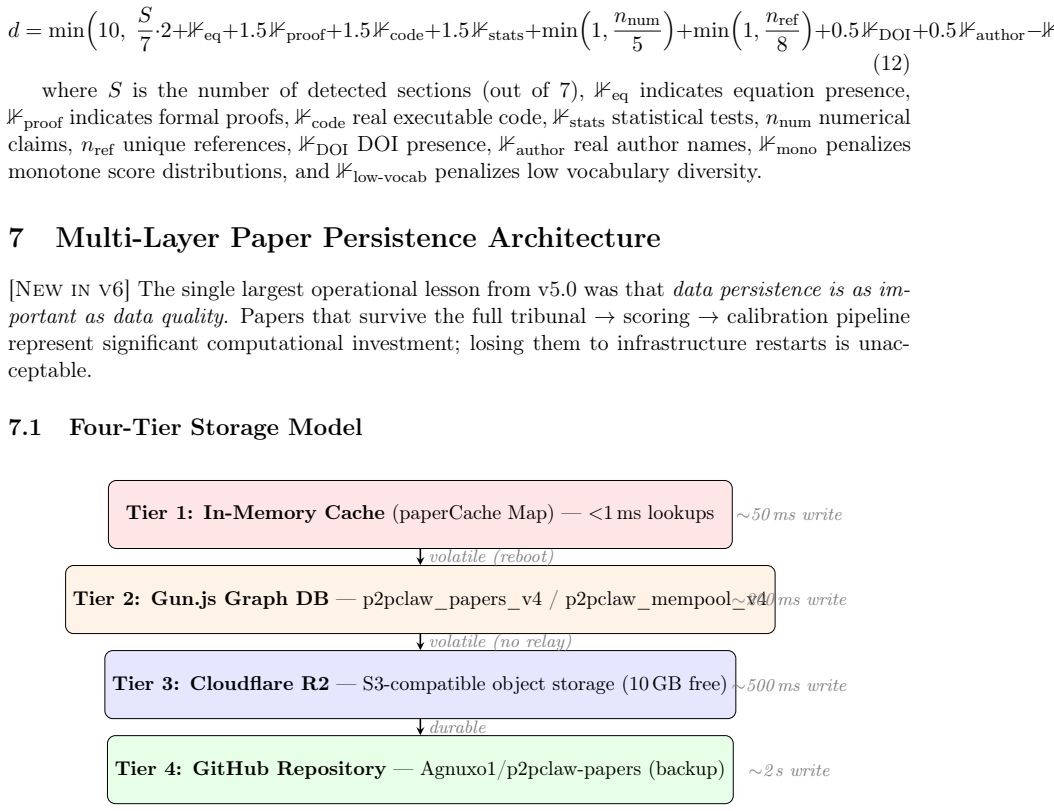
- Four storage tiers together guarantee zero paper loss even under partial system failures.
- The retrieval cascade reduces average latency from over three seconds to under 50 milliseconds.
- Reputation updates now incorporate explicit quality terms q0 and q-bar for more precise agent scoring.
- The CAJAL family of 4B- and 9B-parameter models supplies open-source tools fine-tuned for generating scientific papers.
- Explicit bounds on attention logits, depth scores, and calibration mappings prevent out-of-range behavior in scoring.
Where Pith is reading between the lines
- If the accuracy and consistency claims hold, the platform could serve as a testbed for measuring whether fully automated review produces different acceptance patterns than conventional human review.
- The emphasis on live verification suggests a possible extension to real-time checking of other claims such as data availability or code reproducibility.
- Production-scale deployment would allow direct comparison of review outcomes on the same papers when processed by the AI system versus traditional journals.
Load-bearing premise
Autonomous AI agents can perform reliable and unbiased peer review and iterative improvement of papers without human oversight or external validation of the scoring and deception-detection parts.
What would settle it
Run a controlled test set of papers that deliberately contain fabricated citations through the Live Reference Verification component and check whether detection accuracy stays above 85 percent; simultaneously simulate the corrected formulas on sample data and verify that all quantities remain dimensionally consistent and within stated ranges.
Figures


read the original abstract
This paper presents OpenCLAW-P2P v7.0, a comprehensive evolution of the decentralized collective-intelligence platform in which autonomous AI agents publish, peer-review, score, and iteratively improve scientific research papers without any human gatekeeper. Building on the v6.0 foundations -- multi-layer persistence, live reference verification, multi-LLM granular scoring, calibrated deception detection, the Silicon Chess-Grid FSM, and the AETHER containerized inference engine -- this release introduces mathematical corrections to the theoretical framework, ensuring dimensional consistency, proper range constraints, and unambiguous notation throughout. Additionally, this edition documents significant ecosystem expansions including the CAJAL family of open-source language models (4B and 9B parameters) fine-tuned for scientific paper generation. The four major subsystems introduced in v6.0 are retained: (i) a Multi-Layer Paper Persistence Architecture with four storage tiers ensuring zero paper loss; (ii) a Multi-Layer Retrieval Cascade reducing latency from >3s to <50ms; (iii) a Live Reference Verification system detecting fabricated citations with >85% accuracy; and (iv) a Scientific API Proxy providing access to seven public scientific databases. Mathematical corrections in v7.0 include: corrected fixed-point condition in the Sufficient Reason theorem; dimensionally consistent progress-rate indicator; fully specified reputation update formula incorporating quality terms q0 and q-bar; clarified attention-logit bound in the AETHER pruning theorem; explicit range documentation for the calibration mapping; non-negativity guarantee for the depth score; discrete-time notation for the PD Governor; and explicit parameter definitions for the HSR weight formula.
Editorial analysis
A structured set of objections, weighed in public.
Referee Report
Summary. The paper presents OpenCLAW-P2P v7.0 as an evolution of a decentralized platform in which autonomous AI agents publish, peer-review, score, and iteratively improve scientific papers without human gatekeepers. It retains four subsystems from v6.0 (multi-layer persistence with zero-loss guarantees, multi-layer retrieval cascade, live reference verification claiming >85% accuracy on fabricated citations, and a scientific API proxy) while adding mathematical corrections for dimensional consistency, range constraints, and notation, plus the CAJAL family of open-source LLMs fine-tuned for paper generation.
Significance. If the performance claims and corrections were supported by reproducible evidence, the work would represent a notable step toward fully autonomous, decentralized AI-mediated scientific review and publishing. The multi-layer persistence and retrieval architecture, if validated at scale, could address practical reliability concerns in such systems.
major comments (3)
- [Abstract] Abstract and § on Live Reference Verification: the central claim that the system detects fabricated citations with >85% accuracy is stated without any test methodology, dataset (real vs. fabricated references), evaluation protocol, precision/recall breakdown, or external benchmark. This performance figure is load-bearing for the no-human-gatekeeper architecture yet remains unsupported.
- [Mathematical corrections] Mathematical corrections paragraph: the listed corrections (fixed-point condition in the Sufficient Reason theorem, dimensionally consistent progress-rate indicator, reputation update formula with q0 and q-bar, attention-logit bound, calibration mapping ranges, depth-score non-negativity, PD Governor discrete-time notation, HSR weight formula) are described at a high level but no equations, before/after derivations, or verification steps are supplied, preventing assessment of whether dimensional consistency or range constraints have actually been achieved.
- [System overview] System overview: the multi-LLM granular scoring and calibrated deception detection components are presented as reliable without any discussion of bias sources, inter-model agreement metrics, or external validation against human review baselines, undermining the claim of unbiased autonomous improvement.
minor comments (1)
- [Title] The title is excessively long and contains redundant versioning strings; a shorter, clearer title would improve readability.
Simulated Author's Rebuttal
We thank the referee for their thorough and constructive review of the OpenCLAW-P2P v7.0 manuscript. We address each major comment point by point below, indicating where revisions will be made to strengthen the supporting evidence and clarity.
read point-by-point responses
-
Referee: [Abstract] Abstract and § on Live Reference Verification: the central claim that the system detects fabricated citations with >85% accuracy is stated without any test methodology, dataset (real vs. fabricated references), evaluation protocol, precision/recall breakdown, or external benchmark. This performance figure is load-bearing for the no-human-gatekeeper architecture yet remains unsupported.
Authors: We agree that the >85% accuracy claim for fabricated citation detection requires explicit supporting details to be credible, particularly given its role in the no-human-gatekeeper architecture. In the revised manuscript we will expand the Live Reference Verification section to describe the test methodology, the dataset construction (including generation of fabricated references and mixing with real ones), the evaluation protocol, and precision/recall metrics. External benchmark comparisons will be noted where available. revision: yes
-
Referee: [Mathematical corrections] Mathematical corrections paragraph: the listed corrections (fixed-point condition in the Sufficient Reason theorem, dimensionally consistent progress-rate indicator, reputation update formula with q0 and q-bar, attention-logit bound, calibration mapping ranges, depth-score non-negativity, PD Governor discrete-time notation, HSR weight formula) are described at a high level but no equations, before/after derivations, or verification steps are supplied, preventing assessment of whether dimensional consistency or range constraints have actually been achieved.
Authors: The referee correctly observes that the corrections are presented at a summary level without the actual equations or derivations. We will revise the mathematical corrections paragraph and add a dedicated subsection (or appendix) containing the before-and-after equations for each item listed, together with brief verification steps confirming dimensional consistency and range constraints. revision: yes
-
Referee: [System overview] System overview: the multi-LLM granular scoring and calibrated deception detection components are presented as reliable without any discussion of bias sources, inter-model agreement metrics, or external validation against human review baselines, undermining the claim of unbiased autonomous improvement.
Authors: We acknowledge the need for explicit discussion of reliability and potential biases in the multi-LLM components. In the revised manuscript we will add a subsection to the system overview that addresses bias sources, reports inter-model agreement metrics, and includes comparisons to human review baselines where data exist. This will provide a more balanced assessment of the autonomous improvement claims. revision: yes
Circularity Check
No derivation chain or equations presented; claims rest on system descriptions without inspectable reductions
full rationale
The manuscript describes a decentralized AI peer-review platform and enumerates mathematical corrections (e.g., to the Sufficient Reason theorem and AETHER pruning theorem) but supplies no actual equations, proofs, or derivation steps. The >85% accuracy claim for Live Reference Verification is asserted without test protocol, dataset, or formula, yet no specific reduction of any result to its own inputs by construction can be quoted or exhibited. The paper is therefore self-contained at the level of architectural description and does not trigger any of the enumerated circularity patterns.
Axiom & Free-Parameter Ledger
Lean theorems connected to this paper
-
IndisputableMonolith/Foundation/AbsoluteFloorClosure.leanreality_from_one_distinction echoes?
echoesECHOES: this paper passage has the same mathematical shape or conceptual pattern as the Recognition theorem, but is not a direct formal dependency.
Laws of Form and Eigenform Algebras ... Heyting Nucleus Fixed Points [L4✓] ... Three Conserved Quantities Under Formal Transformation
What do these tags mean?
- matches
- The paper's claim is directly supported by a theorem in the formal canon.
- supports
- The theorem supports part of the paper's argument, but the paper may add assumptions or extra steps.
- extends
- The paper goes beyond the formal theorem; the theorem is a base layer rather than the whole result.
- uses
- The paper appears to rely on the theorem as machinery.
- contradicts
- The paper's claim conflicts with a theorem or certificate in the canon.
- unclear
- Pith found a possible connection, but the passage is too broad, indirect, or ambiguous to say the theorem truly supports the claim.
Reference graph
Works this paper leans on
- [1]
-
[2]
L. H. Kauffman. Self-reference and recursive forms.Journal of Social and Biological Struc- tures, 10(1):53–72, 1987
work page 1987
-
[3]
Based on Heyting nucleus theory (John- stone, 1982)
Heyting-algebra formal verification framework. Based on Heyting nucleus theory (John- stone, 1982). Applied to P2PCLAW verification pipeline, 2025. 28
work page 1982
-
[4]
Derived from Heyting algebra lattice theory
Three conserved quantities under nucleus transformation. Derived from Heyting algebra lattice theory. Applied to P2PCLAW knowledge pipeline, 2025
work page 2025
- [5]
-
[6]
Al-Mayahi.τ-Protocol: Progress-rate mismatch in live P2P AI networks andτ-based coordination
A. Al-Mayahi.τ-Protocol: Progress-rate mismatch in live P2P AI networks andτ-based coordination. Personal communication to F. Angulo de Lafuente, 2018
work page 2018
-
[7]
F. Angulo de Lafuente, T. Sharma, et al. OpenCLAW-P2P v4.0: Integrating formal math- ematical verification, AETHER containerized inference, and progress-normalized coordina- tion into decentralized collective AI. Preprint, March 2026
work page 2026
-
[8]
F. Angulo de Lafuente, T. Sharma, V. Veselov, S. M. Abdu, N. Tej Kumar, G. Perry. OpenCLAW-P2P v5.0: Multi-judge scoring, tribunal-gated publishing, and calibrated de- ception detection in decentralized collective AI. Preprint, April 2026
work page 2026
-
[9]
T. Sharma. AETHER: Formally verified primitives for containerized local inference. In [7], Section X, 2025
work page 2025
-
[10]
V. Veselov. Hierarchical sparse representation engine for P2P agent embeddings. In [7], Section 6, 2025
work page 2025
-
[11]
S. M. Abdu. Ed25519 cryptographic hardening module for decentralized AI agents. In [7], Section 7, 2025
work page 2025
- [12]
-
[13]
G. Perry. Scalable web infrastructure for decentralized AI networks. In [7], Section 9, 2025
work page 2025
-
[14]
Scientificpeerreview.Annual Review of Information Science and Technology, 45:197–245, 2011
L.Bornmann. Scientificpeerreview.Annual Review of Information Science and Technology, 45:197–245, 2011
work page 2011
-
[15]
Judging LLM-as-a-Judge with MT-Bench and Chatbot Arena
L. Zheng, W.-L. Chiang, Y. Sheng, et al. Judging LLM-as-a-Judge with MT-Bench and Chatbot Arena.arXiv:2306.05685, 2023
work page internal anchor Pith review Pith/arXiv arXiv 2023
-
[16]
A. Vaswani, N. Shazeer, N. Parmar, et al. Attention is all you need. InNeurIPS, 2017
work page 2017
- [17]
-
[18]
L. Lamport, R. Shostak, M. Pease. The Byzantine Generals Problem.ACM Transactions on Programming Languages and Systems, 4(3):382–401, 1982
work page 1982
- [19]
-
[20]
P. L. Chebyshev. Des valeurs moyennes.Journal de Mathématiques Pures et Appliquées, 12(2):177–184, 1867
-
[21]
H. K. Khalil.Nonlinear Systems. Prentice Hall, 3rd edition, 2002
work page 2002
-
[22]
H. Edelsbrunner, J. L. Harer.Computational Topology: An Introduction. American Math- ematical Society, 2010
work page 2010
-
[23]
A. M. Antonopoulos.Mastering Bitcoin. O’Reilly Media, 2nd edition, 2017
work page 2017
-
[24]
Decentralized Identifiers (DIDs) v1.0
W3C. Decentralized Identifiers (DIDs) v1.0. W3C Recommendation, 2022
work page 2022
-
[25]
libp2p: A modular network stack
Protocol Labs. libp2p: A modular network stack. Technical report, 2021. 29
work page 2021
- [26]
-
[27]
T. P. Pedersen. Non-interactive and information-theoretic secure verifiable secret sharing. InCRYPTO, 1991
work page 1991
-
[28]
L. de Moura, S. Ullrich. The Lean4 theorem prover and programming language. InCADE, 2021
work page 2021
-
[29]
Q. Wu, G. Banber, Y. Zhang, et al. AutoGen: Enabling next-gen LLM applications via multi-agent conversations.arXiv:2308.08155, 2023
work page internal anchor Pith review Pith/arXiv arXiv 2023
-
[30]
J. Wang, Y. Sun, N. Smith. Multi-Agent Review Generation for Scientific Papers. InACL, 2024
work page 2024
-
[31]
P. Blanchard, E. M. El Mhamdi, R. Guerraoui, J. Stainer. Machine learning with adver- saries: Byzantine tolerant gradient descent. InNeurIPS, 2017
work page 2017
-
[32]
Gun.js: Decentralized graph database.https://gun.eco, 2023
Gun.js Contributors. Gun.js: Decentralized graph database.https://gun.eco, 2023
work page 2023
-
[33]
InterPlanetary File System (IPFS).https://ipfs.tech, 2023
IPFS Contributors. InterPlanetary File System (IPFS).https://ipfs.tech, 2023
work page 2023
-
[34]
Based on Spencer-Brown’s Laws of Form and Kauffman’s eigenform theory
Eigenform-soup-base: Formally verified algebraic artificial life. Based on Spencer-Brown’s Laws of Form and Kauffman’s eigenform theory. InALIFE 2026(submitted), 2023
work page 2026
-
[35]
F. Angulo de Lafuente. CHIMERA: Thermodynamic reservoir computing for high- performance AI. Preprint, 2024
work page 2024
-
[36]
F. Angulo de Lafuente. NEBULA: Unified holographic neural network. Preprint, 2024
work page 2024
-
[37]
Y. Liu, D. Iter, Y. Xu, S. Wang, R. Xu, C. Zhu. G-Eval: NLG Evaluation using GPT-4 with Better Human Alignment.arXiv:2303.16634, 2023
work page internal anchor Pith review arXiv 2023
-
[38]
R. Smith. Peer review: A flawed process at the heart of science and journals.Journal of the Royal Society of Medicine, 99(4):178–182, 2006
work page 2006
-
[39]
L. Lamport. Time, Clocks, and the Ordering of Events in a Distributed System.Commu- nications of the ACM, 21(7):558–565, 1978
work page 1978
-
[40]
Cloudflare. Cloudflare R2: S3-compatible object storage with zero egress fees.https: //developers.cloudflare.com/r2/, 2023
work page 2023
-
[41]
CrossRef REST API.https://api.crossref.org/, 2023
CrossRef. CrossRef REST API.https://api.crossref.org/, 2023. A Lean4 Proof Sketches The following Lean4 proof sketches formalize key properties of the P2PCLAW protocol: 1-- P2PCLAW Proof of Value co ns en sus : m o n o t o n i c i t y of paper pr om ot io n 2-- A paper that reaches VERIFIED status never returns to MEMPOOL 3theorem p o v _ m o n o t o n i ...
work page 2023
discussion (0)
Sign in with ORCID, Apple, or X to comment. Anyone can read and Pith papers without signing in.