Recognition: unknown
One-dimensional non-Hausdorff manifolds and CW complexes
Pith reviewed 2026-05-08 13:21 UTC · model grok-4.3
The pith
Connected one-dimensional non-Hausdorff manifolds with locally finite non-Hausdorff points admit a quotient map to an open one-dimensional CW complex that is their minimal Hausdorff quotient.
A machine-rendered reading of the paper's core claim, the machinery that carries it, and where it could break.
Core claim
If M is a connected one-dimensional non-Hausdorff manifold such that the set of its non-Hausdorff points is locally finite, and each component of its complement has a countable base, then there exists a quotient map π∶M→Γ onto an open one-dimensional CW complex, which maps the non-Hausdorff points of M to the vertices of Γ. Moreover, Γ is the minimal Hausdorff quotient of M, that is, for every continuous map f∶M→N into a Hausdorff space N, there exists a unique continuous map ˆf∶Γ→N such that f = ˆf ∘ π.
What carries the argument
The quotient map π∶M→Γ that sends non-Hausdorff points of M exactly to the vertices of the open one-dimensional CW complex Γ and serves as the universal map through which all continuous maps from M to Hausdorff spaces factor.
If this is right
- Continuous maps from M to any Hausdorff space are in bijection with continuous maps from Γ to that space.
- Topological invariants of M that descend to quotients can be computed directly on the CW complex Γ.
- The one-dimensional character of M is preserved in the quotient, allowing graph-theoretic techniques to apply to the original manifold.
- Any two maps from M that agree on Γ must agree everywhere, giving a canonical reduction of the space.
Where Pith is reading between the lines
- The same quotient construction could supply a classification of such manifolds by their CW complexes together with data on how vertices are split.
- The minimality of Γ suggests that questions about embeddings or coverings of M might reduce to corresponding questions for ordinary one-dimensional complexes.
- If the assumptions on local finiteness or countability are relaxed, the quotient may fail to be a CW complex, indicating where the one-dimensional case breaks.
Load-bearing premise
The non-Hausdorff points form a locally finite set and every component of the complement has a countable base for its topology.
What would settle it
A connected one-dimensional non-Hausdorff manifold satisfying the local-finiteness and countable-base conditions whose continuous images in Hausdorff spaces do not all factor through any single open one-dimensional CW complex.
Figures

read the original abstract
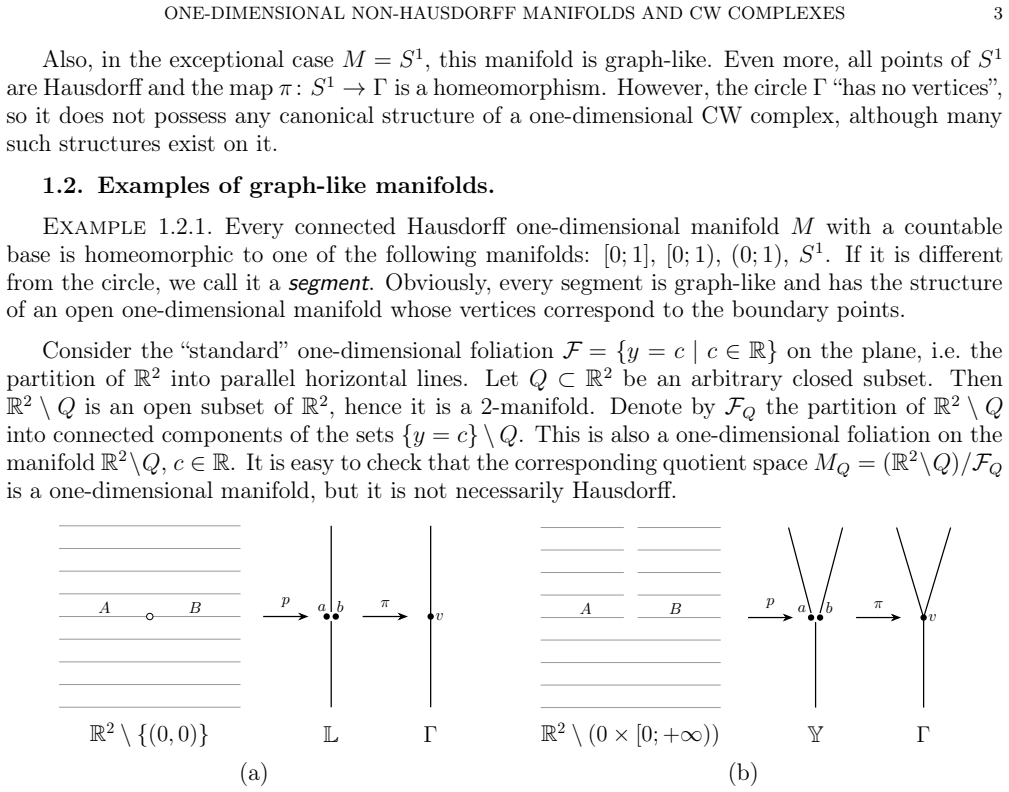
This paper studies one-dimensional non-Hausdorff manifolds that are similar to "graphs with split vertices". It is shown that if $M$ is a connected one-dimensional non-Hausdorff manifold such that the set of its "non-Hausdorff" points is locally finite, and each component of its complement has a countable base, then there exists a quotient map $\pi\colon M \to \Gamma$ onto an open one-dimensional CW complex, which maps the non-Hausdorff points of $M$ to the vertices of $\Gamma$. Moreover, $\Gamma$ is the minimal Hausdorff quotient of $M$, that is, for every continuous map $f\colon M \to N$ into a Hausdorff space $N$, there exists a unique continuous map $\hat{f}\colon \Gamma \to N$ such that $f = \hat{f} \circ \pi$.
Editorial analysis
A structured set of objections, weighed in public.
Referee Report
Summary. The paper proves that if M is a connected one-dimensional non-Hausdorff manifold whose non-Hausdorff points form a locally finite set and whose complement components are second-countable, then there exists a quotient map π: M → Γ onto an open one-dimensional CW complex Γ that sends the non-Hausdorff points of M to the vertices of Γ. Moreover, Γ is the minimal Hausdorff quotient of M in the sense that every continuous map from M to a Hausdorff space factors uniquely through π.
Significance. If the result holds, the construction supplies an explicit, canonical Hausdorff CW complex that captures the topology of the given non-Hausdorff manifold while satisfying a universal property with respect to maps into Hausdorff spaces. This provides a concrete bridge between non-Hausdorff one-dimensional spaces and standard CW complexes, which may be useful for classification or deformation problems in geometric topology. The explicit quotient construction and verification of the weak topology and universal property are strengths of the argument.
minor comments (3)
- The abstract uses both “countable base” and “second-countable”; standardize the terminology to “second-countable” throughout for consistency with standard topological usage.
- In the statement of the main theorem, explicitly recall or cite the precise definition of “one-dimensional non-Hausdorff manifold” that is used, so that the hypotheses on non-Hausdorff points and complement components are immediately verifiable from the definition.
- The phrase “open one-dimensional CW complex” appears without a prior reference; add a sentence or footnote clarifying whether this means a CW complex whose 1-skeleton is open in the usual sense or simply a 1-dimensional CW complex without boundary.
Simulated Author's Rebuttal
We thank the referee for their careful reading of the manuscript and for recommending acceptance. The referee's summary accurately reflects the main result and the universal property established in the paper.
Circularity Check
No significant circularity; direct existence via explicit quotient construction
full rationale
The paper states a conditional existence theorem: given a connected one-dimensional non-Hausdorff manifold M whose non-Hausdorff points form a locally finite set and whose complement components are second-countable, an explicit quotient map π: M → Γ is constructed by collapsing inseparable points to vertices while preserving the manifold structure on the complement. The text then verifies that Γ carries the structure of an open 1-dimensional CW complex (via the weak topology axiom) and satisfies the universal property of the minimal Hausdorff quotient. No quantities are defined in terms of themselves, no parameters are fitted to data and then re-predicted, and no load-bearing steps reduce to self-citations or imported uniqueness theorems. The derivation is therefore self-contained within the stated hypotheses and standard topological constructions.
Axiom & Free-Parameter Ledger
axioms (3)
- domain assumption M is a connected one-dimensional non-Hausdorff manifold
- domain assumption The set of non-Hausdorff points of M is locally finite
- domain assumption Each component of the complement of the non-Hausdorff points has a countable base
Reference graph
Works this paper leans on
-
[1]
On non-Hausdorff manifolds, 2025.arXiv:arXiv:2502.17707
Mathieu Baillif. On non-Hausdorff manifolds, 2025.arXiv:arXiv:2502.17707
-
[2]
Manifolds: Hausdorffness versus homogeneity.Proc
Mathieu Baillif and Alexandre Gabard. Manifolds: Hausdorffness versus homogeneity.Proc. Amer. Math. Soc., 136(3):1105–1111, 2008.doi:10.1090/S0002-9939-07-09100-9
-
[3]
Foliations on non-metrisable manifolds: ab- sorption by a Cantor black hole.Proc
Mathieu Baillif, Alexandre Gabard, and David Gauld. Foliations on non-metrisable manifolds: ab- sorption by a Cantor black hole.Proc. Amer. Math. Soc., 142(3):1057–1069, 2014.doi:10.1090/ S0002-9939-2013-11900-3
2014
-
[4]
Ralph H. Fox and Emil Artin. Some wild cells and spheres in three-dimensional space.Ann. of Math. (2), 49:979–990, 1948.doi:10.2307/1969408. ONE-DIMENSIONAL NON-HAUSDORFF MANIFOLDS AND CW COMPLEXES 19
-
[5]
Homogeneous and inhomogeneous manifolds.Proc
Paul Gartside, David Gauld, and Sina Greenwood. Homogeneous and inhomogeneous manifolds.Proc. Amer. Math. Soc., 136(9):3363–3373, 2008.doi:10.1090/S0002-9939-08-09343-X
-
[6]
Springer, Singapore, 2014.doi:10.1007/978-981-287-257-9
David Gauld.Non-metrisable manifolds. Springer, Singapore, 2014.doi:10.1007/978-981-287-257-9
-
[7]
Vari´ et´ es (non s´ epar´ ees) ` a une dimension et structures feuillet´ ees du plan
Andr´ e Haefliger and Georges Reeb. Vari´ et´ es (non s´ epar´ ees) ` a une dimension et structures feuillet´ ees du plan. Enseignement Math. (2), 3:107–125, 1957
1957
-
[8]
P. H´ aj´ ıˇ cek. Causality in non-Hausdorff space-times.Comm. Math. Phys., 21:75–84, 1971. URL:http: //projecteuclid.org/euclid.cmp/1103857261
-
[9]
Non-Hausdorff parallelized manifolds over geometric models of conservative programs
Emmanuel Haucourt. Non-Hausdorff parallelized manifolds over geometric models of conservative programs. Math. Structures Comput. Sci., 35:Paper No. e17, 60, 2025.doi:10.1017/S0960129525100169
-
[10]
Geometry of non-Hausdorff spaces and its significance for physics.J
Michael Heller, Leszek Pysiak, and Wies law Sasin. Geometry of non-Hausdorff spaces and its significance for physics.J. Math. Phys., 52(4):043506, 7, 2011.doi:10.1063/1.3574352
-
[11]
Generalised manifolds as basic objects of general relativity.Found
Joanna Luc. Generalised manifolds as basic objects of general relativity.Found. Phys., 50(6):621–643, 2020. doi:10.1007/s10701-019-00292-w
-
[12]
Interpreting non-Hausdorff (generalized) manifolds in general relativity.Philos
Joanna Luc and Tomasz Placek. Interpreting non-Hausdorff (generalized) manifolds in general relativity.Philos. Sci., 87(1):21–42, 2020.doi:10.1086/706116
-
[13]
Classification of differentiable structures on the non-hausdorff line with two origins
Mykola Lysynskyi and Sergiy Maksymenko. Classification of differentiable structures on the non-hausdorff line with two origins. InGeometric Methods in Physical Systems: From Differentiable Structures to Applica- tions, The Wis la 22 Winter School and Workshop (2026), 2026. URL:https://link.springer.com/book/ 9783032003980
2026
-
[14]
Differentiable structures on a union of two open sets.Topology Appl., 378:Paper No
Mykola Lysynskyi and Sergiy Maksymenko. Differentiable structures on a union of two open sets.Topology Appl., 378:Paper No. 109687, 2026.doi:10.1016/j.topol.2025.109687
-
[15]
Maksymenko and E
S. Maksymenko and E. Polulyakh. Foliations with all non-closed leaves on non-сompact surfaces.Methods Funct. Anal. Topology, 22(3):266–282, 2016. URL:https://mfat.imath.kiev.ua/article/?id=884
2016
-
[16]
S. Maksymenko and E. Polulyakh. Homeotopy groups of leaf spaces of one-dimensional foliations on non- compact surfaces with non-compact leaves.Proc. Int. Geom. Cent., 14(4):271–290, 2021.doi:10.15673/tmgc. v14i4.2204
-
[17]
Topology change from pointlike sources.Phys
Yasha Neiman and David O’Connell. Topology change from pointlike sources.Phys. Rev. D, 110(6):Paper No. 064026, 21, 2024.doi:10.1103/physrevd.110.064026
-
[18]
Peter J. Nyikos. Various smoothings of the long line and their tangent bundles.Adv. Math., 93(2):129–213, 1992.doi:10.1016/0001-8708(92)90027-I
-
[19]
Non-Hausdorff manifolds via adjunction spaces.Topology Appl., 326:Paper No
David O’Connell. Non-Hausdorff manifolds via adjunction spaces.Topology Appl., 326:Paper No. 108388, 18, 2023.doi:10.1016/j.topol.2022.108388
-
[20]
David O’Connell. Vector bundles over non-Hausdorff manifolds.Topology and its Applications, page 108982, 2024.doi:10.1016/j.topol.2024.108982
-
[21]
Michael Spivak.A comprehensive introduction to differential geometry. Vol. I. Publish or Perish, Inc., Wilm- ington, DE, second edition, 1979
1979
-
[22]
Ginn (A Xerox company), Waltham, Mass.-Toronto, Ont.-London, 1970
Albert Wilansky.Topology for analysis. Ginn (A Xerox company), Waltham, Mass.-Toronto, Ont.-London, 1970
1970
-
[23]
G. K. Williams. Mappings and decompositions.Pacific J. Math., 45:387–392, 1973. URL:http:// projecteuclid.org/euclid.pjm/1102947736. Email address:vlasenko@imath.kiev.ua, maks@imath.kiev.ua Algebra and Topology Department, Institute of Mathematics of Nationakl Academy od Sci- ences of Ukraine, Tereshchenkivska Str., 3, Kyiv, 01024, Ukraine
discussion (0)
Sign in with ORCID, Apple, or X to comment. Anyone can read and Pith papers without signing in.