Recognition: unknown
Toward a Scientific Discovery Engine for Weather and Climate Data: A Visual Analytics Workbench for Embedding-Based Exploration
Pith reviewed 2026-05-09 14:52 UTC · model grok-4.3
The pith
A visual analytics workbench links embedding spaces of weather data back to physical observations so researchers can identify and retrieve similar meteorological events across large archives.
A machine-rendered reading of the paper's core claim, the machinery that carries it, and where it could break.
Core claim
The workbench integrates embedding experiments with source meteorological data, metadata, spatial views, and model configurations so that nearest neighbors in latent space can be traced to their physical origins. Users can compare representation models, develop retrieval strategies, and validate analogs against real weather evidence. In the tropical-cyclone case, a signature identified in a labeled subset is used to probe broader archives for similar events.
What carries the argument
The visual analytics workbench that links embedding vectors to source data, metadata, and interactive meteorological views for inspection, comparison, and retrieval.
If this is right
- Side-by-side comparison of multiple embedding models becomes possible within the same interface.
- Global and localized similarity queries can be issued and inspected through standard meteorological visualizations.
- Retrieval strategies can be tested and refined before scaling to unlabeled archives or ensembles.
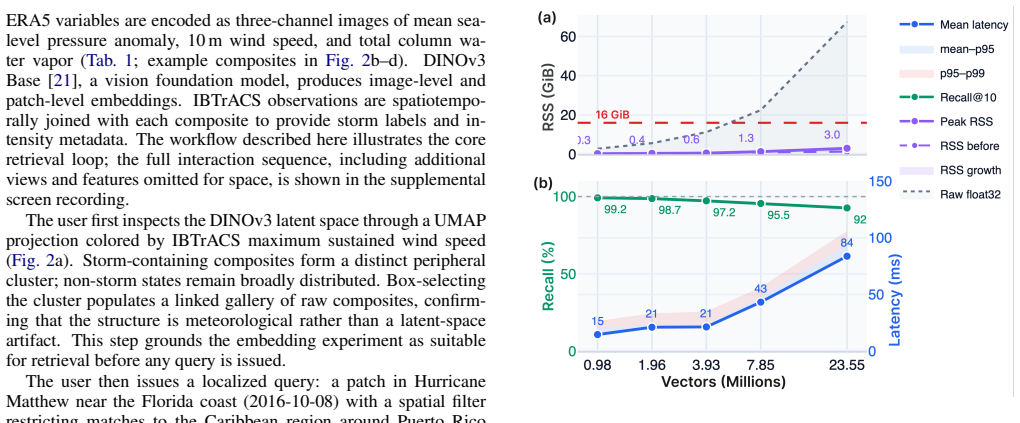
- Large embedding collections can be searched on commodity hardware without loading everything into memory.
- The workflow allows characterization of events in small well-labeled sets followed by discovery in much larger climate archives.
Where Pith is reading between the lines
- The same linking approach could be applied to other high-dimensional scientific domains such as ocean or atmospheric chemistry data.
- Visual validation might lower the barrier for using embeddings in settings where full quantitative labels are scarce.
- The workbench could be extended with automated candidate ranking before human review to speed up large-scale searches.
- Tracing results back to source physics may improve the reproducibility of analog-based studies in climate research.
Load-bearing premise
Visual inspection together with metadata links will let domain scientists reliably separate physically meaningful structures in the embedding space from preprocessing artifacts or model biases.
What would settle it
Domain experts using the workbench on a controlled dataset with injected known biases consistently label artifact clusters as physically meaningful events when asked to characterize phenomena.
Figures


read the original abstract
Earth system science is producing increasingly large, high-dimensional datasets from physics based Earth system models to AI-based weather and climate models. Embedding-based representations can make these data searchable through similarity search and analog retrieval, but nearest neighbors in latent space are not automatically scientifically meaningful: it may reflect real weather structure, or preprocessing, geography, or model bias. Researchers therefore need ways to inspect how embeddings organize meteorological data, compare representation models, develop retrieval strategies, and verify results against physical evidence. We present an open-source visual analytics workbench for each of these steps. The system links embedding experiments to source data, metadata, spatial context, and model configurations, so latent-space results can be traced back to the physics. Users can explore latent spaces for different models, issue global or localized queries, and inspect analogs through familiar meteorological views. This enables a discovery workflow in which scientists characterize a phenomenon of interest in a well-understood dataset, identifying its signature in latent space, and then use that signature to probe larger, less-labeled archives or ensembles for similar events. We demonstrate the workbench through tropical-cyclone retrieval using ERA5-derived embeddings and IBTrACS metadata, and evaluate its out-of-core retrieval backend to show that large embedding collections can be searched beyond in-memory limits on commodity workstation hardware.
Editorial analysis
A structured set of objections, weighed in public.
Referee Report
Summary. The manuscript presents an open-source visual analytics workbench for exploring and validating embedding-based representations of large weather and climate datasets. The system links latent-space embeddings to source data, metadata (e.g., IBTrACS), spatial context, and model configurations, enabling users to inspect organization of meteorological data, perform similarity queries, and trace results to physical evidence. It supports a discovery workflow of characterizing phenomena in well-understood datasets and retrieving analogs from larger archives, demonstrated via tropical-cyclone retrieval on ERA5-derived embeddings and evaluated for out-of-core scalability on commodity hardware.
Significance. If the linked visual and metadata views prove effective at distinguishing physically meaningful structures from artifacts, the workbench would be a significant contribution to Earth system data analysis by making embedding-based similarity search interpretable and usable for scientific discovery. The open-source release, concrete demonstration on ERA5/IBTrACS data, and evidence that large collections can be searched beyond in-memory limits on standard hardware are clear strengths that could support community adoption and extension.
major comments (1)
- [Abstract] The central claim that the workbench enables a verifiable discovery workflow (abstract) rests on the assumption that visual inspection and metadata linking will reliably allow domain scientists to identify physically meaningful latent-space structures rather than preprocessing or bias artifacts. The tropical-cyclone demonstration illustrates the workflow but provides no quantitative metrics (e.g., precision against IBTrACS labels or controlled comparison to non-visual baselines) or user evaluation to substantiate this reliability.
minor comments (2)
- The out-of-core retrieval evaluation would be strengthened by reporting specific dataset sizes, embedding dimensions, and hardware specifications used in the scalability test.
- Adding interface screenshots or a system architecture diagram would improve clarity on how the linked views (embedding space, spatial context, metadata) operate together.
Simulated Author's Rebuttal
We thank the referee for their constructive comments and positive assessment of the manuscript's significance. We address the major comment below.
read point-by-point responses
-
Referee: [Abstract] The central claim that the workbench enables a verifiable discovery workflow (abstract) rests on the assumption that visual inspection and metadata linking will reliably allow domain scientists to identify physically meaningful latent-space structures rather than preprocessing or bias artifacts. The tropical-cyclone demonstration illustrates the workflow but provides no quantitative metrics (e.g., precision against IBTrACS labels or controlled comparison to non-visual baselines) or user evaluation to substantiate this reliability.
Authors: We appreciate the referee's point on the strength of the claims. The abstract states that the workbench 'enables a discovery workflow' by linking embeddings to source data, metadata, and physical context so that 'latent-space results can be traced back to the physics.' It does not assert that visual inspection and metadata linking will reliably or automatically distinguish meaningful structures from artifacts; the system supplies the inspection mechanisms, while domain expertise supplies the judgment. The tropical-cyclone demonstration shows one concrete use of these mechanisms (retrieval against IBTrACS labels and ERA5 fields) but is presented as an illustration rather than a controlled validation. We agree that quantitative metrics (e.g., retrieval precision against IBTrACS) and a user study would strengthen the paper. In revision we will (1) tighten the abstract wording to emphasize 'support for' rather than implicit reliability of verification, (2) add a limitations paragraph discussing the illustrative nature of the case study, and (3) include a brief quantitative retrieval analysis against the IBTrACS labels already present in the dataset. A full user study lies outside the current scope but is noted as future work. revision: partial
Circularity Check
No significant circularity; software tool description without derivations or self-referential predictions
full rationale
The paper describes the design and demonstration of an open-source visual analytics workbench for embedding-based exploration of weather and climate data. The central claim is that linked views (embedding space, source data, metadata, spatial context) enable a discovery workflow of characterizing phenomena in known datasets and retrieving analogs from larger archives. This is presented as a system architecture and usage example (tropical cyclone retrieval on ERA5/IBTrACS), not as a mathematical derivation or fitted prediction. No equations, parameter fits, uniqueness theorems, or ansatzes appear in the provided text. Any self-citations are incidental and non-load-bearing for the contribution, which rests on the software implementation itself rather than reducing to prior author results by construction. The work is self-contained as a tool report.
Axiom & Free-Parameter Ledger
axioms (1)
- domain assumption Embedding models produce latent spaces in which proximity can correspond to meteorological similarity when properly inspected
Reference graph
Works this paper leans on
-
[1]
R. P. Abernathey, T. Augspurger, A. Banihirwe, C. C. Blackmon-Luca, T. J. Crone, C. L. Gentemann, J. J. Hamman, N. Henderson, C. Lep- ore, T. A. McCaie, N. H. Robinson, and R. P. Signell. Cloud-Native Repositories for Big Scientific Data.Computing in Science & Engi- neering, 23(2):26–35, Mar. 2021. doi: 10.1109/MCSE.2021.3059437 2
-
[2]
Z. B. Bouall `egue, M. C. A. Clare, L. Magnusson, E. Gasc ´on, M. Maier-Gerber, M. Janou ˇsek, M. Rodwell, F. Pinault, J. S. Dram- sch, S. T. K. Lang, B. Raoult, F. Rabier, M. Chevallier, I. Sandu, P. Dueben, M. Chantry, and F. Pappenberger. The Rise of Data- Driven Weather Forecasting: A First Statistical Assessment of Ma- chine Learning–Based Weather Fo...
-
[3]
C. F. Brown, M. R. Kazmierski, V . J. Pasquarella, W. J. Ruck- lidge, M. Samsikova, C. Zhang, E. Shelhamer, E. Lahera, O. Wiles, S. Ilyushchenko, N. Gorelick, L. L. Zhang, S. Alj, E. Schechter, S. Askay, O. Guinan, R. Moore, A. Boukouvalas, and P. Kohli. AlphaEarth Foundations: An embedding field model for accurate and efficient global mapping from sparse...
-
[4]
Eyring, W
V . Eyring, W. D. Collins, P. Gentine, E. A. Barnes, M. Bar- reiro, T. Beucler, M. Bocquet, C. S. Bretherton, H. M. Christensen, K. Dagon, D. J. Gagne, D. Hall, D. Hammerling, S. Hoyer, F. Iglesias- Suarez, I. Lopez-Gomez, M. C. McGraw, G. A. Meehl, M. J. Molina, C. Monteleoni, J. Mueller, M. S. Pritchard, D. Rolnick, J. Runge, P. Stier, O. Watt-Meyer, K....
2024
-
[5]
Billion-scale similarity search with GPUs
J. Johnson, M. Douze, and H. J ´egou. Billion-Scale Similarity Search with GPUs.IEEE Transactions on Big Data, 7(3):535–547, July 2021. doi: 10.1109/TBDATA.2019.2921572 4
-
[6]
H. J ´egou, M. Douze, and C. Schmid. Product Quantization for Near- est Neighbor Search.IEEE Transactions on Pattern Analysis and Ma- chine Intelligence, 33(1):117–128, Jan. 2011. doi: 10.1109/TPAMI. 2010.57 4
-
[7]
Y . Kawakami, D. Cayan, D. Liu, and K.-L. Ma. ClimateSOM: A Vi- sual Analysis Workflow for Climate Ensemble Datasets.IEEE Trans- actions on Visualization and Computer Graphics, 32(01):473–483, Jan. 2026. doi: 10.1109/TVCG.2025.3634788 2
-
[8]
D. A. Keim, F. Mansmann, J. Schneidewind, J. Thomas, and H. Ziegler. Visual Analytics: Scope and Challenges. In S. J. Simoff, M. H. B ¨ohlen, and A. Mazeika, eds.,Visual Data Mining: The- ory, Techniques and Tools for Visual Analytics, pp. 76–90. Springer, Berlin, Heidelberg, 2008. doi: 10.1007/978-3-540-71080-6 6 2
-
[9]
K. R. Knapp, M. C. Kruk, D. H. Levinson, H. J. Diamond, and C. J. Neumann. The International Best Track Archive for Climate Stew- ardship (IBTrACS): Unifying Tropical Cyclone Data.Bulletin of the American Meteorological Society, 91(3):363–376, Mar. 2010. doi: 10 .1175/2009BAMS2755.1 2
2010
-
[10]
Y . Liu, X. Wang, Y . Wang, F. Huang, Y . Huang, Y . Li, W. Zhang, S. Gong, G. Mai, Y . Yao, Y . Yue, H. Li, and F. Zhang. Representa- tion learning for geospatial data.Annals of GIS, 31(4):557–583, Oct
-
[11]
doi: 10.1080/19475683.2025.2552157 2
eprint: https://doi.org/10.1080/19475683.2025.2552157. doi: 10.1080/19475683.2025.2552157 2
-
[12]
A. Mahesh, W. D. Collins, B. Bonev, N. Brenowitz, Y . Cohen, P. Har- rington, K. Kashinath, T. Kurth, J. North, T. A. O’Brien, M. Pritchard, D. Pruitt, M. Risser, S. Subramanian, and J. Willard. Huge ensembles – Part 2: Properties of a huge ensemble of hindcasts generated with spherical Fourier neural operators.Geoscientific Model Development, 18(17):5605...
-
[13]
M. J. Molina, T. A. O’Brien, G. Anderson, M. Ashfaq, K. E. Bennett, W. D. Collins, K. Dagon, J. M. Restrepo, and P. A. Ullrich. A Re- view of Recent and Emerging Machine Learning Applications for Cli- mate Variability and Weather Phenomena.Artificial Intelligence for the Earth Systems, 2(4), Sept. 2023. doi: 10.1175/AIES-D-22-0086.1 2
-
[14]
A. H. Monahan, J. C. Fyfe, M. H. P. Ambaum, D. B. Stephenson, and G. R. North. Empirical Orthogonal Functions: The Medium is the Message.Journal of Climate, 22(24):6501–6514, Dec. 2009. doi: 10. 1175/2009JCLI3062.1 2
2009
-
[15]
J. T. Overpeck, G. A. Meehl, S. Bony, and D. R. Easterling. Climate data challenges in the 21st century.Science, 331(6018):700–702, Feb
-
[16]
doi: 10.1126/science.1197869 2
- [17]
-
[18]
A. Panta, X. Huang, N. McCurdy, D. Ellsworth, A. A. Gooch, G. Scorzelli, H. Torres, P. Klein, G. A. Ovando-Montejo, and V . Pas- cucci. Web-based Visualization and Analytics of Petascale data: Eq- uity as a Tide that Lifts All Boats. In2024 IEEE 14th Symposium on Large Data Analysis and Visualization (LDAV), pp. 1–11. IEEE, St Pete Beach, FL, USA, Oct. 20...
work page doi:10.1109/lda 2024
-
[19]
Prabhat, K. Kashinath, M. Mudigonda, S. Kim, L. Kapp-Schwoerer, A. Graubner, E. Karaismailoglu, L. von Kleist, T. Kurth, A. Greiner, A. Mahesh, K. Yang, C. Lewis, J. Chen, A. Lou, S. Chandran, B. Toms, W. Chapman, K. Dagon, C. A. Shields, T. O’Brien, M. Wehner, and W. Collins. ClimateNet: an expert-labeled open dataset and deep learning architecture for e...
-
[20]
D. Ren, F. Hohman, H. Lin, and D. Moritz. Embedding At- las: Low-Friction, Interactive Embedding Visualization, July 2025. arXiv:2505.06386 [cs]. doi: 10.48550/arXiv.2505.06386 2
-
[21]
B. Richards and P. K. Balan. Latent Representations of Land–Sea Boundaries and Extreme Temperature in Aurora’s Encoder (Student Abstract).Proceedings of the AAAI Conference on Artificial Intel- ligence, 40(48):41368–41369, Mar. 2026. doi: 10.1609/aaai.v40i48. 42272 2
-
[22]
S. L. Sellars. “Grand Challenges” in Big Data and the Earth Sciences. Bulletin of the American Meteorological Society, 99(6):ES95–ES98, June 2018. doi: 10.1175/BAMS-D-17-0304.1 2
-
[23]
O. Sim ´eoni, H. V . V o, M. Seitzer, F. Baldassarre, M. Oquab, C. Jose, V . Khalidov, M. Szafraniec, S. Yi, M. Ramamonjisoa, F. Massa, D. Haziza, L. Wehrstedt, J. Wang, T. Darcet, T. Moutakanni, L. Sen- tana, C. Roberts, A. Vedaldi, J. Tolan, J. Brandt, C. Couprie, J. Mairal, H. J ´egou, P. Labatut, and P. Bojanowski. DINOv3, Aug. 2025. arXiv:2508.10104 ...
work page internal anchor Pith review Pith/arXiv arXiv doi:10.48550/arxiv.2508.10104 2025
-
[24]
K. I. Tempest, M. Beylich, and G. C. Craig. Mechanistic Interpretabil- ity Tool for AI Weather Models, 2026. Version Number: 1. doi: 10. 48550/ARXIV.2604.20467 2
work page internal anchor Pith review Pith/arXiv arXiv 2026
-
[25]
T. C. Vance, T. Huang, and K. A. Butler. Big data in Earth science: Emerging practice and promise.Science, 383(6688):eadh9607, Mar
-
[26]
doi: 10.1126/science.adh9607 2
-
[27]
S. Zhao, F. Liu, X. Zhang, H. Chen, T. Han, J. Gong, R. Tao, P. Xiao, L. Bai, and W. Ouyang. Transforming Weather Data from Pixel to Latent Space, Mar. 2025. arXiv:2503.06623 [cs]. doi: 10.48550/arXiv .2503.06623 2
work page internal anchor Pith review doi:10.48550/arxiv 2025
discussion (0)
Sign in with ORCID, Apple, or X to comment. Anyone can read and Pith papers without signing in.